
- Home
- »
- Water & Sludge Treatment
- »
-
Magnesium Hydroxide Market Size, Share Report 2025-2030GVR Report cover
![Magnesium Hydroxide Market (2025 - 2030)Report]()
Magnesium Hydroxide Market (2025 - 2030)
Size, Share & Trends Analysis Report By Grade (Industrial Grade, Pharmaceutical Grade, Food Grade), By Region (Europe, Asia Pacific, Middle East & Africa), And Segment Forecasts
Market Size, 2024
$1,356.1MMarket Estimate, 2026
$1,568.5MMarket Forecast, 2030
$2,063.6MCAGR, 2025–2030
7.3%Magnesium Hydroxide Market Summary
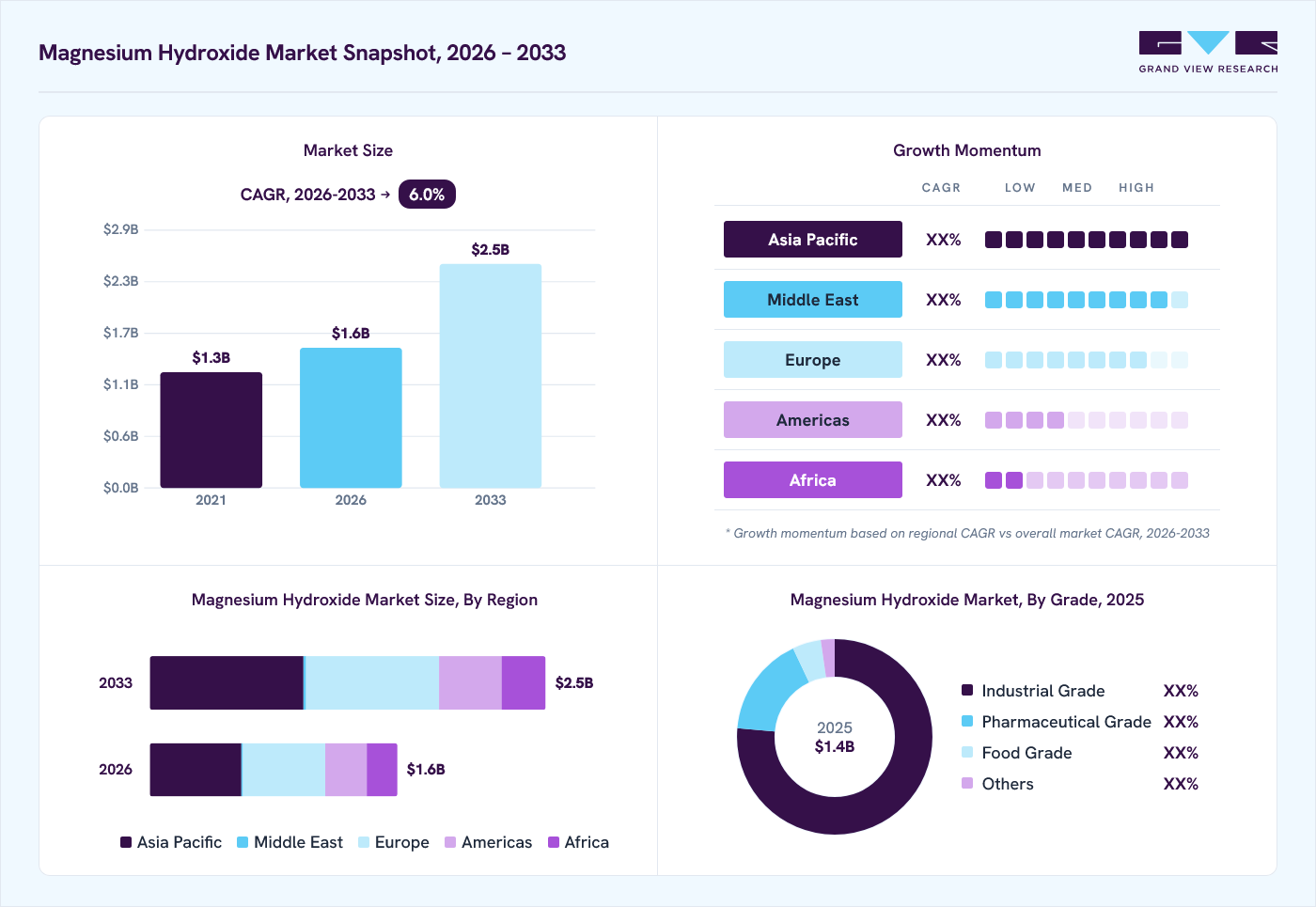
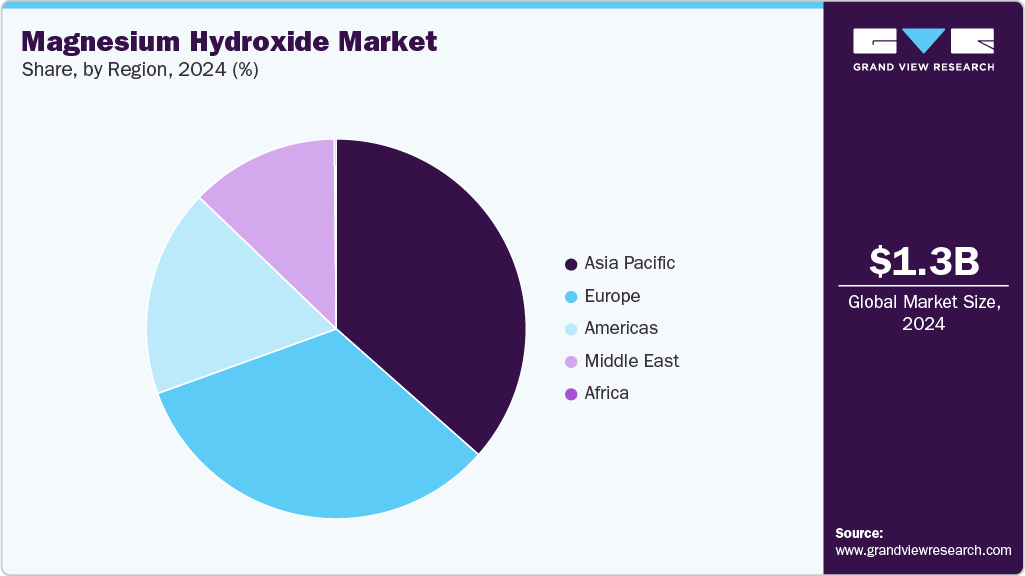
The global magnesium hydroxide market size was valued at USD 1,356.1 million in 2024 and is projected to grow from USD 1,568.5 million in 2026 to USD 2,063.6 million by 2030, at a CAGR of 7.3% from 2025 to 2030. Asia pacific dominated the market, accounting for a revenue share of 36.5% in 2024. The market is driven by its applications in wastewater treatment and low-cost flame retardants.
Key Market Trends & Insights
- The U.S. remains the primary market in America.
- By grade, industrial-grade magnesium hydroxide segment dominated the market with a share of 76.3% in 2024.
Market Size & Forecast
- 2024 Market Size: USD 1,356.1 Million
- 2030 Projected Market Size: USD 2,063.6 Million
- CAGR (2025-2030): 7.3%
- Asia Pacific: Largest market in 2024
Regulatory changes such as the U.S. Clean Air Interstate Rule and Europe’s Industrial Emissions Directive marked a shift, pushing industries to adopt cleaner technologies. This has led to increased product utilization in flue gas desulfurization, particularly in coal-fired power plants. The electronics sector further boosted demand as safety regulations encouraged the replacement of halogenated flame retardants with environmentally safer alternatives, positioning magnesium hydroxide as a preferred material due to its thermal stability and non-toxic nature.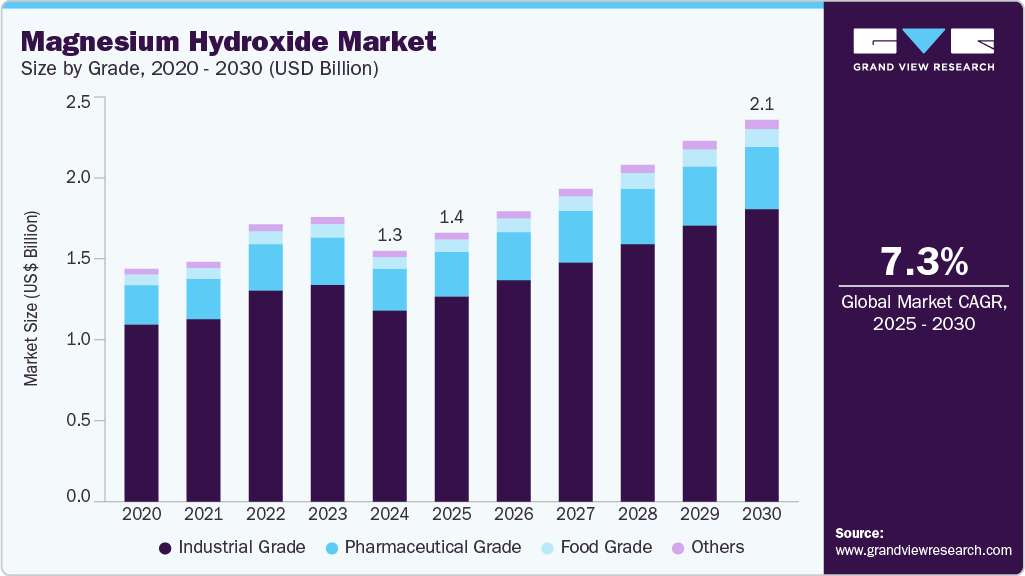
The global magnesium hydroxide market is gaining traction due to the critical role of water sanitation, boosting demand in municipal wastewater treatment. A surge in environmental initiatives and stricter pollution controls globally, reinforcing the product’s position in emission reduction technologies and sustainable manufacturing. Advances in processing technology also opened opportunities in the pharmaceuticals and food industries, where high-purity grades became essential for antacid formulations and food additives.
As EV battery manufacturing scales up, the need for effective, environmentally safe flame retardants in battery casings and components will become more pronounced. Simultaneously, stricter discharge regulations across developing economies are projected to drive significant investment in advanced wastewater treatment infrastructure, where magnesium hydroxide plays a key role.
Although magnesium hydroxide offers clear environmental and safety advantages, it often faces pricing pressure in cost-sensitive application segments. In industries like construction materials, cement boards, and polymer flame retardants, buyers frequently prioritize price over performance or sustainability, especially in projects governed by tight budgets or public procurement guidelines. In such cases, calcium-based neutralizers (like lime or calcium hydroxide) and aluminum hydroxide are favored due to their lower upfront cost, wider availability, and entrenched supply chains.
Market Concentration & Characteristics
The global magnesium hydroxide market is highly fragmented, with numerous regional and domestic producers contributing to supply, particularly across China, India, and Southeast Asia. These firms typically operate at varying production capacities, supplying local markets with industrial wastewater treatment, flue gas desulfurization, and lower-cost flame retardants. Their collective dominance reflects the commodity nature of large portions of the magnesium hydroxide market, where price competitiveness and local availability of raw materials play key roles in supply.

The threat of substitution primarily comes from advancements in traditional concrete technologies and the development of alternative low-carbon materials. Innovations such as carbon capture and storage in cement production, as well as the use of supplementary cementitious materials like calcined clay, offer competitive solutions that may limit the adoption of magnesium hydroxide.
Grade Insights
Industrial-grade magnesium hydroxide dominated the market with a share of 76.3% in 2024. This dominance directly results from tightening global environmental regulations and the growing urgency around sustainable industrial practices. The product’s high decomposition temperature and non-toxic properties have positioned it as a preferred flame retardant in electric vehicle battery casings and the construction sector, supporting fire safety compliance without compromising environmental credentials. It has significantly boosted demand for magnesium hydroxide in emission control applications.
Pharmaceutical-grade magnesium hydroxide is driven by the sustained demand for antacids and laxatives across both developed and emerging economies. Rising incidences of lifestyle-related gastrointestinal issues, particularly in Americas and Europe, coupled with an aging population increasingly dependent on over-the-counter digestive aids, continue to propel this segment. Notably, pharmaceutical companies are capitalizing on magnesium hydroxide’s dual functionality, offering both acid-neutralizing and gentle laxative effects, making it a staple in widely consumed products like milk of magnesia.
Food-grade magnesium hydroxide is critical in a niche but is highly regulated. The product is used as a food additive under designations such as E528, serving primarily as a pH regulator and firming agent in processed foods and bakery products. The clean-label movement, particularly strong in European and Americas markets, has increased the preference for naturally derived and multifunctional additives, indirectly supporting the consumption of magnesium hydroxide in food processing.
Regional Insights
Asia Pacific magnesium hydroxide market dominated with a revenue share of 36.5% of the global market in 2024. This was attributed to its rapid industrialization coupled with growing environmental accountability. Simultaneously, the region’s position as a global electronics manufacturing hub has amplified demand for non-halogenated flame retardants, particularly as electric vehicle production surges in China and South Korea, where battery safety standards are becoming increasingly stringent.
China magnesium hydroxide market in the Asia Pacific region. The country’s “Blue Sky Protection Plan,” initiated in 2018, forced coal-fired power plants and heavy industries to adopt emission control technologies, driving significant use of magnesium hydroxide in flue gas desulfurization systems.
America Magnesium Hydroxide Market Trends
America magnesium hydroxide market witnessed a CAGR of 6.8% from 2025 to 2030. The U.S. remains the primary market, using magnesium hydroxide extensively for pH control in municipal wastewater treatment and flue gas cleaning in industrial plants. Additionally, sectors such as pulp and paper and mining contribute to ongoing demand.
Europe Magnesium Hydroxide Market Trends
The European Green Deal’s stringent environmental regulations, combined with strict wastewater discharge directives, have positioned magnesium hydroxide as a critical material for achieving compliance across various industries. Demand is further driven by Europe’s advanced pharmaceutical and food sectors, where high-purity magnesium hydroxide is essential for manufacturing antacid formulations and approved food additives. Additionally, the region’s strong emphasis on fire safety in electric vehicles and sustainable building practices continues to boost its use in flame retardant applications.
Middle East & Africa Magnesium Hydroxide Market Trends
The Middle East magnesium hydroxide market is driven by rising investments in desalination and advanced wastewater treatment to combat chronic water scarcity. Africa reflects limited industrial activity, but as infrastructure and water management systems improve, the region holds untapped potential for future growth.
Key Magnesium Hydroxide Company Insights
Some of the key players operating in the market include Geopolymer Solutions, LLC and SLB.
-
Kyowa Chemical Industry Co., Ltd. is a well-established Japanese company founded in 1947 and headquartered in Kagawa Prefecture, Japan. It is globally recognized for its expertise in the production of high-purity magnesium compounds, with a strong focus on magnesium hydroxide. Leveraging proprietary precipitation technologies and stringent quality control systems, Kyowa has positioned itself as a key supplier across pharmaceutical, flame retardant, and environmental markets. Its products are used in various applications, including as an active pharmaceutical ingredient in antacids and laxatives, a flame-retardant additive in plastics and rubber, and a neutralizing agent in flue gas desulfurization and wastewater treatment processes. Kyowa Chemical has a strong international footprint, particularly in Asia, Europe, and Americas, and continues to maintain its competitive edge through consistent investment in research, development, and application-specific innovation.
NikoMag and Konoshima Chemical Co.,Ltd. are some of the emerging market participants in the Magnesium Hydroxide industry.
- NikoMag was established in 2006 and headquartered in Volgograd, Russia. The company specializes in producing high-purity magnesium compounds, derived from bischofite sourced from the Svetloyarskoye deposit. NikoMag's magnesium hydroxide is notable for its purity (minimum 99.8%) and fine particle size, making it suitable for a wide range of applications across multiple sectors.
Key Magnesium Hydroxide Companies:
The following are the leading companies in the magnesium hydroxide market. These companies collectively hold the largest market share and dictate industry trends.
- Kyowa Chemical Industry Co., Ltd.
- Elementis PLC
- NikoMag
- Premier Magnesia, LLC
- ICL
- Huber Engineered Materials
- Konoshima Chemical Co.,Ltd.
- UBE Corporation
- Nedmag B.V.
- Xinyang Minerals Group
- Martin Marietta Magnesia Specialties
- Tateho Chemical Industries Co.,Ltd.
Recent Developments
-
In January 2025, Ocean Resources Holdings Limited announced at the Future Minerals Forum in Riyadh the successful development of a proprietary system for extracting essential mineral compounds from reverse osmosis brine-a byproduct of desalination processes. Following three years of intensive research and development, the company achieved a 98% purity level in magnesium hydroxide extraction. The company plans to construct a dedicated processing facility near a Gulf desalination hub, with a planned annual capacity of 25,000 metric tons. The plant is expected to initiate operations in 2026.
-
In September 2023, Nedmag launched the magnesium-enriched cheese "Veendammer" by Nedmag in collaboration with cheese farmer Slob highlights a growing market demand for magnesium hydroxide and related compounds. This product, which partially replaces regular table salt with magnesium salt derived from the pure deposits of the ancient Zechstein sea, is aimed to address consumer interest in healthier food options by reducing sodium intake and increasing magnesium consumption.
Global Magnesium Hydroxide Market Report Scope
Report Attribute
Details
Market size in 2024
USD 1,356.1 million
Estimated market size in 2026
USD 1,453.2 million
Projected market size by 2030
USD 2,063.6 million
Growth rate
CAGR of 7.3% from 2025 to 2030
Base year for estimation
2024
Historical data
2018 - 2023
Forecast period
2025 - 2030
Quantitative units
Revenue in USD million/billion, Volume in Kilotons, and CAGR from 2025 to 2030
Report coverage
Revenue forecast, company ranking, competitive landscape, growth factors, and trends
Segments covered
Grade, region
Regional scope
Americas; Europe; Asia Pacific; Middle East & Africa
Country scope
U.S.; Canada; Mexico, Argentina, Chile, UK; Germany; Italy; Spain; Hungary, Russia, China; India; Japan; Kazakhstan; Malaysia; Australia; South Korea; Qatar; Oman; Saudi Arabia; Lebanon; Morocco; Algeria; South Africa
Key companies profiled
Kyowa Chemical Industry Co., Ltd.; Elementis PLC; NikoMag; Premier Magnesia, LLC; ICL; Huber Engineered Materials; Konoshima Chemical Co.,Ltd.; UBE Corporation; Nedmag B.V.; Xinyang Minerals Group; Martin Marietta Magnesia Specialties; Tateho Chemical Industries Co., Ltd.
Customization scope
Free report customization (equivalent up to 8 analysts’ working days) with purchase. Addition or alteration to country, regional & segment scope.
Pricing and purchase options
Avail customized purchase options to meet your exact research needs. Explore purchase options
Global Magnesium Hydroxide Market Report Segmentation
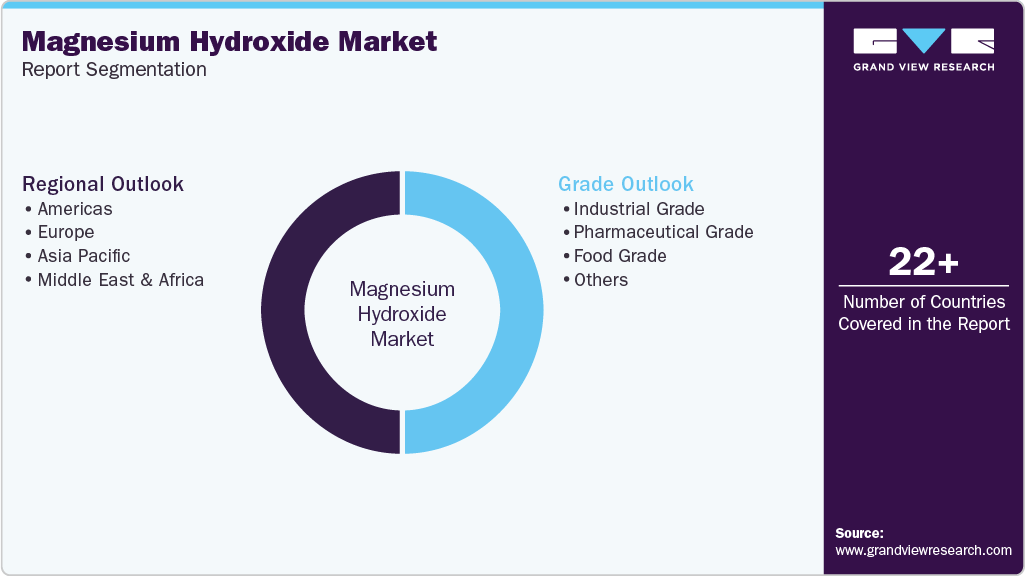
This report forecasts revenue growth at global, regional, and country levels and provides an analysis of the latest industry trends in each of the sub-segments from 2018 to 2030. For this study, Grand View Research has segmented the global magnesium hydroxide market report based on grade and region.
-
Grade Outlook (Revenue, USD Million; Volume, Kilotons, 2018 - 2030)
-
Industrial Grade
-
Wastewater Treatment
-
Flue Gas Desulfurization
-
Flame Retardants
-
Pulp & Paper
-
-
Pharmaceutical Grade
-
Food Grade
-
Others
-
-
Regional Outlook (Revenue, USD Million; Volume, Kilotons, 2018 - 2030)
-
Americas
-
U.S.
-
Canada
-
Mexico
-
Argentina
-
Chile
-
-
Europe
-
Germany
-
UK
-
Italy
-
Spain
-
Hungary
-
Russia
-
-
Asia Pacific
-
China
-
India
-
Japan
-
South Korea
-
Kazakhstan
-
Malaysia
-
Australia
-
-
Middle East & Africa
-
Qatar
-
Oman
-
Saudi Arabia
-
Lebanon
-
Morocco
-
Algeria
-
South Africa
-
-
Frequently Asked Questions About This Report
The global magnesium hydroxide market size was estimated at USD 1.36 billion in 2024 and is expected to reach USD 1.45 billion in 2025.
The global magnesium hydroxide market is expected to grow at a compound annual growth rate of 7.3% from 2025 to 2030 to reach USD 2.06 billion by 2030.
The industrial-grade segment led the market and accounted for the largest revenue share of 76.3% in 2024, driven due to the tightening global environmental regulations and the growing urgency around sustainable industrial practices. generation.
Some of the key players operating in the magnesium hydroxide market include Kyowa Chemical Industry Co., Ltd., Elementis PLC, NikoMag, Premier Magnesia, LLC, ICL, Huber Engineered Materials, Konoshima Chemical Co.,Ltd., UBE Corporation, Nedmag B.V., Xinyang Minerals Group, Martin Marietta Magnesia Specialties, Tateho Chemical Industries Co.,Ltd.
The key factors that are driving the magnesium hydroxide market is its basic applications in wastewater treatment and low-cost flame retardants, with limited industrial focus on its environmental benefits.
About the Author(s)
Water & Sludge Treatment Research Team
Bulk Chemicals · Water & Sludge TreatmentThis report was authored by the water & sludge treatment research team at Grand View Research - comprising two research analysts, one senior research analyst, and one industry expert - with specialized expertise in the water & sludge treatment segment of the bulk chemicals industry. All findings are based on proprietary bulk chemicals databases, executive interviews, and regulatory analysis, subject to internal peer review prior to publication.
Last Updated:
Speak to Analyst

Need a Tailored Report?
Customize this report to your needs — add regions, segments, or data points, with 20% free customization.
Or view our licence options:


ISO 9001:2015 & 27001:2022 Certified
We are GDPR and CCPA compliant! Your transaction & personal information is safe and secure. For more details, please read our privacy policy.












