
- Home
- »
- Plastics, Polymers & Resins
- »
-
Magnetic Field-Responsive Polymers Market Report 2025-2033GVR Report cover

Magnetic Field-Responsive Polymers Market (2025 - 2033)
Size, Share & Trends Analysis Report By Product Type (Metal-oxide/ Ferromagnetic-particle Loaded, Metal-ion/ Coordination-Polymer, Organic/ Intrinsically Magnetic Polymer), By Application, By Region and Segment Forecasts
Market Size, 2024
$61.4MMarket Estimate, 2026
$71.9MMarket Forecast, 2033
$129.3MCAGR, 2025–2033
8.7%Magnetic Field-Responsive Polymers Market Summary
The global magnetic Field-Responsive polymers market size was valued at USD 61.4 million in 2024 and is projected to grow from USD 71.9 million in 2026 to USD 129.3 million by 2033, at a CAGR of 8.7% from 2025 to 2033. North America dominated the market, accounting for a revenue share of 38.9% in 2024. Rising demand for smart materials in flexible electronics and wearable technologies is driving the adoption of magnetic field-responsive polymers due to their ability to provide controlled motion and sensitivity.
 Source: Grand View Research, IR Documents, Primary Interviews, Paid DatabasesTo learn more about this report,
 Download Free Sample Report
 Key Market Trends & Insights
- The magnetic field-responsive polymers market in Canada is expected to grow at a substantial CAGR of 8.8% from 2025 to 2033.
- By product type, the organic/intrinsically magnetic polymer segment is expected to grow at a considerable CAGR of 9.8% from 2025 to 2033 in terms of revenue.
- By application, the electronics & printed electronics segment is expected to grow at a considerable CAGR of 9.2% from 2025 to 2033 in terms of revenue.
Market Size & Forecast
- 2024 Market Size: USD 61.4 Million
- 2033 Projected Market Size: USD 129.3 Million
- CAGR (2025-2033): 8.7%
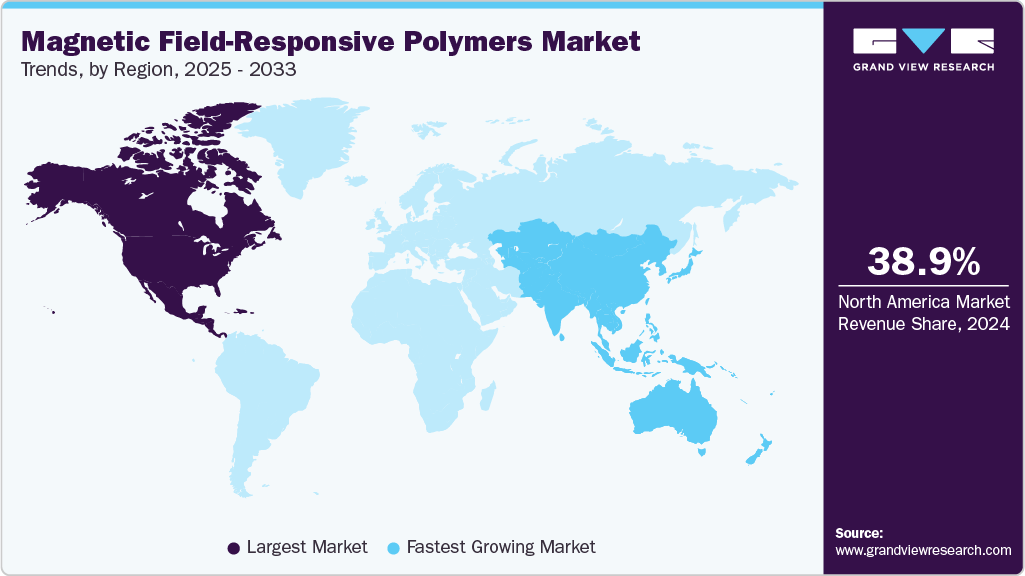
- North America: Largest market in 2024
- Asia Pacific: Fastest growing market
Three ways to get this report
Buy it, customize it, or ask a question.Ask an Analyst
Analyst response in 1 business day
- AccessReport author, directly
- Reply timeWithin 1 working day
- No sales callDirect answer only
- FormatEmail reply
- CostFree, no cost
Get the Full Report
What the study covers
- FormatsPDF · Excel · Dashboard
- Timeline2025–2033 annual, 2024 base
- Coverage20+ countries, 5 regions
- Companies10+ key players profiled
Customize the Report
20% free customization
- IncludeCountries, segments, points
- TailorTo your product definition
- ExtendDeeper competitor detail
- OrA fully bespoke study
- Turnaround5–10 working days
The magnetic field responsive polymers market is shifting from materials research toward system level solutions where smart polymers are integrated directly into devices and assemblies. Developers are combining polymer chemistries with embedded magnetic nanoparticle architectures and electronics to deliver closed loop actuation and sensing, enabling applications from soft robotics to adaptive optics. This convergence is driving suppliers to offer validated component stacks rather than raw materials alone, increasing the importance of interoperability with existing manufacturing lines and control systems. As a result, commercialization timelines are shortening while product differentiation is moving from chemistry alone to system capabilities and certification readiness. To learn more about this report, Download Free Sample Report
 Drivers, Opportunities & Restraints
A primary growth driver is the rapid improvement in polymer design and nanoparticle dispersion techniques that permit precise, repeatable control of mechanical and thermal properties under magnetic fields. Advances in scalable synthesis and coating processes have reduced batch variability and enabled tighter tolerances for actuator and sensor components. At the same time, growing demand for non-contact actuation and miniaturized motion control in healthcare, industrial automation and consumer devices is creating pull from OEMs who value responsive, low maintenance solutions. These technical and market forces together accelerate conversion from prototypes to validated production parts.
Significant opportunity exists for firms that can turn laboratory formulations into licensed platform technologies and application specific modules. There is clear commercial upside in forming co-development partnerships with medical device makers, robotics integrators and textiles brands to create turnkey magnetic actuation packages. Suppliers who invest in certification, long term reliability studies and manufacturing playbooks can capture license fees and high margin system level contracts. In addition, retrofittable solutions that enable legacy equipment to adopt magnetic actuation present near term revenue streams while productized polymer formulations expand addressable markets.
Widespread adoption is constrained by scale up challenges, long term durability concerns and fragmented regulatory pathways across end markets. Producing consistent magnetic nanoparticle dispersion at industrial volumes remains technically demanding and costly, and performance can degrade under repeated cycling or harsh environments. For medical and consumer applications, biocompatibility, electromagnetic compatibility and end of life recycling impose additional technical and compliance burdens. These factors raise time to market and capital requirements, favoring incumbent materials suppliers and well financed specialists over smaller entrants.
Market Concentration & Characteristics
The market growth stage of the magnetic field-responsive polymers market is medium, and the pace is accelerating. The market exhibits consolidation, with key players dominating the industry landscape. Major companies such as 3M, Arkema, BASF SE, Celanese Corporation, Covestro AG, Dow Inc., Evonik, Heraeus, Parker Hannifin, RTP Company, Solvay S.A., and others play a significant role in shaping the market dynamics. These leading players often drive innovation within the market, introducing new products, technologies, and applications to meet evolving industry demands.
The sector is advancing from single-material novelty toward engineered, multi-scale platforms that combine controlled nanoparticle architectures, programmable polymer matrices and additive manufacturing to deliver predictable, application-ready behaviour. Recent work on 4D printing and refined nanoparticle dispersion techniques is enabling reproducible shape change and tunable stiffness at component scale, which shifts the value discussion from lab performance to manufacturability, reliability testing and system certification. Firms that translate these material advances into validated design rules and production-ready feedstocks gain leverage with OEMs seeking lower integration risk and faster product cycles.
 To learn more about this report, Download Free Sample Report
 Magnetic field-responsive polymers compete directly with magnetorheological elastomers, electroactive polymers and shape memory polymers, as well as conventional electromechanical actuators, each offering a distinct profile of response speed, force density and lifecycle cost. Magnetorheological systems deliver very fast stiffness tuning but rely on particulate suspensions and often heavier matrices; electroactive polymers offer high strain in thin formats yet demand high driving voltages; shape memory polymers give large shape change but are typically slower and thermally driven. Buyers therefore choose substitutes based on tradeoffs between integration complexity, energy efficiency and regulatory constraints, making application fit and total cost of ownership the decisive commercial parameters.
Product Type Insights
Metal-oxide/ferromagnetic-particle loaded dominated the magnetic field-responsive polymers market across the product segmentation in terms of revenue, accounting for a market share of 45.71% in 2024 and is forecasted to grow at 8.5% CAGR from 2025 to 2033. Manufacturers of metal oxide and ferromagnetic particle loaded polymers are being driven by recent advances in scalable nanoparticle synthesis and surface engineering that improve batch consistency and magnetic responsiveness at industrial volumes.
Better control of particle size distribution and surface chemistry reduces sedimentation and enhances polymer compatibility, which lowers process scrap and enables tighter tolerances for actuators and sensors. This technical progress reduces integration risk for OEMs in medical devices and industrial actuators and shifts supplier discussions from material feasibility to cost of goods and supply reliability.
The organic/intrinsically magnetic polymer segment is anticipated to grow at a substantial CAGR of 9.8% through the forecast period. A unique driver for organic intrinsically magnetic polymers is the emergence of metal free magnetic chemistries and radical network designs that deliver lightweight, tailorable magnetism without reliance on inorganic fillers.
These materials promise simpler recycling streams and reduced density for aerospace and wearable applications, creating an environmental and performance value proposition for system integrators. Commercialization is being accelerated by proof-of-concept studies showing repeatable magnetomechanical behavior, which invites licensing and co-development agreements with firms seeking low density magnetic components.
Application Insights
Electronics & Printed Electronics dominated the magnetic field-responsive polymers market across the application segmentation in terms of revenue, accounting for a market share of 33.59% in 2024 and is forecasted to grow at 9.2% CAGR from 2025 to 2033. In printed electronics, demand is driven by the ability of magnetic field responsive polymers to enable fully additive manufacturing of sensors and soft actuators within flexible circuits, reducing assembly steps and enabling new form factors.
Recent demonstrations of magnetically responsive inks and 4D printing methods allow manufacturers to embed actuation or field sensing directly into stretchable substrates, cutting component count and improving robustness for wearables and e-textiles. This creates a fast adoption pathway where value is captured not from the polymer alone but from reduced assembly cost and novel product features.
 To learn more about this report, Download Free Sample Report
 The automotive segment is expected to expand at a substantial CAGR of 8.9% through the forecast period. Automotive uptake is being propelled by growing interest in electromagnetic subsystems for haptics, adaptive comfort and active suspension, where magnetic polymers can replace heavier mechanical parts and offer silent, low maintenance actuation.
OEMs and tier one suppliers are evaluating polymer based magnetic actuators to meet electrification and weight reduction targets while delivering customer facing features such as refined haptic feedback and adaptive damping. The commercial case strengthens where polymers reduce system complexity and enable modular retrofits for mid lifecycle vehicle enhancements.
Regional Insights
North America held the largest share of 38.99% in terms of revenue of the magnetic field-responsive polymers market in 2024 and is expected to grow at the fastest CAGR of 7.9% over the forecast period. Geopolitical pressure and procurement priorities are driving North American firms to secure domestic sources of rare earth magnets and related feedstocks, a shift that directly benefits magnetic polymer suppliers by reducing material supply risk for integrated components.
 To learn more about this report, Download Free Sample Report
 Venture funding and strategic contracts for onshore magnet production are accelerating supplier investments in validated manufacturing processes and quality systems, shortening the path from pilot to production. As OEMs in defense and industrial automation demand auditable, traceable supply chains, materials providers that can demonstrate domestic sourcing and end to end control gain clear commercial leverage.
The North America magnetic field-responsive polymers market is driven by the dense innovation ecosystem that connects advanced materials startups, specialized contract manufacturers and tier one integrators, enabling fast iteration from lab scale to application prototypes. Access to venture capital, manufacturing accelerators and university consortia reduces commercialization friction for magnetic polymer formulations and supports co development models with system integrators. Companies that can plug into this ecosystem and offer manufacturable feedstocks or componentized modules are well positioned to capture early volume and strategic partnerships across medtech and robotics.
U.S. Magnetic Field-Responsive Polymers Market Trends
In the U.S., targeted R&D programs and defense research awards are materially increasing investment into magnetic materials and their polymer composites, creating pull for scalable, ruggedized formulations. Programs that prioritize new magnet chemistries and tactical applications provide non-dilutive funding and validation pathways for suppliers, while DURIP and similar awards equip universities and labs to mature manufacturing relevant processes. This creates a favorable environment for firms that align product roadmaps with government priorities and can demonstrate performance under demanding operational criteria.
Europe Magnetic Field-Responsive Polymers Market Trends
European regulatory developments around ecodesign and critical raw materials are driving demand for magnetic polymer solutions that reduce rare earth intensity and improve recyclability in end products. The Ecodesign for Sustainable Products Regulation and complementary initiatives promote product traceability and higher recycling content, incentivizing material choices that ease compliance and lower lifecycle cost. Suppliers that can document recycled content, enable remanufacturing or propose lower density magnetic alternatives will find stronger uptake among European OEMs facing tightening product requirements.
Asia Pacific Magnetic Field-Responsive Polymers Market Trends
Asia Pacific’s ongoing investment in electronics manufacturing, semiconductor capacity and automation is creating near term demand for magnetic field responsive polymers that can be integrated within high volume printed electronics and soft actuation modules. Large capital deployments for chipmaking and contract manufacturing hubs increase the attractiveness of additive and inline processable materials that reduce assembly steps and improve yield for wearable and IoT products. Regional integrators therefore prefer materials that demonstrate compatibility with roll-to-roll processes and meet strict throughput and reliability targets.
Magnetic Field-Responsive Polymers Company Insights
The magnetic field-responsive polymers market is highly competitive, with several key players dominating the landscape. Major companies include 3M, Arkema, BASF SE, Celanese Corporation, Covestro AG, Dow Inc., Evonik, Heraeus, Parker Hannifin, RTP Company, and Solvay S.A. The magnetic field-responsive polymers market is characterized by a competitive landscape with several key players driving innovation and market growth. Major companies in this sector are investing heavily in research and development to enhance the performance, cost-effectiveness, and sustainability of their types.
Key Magnetic Field-Responsive Polymers Companies:
The following are the leading companies in the magnetic field-responsive polymers market. These companies collectively hold the largest market share and dictate industry trends.
- 3M
- Arkema
- BASF SE
- Celanese Corporation
- Covestro AG
- Dow Inc.
- Evonik
- Heraeus
- Parker Hannifin
- RTP Company
- Solvay S.A.
Recent Developments
-
In July 2025, MP Materials announced a transformational public-private partnership with the U.S. Department of Defense to scale domestic rare-earth magnet production. Faster, onshore magnet capacity reduces supply risk and improves price visibility for downstream manufacturers of magnetic field-responsive polymer systems.
-
In 2024, researchers demonstrated dual-material aerosol-jet printing and magnetically responsive inks for 3D/printed devices, validating additive routes to embed magnetic functionality directly into polymer parts. Those technical demonstrations create an industrial pathway for printed, application-ready magnetic polymer components in sensors, soft robotics and flexible electronics.
Magnetic Field-Responsive Polymers Market Report Scope
Report Attribute
Details
Market size in 2024
USD 61.4 million
Estimated market size in 2026
USD 71.9 million
Projected market size by 2033
USD 129.3 million
Growth rate
CAGR of 8.7% from 2025 to 2033
Historical data
2021 - 2023
Forecast period
2025 - 2033
Quantitative units
Revenue in USD million/billion, volume in tons, and CAGR from 2025 to 2033
Report coverage
Revenue forecast, competitive landscape, growth factors, and trends
Report segmentation
Product type, application, region
Regional scope
North America; Europe; Asia Pacific; Latin America; Middle East & Africa
Country scope
U.S.; Canada; Mexico; Germany; France; UK; Spain; Italy; China; Japan; India; South Korea; Brazil; Argentina; Saudi Arabia; South Africa; UAE
Key companies profiled
3M; Arkema; BASF SE; Celanese Corporation; Covestro AG; Dow Inc.; Evonik; Heraeus; Parker Hannifin; RTP Company; Solvay S.A.
Customization scope
Free report customization (equivalent up to 8 analyst’s working days) with purchase. Addition or alteration to country, regional & segment scope
Pricing and purchase options
Avail customized purchase options to meet your exact research needs. Explore purchase options
Global Magnetic Field-Responsive Polymers Market Report Segmentation
This report forecasts revenue growth at the global, regional, and country levels and provides an analysis of the latest industry trends in each of the sub-segments from 2021 to 2033. For this study, Grand View Research has segmented the global magnetic field-responsive polymers market report on the basis of product type, application, and region:
 To learn more about this report, Download Free Sample Report
 -
Product Type Outlook (Volume, Tons; Revenue, USD Million, 2021 - 2033)
-
Metal-oxide/Ferromagnetic-particle Loaded
-
Metal-ion/Coordination-polymer
-
Organic/Intrinsically Magnetic Polymer
-
Other Product Types
-
-
Application Outlook (Volume, Tons; Revenue, USD Million, 2021 - 2033)
-
Electronics & Printed Electronics
-
Automotive
-
Medical & Biomedical Device
-
Research & Development/Prototyping
-
Other Applications
-
-
Regional Outlook (Volume, Tons; Revenue, USD Million, 2021 - 2033)
-
North America
-
U.S.
-
Canada
-
Mexico
-
-
Europe
-
Germany
-
UK
-
France
-
Italy
-
Spain
-
-
Asia Pacific
-
China
-
India
-
Japan
-
South Korea
-
-
Latin America
-
Brazil
-
Argentina
-
-
Middle East & Africa
-
Saudi Arabia
-
South Africa
-
UAE
-
-
Frequently Asked Questions About This Report
The global magnetic Field-Responsive polymers market size was valued at USD 61.4 billion in 2024 and is estimated at USD 71.9 billion for 2026.
The global magnetic Field-Responsive polymers market is expected to grow at a CAGR of 8.7% from 2025 to 2033, reaching USD 129.3 billion by 2033.
Metal-oxide/ferromagnetic-particle loaded dominated the market, accounting for a market share of 45.71% in 2024.
Some key players operating in the magnetic field-responsive polymers market include 3M, Arkema, BASF SE, Celanese Corporation, Covestro AG, Dow Inc., Evonik, Heraeus, Parker Hannifin, RTP Company, and Solvay S.A.
Rising demand for smart materials in flexible electronics and wearable technologies is driving the adoption of magnetic field-responsive polymers due to their ability to provide controlled motion and sensitivity.
About the Author(s)
Plastics, Polymers & Resins Research Team
Bulk Chemicals · Plastics, Polymers & ResinsThis report was authored by the plastics, polymers & resins research team at Grand View Research - comprising two research analysts, one senior research analyst, and one industry expert - with specialized expertise in the plastics, polymers & resins segment of the bulk chemicals industry. All findings are based on proprietary bulk chemicals databases, executive interviews, and regulatory analysis, subject to internal peer review prior to publication.
Last Updated:
Speak to Analyst

Customize this report to your needs - add regions, segments, or data points, with 20% free customization.
Or view our licence options:


ISO 9001:2015 & 27001:2022 Certified
We are GDPR and CCPA compliant! Your transaction & personal information is safe and secure. For more details, please read our privacy policy.


