
- Home
- »
- Next Generation Technologies
- »
-
Managed Infrastructure Services Market Size And Share Report, 2026-2033GVR Report cover
![Managed Infrastructure Services Market (2026 - 2033)Report]()
Managed Infrastructure Services Market (2026 - 2033)
Size, Share, & Trend Analysis By Service Type (Network Management Services, Server & Compute Management, Managed Security Services), By Deployment, By Enterprise Size, By End Use, By Region, And Segment Forecasts
Market Size, 2025
$44.7BMarket Estimate, 2026
$47.7BMarket Forecast, 2033
$82.1BCAGR, 2026–2033
8.1%Managed Infrastructure Services Market Summary
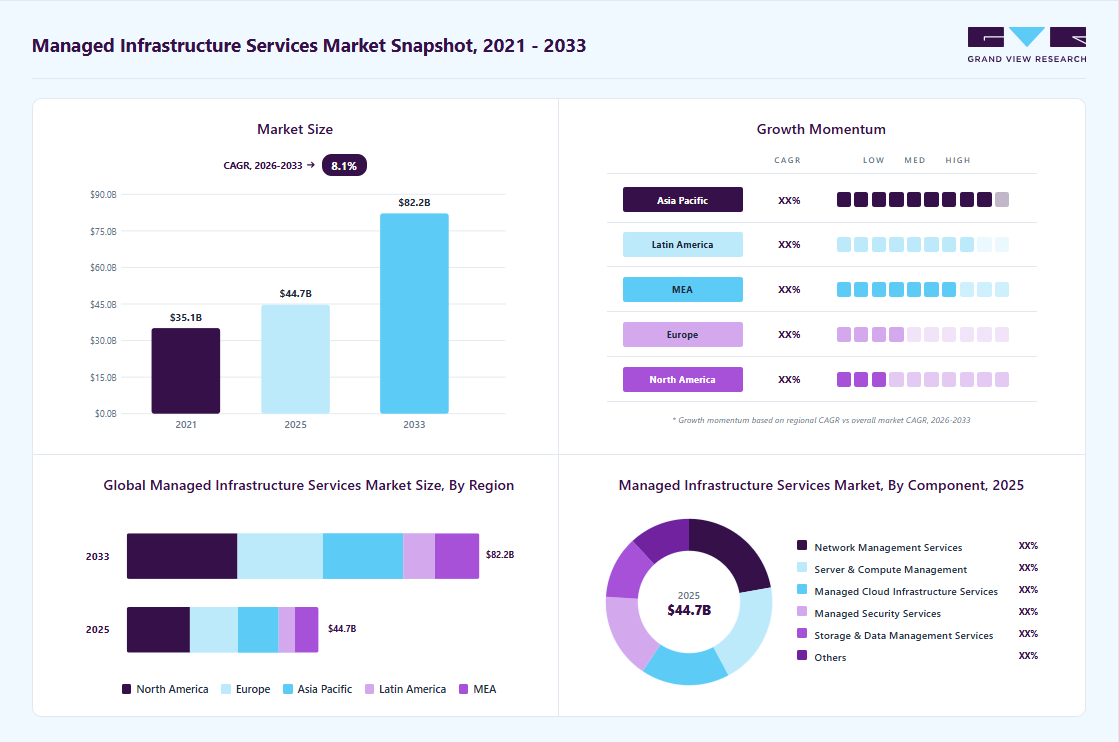
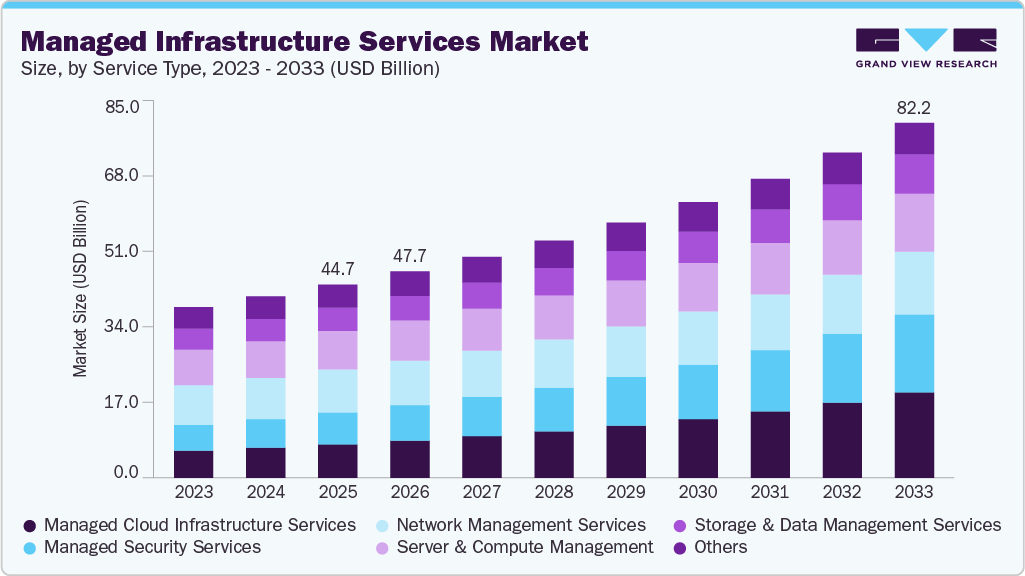
The global managed infrastructure services market size was valued at USD 44.7 billion in 2025 and is projected to grow from USD 47.7 billion in 2026 to USD 82.1 billion by 2033, at a CAGR of 8.1% from 2026 to 2033. The North America market held the largest share of 33.0% of the global market in 2025., owing to the enterprises accelerating digital transformation initiatives. Organizations across industries are modernizing legacy IT environments and adopting hybrid and multi-cloud architectures to improve agility, scalability, and performance.
Key Market Trends & Insights
- By service type: The network management services segment led the market with the largest revenue share of 22.2% in 2025.
- By deployment: The on-premises segment accounted for the largest market share in 2025.
- By enterprise size: The large enterprise segment accounted for the largest market revenue share in 2025.
- By end use: The BFSI segment accounted for the largest market share in 2025.
Regional Highlights
- Largest regional market: North America (33.0% revenue share, 2025)
- Fastest-growing regional market: Asia Pacific (highest CAGR, 2026-2033)
- By country: The U.S. held the largest market share in 2025.
Market Size & Forecast
- Market size in 2025: USD 44.7 Billion
- Estimated market size in 2026: USD 47.7 Billion
- Projected market size by 2033: USD 82.1 Billion
- CAGR (2026-2033): 8.1%
Managing increasingly complex infrastructure environments requires specialized expertise, prompting businesses to outsource infrastructure management to service providers with advanced capabilities and tools.
The rising need for cost optimization and operational efficiency also contributes to the growth in the managed infrastructure services industry. Enterprises are shifting from capital-intensive IT ownership models to consumption-based or managed service models that offer predictable operating expenses. Managed infrastructure services enable organizations to reduce internal IT overhead, optimize resource utilization, and leverage automation for routine maintenance tasks such as patching, monitoring, and provisioning, thereby improving overall cost-efficiency.
The growing cybersecurity threat landscape is also significantly driving the demand. With the increasing frequency and sophistication of cyberattacks, organizations require continuous monitoring, threat detection, incident response, and compliance management. Managed infrastructure service providers integrate security into infrastructure management through offerings such as managed security services, secure network management, and compliance frameworks, making them critical partners in ensuring business continuity and data protection.
In addition, the proliferation of data-intensive technologies such as AI, IoT, and big data analytics is driving infrastructure complexity and scale. These technologies require high-performance computing, scalable storage, and low-latency networks, which are difficult to manage in-house. Managed infrastructure providers offer the expertise and advanced infrastructure management capabilities needed to support these workloads efficiently.
Service Type Insights
The network management services segment led the market with the largest revenue share of 22.2% in 2025, due to the increasing complexity of enterprise network environments. Organizations are transitioning from traditional, static network architectures to dynamic, software-defined networks (SDN), hybrid cloud, and multi-cloud ecosystems. This evolution introduces challenges in network visibility, performance monitoring, and traffic optimization across distributed environments. As a result, enterprises are relying on managed network service providers to ensure seamless connectivity, real-time monitoring, and efficient traffic management across geographically dispersed operations.
The managed cloud infrastructure services segment is anticipated to grow at the fastest CAGR during the forecast period, driven by the increasing adoption of cloud-native technologies. Enterprises are embracing containers, micro services, and DevOps practices to accelerate application development and deployment. However, managing container orchestration platforms such as Kubernetes, CI/CD pipelines, and dynamic cloud environments requires specialized expertise. Managed cloud infrastructure services simplify these operations by offering end-to-end lifecycle management, enabling faster innovation without burdening internal IT teams.
Deployment Insights
The on-premises segment accounted for the largest market share in 2025, driven by persistent enterprise requirements for data sovereignty, regulatory compliance, and control over critical IT assets. Industries such as banking, financial services, healthcare, and government operate under stringent regulatory frameworks that mandate sensitive data to be stored and processed within controlled environments. On-premises infrastructure enables organizations to maintain full governance over data security, access controls, and compliance protocols, making managed on-premises services an essential solution for these sectors.
The cloud segment is expected to grow at the fastest CAGR during the forecast period, driven by the rapid shift toward cloud-first and hybrid IT strategies by enterprises. Organizations are increasingly moving workloads from on-premises environments to public and hybrid cloud platforms to achieve greater scalability, flexibility, and speed of deployment. This transition requires continuous monitoring, optimization, and governance of cloud environments, leading enterprises to rely on managed service providers for end-to-end cloud infrastructure management, including provisioning, orchestration, and performance tuning.
Enterprise Size Insights
The large enterprise segment accounted for the largest market revenue share in 2025, due to the scale, complexity, and mission-critical nature of its IT environments. Large organizations typically operate across multiple geographies with highly distributed infrastructure estates, including legacy data centers, private clouds, and multiple public cloud platforms. Managing such heterogeneous environments requires advanced orchestration, monitoring, and integration capabilities, which drives demand for managed infrastructure providers that can deliver centralized control, standardized operations, and high service reliability.
The small & medium enterprises segment is expected to grow at the fastest CAGR during the forecast period, driven by the need to access enterprise-grade IT capabilities without heavy capital investment. SMEs typically operate with limited budgets and lean IT teams, making it challenging to build and maintain in-house infrastructure. Managed infrastructure services provide a cost-effective alternative through subscription-based or pay-as-you-go models, enabling SMEs to leverage advanced technologies such as cloud computing, network management, and storage solutions without significant upfront expenditure.
End Use Insights
The BFSI segment accounted for the largest market share in 2025, driven by its high reliance on secure, resilient, and always-available IT systems. Financial institutions operate mission-critical applications such as core banking systems, payment gateways, trading platforms, and insurance processing systems that require near-zero downtime and high performance. Managed infrastructure service providers enable BFSI organizations to ensure 24/7 system availability, proactive monitoring, and rapid incident response, thereby maintaining operational continuity and customer trust.
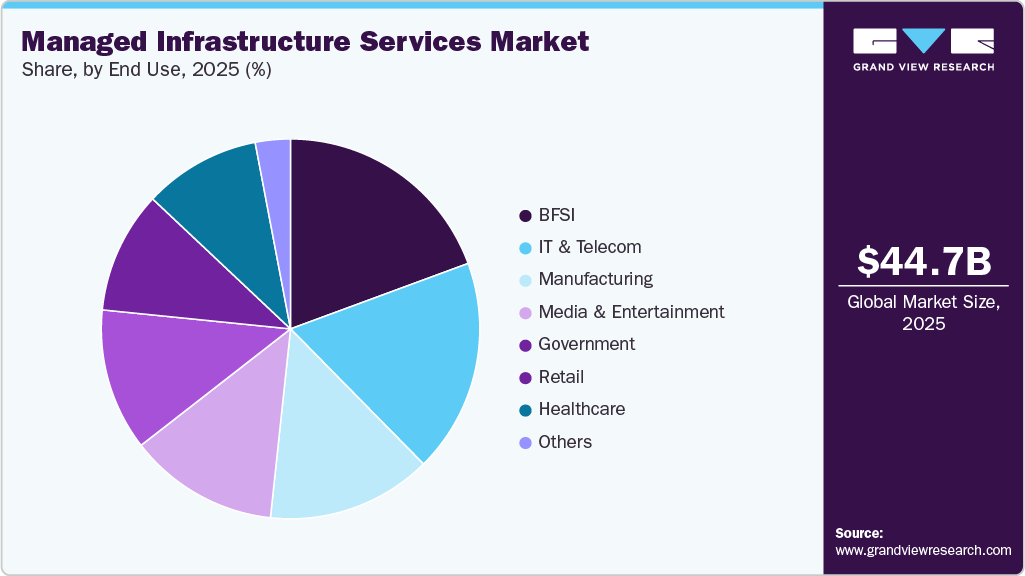
The IT & telecom segment is expected to grow at the fastest CAGR over the forecast period, due to the ongoing global rollout of 5G networks. Telecom companies are investing heavily in 5G infrastructure, including small cells, edge computing nodes, and upgrades to core networks. These deployments generate massive volumes of data and require real-time processing and orchestration. Managed infrastructure service providers play a vital role in supporting telecom operators by managing networks, planning capacity, and optimizing performance, enabling faster deployment and more efficient operation of 5G ecosystems.
Regional Insights
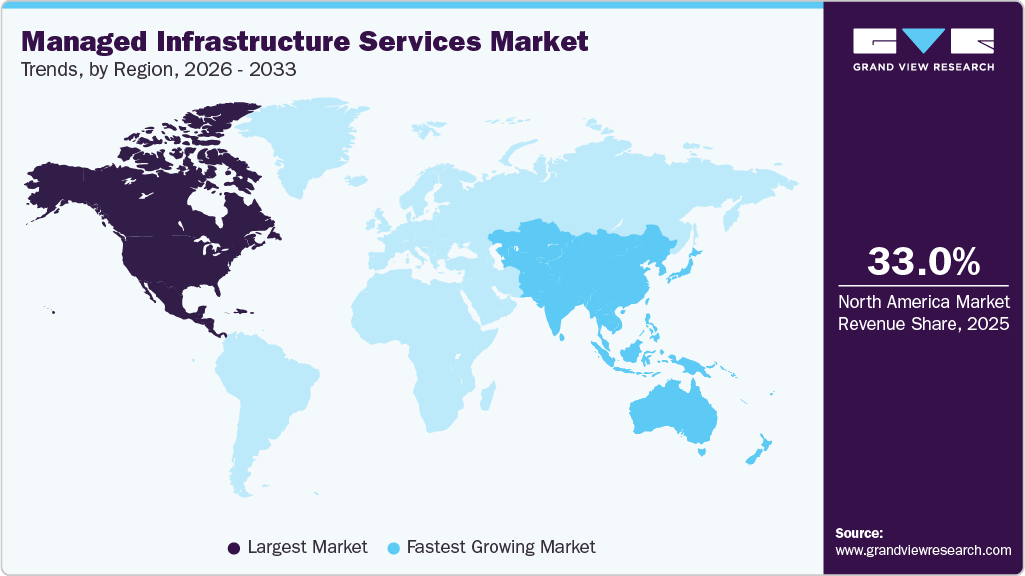
North America dominated the global managed infrastructure services market with the largest revenue share of 33.0% in 2025, driven by the rapid adoption of hybrid IT environments across large enterprises and mid-sized firms. Organizations are increasingly integrating legacy systems with modern cloud platforms, creating complex multi-environment architectures that require continuous orchestration, interoperability management, and performance tuning. This has accelerated demand for managed service providers capable of delivering unified infrastructure visibility and lifecycle management across diverse IT ecosystems.
U.S. Managed Infrastructure Services Market Trends
The managed infrastructure services market in the U.S. accounted for the largest market share in 2025, driven by hyperscale data center expansion and the dominance of large cloud and digital service providers. The surge in data generated by digital platforms, streaming services, and enterprise applications is driving organizations to rely on managed infrastructure services for data center operations, capacity optimization, and high-availability architectures, particularly in mission-critical environments.
Europe Managed Infrastructure Services Market Trends
The managed infrastructure services market in Europe is anticipated to register at a considerable CAGR from 2026 to 2033 due to stringent data protection regulations and sovereignty requirements. Enterprises are increasingly adopting managed infrastructure services to ensure compliance with frameworks such as GDPR, particularly for data residency, governance, and auditability. Service providers offering localized infrastructure management and compliance-driven solutions are seeing strong demand across regulated industries.
The UK managed infrastructure services market is expected to grow rapidly in the coming years, driven by the increasing outsourcing of IT operations amid economic uncertainty and cost pressures. Organizations are prioritizing vendor-led infrastructure management to convert fixed IT costs into variable expenses while maintaining service quality, leading to an increase in long-term managed service contracts across sectors such as BFSI and retail.
The managed infrastructure services market in Germany held a substantial market share in Europe in 2025, due to its strong industrial base undergoing Industry 4.0 transformation. Manufacturing enterprises are integrating smart factory technologies, requiring robust infrastructure for real-time data processing, machine connectivity, and automation. Managed infrastructure services are critical to supporting these highly specialized, performance-sensitive environments.
Asia Pacific Managed Infrastructure Services Market Trends
The managed infrastructure services market in the Asia Pacific is anticipated to grow at the fastest CAGR during the forecast period, due tothe rapid expansion of digital economies and increasing internet penetration in emerging markets. Businesses are scaling their IT infrastructure to support growing online user bases and digital services, driving demand for managed infrastructure solutions that ensure scalability, uptime, and efficient resource allocation in high-growth environments.
The Japan managed infrastructure services market is expected to grow rapidly in the coming years. Many enterprises rely on outdated infrastructure but face challenges in maintaining and modernizing these systems due to a shrinking skilled labor pool. Managed infrastructure providers are increasingly engaged to handle system maintenance, modernization, and gradual migration to more efficient environments.
The managed infrastructure services market in China held a substantial market share in the Asia Pacific in 2025, due to government-backed digital infrastructure initiatives and the expansion of domestic cloud ecosystems. Large-scale investments in smart cities, the industrial internet, and digital public services are driving demand for managed infrastructure services to support large, complex, and state-aligned IT deployments that require high scalability and centralized control.
Key Managed Infrastructure Services Company Insights
Key players operating in the managed infrastructure services industry are Dell Technologies Inc., Hewlett Packard Enterprise Company, Cisco Systems, Inc., IBM Corporation, and Fujitsu Limited. The companies are focusing on various strategic initiatives, including new product development, partnerships & collaborations, and agreements to gain a competitive advantage over their rivals. The following are some instances of such initiatives.
Key Managed Infrastructure Services Companies:
The following key companies have been profiled for this study on the managed infrastructure services market.
- Accenture
- Atos SE
- Cisco Systems, Inc.
- Citrix Systems, Inc.
- Dell Technologies Inc.
- Fujitsu Limited
- Hewlett Packard Enterprise Company
- IBM Corporation
- Konica Minolta, Inc.
- Kyndryl Holdings, Inc.
- Lexmark International, Inc.
- Microsoft Corporation
- NTT DATA Corporation
- Orange Business Services
- Verizon Communications Inc.
Recent Development
-
In August 2025, Kyndryl Holdings, Inc. announced the expansion of its strategic alliance with Hewlett Packard Enterprise to accelerate the adoption of AI-powered private cloud environments, strengthening its capabilities in managed infrastructure services. Through this collaboration, the companies aim to support enterprises in designing, deploying, and managing private cloud infrastructure tailored for AI workloads, leveraging HPE’s GreenLake platform and Kyndryl’s expertise in infrastructure operations and management. The partnership focuses on delivering end-to-end lifecycle services, including infrastructure modernization, automation, and ongoing management, enabling organizations to enhance performance, scalability, and operational efficiency in hybrid IT environments.
-
In June 2025, Tech Mahindra partnered with Cisco Systems, Inc. to launch a managed services solution for Cisco Multicloud Defense, part of Cisco’s Hybrid Mesh Firewall. The offering enables enterprises to securely operate across multi-cloud environments by providing fully managed cloud security services that support scalability, seamless operations, and enhanced protection, reflecting the growing trend of outsourcing critical infrastructure and security management to service providers.
Managed Infrastructure Services Market Report Scope
Report Attribute
Details
Market size in 2025
USD 44.7 billion
Estimated market size in 2026
USD 47.7 billion
Projected market size by 2033
USD 82.1 billion
Growth rate
CAGR of 8.1% from 2026 to 2033
Base year for estimation
2025
Historical data
2021 - 2024
Forecast period
2026 - 2033
Quantitative units
Revenue in USD million/billion, and CAGR from 2026 to 2033
Report enterprise size
Revenue forecast, company share, competitive landscape, growth factors, and trends
Segments covered
Service type, deployment, enterprise size, end use, region
Regional scope
North America; Europe; Asia Pacific; Latin America; MEA
Country scope
U.S.; Canada; Mexico; U.K.; Germany; France; China; India; Japan; Australia; South Korea; Brazil; UAE; Kingdom of Saudi Arabia; and South Africa
Key companies profiled
Accenture; Atos SE; Cisco Systems, Inc.; Citrix Systems, Inc.; Dell Technologies Inc.; Fujitsu Limited; Hewlett Packard Enterprise Company; IBM Corporation; Konica Minolta, Inc.; Kyndryl Holdings, Inc.; Lexmark International, Inc.; Microsoft Corporation; NTT DATA Corporation; Orange Business Services; Verizon Communications Inc.
Customization scope
Free report customization (equivalent to 8 analysts working days) with purchase. Addition or alteration to country, regional & segment scope.
Pricing and purchase options
Avail customized purchase options to meet your exact research needs. Explore purchase options
Global Managed Infrastructure Services Market Report Segmentation
This report forecasts revenue growth at the global, regional, and country levels and provides an analysis of the latest industry trends in each of the sub-segments from 2021 to 2033. For this study, Grand View Research has segmented the global managed infrastructure services market report based on service type, deployment, enterprise size, end use, and region.
-
Service Type Outlook (Revenue, USD Billion, 2021 - 2033)
-
Network Management Services
-
Server & Compute Management
-
Managed Security Services
-
Managed Cloud Infrastructure Services
-
Storage & Data Management Services
-
Others
-
-
Deployment Outlook (Revenue, USD Billion, 2021 - 2033)
-
Cloud
-
On-premise
-
-
Enterprise Size Outlook (Revenue, USD Billion, 2021 - 2033)
-
Small & Medium Enterprises
-
Large Enterprise
-
-
End Use Outlook (Revenue, USD Billion, 2021 - 2033)
-
BFSI
-
Government
-
Healthcare
-
IT & Telecom
-
Manufacturing
-
Media & Entertainment
-
Retail
-
Others
-
-
Regional Outlook (Revenue, USD Billion, 2021 - 2033)
-
North America
-
U.S.
-
Canada
-
Mexico
-
-
Europe
-
U.K.
-
Germany
-
France
-
-
Asia Pacific
-
China
-
India
-
Japan
-
South Korea
-
Australia
-
-
Latin America
-
Brazil
-
-
Middle East & Africa
-
UAE
-
Saudi Arabia
-
South Africa
-
-
Frequently Asked Questions About This Report
Asia Pacific is the fastest-growing region over the forecast period.
The network management services segment led with a 22.2% revenue share in 2025, while managed cloud infrastructure services is the fastest-growing segment.
The large enterprise segment held the highest market share in 2025, while small & medium enterprises is the fastest-growing segment.
The on-premises segment held the highest market share in 2025, while cloud is the fastest-growing segment.
BFSI segment accounted for the largest market share in 2025, while IT & telecom is the fastest-growing segment.
Key factors include organizations across industries that are modernizing legacy IT environments and adopting hybrid and multi-cloud architectures to improve agility, scalability, and performance. Managing increasingly complex infrastructure environments requires specialized expertise, prompting businesses to outsource infrastructure management to service providers with advanced capabilities and tools.
The global managed infrastructure services market size was estimated at USD 44.7 billion in 2025 and is expected to reach USD 47.7 billion in 2026.
The global managed infrastructure services market is expected to grow at a compound annual growth rate of 8.1% from 2026 to 2033 to reach USD 82.1 billion by 2033.
North America dominated the global market with the largest revenue share of 33.0% in 2025.
Some key players operating in the managed infrastructure services market include Accenture, Atos SE, Cisco Systems, Inc., Citrix Systems, Inc., Dell Technologies Inc., Fujitsu Limited, Hewlett Packard Enterprise Company, IBM Corporation, Konica Minolta, Inc., Kyndryl Holdings, Inc., Lexmark International, Inc., Microsoft Corporation, NTT DATA Corporation, Orange Business Services, Verizon Communications Inc.
About the Author(s)
Next Generation Technologies Research Team
Technology · Next Generation TechnologiesThis report was authored by the next generation technologies research team at Grand View Research - comprising two research analysts, one senior research analyst, and one industry expert - with specialized expertise in the next generation technologies segment of the technology industry. All findings are based on proprietary technology databases, executive interviews, and regulatory analysis, subject to internal peer review prior to publication.
Last Updated:
Speak to Analyst

Need a Tailored Report?
Customize this report to your needs — add regions, segments, or data points, with 20% free customization.
Or view our licence options:


ISO 9001:2015 & 27001:2022 Certified
We are GDPR and CCPA compliant! Your transaction & personal information is safe and secure. For more details, please read our privacy policy.












