
- Home
- »
- Digital Media
- »
-
Manga Market Size, Share And Growth Report, 2026-2033GVR Report cover

Manga Market (2026 - 2033)
Size, Share & Trends Analysis Report By Content (Printed, Digital), By Gender (Male, Female), By Distribution Channel (Online, Offline), By Genre (Action & Adventure, Romance & Drama ), By Audience, By Region, And Segment Forecasts
Market Size, 2025
$10.2BMarket Estimate, 2026
$11.9BMarket Forecast, 2033
$43.9BCAGR, 2026–2033
20.5%Manga Market Summary
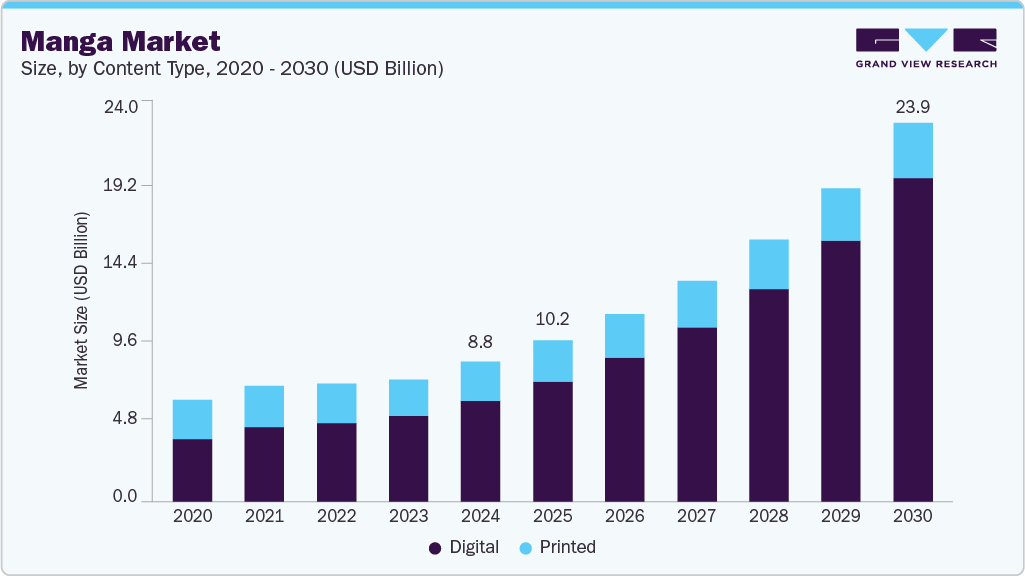
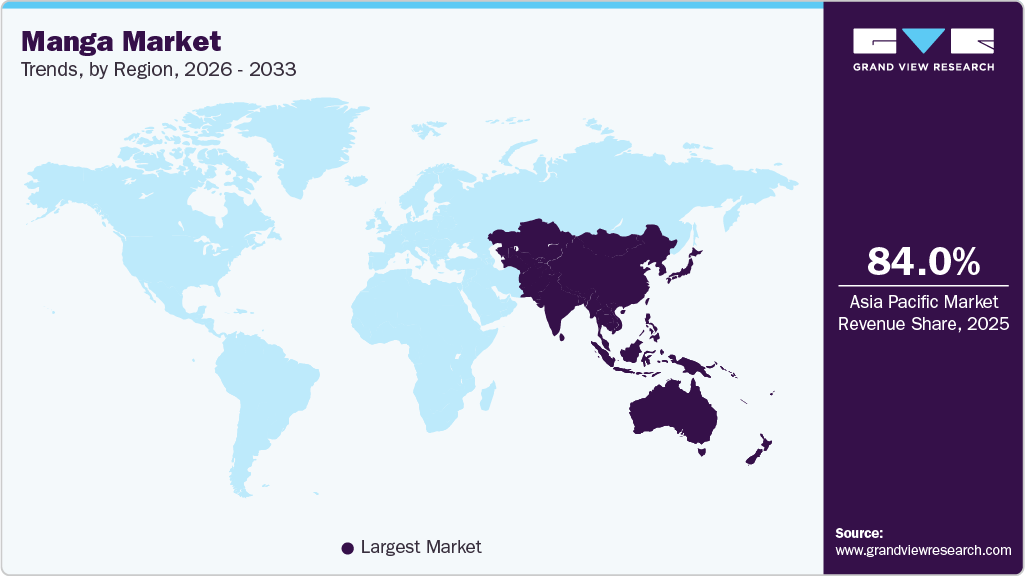
The global manga market size was valued at USD 10.2 billion in 2025 and is projected to grow from USD 11.9 billion in 2026 to USD 43.9 billion by 2033, at a CAGR of 20.5% from 2026 to 2033. Asia Pacific dominated the global market, accounting for a revenue share of 84.0% in 2025. Market growth is driven by the rapid adoption of digital manga through e-books, mobile applications, and online platforms, alongside rising demand for anime adaptations and the expansion of manga intellectual property across streaming, gaming, merchandising, and other cross-media formats.
 Source: Grand View Research, IR Documents, Primary Interviews, Paid DatabasesTo learn more about this report,
 Download Free Sample Report
Key Market Trends & Insights
- By content: Digital segment accounted for the largest revenue share of 66.7% in 2025.
- By distribution channel: Online segment accounted for the largest revenue share of 70.2%
- By genre: Action and adventure segment accounted for the largest market share of 34.0% in 2025.
- By gender: Male segment held the largest revenue share of 66.4% in 2025.
- By audience: Adults segment held the largest revenue share of 57.4% in 2025.
Regional Highlights
- Largest regional market: Asia Pacific (84.0% revenue share, 2025)
- Fastest-growing regional market: North America (highest CAGR 23.3%, 2026-2033)
Market Size & Forecast
- Market size in 2025: USD 10.2 Billion
- Estimated market size in 2026: USD 11.9 Billion
- Projected market size by 2033: USD 43.9 Billion
- CAGR (2026-2033): 20.5%
Three ways to get this report
Buy it, customize it, or ask a question.Ask an Analyst
Analyst response in 1 business day
- AccessReport author, directly
- Reply timeWithin 1 working day
- No sales callDirect answer only
- FormatEmail reply
- CostFree, no cost
Get the Full Report
What the study covers
- FormatsPDF · Excel · Dashboard
- Timeline2026–2033 annual, 2025 base
- Coverage20+ countries, 5 regions
- Companies10+ key players profiled
Customize the Report
20% free customization
- IncludeCountries, segments, points
- TailorTo your product definition
- ExtendDeeper competitor detail
- OrA fully bespoke study
- Turnaround5–10 working days
In addition, rising social media engagement, the growing proliferation of e-commerce, and diverse genre appeal spanning romance, fantasy, and sci-fi are attracting broader demographics amid the continued global influence of Japanese cultural exports. The growing popularity of webtoons, particularly in South Korea and China, is having a significant impact on the manga sector. Webtoons, which are typically published on digital platforms in a vertical-scroll format, cater to the preferences of mobile-first readers and offer an accessible way to consume serialized content. As demand for webtoons continues to rise, many manga publishers are adapting their works to digital-first formats, either to expand their existing portfolios or tap into the rapidly expanding webtoon audience. As webtoons gain traction worldwide, they are creating new opportunities for manga creators and publishers to reach broader, more diverse readerships while accelerating the digital transformation of the manga industry.The demand for a wider variety of genres within the manga industry is growing as readers increasingly seek stories that extend beyond traditional action and fantasy themes. Niche genres such as slice-of-life, romance, LGBTQ+, and horror are gaining popularity, catering to a broad range of tastes, interests, and demographics. Publishers are responding to this shift by diversifying their portfolios and developing manga that resonates with previously underserved audiences. The expansion of genre offerings is also being supported by digital platforms, which enable publishers to test and distribute specialized content with greater flexibility. This trend is contributing to the growth of the manga sector by attracting new readers and encouraging more inclusive and varied forms of storytelling.
 To learn more about this report, Download Free Sample Report
The role of manga as an educational tool is becoming increasingly important, especially in Japan and other parts of Asia. Educational manga, which integrates subjects such as history, science, mathematics, and economics, is gaining recognition among students and educators for its ability to present complex topics in an engaging and accessible format. The growing use of visual storytelling and digital learning resources is further supporting the adoption of educational manga among younger audiences. Its use in classrooms, study programs, and supplementary learning materials highlights manga's expanding influence in modern education and is expected to support market expansion by creating additional applications and readership segments in the coming years.
The increasing demand for manga adaptations across various media formats, including anime, video games, and live-action movies, is a key driver of growth within the manga industry. Successful manga series such as Demon Slayer and Attack on Titan have demonstrated how adaptations can broaden intellectual property reach, strengthen audience engagement, and stimulate demand for original manga content. Publishers and creators are increasingly exploring partnerships with anime studios, gaming companies, streaming platforms, and other entertainment businesses to develop cross-media content and maximize the value of established intellectual properties. This cross-platform approach is generating opportunities for revenue diversification across multiple entertainment channels while reinforcing the interconnected nature of the manga, anime, gaming, and streaming ecosystems.
The rise of digital manga platforms is also reshaping how readers engage with the manga industry. Digital distribution offers readers the convenience of accessing manga anytime and anywhere, contributing to the continued expansion of global readership. Subscription services, digital storefronts, mobile reading applications, and simultaneous international releases are making it easier for publishers to reach audiences across markets while reducing reliance on traditional print distribution. Digital platforms are therefore expanding the accessibility of manga beyond conventional physical formats and enabling publishers to respond more rapidly to changing reader preferences. This shift is helping the manga industry strengthen its international presence and reach a new generation of readers who increasingly prefer mobile and digital content.
The increasing integration of manga into pop culture is influencing the broader entertainment industry. Manga’s influence on fashion, music, gaming, collectibles, and social media is creating deeper connections with younger audiences, particularly Generation Z. Social media communities, fan-created content, short-form video, and online fandoms are amplifying the visibility of manga-related characters, stories, and merchandise beyond traditional readership. This cultural crossover is driving greater demand for manga-related content and creating additional opportunities for publishers, creators, and entertainment companies to monetize established intellectual properties across multiple categories. Manga's prominent role in shaping contemporary pop culture is expected to continue expanding its influence on global entertainment trends, further strengthening its position within the broader media and entertainment industry.
Market Dynamics
The global manga market is undergoing a structural shift from print-led publishing toward a digitally enabled, cross-media entertainment ecosystem. Rising smartphone penetration, mobile-first reading, digital platforms, and expanding international localization are improving accessibility and broadening manga consumption beyond Japan. Growing integration with anime, gaming, streaming, merchandise, and social media is further increasing intellectual property visibility and creating additional monetization avenues. At the same time, publishers face challenges from digital piracy, fragmented international licensing environments, translation requirements, and pressure on physical publishing economics. Overall, continued digital adoption, genre diversification, and international expansion are expected to support market growth, while piracy and distribution-related challenges may constrain revenue capture.
The rapid shift toward digital manga consumption is a major factor driving global market growth. Mobile reading applications, digital storefronts, subscription services, and publisher-operated platforms are improving access to manga across international markets while reducing dependence on physical distribution. In Japan, digital comics accounted for 87.8% of the overall e-book market in fiscal 2025, highlighting the continued structural shift toward digital content consumption. At the same time, manga intellectual property is increasingly being extended through anime, streaming, gaming, merchandise, and live-action adaptations, allowing successful titles to engage audiences across multiple entertainment formats. Recent industry analysis indicates that Japanese properties connected to the anime ecosystem are gaining substantially greater global audience demand through live-action adaptations. This interconnected content ecosystem is strengthening audience discovery, engagement, and monetization opportunities for manga publishers.
The widespread availability of unauthorized digital manga remains a significant restraint on market expansion, particularly as readership increasingly shifts toward online platforms. Pirated manga sites can offer extensive catalogs, rapid access, and translated content without payment, thereby competing with legitimate digital services and potentially reducing monetization opportunities for publishers and creators. The scale of the challenge remains substantial: MUSO reported that manga accounted for more than 73% of publishing piracy traffic globally in 2025, demonstrating the extent of unauthorized demand for the category. In addition, investigations by Japan's Content Overseas Distribution Association identified extensive networks of manga piracy domains operating across markets, illustrating the difficulty of sustaining enforcement against decentralized digital distribution. Continued investment in copyright protection, platform monitoring, and international enforcement may therefore increase operating costs for rights holders.
The continued internationalization of manga presents significant opportunities for publishers to expand beyond established markets through localized digital distribution. Smartphone-based platforms enable publishers to introduce titles simultaneously across regions, while translation, culturally adapted marketing, and flexible payment models can reduce barriers to adoption among new audiences. Demand is also broadening beyond conventional action-oriented titles toward romance, drama, fantasy, horror, and other genres, creating opportunities to reach more diverse demographic groups.
Current market analysis indicates strong growth potential in regions outside Japan, with North America and other international markets increasingly adopting digital manga through online channels. Publisher-controlled platforms, subscription models, chapter-based purchases, and partnerships with global entertainment companies can further improve monetization and discoverability. Expanding localized catalogs and leveraging manga-related intellectual property across digital entertainment could therefore create new revenue streams while strengthening the medium's global cultural footprint.
Analyst Perspective
The global manga market is entering a high-growth phase, driven by digitalization, international localization, and the expanding influence of Japanese pop culture. Digital manga is expected to remain the primary growth engine, supported by smartphones, online platforms, e-commerce, and subscription models. Mobile-first formats such as webtoons are reshaping content consumption through vertical and interactive storytelling, while digital platforms, e-books, apps, and streaming services are expanding global accessibility. Anime adaptations, gaming, merchandise, and other cross-media extensions are creating additional monetization opportunities and strengthening the value of manga IP. North America and Europe offer significant growth potential as localization and translated content broaden readership. Diverse genres, including romance, drama, slice-of-life, and niche categories, are also expected to support wider audience engagement and long-term market growth.
Content Insights
The digital segment dominated the manga industry, accounting for a revenue share of 66.7% in 2025, and is projected to grow at the fastest CAGR of 24.1% over the forecast period. International markets are witnessing rapid growth in digital manga, enabled by greater access to digital platforms. Non-Japanese regions, particularly North America and Europe, are also experiencing a strong demand for translated manga, with local publishers using digital platforms to offer content in multiple languages. The expansion is supported by the instant availability of manga on smartphones, tablets, and computers, delivering readers a more flexible and convenient reading experience. As digital platforms continue to localize and adapt content for different cultural markets, global demand for digital manga is expected to rise steadily. The growing adoption of subscription-based reading services and publisher-owned digital applications is further supporting recurring readership and improving monetization opportunities across international markets. Moreover, social media, online fan communities, and digital recommendations are enhancing title discoverability, particularly among younger, mobile-first audiences, thereby accelerating the global adoption of digital manga.
Printed segment is expected to grow at a CAGR of 8.5% over the forecast period. The growing popularity of high-quality printed editions represents another significant trend in the printed manga market. Readers and collectors are increasingly seeking premium manga formats that offer enhanced print quality, including hardcover volumes, high-grade paper, vibrant color reproduction, and high-definition artwork. These editions provide a more immersive and luxurious reading experience while also appealing to collectors who value durability, presentation, and exclusivity. In response to this demand, publishers are investing in premium production techniques, special-edition packaging, and enhanced physical formats to differentiate their offerings and strengthen consumer appeal. As a result, the market for premium printed manga is expanding, driven by consumers’ growing willingness to invest in high-end, collectible editions that combine reading value with long-term ownership and display appeal.
Distribution Channel Insights
The online segment dominated the manga market, accounting for a revenue share of 70.2% in 2025, driven by the rapid shift toward digital consumption and the widespread adoption of mobile-first reading platforms. The growing popularity of webtoons and vertical-scroll formats is further reshaping the online manga landscape, particularly as consumers increasingly favor convenient, visually engaging content that can be accessed seamlessly on smartphones and other connected devices. Originating in South Korea, webtoons have expanded rapidly into international markets, with notable traction across North America and Southeast Asia.
Recognizing this shift in consumer preferences, manga publishers are increasingly experimenting with webtoon-style adaptations, vertical storytelling, episodic releases, and mobile-optimized content to reach new audiences and extend the commercial potential of established intellectual property. The convergence of traditional manga with the broader webcomic ecosystem is creating new avenues for content discovery, audience engagement, and international distribution. As digital platforms continue to lower geographic and accessibility barriers, the growing adoption of mobile-friendly formats is expected to further expand the reach and commercial opportunities of online manga.
The offline segment is anticipated to grow at a CAGR of 14.2% from 2026 to 2033. The growth of manga in non-traditional retail channels is another trend driving the offline market. Retailers such as convenience stores, drugstores, and supermarkets in Japan are increasingly carrying manga, making it more accessible to a wider audience. This expansion into everyday retail outlets allows manga to reach consumers who may not typically visit bookstores, broadening its reach and appeal. As manga continues to be integrated into these diverse retail channels, its availability increases, thereby fostering further growth in the offline market.
Genre Insights
The action and adventure segment accounted for the largest market share of 34.0% in 2025. A growing trend within action-adventure manga is the focus on strong, diverse protagonists who challenge traditional tropes. Readers are increasingly drawn to characters with unique abilities, backgrounds, and perspectives, reflecting broader societal shifts towards inclusivity. These protagonists often embody values such as resilience, leadership, and self-discovery, which resonate with a global audience. As a result, manga series featuring diverse characters are gaining greater recognition, both in Japan and internationally, contributing to the evolution of the action-adventure genre.
The romance & drama segment is expected to grow at the fastest CAGR of 22.0% from 2026 to 2033. The rising popularity of slice-of-life romance manga is a prominent trend in the market. These stories, which focus on the everyday lives and emotional growth of characters, have captured the hearts of readers, particularly those seeking relatable narratives. The genre appeals to a wide audience, offering a break from the action-packed titles while focusing on personal connections, love, and drama. As readers continue to gravitate towards more emotionally-driven stories, the demand for slice-of-life romance manga is expected to rise, further strengthening its presence in the market.
Gender Insights
The male segment dominated the manga industry, with a revenue share of 66.4% in 2025. The increasing popularity of manga adaptations of popular video games and anime is a growing trend in the male manga market. Many successful franchises are expanding their universes by adapting their video game or anime storylines into manga formats, which allow for deeper exploration of characters and plotlines. Male readers who are fans of these original games and shows are often keen to follow the manga versions to gain additional insights into their favorite worlds. This trend underscores the continued integration of manga with other forms of entertainment, appealing to male fans who are already invested in these broader multimedia franchises.
The female segment is anticipated to grow at the fastest CAGR of 22.1% from 2026 to 2033. There is a noticeable shift toward manga series featuring empowering female protagonists who are strong, independent, and often challenge traditional gender roles. Female readers are increasingly gravitating towards stories where the main characters are not just love interests but also complex and multidimensional individuals. These characters often engage in self-improvement, take charge of their destinies, and challenge societal norms, making them more relatable and inspiring to readers. This trend is leading to the creation of more stories where women are portrayed as active agents in their own narratives, reflecting broader societal movements towards gender equality and empowerment.
Audience Insights
The adults segment held the largest revenue share of 57.4% in 2025. The demand for mature romance & drama manga targeted at adult readers has seen a significant uptick. These titles often explore the complexities of relationships, including themes of unrequited love, betrayal, personal growth, and reconciliation, making them more relatable to an older audience. Unlike traditional romance genres, adult romance and drama manga offer a more grounded, real-world perspective on emotional conflicts and relationships. With the success of these stories in both domestic and international markets, publishers are increasingly focusing on producing content that caters to adult readers seeking deeply resonant, emotionally charged narratives.
 To learn more about this report, Download Free Sample Report
The children and kids segment is estimated to grow at the fastest CAGR of 22.4% from 2026 to 2033, owing to the increasing support from parents who view manga as both an educational and entertaining medium for young readers. The rise of digital manga platforms enhances accessibility and convenience, providing children with easier access to a diverse range of manga titles. Furthermore, the growing global interest in Japanese pop culture, anime adaptations, and interactive digital content continues to captivate younger audiences. The merchandising and licensing of popular manga characters also enrich the engagement experience for kids, making manga an appealing and multifaceted entertainment option within this demographic.
Regional Insights
The Asia Pacific manga market held the largest global revenue share of 84.0% in 2025. The demand for digital manga is rapidly increasing, fueled by the widespread use of smartphones and digital platforms. Readers in countries such as Japan, China, South Korea, and Southeast Asia are turning to digital platforms for easier access to a wide range of manga content. This trend is supported by the growth of e-commerce and online subscription services, which offer a more convenient and cost-effective way for readers to enjoy manga. As a result, digital manga is set to become an even more significant driver of market growth in the region.
 To learn more about this report, Download Free Sample Report
The Japan manga market dominated the Asia-Pacific market in 2025, with a revenue share of 67.2%. Japan remains the epicenter of anime and manga, with a strong presence of major publishers and a vast range of content available across genres, appealing to various age groups and interests. This diversity helps keep readers engaged and attracts a broad demographic, further driving the growth of manga in Japan. Beyond entertainment, manga has become an increasingly popular medium for education, with notable examples such as Ishinomori Shōtarō’s educational manga, which introduces readers to Japanese economics.
North America Manga Market Trends
The manga industry in North America is expected to grow at the fastest CAGR of 23.3% from 2026 to 2033. North America has witnessed a significant expansion of manga in libraries and educational settings. Schools and libraries are increasingly incorporating manga into their collections due to its ability to engage reluctant readers and attract younger audiences. This trend has created a niche for manga in education, particularly in promoting literacy among younger readers. As a result, publishers are adapting their releases to cater to both educational institutions and the broader general audience. In July 2026, Emaqi launched a premium subscription service for digital manga in North America, adding titles from publishers including Kodansha USA, Shonengahosha, and Akita, with VIZ Media titles planned.
The U.S. manga market held a dominant position in 2025, driven by its deep integration into the broader anime and gaming culture. The surge in anime’s popularity through platforms like Crunchyroll, Netflix, and Funimation has fueled demand for manga, as fans seek original storylines and extended narratives. Conventions such as Comic-Con are increasingly highlighting manga through dedicated panels and events, reflecting its growing cultural significance. Additionally, publishers are tapping into the gaming community, with manga adaptations of popular video games attracting strong readership and further strengthening the market’s growth.
Europe Manga Market Trends
The manga industry in Europe is expected to grow at a significant CAGR of over 22.4% from 2026 to 2033. In Europe, publishers are experiencing strong demand for high-quality manga translations, particularly in countries with a rich comic book culture, such as France and Italy. As the European market matures, more titles are being localized to appeal to a diverse range of readers across the continent, including those interested in niche or experimental genres. Notably, there is a growing interest in adapting Japanese works to suit European tastes while maintaining the original essence of the stories. As a result, Europe has become an increasingly important market for Japanese manga publishers.
The manga market in Germany is expected to grow at the fastest CAGR of 23.8% over the forecast period. This growth can be attributed to the increasing popularity of manga in the country, driven by its unique storylines and the availability of translated versions. Additionally, the strong presence of renowned distributors, such as Tokyopop, Carlsen Manga, and Egmont Manga, is creating lucrative opportunities for the market.
Key Manga Company Insights
Some of the key players operating in the market include Kodansha Ltd. and Shueisha Inc.
-
Kodansha Ltd. is a major Japanese publisher with a broad manga portfolio, including Attack on Titan and AKIRA. It publishes manga in print and digital formats and distributes titles internationally through businesses such as Kodansha USA and its digital platform K MANGA. Kodansha also develops and licenses manga intellectual property across anime, games, and other media.
-
Shueisha is a leading Japanese manga publisher behind major titles such as One Piece, Demon Slayer: Kimetsu no Yaiba, and My Hero Academia. It operates digital services, including MANGA Plus and Shonen Jump+, supporting the international distribution of its manga catalog.
Key Manga Companies
The following key companies have been profiled for this study of the manga market.
-
Akita Publishing Co., Ltd.
-
Bungeishunjū Ltd.
-
Good Smile Company, Inc.
-
Hitotsubashi Group
-
Houbunsha Co., Ltd.
-
Kadokawa Corporation
-
Kodansha Ltd.
-
Nihon Bungeisha Co., Ltd.
-
Seven Seas Entertainment, LLC.
-
Shogakukan Inc.
-
Shueisha Inc.
-
VIZ Media LLC
-
Yen Press LLC
Recent Developments
-
In March 2026, Media Do International completed its acquisition of 100% of Seven Seas Entertainment, LLC, one of the largest independent manga publishers in the English-language market. Seven Seas said the acquisition would expand its position across manga, light novels, webtoons, and danmei while allowing it to retain its existing leadership and editorial direction.
-
In October 2025, Kodansha unveiled its Fall 2026 print manga licenses at New York Comic Con, announcing a slate of new manga titles, picture books, premium editions, and box sets, with print and digital releases planned.
-
In July 2025, Seven Seas Entertainment, LLC acquired English-language licenses for several manga series, including I Have a Secret, DOGGO, and The Babe at My Back Has Her Eye on Me. I’m Done For is expanding its catalog across coming-of-age, supernatural, action, and romantic-comedy titles.
-
In July 2025, VIZ Media announced an anime co-production of Hirayasumi, based on Keigo Shinzo’s manga, in partnership with Shogakukan-Shueisha Productions Co., Ltd.
-
In May 2025, KADOKAWA agreed to acquire a 70% stake in Italian manga and light-novel publisher Edizioni BD. The acquisition strengthened KADOKAWA's European publishing presence and expanded its ability to distribute Japanese manga and related intellectual property in Italy.
Manga Market Report Scope
Report Attribute
Details
Market size in 2025
USD 10.2 billion
Estimated market size in 2026
USD 11.9 billion
Projected market size by 2033
USD 43.9 billion
Growth rate
CAGR of 20.5% from 2026 to 2033
Base year for estimation
2025
Historical data
2021 - 2024
Forecast period
2026 - 2033
Quantitative units
Revenue in USD million/billion and CAGR from 2026 to 2033
Report coverage
Revenue forecast, company ranking, competitive landscape, growth factors, and trends
Segments covered
Content, distribution channel, genre, gender, audience, region
Regional scope
North America; Europe; Asia Pacific; Latin America; Middle East & Africa
Country scope
U.S.; Canada; Germany; UK; France; Italy; Spain; China; Japan; India; South Korea; Australia; Brazil; Mexico; Argentina; UAE; Saudi Arabia; South Africa
Key companies profiled
Akita Publishing Co., Ltd.; Bungeishunjū Ltd.; Good Smile Company, Inc.; Hitotsubashi Group; Houbunsha Co., Ltd.; Kadokawa Corporation; Kodansha Ltd.; Nihon Bungeisha Co., Ltd.; Seven Seas Entertainment, LLC; Shogakukan Inc.; Shueisha, Inc.; VIZ Media LLC; Yen Press LLC
Customization scope
Free report customization (equivalent to 8 analyst working days) with purchase. Addition or alteration to country, regional & segment scope.
Pricing and purchase options
Avail customized purchase options to meet your exact research needs. Explore purchase options
Global Manga Market Report Segmentation
This report forecasts revenue growth at the global, regional & country levels and provides an analysis of the latest technology trends in each of the sub-segments from 2021 to 2033. For this study, Grand View Research has segmented the global manga market report based on content, distribution channel, genre, gender, audience, and region:
-
Content Outlook (Revenue, USD Million/Billion, 2021 - 2033)
-
Printed
-
Digital
-
-
Distribution Channel Outlook (Revenue, USD Million/Billion, 2021 - 2033)
-
Online
-
Offline
-
-
Genre Outlook (Revenue, USD Million/Billion, 2021 - 2033)
-
Action & Adventure
-
Sci-Fi & Fantasy
-
Sports
-
Romance & Drama
-
Others
-
-
Gender Outlook (Revenue, USD Million/Billion, 2021 - 2033)
-
Male
-
Female
-
-
Audience Outlook (Revenue, USD Million/Billion, 2021 - 2033)
-
Children & Kids
-
Teenagers
-
Adults
-
-
Regional Outlook (Revenue, USD Million/Billion, 2021 - 2033)
-
North America
-
U.S.
-
Canada
-
-
Europe
-
UK
-
Germany
-
France
-
Italy
-
Spain
-
-
Asia Pacific
-
China
-
India
-
Japan
-
South Korea
-
Australia
-
-
Latin America
-
Brazil
-
Mexico
-
Argentina
-
-
Middle East & Africa
-
South Africa
-
Saudi Arabia
-
UAE
-
-
Frequently Asked Questions About This Report
The digital segment led with a 66.7% revenue share in 2025.
Male segment held the largest revenue share of 66.4% in 2025.
The online segment dominated the manga market, accounting for a revenue share of 70.2% in 2025.
The action and adventure held the largest share in 2025 and romance & drama is the fastest-growing.
The global manga market size was estimated at USD 10.2 billion in 2025 and is expected to reach USD 11.9 billion in 2026.
Key factors driving the manga market include accelerating digital consumption via mobile applications and online platforms, as well as the expansion of manga IP across anime, gaming, streaming, and merchandising.
Key players include Akita Publishing Co., Ltd., Bungeishunjū Ltd., Good Smile Company, Inc., Hitotsubashi Group, Houbunsha Co., Ltd., Kadokawa Corporation, Kodansha Ltd., Nihon Bungeisha Co., Ltd., Seven Seas Entertainment, LLC, Shogakukan Inc., Shueisha, Inc., VIZ Media LLC, and Yen Press LLC, among others.
The Asia Pacific dominated the manga market, accounting for a share of over 84.0% in 2025.
The global manga market is expected to grow at a compound annual growth rate of 20.5% from 2026 to 2033 and to reach USD 43.9 billion by 2033.
About the Author(s)
Digital Media Research Team
Technology · Digital MediaThis report was authored by the digital media research team at Grand View Research - comprising two research analysts, one senior research analyst, and one industry expert - with specialized expertise in the digital media segment of the technology industry. All findings are based on proprietary technology databases, executive interviews, and regulatory analysis, subject to internal peer review prior to publication.
Last Updated:
Speak to Analyst

Customize this report to your needs - add regions, segments, or data points, with 20% free customization.
Or view our licence options:


ISO 9001:2015 & 27001:2022 Certified
We are GDPR and CCPA compliant! Your transaction & personal information is safe and secure. For more details, please read our privacy policy.


