
- Home
- »
- Automotive & Transportation
- »
-
Marine Hybrid Propulsion Market Size, Growth Report, 2026-2033GVR Report cover

Marine Hybrid Propulsion Market (2026 - 2033)
Size, Share & Trends Analysis Report By Propulsion (Parallel Hybrid Propulsion, Diesel-Electric Hybrid), By Installation, By Power Rating, By Vessel, By Application (Offshore, Defense), By Region, And Segment Forecasts
Market Size, 2025
$8.1BMarket Estimate, 2026
$9.0BMarket Forecast, 2033
$18.7BCAGR, 2026–2033
11.1%Marine Hybrid Propulsion Market Summary
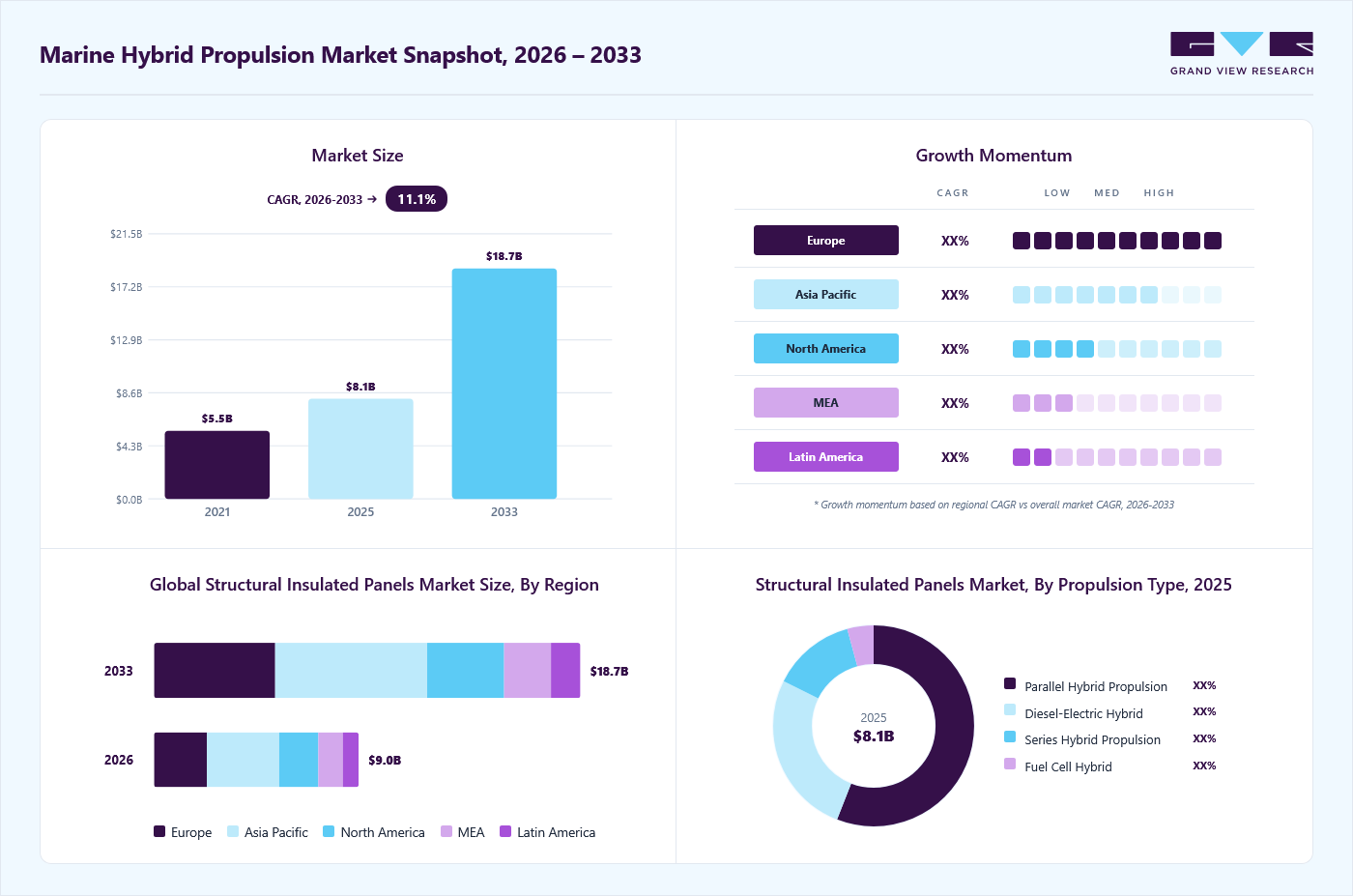
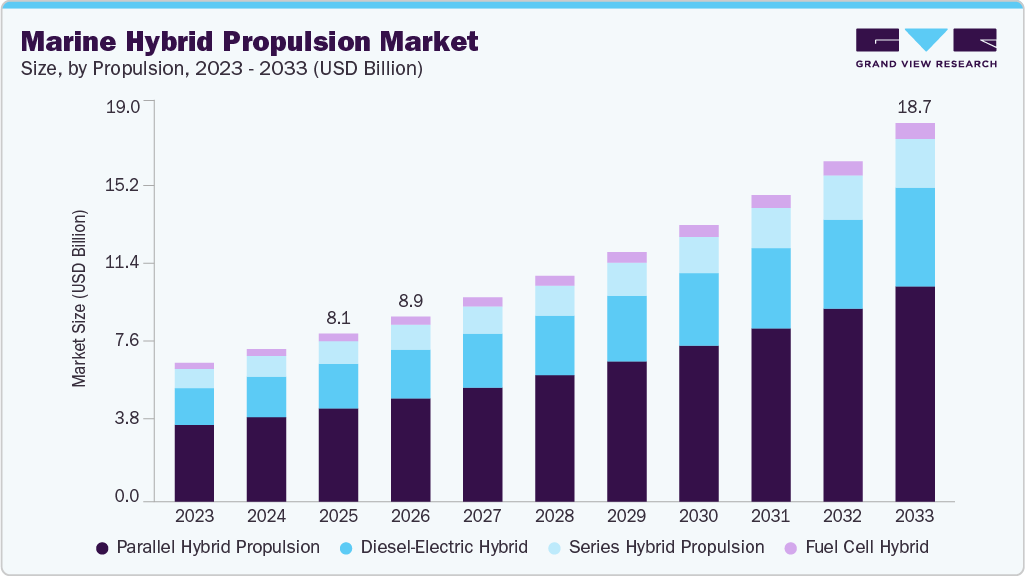
The global marine hybrid propulsion market size was valued at USD 8.1 billion in 2025 and is projected to grow from USD 9.0 billion in 2026 to USD 18.7 billion by 2033, at a CAGR of 11.1% from 2026 to 2033. Asia-Pacific dominated the global market, accounting for the largest revenue share of 35.3% in 2025. The market is witnessing strong growth, driven by the increasing demand for fuel-efficient, low-emission, and high-performance propulsion systems across the maritime industry.
 Source: Grand View Research, IR Documents, Primary Interviews, Paid DatabasesTo learn more about this report,
 Download Free Sample Report
 Key Market Trends & Insights
- By propulsion: Parallel hybrid propulsion segment led the market and held the largest revenue share of over 55.9% in 2025.
- By installation: Retrofit segment led the market and held the largest revenue share of over 65.0% in 2025.
- By power rating: 1 MW - 5 MW is expected to grow at the fastest CAGR of 11.5% from 2026 to 2033.
Regional Highlights
- Largest regional market: Asia-Pacific (35.3% revenue share, 2025)
- Fastest-growing regional market: North America (highest CAGR, 2026-2033)
- By country: The China marine hybrid propulsion industry is a major contributor to the global market.
Market Size & Forecast
- Market size in 2025: USD 8.1 Billion
- Estimated market size in 2026: USD 9.0 Billion
- Projected market size by 2033: USD 18.7 Billion
- CAGR (2026-2033): 11.1%
Three ways to get this report
Buy it, customize it, or ask a question.Ask an Analyst
Analyst response in 1 business day
- AccessReport author, directly
- Reply timeWithin 1 working day
- No sales callDirect answer only
- FormatEmail reply
- CostFree, no cost
Get the Full Report
What the study covers
- FormatsPDF · Excel · Dashboard
- Timeline2026–2033 annual, 2025 base
- Coverage20+ countries, 5 regions
- Companies10+ key players profiled
Customize the Report
20% free customization
- IncludeCountries, segments, points
- TailorTo your product definition
- ExtendDeeper competitor detail
- OrA fully bespoke study
- Turnaround5–10 working days
As global shipping activities expand and environmental concerns intensify, the need for advanced propulsion technologies that reduce fuel consumption and comply with stringent emission regulations has become critical. The rapid adoption of innovative technologies such as energy storage systems, smart power management, automation, and digital monitoring is further accelerating market growth. Hybrid propulsion systems enable seamless integration of conventional engines with electric power sources, optimizing energy installation and improving operational efficiency.
 To learn more about this report, Download Free Sample Report
 The demand for marine hybrid propulsion solutions is increasing as shipowners and operators seek to enhance fuel efficiency, operational performance, and cost optimization while complying with stringent environmental regulations. The growth of the hybrid electric marine propulsion engine market is further reinforcing this trend, as maritime companies increasingly adopt advanced propulsion technologies that combine conventional engines with electric power systems. These hybrid propulsion systems enable seamless integration of multiple power sources, allowing optimized energy usage across varying load conditions. These systems support reduced fuel consumption, lower emissions, and improved vessel efficiency across diverse marine operations. In addition, the rapid adoption of advanced technologies such as energy storage systems, automation, digital monitoring, and smart power management is driving the need for flexible and scalable propulsion solutions that can support modern maritime requirements.
Parallel hybrid propulsion systems also reduce the complexity associated with traditional single-engine marine propulsion by enabling flexible integration of mechanical and electric power sources within the same drivetrain. This minimizes the need for extensive engine overhauls while optimizing fuel consumption and power distribution. As a result, vessel operators benefit from improved operational efficiency, enhanced performance across varying load conditions, and the ability to adapt quickly to changing voyage requirements. Furthermore, parallel hybrid systems lower fuel and maintenance costs by allowing engines to operate at optimal efficiency levels and enabling electric-only operations in low-speed or port environments.
In addition, the growing adoption of sustainable maritime practices across industries such as commercial shipping, offshore energy, naval defense, passenger transport, and inland waterways is accelerating the demand for advanced propulsion solutions. Parallel hybrid propulsion plays a critical role in supporting emission reduction targets and regulatory compliance set by organizations like the International Maritime Organization, while also enabling quieter operations, reduced environmental impact, and improved overall vessel performance.
Propulsion Insights
The parallel hybrid propulsion segment dominated the market, accounting for over 55.9% of the global revenue share in 2025, driven by the increasing demand for highly efficient, flexible, and cost-effective propulsion solutions across diverse marine applications. This propulsion enables vessels to utilize both mechanical engines and electric motors simultaneously or independently, allowing optimized power distribution based on operational requirements. The ability to switch seamlessly between power sources reduces fuel consumption, enhances performance, and minimizes emissions, making it highly attractive for shipowners aiming to improve efficiency without significant system complexity.
The diesel-electric hybrid segment is anticipated to witness notable growth over the forecast period due to its ability to deliver enhanced fuel efficiency, operational flexibility, and reduced emissions across a wide range of vessels. This system uses diesel generators to produce electricity, which then powers electric motors, allowing engines to operate at optimal load levels rather than fluctuating with speed demands. As a result, it significantly reduces fuel consumption and improves overall energy efficiency, especially in vessels with variable load profiles such as offshore support vessels, ferries, and cruise ships.
Installation Insights
Retrofit is dominating the market with over 65% market share due to its strong economic and operational advantages for shipowners. The growth of the marine hybrid propulsion system industry is further driven by the increasing need to upgrade existing vessels with advanced, fuel-efficient technologies. Upgrading existing vessels with hybrid propulsion systems is significantly more cost-effective than building new ships, allowing operators to enhance fuel efficiency and reduce emissions without heavy capital expenditure.
One of the key reasons for this dominance is the urgent need to comply with environmental regulations set by organizations such as the International Maritime Organization. Retrofitting enables older vessels to meet these standards quickly, avoiding penalties and operational restrictions. In addition, retrofit solutions offer shorter installation timelines and minimal disruption, making them practical for active fleets.
Newbuild (factory-installed systems) is anticipated to grow significantly over the forecast period, driven by the increasing demand for next-generation, energy-efficient vessels designed with hybrid systems from the outset. Shipowners and operators are increasingly investing in new vessels that integrate hybrid propulsion technologies during the design phase, enabling optimized system architecture, better space utilization, and higher overall efficiency compared to retrofit solutions. In addition, newbuild installations offer enhanced reliability, lower lifecycle costs, and improved performance, as all components are seamlessly integrated during construction. Growing investments in green shipbuilding, expansion of global maritime trade, and increasing demand for technologically advanced vessels especially in ferries, cruise ships, and naval applications are further accelerating the growth of the newbuild segment.
Power Rating Insights
The 1 MW - 5 MW segment dominated the market, accounting for over 48.0% of the global revenue share in 2025, driven by its widespread applicability across medium-sized vessels such as ferries, offshore support vessels, and commercial ships. This power range offers an optimal balance between performance, fuel efficiency, and cost-effectiveness, making it highly suitable for vessels operating under variable load conditions. It enables efficient power distribution, supports hybrid operations, and enhances overall vessel performance without the complexity associated with higher power systems.
The above 5 MW segment is anticipated to grow notably over the forecast period, driven by the increasing adoption of hybrid systems in large vessels such as cruise ships, naval vessels, and large commercial ships that require high power output and continuous operations. These vessels operate on long routes and under heavy load conditions, creating strong demand for advanced propulsion systems that can enhance fuel efficiency while maintaining high performance. Furthermore, the integration of hybrid propulsion in this segment enables optimized energy management, reduced fuel consumption, and lower emissions, particularly during variable load operations and port activities. In addition, growing regulatory pressure from organizations such as the International Maritime Organization is encouraging shipowners to adopt cleaner propulsion technologies even in high-power applications.
Vessel Insights
The Offshore Support Vessels (OSVs) segment dominated the market, accounting for over 33.0% of the global revenue share in 2025, driven by the high demand for fuel-efficient and flexible propulsion systems in offshore oil & gas and wind operations. The expansion of the marine hybrid & full electric propulsion segment is further supporting this dominance, as offshore operators increasingly adopt advanced propulsion technologies to enhance efficiency and sustainability. OSVs typically operate under highly variable load conditions, including dynamic positioning, standby, and transit modes, making hybrid propulsion systems ideal for optimizing power usage and reducing fuel consumption. In addition, hybrid systems enable OSVs to run engines at optimal load levels while utilizing battery power during low-demand operations, significantly lowering emissions and operational costs.
The Naval / Defense vessels segment is anticipated to grow significantly over the forecast period, driven by the increasing need for enhanced operational efficiency, stealth capabilities, and fuel optimization in modern naval fleets. Hybrid propulsion systems enable naval vessels to operate in electric mode, significantly reducing acoustic and thermal signatures, which is critical for stealth operations and mission effectiveness.
In addition, these systems provide greater energy flexibility and reliability, allowing naval ships to efficiently manage varying power demands during surveillance, combat, and patrol operations. The ability to optimize fuel consumption and extend operational range is particularly valuable for long-duration missions. Growing investments in naval modernization programs and the development of next-generation warships are further accelerating the adoption of hybrid propulsion technologies.
Application Insights
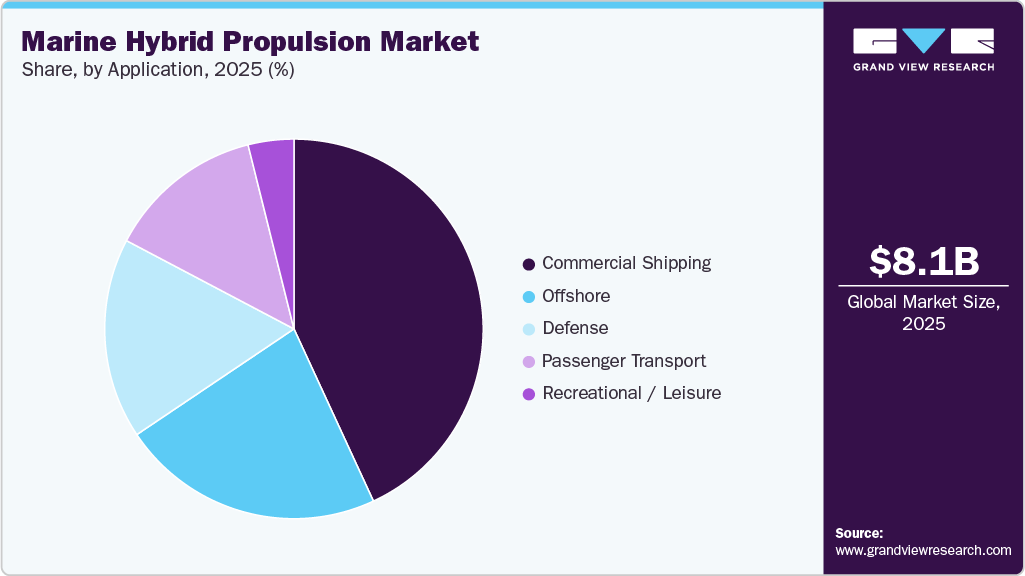
The commercial shipping segment dominated the market, accounting for over 43.0% of the global revenue share in 2025, driven by the extensive size of the global merchant fleet and the increasing need for fuel-efficient and cost-optimized operations. Commercial vessels such as cargo ships, bulk carriers, and container ships operate on long routes with high fuel consumption, making hybrid propulsion systems highly valuable for reducing operating costs and improving energy efficiency. In addition, hybrid systems enable better power management during variable operating conditions, including cruising, maneuvering, and port operations, resulting in lower fuel usage and reduced emissions. The growing pressure to comply with environmental regulations set by organizations such as the International Maritime Organization is significantly accelerating the adoption of hybrid propulsion in commercial fleets.
 To learn more about this report, Download Free Sample Report
 The Defense segment is anticipated to grow significantly over the forecast period, driven by the increasing focus on advanced naval capabilities, energy efficiency, and mission flexibility. Hybrid propulsion systems enable defense vessels to operate in low-noise electric mode, reducing acoustic signatures and enhancing stealth during critical operations such as surveillance and anti-submarine warfare. In addition, these systems provide improved fuel efficiency and extended operational range, which are essential for long-duration missions and remote deployments. Hybrid propulsion also supports efficient power distribution for onboard systems, including radar, communication, and weapon technologies, ensuring optimal performance under varying operational conditions.
Regional Insights
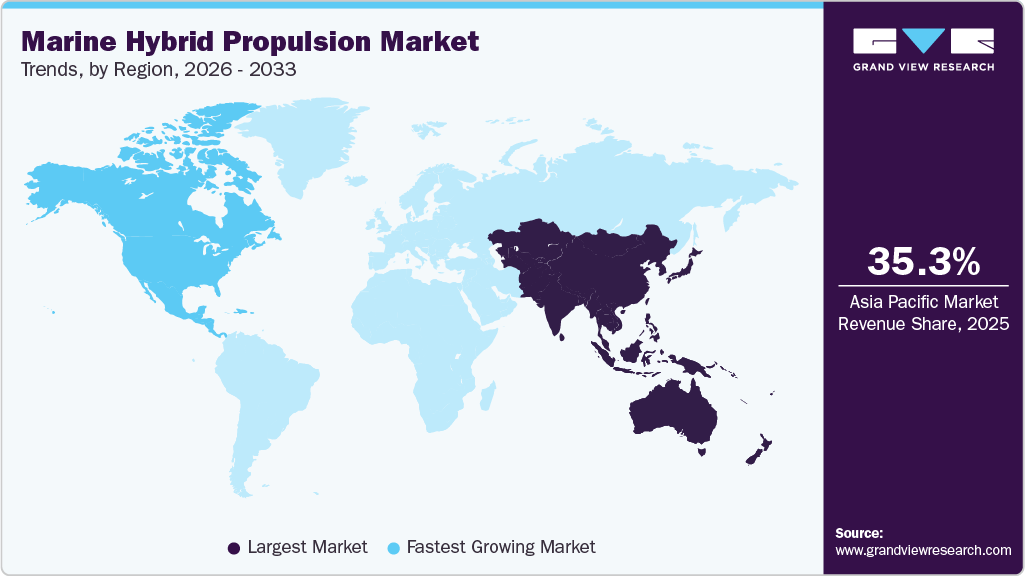
Asia-Pacific marine hybrid propulsion industry dominated the global industry with a market share of over 35.3% in 2025, driven by the region’s strong shipbuilding industry, expanding maritime trade, and increasing adoption of energy-efficient propulsion technologies. Countries such as China, South Korea, and Japan are major global shipbuilding hubs, creating significant demand for advanced propulsion systems, including hybrid solutions. The growing focus on reducing fuel consumption and improving vessel performance across commercial and offshore fleets is further supporting market growth in the region.
 To learn more about this report, Download Free Sample Report
 Asia-Pacific marine hybrid propulsion industry is growing significantly, driven by the region’s expanding maritime trade, strong shipbuilding capabilities, and increasing focus on fuel efficiency and emission reduction. Countries such as China, South Korea, and Japan are global leaders in shipbuilding, creating a robust demand for advanced propulsion technologies, including hybrid systems, across both newbuild and retrofit vessels.
In addition, the rapid growth of coastal shipping, inland waterways, and offshore activities is accelerating the need for energy-efficient and cost-effective propulsion solutions. Hybrid systems help operators reduce fuel consumption and operating costs while improving vessel performance, making them highly attractive in a region with high shipping activity
China marine hybrid propulsion industry dominated the Asia Pacific market, driven by its position as the world’s largest shipbuilding hub and its strong industrial ecosystem supporting marine equipment manufacturing. The country has a vast network of shipyards, component suppliers, and technology providers, enabling large-scale production and faster adoption of advanced propulsion systems, including hybrid technologies. In addition, China’s rapidly expanding maritime trade and coastal shipping activities are creating significant demand for fuel-efficient and low-emission vessels. The government’s strong focus on green shipping and decarbonization initiatives, supported by favorable policies and investments, is accelerating the deployment of hybrid propulsion systems across commercial and inland waterway fleets.
Europe Marine Hybrid Propulsion Market Trends
Europe marine hybrid propulsion industry is growing significantly, driven by its strong focus on sustainability, decarbonization, and early adoption of green maritime technologies. The region has some of the strictest environmental regulations, pushing shipowners to adopt low-emission propulsion systems to comply with evolving standards set by authorities and organizations such as the International Maritime Organization. In addition, European countries particularly Norway, Finland, and the Netherlands are leading in the deployment of hybrid and fully electric vessels, especially in ferry and short-sea shipping segments. Government support through subsidies, incentives, and funding programs for clean shipping is further accelerating the transition toward hybrid propulsion systems.
Key Marine Hybrid Propulsion Company Insights
The marine hybrid propulsion industry features several key players that significantly shape its global landscape through advanced propulsion technologies, integrated power systems, and energy-efficient marine solutions. Companies in this market focus on developing hybrid propulsion architectures, energy storage systems, and smart power management technologies to enhance vessel performance, reduce emissions, and improve operational efficiency across commercial, offshore, and defense applications.
-
ABB Ltd. is a global leader in marine electrification, offering integrated hybrid propulsion systems, energy storage solutions, and digital power management platforms that enable efficient and sustainable vessel operations. Its strong technological expertise supports improved fuel efficiency and reduced emissions across diverse marine applications.
-
Wärtsilä Corporation provides advanced hybrid propulsion solutions combining engines, energy storage, and automation systems. The company focuses on optimizing vessel efficiency, enabling flexible operations, and supporting decarbonization initiatives in the maritime sector.
Key Marine Hybrid Propulsion Companies:
The following key companies have been profiled for this study on the marine hybrid propulsion market.
- ABB Ltd.
- Wärtsilä Corporation
- Rolls-Royce Holdings plc
- MAN Energy Solutions
- Siemens Energy AG
- Kongsberg Gruppen
- GE Marine
- Volvo Penta
- Caterpillar Inc.
- BAE Systems
Recent Development
-
In March 2026, ABB Ltd. announced that it will supply an integrated hybrid-electric propulsion system for a new 75-car passenger and vehicle ferry for the Cape May-Lewes route in the United States. The solution includes ABB’s Onboard DC Grid platform, advanced power and energy management systems, and end-to-end engineering support, enabling optimized energy usage and improved operational efficiency. The hybrid configuration is expected to reduce fuel consumption by approximately 35% while lowering operating and maintenance costs, with future capability for full battery-electric, zero-emission operations.
-
In June 2025, Wärtsilä Corporation announced that it will supply an integrated hybrid propulsion solution for four new 10,700 DWT geared tween decker vessels being built for Dutch shipowner Vertom Group. The solution combines a medium-speed engine with a hybrid drivetrain, enabling optimized propulsion efficiency and battery-powered, zero-emission sailing modes without relying on combustion power.
Marine Hybrid Propulsion Market Report Scope
Report Attribute
Details
Market size in 2025
USD 8.1 billion
Estimated Market size in 2026
USD 9.0 billion
Projected Market size by 2033
USD 18.7 billion
Growth rate
CAGR of 11.1% from 2026 to 2033
Actual data
2021 - 2025
Forecast period
2026 - 2033
Quantitative units
Revenue in USD million and CAGR from 2026 to 2033
Report coverage
Revenue forecast, company ranking, competitive landscape, growth factors, and trends
Segments covered
Propulsion, installation, application, power rating, vessel, region
Regional scope
North America; Europe; Asia Pacific; Latin America; MEA
Country scope
U.S.; Canada; Mexico; Germany; UK; France; China; India; Japan; Australia; South Korea; Brazil; UAE; South Africa; KSA
Key companies profiled
ABB Ltd.; Wärtsilä Corporation; Rolls-Royce Holdings plc; MAN Energy Solutions; Siemens Energy AG; Kongsberg Gruppen; GE Marine; Volvo Penta; Caterpillar Inc.; BAE Systems
Customization scope
Free report customization (equivalent up to 8 analysts working days) with purchase. Addition or alteration to country, regional & segment scope.
Pricing and purchase options
Avail customized purchase options to meet your exact research needs. Explore purchase options
Global Marine Hybrid Propulsion Market Report Segmentation
This report forecasts revenue growth at global, regional, and country levels and provides an analysis of the latest industry trends in each of the sub-segments from 2021 to 2033. For this study, Grand View Research has segmented the global marine hybrid propulsion market report based on propulsion, installation, application, power rating, vessel, and region:
-
Propulsion Outlook (Revenue, USD Million, 2021 - 2033)
-
Parallel Hybrid Propulsion
-
Diesel-Electric Hybrid
-
Series Hybrid Propulsion
-
Fuel Cell Hybrid
-
-
Installation Outlook (Revenue, USD Million, 2021 - 2033)
-
Retrofit
-
Newbuild (Factory-installed systems)
-
-
Power Rating Outlook (Revenue, USD Million, 2021 - 2033)
-
1 MW - 5 MW
-
Above 5 MW
-
Up to 1 MW
-
-
Vessel Outlook (Revenue, USD Million, 2021 - 2033)
-
Offshore Support Vessels
-
Ferries
-
Naval / Defense Vessels
-
Cruise Ships
-
Yachts & Recreational Boats
-
Others
-
-
Application Outlook (Revenue, USD Million, 2021 - 2033)
-
Commercial Shipping
-
Offshore
-
Defense
-
Passenger Transport
-
Recreational / Leisure
-
-
Regional Outlook (Revenue, USD Million, 2021 - 2033)
-
North America
-
U.S.
-
Canada
-
Mexico
-
-
Europe
-
UK
-
Germany
-
France
-
-
Asia Pacific
-
China
-
Japan
-
India
-
Australia
-
South Korea
-
-
Latin America
-
Brazil
-
-
Middle East and Africa (MEA)
-
KSA
-
UAE
-
South Africa
-
-
Frequently Asked Questions About This Report
North America is the fastest-growing region over the forecast period.
The parallel hybrid propulsion segment led with a 55.9% revenue share in 2025.
The 1 MW - 5 MW segment dominated the market and accounted for the largest revenue share over 48.0% in 2025.
The offshore support vessels (OSVs) segment led with a 33.0% revenue share in 2025.
Retrofit segment held the largest share (over 65.0%) in 2025.
Key players include ABB Ltd.; Wärtsilä Corporation; Rolls-Royce Holdings plc; MAN Energy Solutions; Siemens Energy AG; Kongsberg Gruppen; GE Marine; Volvo Penta; Caterpillar Inc.; BAE Systems.
The global marine hybrid propulsion market is expected to grow at a CAGR of 11.1% from 2026 to 2033, reaching USD 18.7 billion by 2033.
Asia-Pacific dominated the marine hybrid propulsion Market with a share of 35.3% in 2025, driven by the region’s strong shipbuilding industry, expanding maritime trade, and increasing demand for fuel-efficient and low-emission propulsion systems. Countries such as China, South Korea, and Japan play a critical role as global shipbuilding hubs, supporting the large-scale adoption of hybrid propulsion technologies across commercial, offshore, and inland vessels.
Key factors that are driving the growth of the Marine Hybrid Propulsion Market include increasing demand for fuel-efficient and low-emission vessels, rising pressure to comply with environmental regulations set by organizations such as the International Maritime Organization, and the need to reduce operating and fuel costs across maritime operations.
The global marine hybrid propulsion market size was valued at USD 8.1 billion in 2025 and is estimated at USD 9.0 billion for 2026.
About the Author(s)
Automotive & Transportation Research Team
Technology · Automotive & TransportationThis report was authored by the automotive & transportation research team at Grand View Research - comprising two research analysts, one senior research analyst, and one industry expert - with specialized expertise in the automotive & transportation segment of the technology industry. All findings are based on proprietary technology databases, executive interviews, and regulatory analysis, subject to internal peer review prior to publication.
Last Updated:
Speak to Analyst

Customize this report to your needs - add regions, segments, or data points, with 20% free customization.
Or view our licence options:


ISO 9001:2015 & 27001:2022 Certified
We are GDPR and CCPA compliant! Your transaction & personal information is safe and secure. For more details, please read our privacy policy.


