
- Home
- »
- Electronic & Electrical
- »
-
Massage Equipment Market Size & Share Report, 2026-2033GVR Report cover

Massage Equipment Market (2026 - 2033)
Size, Share & Trends Analysis Report By Product (Massage Chairs & Sofas, Handheld Massagers), By Application (Commercial, Home), By Region, And Segment Forecasts
Market Size, 2025
$12.4BMarket Estimate, 2026
$13.2BMarket Forecast, 2033
$21.8BCAGR, 2026–2033
7.4%Massage Equipment Market Summary
The global massage equipment market size was valued at USD 12.4 billion in 2025 and is projected to grow from USD 13.2 billion in 2026 to USD 21.8 billion by 2033, at a CAGR of 7.4% from 2026 to 2033. North America dominated the massage equipment market with the largest revenue share of 36.8% in 2025. The market growth is driven by rising stress levels and increasingly sedentary lifestyles, which are fueling demand for relaxation and pain relief solutions.
 Source: Grand View Research, IR Documents, Primary Interviews, Paid DatabasesTo learn more about this report,
 Download Free Sample Report
 Key Market Trends & Insights
- By product: Massage chairs & sofas segment held the largest market share of 39.4% in 2025.
- By application: Commercial massage equipment segment held the largest market share of 83.1% in 2025.
Regional Highlights
- Largest regional market: North America (36.8% revenue share, 2025)
- Fastest-growing regional market: Asia Pacific (highest CAGR, 2026-2033)
- By country: The U.S. held the largest market share in 2025
Key Market Trends & Insights
- Market size in 2025: USD 12.4 Billion
- Estimated market size in 2026: USD 13.2 Billion
- Projected market size by 2033: USD 21.8 Billion
- CAGR (2026-2033): 7.4%
Three ways to get this report
Buy it, customize it, or ask a question.Ask an Analyst
Analyst response in 1 business day
- AccessReport author, directly
- Reply timeWithin 1 working day
- No sales callDirect answer only
- FormatEmail reply
- CostFree, no cost
Get the Full Report
What the study covers
- FormatsPDF · Excel · Dashboard
- Timeline2026–2033 annual, 2025 base
- Coverage20+ countries, 5 regions
- Companies10+ key players profiled
Customize the Report
20% free customization
- IncludeCountries, segments, points
- TailorTo your product definition
- ExtendDeeper competitor detail
- OrA fully bespoke study
- Turnaround5–10 working days
Technological advancements have led to the development of innovative, customizable massage equipment that is more effective and appealing to consumers. For instance, In July 2025, Fujiiryoki launched its Cyber Relax Elite massage chair in the U.S. The model featured a 4D dual-robot massage system, SL-Track, triple-action foot and leg therapy, 86 airbags, quad-heat zones, zero-gravity recline, touchscreen control, and Bluetooth sound for a luxurious wellness experience. The increasing emphasis on holistic well-being and the growth of wellness tourism have further fueled market expansion. Moreover, the rising popularity of home fitness and wellness, combined with the convenience of e-commerce and online retail, has made massage equipment more accessible to a broader consumer base.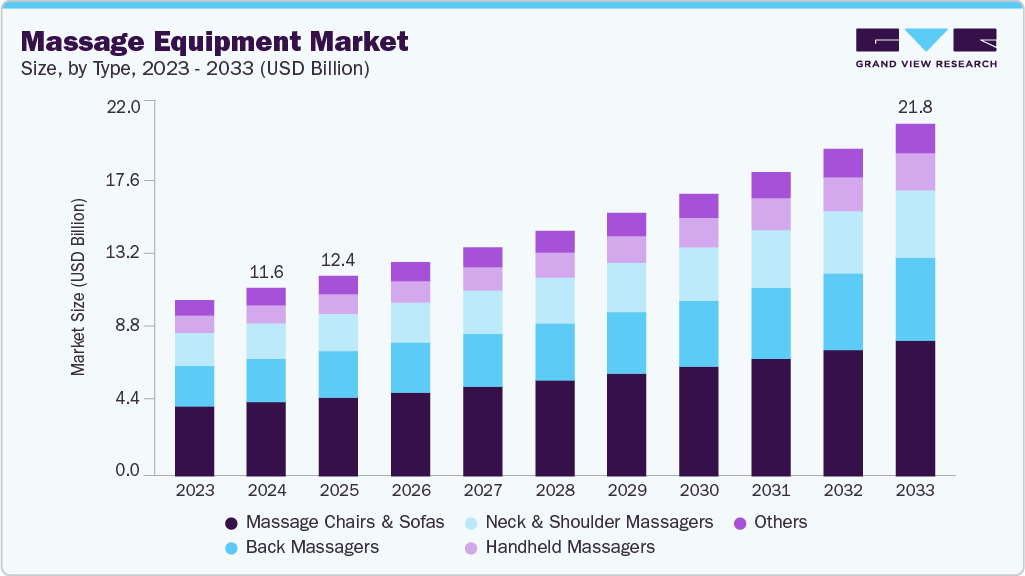 To learn more about this report, Download Free Sample Report
 Additionally, the growing aging population and the increasing prevalence of musculoskeletal disorders are boosting the need for therapeutic massage devices. According to the World Health Organization (WHO), published in July 2022, about 1.71 billion people globally suffer from musculoskeletal conditions, limiting their mobility and dexterity, requiring them to retire from work early.
Moreover, rising disposable incomes and changing lifestyle preferences are encouraging consumers to invest in premium wellness products. Corporate wellness initiatives and the adoption of massage equipment in workplaces are also enhancing demand. Furthermore, expanding product availability in spas, gyms, and rehabilitation centers is contributing to the market’s sustained growth.
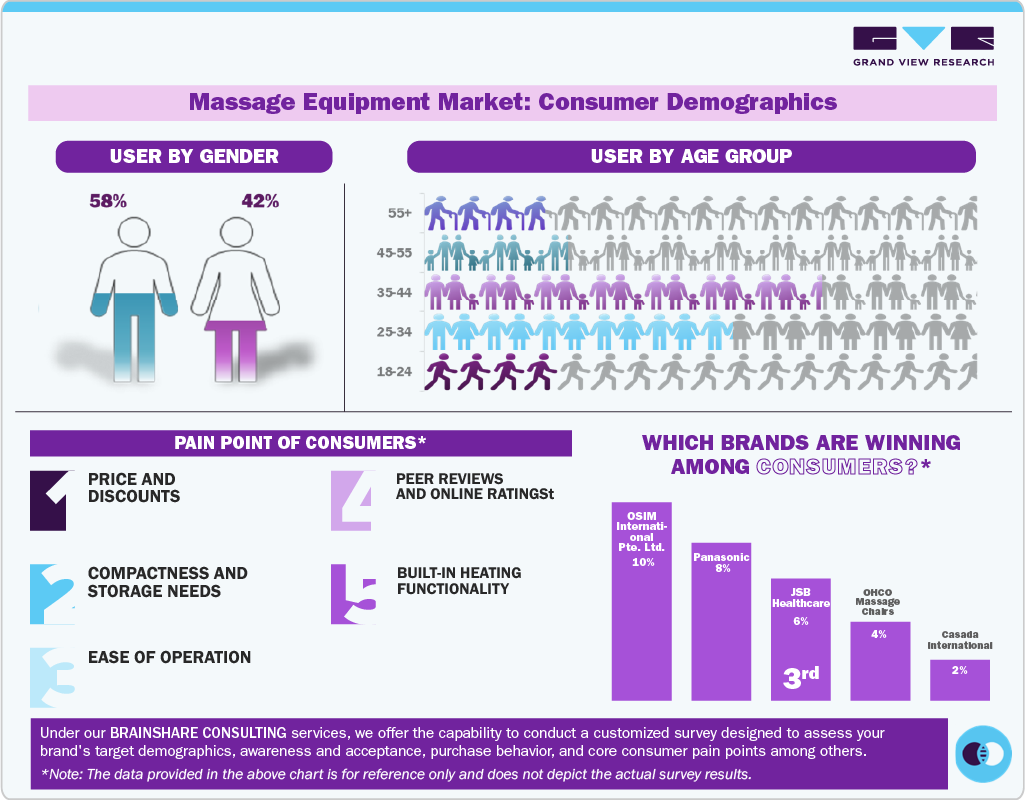
Consumer Insights for Massage Equipment
 To learn more about this report, Download Free Sample Report
 Market Dynamics
The global massage equipment market is driven by growing consumer focus on stress management, muscle recovery, and at-home wellness solutions. Increasing awareness of physical well-being, coupled with rising adoption of self-care routines, is supporting demand for both personal and commercial massage equipment. Demand is increasingly shifting toward feature-rich and technologically advanced products, while high product costs and the availability of lower-cost alternatives continue to influence purchasing decisions.
A key driver of the market is the increasing emphasis on physical wellness, stress reduction, and muscle recovery among consumers. Growing participation in fitness activities, longer working hours, and sedentary lifestyles are encouraging the adoption of massage equipment for relaxation, pain relief, and recovery purposes across both home and commercial settings.
Market growth is constrained by the relatively high purchase cost of premium massage chairs and technologically advanced massage devices. For many consumers, massage equipment remains a discretionary purchase, while commercial buyers often face longer investment evaluation cycles due to equipment costs and maintenance requirements.
A significant opportunity exists in the growing demand for massage equipment incorporating advanced features such as body-scanning technology, customized massage programs, app connectivity, heat therapy, and AI-assisted personalization. As consumers increasingly seek professional-grade wellness experiences at home, premium and technology-enabled massage equipment is expected to capture a larger share of market value growth.
Analyst Perspective
The massage equipment market is evolving from a niche wellness category toward a broader personal health and recovery market, supported by growing adoption among home users and commercial wellness operators. Market value is increasingly concentrated in premium products offering advanced therapeutic features and enhanced user experiences. Over the forecast period, product effectiveness, technological innovation, and brand credibility are expected to remain key competitive differentiators.
Product Insights
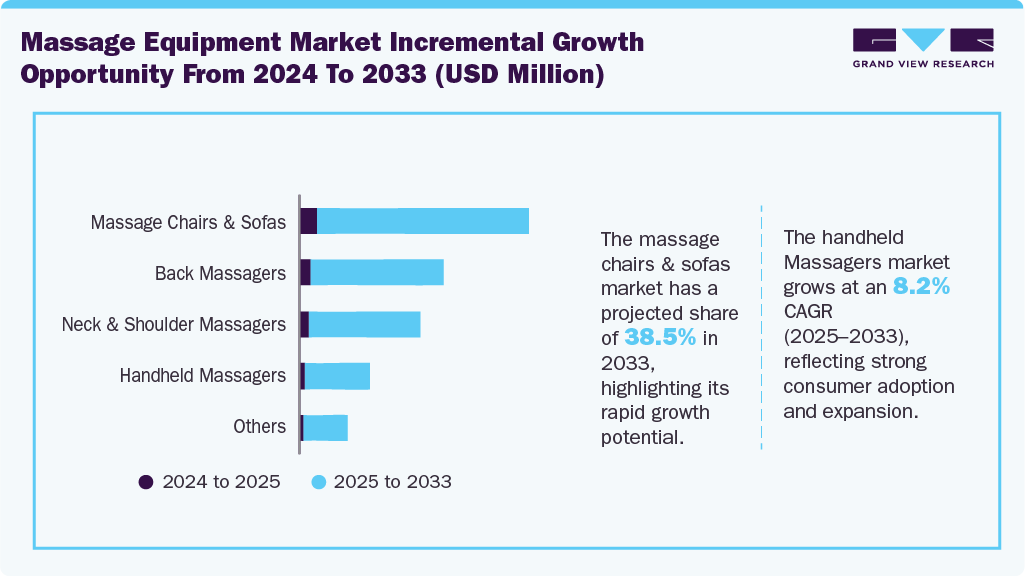
Based on product, massage chairs & sofas led the market with the largest revenue share of 39.4% in 2025, and the handheld massager grows at the fastest CAGR over the forecast period. The massage chairs and sofas market is driven by the growing preference for luxury and comfort-oriented home furnishings. Increasing awareness of posture-related issues and the benefits of ergonomic seating solutions is fueling demand. Integration of smart technologies such as AI, voice control, and app connectivity is enhancing product appeal. For instance, in March 2024, Cozzia USA unveiled its Quantum massage chair in the U.S. at High Point Market. The chair integrated AI-powered voice control, a 5D adaptive mechanism, precise body mapping via 27 sensors, SL FlexTrack, chromotherapy, surround sound, aromatherapy, and full-body heat, setting a new industry technology benchmark. Additionally, rising urbanization and the expansion of premium residential and hospitality sectors are further supporting market growth.
 To learn more about this report, Download Free Sample Report
 The handheld massager market is projected to grow at the fastest CAGR of 8.2% from 2025 to 2033. The handheld massager market is driven by increasing consumer focus on convenient, portable wellness solutions. Growing awareness of self-care and at-home muscle recovery is boosting adoption among fitness enthusiasts and working professionals. Technological innovations such as rechargeable, cordless, and multi-speed designs are enhancing usability and appeal. For instance, in October 2023, Therabody, Inc. launched three massage guns in the following variants: Theragun PRO Plus, Theragun Sense, and Theragun Relief, designed to offer benefits including reducing tension, enhancing sleep quality, and faster recovery. Moreover, social media influence and celebrity endorsements are further accelerating market demand.
Application Insights
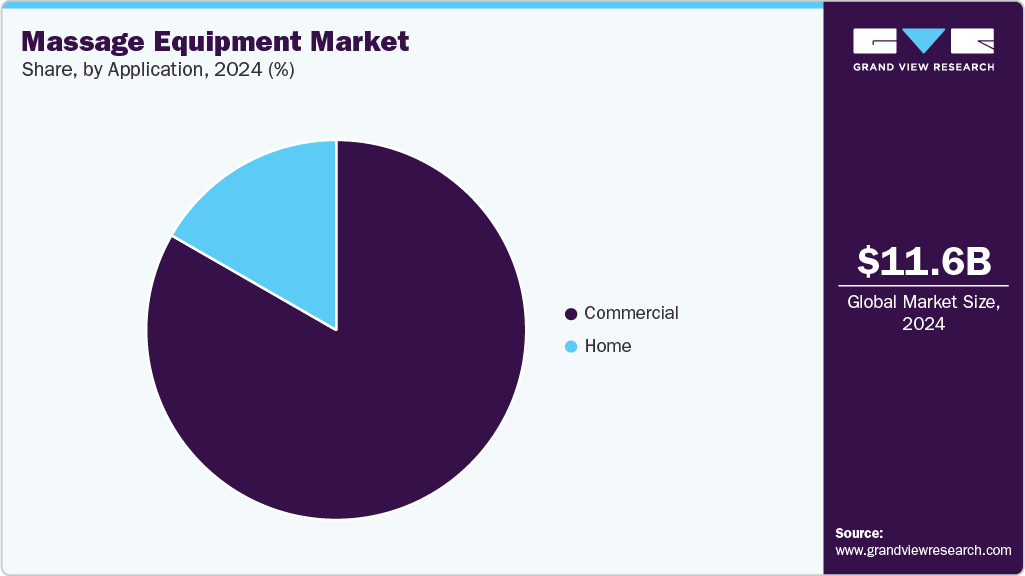
Based on application, commercial massage equipment led the market with a revenue share of 83.1% in 2025, and home massage equipment is the fastest growing CAGR over the forecast period. The commercial massage equipment market is driven by the rapid expansion of spas, wellness centers, and luxury hotels worldwide. According to the U.S. Spa Industry Study by the International Spa Association (ISPA), data published in June 2025, 16% of spas in the U.S. now offer percussive massage services, and 7% provide robotic massage options, reflecting a growing adoption of advanced massage equipment in commercial settings. Growing investments in professional-grade therapeutic equipment to enhance customer experience are fueling demand. Rising corporate partnerships with wellness providers to support employee health programs are also contributing to market growth. Additionally, the increasing popularity of sports recovery centers and physiotherapy clinics is boosting the adoption of advanced commercial massage systems.
 To learn more about this report, Download Free Sample Report
 The massage equipment market for home application is projected to grow at a significant CAGR of 8.5% from 2025 to 2033. The rising trend of personal wellness spaces and home-based relaxation routines drives the home massage equipment market. Increasing consumer inclination toward cost-effective alternatives to spa treatments is propelling product adoption. The availability of compact, aesthetically designed devices that complement modern home interiors is enhancing market appeal. Furthermore, aggressive marketing campaigns and subscription-based maintenance or upgrade services are stimulating continued consumer engagement.
Regional Insights
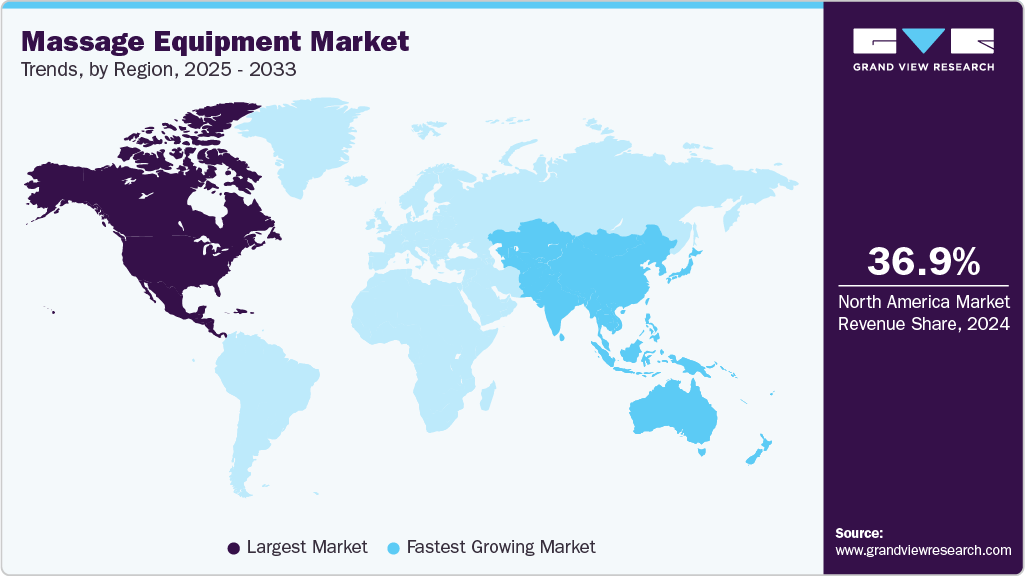
North America dominated the massage equipment market with the largest revenue share of 36.8% in 2025. The massage equipment market in North America is driven by the growing prevalence of chronic pain and high stress levels due to fast-paced lifestyles. Consumers are increasingly investing in premium, tech-integrated devices for home wellness. According to the GD COLLEGE INC data published in August 2025, about 35% of Canadians have used massage therapy services in the past year. The presence of established wellness brands and advanced distribution channels enhances market penetration. Supportive healthcare reimbursement policies for therapeutic devices further strengthen demand. Additionally, rising awareness of preventive healthcare and self-care habits sustains long-term growth.
 To learn more about this report, Download Free Sample Report
 U.S. Massage Equipment Market Trends
The massage equipment market in U.S. held the market share of 84.2% in the North America region in 2025. In the U.S., the market is driven by strong consumer purchasing power and an expanding fitness and recovery culture. The adoption of massage devices among athletes, office workers, and the elderly is accelerating. Innovations in AI-based and app-controlled massage systems are gaining significant traction. Retail partnerships and omnichannel strategies by major brands are improving accessibility. Moreover, the country’s growing focus on mental health and relaxation therapies supports market expansion.
Europe Massage Equipment Market Trends
The massage equipment market in Europe held a significant market share of 21.4% in the global market. Europe’s massage equipment market is influenced by the region’s well-established spa and wellness industry. Consumers’ increasing preference for eco-friendly, durable, and energy-efficient products is shaping product innovation. Government initiatives promoting employee well-being and ergonomic workplaces are supporting adoption. The rising trend of integrating massage features into furniture and vehicles adds further appeal. Additionally, an aging population with higher disposable incomes drives sustained demand for therapeutic devices.
The Germany massage equipment market held the largest market share of 28.5% in the European market. The massage equipment demand is driven by the country’s strong healthcare infrastructure and emphasis on physical rehabilitation. Consumers value high-quality, precision-engineered products, encouraging growth in premium massage solutions. The integration of massage devices into physiotherapy and orthopedic care is becoming common. Increasing health awareness and participation in preventive wellness programs boost household adoption. Furthermore, collaborations between medical professionals and wellness manufacturers enhance product credibility and acceptance.
Asia Pacific Massage Equipment Market Trends
The Asia Pacific massage equipment market is projected to grow at the fastest CAGR of 8.0% from 2025 to 2033. The Asia Pacific massage equipment market is expanding rapidly due to growing urbanization and rising middle-class income levels. Increasing health consciousness and traditional massage culture in countries including China, Japan, and Thailand support strong regional demand. As of October 2025, Thailand has 4,095 spas, with significant concentrations in Bangkok and Phuket. Local manufacturers are offering affordable, feature-rich devices, improving accessibility. The proliferation of online retail and cross-border e-commerce platforms enhances product reach. Additionally, government initiatives promoting wellness and preventive healthcare are accelerating market growth.
Key Massage Equipment Company Insights
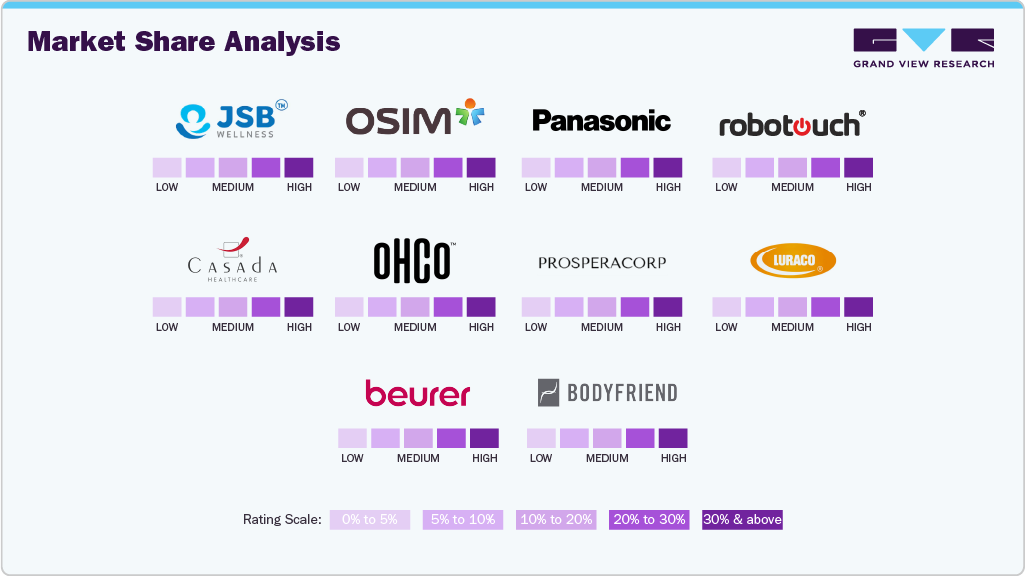
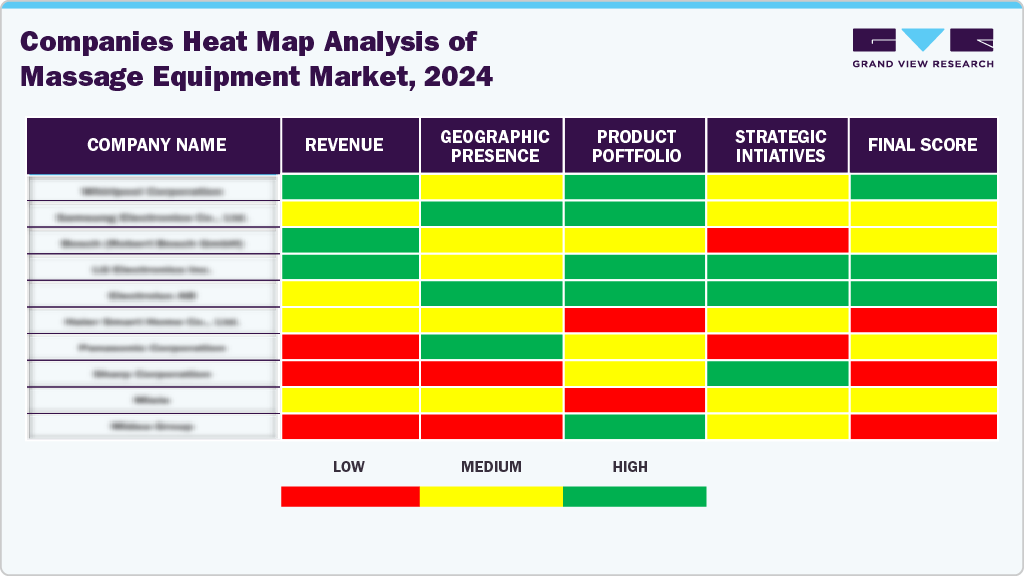
Many brands in the massage equipment market have recognized untapped opportunities within their end-use portfolios and are actively working to capitalize on these gaps. This includes launching innovative designs, expanding customization options, and tailoring marketing strategies to align with evolving consumer tastes and cultural trends. By addressing niche segments and emerging preferences, these brands aim to increase their market share and strengthen their competitive positioning worldwide
 To learn more about this report, Download Free Sample Report
  To learn more about this report, Download Free Sample Report
 Key Massage Equipment Companies:
The following key companies have been profiled for this study on the massage equipment market.
-
JSB Healthcare
-
OSIM International Pte. Ltd.
-
Panasonic
-
RoboTouch
-
Casada International
-
OHCO Massage Chairs
-
Prosperacorp
-
Luraco Technologies Corp
-
Beurer GmbH
-
BODYFRIEND
Competitive Benchmarking
Category
Operating Strategies
Competitive Edge
Weakness
Established Players (Panasonic, OSIM International Pte. Ltd., Beurer GmbH, BODYFRIEND, JSB Healthcare)
- Focus on product innovation, premium massage technologies, distribution expansion, and development of comprehensive wellness-focused product portfolios.
- Strong brand recognition, extensive distribution networks, established manufacturing capabilities, and broad product portfolios.
- Higher operating costs and greater exposure to pricing pressure from lower-cost alternatives and emerging brands.
Emerging Players (RoboTouch, Casada International, OHCO Massage Chairs, Prosperacorp, Luraco Technologies Corp.)
- Focus on product innovation, premium massage technologies, distribution expansion, and development of comprehensive wellness-focused product portfolios.
- Greater flexibility, faster innovation cycles, and stronger focus on specific wellness and recovery requirements.
- Limited brand visibility, narrower distribution reach, and lower marketing and financial resources compared to established market participants.
Recent Developments
-
In July 2025, Fujiiryoki launched its Cyber Relax Elite massage chair in the U.S. The model featured a 4D dual‑robot massage system, SL‑Track, triple‑action foot and leg therapy, 86 airbags, quad‑heat zones, zero‑gravity recline, touchscreen control, and Bluetooth sound for luxury wellness experiences.
-
In May 2024, Xiaomi introduced the Mijia Smart Waist Massager in China. The device features dual-function lumbar support, dual-sided adjustable heating, and 20 built-in massage balls. It supports the Mi Home app and NFC connectivity and offers multiple preset and customizable massage modes for targeted relief.
-
In March 2024, Cozzia USA unveiled its Quantum massage chair in the U.S. at High Point Market. The chair integrated AI-powered voice control, a 5D adaptive mechanism, precise body mapping via 27 sensors, SL FlexTrack, chromotherapy, surround sound, aromatherapy, and full-body heat, setting a new industry technology benchmark.
Massage Equipment Market Report Scope
Report Attribute
Details
Market size in 2025
USD 12.4 billion
Estimated market size in 2026
USD 13.2 billion
Projected market size by 2033
USD 21.8 billion
Growth rate
CAGR of 7.4 % from 2026 to 2033
Base year for estimation
2025
Historical data
2021 - 2024
Forecast period
2026 - 2033
Quantitative units
Revenue in USD million/billion and CAGR from 2026 to 2033
Report coverage
Revenue forecast, company ranking, competitive landscape, growth factors, and trends
Segments covered
Product, application, region
Regional scope
North America; Europe; Asia Pacific; Central & South America; Middle East & Africa
Country scope
U.S.; Canada; Mexico; Germany; UK; France; Italy; Spain; China; Japan; India; South Korea; Australia & New Zealand; Brazil; and South Africa
Key companies profiled
JSB Healthcare; OSIM International Pte. Ltd.; Panasonic; RoboTouch; Casada International; OHCO Massage Chairs; Prosperacorp; Luraco Technologies Corp; Beurer GmbH; BODYFRIEND
Customization scope
Free report customization (equivalent up to 8 analysts' working days) with purchase. Addition or alteration to country, regional & segment scope.
Pricing and purchase options
Avail customized purchase options to meet your exact research needs. Explore purchase options
Global Massage Equipment Market Report Segmentation
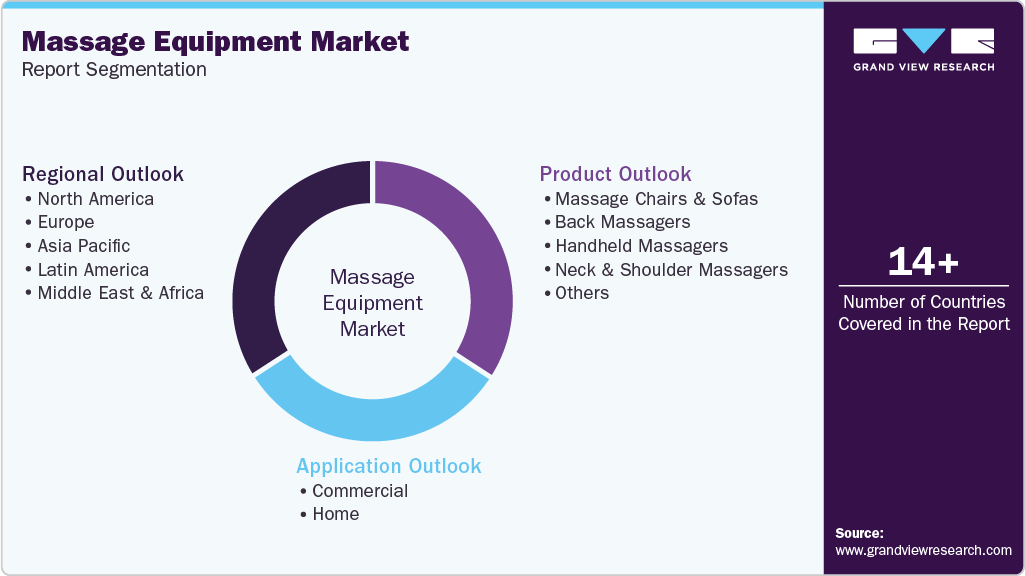
This report forecasts revenue growth at the regional and country levels and provides an analysis of the latest industry trends and opportunities in each of the sub-segments from 2021 to 2033. For the purpose of this study, Grand View Research has segmented the massage equipment market report on the basis of product, application, and region:
 To learn more about this report, Download Free Sample Report
 -
Product Outlook (Revenue, USD Million, 2021 - 2033)
-
Massage Chairs & Sofas
-
Back Massagers
-
Handheld Massagers
-
Neck & Shoulder Massagers
-
Others
-
-
Application Outlook (Revenue, USD Million, 2021 - 2033)
-
Commercial
-
Home
-
-
Regional Outlook (Revenue, USD Million, 2021 - 2033)
-
North America
-
U.S.
-
Canada
-
Mexico
-
-
Europe
-
UK
-
Germany
-
France
-
Italy
-
Spain
-
-
Asia Pacific
-
China
-
India
-
Japan
-
Australia
-
-
Latin America
-
Brazil
-
-
Middle East & Africa
-
South Africa
-
-
Research Methodology
The massage equipment market figures in this report are based on a proven research process that combines executive interviews with secondary research from proprietary databases, company filings, and recognized regulatory and institutional sources. Market size is built through value-chain sizing - reconciling supply-side and demand-side estimates - and triangulated with bottom-up and top-down approaches. Every estimate passes multiple levels of expert validation before publication, with each massage equipment segment quantified using the revenue-capture definitions in the table below.
Segment Definition
Segment - Product
Revenue capture definition
Massage Chairs & Sofas
Revenue is generated through the sale of massage chairs and massage sofas designed to provide full-body massage, relaxation, and wellness benefits. Revenue includes sales across residential and commercial applications through offline and online channels.
Back Massagers
Revenue is generated through the sale of massage equipment specifically designed to target back muscles, spinal regions, and lower back discomfort. Revenue includes sales through home-use and commercial wellness channels.
Handheld Massagers
Revenue is generated through the sale of portable handheld massage devices used for localized muscle relaxation, pain relief, and recovery. Revenue includes sales across consumer and professional applications through various distribution channels.
Neck & Shoulder Massagers
Revenue is generated through the sale of massage equipment designed to relieve tension and discomfort in the neck and shoulder regions. Revenue includes sales for personal wellness, recovery, and therapeutic applications through offline and online retail channels.
Others
Revenue is generated through the sale of other massage equipment products, including foot massagers, massage cushions, massage mats, percussion massagers, and specialty massage devices. Revenue includes sales across residential and commercial applications through various distribution channels.
Estimation Model
Addressable Consumer & Institutional Base Layer
Wellness Equipment Adoption Layer
Massage Equipment Penetration Layer
Monetisation Layer
Who forms the addressable customer base?
Who purchases wellness and recovery equipment?
Who adopts massage equipment solutions?
How much revenue is generated?
Individuals seeking wellness, relaxation, pain management, and recovery solutions, along with commercial establishments such as spas, wellness centers, fitness facilities, hotels, and healthcare providers.
Consumers and organizations actively investing in products that support stress relief, muscle recovery, physical wellness, and therapeutic care.
Wellness equipment buyers purchasing massage chairs, massage sofas, back massagers, handheld massagers, neck & shoulder massagers, and other massage devices for home or commercial use.
Revenue generated through the sale of massage equipment across product categories, applications, distribution channels, and price points.
Delivered Customizations
This report has been delivered with the following In-depth customizations
CLIENT REQUEST
CUSTOMIZATION DELIVERED
VALUE ADDS
Product–Application Opportunity Mapping (Product Type × Application)
Mapped demand for massage chairs & sofas, back massagers, handheld massagers, neck & shoulder massagers, and other massage equipment across home and commercial settings.
Identifies the most attractive product-application combinations and highlights key revenue concentration areas.
Consumer Usage Intensity Assessment (Usage Frequency × Product Adoption)
Evaluated how occasional, routine, and intensive wellness users differ in product preferences, replacement behavior, and spending patterns across massage equipment categories.
Reveals the most monetizable customer groups and supports product positioning and demand forecasting.
Technology & Premiumization Analysis (Feature Adoption × Value Creation)
Assessed the role of advanced features such as heat therapy, body scanning, smart controls, app connectivity, and customized massage programs in driving product differentiation and pricing power.
Identifies premium value pools, innovation opportunities, and feature sets that command higher consumer spending.
Frequently Asked Questions About This Report
Commercial massage equipment holds the largest market share of 83.1% in 2025, whereas home massage equipment is the fastest-growing segment.
North America dominated with a 36.8% revenue share in 2025.
Asia Pacific is the fastest-growing region over the forecast period.
The U.S. led the North America massage equipment market with a revenue share of 84.2% in 2025.
Massage chairs & sofas led with a 39.4% revenue share in 2025, while handheld massagers are the fastest-growing segment.
Key players include JSB Healthcare, OSIM International Pte. Ltd., Panasonic, RoboTouch, Casada International, OHCO Massage Chairs, Prosperacorp, Luraco Technologies Corp, Beurer GmbH, and BODYFRIEND.
Key factors driving growth in the massage equipment market include rising consumer awareness of the health, wellness, and stress-management benefits of massage. Increasing sedentary lifestyles and work-related stress are fueling demand for convenient at-home relaxation solutions. Technological innovations such as AI integration, zero-gravity mechanisms, and smart controls are enhancing user experience.
The global massage equipment market size was valued at USD 12.4 billion in 2025 and is estimated at USD 13.2 billion for 2026.
The global massage equipment market is expected to grow at a CAGR of 7.4% from 2026 to 2033, reaching USD 21.8 billion in 2033.
About the Author(s)
Electronic & Electrical Research Team
Consumer Goods · Electronic & ElectricalThis report was authored by the electronic & electrical research team at Grand View Research - comprising two research analysts, one senior research analyst, and one industry expert - with specialized expertise in the electronic & electrical segment of the consumer goods industry. All findings are based on proprietary consumer goods databases, executive interviews, and regulatory analysis, subject to internal peer review prior to publication.
Last Updated:
Speak to Analyst

Customize this report to your needs - add regions, segments, or data points, with 20% free customization.
Or view our licence options:


ISO 9001:2015 & 27001:2022 Certified
We are GDPR and CCPA compliant! Your transaction & personal information is safe and secure. For more details, please read our privacy policy.


