
- Home
- »
- Medical Devices
- »
-
Medical Crutches Market Size & Share Report, 2026-2033GVR Report cover

Medical Crutches Market (2026 - 2033)
Size, Share & Trends Analysis Report By Product (Underarm Crutch, Forearm Crutch, Tetrapod Crutch, Leg Support Crutch), By Material (Wood, Metal Alloy, Carbon Or Glass Fiber Reinforced Composite), By End Use, By Region, And Segment Forecasts
Market Size, 2025
$879.2MMarket Estimate, 2026
$936.3MMarket Forecast, 2033
$1,500.0MCAGR, 2026–2033
6.1%Medical Crutches Market Summary
The global medical crutches market was valued at USD 879.2 million in 2025 and is projected to grow from USD 936.3 million in 2026 to USD 1,500.0 million in 2033, at a CAGR of 6.1% from 2026 to 2033. The market in North America dominated with a revenue share of 35.0% in 2025. This growth can be attributed to the high number of surgeries worldwide, which drives demand for medical crutches. Moreover, there is a high prevalence of osteoporosis and other bone-related disorders globally. This further drives global demand for medical crutches.
Key Market Trends & Insights
- By product: The forearm crutch segment led the market, accounting for over 32.0% of revenue in 2025.
- By material: The metal alloy segment accounted for the largest share, around 40.0%, in 2025.
- By end use: The adult segment led the market, accounting for around 55.0% of the market in 2025.
Regional Highlights
- Largest regional market: North America (35.0% revenue share, 2025)
- Fastest-growing regional market: Asia Pacific (highest CAGR, 2026 - 2033)
Market Size & Forecast
- Market size in 2025: USD 879.2 Million
- Estimated market size in 2026: USD 936.3 Million
- Projected market size by 2033: USD 1,500 Million
- CAGR (2026-2033): 6.1%
Three ways to get this report
Buy it, customize it, or ask a question.Ask an Analyst
Analyst response in 1 business day
- AccessReport author, directly
- Reply timeWithin 1 working day
- No sales callDirect answer only
- FormatEmail reply
- CostFree, no cost
Get the Full Report
What the study covers
- FormatsPDF · Excel · Dashboard
- Timeline2026–2033 annual, 2025 base
- Coverage20+ countries, 5 regions
- Companies10+ key players profiled
Customize the Report
20% free customization
- IncludeCountries, segments, points
- TailorTo your product definition
- ExtendDeeper competitor detail
- OrA fully bespoke study
- Turnaround5–10 working days
Medical crutches are in strong demand because they are affordable and accessible compared to other mobility aids, including wheelchairs, scooters, and advanced walking aids. Typically, they cost between USD 50 and USD 200. Crutches provide a budget-friendly option for patients recovering from orthopedic injuries, fractures, sports injuries, and surgeries. Their lightweight design, ease of use, and wide availability make them a popular choice for short- to medium-term mobility support. In addition, growing awareness of healthcare costs among patients and providers is driving the adoption of cost-effective rehabilitation aids, which is helping the market grow.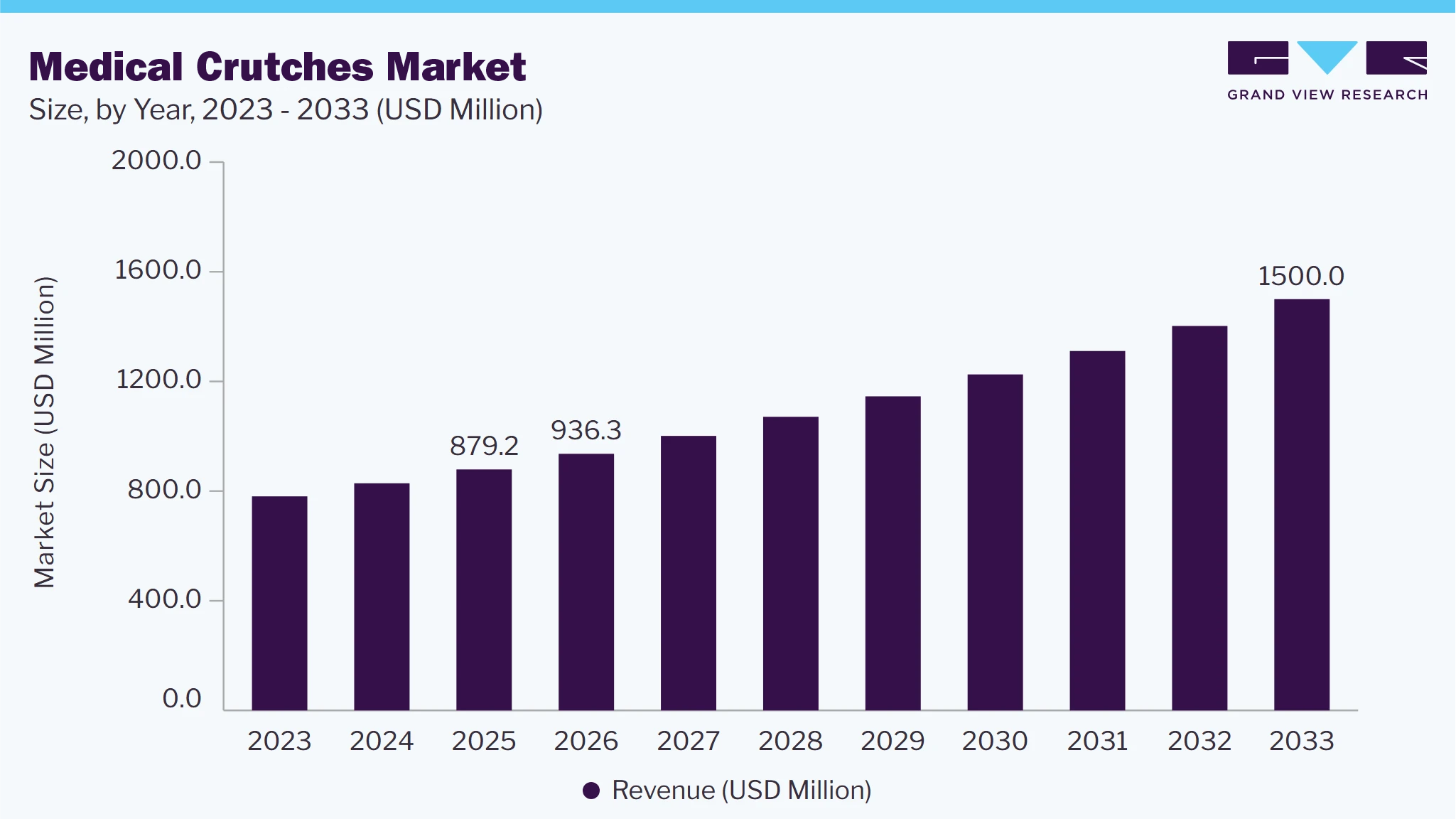 Source: Grand View Research, IR Documents, Primary Interviews, Paid DatabasesTo learn more about this report,
 Download Free Sample Report
The market is increasingly characterized by innovation focused on improving patient comfort, mobility, and rehabilitation outcomes. Manufacturers and research institutions are developing lightweight, ergonomic, and advanced mobility solutions that reduce physical strain while enhancing stability and walking efficiency. The growing emphasis on home-based recovery, post-operative rehabilitation, and independent mobility is encouraging the adoption of user-friendly crutch designs that support faster recovery and improved quality of life. In addition, advancements in materials science, biomechanics, and assistive technologies are driving the development of next-generation crutches with enhanced functionality and patient-centric features.
Furthermore, the market is witnessing advancements in crutch design and materials to improve patient comfort and mobility. Manufacturers are increasingly investing in ergonomic, lightweight, shock-absorbing crutches, which improve the user experience and enable longer use. In addition, the use of materials such as carbon fiber composites helps lower device weight and reduce user fatigue. Emerging smart crutches have sensors and monitoring capabilities that allow healthcare providers to track patient rehabilitation progress more effectively. These innovations promote the use of premium mobility aids and help market growth.
Market Dynamics
The rising number of osteoporosis and other bone-related disorders is driving the demand for medical crutches across the globe. As more people age and more musculoskeletal conditions arise, the need for mobility assistance devices, both temporary and long-term, is growing in healthcare settings. According to the U.S. Food and Drug Administration (FDA), about 10 million Americans have osteoporosis, a condition that reduces bone density and makes bones more fragile, increasing the risk of fractures. Women make up over 80% of osteoporosis cases in the U.S. In addition, the Bone Health and Osteoporosis Foundation estimates that one in two women and one in four men will suffer an osteoporosis-related bone fracture in their lifetime. The rising incidence of osteoporosis-related fractures and orthopedic injuries is likely to boost demand for rehabilitation and mobility support products, such as medical crutches, as patients seek effective ways to maintain mobility, aid recovery, and enhance their quality of life during the healing process.
The growing availability and use of alternative mobility devices constrain market growth. These include wheelchairs, walkers, knee scooters, and powered mobility aids. Crutches are often used for short-term support after injuries and surgeries, but they can cause discomfort, pressure under the arms, wrist strain, and fatigue when used for long periods. As a result, many patients, especially elderly individuals and those needing long-term support, prefer more stable and comfortable options that provide better balance and require less physical effort. In addition, advances in mobility technology and the rise of ergonomic devices are giving patients more choices for rehabilitation, potentially reducing the need for traditional medical crutches.
A major market opportunity is the growing adoption of smart, sensor-enabled mobility aids that offer real-time monitoring and analytics. As healthcare systems shift their focus to precise rehabilitation, post-operative recovery, and home care, there is a growing demand for crutches equipped with inertial measurement units (IMUs), motion sensors, and AI-driven algorithms to track and analyze patient walking patterns. These technologies allow for continuous mobility assessment, improve rehabilitation accuracy, and support safer, more personalized recovery pathways. For instance, a study in January 2026 developed a simple IMU-based system installed in the crutch hand grip that enables real-time detection of walking phases and steps without complex force-sensing equipment. The system uses deep learning techniques, with the Temporal Convolutional Network (TCN) achieving the best results in terms of accuracy and speed. Importantly, the solution reached a 94% success rate in step detection and worked well even for paralyzed users. This innovation highlights the growing potential for affordable, AI-enabled crutches that improve rehabilitation efficiency and broaden their use in assistive mobility.
Analyst Perspective
Market growth is driven by rising rates of orthopedic injuries and fractures, post-surgical rehabilitation needs, and age-related mobility issues. More cases of road accidents, sports injuries, and musculoskeletal conditions are also driving demand for mobility assistance devices. In addition, the growing preference for home recovery and outpatient care supports the adoption of lightweight, ergonomic, and adjustable crutch designs that enhance patient comfort and mobility. However, the market faces challenges such as product affordability in low-income areas, discomfort from long-term use, and competition from other mobility aids, such as walkers and wheelchairs. In this environment, manufacturers that focus on new material designs, improved ergonomics, and easy adjustability are well-positioned to meet demand across different patient groups.
Product Insights
The forearm crutch segment led the market, accounting for around 32.0% of revenue in 2025. The demand for forearm crutches is rising, as they offer greater comfort, mobility, and long-term usability than traditional mobility aids. Forearm crutches distribute body weight more effectively through the forearm and wrist. This reduces pressure on the underarm and lowers the risk of nerve compression. These factors make forearm crutches a good choice for patients with chronic mobility issues, neurological disorders, or long-term rehabilitation needs. Furthermore, more physiotherapists and healthcare providers are becoming aware of ergonomic assistive devices, which encourages the use of forearm crutches in rehabilitation programs.
The underarm crutches segment is anticipated to register the fastest CAGR of over 6.5% over the forecast period. The underarm crutches market is primarily driven by their widespread use for short-term mobility after fractures, orthopedic injuries, and surgeries. Underarm crutches are affordable, simple to use, and widely available in hospitals, emergency care centers, and rehabilitation facilities. This makes them the first option prescribed for those recovering from acute conditions. Their design helps patients quickly adjust to temporary mobility limitations without needing extensive training. In addition, the rising number of sports injuries, road accidents, and orthopedic surgeries globally is driving demand for underarm crutches.
Material Insights
The metal alloy segment accounted for the largest share, around 40.0%, in 2025. Based on type, the market is segmented into wood, metal alloy, carbon- or glass-fiber-reinforced composite, and others. Metal alloy crutches are inexpensive, lightweight, and durable, and are especially preferred by people who need them for long periods. This is expected to improve the adoption of these crutches among people with long-term disability or geriatrics. All these factors are improving the adoption of metal alloy crutches in the market.
The carbon- or glass-fiber-reinforced composite segment is expected to grow at the fastest CAGR of around 7.0%. These types of crutches are considered the strongest and lightest. These crutches are stronger than metal alloy crutches. These do not bend or break easily. They support over 140 kg. Owing to this reason, they can be easily used by people suffering from obesity. However, it is considered more expensive than metal. This is expected to affect its market share.
End Use Insights
The adult segment led the market with a maximum share of around 55.0% in 2025. Based on end-use, the market is segmented into children, adults, and others. Adults aged 18-64 years are a major part of the global population. A large proportion of people in this age group suffer from amputations, accidents, long-term disabilities, and short-term disabilities. The majority of surgeries are also conducted on people in this age group. These factors continue to propel high demand for medical crutches among adults.
The children segment is expected to grow at a CAGR of over 6.5% across the forecast period. A significant number of children worldwide have some form of disability. According to UNICEF, approximately 108 million children with disabilities live in the Asia and the Pacific region, contributing nearly half of the total 240 million children with disabilities across the globe. This large group of children with mobility issues is expected to significantly increase demand for assistive mobility solutions, including medical crutches for kids. The growing focus on early rehabilitation, inclusive healthcare systems, and pediatric orthopedic care is also driving the adoption of child-friendly crutches that enhance mobility, safety, and independence.
Regional Insights
North America is expected to witness the largest market share of around 35.0% in 2025. The medical crutches market in North America is fueled by the high rates of orthopedic injuries, fractures, and sports-related trauma, especially in the U.S. and Canada. A large, active population, along with widespread participation in sports and fitness activities, results in a consistent number of lower-limb injuries requiring temporary mobility support. In addition, the region’s strong healthcare system, significant healthcare spending, and good access to rehabilitation services help drive rapid adoption of mobility aids such as medical crutches. All these factors support the regional market growth.
 To learn more about this report, Download Free Sample Report
Asia Pacific Medical Crutches Market Trends
The medical crutches market in the Asia Pacific region is expected to grow at the fastest CAGR of over 7.0% during the forecast period. The growing population of the region and the high geriatric population are expected to increase the number of people with disabilities in the region. Moreover, the region suffers from a high accident rate. According to the Indian Ministry of Road Transport and Highway, the number of road accidents increased from 412,432 in 2021 to 487,705 in 2024. These accidents result in hundreds of thousands of road traffic injuries each year, requiring medical treatment and rehabilitation. The persistent burden of road traffic injuries is expected to support demand for forearm crutches and other mobility aids used during recovery. The high incidence of trauma-related injuries requiring orthopedic treatment and rehabilitation is expected to support demand for medical crutches across the region.
Key Medical Crutches Company Insights
Market players are undertaking various strategic initiatives, such as new product launches, partnerships, mergers and acquisitions, and geographic expansion, to strengthen their product portfolios and gain a competitive advantage.
-
In April 2026, Bioness Medical acquired the PoNS Neuromodulation System to expand its rehabilitation technology portfolio and strengthen its position in neurological mobility and gait recovery solutions. The acquisition reflects the growing trend of strategic expansion and innovation within the rehabilitation and assistive mobility industry.
-
In July 2024, Rebotics Technology introduced a new mobility support solution to improve the safety and usability of crutches and walking sticks. The newly launched Steets Crutch Parking Aid seeks to prevent accidental falls and injuries by making mobility aids more stable when not in use. This device has a wide, stable base that can be attached to most standard crutches and walking sticks, ensuring secure placement even on uneven surfaces. It also comes with a mounting kit for quick, easy retrofitting to existing devices, allowing users to park their crutches with one hand.
Key Medical Crutches Companies
The following key companies have been profiled for this study on the medical crutches market.
-
Sunrise Medical
-
Nova Medical Products
-
Millennial Medical
-
Medline Industries
-
Chinesport
-
IWALKFree
-
Cardinal Health
-
Home Medical Products
-
AMG Medical
-
Breg, Inc.
Medical Crutches Market Report Scope
Report Attribute
Details
Market size value in 2025
USD 879.2 million
Estimated market size in 2026
USD 936.3 million
Projected market size by 2033
USD 1,500 million
Growth rate
CAGR of 6.1% from 2026 to 2033
Historical data
2021 - 2025
Forecast period
2026 - 2033
Quantitative units
Revenue in USD million/billion, and CAGR from 2026 to 2033
Report coverage
Revenue forecast, company ranking, competitive landscape, growth factors, and trends
Segments covered
Product, material, end use, region
Regional scope
North America, Europe, Asia Pacific, Latin America, MEA
Country scope
U.S.; Canada; UK; Germany; France; Italy; Spain; Denmark; Sweden; Norway; Japan; China; India; Australia; South Korea; Thailand; Brazil; Mexico; Argentina; South Africa; Saudi Arabia; UAE; Kuwait
Key companies profiled
Sunrise Medical; Nova Medical Products; Millennial Medical; Medline Industries; Chinesport; IWALKFree; Cardinal Health; Home Medical Products; AMG Medical; Breg, Inc.
Customization scope
Free report customization (equivalent up to 8 analysts working days) with purchase. Addition or alteration to country, regional & segment scope.
Pricing and purchase options
Avail of customized purchase options to meet your exact research needs. Explore purchase options
Global Medical Crutches Market Report Segmentation
This report forecasts revenue growth at the regional and country levels and provides an analysis of the latest industry trends and opportunities in each of the sub-segments from 2021 to 2033. For this study, Grand View Research has segmented the global medical crutches market based on product, material, end use, and region:
 To learn more about this report, Download Free Sample Report
-
Product Outlook (Revenue, USD Million, 2021 - 2033)
-
Underarm Crutch
-
Forearm Crutch
-
Tetrapod Crutch
-
Leg Support Crutch
-
Others
-
-
Material Outlook (Revenue, USD Million, 2021 - 2033)
-
Wood
-
Metal Alloy
-
Carbon Or Glass Fiber Reinforced Composite
-
Others
-
-
End-use Outlook (Revenue, USD Million, 2021 - 2033)
-
Children
-
Adults
-
Others
-
-
Regional Outlook (Revenue, USD Million, 2021 - 2033)
-
North America
-
U.S.
-
Canada
-
-
Europe
-
U.K.
-
Germany
-
France
-
Italy
-
Spain
-
Denmark
-
Sweden
-
Norway
-
-
Asia Pacific
-
Japan
-
China
-
India
-
Australia
-
South Korea
-
Thailand
-
-
Latin America
-
Brazil
-
Mexico
-
Argentina
-
-
Middle East & Africa
-
South Africa
-
Saudi Arabia
-
UAE
-
Kuwait
-
-
Frequently Asked Questions About This Report
North America dominated with a 35.0% revenue share in 2025.
The global medical crutches market size was valued at USD 879.2 million in 2025 and is estimated at USD 936.3 million for 2026.
The global medical crutches market is expected to grow at a CAGR of 6.1% from 2026 to 2033, reaching USD 1,500.0 million.
Key players include Sunrise Medical; Nova Medical Products; Millennial Medical; Medline Industries; Chinesport; IWALKFree; Cardinal Health; Home Medical Products; AMG Medical; Breg, Inc.
Adult dominated the medical crutches market with a share of 55.0% in 2025.
About the Author(s)
Medical Devices Research Team
Healthcare · Medical DevicesThis report was authored by the medical devices research team at Grand View Research - comprising two research analysts, one senior research analyst, and one industry expert - with specialized expertise in the medical devices segment of the healthcare industry. All findings are based on proprietary healthcare databases, executive interviews, and regulatory analysis, subject to internal peer review prior to publication.
Last Updated:
Speak to Analyst

Customize this report to your needs - add regions, segments, or data points, with 20% free customization.
Or view our licence options:


ISO 9001:2015 & 27001:2022 Certified
We are GDPR and CCPA compliant! Your transaction & personal information is safe and secure. For more details, please read our privacy policy.


