
- Home
- »
- Plastics, Polymers & Resins
- »
-
Medical Packaging Films Market Size & Share Report, 2033GVR Report cover

Medical Packaging Films Market (2026 - 2033) Size, Share & Trends Analysis Report By Product (PE Films, PP Films, PET Films, PVC Films, Bioplastic Films), By Application (Bags & Pouches, Blister Packs, Medical Device Trays), By End Use, By Region, And Segment Forecasts
Market Size, 2025
$12.6BMarket Estimate, 2026
$13.2BMarket Forecast, 2033
$18.8BCAGR, 2026–2033
5.1%Medical Packaging Films Market Summary
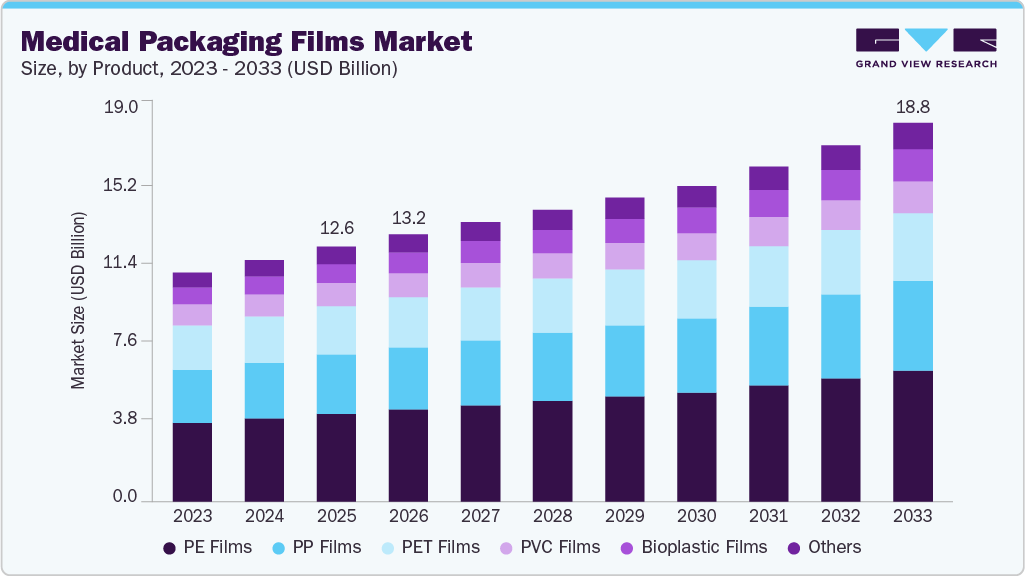
The global medical packaging films market size was valued at USD 12.6 billion in 2025 and is projected to grow from USD 13.2 billion in 2026 to USD 18.8 billion by 2033, at a CAGR of 5.1% from 2026 to 2033. Asia Pacific dominated the global medical packaging films market with the largest revenue share of 42.0% in 2025. Rising pharmaceutical and medical device production, driven by aging populations and the prevalence of chronic diseases, is increasing demand for high-barrier, sterile, and contamination-resistant medical packaging films.
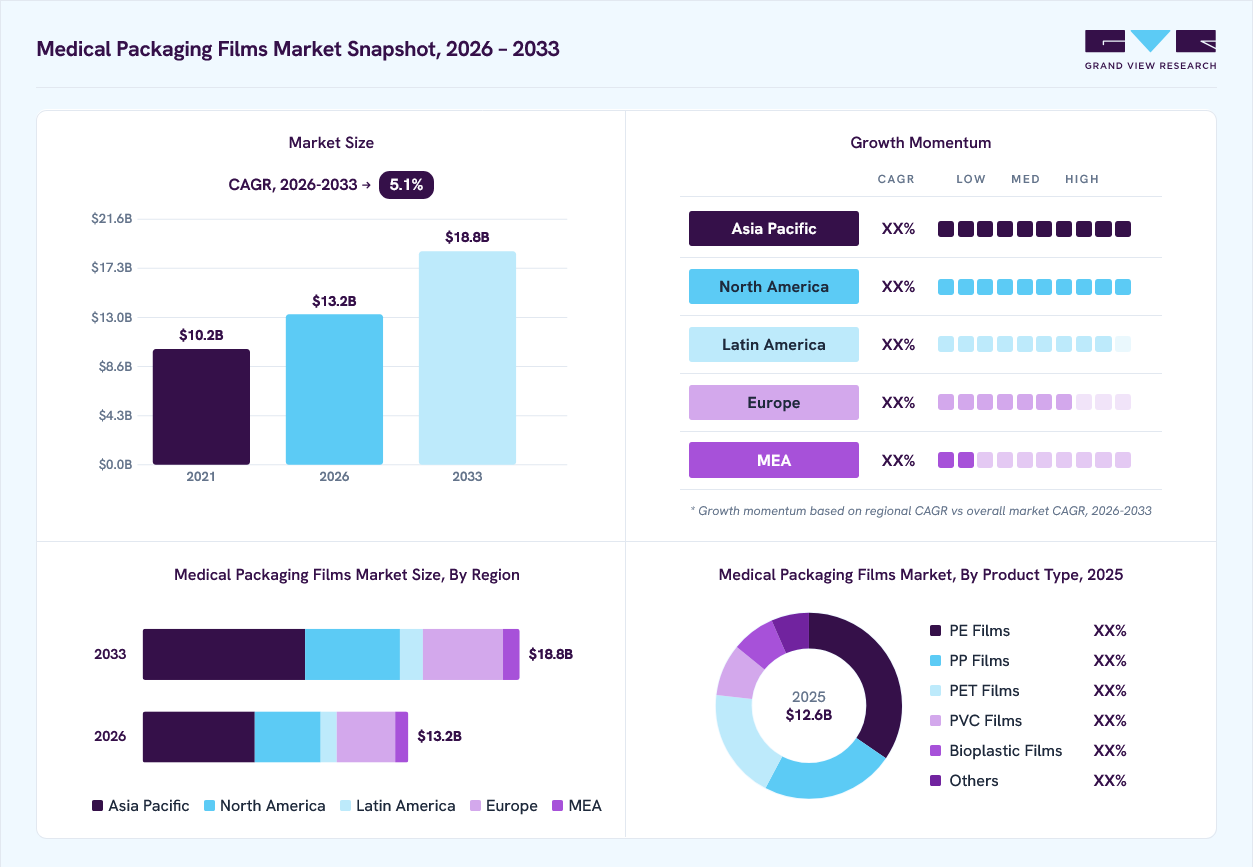 Source: Grand View Research, IR Documents, Primary Interviews, Paid DatabasesTo learn more about this report,
 Download Free Sample Report
Key Market Trends & Insights
- By product: PE films segment led the market with the largest revenue share of 34.4% in 2025.
- By application: Bags and pouches segment led the market with the largest revenue share of 37.7% in 2025.
- By end-use: Pharmaceutical manufacturers segment led the market with the largest revenue share of 35.7% in 2025.
Regional Highlights
- Largest regional market: Asia Pacific (42.0% revenue share, 2025)
- The medical packaging films industry in China accounted for the largest market revenue share in the Asia Pacific in 2025.
Market Size & Forecast
- Market size in 2025: USD 12.6 Billion
- Estimated market size in 2026: USD 13.2 Billion
- Projected market size by 2033: USD 18.8 Billion
- CAGR (2026-2033): 5.1%
Three ways to get this report
Buy it, customize it, or ask a question.Ask an Analyst
Analyst response in 1 business day
- AccessReport author, directly
- Reply timeWithin 1 working day
- No sales callDirect answer only
- FormatEmail reply
- CostFree, no cost
Get the Full Report
What the study covers
- FormatsPDF · Excel · Dashboard
- Timeline2026–2033 annual, 2025 base
- Coverage20+ countries, 5 regions
- Companies10+ key players profiled
Customize the Report
20% free customization
- IncludeCountries, segments, points
- TailorTo your product definition
- ExtendDeeper competitor detail
- OrA fully bespoke study
- Turnaround5–10 working days
Stricter regulatory requirements, growth in single-use medical products, and adoption of advanced multilayer and sustainable film technologies are further accelerating market expansion. Aging populations, increasing prevalence of chronic diseases, and higher surgical procedure rates are directly translating into greater demand for sterile, high-barrier packaging solutions. Medical films play a critical role in maintaining product integrity, sterility, and shelf life across applications such as blister packs, IV bags, wound care products, and diagnostic kits, making them indispensable as healthcare delivery scales in both developed and emerging markets.Regulatory emphasis on patient safety and contamination control is another major growth driver shaping the medical packaging films industry. Stringent standards imposed by regulatory bodies such as the FDA, EMA, and ISO require packaging materials to demonstrate high chemical resistance, puncture strength, seal integrity, and compatibility with sterilization methods, including ethylene oxide, gamma radiation, and steam. This regulatory pressure is accelerating the adoption of advanced multilayer and specialty films, including high-performance polyethylene, polypropylene, PET, and co-extruded structures, thereby increasing the value per unit of medical packaging films.
 To learn more about this report, Download Free Sample Report
Technological advancements in medical devices and pharmaceutical formulations are also fueling demand for sophisticated packaging films. The growing use of minimally invasive devices, combination drug-device products, and biologics requires packaging materials with precise barrier properties, transparency, and peelability. In addition, the shift toward home healthcare, self-administration devices, and point-of-care diagnostics is driving demand for lightweight, flexible, and user-friendly packaging formats, where medical films offer superior design flexibility compared to rigid alternatives.
Finally, sustainability and supply chain efficiency are emerging as influential demand drivers. Healthcare companies are increasingly seeking downgauged, recyclable, and mono-material film structures to meet environmental targets without compromising safety or compliance. At the same time, medical packaging films enable cost-effective high-speed manufacturing, reduced transportation weight, and improved inventory efficiency, which is particularly critical in a healthcare environment focused on cost containment and resilience. These economic and sustainability benefits are reinforcing the long-term adoption of medical packaging films across global healthcare value chains.
Market Dynamics
The increasing use of single-use medical devices, diagnostic kits, wound care products, syringes, catheters, surgical instruments, and drug delivery systems is driving demand for high-performance medical packaging films. These films are widely used in bags & pouches, blister packs, and medical device trays to protect products from moisture, oxygen, microbial contamination, puncture damage, and handling-related exposure. The growing preference for pre-sterilized, ready-to-use healthcare products is further strengthening the need for packaging films that can withstand sterilization processes while maintaining seal integrity, transparency, and product stability.
The expansion of home healthcare, point-of-care diagnostics, and self-administered therapies is also supporting market growth. Products used outside hospital environments require packaging that is lightweight, easy to open, tamper-evident, and capable of preserving sterility until final use. In addition, pharmaceutical manufacturers and medical device companies are increasingly adopting multilayer and high-barrier films to improve shelf life, reduce contamination risks, and comply with stringent quality standards. This is creating strong demand for PE films, PP films, PET films, PVC films, bioplastic films, and other specialty medical packaging films across healthcare applications.
Stringent regulatory requirements and long qualification cycles are expected to restrain market growth. Medical packaging films are used in critical healthcare applications where packaging failure can directly impact sterility, patient safety, drug stability, and device performance. As a result, any change in film structure, resin grade, supplier, coating, additive, or sealing process requires extensive validation, documentation, and customer approval. These requirements increase product development costs and limit the ability of manufacturers to quickly shift to alternative materials, especially in high-barrier, recyclable, or sustainable film formats.
Market Concentration & Characteristics
The medical packaging films industry is characterized by a value-over-volume pricing structure. Medical packaging films command higher margins compared to commodity flexible films due to stringent quality requirements, lower tolerance for defects, and the critical nature of end-use applications. Demand is relatively resilient to economic cycles, as healthcare consumption is non-discretionary. However, pricing is influenced by raw material volatility and the ability of suppliers to pass through costs while maintaining long-term contracts with healthcare customers.
 To learn more about this report, Download Free Sample Report
The medical packaging films industry operates within a highly integrated and risk-averse value chain. Close collaboration between resin suppliers, film extruders, converters, sterilization service providers, and end users is essential to ensure compliance and performance throughout the product lifecycle. Supply chain resilience, traceability, and geographic diversification have become increasingly important characteristics, particularly after recent global disruptions. As a result, scale, technical credibility, and regulatory expertise are key competitive advantages shaping industry structure and consolidation trends.
Product Insights
The PE films segment led the market with the largest revenue share of 34.4% in 2025, due to its excellent chemical resistance, sealability, and compatibility with multiple sterilization methods. Its versatility across applications such as pouches, bags, blister lidding, and medical device packaging supports widespread adoption. In addition, PE films offer a favorable balance of cost efficiency, processability, and regulatory acceptance, reinforcing their leading market position.
The bioplastic films segment is expected to register at the fastest CAGR of 6.7% during the forecast period, driven by increasing sustainability commitments across the healthcare value chain. Medical device and pharmaceutical companies are actively adopting bio-based and recyclable film solutions to meet regulatory, ESG, and corporate decarbonization targets. Advances in bio-based PE, PLA blends, and compostable barrier films that maintain medical-grade performance are accelerating adoption without compromising safety or compliance.
Application Insights
The bags and pouches segment led the market with the largest revenue share of 37.7% in 2025, supported by their extensive use in sterile medical devices, pharmaceutical products, and IV solutions. Their flexibility, strong barrier performance, and compatibility with multiple sterilization techniques make them a preferred packaging format. In addition, cost efficiency, ease of handling, and suitability for high-volume healthcare applications reinforced their dominant market position.
The blister packs segment is projected to grow at the fastest CAGR of 5.8% over the forecast period, driven by rising demand for unit-dose pharmaceutical packaging and enhanced product protection. Blister packs offer superior barrier properties, tamper evidence, and dosing accuracy, which are critical for patient safety and regulatory compliance. Increasing adoption in solid oral drugs, diagnostic kits, and home healthcare applications is further accelerating segment growth.
End Use Insights
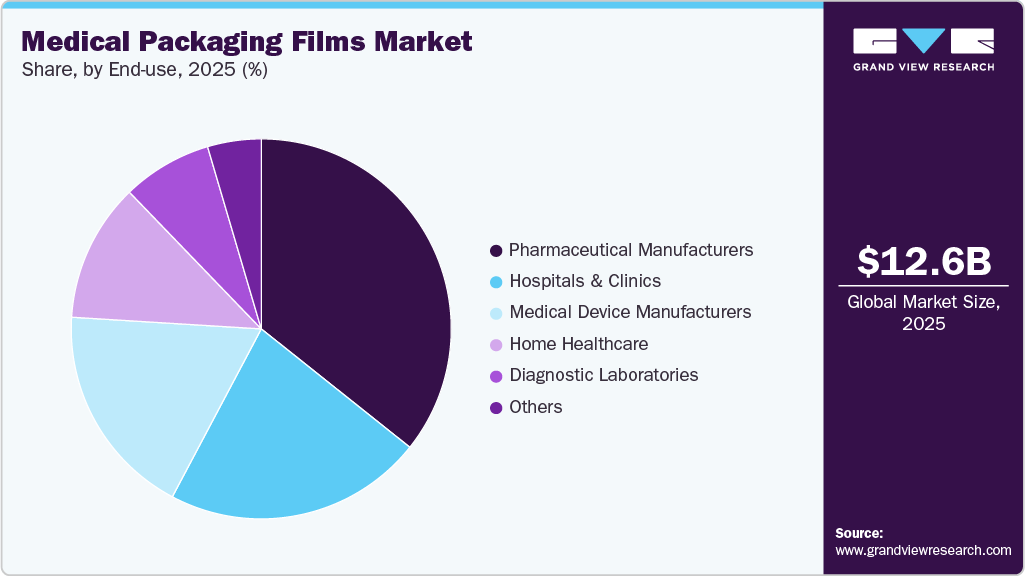
The pharmaceutical manufacturers segment led the market with the largest revenue share of 35.7% in 2025, due to high volumes of oral solids, injectables, and sterile formulations. Strict regulatory requirements for moisture, oxygen, and contamination protection drive sustained demand for high-performance film structures. In addition, growth in chronic therapies, generics, and contract pharmaceutical manufacturing continues to reinforce this segment’s leadership.
 To learn more about this report, Download Free Sample Report
The home healthcare segment is expected to register at the fastest CAGR of 5.7% over the forecast period, driven by the shift toward outpatient care, self-administered therapies, and remote patient monitoring. The growing use of disposable medical devices, diagnostic kits, and drug-delivery systems increases demand for lightweight, flexible, and user-friendly packaging films. Aging populations and cost pressures on hospital systems are further accelerating the adoption of home-based care solutions.
Regional Insights
The medical packaging films market in North America is a mature yet high-value region in the medical packaging films industry, driven by advanced healthcare infrastructure and strong demand for premium, compliant packaging solutions. The presence of leading pharmaceutical and medical device manufacturers, coupled with strict FDA and USP regulatory requirements, sustains demand for high-performance, multilayer, and specialty films. In addition, growth in biologics, combination devices, and home healthcare continues to support steady market expansion despite overall market maturity.
U.S. Medical Packaging Films Market Trends
The medical packaging films market in the U.S. represents the largest and most technologically advanced market for medical packaging films within North America, supported by its dominant pharmaceutical and medical device manufacturing base. Stringent FDA regulations and a strong focus on patient safety drive high demand for premium multilayer films with superior barrier properties, seal integrity, and sterilization compatibility. In addition, rapid growth in biologics, specialty drugs, and home healthcare products continues to reinforce the U.S. market’s high value and innovation-led demand profile.
Asia Pacific Medical Packaging Films Market Trends
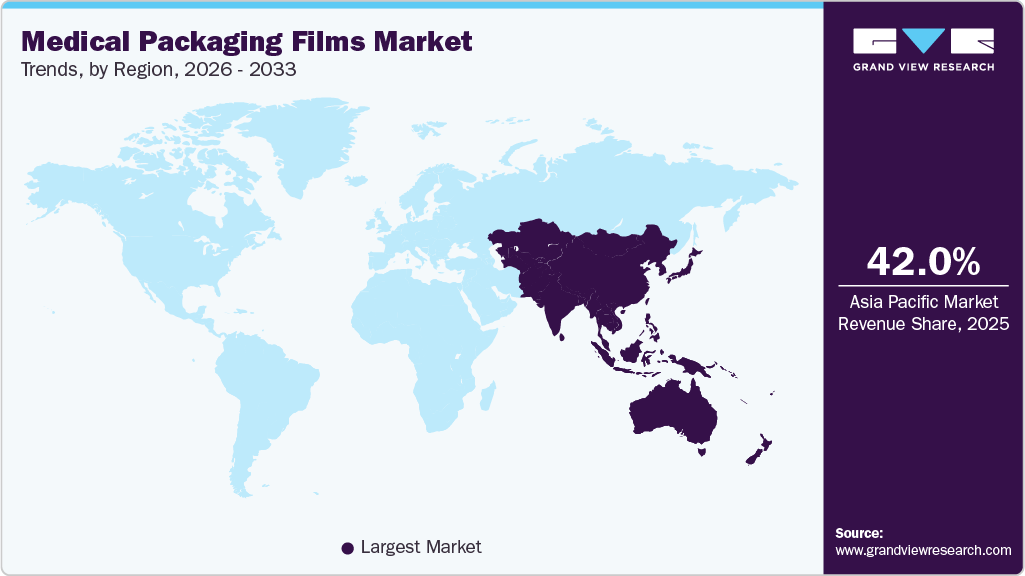
Asia Pacific dominated the global medical packaging films market with the largest revenue share in 42.0% in 2025 and is also expected to register at the fastest CAGR of 5.4% during the forecast period. This leadership is driven by expanding pharmaceutical manufacturing, rising healthcare expenditure, and strong growth in generic drugs and medical device production across China, India, and Southeast Asia. In addition, cost-competitive manufacturing, improving regulatory frameworks, and increasing demand for affordable healthcare packaging solutions continue to accelerate regional growth.
 To learn more about this report, Download Free Sample Report
The medical packaging films market in China accounted for the largest market revenue share in the Asia Pacific in 2025, driven by its massive pharmaceutical manufacturing base and rapidly expanding medical device sector. Strong government support for domestic drug production, rising exports of generics and APIs, and increasing demand for compliant primary packaging are fueling sustained consumption of high-barrier PE, PP, and multilayer films. In parallel, growing healthcare access, hospital expansion, and accelerated adoption of home healthcare and diagnostic products are strengthening China’s role as both a high-volume consumer and a strategic manufacturing hub for medical packaging films.
Europe Medical Packaging Films Market Trends
The medical packaging films market in Europe is a key value-driven industry, characterized by strict regulatory oversight under the EU MDR and a strong emphasis on patient safety and sustainability. The region’s well-established pharmaceutical and medical device industries in countries such as Germany, France, and Switzerland drive consistent demand for high-barrier and specialty film solutions. In parallel, the growing adoption of recyclable and mono-material packaging structures is shaping product innovation and reinforcing Europe’s role as a leader in compliant, sustainable medical packaging.
Key Medical Packaging Films Company Insights
The medical packaging films industry operates in a concentrated, highly regulated competitive environment, dominated by a mix of global packaging majors and specialized film manufacturers with strong technical and regulatory expertise. Competition is driven less by price and more by product performance, regulatory compliance, supply reliability, and long-term partnerships with pharmaceutical and medical device companies.
High entry barriers, lengthy qualification cycles, and strict change-control requirements limit new entrants and favor established players with validated manufacturing processes and global footprints. As a result, the market is characterized by stable customer relationships, selective innovation, and targeted M&A focused on expanding healthcare portfolios and advanced film capabilities.
Key Medical Packaging Films Companies:
The following key companies have been profiled for this study on the medical packaging films market.
- Amcor plc
- Sealed Air
- Klöckner Pentaplast
- UFlex Limited
- TOPPAN Inc.
- ACG
- Tekni-Plex, Inc.
- Neelam Global Pvt. Ltd.
- WEIFU Films
- DUNMORE
- SIGMA Medical Supplies Corp.
Competitive Benchmarking
Operating Strategies
Competitive Edge
Weakness
Mature Players: Amcor plc; Sealed Air; Klöckner Pentaplast; Tekni-Plex, Inc.; TOPPAN Inc.
- Leading companies are focusing on high-barrier films, sterile barrier packaging, recyclable healthcare packaging structures, and application-specific films for blister packs, bags & pouches, and medical device trays.
- Major players are strengthening partnerships with pharmaceutical and medical device manufacturers to support validated packaging solutions, long-term supply contracts, and regulatory-compliant film development.
- Mature players benefit from strong regulatory expertise, validated manufacturing systems, global supply networks, and established relationships with pharmaceutical and medical device companies.
- Broad product portfolios across PE, PP, PET, PVC, bioplastic, and multilayer films provide strong positioning across multiple healthcare packaging applications.
- Large companies face high production, validation, cleanroom manufacturing, and regulatory compliance costs.
- Material innovation cycles may be slower due to lengthy customer qualification and approval procedures, while dependence on petrochemical-based resins can expose companies to raw material price volatility.
Emerging Players: UFlex Limited; ACG; DUNMORE; WEIFU Films; Neelam Global Pvt. Ltd.; SIGMA Medical Supplies Corp.
- Emerging companies are focusing on customized films, cost-effective medical packaging solutions, and application-specific packaging for diagnostics, home healthcare, medical devices, and hospital supplies.
- Regional manufacturers are expanding capabilities to serve pharmaceutical and medical device customers located near key healthcare manufacturing clusters.
- Emerging players often provide greater flexibility in customization, faster regional responsiveness, and competitive pricing.
- Localized manufacturing and shorter lead times help improve customer service for regional pharmaceutical and healthcare packaging buyers.
- Emerging players may have limited global distribution capabilities and fewer validated relationships with multinational pharmaceutical and medical device companies.
- Lower regulatory support capabilities and limited certification infrastructure may restrict participation in high-value sterile barrier applications.
Recent Developments
-
In April 2025, Amcor plc completed construction of a cutting-edge coating facility for healthcare packaging in Selangor, Malaysia, marking a significant milestone as the first in Asia to utilize advanced air knife coating technology and to produce both top and bottom substrates for medical packaging. This state-of-the-art facility, integrated with Amcor’s existing healthcare packaging plant, enhances supply chain security, reduces lead times, and supports the growing demand for high-quality, sterile packaging in the Asia Pacific region.
-
In October 2024, Klöckner Pentaplast launched kpNext MDR1, a sustainable medical device packaging film that extends its kpNext brand from pharmaceutical blister films into the medical device sector. The film is recyclable in the RIC 1 stream and halogen-free, reinforcing the company’s commitment to sustainability and innovation in healthcare packaging.
-
In January 2024, Tekni-Plex, Inc. partnered with Alpek Polyester to launch the world’s first pharmaceutical-grade polyethylene terephthalate (PET) blister film featuring 30% post-consumer recycled (PCR) monomers. This innovative film, produced through a chemical recycling process that depolymerizes post-consumer plastic waste back into monomers and repolymerizes them into PET, matches the quality of virgin material and meets stringent pharmaceutical standards outlined in the U.S. and European Pharmacopoeias.
Medical Packaging Films Market Report Scope
Report Attribute
Details
Market size in 2026
USD 12.6 billion
Estimated market size in 2026
USD 13.2 billion
Projected market size by 2033
USD 18.8 billion
Growth rate
CAGR of 5.1% from 2026 to 2033
Base year for estimation
2025
Historical data
2021 - 2024
Forecast period
2026 - 2033
Quantitative units
Revenue in USD million/billion and CAGR from 2026 to 2033
Report coverage
Revenue forecast, company ranking, competitive landscape, growth factors, and trends
Segments covered
Product, application, end use, region
Regional scope
North America; Europe; Asia Pacific; Latin America; Middle East & Africa
Country scope
U.S.; Canada; Mexico; Germany; France; UK; Italy; Spain; China; India; Japan; Australia; South Korea; Brazil; Argentina; South Africa; Saudi Arabia; UAE
Key companies profiled
Amcor plc; Sealed Air; Klöckner Pentaplast; UFlex Limited; TOPPAN Inc.; ACG; Tekni-Plex, Inc.; Neelam Global Pvt. Ltd.; WEIFU Films; DUNMORE; SIGMA Medical Supplies Corp.
Customization scope
Free report customization (equivalent up to 8 analysts working days) with purchase. Addition or alteration to country, regional & segment scope.
Pricing and purchase options
Avail of customized purchase options to meet your exact research needs. Explore purchase options
Global Medical Packaging Films Market Report Segmentation
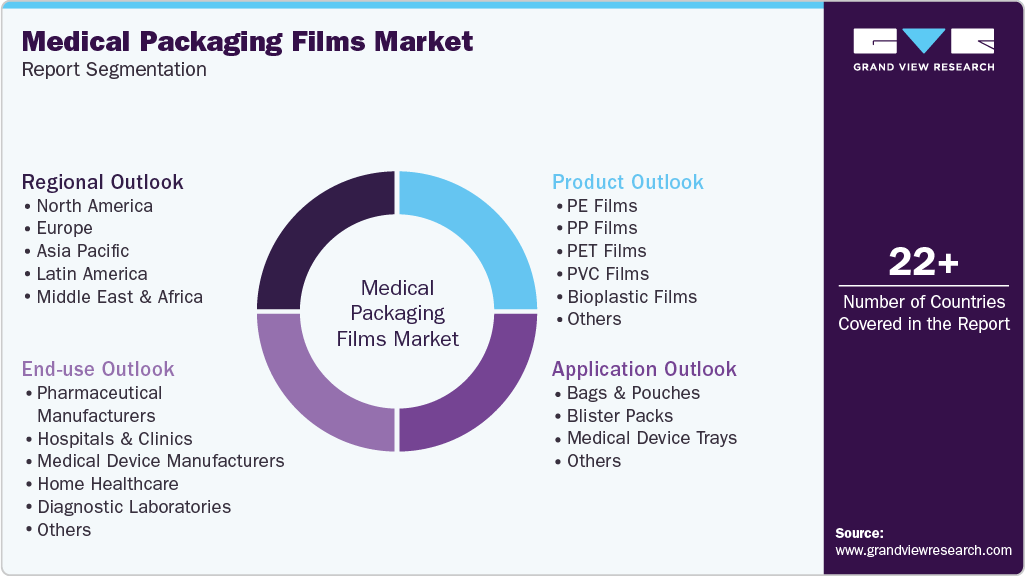
This report forecasts revenue growth at the regional, and country levels and provides an analysis on the latest industry trends and opportunities in each of the sub-segments from 2021 to 2033. For this study, Grand View Research has segmented the global medical packaging films market report based on the product, application, end use, and region:
 To learn more about this report, Download Free Sample Report
-
Product Outlook (Revenue, USD Million, 2021 - 2033)
-
PE Films
-
PP Films
-
PET Films
-
PVC Films
-
Bioplastic Films
-
Others
-
-
Application Outlook (Revenue, USD Million, 2021 - 2033)
-
Bags & Pouches
-
Blister Packs
-
Medical Device Trays
-
Others
-
-
End Use Outlook (Revenue, USD Million, 2021 - 2033)
-
Pharmaceutical Manufacturers
-
Hospitals & Clinics
-
Medical Device Manufacturers
-
Home Healthcare
-
Diagnostic Laboratories
-
Others
-
-
Regional Outlook (Revenue, USD Million, 2021 - 2033)
-
North America
-
U.S.
-
Canada
-
Mexico
-
-
Europe
-
Germany
-
France
-
UK
-
Italy
-
Spain
-
-
Asia Pacific
-
China
-
India
-
Japan
-
South Korea
-
Australia
-
-
Latin America
-
Brazil
-
Argentina
-
-
Middle East & Africa
-
Saudi Arabia
-
UAE
-
South Africa
-
-
Delivered Customizations
This report has been delivered with the following In-depth customizations
Client Request
Customization Delivered
Value Adds
Product-Application Cross-Segmentation
Detailed cross-segmentation of medical packaging films by product and application, covering PE films, PP films, PET films, PVC films, bioplastic films, and other specialty films across bags & pouches, blister packs, medical device trays, and other healthcare packaging applications.
Helps identify which film types are most suitable for specific healthcare packaging formats. Supports product portfolio planning, material selection, and prioritization of high-demand applications such as blister packaging, sterile pouches, and tray lidding films.
End-use Opportunity Assessment
Assessment of demand across pharmaceutical manufacturers, medical device manufacturers, hospitals & clinics, home healthcare, diagnostic laboratories, and other healthcare end users. The customization evaluates usage patterns, packaging performance requirements, sterility needs, and adoption potential across each end-use category.
Enables clients to identify high-potential customer groups and application areas. Supports targeted sales strategy, customer prioritization, and opportunity mapping across pharmaceuticals, diagnostics, home healthcare, and medical device packaging.
Competitive Benchmarking
Benchmarking of key medical packaging films companies based on product portfolio, material capabilities, sterile barrier packaging solutions, healthcare packaging certifications, sustainability initiatives, manufacturing footprint, application focus, and recent strategic developments.
Supports competitor tracking, supplier evaluation, and strategic positioning. Helps identify innovation gaps, partnership opportunities, sustainability-led differentiation areas, and potential target companies for procurement or collaboration.
Frequently Asked Questions About This Report
Asia Pacific dominated with the largest revenue share in 42.0% in 2025
The global medical packaging films market was estimated at around USD 12.6 billion in the year 2025 and is expected to reach around USD 13.2 million in 2026.
The key players in the medical packaging films market include Amcor plc; Sealed Air; Klöckner Pentaplast; UFlex Limited; TOPPAN Inc.; ACG; Tekni-Plex, Inc.; Neelam Global Pvt. Ltd.; WEIFU Films; DUNMORE; and SIGMA Medical Supplies Corp.
The medical packaging films industry is primarily driven by the sustained expansion of the global healthcare sector, particularly the rising volume of medical devices, pharmaceuticals, and diagnostic consumables.
The PE films segment led the market with the largest revenue share of 34.4% in 2025, while bioplastic films is the fastest-growing segment
Bags and pouches held the largest revenue share of 37.7% in 2025, while blister packs is the fastest-growing segment
The global medical packaging films market is expected to grow at a compound annual growth rate of 5.1% from 2026 to 2033 to reach around USD 18.8 million by 2033.
The pharmaceutical manufacturers segment dominated the medical packaging films market with the largest revenue share of 35.7% in 2025, due to the high volume production of solid, liquid, and injectable drugs requiring strict moisture, oxygen, and contamination protection.
About the Author(s)
Plastics, Polymers & Resins Research Team
Bulk Chemicals · Plastics, Polymers & ResinsThis report was authored by the plastics, polymers & resins research team at Grand View Research - comprising two research analysts, one senior research analyst, and one industry expert - with specialized expertise in the plastics, polymers & resins segment of the bulk chemicals industry. All findings are based on proprietary bulk chemicals databases, executive interviews, and regulatory analysis, subject to internal peer review prior to publication.
Last Updated:
Speak to Analyst

Customize this report to your needs - add regions, segments, or data points, with 20% free customization.
Or view our licence options:


ISO 9001:2015 & 27001:2022 Certified
We are GDPR and CCPA compliant! Your transaction & personal information is safe and secure. For more details, please read our privacy policy.


