
- Home
- »
- Next Generation Technologies
- »
-
Metadata Management Tools Market Size Report, 2026-2033GVR Report cover

Metadata Management Tools Market (2026 - 2033)
Size, Share & Trends Analysis Report By Metadata Type (Business Metadata, Technical Metadata, Operational Metadata), By Deployment (On-Premises, Cloud), By Application, By End Use, By Region, And Segment Forecasts
Market Size, 2025
$14.1BMarket Estimate, 2026
$17.0BMarket Forecast, 2033
$65.2BCAGR, 2026–2033
21.1%Metadata Management Tools Market Summary
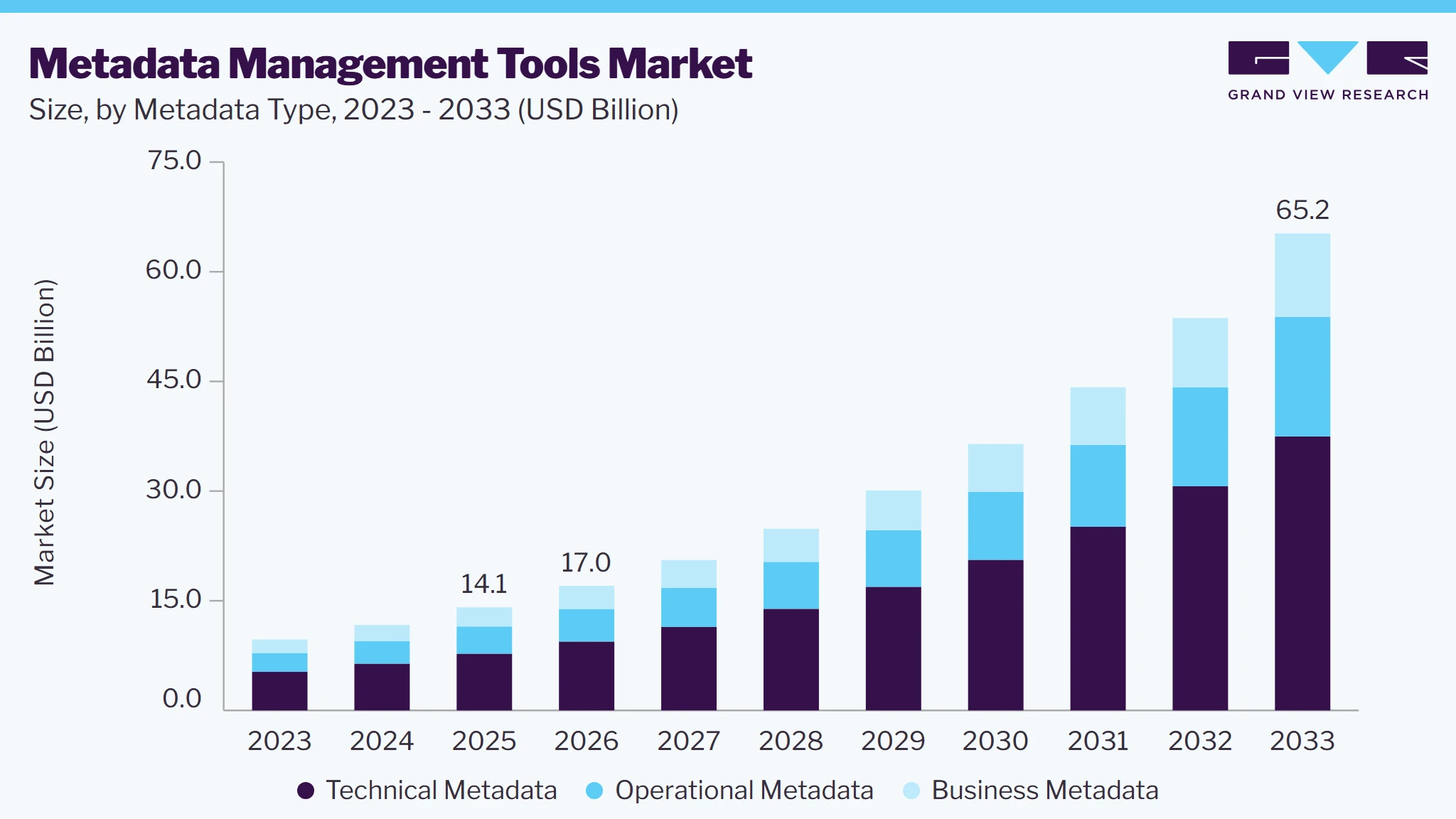
The global metadata management tools market size was valued at USD 14.1 billion in 2025 and is projected to grow from USD 17.0 billion in 2026 to USD 65.2 billion by 2033, at a CAGR of 21.1% from 2026 to 2033. North America dominated the global market with the largest revenue share of 34.3% in 2025. The market is driven by the integration of AI-powered metadata discovery and automated data lineage capabilities to reduce manual data governance efforts and improve data intelligence.
 Source: Grand View Research, IR Documents, Primary Interviews, Paid DatabasesTo learn more about this report,
 Download Free Sample Report
Key Market Trends & Insights
- By metadata type: Technical metadata segment dominated the market, with a revenue share of 55.0% in 2025.
- By deployment: Cloud segment held the largest market share of 62.5% in 2025.
- By application: Data governance segment dominated the market, with a revenue share of 41.7% in 2025.
- By end-user: BFSI segment held the largest market share of 23.3% in 2025.
Regional Highlights
- Largest regional market: North America (34.3% revenue share, 2025)
- Fastest-growing regional market: Asia Pacific (highest CAGR, 2026-2033)
- By country: The U.S. held the largest market share in 2025
Market Size & Forecast
- Market size in 2025: USD 14.1 Billion
- Estimated market size in 2026: USD 17.0 Billion
- Projected market size by 2033: USD 65.2 Billion
- CAGR (2026-2033): 21.1%
Three ways to get this report
Buy it, customize it, or ask a question.Ask an Analyst
Analyst response in 1 business day
- AccessReport author, directly
- Reply timeWithin 1 working day
- No sales callDirect answer only
- FormatEmail reply
- CostFree, no cost
Get the Full Report
What the study covers
- FormatsPDF · Excel · Dashboard
- Timeline2026–2033 annual, 2025 base
- Coverage20+ countries, 5 regions
- Companies10+ key players profiled
Customize the Report
20% free customization
- IncludeCountries, segments, points
- TailorTo your product definition
- ExtendDeeper competitor detail
- OrA fully bespoke study
- Turnaround5–10 working days
The increasing necessity for centralized data administration, the growing value of metadata management in data security, and the growing requirement for greater data quality and trustworthy analytics are the primary factors driving the market growth.Furthermore, the implementation of metadata management tools and applications is likely to be driven by sales volume increase for SMEs in a variety of industries across the globe.
 To learn more about this report, Download Free Sample Report
Metadata increases the usefulness and discoverability of data, hence increasing its worth. It's easier to discover and use data while using metadata management and giving business and IT teams the required and important data context. In the developed countries from North America and Europe, metadata management tools have seen a rise in implementation as they serve variety of purposes, such as information retrieval and strict non-compliance fines on the violation of any private information that may be internal or external to the company. The increasing adoption of metadata management tools across retail, industrial, IT & telecommunication, and BFSI industry verticals is fostering market expansion. Many firms have spent a lot of time and money developing Data Warehouse projects that use tools to collect, load, and convert data into useful information for end uses all around the company.
Most businesses have already adopted cloud-based metadata management tools for storing their data in the cloud and it is more used in organizations because they are easily available and scalable. Metadata is managed independently of actual files in the cloud-based metadata management.
The metadata management tools industry also faces challenges like the selection of poor technology, costly implementation of tools and maintenance, missing metadata relationships, and applications built by Non-Metadata Professionals. The volume of data is also a big challenge as the tools must be able to manage large amounts of data effectively with the data being increased. Security and privacy is also a huge concern that needs to be handled, tools must be able to ensure that the data is protected and remains confidential.
Market Dynamics
The growing volume of structured and unstructured enterprise data across cloud platforms, AI applications, and hybrid IT environments is driving demand for metadata management tools that improve data discovery, governance, lineage, and quality. Organizations are increasingly adopting these platforms to establish consistent data definitions, simplify regulatory compliance, and enable trusted analytics across business functions. The rising use of data fabrics, data catalogs, and self-service analytics further increases the need for centralized metadata management.
Organizations are generating unprecedented volumes of structured, semi-structured, and unstructured data from cloud applications, IoT devices, enterprise software, and digital business processes. As data becomes distributed across hybrid and multi-cloud environments, maintaining consistent visibility, classification, and relationships between datasets has become increasingly challenging. Metadata management tools provide a centralized framework to organize, discover, and track data assets across these diverse environments, improving accessibility and operational efficiency.
The growing complexity of enterprise data ecosystems has also increased the need for automated metadata discovery, data lineage, and cataloging capabilities. These tools enable organizations to understand data origins, monitor data movement, and support reliable analytics while reducing manual data management efforts. As businesses continue expanding their digital operations, metadata management platforms have become essential for maintaining trusted, well-governed, and easily accessible enterprise data.
Many organizations operate a combination of legacy systems, on-premises databases, cloud platforms, and SaaS applications, making metadata integration a complex process. Differences in data formats, architectures, and proprietary technologies often require extensive customization to establish a unified metadata repository. These integration challenges increase deployment timelines and implementation costs, particularly for large enterprises with highly fragmented IT environments.
As organizations continue expanding their hybrid and multi-cloud strategies, maintaining consistent metadata across distributed systems becomes more difficult. Frequent infrastructure updates and the addition of new data sources require continuous synchronization and governance, increasing operational complexity. These factors can slow adoption, especially among organizations with limited technical resources or highly customized legacy infrastructure.
The rapid adoption of artificial intelligence across enterprise data ecosystems is creating significant opportunities for metadata management tool providers. AI-powered metadata automation enables organizations to classify data assets, identify relationships, generate business glossaries, and maintain data lineage with minimal manual intervention. This improves governance efficiency while reducing operational complexity in large-scale data environments.
As enterprises manage increasing volumes of distributed data, intelligent metadata capabilities support faster data discovery, higher data quality, and more accurate compliance reporting. Organizations are also embedding AI-driven governance into data catalogs and analytics platforms to enhance trust in business insights and accelerate data-driven decision-making across departments.
Market Concentration & Characteristics
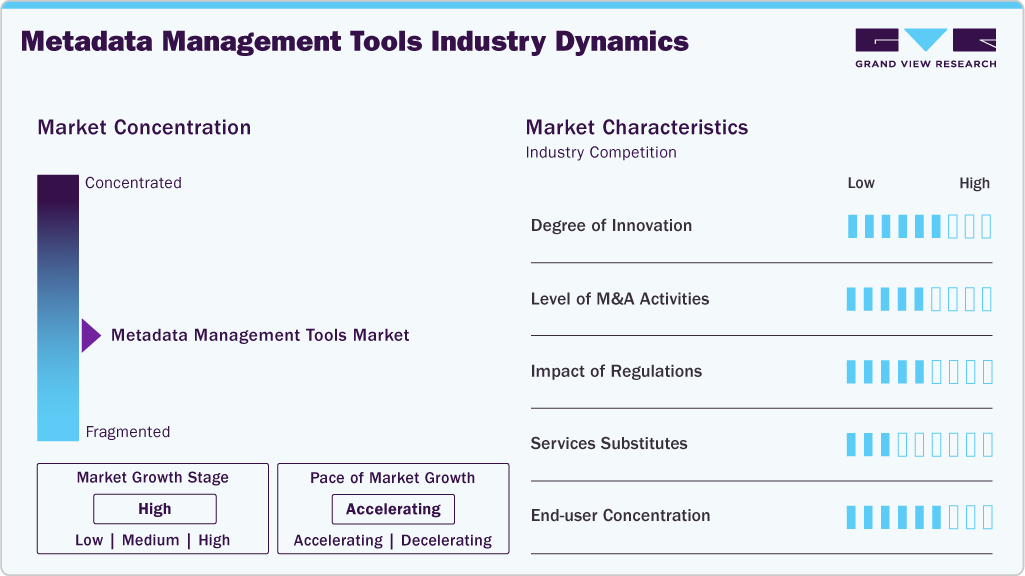
Innovation remains a defining characteristic of the market as vendors continue to introduce AI-powered metadata discovery, automated classification, intelligent data lineage, and semantic search capabilities. The growing adoption of data fabric, data mesh, and generative AI has accelerated investment in advanced metadata technologies that improve governance and data accessibility. Providers are also integrating machine learning to automate metadata enrichment and improve data quality management. These developments enable enterprises to manage increasingly complex and distributed data environments more efficiently.
 To learn more about this report, Download Free Sample Report
Regulatory requirements have a significant influence on the adoption of metadata management tools, particularly as organizations comply with data privacy, security, and governance regulations across multiple regions. Metadata platforms support data lineage, auditability, policy enforcement, and data classification, helping enterprises demonstrate compliance and improve data transparency. Increasing regulatory scrutiny surrounding AI governance and cross-border data management further reinforces investment in metadata solutions. As compliance obligations become more complex, enterprises are prioritizing centralized metadata governance frameworks.
Analyst Perspective
The metadata management tools market is entering a phase where enterprise data complexity, rather than data volume alone, is becoming the primary catalyst for investment. The rapid expansion of hybrid cloud environments, AI-driven applications, and distributed data ecosystems has elevated metadata from a supporting IT function to a strategic enterprise asset that enables trusted analytics, governance, and regulatory compliance. The strongest competitive advantage is likely to belong to vendors that unify metadata cataloging, data lineage, governance, quality, and AI-driven discovery within a single intelligent platform, reducing operational silos and improving enterprise-wide data visibility. As organizations increasingly rely on AI and automated decision-making, metadata management tools are evolving into the foundational intelligence layer that supports scalable data governance and long-term digital transformation.
Metadata Types Insights
Based on metadata type, the technical metadata segment led the market with the largest revenue share of 55.0% in 2025 and is expected to grow at the fastest CAGR over the forecast period. The segment is also projected to lead in terms of growth rate owing to the significant implementation of data governance and management. Technical metadata refers to physical characteristics that aid in the loading of information from primary articles and technical attributes that are important for the presentation of data. It involves structural information like foreign key attributes, and its primary focus is on organizing the various data sources and their attributes, including data source, location, credentials, mapping, etc. Some of examples of technical metadata include physical database tables, backup rules, access permission, mapping documentation, and many more.
The operational metadata segment is also expected to witness at a prominent CAGR during the forecast period, owing to substantial applications in the retail and logistics industry. Operational metadata handles data generation and management processes, as well as proper data measurement and analysis. Some examples of operational metadata include audit results, error logs, archive and retention rules, job execution logs, etc.
Deployment Insights
Based on deployment, the cloud segment led the market with the largest revenue share of 62.5% in 2025 and is expected to grow at the fastest CAGR over the forecast period. The developments in cloud computing have transformed and enabled the creation of cloud-based metadata management Applications. In Asia Pacific, the cloud segment is projected to witness at a prominent CAGR over the forecast period. In 2024, the segment acquired the leading market revenue share in North America, ascending the growth of cloud-based applications in the region.
The capability of cloud-based solutions to handle large data sets along with providing an improved experience has promoted several companies to choose cloud-based deployment over On-Premises. Since most enterprises don’t have the networks and infrastructure capable of handling large datasets, there is a huge demand for cloud-based deployment in the global market.
Application Insights
Based on application, the data governance segment led the market with the largest revenue share of 41.7% in 2025 and is expected to grow at the fastest CAGR over the forecast period. Data governance plays a prominent role in data management strategy. It includes a governing body, a set of standards and policies, and a plan to implement those standards and policies by making sure that data standards and policies are created and implemented consistently across the organization. Data governance is witnessing increased adoption in industries like government, healthcare, and finance.
The product and process management segment is expected to witness at a substantial CAGR during the forecast period. It is implemented by the companies for storing and managing all related information of a product and processes. The information includes information ranging from raw materials to constructing the product including the data required across several business processes from design to marketing. An ideal product and process data management system is accessible by multiple applications and teams across an organization and supports business-specific needs.
End Use Insights
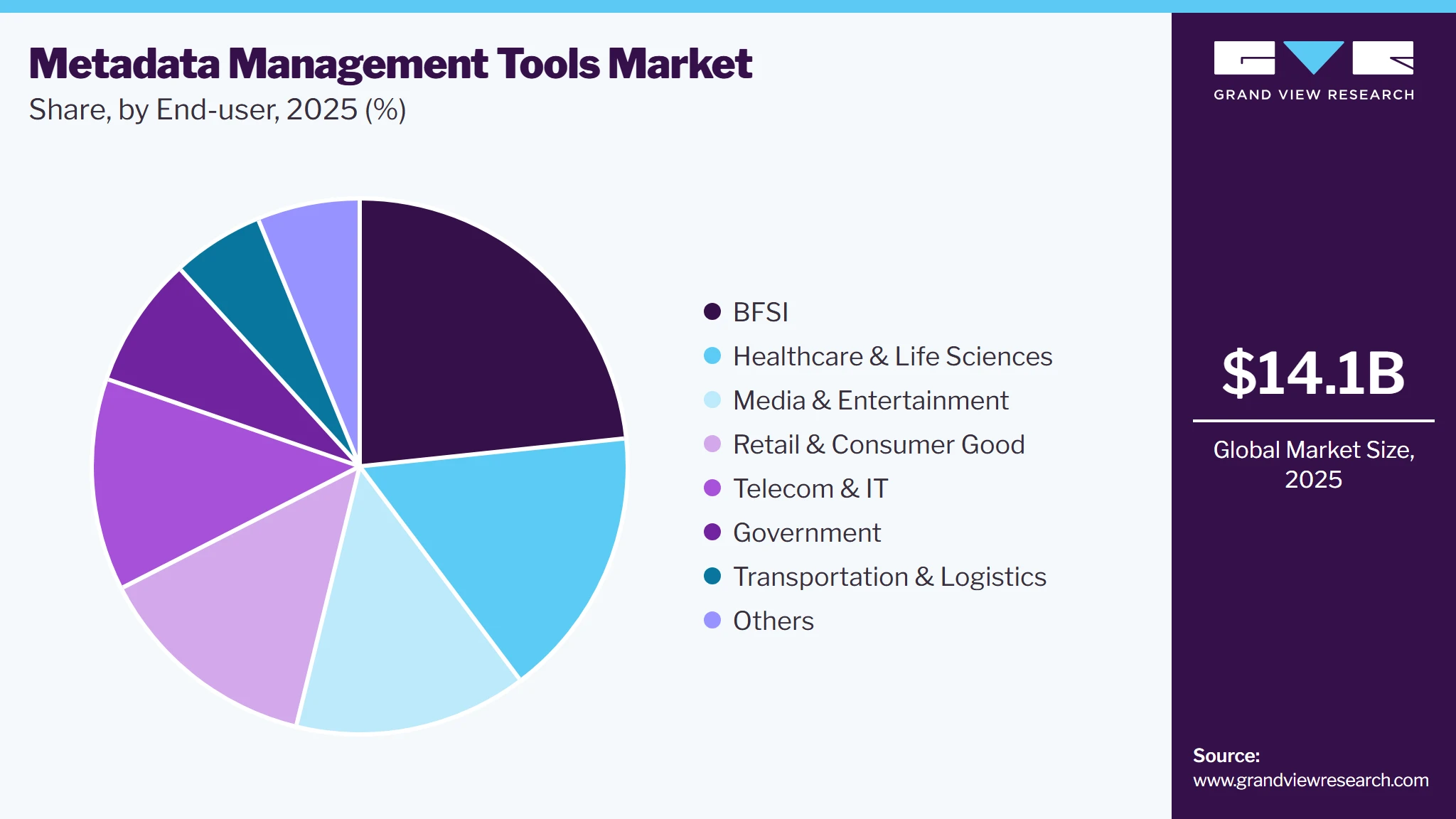
Based on end-user, the BFSI segment led the market with the largest revenue share of 23.3% in 2025 and is expected to grow at a significant CAGR over the forecast period. BFSI industries use metadata management tools for improved customer experience in the market. The increasing prominence of cloud-based metadata management tools helps in easy deployment and reduced operational costs for businesses.
 To learn more about this report, Download Free Sample Report
The media & entertainment segment is anticipated to witness at a substantial CAGR during the forecast period. Vendors are focusing on data enrichment, automated reporting, analyzing, metadata insights, etc., for improved customer experience and operations. Moreover, the rising number of client dealings outside of the branch through various channels, including mobile, web, chat, and social media, is expected to drive the adoption of corporate metadata management tools.
Regional Insights
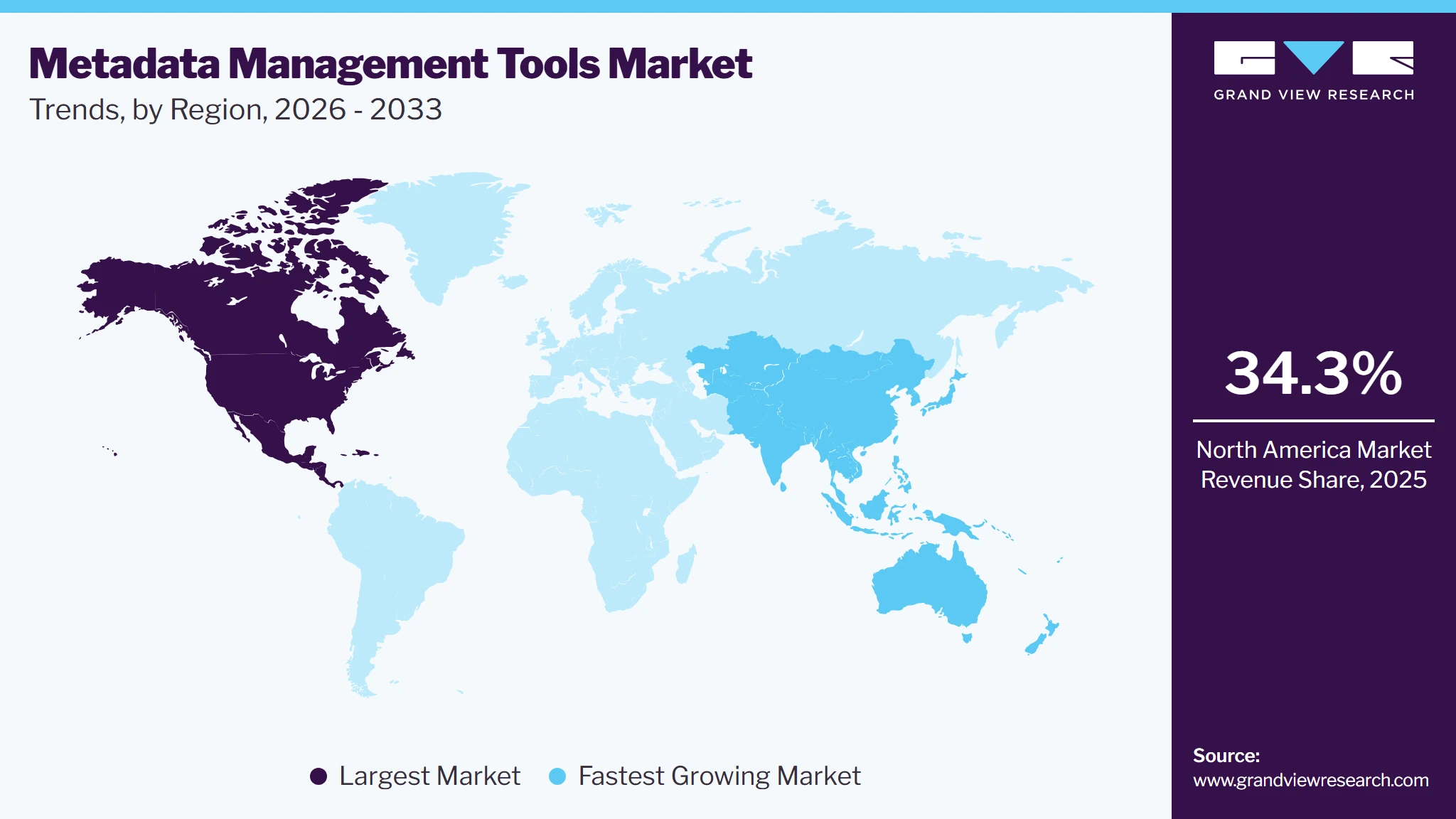
North America dominated the metadata management tools market with the largest revenue share of 34.3% in 2025. The leading share is attributable to the prevalence of the majority of the organizations and vendors, with extensive operations and client base, in North America. In addition, being early adopters of technology along with the established economic structures, the region has witnessed extensive implementation of cloud-based security Applications, primarily among large businesses.
 To learn more about this report, Download Free Sample Report
U.S. Metadata Management Tools Market Trends
The metadata management tools market in the U.S. held the largest share in the North America region in 2025, organizations are prioritizing data governance to ensure compliance with regulations like GDPR and CCPA. This drives demand for robust metadata management tools that facilitate data lineage, data quality, and regulatory reporting. Moreover, the significant integration of AI and ML is augmenting the market expansion in the U.S. Tools that leverage AI and ML for automated metadata tagging, data discovery, and classification are gaining traction. These technologies help organizations efficiently manage and utilize their data assets.
Europe Metadata Management Tools Market Trends
The metadata management tools market in Europe is also growing. As in Europe, the growth of metadata management tools is largely driven by the increasing emphasis on data governance and compliance with stringent regulations such as the General Data Protection Regulation (GDPR). Organizations are prioritizing tools that enhance data lineage, quality, and accessibility to ensure adherence to these regulations. In addition, European organizations are focusing on collaboration features that enable cross-departmental cooperation on data initiatives, thereby enhancing productivity. The demand for robust data catalogs is also increasing, as organizations look to create comprehensive inventories of their data assets for better usability.
Asia Pacific Metadata Management Tools Market Trends
The metadata management tools market in Asia Pacific is anticipated to grow at the fastest CAGR of 22.7% from 2025 to 2030. In the Asia-Pacific region, the growth of metadata management tools is significantly influenced by the rapid digital transformation and data-driven initiatives undertaken by businesses. Organizations are increasingly recognizing the importance of effective metadata management to navigate the complexities of diverse data sources and ensure compliance with evolving local regulations, such as the Personal Data Protection Act (PDPA) in several countries. The data governance Deployments and management are considered as highly effective by most of the organizations.
Key Metadata Management Tools Company Insights
Some of the key companies in the global market include Collibra, IBM, Microsoft, Oracle, SAP; ASG Technologies, Informatica, Adaptive, Cambridge Semantics; Data Advantage Group; and others. Organizations are prioritizing the expansion of their customer base to secure a competitive advantage in the industry. As a result, key players are implementing various strategic initiatives, including mergers and acquisitions, as well as forming partnerships with other major companies.
-
IBM stands out as a comprehensive technology provider with a rich history of innovation and a strong commitment to helping organizations leverage technology for business transformation. Its diverse offerings in cloud computing, AI, and consulting services position it as a key player in the global technology landscape. IBM is actively engaged in research related to metadata management, focusing on enhancing capabilities like metadata discovery, enrichment, governance, and lineage tracking. The company aims to improve how organizations utilize metadata for better decision-making and compliance
-
SAP is a global leader in enterprise software, recognized for its comprehensive suite of solutions that support various business functions, including finance, supply chain, and human resources. In the realm of metadata management, SAP offers several specialized tools designed to help organizations effectively manage their data assets
Key Metadata Management Tools Companies:
The following key companies have been profiled for this study on the metadata management tools Market.
-
IBM
-
Oracle
-
SAP
-
ASG Technologies
-
Adaptive
-
Cambridge Semantics
-
Data Advantage Group
-
Erwin
-
Alex Deployments
-
Natuvion
-
Immuta
-
CentricMinds
-
Syniti
Competitive Benchmarking
Category
Operating Strategies
Competitive Edge
Weakness
Established Players (IBM; Oracle; SAP; ASG Technologies; Erwin; Adaptive; Syniti)
- Focus on delivering integrated metadata management platforms as part of broader enterprise data management and governance portfolios.
- Expand capabilities through AI-driven automation, cloud integration, strategic partnerships, and continuous product enhancements.
- Strong enterprise customer base with comprehensive product ecosystems supporting governance, lineage, cataloging, and compliance.
- Extensive implementation expertise, global service networks, and seamless integration with enterprise IT environments.
- Higher implementation costs and longer deployment cycles compared to lightweight cloud-native solutions.
- Legacy architectures may reduce flexibility for organizations seeking highly customized or agile deployments.
Emerging Players (Cambridge Semantics; Data Advantage Group; Alex Deployments; Natuvion; Immuta; CentricMinds)
- Focus on specialized metadata management capabilities such as AI-driven discovery, privacy governance, semantic knowledge graphs, and cloud-native deployments.
- Target niche enterprise requirements through flexible SaaS offerings and rapid product innovation.
- Faster product innovation with modern architectures designed for hybrid and multi-cloud environments.
- Greater flexibility, shorter implementation timelines, and specialized functionality for evolving data governance needs.
- Limited global market presence and smaller enterprise customer base compared to established vendors.
- Lower investment capacity and partner ecosystems may restrict expansion into large-scale enterprise deployments.
Recent Developments
-
In June 2024, Immuta, the data security specialists, today unveiled new data governance and audit features for Retrieval Augmented Generation (RAG)-based GenAI solutions across various cloud platforms. This release positions Immuta as the first to offer a multi-layer architecture designed to secure, monitor, and audit sensitive data accessed by RAG-based AI applications
-
In March 2024, SAP has unveiled the SAP Datasphere solution, the latest addition to its data management portfolio, designed to provide customers with easy access to business-ready data across their data landscape. Additionally, SAP announced strategic partnerships with leading data and AI companies-Collibra NV, Confluent Inc., Databricks Inc., and DataRobot Inc.-to enhance SAP Datasphere. These collaborations will enable organizations to develop a unified data architecture that securely integrates data from both SAP software and non-SAP sources
-
In September 2024 HCLBusiness Metadata, the software division of HCLTech, announced the completion of its acquisition of Zeenea, a Paris-based innovator in data catalog and governance solutions. This acquisition allows Actian, a division of HCLBusiness Metadata, to provide a unified data intelligence and governance solution that empowers customers to effortlessly discover, manage, and maximize the value of their data assets. Additionally, it enhances Actian's presence, workforce, and customer base in Europe.
Metadata Management Tools Market Report Scope
Report Attribute
Details
Market size in 2025
USD 14.1 billion
Estimated market size in 2026
USD 17.0 billion
Projected market size by 2033
USD 65. 2 billion
Growth rate
CAGR of 21.1% from 2026 to 2033
Base year for estimation
2025
Historical data
2021 - 2024
Forecast period
2026 - 2033
Quantitative units
Revenue in USD million/billion and CAGR from 2026 to 2033
Report coverage
Revenue forecast, company ranking, competitive landscape, growth factors, and trends
Segments covered
Metadata type, deployment, application, end-user, region
Regional scope
Asia Pacific; Europe; North America; Latin America; MEA
Country scope
U.S.; Canada; Mexico; Germany; UK; France; China; Japan; India; South Korea; Australia; Brazil; Saudi Arabia; South Africa; UAE
Key companies profiled
Collibra; IBM; Microsoft; Oracle; SAP; ASG Technologies;Informatica; Adaptive; Cambridge Semantics; Data Advantage Group; Erwin; Alex Deployments; Natuvion; Immuta; CentricMinds; Syniti
Customization scope
Free report customization (equivalent up to 8 analysts' working days) with purchase. Addition or alteration to country, regional & segment scope.
Pricing and purchase options
Avail customized purchase options to meet your exact research needs. Explore purchase options
Global Metadata Management Tools Market Report Segmentation
This report forecasts revenue growth at global, regional, and country levels and provides an analysis of the latest industry trends and opportunities in each of the sub-segments from 2021 to 2033. For this study, Grand View Research has segmented the global metadata management tools market report based on metadata type, deployment, application, end use, and region:
-
Metadata Type Outlook (Revenue, USD Billion, 2021 - 2033)
-
Business Metadata
-
Technical Metadata
-
Operational Metadata
-
-
Deployment Outlook (Revenue, USD Billion, 2021 - 2033)
-
Cloud
-
On Premises
-
-
Application Outlook (Revenue, USD Billion, 2021 - 2033)
-
Data Governance
-
Risk and compliance management
-
Incident Management
-
Product and process management
-
Others
-
-
End Use Outlook (Revenue, USD Billion, 2021 - 2033)
-
BFSI
-
Retail and consumer good
-
Government
-
Telecom and IT
-
Healthcare and life sciences
-
Media & Entertainment
-
Transportation and logistics
-
Others (Manufacturing, Energy & Utilities, etc.)
-
-
Regional Outlook (Revenue, USD Billion, 2021 - 2033)
-
North America
-
U.S.
-
Canada
-
Mexico
-
-
Europe
-
UK
-
Germany
-
France
-
-
Asia Pacific
-
China
-
Japan
-
India
-
South Korea
-
Australia
-
-
Latin America
-
Brazil
-
-
Middle East & Africa (MEA)
-
KSA
-
UAE
-
South Africa
-
-
Research Methodology
The metadata management tools market figures in this report are based on a proven research process that combines executive interviews with secondary research from proprietary databases, company filings, and recognized regulatory and institutional sources. Market size is built through value-chain sizing - reconciling supply-side and demand-side estimates - and triangulated with bottom-up and top-down approaches. Every estimate passes multiple levels of expert validation before publication, with each metadata management tools segment quantified using the revenue-capture definitions in the table below.
Segment Definition
Segment - Metadata Type
Revenue capture definition
Business Metadata
Revenue is captured from solutions that manage business definitions, glossaries, data ownership, and policy information, enabling consistent interpretation of enterprise data across business functions. Adoption is driven by governance initiatives, regulatory compliance, and business intelligence programs.
Technical Metadata
Revenue is generated through platforms that organize information related to data models, schemas, databases, ETL processes, APIs, and system lineage. Demand is supported by enterprise data integration, cloud migration, and analytics infrastructure modernization.
Operational Metadata
Revenue is derived from tools that monitor data processing activities, execution logs, workflow performance, and system usage metrics to improve operational visibility. Organizations adopt these capabilities to optimize data pipelines, enhance reliability, and support IT operations.
Segment - Deployment
Revenue capture definition
Cloud
Cloud deployment captures revenue from subscription-based metadata management platforms delivered through public, private, or hybrid cloud environments. Demand is supported by scalable infrastructure, remote accessibility, and seamless integration with cloud-native data ecosystems.
On-Premise
On-premise deployment generates revenue from software installed and managed within an organization's own IT infrastructure. Adoption remains strong among enterprises requiring direct control over sensitive data, security policies, and regulatory compliance.
Segment - Application
Revenue capture definition
Data Governance
This segment captures revenue generated from metadata management tools used to define data ownership, maintain metadata consistency, and establish enterprise-wide governance policies. It includes platforms supporting data catalogs, lineage, stewardship, and governance workflows.
Risk and compliance management
Revenue in this segment includes solutions that manage regulatory compliance through metadata traceability, audit readiness, and policy enforcement. These tools support organizations in meeting data privacy, security, and industry-specific compliance requirements.
Incident Management
This segment includes revenue from metadata solutions that identify, investigate, and document data-related incidents affecting quality, integrity, or governance. It covers capabilities such as impact analysis, root cause identification, and issue tracking.
Product and process management
Revenue is derived from metadata platforms that organize business processes, product information, and operational workflows through standardized metadata. These solutions improve process visibility, data consistency, and collaboration across business functions.
Others
This segment covers metadata management applications beyond core governance functions, including knowledge management, business glossary management, master data initiatives, analytics enablement, and digital transformation projects. It also includes emerging use cases tailored to specific enterprise requirements.
Segment - End-user
Revenue capture definition
BFSI
Revenue from the BFSI segment is generated through the adoption of metadata management tools for data governance, regulatory reporting, risk management, and enterprise data cataloging. Financial institutions use these platforms to improve data consistency, lineage visibility, and compliance across complex information systems.
Retail and consumer good
This segment contributes revenue through metadata solutions that organize customer, product, and supply chain data across omnichannel operations. Retailers rely on metadata management to improve analytics accuracy and maintain consistent product information across digital platforms.
Government
Government organizations generate demand by deploying metadata management tools to improve public data governance, information sharing, and regulatory compliance. These platforms support secure management of large-scale administrative and citizen data assets.
Telecom and IT
Revenue in this segment comes from managing large volumes of network, operational, and customer data generated across digital infrastructure. Metadata management tools enhance data discovery, governance, and integration within complex IT ecosystems.
Healthcare and life sciences
Healthcare and life sciences organizations invest in metadata management to organize clinical, operational, and research data while maintaining regulatory compliance. The platforms improve data traceability and support secure access to high-value healthcare information.
Media & Entertainment
This segment generates revenue through metadata solutions that classify, organize, and manage digital media assets across content production and distribution workflows. Standardized metadata improves content searchability and asset lifecycle management.
Transportation and logistics
Transportation and logistics companies use metadata management tools to govern operational, fleet, and supply chain data across connected systems. These solutions improve data visibility and support efficient coordination of logistics operations.
Others
Revenue from this segment comes from organizations managing industrial, operational, and asset-related data across diverse business environments. Metadata management tools improve data governance, integration, and consistency for enterprise-wide decision-making.
Estimation Model
Layer Name
Key Questions
Description
Enterprise Data Layer
Who generates metadata?
Identify enterprises generating large volumes of structured and unstructured data across cloud, on-premises, and hybrid environments. This establishes the addressable base of organizations requiring metadata governance and management capabilities.
Adoption Layer
How many organizations deploy metadata management tools?
Apply adoption rates across industries such as BFSI, healthcare, retail, telecom, government, and manufacturing to estimate the number of enterprises implementing metadata management platforms. This converts the enterprise base into active users of metadata management solutions.
Deployment Layer
How are metadata management tools implemented?
Measure deployments across cloud-based, on-premises, and hybrid environments while accounting for enterprise size and data governance maturity. This reflects technology penetration and deployment preferences across end users.
Monetization Layer
How much revenue is generated?
Apply the average annual spending per organization, including software licenses, subscriptions, implementation, integration, support, and managed services. Aggregate these revenues across industries and deployment models to estimate the total market size.
Delivered Customizations
This report has been delivered with the following In-depth customizations
CLIENT REQUEST
CUSTOMIZATION DELIVERED
VALUE ADDS
Market Entry & Expansion Assessment
Regional demand sizing and forecasting
Customer segmentation and buying behavior analysis
Competitive landscape benchmarking
Regulatory and distribution channel assessment
Identified high-growth market opportunities
Supported go-to-market strategy development
Highlighted investment priorities and risks
Enabled data-driven expansion planning
Technology & Innovation Assessment
Emerging technology trend analysis
Innovation pipeline
Technology adoption readiness assessment
Ecosystem and partnership mapping
Identified future growth areas
Supported innovation roadmap planning
Evaluated commercialization potential
Strengthened strategic partnership decisions
Customer & End-User Insights Study
Consumer awareness and adoption analysis
Purchase decision journey mapping
Satisfaction and loyalty assessment
Usage pattern and pain-point evaluation
Revealed key adoption drivers and barriers
Supported customer-centric product development
Improved targeting and engagement strategy
Identified opportunities for retention and upselling
Frequently Asked Questions About This Report
Asia Pacific is the fastest-growing region over the forecast period.
The technical metadata segment led with a 55.0% revenue share in 2025, while Operational Metadata is the significant growing segment.
The cloud segment led with a 62.5% revenue share in 2025, while on-premise is the significant growing segment.
North America dominated the metadata management tools market with a share of 34.3% in 2025. This is attributable to the prevalence of the majority of the organizations and vendors with extensive operations and client bases in North America.
The market is driven by the integration of AI-powered metadata discovery and automated data lineage capabilities to reduce manual data governance efforts and improve data intelligence.
BFSI held the largest revenue share in 2025, while media & entertainment is the fastest growing segment.
The global metadata management tools market size was estimated at USD 14.1 billion in 2025 and is projected to grow from USD 17.0 billion in 2026.
The global metadata management tools market is expected to grow at a compound annual growth rate of 21.1% from 2026 to 2033 to reach USD 65.2 billion by 2033
Some key players operating in the metadata management tools market include Collibra; IBM; Microsoft; Oracle; SAP; ASG Technologies; Informatica; Adaptive; Cambridge Semantics; Data Advantage Group; Erwin; Alex Deployments; Natuvion; Immuta; CentricMinds; Syniti
About the Author(s)
Next Generation Technologies Research Team
Technology · Next Generation TechnologiesThis report was authored by the next generation technologies research team at Grand View Research - comprising two research analysts, one senior research analyst, and one industry expert - with specialized expertise in the next generation technologies segment of the technology industry. All findings are based on proprietary technology databases, executive interviews, and regulatory analysis, subject to internal peer review prior to publication.
Last Updated:
Speak to Analyst

Customize this report to your needs - add regions, segments, or data points, with 20% free customization.
Or view our licence options:


ISO 9001:2015 & 27001:2022 Certified
We are GDPR and CCPA compliant! Your transaction & personal information is safe and secure. For more details, please read our privacy policy.


