
- Home
- »
- Advanced Interior Materials
- »
-
Metal Abrasives Market Size And Share Report, 2026-2033GVR Report cover

Metal Abrasives Market (2026 - 2033)
Size, Share & Trends Analysis Report By Material (Steel, Others), By Application (Automotive, Metalworking, Construction, Machinery & Equipment), By Region (North America, Europe, Asia Pacific, Latin America, MEA), And Segment Forecasts
Market Size, 2025
$6.7BMarket Estimate, 2026
$7.1BMarket Forecast, 2033
$10.1BCAGR, 2026–2033
5.1%Metal Abrasives Market Summary
The global metal abrasives market size was valued at USD 6.7 billion in 2025 and is projected to grow from USD 7.1 billion in 2026 to USD 10.1 billion by 2033, at a CAGR of 5.1% from 2026 to 2033. Asia Pacific dominated the metal abrasives market with the largest revenue share of 56.0% in 2025. Metal abrasives are used in applications such as cleaning, descaling, shot peening, and desanding of different parts produced in various production industries such as casting, forging, aluminum die casting, auto components, and investment casting, among others.
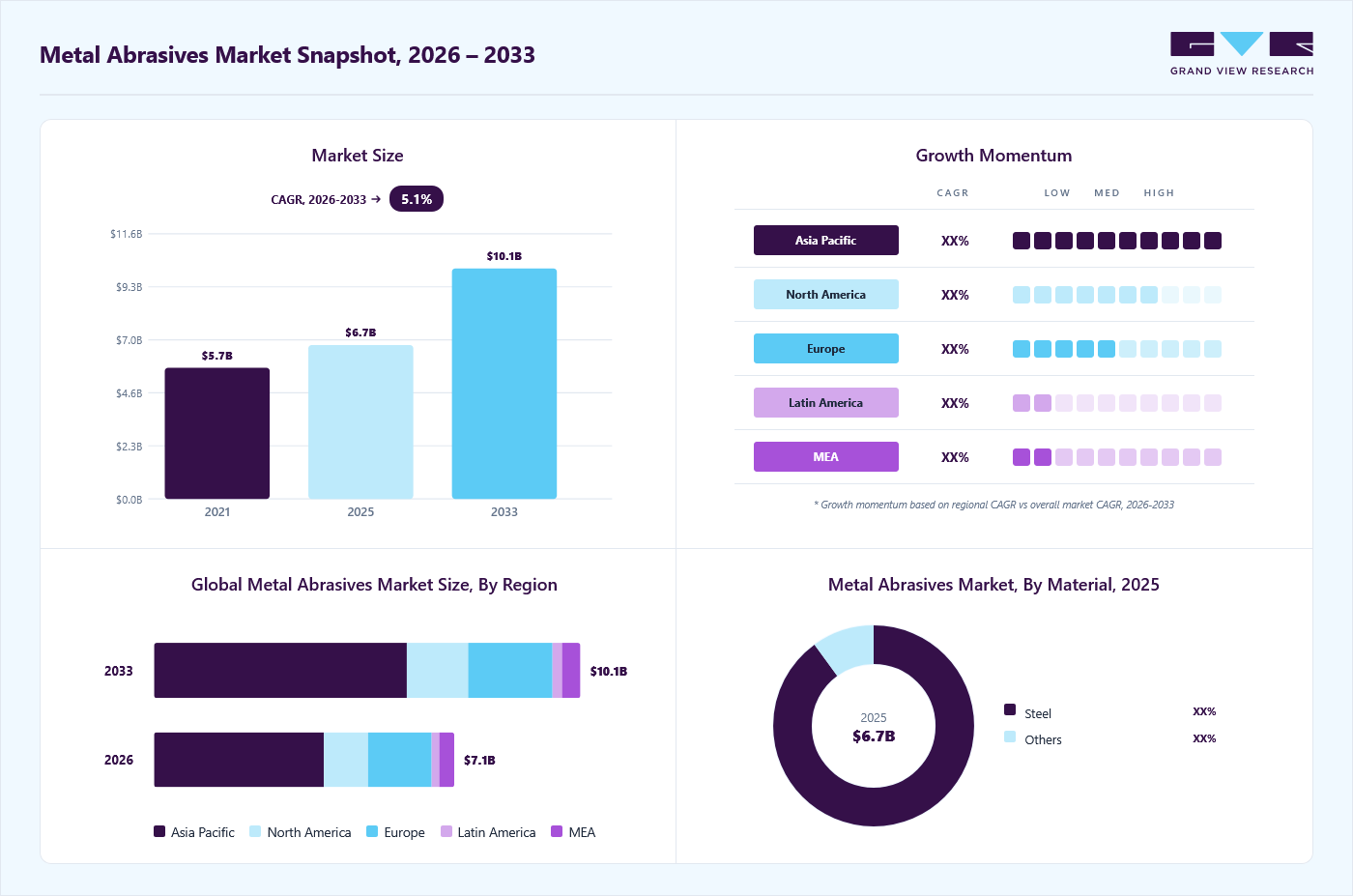 Source: Grand View Research, IR Documents, Primary Interviews, Paid DatabasesTo learn more about this report,
 Download Free Sample Report
Key Market Trends & Insights
- By application: Metalworking segment held the largest market share of 47.2% in 2025.
- By material: Steel segment held the largest market share of 89.9% in 2025.
Regional Highlights
- Largest regional market: Asia Pacific (56.0% revenue share, 2025)
- By country: China held the largest market share in 2025
Market Size & Forecast
- Market size in 2025: USD 6.7 Billion
- Estimated market size in 2026: USD 7.1 Billion
- Projected market size by 2033: USD 10.1 Billion
- CAGR (2026-2033): 5.1%
Three ways to get this report
Buy it, customize it, or ask a question.Ask an Analyst
Analyst response in 1 business day
- AccessReport author, directly
- Reply timeWithin 1 working day
- No sales callDirect answer only
- FormatEmail reply
- CostFree, no cost
Get the Full Report
What the study covers
- FormatsPDF · Excel · Dashboard
- Timeline2026–2033 annual, 2025 base
- Coverage20+ countries, 5 regions
- Companies10+ key players profiled
Customize the Report
20% free customization
- IncludeCountries, segments, points
- TailorTo your product definition
- ExtendDeeper competitor detail
- OrA fully bespoke study
- Turnaround5–10 working days
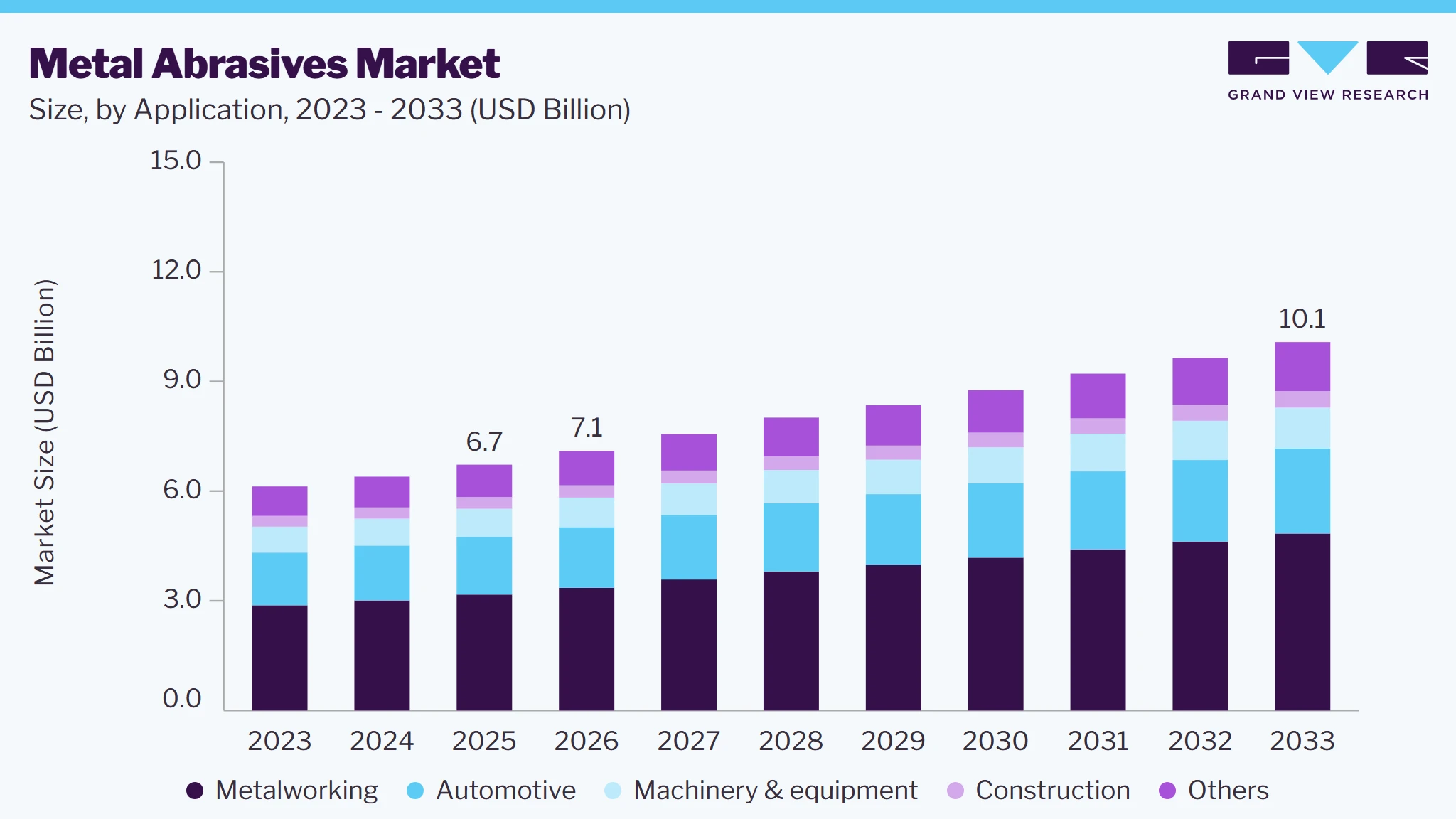
Metal abrasives are used in applications such as cleaning, descaling, shot peening, and desanding of different parts produced in various production industries such as casting, forging, aluminum die casting, auto components, and investment casting, among others. Increasing investments in the automotive sector are projected to augment demand for metal abrasives throughout the forecast period.In October 2023, Tyrolit Group, a leading abrasives manufacturer, acquired Acme Holding Company, a Michigan-based manufacturer. This acquisition strengthens Tyrolit's portfolio by integrating grinding and specialty abrasives solutions, expanding its presence in key industries such as foundry, steel, and rail.
 To learn more about this report, Download Free Sample Report
Considering the rising spending in the automotive sector, the U.S. is one of the major consumers of metal abrasives. For instance, Hyundai Motor Group established its USD 7.6 billion electric vehicle (EV) manufacturing facility in Bryan County, Georgia. This facility, known as Hyundai Motor Group Metaplant America (HMGMA), commenced production in October 2024, less than two years after groundbreaking. The plant aims to produce up to 300,000 EVs annually, including models like the Hyundai Ioniq 5 and the Ioniq 9, with plans to expand capacity to 500,000 units in the coming years.
In addition, continuing investments in machinery & equipment manufacturing plants are likely to boost demand for metal abrasives during the forecast period. For instance, in June 2022, KUBOTA Corporation, an equipment manufacturer based in Japan, invested USD 140 million in setting up a new facility to produce front-end loaders in Northeast Georgia, U.S.
Furthermore, operations were commenced at Reliance Industries' Polypropylene Plant-3 in Jamnagar, India, in 2025. This facility, with a production capacity of 5.2 million tonnes per annum (mtpa), is among Asia's most significant polypropylene projects. The plant's establishment is part of a broader trend in India, where 281 petrochemical projects are expected to start operations by 2025, contributing to a substantial increase in regional production capacity.
Market Dynamics
The metal abrasives market is primarily driven by the growing demand for surface preparation, cleaning, and finishing solutions across automotive, construction, foundry, aerospace, shipbuilding, and metal fabrication industries. Metal abrasives are widely used in blasting and shot peening applications to improve surface quality, remove contaminants, and enhance the durability of metal components. Increasing industrial production, infrastructure development, and investments in manufacturing facilities are driving the growing adoption of metal abrasives across major economies.
In addition, the expansion of automotive manufacturing, rising production of fabricated metal products, and growing maintenance requirements across industrial equipment and infrastructure are supporting market growth. Technological advancements in abrasive materials, coupled with increasing automation in surface treatment processes, are further enhancing operational efficiency and driving demand for high-performance metal abrasive solutions.
The increasing demand for metal abrasives from the automotive and metalworking industries remains a key growth driver for the market. Metal abrasives are widely used for cleaning, descaling, deburring, shot peening, and surface finishing in the production of automotive components, castings, forgings, and fabricated metal products. Rising investments in automotive manufacturing facilities, including electric vehicle production plants, are accelerating the consumption of metal abrasives across various production processes.
Furthermore, the expansion of metalworking activities and industrial manufacturing operations is increasing the need for efficient surface treatment solutions. Manufacturers are increasingly focusing on improving product quality, operational efficiency, and component lifespan, which continues to support the adoption of metal abrasives across machinery, transportation equipment, and fabricated metal industries worldwide.
Despite favorable growth prospects, volatility in the prices of steel, iron, and other raw materials used in metal abrasive manufacturing can significantly impact production costs and profit margins. Additionally, abrasive blasting operations are increasingly subject to stringent environmental and occupational safety regulations related to dust emissions, waste management, and worker protection. Compliance with these standards often requires additional investments in filtration systems, waste-disposal processes, and safety equipment, which can increase operational expenses and pose challenges for small- and medium-sized market participants
The increasing adoption of automated blasting and surface treatment systems across manufacturing and industrial facilities presents significant growth opportunities for the metal abrasives market. Industries are increasingly seeking high-performance, reusable abrasive solutions that improve operational efficiency, reduce material consumption, and lower overall processing costs. Furthermore, the growing emphasis on sustainable manufacturing practices and advancements in abrasive production technologies are driving demand for durable and environmentally responsible products, creating new avenues for market expansion over the forecast period.
Analyst Perspective
The metal abrasives market is witnessing steady growth driven by expanding industrial manufacturing activities, infrastructure development projects, and increasing demand for efficient surface preparation and finishing solutions. Growing production across automotive, metalworking, construction, machinery, and foundry industries is accelerating the adoption of steel shot, steel grit, and other metallic abrasives for cleaning, descaling, shot peening, and surface treatment applications. While fluctuations in raw material prices and stringent environmental regulations remain key challenges, advancements in abrasive manufacturing technologies and automated blasting systems are improving operational efficiency and product performance. Rising demand for reusable, high-durability abrasive materials and increasing investments in industrial modernization are creating new opportunities across end-use sectors. In the coming years, companies that can enhance product quality, optimize manufacturing efficiency, and expand their presence in high-growth industrial markets are expected to strengthen their competitive position in the industry.
Drivers, Opportunities & Restraints
The global metal abrasives industry is experiencing robust growth, primarily driven by expanding industrial sectors such as automotive, construction, metal fabrication, and petrochemicals. A key contributor is the accelerating shift toward electric vehicles (EVs), where metal abrasives play a critical role in the manufacturing and finishing of precision components such as battery housings, drivetrains, and body panels. Leading automakers like Hyundai and Tesla are investing billions into EV production facilities, significantly increasing the demand for high-performance metal abrasives in cutting, grinding, and surface finishing processes.
Similarly, the ongoing boom in construction and infrastructure, particularly in rapidly urbanizing regions such as Asia-Pacific and the Middle East, is fueling the need for abrasives in activities like concrete surface preparation, metal structure fabrication, and welding. As infrastructure spending rises, so does the requirement for metal abrasives to prepare and maintain tools and equipment. The metal fabrication and machinery industry remains a vital end user of metal abrasives, driven by global demand for industrial equipment, heavy machinery, and precision tools.
The global metal abrasives industry is witnessing significant growth opportunities as industries increasingly focus on enhancing efficiency, precision, and sustainability in their manufacturing operations. A key area of potential is in the expanding use of automated and robotic metalworking systems, particularly within the automotive, aerospace, and heavy equipment sectors. These advanced systems rely on high-performance abrasives for grinding, polishing, and surface finishing processes critical for improving product quality and reducing production time.
One major challenge facing the global metal abrasives industry is fluctuating raw material prices, especially for key materials such as aluminum oxide, silicon carbide, and synthetic diamonds. Changes in the cost of these materials, caused by factors such as supply and demand imbalances, political tensions, and natural disasters, can increase production costs and cause price instability, which affects manufacturers' profitability.
Material Insights
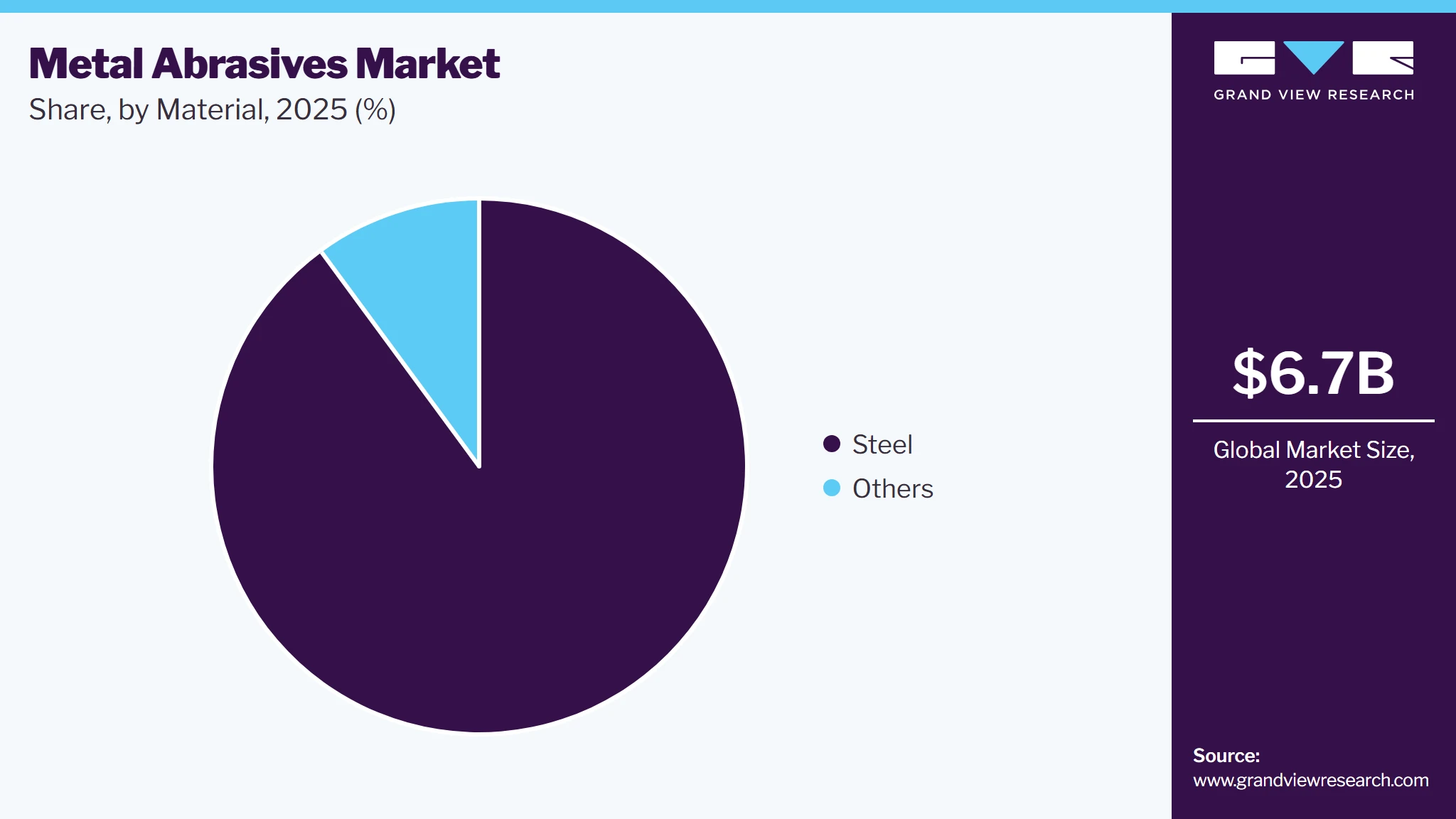
Based on material, the steel segment led the market with the largest revenue share of 89.9% in 2025, which is expected to continue during the forecast period. Steel abrasives are preferred for their hardness, cleanliness, grain size, and toughness. Due to these properties, they are widely used in various industries, including automotive, construction, and petrochemical industries.
Steel mainly includes steel shots and grits, which are used in metalworking industries such as forging, casting, die casting, investment casting, fabrication, and others. Investments in these industries are expected to benefit from the demand for steel shots and grits in air-blasting applications. For instance, in February 2025, according to Huatong Abrasives, steel shot and steel grit exports saw a 12% year-on-year increase in January and February 2025, reaching a total volume of 85,000 metric tons. This growth is attributed to heightened demand from North America, Europe, and Southeast Asia, driven by increased activity in the shipbuilding, automotive, and construction sectors.
 To learn more about this report, Download Free Sample Report
Iron abrasives are also extensively used by several end use industries. The wide demand for abrasives makes its manufacturers engage in acquisitions to further their business. For instance, in September 2023, Saint-Gobain, a global leader in building and high-performance materials, partnered with Dedeco Abrasive Products to market Dedeco's Sunburst abrasive line.
Application Insights
Based on applications, the metalworking segment led the market with the largest revenue share of 47.2% in 2025, and the trend is expected to continue during the forecast period. Investment in fabrication plants will likely fuel market growth throughout the forecast period. For instance, in October 2021, Ramakrishna Forgings, a supplier of forged, rolled, and machined products, began producing fabrications in its facility in Jamshedpur, India. The plant mainly manufactures fabrications for excavator parts.
Rising EV production by automotive manufacturers is projected to boost the demand for metal abrasives such as steel shots and grits for the different types of components produced from casting, forging, fabrication, etc. For instance, in March 2024, Stellantis, a global automotive manufacturer, entered into a joint venture with Contemporary Amperex Technology Co. Ltd. to invest ~USD 4.61 billion (€4.1 billion) in building a large-scale lithium iron phosphate (LFP) battery plant in Zaragoza, Spain. This initiative is part of Stellantis' strategy to enhance its EV production capabilities, necessitating advanced metal abrasives for the precision manufacturing of battery components and other EV parts.
In addition, the construction sector is one of the primary end users of metal abrasives, and various investments in construction activities are likely to positively influence demand for the commodity during the forecast period positively. In 2024, Mexico's government, under President Claudia Sheinbaum, announced significant infrastructure investments to modernize the country's transportation and energy sectors. These initiatives are expected to stimulate demand for metal abrasives, particularly in automotive manufacturing, construction, and energy infrastructure sectors.
Regional Insights
North America metal abrasives industry is projected to register a revenue growth rate of 5.1% from 2025 to 2030. The growth rate is expected to be driven by the rising shortage of funds for setting up machinery and equipment manufacturing hubs in the country. In November 2023, Siemens invested USD 140 million in two electrical products manufacturing plants in Grand Prairie, Texas, and Pomona, California. These facilities aim to meet the growing demand for electrification in critical infrastructure sectors.
U.S. Metal Abrasives Market Trends
The U.S. metal abrasives industry is expected to maintain a steady growth trajectory through the decade's end. The market has gained momentum due to strong demand from core industries such as metalworking, automotive, machinery, and construction. With rising investments in electric vehicle production, infrastructure development, and precision manufacturing, the use of metal abrasives for grinding, cutting, and surface finishing is projected to increase steadily.
The metalworking segment remains the most significant and fastest-growing segment, driven by advancements in industrial automation, fabrication, and machine technologies. The automotive sector is supported by growing electric vehicle (EV) production and demand for lightweight metal components.
Asia Pacific Metal Abrasives Market Trends
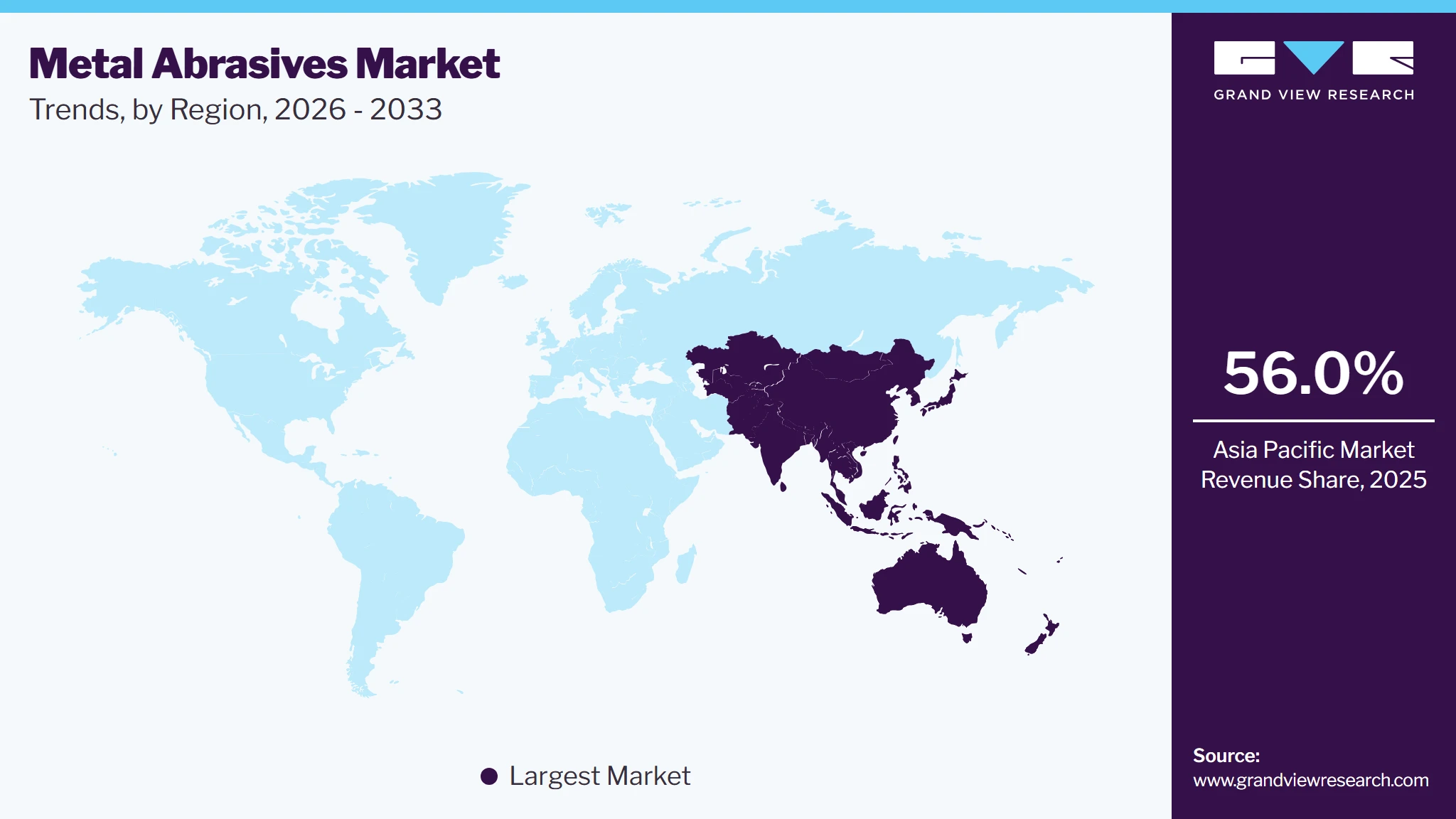
Asia Pacific dominated the metal abrasives market with the largest revenue share of 56.0% in 2025. The high volume of die-cast components supported by vehicle production will likely boost demand for metal abrasives within the region in the coming years. For instance, in 2025, Maruti Suzuki India Limited commenced commercial production at its new manufacturing facility in Kharkhoda, Haryana. This plant has a capacity of 250,000 units and is currently focused on producing the SUV. The plant plans to increase the total production capacity at the site to 750,000 vehicles per year by 2029.
 To learn more about this report, Download Free Sample Report
China Metal Abrasives Market Trends
The metal abrasives market in China held the largest share in the Asia Pacific region in 2025.
Europe Metal Abrasives Market Trends
The European metal abrasives industry witnessed steady growth in 2024, with Germany holding the largest market share in the region. Germany's dominance is primarily attributed to its strong industrial base, particularly in the automotive, machinery, and manufacturing sectors, significantly contributing to the demand for metal abrasives.
Among various applications, metalworking holds the largest share of the market in 2024. The metalworking sector's robust demand for abrasives is driven by the ongoing need for precision machining, grinding, and polishing in automotive, aerospace, and industrial equipment manufacturing industries.
Key Metal Abrasives Company Insights
Some of the key players operating in the market include Abrasives Inc., Vulkan INOX GmbH, and Ervin Industries.
-
Abrasives Inc., founded in 1990 in North Dakota, is a leading supplier in the metal abrasives industry, known for its flagship product Black Magic, a coal slag abrasive used widely in industrial blasting. The company also offers a range of metallic and non-metallic abrasives, including steel grit, steel shot, aluminum oxide, garnet, and crushed glass.
-
VULKAN INOX GmbH, established in 1985 and headquartered in Hattingen, Germany, specializes in stainless steel abrasives tailored for treating metallic and mineral surfaces. Its key products, CHRONITAL and GRITTAL, serve critical roles in deburring, descaling, and cleaning in sectors like automotive, aerospace, and foundry.
Key Metal Abrasives Companies:
The following are the leading companies in the metal abrasives market. These companies collectively hold the largest market share and dictate industry trends.
- Abrasives Inc.
- Vulkan INOX GmbH
- Abrasive Shot
- 3M India Ltd.
- Macro Group International
- Metaltec Steel Abrasive
- W Abrasives
- Grind well, Norton Ltd
- Silcal Metallurgic Ltd.
- Ervin Industries
- Siambrator Co., Ltd.
- Air blast-Abrasives B.V.
Competitive Benchmarking
Category
Operating Strategies
Competitive Edge
Weakness
Established Players (e.g., W Abrasives, Ervin Industries, Metaltec Steel Abrasive, Grindwell Norton Ltd., Airblast-Abrasives B.V.)
- Focus on large-scale production of steel shot, steel grit, and specialty metal abrasives supported by extensive distribution networks.
- Emphasize product quality, manufacturing efficiency, recycling solutions, and long-term partnerships with automotive, foundry, construction, and metalworking industries.
- Benefit from established brand recognition, broad product portfolios, strong manufacturing capabilities, and global customer networks.
- Large-scale operations support cost efficiencies, consistent product quality, and reliable supply chain management.
- Face high operating costs associated with raw material procurement, manufacturing facilities, and environmental compliance requirements.
- Profitability may be affected by fluctuations in steel prices, energy costs, and changing industrial production cycles.
Emerging & Specialized Players (e.g., Abrasives Inc., Vulkan INOX GmbH, Abrasive Shot, Macro Group International, Silcal Metallurgic Ltd., Siambrator Co., Ltd., 3M India Ltd.)
- Focus on niche abrasive products, customized blasting solutions, stainless steel abrasives, and application-specific surface treatment technologies.
- Emphasize product innovation, technical expertise, customer-specific solutions, and regional market expansion strategies.
- Benefit from operational flexibility, specialized product offerings, and the ability to address unique customer requirements across targeted industries.
- Agile business models support faster product development and responsiveness to evolving market needs.
- Limited production capacity and narrower geographic presence compared to larger industry participants.
- Expansion often requires significant investments in manufacturing infrastructure, distribution networks, and customer acquisition efforts.
Recent Developments
-
In January 2024, Vulkan INOX expanded its presence in North America by opening a new branch in Santiago de Querétaro, Mexico. This strategic move aims to strengthen customer relationships and provide exceptional service in the growing automotive and machinery industries.
-
In September 2024, Carborundum Universal Limited (CUMI), a Murugappa Group company, made significant strides in expanding its global footprint within the abrasives sector. In September 2024, CUMI acquired a 100% stake in Silicon Carbide Products, Inc. (SCP), a U.S.-based manufacturer specializing in Nitride Bonded Silicon Carbide (NBSiC) products. The acquisition, valued at approximately USD 6.66 million (INR 56 crore), was finalized through a Type-F reorganization under the U.S. Internal Revenue Code.
Metal Abrasives Market Report Scope
Report Attribute
Details
Market definition
The global Metal Abrasives Market refers to the revenue generated from the sales of metallic abrasive products, including steel shot, steel grit, stainless steel abrasives, and cut wire abrasives, used for surface preparation, cleaning, descaling, shot peening, and finishing applications across industrial sectors.
Market size in 2025
USD 6.7 billion
Estimated Market size in 2026
USD 7.1 billion
Projected Market size by 2033
USD 10.1 billion
Growth rate
CAGR of 5.1% from 2026 to 2033
Base year for estimation
2025
Historical data
2021 - 2024
Forecast period
2026 - 2033
Quantitative units
Revenue in USD million and CAGR from 2026 to 2033
Report coverage
Revenue forecast, company ranking, competitive landscape, growth factors, and trends
Segments covered
Type, vehicle type, end-use, region.
Regional scope
North America; Europe; Asia Pacific; Latin America; Middle East & Africa
Country scope
U.S, Canada, Mexico, Germany, UK, Russia, France, Italy, India, China, Japan, Australia, Brazil, South Africa
Key companies profiled
Abrasives Inc., Vulkan INOX GmbH, 3M India Ltd., Grind well Norton Ltd, Ervin Industries, Siambrator Co., Ltd., Air blast-Abrasives B.V.
Customization scope
Free report customization (equivalent up to 8 analysts' working days) with purchase. Addition or alteration to country, regional & segment scope.
Pricing and purchase options
Avail customized purchase options to meet your exact research needs. Explore purchase options
Global Metal Abrasives Market Report Segmentation
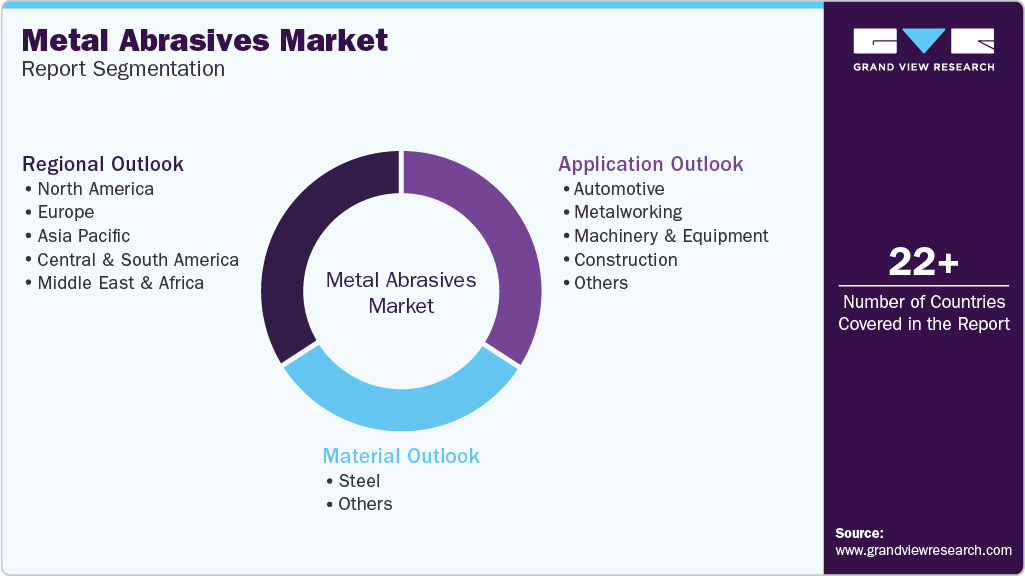
This report forecasts revenue growth at the global, country, and regional levels and provides an analysis of the latest trends in each of the sub-segments from 2021 to 2033. For this study, Grand View Research has segmented the global metal abrasives market report based on material, application, and region.
 To learn more about this report, Download Free Sample Report
-
Material Outlook (Revenue, USD Million, 2021 - 2033)
-
Steel
-
Others
-
-
Application Outlook (Revenue, USD Million, 2021 - 2033)
-
Automotive
-
Metalworking
-
Machinery & Equipment
-
Construction
-
Others
-
-
Regional Outlook (Revenue, USD Million, 2021 - 2033)
-
North America
-
U.S.
-
Canada
-
Mexico
-
-
Europe
-
Germany
-
UK
-
Russia
-
France
-
Italy
-
-
Asia Pacific
-
China
-
Japan
-
India
-
Australia
-
-
Central & South America
-
Brazil
-
-
Middle East & Africa
-
South Africa
-
-
Research Methodology
The metal abrasives Market figures in this report are based on a proven research process that combines executive interviews with secondary research from proprietary databases, company filings, and recognized regulatory and institutional sources. Market size is built through value-chain sizing - reconciling supply-side and demand-side estimates - and triangulated with bottom-up and top-down approaches. Every estimate passes multiple levels of expert validation before publication, with each Metal Abrasives segment quantified using the revenue-capture definitions in the table below.
Segment Definition
Material
Revenue Capture Definition
Steel
Steel abrasives include steel shot, steel grit, and other steel-based blasting media used for surface preparation, cleaning, descaling, shot peening, and finishing applications. Market revenue is attributed to the manufacturing and sale of steel abrasives, distribution activities, abrasive recycling systems, blasting equipment compatibility solutions, and related surface treatment services.
Others
This segment includes non-steel metallic abrasives, such as stainless-steel shot, cut-wire abrasives, aluminum shot, zinc shot, copper-slag-based metallic abrasives, and specialty abrasive materials. Revenue is generated through the production, supply, distribution, and application of these abrasives across industrial cleaning, surface finishing, and specialized treatment processes.
Application
Revenue Capture Definition
Automotive
Metal abrasives are widely used in automotive manufacturing for surface cleaning, shot peening, deburring, descaling, and preparing vehicle components before coating and assembly. Revenue capture includes abrasive consumption, blasting operations, surface treatment services, equipment integration, and maintenance activities across automotive production facilities.
Metalworking
The metalworking segment uses metal abrasives to clean castings, forgings, fabricated metal parts, welded structures, and machined components. Revenue is generated through abrasive sales, blasting systems, finishing processes, surface enhancement operations, and related industrial metal processing activities.
Machinery & Equipment
Metal abrasives are used in the manufacturing and maintenance of industrial machinery, heavy equipment, agricultural equipment, and production systems to improve surface quality and component durability. Market revenue includes abrasive products, blasting services, refurbishment activities, maintenance operations, and associated surface preparation solutions.
Construction
In the construction industry, metal abrasives are used to clean and prepare structural steel, bridges, pipelines, storage tanks, and other infrastructure assets before coating, painting, or maintenance activities. Revenue is derived from abrasive consumption, surface preparation services, infrastructure rehabilitation projects, and corrosion control applications.
Others
This category includes applications across shipbuilding, aerospace, rail transportation, energy, foundry operations, and general industrial manufacturing. Associated revenues are linked to abrasive sales, blasting and peening operations, surface treatment processes, equipment utilization, and specialized industrial finishing services.
Estimation Model
Layer Name
Key Question
Description
Industrial Activity Demand Base Layer
What forms the demand base?
Identify global demand for metal abrasives across industries requiring surface preparation, cleaning, finishing, and strengthening of metal components. Assess activity levels in automotive, metal fabrication, foundries, machinery manufacturing, construction, and infrastructure maintenance to establish the addressable market opportunity.
Abrasive Production & Supply Layer
Where are metal abrasives produced and supplied?
Estimate the production capacity of steel shot, steel grit, and other metallic abrasives across key regions. Analyze raw material availability, manufacturing facilities, distribution networks, and supply chain infrastructure to assess market accessibility and supply dynamics.
Application Adoption Layer
How extensively are metal abrasives utilized?
Analyze the adoption of metal abrasives across automotive, metalworking, machinery & equipment, construction, and other industrial applications. Evaluate surface treatment requirements, blasting activities, quality standards, and maintenance practices influencing abrasive consumption.
Revenue Layer
How is market revenue generated?
Expenditures on metal abrasives, blasting operations, abrasive recycling systems, and related surface treatment services quantify market revenue. Abrasive consumption volumes, product pricing, industrial output, and maintenance spending across end-use industries drive the overall market value.
Delivered Customizations
This report has been delivered with the following In-depth customizations
CLIENT REQUEST
CUSTOMIZATION DELIVERED
VALUE ADDS
Metal Abrasives Competitive Landscape Assessment
Detailed competitive landscape analysis covering manufacturers and suppliers of steel shot, steel grit, stainless steel abrasives, cut wire abrasives, and related surface treatment solutions. The study profiled key market participants based on geographic presence, organizational structure, product portfolio, production capacity, distribution networks, customer base, strategic initiatives, and investments in manufacturing expansion and product innovation.
Enabled evaluation of competitive positioning, production capabilities, distribution strengths, customer engagement strategies, and market participation across the metal abrasives value chain.
Application & Technology Assessment
Evaluation of global metal abrasive demand across automotive, metalworking, machinery & equipment, construction, foundry, and other industrial applications. Included assessment of abrasive types, surface treatment technologies, blasting processes, manufacturing trends, adoption patterns, regulatory considerations, and regional industrial activity across major markets.
Highlighted application trends, technology adoption patterns, and regional demand opportunities. Supported strategic planning, product portfolio optimization, market entry evaluation, and investment prioritization decisions.
Opportunity Assessment
Identification of high-growth opportunities associated with industrial automation, infrastructure rehabilitation, advanced surface treatment technologies, and increasing demand for reusable abrasive solutions. Assessed emerging opportunities arising from manufacturing modernization, expansion of automotive and metal fabrication industries, and growing investments in corrosion protection and asset maintenance activities.
Enabled prioritization of high-value growth opportunities and emerging application segments. Supported long-term business planning, product development strategies, capacity expansion initiatives, and investment decisions aligned with evolving industrial requirements.
Frequently Asked Questions About This Report
Asia Pacific dominated the market with revenue share of 56.0% in 2025.
China dominated the Asia Pacific market with a revenue share of 56.5% in 2025.
Asia Pacific is anticipated to register the fastest CAGR of 5.8% over the forecast period.
Based on applications, metalworking accounted for largest revenue share of 47.2% in 2025.
The metal abrasives market size was estimated at USD 6.7 billion in 2025 and is expected to reach USD 7.1 billion in 2026.
The metal abrasives market is expected to grow at a compound annual growth rate of 5.1% from 2026 to 2033 to reach USD 10.1 billion by 2033.
Based on material, steel accounted for largest revenue share of 89.9% in 2025.
Some of the key players operating in the metal abrasives market include W Abrasives, Ervin Industries, Metaltec Steel Abrasive, Abrasives Inc., Vulkan INOX GmbH, Abrasive Shot, 3M India Ltd., Macro Group International, Grindwell Norton Ltd., Silcal Metallurgic Ltd., Siambrator Co., Ltd., and Airblast-Abrasives B.V.
The key driver of the global metal abrasives market is the growing demand for surface preparation, cleaning, and finishing solutions across automotive, metalworking, construction, and machinery industries. Rising industrial production, infrastructure development, and increased investments in manufacturing modernization are driving the adoption of steel shot, steel grit, and other metallic abrasives for blasting, descaling, and shot peening worldwide.
About the Author(s)
Advanced Interior Materials Research Team
Advanced Materials · Advanced Interior MaterialsThis report was authored by the advanced interior materials research team at Grand View Research - comprising two research analysts, one senior research analyst, and one industry expert - with specialized expertise in the advanced interior materials segment of the advanced materials industry. All findings are based on proprietary advanced materials databases, executive interviews, and regulatory analysis, subject to internal peer review prior to publication.
Last Updated:
Speak to Analyst

Customize this report to your needs - add regions, segments, or data points, with 20% free customization.
Or view our licence options:


ISO 9001:2015 & 27001:2022 Certified
We are GDPR and CCPA compliant! Your transaction & personal information is safe and secure. For more details, please read our privacy policy.


