
- Home
- »
- Advanced Interior Materials
- »
-
Metal-organic Framework Market Size, Industry Report, 2033GVR Report cover
![Metal-organic Framework Market Size, Share & Trends Report]()
Metal-organic Framework Market (2025 - 2033) Size, Share & Trends Analysis Report By Application (Gas Storage & Separation, Catalysis, Energy Storage, Sensors & Electronics), By Region (North America, Europe, Asia Pacific), And Segment Forecasts
Market Size, 2024
$143.8MMarket Estimate, 2026
$159.0MMarket Forecast, 2033
$443.4MCAGR, 2025–2033
13.7%Metal-organic Framework Market Summary
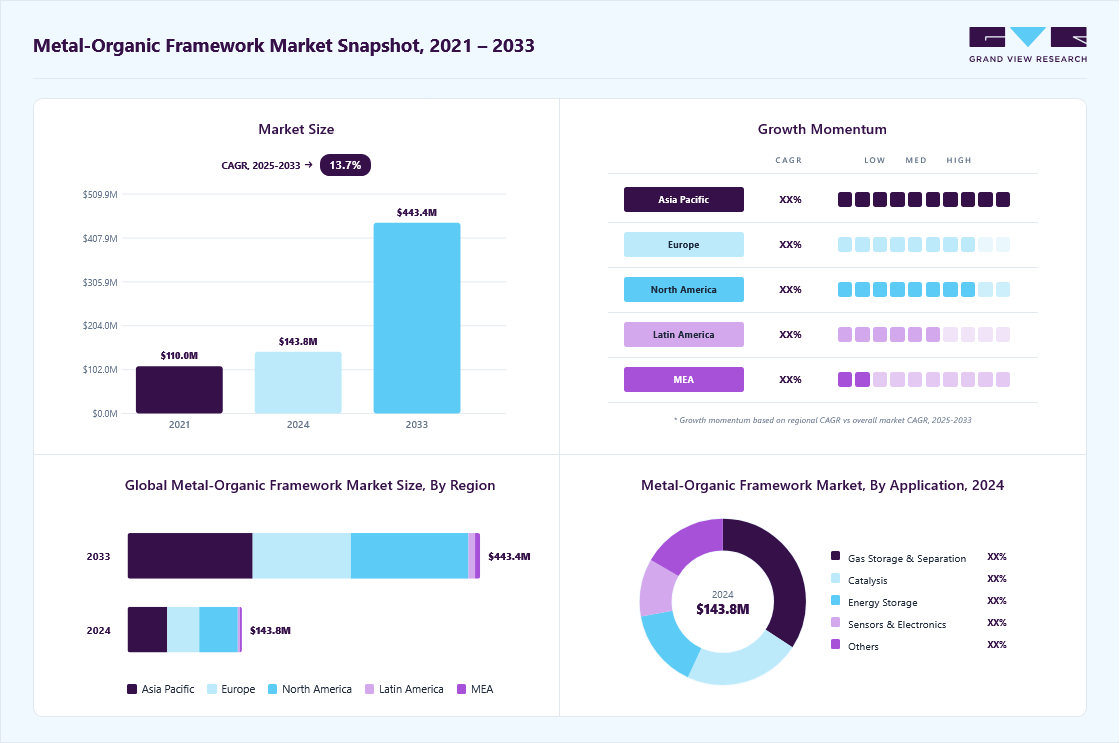
The global metal-organic framework market size was estimated at USD 143.8 million in 2024 and is projected to reach USD 443.4 million by 2033, growing at a CAGR of 13.7% from 2025 to 2033. The market growth is primarily driven by the increasing utilization of MOFs in gas storage & separation and catalysis applications, owing to their high surface area, tunable pore structure, and superior adsorption properties.
Key Market Trends & Insights
- Asia Pacific dominated the metal-organic framework market with a revenue share of over 34.7% in 2024.
- The U.S. is a key growth market for MOFs, driven primarily by demand in gas storage & separation and catalysis applications within the oil & gas and chemical sectors.
- By application, the gas storage & separation segment held the largest revenue share of 34.2% in 2024.
Market Size & Forecast
- 2024 Market Size: USD 143.8 Million
- 2033 Projected Market Size: USD 443.4 Million
- CAGR (2025-2033): 13.7%
- Asia Pacific: Largest market in 2024
Expanding use across oil & gas and chemical & petrochemical industries, supported by ongoing advancements in material engineering and process efficiency, further propels market demand. Sustainability and responsible production practices are becoming integral to expanding the Metal-Organic Framework (MOF) market. Industry participants and governments emphasize energy-efficient synthesis methods, ethical sourcing of raw materials, and traceable supply chains to minimize environmental impact and align with global Environmental, Social, and Governance (ESG) standards. Integration of recycled precursors and circular economy principles is reducing dependence on conventional chemical inputs while enhancing resource efficiency.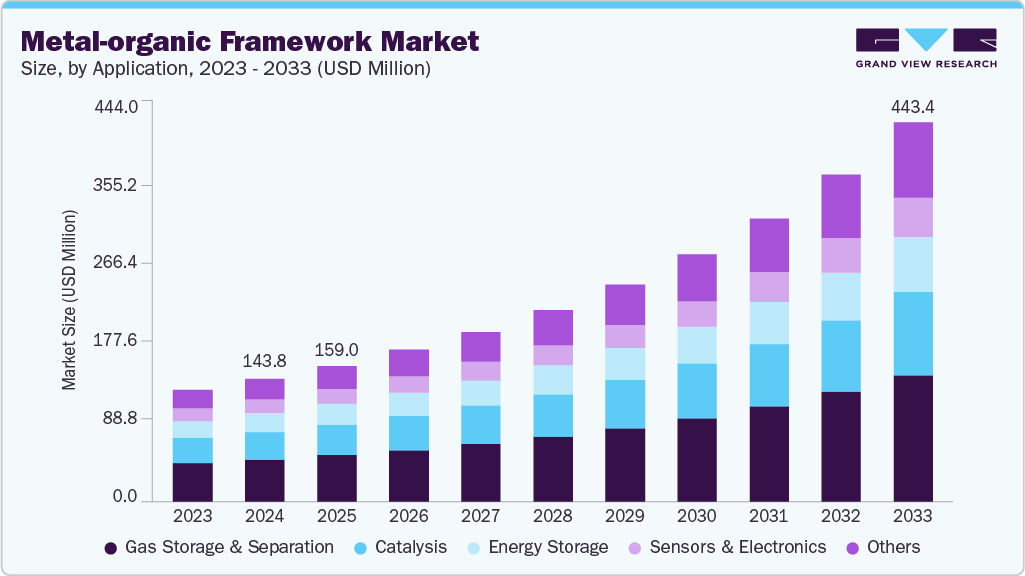
Technological advancements that improve adsorption performance, stability, and scalability further accelerate MOF adoption across industrial sectors. Supportive government frameworks promoting clean energy, carbon capture, and green chemistry are driving demand, particularly in the Asia Pacific, North America, and Europe. As demand rises from oil and gas and chemical and petrochemical industries for sustainable gas separation, purification, and catalytic processes, Metal-Organic Frameworks are emerging as a strategic, eco-efficient, and commercially viable material platform enabling the transition toward a low-carbon industrial future.
Drivers, Opportunities & Restraints
One of the key drivers for the MOF market is the growing demand for efficient gas storage and separation technologies, particularly in efforts to decarbonize heavy industries and mitigate greenhouse gas emissions. Companies such as Svante, Nuada, Mosaic Materials, and AspiraDAC actively deploy MOF-based solutions for point-source CO₂ capture and direct air capture (DAC). For instance, BASF’s zinc-based MOF “CALF-20” has demonstrated the ability to capture approximately one tonne of CO₂ per day from cement plant flue gas, signaling the transition of MOFs from laboratory research to industrial-scale applications. Moreover, the global shift toward sustainable energy generation and green hydrogen production is increasing demand for MOFs that deliver superior adsorption performance, higher selectivity, and reduced energy regeneration costs.
Significant opportunities exist to expand MOF applications beyond traditional sectors such as oil & gas and chemical & petrochemical into emerging domains, including environmental remediation, water treatment, and sensor technologies. The high tunability and porosity of MOFs make them promising candidates for selective adsorption of pollutants, desalination, and catalytic transformations. Recent advancements in AI-driven material discovery, such as generative modeling for designing new MOF structures, accelerate innovation and reduce development cycles. Moreover, the growing global focus on hydrogen storage and carbon capture, supported by government incentives and industrial investments, presents substantial growth prospects for MOFs as sustainable material solutions.
Despite their high potential, several challenges hinder the widespread adoption of MOFs. The high production cost of complex synthesis routes, specialized solvents, and controlled processing environments limits large-scale commercialization. Moreover, certain MOFs exhibit limited stability under harsh operating conditions common in oil & gas and chemical & petrochemical industries, leading to reduced performance over time. The absence of standardized manufacturing protocols and performance validation frameworks further complicates market entry for emerging MOF products, especially in environmental and biomedical applications. These factors collectively constrain scalability and slow industrial adoption despite strong technological promise.
Application Insights
Gas Storage & Separation is the dominant application segment in the global MOF market with revenue share of 34.2% in 2024, driven by increasing demand for efficient CO₂ capture, hydrogen storage, and methane separation. MOFs’ exceptionally high surface area, tunable pore sizes, and selective adsorption properties make them ideal for industrial-scale gas storage and purification processes. Industries focused on carbon capture and storage (CCS) and the production of green hydrogen are rapidly adopting MOF-based solutions to improve efficiency, reduce energy consumption, and comply with environmental regulations.
The Catalysis application is witnessing steady growth as MOFs are leveraged in chemical synthesis, petrochemical refining, and selective oxidation reactions. Their structural versatility allows for precise tuning of active sites, enhancing reaction rates and product selectivity. Although catalysis remains a secondary application compared to gas storage, recent research has expanded metal-organic framework use in biocatalysis and environmental catalysis, providing new avenues for industrial adoption.
Emerging applications categorized under others, including water treatment, sensing, and environmental remediation, are gaining attention as MOFs prove effective in pollutant adsorption, gas sensing, and separation of contaminants from complex matrices. These niche applications benefit from ongoing technological advancements and the growing focus on sustainability and circular economy initiatives. However, their market share remains smaller relative to Gas Storage & Separation, which continues to dominate due to its critical role in global energy transition and emission reduction strategies.
Regional Insights
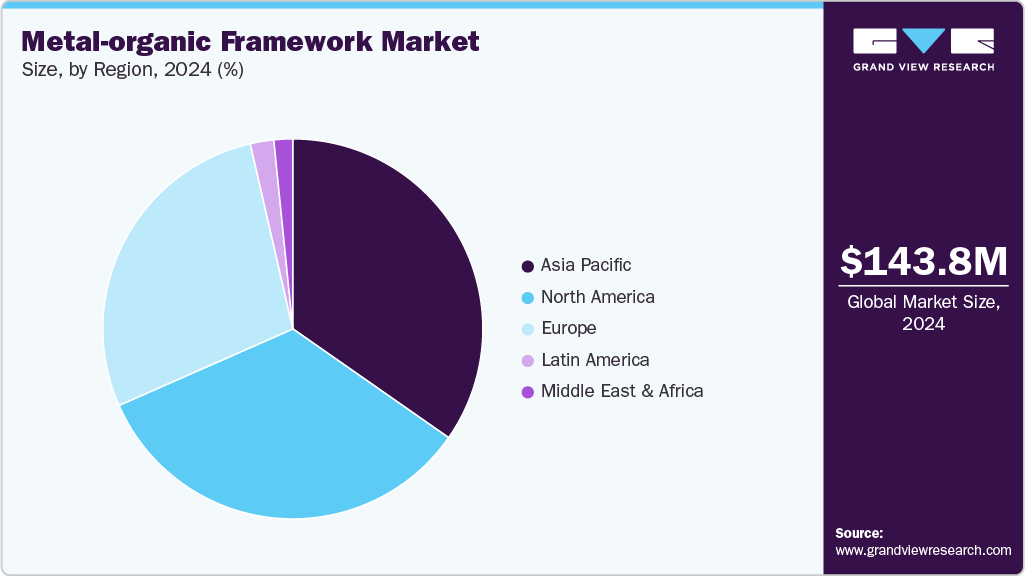
Asia Pacific dominated the metal-organic framework market with a revenue share of 34.7% in 2024, driven by the rapid growth of chemical & petrochemical and energy-intensive industries. Countries such as China, India, and Japan invest heavily in MOF-based hydrogen storage systems, CO₂ separation units, and catalytic processes to support energy transition initiatives and industrial efficiency. Government policies encouraging sustainable manufacturing and a growing network of specialized MOF production facilities enable the Asia Pacific to maintain technological leadership and supply chain resilience in advanced material applications.
North America Metal-organic Framework Market Trends
North America is emerging as a key growth region for MOFs, driven by industrial demand for gas storage and separation and catalysis solutions in the oil and gas sector. Investments in pilot-scale MOF synthesis facilities support technological adoption and R&D centers focused on energy-efficient gas separation and carbon capture. The U.S. and Canada also prioritize research collaborations between universities and industrial players to accelerate the development of robust and scalable MOFs for industrial applications, positioning the region as a hub for high-performance material innovation.
U.S. Metal-organic Framework Market Trends
The U.S. is a key growth market for MOFs, driven primarily by demand in gas storage & separation and catalysis applications within the oil & gas and chemical sectors. Investments in advanced MOF production and R&D facilities enable the development of high-performance, scalable metal-organic framework for industrial gas purification, carbon capture, and hydrogen storage. Collaborative initiatives between government agencies, universities, and private companies are accelerating innovation, supporting energy efficiency, emission reduction, and sustainable industrial operations. This positions the United States as a strategic MOF adoption and commercialization hub.
Europe Metal-organic Framework Market Trends
Europe is witnessing steady metal-organic framework market growth as governments and industries adopt sustainable gas separation and catalytic solutions to meet stringent environmental standards. Countries such as Germany, France, and the Netherlands are integrating MOFs into industrial processes for carbon capture, green chemical synthesis, and environmental remediation. Strategic initiatives, including public-private partnerships and incentives for clean material technologies, are fostering industrial-scale MOF deployment, supporting Europe’s transition to low-carbon operations while enhancing the competitiveness of its oil & gas and chemical sectors.
Key Metal-organic Framework Company Insights
Some of the key players operating in the market include BASF SE, Mosaic Materials, NuMat Technologies, and Others.
-
BASF SE, established in 1865, is a global chemical company and a pioneer in the commercial production of Metal-Organic Frameworks (MOFs). The company focuses on large-scale MOF manufacturing for gas storage, CO₂ capture, and separation technologies, partnering with industrial players to develop scalable, energy-efficient solutions. BASF emphasizes sustainable practices, research-driven innovation, and collaboration with academic and industrial partners to enhance material performance and support clean energy and industrial efficiency initiatives.
-
Mosaic Materials, founded in 2014, is a leading innovator in MOF-based carbon capture and natural gas storage technologies. The company develops high-performance MOFs for industrial gas separation and purification applications to reduce energy consumption and greenhouse gas emissions. Mosaic Materials focuses on scalable manufacturing, applied research, and strategic partnerships with the energy and industrial sectors to accelerate the commercial deployment of MOFs.
-
NuMat Technologies, established in 2010, specializes in designing and developing MOFs for natural gas storage, air separation, and catalysis. The company leverages proprietary MOF structures to enhance adsorption capacity and selectivity, enabling more efficient and sustainable industrial processes. NuMat Technologies prioritizes research collaboration, process scalability, and commercialization of MOFs to support industries such as oil & gas, chemical production, and environmental remediation.
Key Metal-organic Framework Companies:
The following are the leading companies in the metal-organic framework market. These companies collectively hold the largest market share and dictate industry trends.
- BASF SE
- Framergy, Inc.
- MOF Technologies / Nuada
- MOFapps
- Mosaic Materials
- Nanorh
- novoMOF AG
- NuMat Technologies
- Promethean Particles Ltd.
- Strem Chemicals
Recent Developments
-
In September 2025, NuMat Technologies partnered with a leading chemical manufacturer to implement MOF-based catalysts for selective hydrocarbon conversion. The collaboration focuses on improving process yield, reducing energy. consumption, and demonstrating scalable applications of MOFs in petrochemical and industrial gas processing.
-
In August 2025, Mosaic Materials reported the successful deployment of MOF-based carbon capture units at a U.S. natural gas processing plant. The project demonstrated over 90% CO₂ capture efficiency, highlighting the commercial viability of MOFs for large-scale emission reduction and energy-efficient gas purification.
-
In July 2025, BASF SE announced the commercial-scale production of its zinc-based MOF “CALF-20” for industrial CO₂ capture applications. The facility is designed to produce several hundred tons annually, supporting large-scale gas separation projects and strengthening BASF’s position in sustainable industrial processes.
Metal-organic Framework Market Report Scope
Report Attribute
Details
Market size value in 2025
USD 159.0 million
Revenue forecast in 2033
USD 443.4 million
Growth rate
CAGR of 13.7% from 2025 to 2033
Base year for estimation
2024
Historical data
2021 - 2023
Forecast period
2025 - 2033
Quantitative Units
Revenue in USD million/billion and CAGR from 2025 to 2033
Report coverage
Revenue forecast, competitive landscape, growth factors, and trends
Segments covered
Application, region
Regional scope
North America; Europe; Asia Pacific; Latin America; Middle East & Africa
Country scope
U.S.; Canada; Mexico; Germany; France; UK.; Italy; China; India; Japan; South Korea; Brazil; South Africa
Key companies profiled
BASF SE; Mosaic Materials; NuMat Technologies; Framergy, Inc.; MOF Technologies / Nuada; MOFapps; Nanorh; novoMOF AG; Promethean Particles Ltd.; Strem Chemicals
Customization scope
Free report customization (equivalent up to 8 analysts working days) with purchase. Addition or alteration to country, regional & segment scope.
Pricing and purchase options
Avail customized purchase options to meet your exact research needs. Explore purchase options
Global Metal-organic Framework Market Report Segmentation
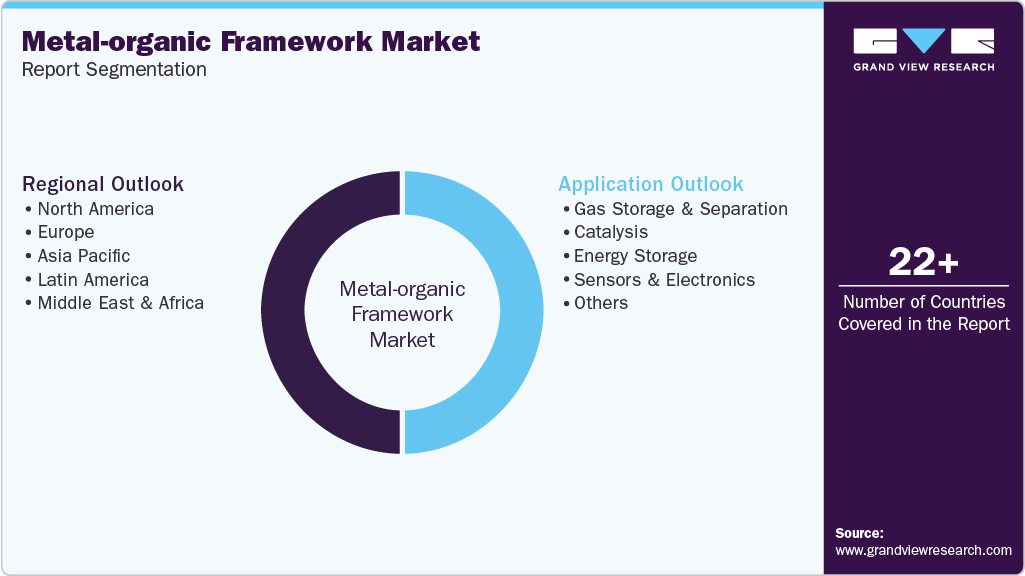
This report forecasts global, country, and regional revenue growth and analyzes the latest trends in each sub-segment from 2021 to 2033. For this study, Grand View Research has segmented the global metal-organic framework market report based on application and region:
-
Application Outlook (Revenue, USD Million, 2021 - 2033)
-
Gas Storage & Separation
-
Catalysis
-
Energy Storage
-
Sensors & Electronics
-
Others
-
-
Regional Outlook (Revenue, USD Million, 2021 - 2033)
-
North America
-
U.S.
-
Canada
-
Mexico
-
-
Europe
-
Germany
-
France
-
UK
-
Italy
-
-
Asia Pacific
-
China
-
India
-
Japan
-
South Korea
-
-
Latin America
-
Brazil
-
-
Middle East & Africa
-
South Africa
-
-
Frequently Asked Questions About This Report
The global metal-organic framework market size was estimated at USD 143.8 million in 2024 and is expected to reach USD 159.0 million in 2025.
The global metal-organic framework market is expected to grow at a compound annual growth rate of 13.7% from 2025 to 2033, reaching USD 443.4 million by 2033.
In 2024, the gas storage & separation segment held the largest share, over 34.0% of metal-organic framework revenue.
Some of the key vendors in the global metal-organic framework market are BASF SE; Mosaic Materials; NuMat Technologies; Framergy, Inc.; MOF Technologies/Nuada; MOFapps; Nanorh; novoMOF AG; Promethean Particles Ltd.; Strem Chemicals.
The global Metal-Organic Framework (MOF) market is driven by the growing demand for efficient gas storage and separation, industrial catalysis, and carbon capture solutions, coupled with increasing adoption in the oil and gas and chemical sectors.
About the Author(s)
Advanced Interior Materials Research Team
Advanced Materials · Advanced Interior MaterialsThis report was authored by the advanced interior materials research team at Grand View Research - comprising two research analysts, one senior research analyst, and one industry expert - with specialized expertise in the advanced interior materials segment of the advanced materials industry. All findings are based on proprietary advanced materials databases, executive interviews, and regulatory analysis, subject to internal peer review prior to publication.
Last Updated:
Speak to Analyst

Need a Tailored Report?
Customize this report to your needs — add regions, segments, or data points, with 20% free customization.
Or view our licence options:


ISO 9001:2015 & 27001:2022 Certified
We are GDPR and CCPA compliant! Your transaction & personal information is safe and secure. For more details, please read our privacy policy.












