
- Home
- »
- Advanced Interior Materials
- »
-
Metallic Glass Market Size, Share & Growth Report, 2026-2033GVR Report cover

Metallic Glass Market (2026 - 2033)
Size, Share & Trends Analysis Report By End Use (Electrical & Electronics, Consumer & Precision Products, Industrial & Energy Equipment), By Product (Bulk Metallic Glass, Amorphous Metal Ribbons), By Region, And Segment Forecasts
Market Size, 2025
$1.9BMarket Estimate, 2026
$2.0BMarket Forecast, 2033
$3.1BCAGR, 2026–2033
6.5%Metallic Glass Market Summary
The global metallic glass market size was valued at USD 1.9 billion in 2025 and is projected to grow from USD 2.0 billion in 2026 to USD 3.1 billion by 2033, at a CAGR of 6.5% from 2026 to 2033. Asia Pacific dominated the global market, accounting for the largest revenue share of 46.3% in 2025.. Growth is driven by increasing demand across automotive & mobility, medical & healthcare, consumer & precision products, and electrical & electronics, particularly in applications linked to EVs, renewable energy infrastructure, and advanced industrial manufacturing.
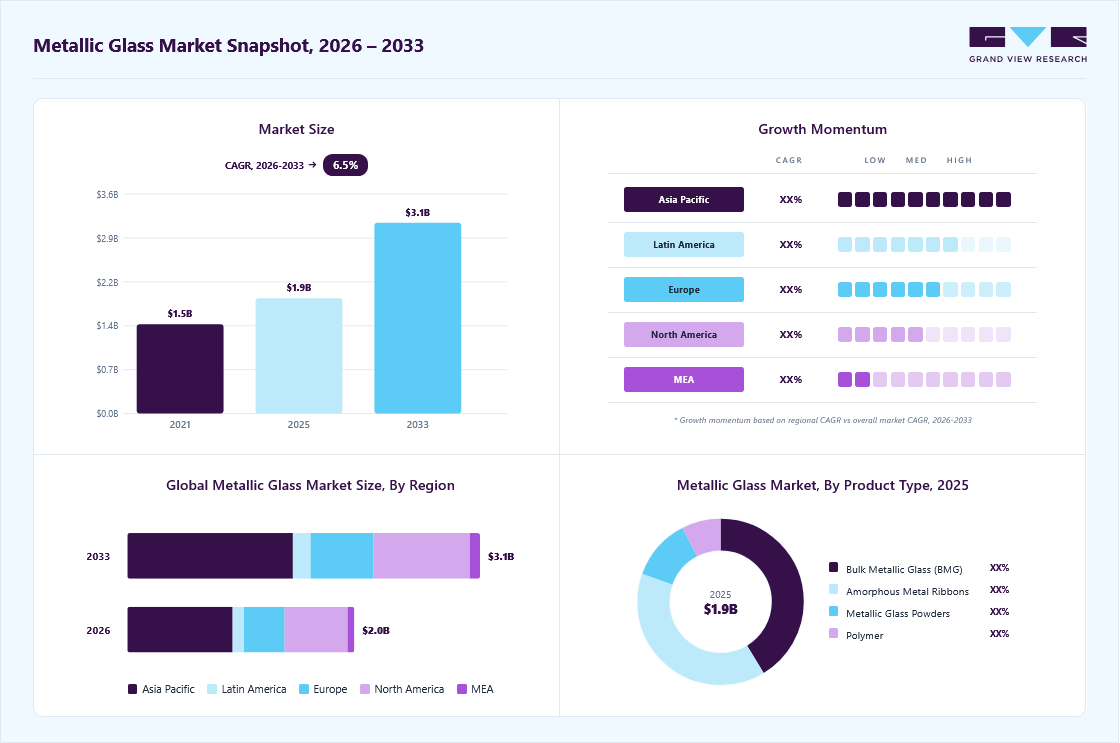 Source: Grand View Research, IR Documents, Primary Interviews, Paid DatabasesTo learn more about this report,
 Download Free Sample Report
Key Market Trends & Insights
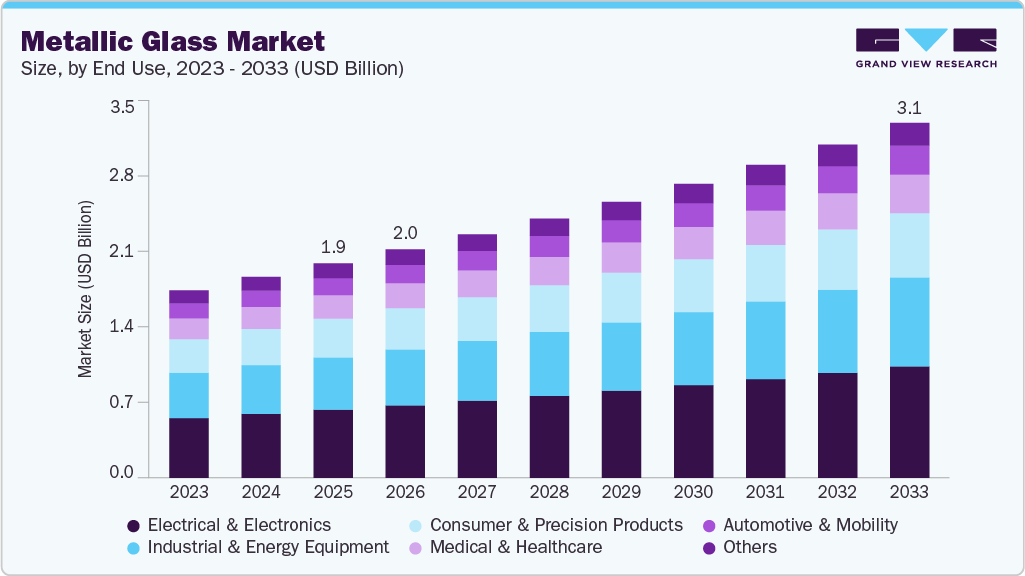
- By end use: Electrical & electronics segment led the market in 2025, accounting for 31.8% of total revenue.
- By product: Bulk metallic glass category is projected to experience consistent expansion, recording a CAGR of 6.7% throughout the forecast duration.
Regional Highlights
- Largest regional market: Asia Pacific (46.3% revenue share, 2025)
- By country: The China metallic glass industry is a major contributor to the global market.
Market Size & Forecast
- Market size in 2025: USD 1.9 Billion
- Estimated market size in 2026: USD 2.0 Billion
- Projected market size by 2033: USD 3.1 Billion
- CAGR (2026-2033): 6.5%
Three ways to get this report
Buy it, customize it, or ask a question.Ask an Analyst
Analyst response in 1 business day
- AccessReport author, directly
- Reply timeWithin 1 working day
- No sales callDirect answer only
- FormatEmail reply
- CostFree, no cost
Get the Full Report
What the study covers
- FormatsPDF · Excel · Dashboard
- Timeline2026–2033 annual, 2025 base
- Coverage20+ countries, 5 regions
- Companies10+ key players profiled
Customize the Report
20% free customization
- IncludeCountries, segments, points
- TailorTo your product definition
- ExtendDeeper competitor detail
- OrA fully bespoke study
- Turnaround5–10 working days
Additionally, rising investments in energy-efficient transformer materials, advanced alloy development, and scalable manufacturing technologies are supporting the long-term expansion of the market.
The industry is gaining sustainability relevance due to its contribution to material efficiency and reduced operational losses in high-performance applications. Metallic glasses possess high strength-to-weight ratios and enhanced fatigue resistance, enabling manufacturers to reduce material usage while maintaining structural performance. Their application in compact electronic devices and lightweight industrial components supports lower resource consumption and improved operational efficiency. In addition, the long service life and resistance to chemical degradation of amorphous alloys help reduce maintenance requirements and replacement cycles, supporting sustainable manufacturing practices across electronics, energy, and industrial equipment sectors.
 To learn more about this report, Download Free Sample Report
Technological advancement in the industry is focused on microfabrication, nanostructured alloy engineering, and precision component manufacturing. Researchers and manufacturers are developing new zirconium-, iron-, and magnesium-based amorphous alloys with improved thermal stability and formability for next-generation applications. The material’s unique ability to combine metal-like strength with glass-like molding characteristics is driving adoption in miniaturized sensors, MEMS devices, and precision medical instruments. Furthermore, advancements in high-throughput casting, laser processing, and hybrid material integration are enabling improved production consistency and expanding the commercial feasibility of metallic glass across complex engineering applications.
Drivers, Opportunities & Restraints
Growth in the industry is propelled by the need for energy-efficient electrical systems and advanced materials with superior performance characteristics. Amorphous metals, particularly in transformer cores, enable substantial reductions in energy losses, making them increasingly relevant in grid modernization and renewable energy integration. A recent example is the March 2026 announcement by Proterial to invest around USD 160 million in setting up an amorphous electrical steel facility in India, aimed at enhancing the domestic supply of low-loss transformer materials. This reflects a broader industry shift toward efficient power infrastructure, especially across the Asia-Pacific, where rising electricity demand and sustainability targets are accelerating adoption.
The industry is witnessing strong opportunity creation through expanding applications in high-precision and high-value sectors. The growing deployment of amorphous metal transformers in renewable energy systems and smart grids is expected to drive robust demand over the coming years. Advancements in bulk metallic glass processing technologies are enabling their use in medical devices, aerospace components, and compact electronic systems that require high strength and dimensional precision. Increasing focus on lightweight and durable materials in automotive and defense sectors, along with ongoing research in alloy innovation and scalable manufacturing, is further broadening the commercial potential of metallic glass across diverse industries.
Market expansion is constrained by challenges associated with production complexity and cost structures. The manufacturing of metallic glass requires controlled rapid cooling and precise alloy composition, which increases capital requirements and limits large-scale output. For the last few years, production scalability has remained a key concern, particularly for bulk metallic glass applications in mainstream industries. Additionally, certain alloy compositions exhibit brittleness, restricting their use in load-bearing applications. The absence of standardized processing methods and reliance on specialized equipment further elevate costs, making adoption less viable in price-sensitive markets and slowing widespread commercialization.
End Use Insights
The electrical & electronics segment dominated the metallic glass market in 2025, driven by increasing use of amorphous alloys in transformers, inductors, sensors, magnetic shielding, and compact electronic components. Metallic glass materials offer low magnetic losses, high electrical efficiency, and excellent soft magnetic properties, making them highly suitable for advanced power distribution and miniaturized electronic systems. Rising investments in renewable energy infrastructure, smart grids, and consumer electronics manufacturing, particularly across the Asia Pacific, continue to strengthen segment demand.
The industrial & energy equipment segment is anticipated to register the highest CAGR during the forecast period due to growing adoption of metallic glass materials in energy-efficient machinery, power systems, and industrial automation equipment. Demand is increasing for amorphous metal transformer cores and high-performance industrial components that help reduce operational energy losses and improve equipment durability. Expanding grid modernization projects, industrial electrification, and the transition toward sustainable energy infrastructure are expected to further accelerate growth across this segment over the coming years.
Product Insights
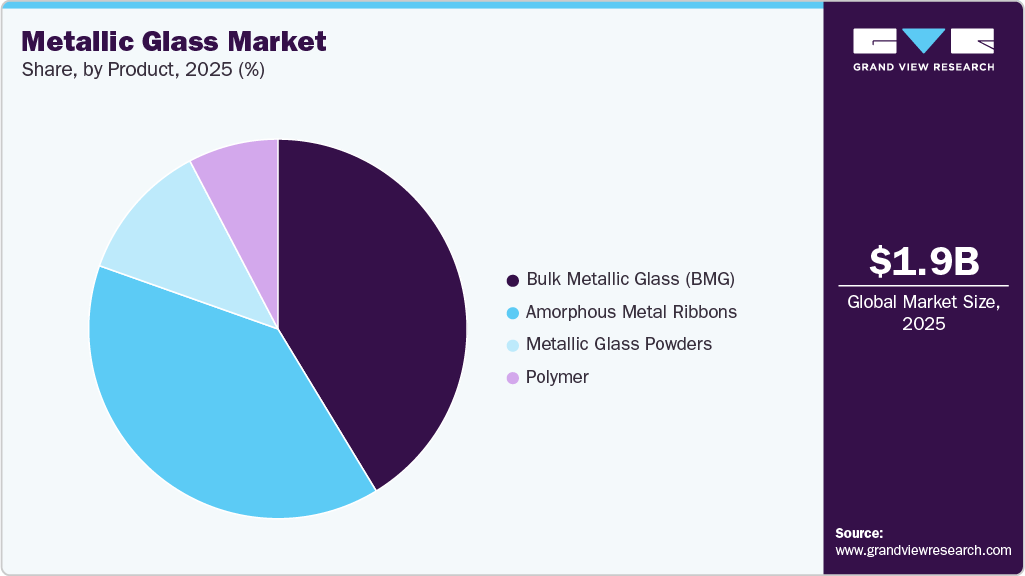
Bulk metallic glass accounted for the largest share of the market in 2025 and is also projected to register the highest CAGR over the forecast period. The segment’s growth is primarily attributed to its superior mechanical strength, corrosion resistance, high elasticity, and precision molding capabilities compared to conventional crystalline metals. Increasing adoption across aerospace, medical devices, consumer electronics, and precision engineering applications is supporting demand, particularly where lightweight and high-strength materials are required. Advancements in thermoplastic forming and alloy design are further improving manufacturability and expanding the commercial application scope of bulk metallic glass materials.
 To learn more about this report, Download Free Sample Report
Amorphous metal ribbons continue to witness stable demand owing to their extensive use in transformer cores and soft magnetic applications that require reduced energy losses and improved electrical efficiency. Metallic glass powders are gaining traction in additive manufacturing and thermal spray coating applications due to their fine microstructure and wear-resistant properties. Meanwhile, polymer-based metallic glass materials are emerging in niche applications involving flexible electronics, coatings, and lightweight engineered components. Growth across these segments is supported by ongoing material innovation and increasing utilization in energy-efficient and high-performance industrial systems.
Regional Insights
The North America metallic glass market is supported by strong research capabilities, advanced manufacturing infrastructure, and demand from aerospace, defense, and electronics sectors. The region emphasizes high-performance materials for precision applications, particularly in medical devices and microelectronics. Increasing investments in energy-efficient grid infrastructure and electrification are also driving the use of amorphous metal transformers. Collaboration between industry and research institutions continues to accelerate innovation in bulk metallic glass (BMG) processing and alloy development.
U.S. Metallic Glass Market Trends
The metallic glass market in the U.S. represents the largest share within North America, driven by robust adoption in defense, aerospace, and healthcare industries. The country benefits from a strong innovation ecosystem, with ongoing research in advanced materials and additive manufacturing supporting metallic glass commercialization. In 2025, several U.S.-based research programs and defense-linked initiatives expanded funding toward next-generation materials, including amorphous alloys for lightweight and high-strength applications, reinforcing the country’s leadership in technological advancement and early-stage adoption.
Asia Pacific Metallic Glass Market Trends
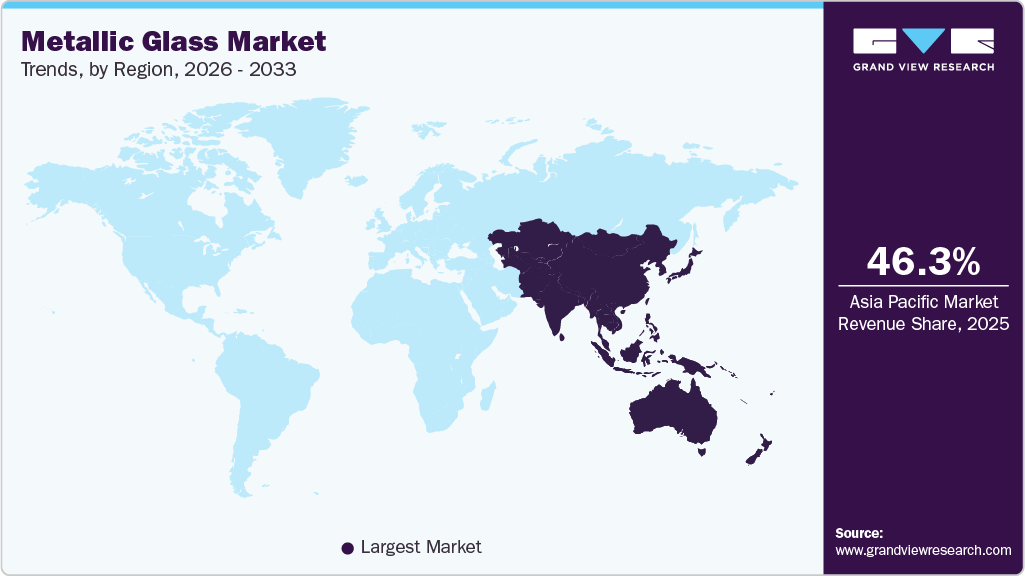
The metallic glass market in Asia Pacific led the global industry, driven by large-scale electronics manufacturing, rapid industrialization, and growing investments in power infrastructure. Countries such as China, Japan, and South Korea are key contributors, with strong demand for amorphous metal transformer cores and electronic components. A notable development includes the March 2026 investment by Proterial in India to establish an amorphous electrical steel plant, highlighting the region’s increasing focus on energy-efficient materials. Expanding renewable energy capacity and rising electricity demand further strengthen the region’s leadership position.
 To learn more about this report, Download Free Sample Report
China metallic glass market dominated the Asia Pacific due to its strong presence in electronics manufacturing, large-scale amorphous alloy production capacity, and expanding power infrastructure investments. The country serves as a major hub for amorphous metal ribbons and transformer core manufacturing, supported by rising demand for energy-efficient electrical systems and industrial automation. Additionally, increasing investments in renewable energy integration, electric vehicles, and advanced materials research continue to strengthen China’s leadership position in the regional metallic glass industry.
Europe Metallic Glass Market Trends
The metallic glass market in Europe is characterized by a focus on sustainability, energy efficiency, and industrial innovation. The region is witnessing increasing use of amorphous metals in automotive, renewable energy, and electrical infrastructure applications, aligned with stringent environmental regulations and carbon reduction targets. Countries such as Germany and France are investing in advanced materials for energy-efficient transformers and industrial systems, while ongoing R&D efforts are supporting the development of improved alloy compositions and scalable production techniques.
Latin America Metallic Glass Market Trends
The metallic glass market in Latin America is at a developing stage, with growth primarily linked to gradual industrialization and modernization of energy infrastructure. Adoption is emerging in sectors such as power distribution and automotive, where efficiency improvements and durability are becoming priorities. Increasing investments in renewable energy projects and grid upgrades are expected to create opportunities for amorphous metal applications, although market penetration remains limited due to cost sensitivity and lower awareness of advanced materials.
Middle East & Africa Metallic Glass Market Trends
The metallic glass market in the Middle East & Africa is witnessing gradual growth, supported by infrastructure development and investments in energy and utilities. The push toward efficient power transmission systems, particularly in Gulf countries, is creating demand for amorphous metal transformers. Additionally, diversification strategies beyond oil economies and investments in advanced manufacturing are expected to support future market growth. However, limited local production capabilities and reliance on imports continue to constrain widespread adoption across the region.
Key Metallic Glass Company Insights
Some of the key players operating in the market include Proterial Ltd., Materion Corporation, Liquidmetal Technologies, Inc., and others.
-
Proterial Ltd., established in 1956 and headquartered in Tokyo, Japan, is a global advanced materials manufacturer engaged in the production of specialty steels, magnetic materials, and amorphous alloys. The company plays a significant role in the metallic glass market through its large-scale manufacturing of amorphous metal ribbons used in energy-efficient transformer cores. It serves end-use industries such as energy & power, electronics, automotive, and industrial equipment. Proterial focuses on enhancing energy efficiency, reducing core losses in electrical systems, and supporting sustainable infrastructure development through advanced material innovation.
-
Liquidmetal Technologies, Inc., established in 1987 and headquartered in Lake Forest, California, U.S., is a materials engineering company specializing in bulk metallic glass (BMG) alloys and related processing technologies. The company develops and licenses proprietary amorphous metal formulations used in consumer electronics, medical devices, and industrial applications. It focuses on precision manufacturing, high-strength lightweight components, and scalable processing techniques such as injection molding of metallic glass. Liquidmetal Technologies emphasizes innovation in alloy design and the commercialization of high-performance materials for next-generation engineering applications.
-
Materion Corporation, established in 1931 and headquartered in Mayfield Heights, Ohio, U.S., is a global advanced materials company engaged in the development and supply of engineered materials, including metallic glass alloys, beryllium products, and specialty coatings. The company serves industries such as aerospace & defense, electronics, energy, and medical devices. Within the metallic glass market, Materion focuses on delivering high-performance amorphous alloys for precision components requiring strength, durability, and corrosion resistance.
Key Metallic Glass Companies:
The following key companies have been profiled for this study on the metallic glass market.
- Advanced Technology & Materials Co., Ltd.
- Eontec Co., Ltd.
- Exmet AB
- Proterial
- Liquidmetal Technologies, Inc.
- Materion Corporation
- Qingdao Yunlu Advanced Materials Technology Co., Ltd.
- TDK Corporation
- VACUUMSCHMELZE GmbH & Co. KG
- Zhejiang Zhaojing Electrical Technology Co., Ltd.
Recent Developments
-
In March 2026, Proterial announced an investment of approximately USD 160 million to establish an amorphous electrical steel manufacturing facility in Sri City, Andhra Pradesh, India. The plant is intended to produce amorphous metal cores for energy-efficient transformers, supporting reduced transmission losses and aligning with increasing demand for grid modernization and sustainable power infrastructure.
-
In February 2026, Materion Corporation announced continued investments in advanced materials innovation, including the development of amorphous alloys for aerospace and defense applications. The company emphasized improvements in processing capabilities and material performance to meet requirements for high strength, corrosion resistance, and reliability in demanding operating environments.
-
In November 2025, Liquidmetal Technologies reported the expansion of its licensing and manufacturing partnerships to scale bulk metallic glass (BMG) applications across consumer electronics and industrial components. The company highlighted advancements in precision molding technologies and growing adoption of its amorphous alloys in lightweight, high-strength product designs.
Metallic Glass Market Report Scope
Report Attribute
Details
Market Definition
The market size represents the revenue generated from the sale of metallic glass across various regions in a given year.
Market size in 2025
USD 1.9 billion
Estimated Market size in 2026
USD 2.0 billion
Projected Market size by 2033
USD 3.1 billion
Growth rate
CAGR of 6.5% from 2026 to 2033
Base year for estimation
2025
Historical data
2021 - 2025
Forecast period
2026 - 2033
Quantitative units
Revenue in USD million/billion, and CAGR from 2026 to 2033
Report coverage
Revenue forecast, competitive landscape, growth factors, and trends
Segments covered
End use, product, region
Regional scope
North America; Europe; Asia Pacific; Latin America; Middle East & Africa
Country scope
U.S.; Canada; Mexico; Germany; France; UK; Italy; India; China; Japan; Indonesia; South Korea; Brazil; Saudi Arabia; UAE
Key companies profiled
Advanced Technology & Materials Co., Ltd.; Eontec Co., Ltd.; Exmet AB; Proterial, Ltd.; Liquidmetal Technologies, Inc.; Materion Corporation; Qingdao Yunlu Advanced Materials Technology Co., Ltd.; TDK Corporation; VACUUMSCHMELZE GmbH & Co. KG; Zhejiang Zhaojing Electrical Technology Co., Ltd.
Customization scope
Free report customization (equivalent up to 8 analysts working days) with purchase. Addition or alteration to country, regional & segment scope.
Pricing and purchase options
Avail customized purchase options to meet your exact research needs. Explore purchase options
Global Metallic Glass Market Report Segmentation
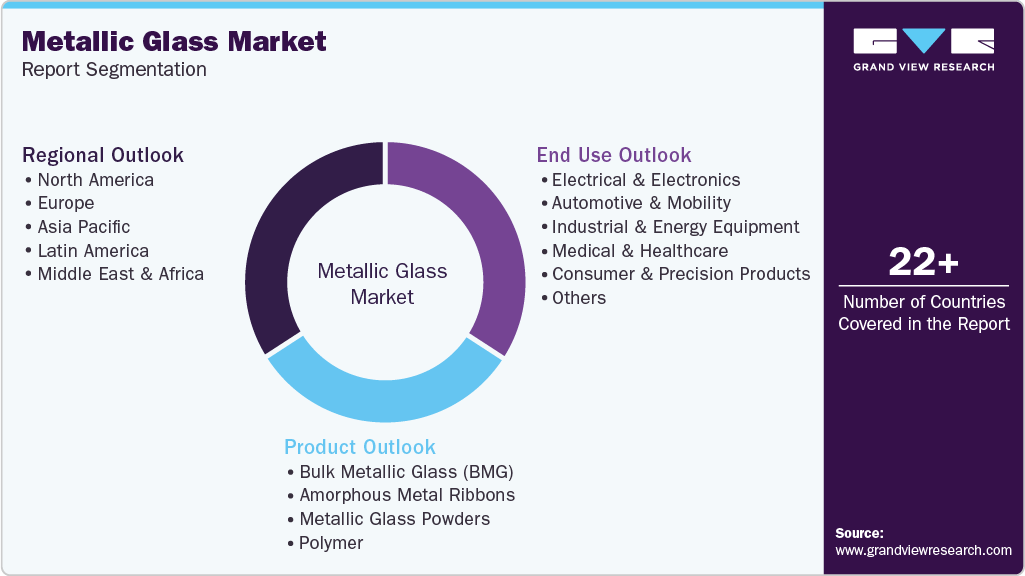
This report forecasts revenue growth at the global, regional, and country levels and analyzes the latest trends in each of the sub-segments from 2021 to 2033. For this study, Grand View Research has segmented the global metallic glass market report by end use, product, and region.
 To learn more about this report, Download Free Sample Report
-
End Use Outlook (Revenue, USD Million, 2021 - 2033)
-
Electrical & Electronics
-
Automotive & Mobility
-
Industrial & Energy Equipment
-
Medical & Healthcare
-
Consumer & Precision Products
-
Others
-
-
Product Outlook (Revenue, USD Million, 2021 - 2033)
-
Bulk Metallic Glass (BMG)
-
Amorphous Metal Ribbons
-
Metallic Glass Powders
-
Polymer
-
-
Regional Outlook (Revenue, USD Million, 2021 - 2033)
-
North America
-
U.S.
-
Canada
-
Mexico
-
-
Europe
-
Germany
-
France
-
UK
-
Italy
-
-
Asia Pacific
-
China
-
India
-
Japan
-
Indonesia
-
South Korea
-
-
Latin America
-
Brazil
-
-
Middle East & Africa
-
Saudi Arabia
-
UAE
-
-
Frequently Asked Questions About This Report
Asia Pacific dominated with a 46.3% revenue share in 2025.
The electrical & electronics segment led with a 31.8% revenue share in 2025, while industrial & energy equipment is the fastest-growing segment.
The bulk metallic glass segment held the largest revenue share in 2025, and is the fastest-growing product.
The global metallic glass market size was valued at USD 1.9 billion in 2025 and is estimated at USD 2.0 billion for 2026.
The global metallic glass market is expected to grow at a CAGR of 6.5% from 2026 to 2033, reaching USD 3.1 billion by 2033.
In terms of end use, the electrical & electronics segment led the market in 2025, accounting for 31.8% of total industry revenue. The segment’s dominance was supported by rising demand for energy-efficient transformers, compact electronic devices, and advanced magnetic components across industrial and consumer applications.
Key players include Advanced Technology & Materials Co., Ltd.; Eontec Co., Ltd.; Exmet AB; Proterial, Ltd.; Liquidmetal Technologies, Inc.; Materion Corporation; Qingdao Yunlu Advanced Materials Technology Co., Ltd.; TDK Corporation; VACUUMSCHMELZE GmbH & Co. KG; Zhejiang Zhaojing Electrical Technology Co., Ltd.
The global metallic glass market is driven by rising demand for energy-efficient electrical infrastructure, high-performance lightweight materials, and advanced manufacturing solutions across electronics, power, and aerospace sectors.
About the Author(s)
Advanced Interior Materials Research Team
Advanced Materials · Advanced Interior MaterialsThis report was authored by the advanced interior materials research team at Grand View Research - comprising two research analysts, one senior research analyst, and one industry expert - with specialized expertise in the advanced interior materials segment of the advanced materials industry. All findings are based on proprietary advanced materials databases, executive interviews, and regulatory analysis, subject to internal peer review prior to publication.
Last Updated:
Speak to Analyst

Customize this report to your needs - add regions, segments, or data points, with 20% free customization.
Or view our licence options:


ISO 9001:2015 & 27001:2022 Certified
We are GDPR and CCPA compliant! Your transaction & personal information is safe and secure. For more details, please read our privacy policy.


