Mexico Hazardous Wastewater Treatment Market Summary
The Mexico hazardous wastewater treatment market size was estimated at USD 989.7 million in 2025 and is projected to reach USD 1,268.5 million by 2033, growing at a CAGR of 3.3% from 2026 to 2033. Strict environmental regulations and stronger enforcement in Mexico are a major driver for hazardous wastewater treatment demand.
Key Market Trends & Insights
- The hazardous wastewater treatment industry in Mexico is expected to grow at a substantial CAGR of 3.3% from 2026 to 2033.
- By source, the pharmaceutical segment is expected to grow at a considerable CAGR of 4.8% from 2026 to 2033 in terms of revenue.
- By treatment process, the biological segment is expected to grow at a considerable CAGR of 3.7% from 2026 to 2033 in terms of revenue.
Market Size & Forecast
- 2025 Market Size: USD 989.7 Million
- 2033 Projected Market Size: USD 1,268.5 Million
- CAGR (2025-2033): 3.3%
Industries are required to control toxic pollutants, heavy metals, and persistent organics before discharge. Non-compliance risks include penalties, shutdowns, and reputational damage. This is pushing facilities to invest in reliable, multi-stage treatment systems, driving the market growth over the forecast period.
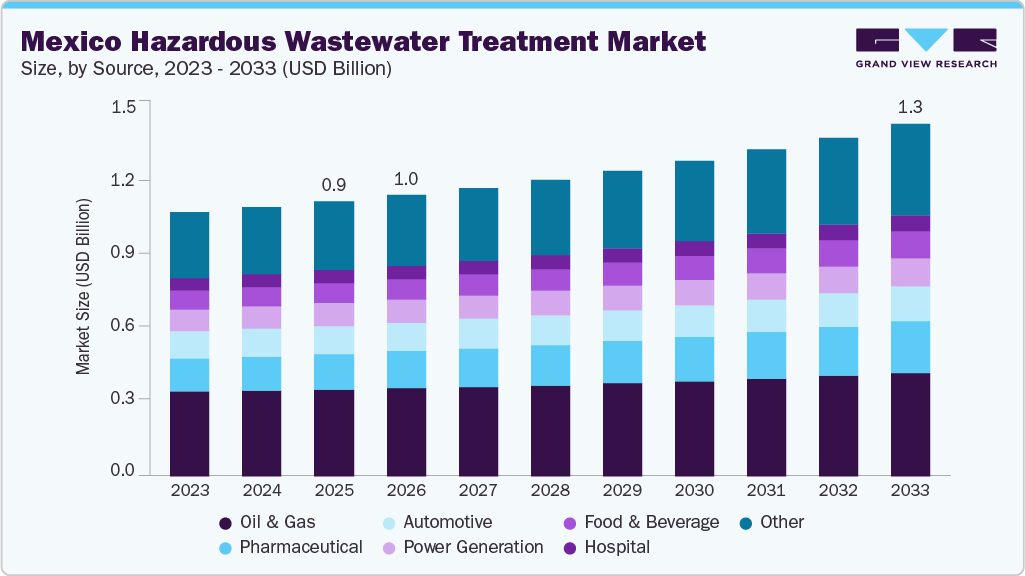
Rapid industrial expansion across pharmaceuticals, automotive, power generation, and oil & gas is another key driver. New plants and capacity expansion increases wastewater volumes and complexity. Export-oriented manufacturing further raises compliance expectations. Together, these trends are accelerating adoption of advanced and scalable hazardous wastewater treatment solutions.
Market Concentration & Characteristics
The Mexico hazardous wastewater treatment industry is moderately fragmented, with a mix of global technology providers, regional engineering firms, and local service companies operating across different industries. Large multinational players dominate high-value projects that require advanced or integrated treatment systems, while local firms are more active in standardized, small- to mid-scale installations. Project-based procurement and customization need limit market consolidation. As regulations tighten and technology requirements increase, selective consolidation is expected in advanced treatment segments.
The market shows a moderate to high level of innovation driven by complex industrial effluents and tightening discharge limits. Companies are increasingly adopting hybrid treatment systems that combine physical, chemical, biological, and advanced processes. Digital monitoring, automation, and modular plant designs are gaining traction to improve reliability and reduce downtime. Innovation is especially strong in pharmaceutical, electronics, and high-purity manufacturing applications.
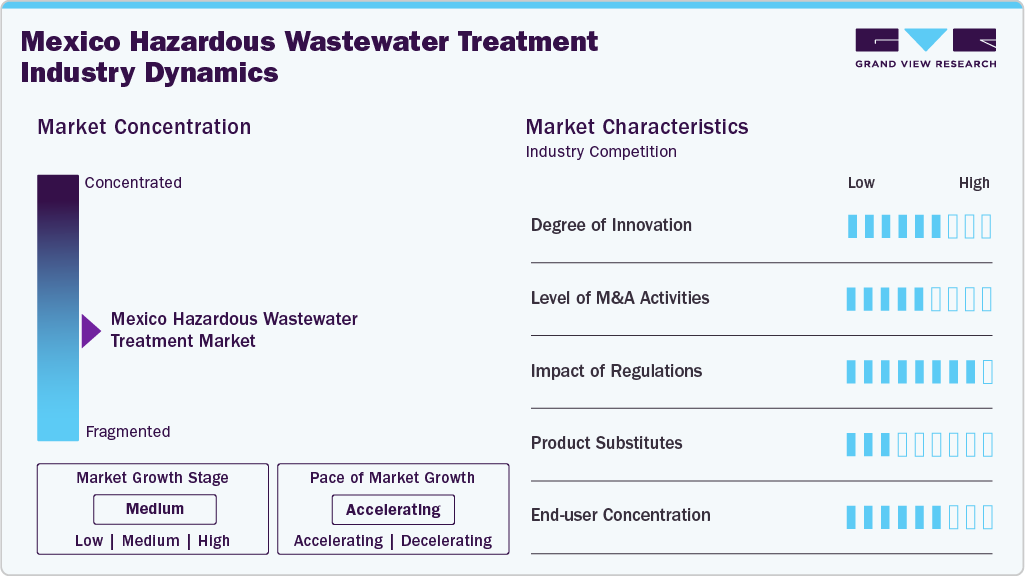
Regulation has a strong and direct influence on market trend in Mexico’s hazardous wastewater treatment sector. Strict limits on toxic discharges, metals, and hazardous residues compel industries to invest in compliant treatment infrastructure. Regulatory oversight is increasing for export-oriented industries and environmentally sensitive regions. As enforcement strengthens, compliance-driven upgrades continue to sustain market demand.
End user demand is concentrated in a few industrial sectors, including oil & gas, pharmaceuticals, automotive, power generation, and chemicals. These industries generate high volumes of hazardous wastewater and face greater regulatory scrutiny. Large industrial clusters amplify localized demand for treatment solutions. This concentration allows solution providers to develop sector-specific technologies and services.
Drivers, Opportunities & Restraints
Rising industrial activity across pharmaceuticals, automotive, oil & gas, and power generation is increasing the volume and complexity of hazardous wastewater in Mexico. Stricter environmental enforcement is pushing industries to upgrade or install compliant treatment systems. Export-oriented manufacturers face additional pressure to meet international environmental standards. Together, these factors are sustaining steady demand for advanced wastewater treatment solutions.
Water scarcity in key industrial regions is creating strong opportunities for reuse-oriented and zero-liquid-discharge solutions. Expansion of high-value industries such as pharmaceuticals, electronics, and clean energy is increasing demand for advanced and hybrid treatment technologies. Public and private investment in infrastructure supports new installations and retrofits. Service-based models and off-site treatment also offer growth potential.
High capital costs and technical complexity remain key barriers, particularly for small and mid-sized facilities. Advanced treatment systems require skilled operation and ongoing maintenance. Lengthy permitting and approval timelines can delay project execution. These factors can slow adoption despite growing regulatory pressure.
Source Insights
The oil & gas sector dominated the Mexico market, accounting for 31.6% of revenue share in 2025, due to the large volumes of produced water and oily effluents generated across upstream and downstream operations. Mature oil fields are increasing water-to-oil ratios, significantly raising treatment demand. Strict discharge limits for hydrocarbons and salinity reinforce continuous investment in treatment systems. Offshore and coastal operations further strengthen this segment’s dominance.
The pharmaceutical segment is anticipated to grow at the fastest CAGR of 4.8% due to rapid capacity expansion and rising investment in drug manufacturing and R&D. New facilities generate complex wastewater streams containing APIs and solvents that require advanced treatment. Export-driven compliance and GMP requirements increase treatment sophistication. This combination is accelerating adoption of high-performance wastewater treatment solutions.
Treatment Process Insights
The chemical treatment dominated the Mexico market with a revenue share of 33.6% in 2025, because it effectively handles toxic, non-biodegradable, and variable industrial effluents. Industries rely on chemical processes to control pH, remove heavy metals, and reduce toxicity to meet discharge norms. It is widely used across oil & gas, pharmaceuticals, and metal processing. Its flexibility and regulatory reliability sustain its leading position.
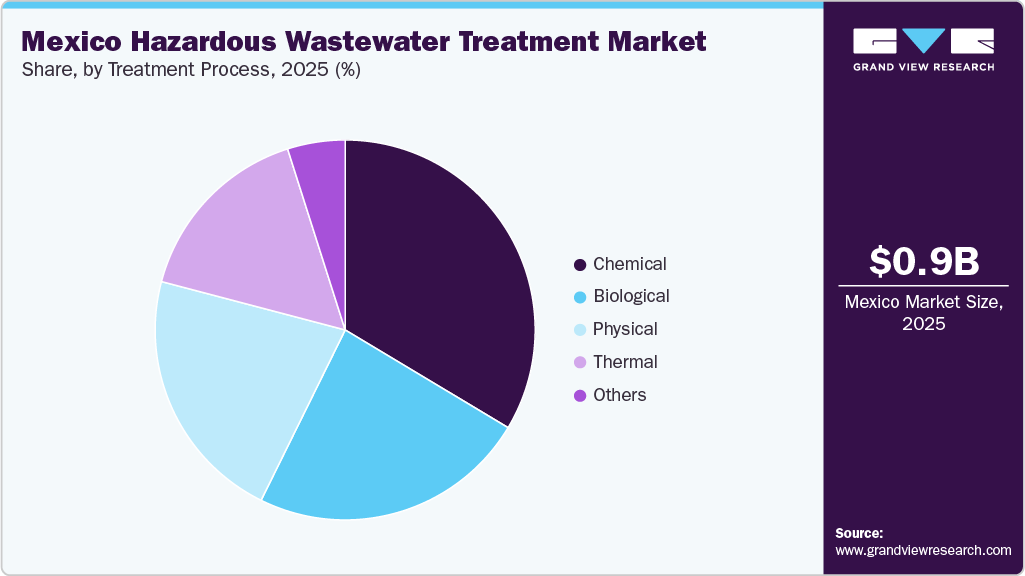
Biological treatment segment is expected to grow at a significant CAGR of 3.7% from 2026 to 2033 in terms of revenue. Biological treatment is the fastest growing process as industries seek cost-efficient and sustainable solutions for biodegradable wastewater. Improved pretreatment and process control are expanding its applicability to hazardous streams. Growth is strong in food & beverage, agro-chemicals, and select pharmaceutical operations. Rising interest in water reuse and energy recovery is further accelerating adoption.
Key Mexico Hazardous Wastewater Treatment Company Insights
Some of the key players operating in the market include Veolia, CLEANMEX, and Grupo Pochteca.
-
Veolia has a strong presence in Mexico’s hazardous wastewater treatment industry through customized industrial water and waste management solutions. The company focuses on complex effluent treatment for sectors such as oil & gas, pharmaceuticals, chemicals, and power generation. Its offerings emphasize integrated treatment trains, reuse-oriented systems, and compliance with stringent discharge norms. Veolia is often involved in large, long-term service contracts and high-capacity projects where operational reliability and regulatory certainty are critical.
-
CLEANMEX is a key domestic player specializing in hazardous waste and wastewater treatment services tailored to Mexican industrial requirements. The company provides on-site and off-site treatment solutions for chemical, pharmaceutical, automotive, and manufacturing clients. Its strength lies in handling hazardous residues, chemical effluents, and sludge management under local regulatory frameworks. CLEANMEX benefits from strong regional coverage and familiarity with permitting and compliance processes in Mexico.
Key Mexico Hazardous Wastewater Treatment Companies:
- Veolia
- CLEANMEX
- Sem Trédi (Groupe Séché)
- Grupo Pochteca
- Servicios Ambientales Internacionales, S. de R.L. de C.V.
- ChemTreat, Inc
- SIR Ambiental
- AGUA Y SANEAMIENTO AMBIENTAL
- VLS Environmental Solutions, LLC
- Clean Harbours
Recent Developments
-
In January 2025, Transition Industries LLC and Veolia established a partnership in Ahome, Mexico, to implement a large-scale industrial water recycling system. Under this agreement, municipal wastewater from the city of Los Mochis will undergo advanced treatment to meet the operational needs of a new methanol production facility. By utilizing recycled effluent instead of local freshwater, the project integrates industrial growth with sustainable water treatment practices, reducing the environmental impact on the Bay of Ohuira and preserving regional water security.
-
In October 2024,VLS Environmental Solutions, LLC reorganized its Waste Division into two distinct units: Hazardous Waste Solutions and Non-Hazardous Waste Solutions. This structural change was implemented to support growth, give equal strategic weight to all four business units, and improve operational focus, with waste management accounting for approximately 70% of company activity.
Mexico Hazardous Wastewater Treatment Market Report Scope
|
Report Attribute
|
Details
|
|
Market size value in 2026
|
USD 1,012.8 million
|
|
Revenue forecast in 2033
|
USD 1,268.5 million
|
|
Growth Rate
|
CAGR of 3.3% from 2026 to 2033
|
|
Historical data
|
2021 - 2024
|
|
Forecast period
|
2026 - 2033
|
|
Quantitative units
|
Revenue in USD million and CAGR from 2026 to 2033
|
|
Report coverage
|
Revenue forecast, company ranking, competitive landscape, growth factors, and trends
|
|
Segments covered
|
Source, treatment process
|
|
Country scope
|
Mexico
|
|
Key companies profiled
|
Veolia; CLEANMEX; Sem Trédi (Groupe Séché); Grupo Pochteca; Servicios Ambientales Internacionales, S. de R.L. de C.V.; ChemTreat, Inc; SIR Ambiental; AGUA Y SANEAMIENTO AMBIENTAL; VLS Environmental Solutions, LLC; Clean Harbours
|
|
Customization scope
|
Free report customization (equivalent up to 8 analysts working days) with purchase. Addition or alteration to country, regional & segment scope.
|
|
Pricing and purchase options
|
Avail customized purchase options to meet your exact research needs. Explore purchase options
|
Mexico Hazardous Wastewater Treatment Market Report Segmentation
This report forecasts revenue growth at country levels and provides an analysis of the latest industry trends in each of the sub-segments from 2021 to 2033. For this study, Grand View Research has segmented the Mexico hazardous wastewater treatment market report based on source and treatment process.
-
Source Outlook (Revenue, USD Million, 2021 - 2033)
-
Hospital
-
Pharmaceutical
-
Oil & Gas
-
Power Generation
-
Automotive
-
Food & Beverage
-
Others
-
Treatment Process Outlook (Revenue, USD Million, 2021 - 2033)
-
Physical
-
Chemical
-
Thermal
-
Biological
-
Others
Frequently Asked Questions About This Report
b. The Mexico hazardous wastewater treatment market size was estimated at USD 989.7 million in 2025 and is expected to be USD 1,012.8 million in 2026.
b. The Mexico hazardous wastewater treatment market, in terms of revenue, is expected to grow at a compound annual growth rate of 3.3% from 2026 to 2033 to reach USD 1,268.5 million by 2033.
b. Chemical treatment dominates Mexico’s hazardous wastewater treatment market and accounting for 33.6% share in 2025, because it effectively handles toxic, non-biodegradable, and variable industrial effluents. Industries rely on chemical processes to control pH, remove heavy metals, and reduce toxicity to meet discharge norms.
b. Some of the key players operating in the Mexico hazardous wastewater treatment market include Veolia; CLEANMEX; Sem Trédi (Groupe Séché); Grupo Pochteca; Servicios Ambientales Internacionales, S. de R.L. de C.V.; ChemTreat, Inc; SIR Ambiental; AGUA Y SANEAMIENTO AMBIENTAL; VLS Environmental Solutions, LLC; Clean Harbours.
b. The Mexico hazardous wastewater treatment market is driven by stricter environmental regulations, rising industrialization, and growing export-oriented manufacturing. Increasing wastewater volumes from pharmaceuticals, automotive, oil & gas, and power generation are intensifying compliance needs. Water scarcity and sustainability goals are further accelerating investment in advanced treatment solutions.

 Download Sample Report
















