
- Home
- »
- Advanced Interior Materials
- »
-
Microreactor Technology Market Size Report, 2025-2033GVR Report cover

Microreactor Technology Market (2025 - 2033)
Size, Share & Trends Analysis Report By Type (Lab Use, Production Use), By Application (Specialty Chemicals, Pharmaceuticals, Commodity Chemicals), By Region, And Segment Forecasts
Market Size, 2024
$597.9MMarket Estimate, 2026
$711.6MMarket Forecast, 2033
$1,408.4MCAGR, 2025–2033
10.1%Microreactor Technology Market Summary
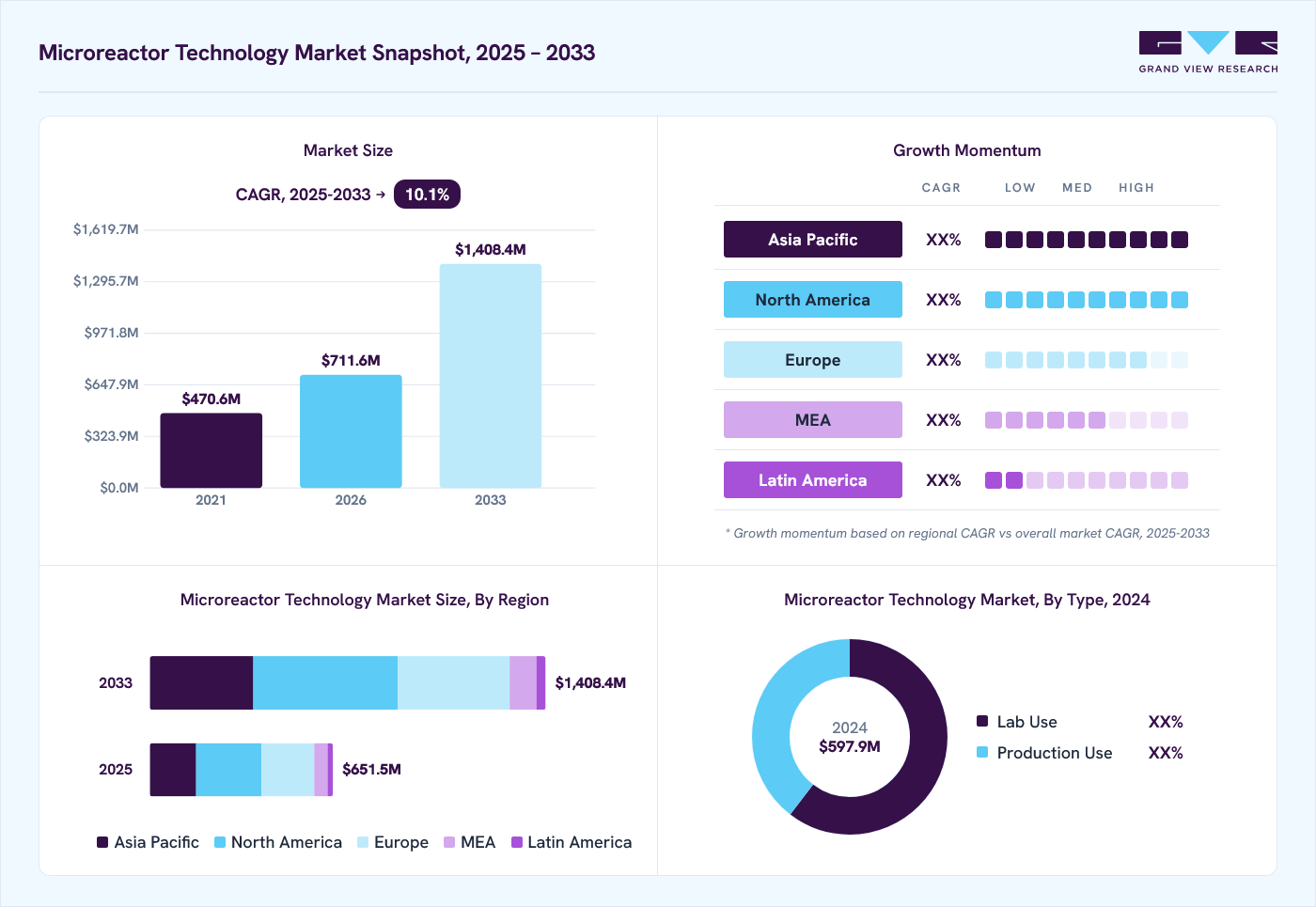
The global microreactor technology market size was valued at USD 597.9 million in 2024 and is projected to grow from USD 711.6 million in 2026 to USD 1,408.4 million by 2033, at a CAGR of 10.1% from 2025 to 2033. North America dominated the market, accounting for a revenue share of 35.5% in 2024. The microreactor technology market is primarily driven by the increasing adoption of continuous flow chemistry in the pharmaceutical and specialty chemicals industries.
 Source: Grand View Research, IR Documents, Primary Interviews, Paid DatabasesTo learn more about this report,
 Download Free Sample Report
 Key Market Trends & Insights
- By type, the production use segment is expected to grow at a CAGR of 10.4% from 2025 to 2033 in terms of revenue.
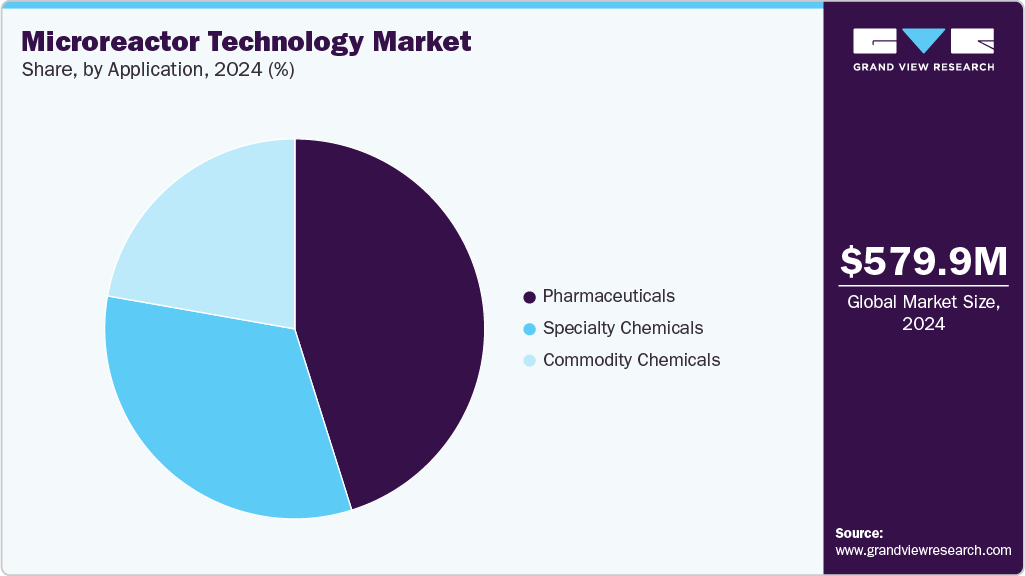
- By application, the pharmaceuticals segment is expected to grow at a CAGR of 10.6% from 2025 to 2033 in terms of revenue.
Market Size & Forecast
- 2024 Market Size: USD 597.9 Million
- 2033 Projected Market Size: USD 1,408.4 Million
- CAGR (2025-2033): 10.1%
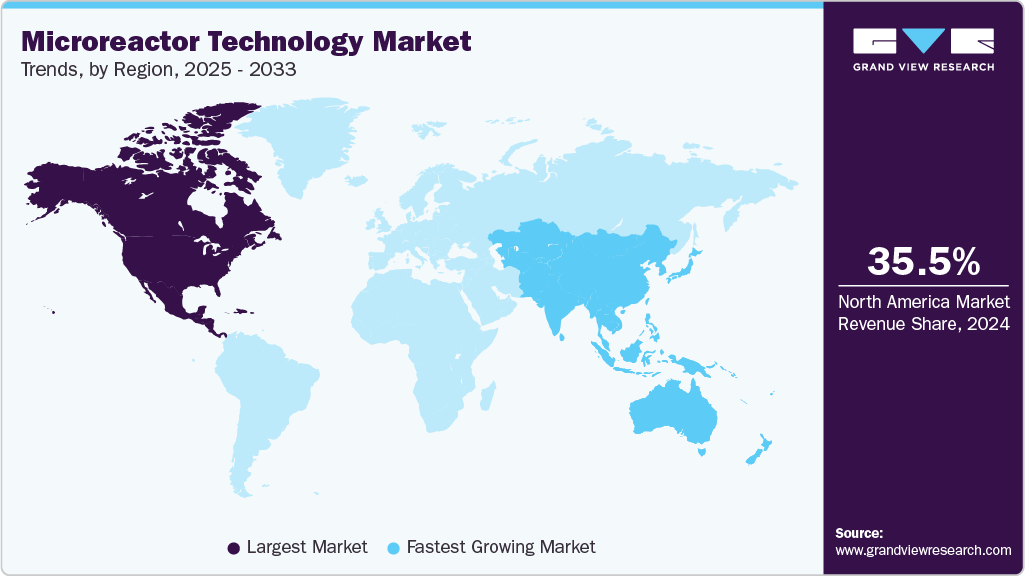
- North America: Largest market in 2024
- Asia Pacific: Fastest growing market
Three ways to get this report
Buy it, customize it, or ask a question.Ask an Analyst
Analyst response in 1 business day
- AccessReport author, directly
- Reply timeWithin 1 working day
- No sales callDirect answer only
- FormatEmail reply
- CostFree, no cost
Get the Full Report
What the study covers
- FormatsPDF · Excel · Dashboard
- Timeline2025–2033 annual, 2024 base
- Coverage20+ countries, 5 regions
- Companies10+ key players profiled
Customize the Report
20% free customization
- IncludeCountries, segments, points
- TailorTo your product definition
- ExtendDeeper competitor detail
- OrA fully bespoke study
- Turnaround5–10 working days
Continuous manufacturing processes offer enhanced control, higher efficiency, and improved safety over traditional batch methods, which aligns with industry goals to reduce costs and accelerate drug development timelines. This has led to significant investment in R&D and the rise of contract research organizations (CROs) supporting early-stage process screening and catalyst development.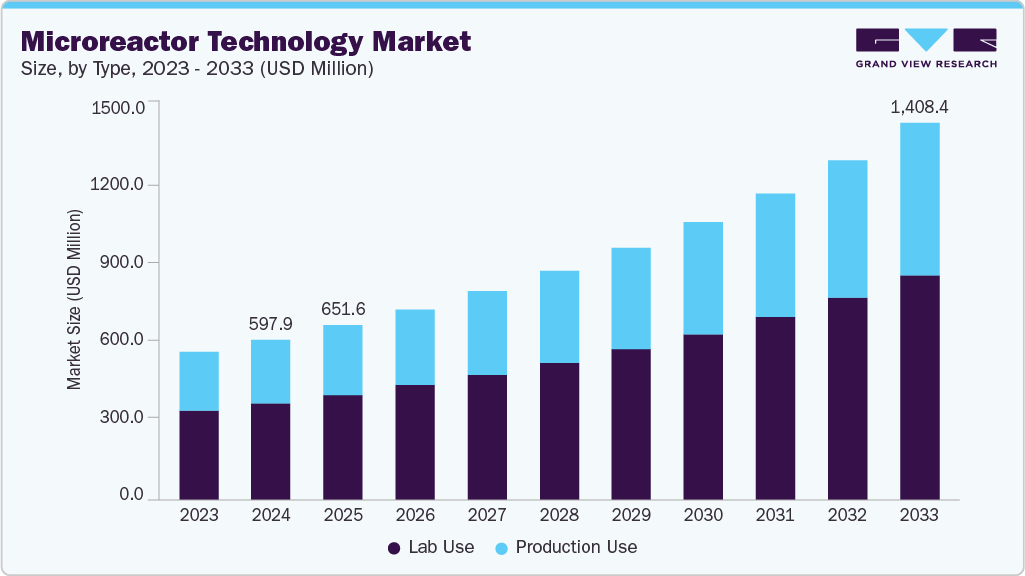 To learn more about this report, Download Free Sample Report
 Technological advancements in reactor design, automation, and materials further boost market growth. Innovations enabling disposable and reusable reactor platforms enhance operational flexibility and cost-effectiveness. In addition, growing regulatory acceptance of continuous manufacturing methods in drug production fosters broader commercial adoption across end-users, solidifying microreactors as an integral technology for future chemical and pharmaceutical manufacturing.
Market Concentration & Characteristics
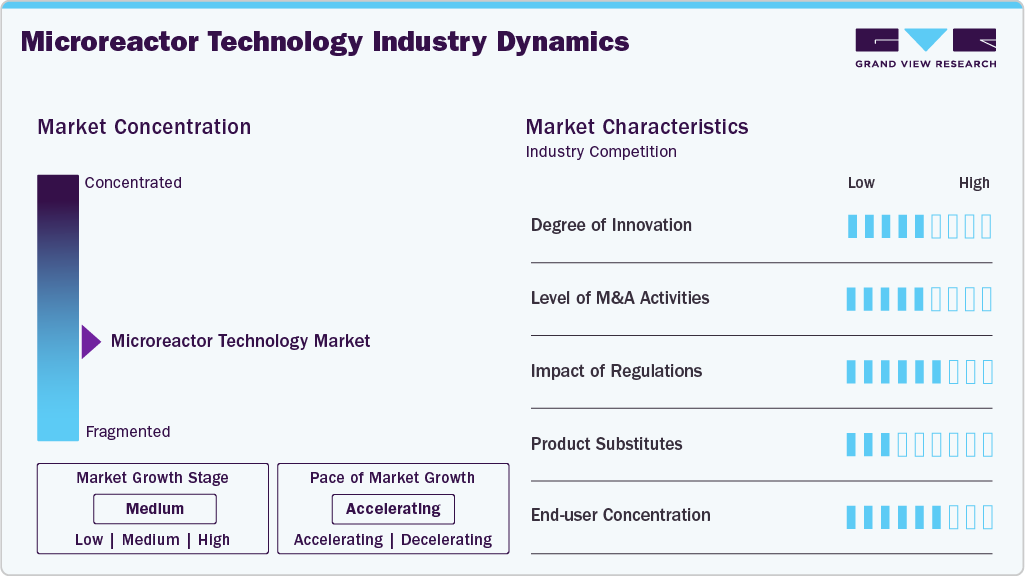
The market concentration is moderate with a diverse mix of established corporations and emerging innovators. It is driven by demand in pharmaceutical, specialty chemicals, and energy sectors where microreactors offer advantages such as enhanced safety, precise control, and improved yields. The end-user base spans across pharmaceutical manufacturing, specialty chemical production, and energy generation, with significant government funding supporting regional developments, particularly in Asia Pacific, North America, and Europe. Asia Pacific leads with the largest regional market share driven by its rapid industrialization, modernization, and investment in research capacities.
 To learn more about this report, Download Free Sample Report
 The market is shaped also by stringent regulatory frameworks emphasizing safety and environmental sustainability, which push users toward adopting microreactor technology over traditional batch reactors. The landscape sees growing continuous manufacturing adoption and process intensification trends, with a focus on automation and digital integration, including AI-driven reaction optimization and real-time process monitoring.
Drivers, Opportunities & Restraints
Another critical driver is the demand for process intensification and modular production in chemical manufacturing. Microreactors facilitate intensified heat and mass transfer, allowing faster and more selective chemical reactions with miniaturized footprints. These advantages are increasingly valued in specialty chemical production, pharmaceutical API synthesis, and fine chemicals, promoting scalability and sustainable manufacturing practices that reduce waste and environmental impact.
The microreactor technology market holds substantial opportunities driven by increasing demand for sustainable, energy-efficient, and precise manufacturing processes. Key growth drivers include rising adoption in pharmaceuticals and specialty chemicals, where microreactors enable faster reactions, improved product quality, and reduced waste. Government investments and funding programs globally especially in advanced nuclear microreactors and clean energy solutions are accelerating innovation and commercialization.
The primary challenge is the high initial investment cost associated with the fabrication, installation, and integration of microreactor systems, which can be prohibitive for small and medium-sized enterprises. In addition, complexities in integrating microreactors into existing manufacturing processes, along with challenges in scaling up from lab to industrial scale, pose hurdles. Regulatory compliance in highly controlled sectors such as pharmaceuticals and specialty chemicals further complicates adoption.
Type Insights
The production use segment is expected to grow at a considerable CAGR of 10.4% from 2025 to 2033 in terms of revenue. The lab use segment dominated the market in 2024 by accounting for a share of 60.4% due to its critical role in academic and industrial R&D activities, early-stage process screening, catalyst development, and formulation testing. It benefits from a strong presence in North America and Europe, where robust R&D infrastructure supports continuous innovation and adoption. Lab use microreactors are vital for experimental workflows, contributing to a majority share of the market driven by ongoing research and development efforts.
The production use segment is experiencing rapid growth due to increasing industrial adoption of microreactors for continuous manufacturing processes. Production use microreactors are valued for their ability to enhance scalability, reduce operational costs, and improve process safety in commercial chemical and pharmaceutical production, fueling expansion in this segment.
Application Insights
The specialty chemicals segment is expected to grow at a considerable CAGR of 10.2% from 2025 to 2033 in terms of revenue. The pharmaceutical segment dominated the market in 2024 holding 45.1% of the market share in 2024 driven by the increasing adoption of continuous API synthesis and intensified drug-substance production routes. Regulatory acceptance of continuous manufacturing methods in the pharmaceutical industry further propels this segment's growth. Frequent transitions from R&D to production scale-ups in pharmaceutical manufacturing underscore the importance of microreactor technology, making it the dominant application segment in the market.
 To learn more about this report, Download Free Sample Report
 The specialty chemical’s segment growth is driven by the rising demand for process intensification in specialty chemical production, where microreactors enable precise reaction control and efficient synthesis of high-value chemicals. The specialty chemicals sector benefits particularly from the technology’s ability to support smaller batch sizes and customized production, which aligns with market trends toward specialty and performance chemicals.
Regional Insights
North America dominated the microreactor technology market with the largest revenue share of 35.5% in 2024, driven by rising demand for miniaturized, efficient, and sustainable production technologies mainly in pharmaceuticals, chemicals, and energy sectors. Growth is supported by regulatory incentives, technological innovation, and increasing R&D investments in advanced microreactor solutions, contributing to an expanding adoption of green manufacturing processes.
 To learn more about this report, Download Free Sample Report
 The microreactor technology market in the U.S. is experiencing strong growth due to significant investments in R&D, increasing adoption in pharmaceutical manufacturing, and supportive government initiatives aimed at advancing clean energy and innovative manufacturing processes. The U.S. market benefits from a well-established industrial base and technological expertise driving adoption of microreactor systems.
Europe Microreactor Technology Market Trends
Europe's microreactor technology market is expected to expand considerably over the forecast period driven by countries such as France and Germany, with strong focus on clean-tech initiatives, sustainable chemical synthesis, and nuclear microreactor exploration. Despite cautious public and regulatory environments, collaborations, EU funding, and R&D initiatives promote technological advancement and commercial deployment.
In France microreactor technology market growth is driven by a focus on sustainable technologies and nuclear microreactor research. Government support combined with strong chemical and pharmaceutical industries fosters development and deployment of microreactor solutions, emphasizing environmental sustainability and process efficiency.
Germany's microreactor technology market expansion is propelled by robust industrial innovation, especially in specialty chemicals and energy sectors. Germany’s emphasis on green technologies and process intensification supports microreactor adoption, alongside strong collaboration between industry and research institutions.
Asia Pacific Microreactor Technology Market Trends
The market in Asia Pacific is driven by economic growth, modernization, and rising investments in pharmaceuticals, specialty chemicals, and nuclear energy sectors. The region is expected to maintain the fastest growth rate over the forecast period, supported by extensive government funding, growing research infrastructure, and a strong manufacturing base, with China as a key driver.
China leads the Asia Pacific region with rapid growth fueled by massive industrialization, government backing for advanced manufacturing, and expanding pharmaceutical and chemical sectors. China’s active investments in clean energy and microreactor technology research position it at the forefront of market expansion.
Microreactor technology market in India is growing steadily, supported by increasing industrial modernization efforts, government incentives for innovation, and rising pharmaceutical production. The growing demand for efficient and scalable manufacturing processes aids the expansion of microreactor technology, while heightened focus on quality control and process safety further drives adoption across chemical and pharmaceutical industries.
Middle East & Africa Microreactor Technology Market Trends
The Middle East and Africa market is expected to grow at a considerably CAGR over the forecast period supported by rapid urbanization, energy security concerns, and increasing adoption of clean and modular microreactor technologies. The region is boosted by government policies promoting nuclear energy and investments in innovative reactor technologies to address power shortages and sustainability goals.
Saudi Arabia microreactor technology market is witnessing growth driven by its vision to diversify energy sources and adopt innovative technologies including nuclear microreactors. Government investments in clean energy infrastructure and industrial modernization support uptake of microreactor systems in this region, with expanding partnerships between local industries and technology providers enhancing deployment and scalability.
Latin America Microreactor Technology Market Trends
The Latin America microreactor market is emerging with steady growth prospects, driven by increasing industrialization and demand for efficient chemical manufacturing. The region is expected to see rising adoption due to efforts in modernizing manufacturing processes, sustainable energy initiatives, and expanding pharmaceutical and chemical industries.
Microreactor technology market growth in Brazil is emerging alongside industrial diversification efforts and investments in sustainable manufacturing. The market is gaining traction primarily due to demand for advanced chemical processing and energy security initiatives, while increasing government support for research and development in process intensification further encourages adoption.
Key Microreactor Technology Company Insights
Some of the key players operating in the market include Corning Incorporated and Chemtrix B.V.
-
Corning Incorporated is a global company involved in specialty glass and materials technology, offering advanced microreactor solutions that enhance chemical processing through superior heat transfer and precise reaction control. Their microreactors are widely used in pharmaceuticals, specialty chemicals, and material sciences due to their high-quality glass reactors and scalable designs. Their strong R&D capabilities and global reach make them a key player in the microreactor technology market.
-
Chemtrix B.V. is a pioneering company specializing in the development and manufacturing of microreactor systems for chemical synthesis and process intensification. They provide modular, customizable microreactors that support continuous flow processes, improving efficiency and safety in pharmaceutical and fine chemical production.
Key Microreactor Technology Companies:
The following are the leading companies in the microreactor technology market. These companies collectively hold the largest market share and dictate industry trends.
- Corning
- Chemtrix
- Little Things Factory
- AM Technology
- Soken Chemical & Engineering
- Ehrfeld Mikrotechnik BTS
- Microinnova Engineering
- Nakamura Choukou
- Uniqsis
- YMC
- Future Chemistry
- Syrris
- Vapourtec
- Suzhou Wenhao
Recent Developments
-
In August 2025, X-Energy announced in collaboration with the U.S. Department of Defense, is advancing its high-temperature gas-cooled microreactor, XENITH, originally developed for Project Pele. This mobile microreactor aims to expand national security applications and represents a next-generation product with significant government backing.
-
In September 2025, Nano Nuclear Energy entered a letter of intent to transfer its ODIN low-pressure coolant microreactor technology to Cambridge Atom Works. This strategic move enables NANO Nuclear to concentrate on its gas-cooled microreactor lineup, including the KRONOS MMR, LOKI MMR, and ZEUS microreactors, while supporting expanding transatlantic partnerships on advanced nuclear technologies between the U.S. and UK.
Microreactor Technology Market Report Scope
Report Attribute
Details
Market size in 2024
USD 597.9 million
Estimated market size in 2026
USD 711.6 million
Projected market size by 2033
USD 1,408.4 million
Growth rate
CAGR of 10.1% from 2025 to 2033
Historical data
2021 - 2023
Forecast period
2025 - 2033
Quantitative units
Revenue in USD million/billion and CAGR from 2025 to 2033
Report coverage
Revenue forecast, company ranking, competitive landscape, growth factors, and trends
Segments covered
Type, application, region
Regional scope
North America; Europe; Asia Pacific; Latin America; Middle East & Africa
Country scope
U.S.; Canada; Mexico; UK; Germany; France; Spain; Italy; China; Japan; India; Australia; South Korea; Brazil; Argentina; Saudi Arabia; South Africa; UAE
Key companies profiled
Corning; Chemtrix; Little Things Factory; AM Technology; Soken Chemical & Engineering; Ehrfeld Mikrotechnik BTS; Microinnova Engineering; Nakamura Choukou; Uniqsis; YMC; Future Chemistry; Syrris; Vapourtec; Suzhou Wenhao
Customization scope
Free report customization (equivalent up to 8 analysts working days) with purchase. Addition or alteration to country, regional & segment scope.
Pricing and purchase options
Avail customized purchase options to meet your exact research needs. Explore purchase options
Global Microreactor Technology Market Report Segmentation
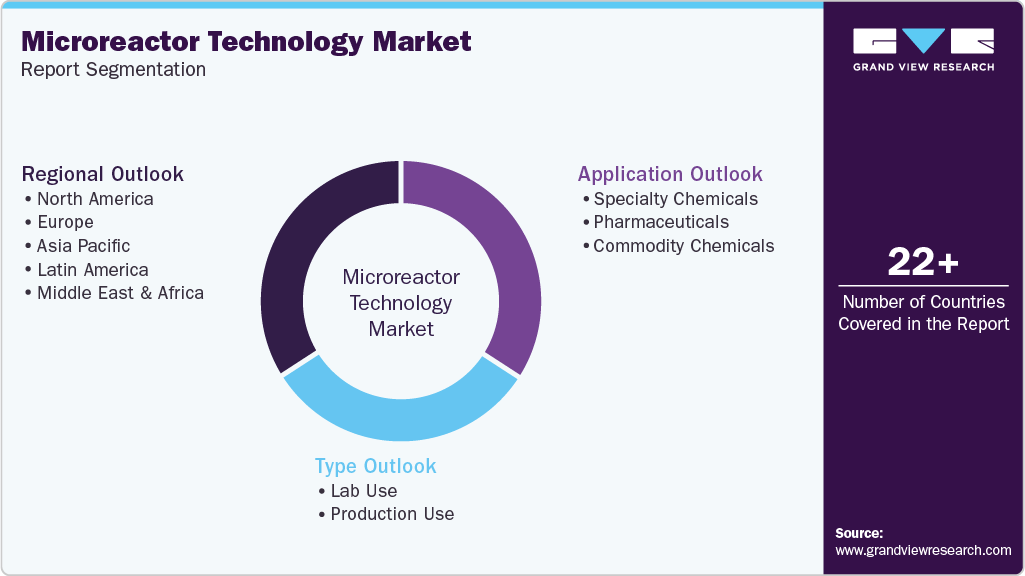
This report forecasts revenue growth at global, regional, and country levels and provides an analysis of the latest industry trends in each of the sub-segments from 2021 to 2033. For this study, Grand View Research has segmented the global microreactor technology market report based on type, application, and region.
 To learn more about this report, Download Free Sample Report
 -
Type Outlook (Revenue, USD Million; 2021 - 2033)
-
Lab Use
-
Production Use
-
-
Application Outlook (Revenue, USD Million; 2021 - 2033)
-
Specialty Chemicals
-
Pharmaceuticals
-
Commodity Chemicals
-
-
Regional Outlook (Revenue, USD Million, 2021 - 2033)
-
North America
-
U.S.
-
Canada
-
Mexico
-
-
Europe
-
Germany
-
France
-
Italy
-
Spain
-
UK
-
-
Asia Pacific
-
China
-
India
-
Japan
-
South Korea
-
Australia
-
-
Latin America
-
Brazil
-
Argentina
-
-
Middle East and Africa
-
Saudi Arabia
-
UAE
-
South Africa
-
-
Frequently Asked Questions About This Report
Some of the key players operating in the global microreactor technology Market include Corning, Chemtrix, Little Things Factory, AM Technology, Soken Chemical & Engineering, Ehrfeld Mikrotechnik BTS, Microinnova Engineering, Nakamura Choukou, Uniqsis, YMC, Future Chemistry, Syrris, Vapourtec, and Suzhou Wenhao.
The global microreactor technology market is primarily driven by increasing demand for efficient, sustainable, and precise chemical manufacturing processes in pharmaceuticals and specialty chemicals, alongside strong government investments in clean energy and advanced manufacturing technologies.
The global microreactor technology market size was estimated at USD 597.9 million in 2024 and is expected to be USD 711.6 million in 2026.
The global microreactor technology market, in terms of revenue, is expected to grow at a compound annual growth rate of 10.1% from 2025 to 2033 to reach USD 1,408.4 million by 2033.
The North America segment dominated the market in 2024, accounting for a 35.5% share fueled by increasing investments in innovative manufacturing and clean energy solutions, along with rising adoption in pharmaceuticals and chemicals industries. The market is projected to expand significantly as regulatory support and technological advancements accelerate deployment.
About the Author(s)
Advanced Interior Materials Research Team
Advanced Materials · Advanced Interior MaterialsThis report was authored by the advanced interior materials research team at Grand View Research - comprising two research analysts, one senior research analyst, and one industry expert - with specialized expertise in the advanced interior materials segment of the advanced materials industry. All findings are based on proprietary advanced materials databases, executive interviews, and regulatory analysis, subject to internal peer review prior to publication.
Last Updated:
Speak to Analyst

Customize this report to your needs - add regions, segments, or data points, with 20% free customization.
Or view our licence options:


ISO 9001:2015 & 27001:2022 Certified
We are GDPR and CCPA compliant! Your transaction & personal information is safe and secure. For more details, please read our privacy policy.


