Middle East Aesthetic Injectable Market Summary
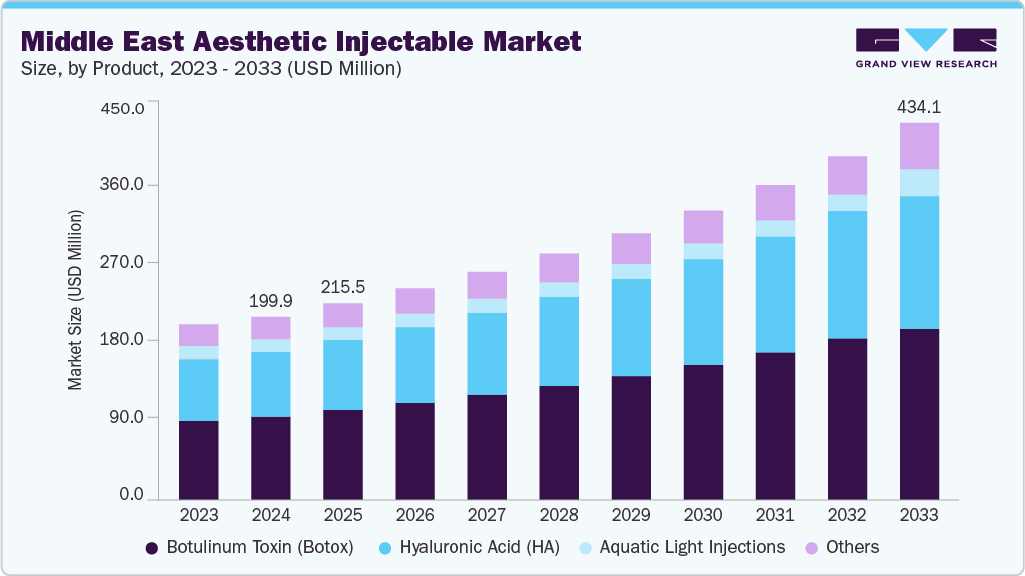
The Middle East aesthetic injectable market size was estimated at USD 199.9 million in 2024 and is projected to reach USD 434.1 million by 2033, growing at a CAGR of 9.1% from 2025 to 2033. This growth is fueled by the increasing awareness and acceptance of minimally invasive cosmetic procedures across the region, driven notably by social media influence and a widening patient demographic that now includes men and younger adults.
Key Market Trends & Insights
- By product, the Botulinum Toxin (Botox) segment held the highest market share of 45.9% in 2024.
- By end use, the medical spas segmentheld the highest market share of 45.4% in 2024.
- By application, the facial line correction segment is projected to grow at the fastest CAGR of 9.4% from 2025 to 2033.
Market Size & Forecast
- 2024 Market Size: USD 199.9 Million
- 2033 Projected Market Size: USD 434.1 Million
- CAGR (2025-2033): 9.1%
Rising disposable incomes and a flourishing medical tourism industry further expand the market, especially in key hubs like the UAE and Saudi Arabia. The rising number of geriatrics is becoming a key growth driver for the Middle East aesthetic injectables industry. According to the World Bank’s 2024 report, around 10% of the region’s population is now aged 65 and above, and this share is expected to keep growing in the coming years. As a result, demand is increasing for cosmetic solutions that address common age-related concerns such as wrinkles, skin laxity, and volume loss.
The growth of the Middle East aesthetic injectable market is fueled by technological progress, improved affordability, and easier access. Botox remains a preferred choice, but the addition of advanced non-invasive options like laser and radiofrequency treatments is giving people more ways to rejuvenate their skin and contour their bodies. At the same time, the rise of aesthetic clinics, medical spas, and loyalty programs is making these procedures more attainable for a wider audience. Botox and other injectables have become central to the region’s cosmetic medicine scene, attracting people across different age groups and reflecting evolving beauty standards, while continuing to drive strong market growth.
Product Insights
The Botulinum Toxin (Botox) segment held the largest market share of 45.9% in 2024, driven by the widespread acceptance of Botox as a minimally invasive, effective treatment for wrinkle reduction, facial rejuvenation, and various therapeutic applications. Advanced formulations offering longer-lasting results, reduced side effects, and expanding networks of trained dermatologists and aesthetic clinics further contribute to its dominance. The rise in aesthetic consciousness among younger demographics and the integration of Botox into personalized beauty regimens solidify its role as the backbone of the injectable market in the Middle East.
The Hyaluronic Acid (HA) segment is expected to grow at the fastest CAGR of 8.9% over the forecast period, driven by rising consumer preference for non-invasive and minimally invasive cosmetic treatments. HA-based dermal fillers are highly favored for their effectiveness in restoring facial volume, smoothing wrinkles, and enhancing features such as lips, all while offering minimal downtime and reduced risk compared to surgical options. Innovations in HA filler formulations, which provide longer-lasting and more natural-looking results, have significantly boosted their appeal across diverse age groups.
End Use Insights
The medical spas segment dominated the Middle East aesthetic injectable industry, with a revenue share of 45.4% in 2024, and is expected to grow at the fastest CAGR over the forecast period. This growth is fueled by the rising consumer preference for minimally invasive cosmetic procedures and the convenience and luxurious experience medical spas offer. These facilities provide a wide range of services under the supervision of licensed physicians, including Botox injections, dermal fillers, skin rejuvenation, and laser treatments, ensuring high safety and efficacy standards. The expanding network of medical spas across key urban centers makes aesthetic injectables more accessible to a diverse demographic. The integration of novel technologies and personalized treatment plans further strengthens the appeal of medical spas, positioning them as a critical distribution channel driving the overall growth of the aesthetic injectable market in the Middle East.
The dermatology clinics segment is expected to grow rapidly over the forecast period, driven by increasing patient trust in specialized medical professionals for injectable treatments. Dermatology clinics offer advanced procedural expertise and personalized care, which appeals strongly to discerning consumers seeking safe and effective wrinkle reduction, volume restoration, and skin rejuvenation solutions. The segment’s growth is supported by expanding clinics equipped with cutting-edge technologies and staffed by trained dermatologists who provide tailored treatment plans based on individual patient needs. As more consumers prioritize medical-grade, evidence-backed aesthetic treatments over traditional beauty services, dermatology clinics are emerging as a critical end use channel, reinforcing market growth across key urban centers in the Middle East.
Application Insights
The facial line correction segment dominated the Middle East aesthetic injectable market with a revenue share of 34.0% in 2024 and is expected to record the fastest CAGR over the forecast period. This robust growth is driven by increased demand for non-surgical treatments targeting dynamic and static wrinkles, particularly in urban centers with high aesthetic consciousness. Advances in botulinum toxin formulations and dermal fillers have enhanced safety and efficacy profiles, making them preferred options for facial line correction. The segment benefits from the expanding presence of dermatology clinics and medical spas offering personalized protocols, supported by rising disposable incomes and growing medical tourism. Consumers increasingly favor these minimally invasive treatments due to their quick recovery times and natural-looking results, fueling rising adoption among diverse age groups seeking rejuvenation without surgery.
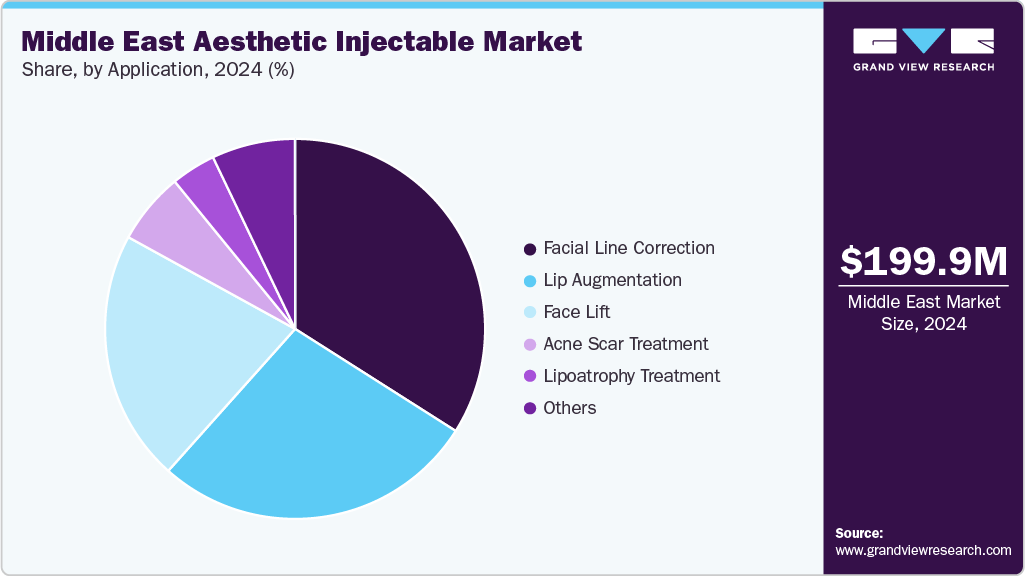
The lip augmentation segment is expected to grow at the second-fastest CAGR over the forecast period, fueled by increasing consumer demand for enhanced facial aesthetics and fuller lips. Popularity is driven particularly by temporary fillers, such as those based on hyaluronic acid, such as Juvederm, which offer effective, minimally invasive results with lower risks and shorter recovery times than surgical options. Technological advancements, including AI-powered imaging for personalized treatment planning and improved safety, further enhance consumer confidence and clinic adoption rates. Overall, lip augmentation is establishing itself as a vital segment within the aesthetic injectable space, responding to evolving beauty preferences in the Middle East.
Country Insights
Saudi Arabia Aesthetic Injectable Market Trends
Saudi Arabia held the largest share of the Middle East aesthetic injectable market in 2024. The country's strong market position is underpinned by high demand for non-surgical cosmetic treatments such as botulinum toxin and hyaluronic acid-based fillers. Major urban centers like Riyadh and Jeddah are seeing a proliferation of advanced dermatology clinics and luxury medical spas, which continue attracting domestic and medical tourism clients.
UAE Aesthetic Injectable Market Trends
The UAE aesthetic injectable market is expected to grow rapidly over the forecast period. This impressive growth is driven by an affluent, innovation-focused consumer base actively seeking advanced, evidence-based skincare solutions for regional concerns like dryness and sensitivity. The UAE’s active digital landscape, booming influence of beauty bloggers, and strong e-commerce channels further accelerate the adoption of probiotic and prebiotic skincare products.
Kuwait Aesthetic Injectable Market Trends
The Kuwait aesthetic injectable market is experiencing steady growth during the forecast period, with the market expected to grow at a CAGR of over 8.76% from 2025 to 2033. The primary drivers include rising demand for non-surgical procedures such as botulinum toxin and hyaluronic acid fillers among women, supported by a proliferation of beauty centers offering diverse injectable treatments and packages. High-value urban clientele and increasing awareness of minimally invasive options fuel uptake.
Turkey Aesthetic Injectable Market Trends
Turkey is projected to grow at a lucrative CAGR in the Middle East aesthetic injectable industry over the forecast period. The country is a regional hub for aesthetic treatments, drawing both domestic and international clients due to its established medical tourism infrastructure and competitive pricing. There is a sustained shift toward non-invasive, “lunch break” procedures such as Botox and dermal fillers, reflecting demand for natural-looking, subtle enhancements that fit a fast-paced lifestyle. This trend is complemented by technological innovation, an increasing number of certified practitioners, and cultural acceptance of cosmetic improvements.
Qatar Aesthetic Injectable Market Trends
The aesthetic injectables market in Qatar is expected to witness growth during the forecast period, owing to urbanization, a young, affluent demographic, frequent social events, and high standards for personal appearance in Doha and other cities. Premium clinics offering tailored services, strong social media influence, and the desire for minimally invasive solutions drive the sector forward. An increase in healthcare spending and government support for private sector medical services further strengthens the market.
Oman Aesthetic Injectable Market Trends
Oman is poised for significant expansion in the Middle East aesthetic injectable market over the forecast period. Awareness and acceptance of aesthetic treatments are rising among both men and women, encouraged by well-equipped urban clinics and growing consumer interest in advanced anti-aging solutions. The trend is marked by an increase in minimally invasive procedures like hyaluronic acid fillers and botulinum toxin for facial rejuvenation. Regulatory clarity and periodic awareness campaigns on safe procedures help maintain trust and ensure market sustainability.
Key Middle East Aesthetic Injectable Company Insights
Some key companies in the Middle East aesthetic injectable industry include AbbVie Inc.; GALDERMA; Merz Pharma; and Daewoong Pharmaceutical Co., Ltd.
- AbbVie is a global biopharmaceutical company known for driving progress in immunology, oncology, neuroscience, eye care, and aesthetics. Through its Allergan Aesthetics division, it delivers some of the world’s most recognized injectable treatments, including Botox and the Juvéderm line.
Key Middle East Aesthetic Injectable Companies:
- AbbVie Inc.
- GALDERMA
- Merz Pharma
- Daewoong Pharmaceutical Co., Ltd.
Recent Developments
-
In July 2025, Daewoong Pharmaceutical announced its expansion to the Middle East region by supplying Nabota, a botulinum toxin, in Kuwait. Daewoong is actively working to establish Nabota as a key botulinum toxin in the region.
-
In May 2025, Hugel Inc., a global medical aesthetics company, introduced its botulinum toxin product, Botulax, by hosting an event in Dubai, UAE, which gathered approximately 180 local dermatologists and plastic surgeons.
Middle East Aesthetic Injectable Market Report Scope
|
Report Attribute
|
Details
|
|
Market size value in 2025
|
USD 215.5 million
|
|
Revenue forecast in 2033
|
USD 434.1 million
|
|
Growth rate
|
CAGR of 9.1% from 2025 to 2033
|
|
Base year for estimation
|
2024
|
|
Historical data
|
2021 - 2023
|
|
Forecast period
|
2025 - 2033
|
|
Quantitative units
|
Revenue in USD million and CAGR from 2025 to 2033
|
|
Report coverage
|
Revenue forecast, company ranking, competitive landscape, growth factors, and trends
|
|
Segments covered
|
Product, end use, application, country
|
|
Regional scope
|
Middle East
|
|
Country scope
|
Saudi Arabia; UAE; Kuwait; Turkey; Qatar; Oman
|
|
Key companies profiled
|
AbbVie Inc.; Daewoong Pharmaceutical Co., Ltd.; GALDERMA; Merz Pharma
|
|
Customization scope
|
Free report customization (equivalent up to 8 analysts working days) with purchase. Addition or alteration to country, regional & segment scope.
|
|
Pricing and purchase options
|
Avail customized purchase options to meet your exact research needs. Explore purchase options
|
Middle East Aesthetic Injectable Market Report Segmentation
This report forecasts revenue growth at the regional and country levels and provides an analysis of the latest industry trends in each of the sub-segments from 2021 to 2033. For this study, Grand View Research has segmented the Middle East aesthetic injectable market report based on product, end use, application, and country:
-
Product Outlook (Revenue, USD Million, 2021 - 2033)
-
Hyaluronic Acid (HA)
-
Botulinum Toxin (Botox)
-
Aquatic Light Injections
-
Others
-
End Use Outlook (Revenue, USD Million, 2021 - 2033)
-
Medical Spas
-
Dermatology Clinics
-
Hospitals
-
Application Outlook (Revenue, USD Million, 2021 - 2033)
-
Facial Line Correction
-
Lip Augmentation
-
Face Lift
-
Acne Scar Treatment
-
Lipoatrophy Treatment
-
Others
-
Country Outlook (Revenue, USD Million, 2021 - 2033)
-
Middle East
-
Saudi Arabia
-
UAE
-
Kuwait
-
Turkey
-
Qatar
-
Oman

 Download Sample Report
















