
- Home
- »
- Electronic Devices
- »
-
Middle East And Africa Emergency Lighting Market, 2030GVR Report cover
![Middle East And Africa Emergency Lighting Market Size, Share, & Trend Report]()
Middle East And Africa Emergency Lighting Market (2025 - 2030) Size, Share, & Trend Analysis By Component, By Light Type, By Power System, By End Use, By Country, And Segment Forecasts
- Report ID: GVR-4-68040-770-1
- Number of Report Pages: 120
- Format: PDF
- Historical Range: 2018 - 2023
- Forecast Period: 2025 - 2030
- Industry: Semiconductors & Electronics
- Report Summary
- Table of Contents
- Segmentation
- Methodology
- Download FREE Sample
-
 Download Sample Report
Middle East And Africa Emergency Lighting Market Summary
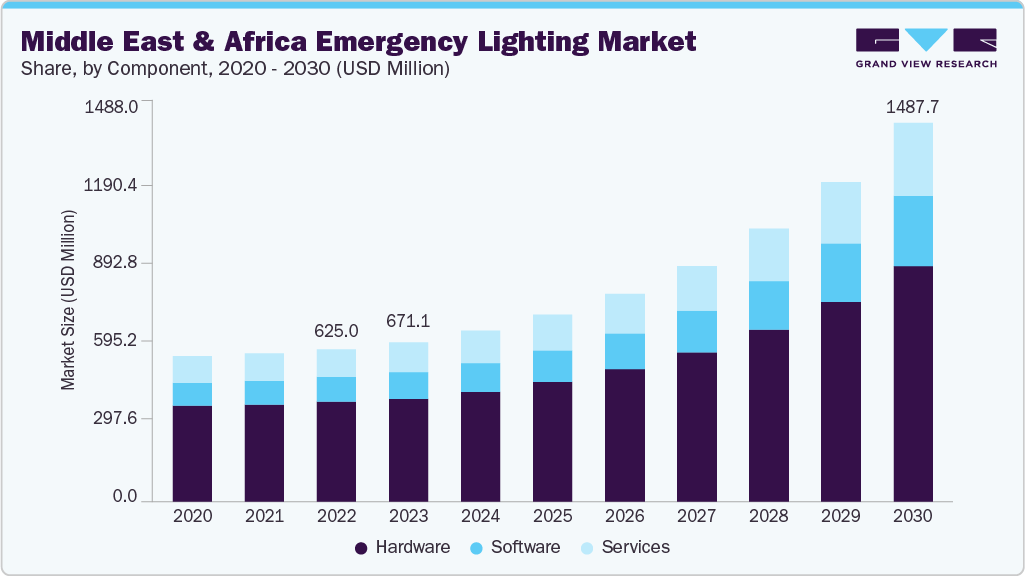
The Middle East and Africa emergency lighting market size was estimated at USD 671.1 million in 2024 and is projected to reach USD 1,487.7 million by 2030, growing at a CAGR of 15.2% from 2025 to 2030. The market is witnessing robust growth, driven by large-scale infrastructure development and stringent regulatory standards across the region.
Key Market Trends & Insights
- Saudi Arabia dominated the Middle East and Africa emergency lighting market with the largest revenue share of 24.2% in 2024.
- By component, the hardware segment led the market with the largest revenue share of 64.49% in 2024.
- By light type, the fluorescent segment accounted for the largest market revenue share in 2024.
Market Size & Forecast
- 2024 Market Size: USD 671.1 Million
- 2030 Projected Market Size: USD 1,487.7 Million
- CAGR (2025-2030): 15.2%
- Saudi Arabia: Largest market in 2024
In addition, increasing adoption of energy-efficient technologies, such as LED-based systems, and advancements in battery backup solutions are enhancing the reliability and sustainability of emergency lighting installations.Moreover, the integration of smart lighting technologies and automation is further improving safety, operational efficiency, and compliance with international standards. Furthermore, growing awareness of energy conservation and environmental sustainability is prompting organizations to invest in innovative, code-compliant, and technologically advanced solutions. The Middle East and Africa emergency lighting industry is driven by the increasing government investments in infrastructure modernization as part of broader economic diversification and urban development strategies.
Projects such as Saudi Arabia’s NEOM, the UAE’s Etihad Rail, Egypt’s New Administrative Capital, and Kenya’s Konza Technopolis demonstrate how national visions are materializing into complex, mixed-use urban ecosystems. These projects demand comprehensive fire and life safety solutions that meet evolving regulatory frameworks, positioning emergency lighting systems as essential to achieving compliance, operational continuity, and occupant safety.
Moreover, the ongoing transformation is not limited to high-profile megaprojects. Across urban and peri-urban areas, there is a steady demand for resilient building systems in sectors such as transportation, hospitality, logistics, education, and retail. As a result, developers, contractors, and consultants are increasingly integrating emergency lighting in the early stages of architectural and engineering planning. These systems are required not only to meet fire codes but also to support advanced building functions such as smart evacuation protocols, centralized control, and low-maintenance diagnostics, especially in high-occupancy or high-risk structures.
Component Insights
The hardware segment led the market with the largest revenue share of 64.5% in 2024, supported by expanding infrastructure projects, rising regulatory compliance, and a transition toward energy-efficient technologies. Hardware elements, including luminaires, batteries, control systems, and charging units, remain essential for ensuring uninterrupted illumination and occupant safety during emergencies.
In addition, the market growth is also influenced by the rapid adoption of LED-based luminaires, which offer superior energy efficiency, longer operational life, and lower maintenance costs compared to conventional fluorescent lighting. At the same time, advancements in battery technologies such as lithium-ion solutions are enabling extended backup capacity, smaller form factors, and improved sustainability, gradually replacing traditional lead-acid alternatives. Control systems are also evolving, with smart, IoT-enabled platforms gaining traction in modern projects across the GCC. These systems provide centralized monitoring, automated testing, and integration with building management systems, helping operators meet stringent safety requirements while reducing operational overhead. Consequently, the hardware segment continues to anchor the MEA emergency lighting market, supported by the dual forces of regulatory enforcement and technological advancement, with growth opportunities emerging across both developed GCC markets and rapidly urbanizing African economies.
The software segment is expected to grow at the fastest CAGR during the forecast period as end-users increasingly prioritize intelligent monitoring, automation, and compliance management within building safety systems. Unlike traditional hardware-only installations, software platforms enable real-time system oversight, predictive maintenance, and centralized control, which are becoming indispensable in modern infrastructure projects across the region.
Moreover, rapid urbanization and the development of smart cities in GCC countries, including Saudi Arabia’s NEOM and the UAE’s Dubai 2040 Urban Master Plan, are accelerating demand for advanced digital safety platforms. Software-driven emergency lighting systems align with these initiatives by supporting data-driven facility management, enabling integration with IoT ecosystems, and contributing to sustainability goals through optimized energy usage and lifecycle management. In conclusion, these factors position the software segment as a critical growth driver in the Middle East and Africa emergency lighting industry, with adoption set to rise further as digital transformation and smart infrastructure development accelerate across the region.
Light Type Insights
The fluorescent segment led the market with the largest revenue share of 57.0% in 2024, largely due to its entrenched presence in the region’s infrastructure and its ability to deliver reliable illumination at a relatively low cost. Many commercial, industrial, and institutional facilities across MEA were originally designed with fluorescent lighting systems, making them a natural choice for emergency lighting applications. Retaining these systems allows facility managers to minimize retrofitting costs and avoid the capital-intensive switch to LEDs, particularly in budget-sensitive markets across Africa. This cost-efficiency, combined with the widespread availability of spare parts and replacement tubes, makes fluorescent solutions a practical option for sustaining safety compliance while managing operational budgets.
Another key driver of growth is the performance characteristics of fluorescent emergency luminaires, which offer broad and uniform light distribution, suitable for high-occupancy spaces such as offices, hospitals, schools, and warehouses. In addition, advancements in compact fluorescent lamps (CFLs) and high-efficiency T8 tubes have improved energy performance compared to older technologies, extending the lifespan of installed systems and reducing maintenance requirements.
The LED segment is expected to grow at the fastest CAGR over the forecast period, driven by rapid adoption of energy-efficient technologies, supportive regulatory frameworks, and large-scale infrastructure investments across the region. LEDs offer substantial advantages over traditional fluorescent and incandescent solutions, including longer operational lifespans, lower power consumption, reduced heat generation, and minimal maintenance requirements. These benefits translate directly into cost savings for building owners and operators, making LEDs the preferred choice for both new installations and retrofit projects in commercial, industrial, and institutional facilities.
In addition, governments in the GCC and across Africa are increasingly promoting energy-efficient solutions as part of broader sustainability and carbon-reduction targets, further accelerating demand for LED-based emergency lighting.
Power System Insights
The self-contained power system segment led the market with the largest revenue share of 56.0% in 2024, driven by its ease of installation, cost efficiency, and suitability for small- and medium-scale facilities. Unlike central battery systems, which require extensive wiring, control infrastructure, and higher upfront investment, self-contained systems operate independently with integrated batteries, ideal for decentralized applications. Moreover, this plug-and-play nature allows for quick deployment in both new constructions and retrofit projects, reducing installation time and minimizing labor costs. For many commercial buildings, retail outlets, educational institutions, and healthcare facilities across MEA, this simplicity has made self-contained systems the most widely adopted power solution.
Moreover, the low maintenance and operational flexibility offered by the self-contained system function is also contributing significantly to spurring the market share. Each luminaire within a self-contained system functions independently, which ensures that a single unit failure does not compromise the overall emergency lighting network. This feature is valuable in regions where maintenance expertise and resources may be limited, as replacements or repairs can be performed without impacting the wider system. Moreover, ongoing advancements in battery technology, such as the integration of lithium-ion cells, have significantly extended the lifespan and reliability of self-contained units, further reducing lifecycle costs and increasing adoption rates.
The hybrid power system segment is expected to grow at the fastest CAGR during the forecast period, due to the growing need for flexibility, redundancy, and energy efficiency in critical safety applications. By combining features of both self-contained units and central battery systems, hybrid power solutions offer a balance between localized autonomy and centralized control. This dual functionality provides enhanced resilience, ensuring that emergency lighting remains operational even if one power source fails. Such reliability is particularly valued in high-risk environments across the GCC, including airports, metro stations, hospitals, and oil and gas facilities, where uninterrupted safety lighting is essential for occupant protection and regulatory compliance.
In addition, the adoption of hybrid power systems is also reinforced by large-scale infrastructure projects across MEA that require customized, future-ready safety solutions. Developers are increasingly seeking adaptable systems that can support diverse building layouts, integrate with smart building technologies, and scale with future expansions. Manufacturers are responding by launching hybrid emergency lighting systems with IoT-enabled monitoring, automated testing, and lithium-ion battery integration to meet the evolving demands of the market. Therefore, the hybrid power system’s ability to combine reliability, sustainability, and adaptability has established it as a vital and fast-growing segment within the Middle East and Africa emergency lighting industry.
End Use Insights
The commercial segment led the market with the largest revenue share of 43.6% in 2024, driven by the rapid expansion of retail, hospitality, healthcare, and office infrastructure across the region. Countries such as the UAE, Saudi Arabia, and Qatar are heavily investing in large-scale commercial projects, including shopping malls, hotels, airports, and mixed-use developments, where compliance with stringent fire and safety regulations mandates the deployment of advanced emergency lighting systems. The growing tourism and hospitality sector, particularly in the Gulf, has further fueled demand for reliable and aesthetically integrated lighting solutions to ensure both safety and operational continuity in high-traffic public environments.
Furthermore, rapid urbanization combined with government-backed initiatives aimed at diversifying economies away from oil dependence is driving large-scale investments in commercial infrastructure, which in turn fuels the demand for advanced emergency lighting solutions. For instance, Saudi Arabia’s Vision 2030 and Dubai’s Smart City program are accelerating the development of world-class commercial infrastructure, each requiring robust and future-ready emergency lighting systems. In Africa, the rise of modern retail formats, commercial hubs, and healthcare investments is similarly expanding the need for cost-effective yet reliable lighting solutions.
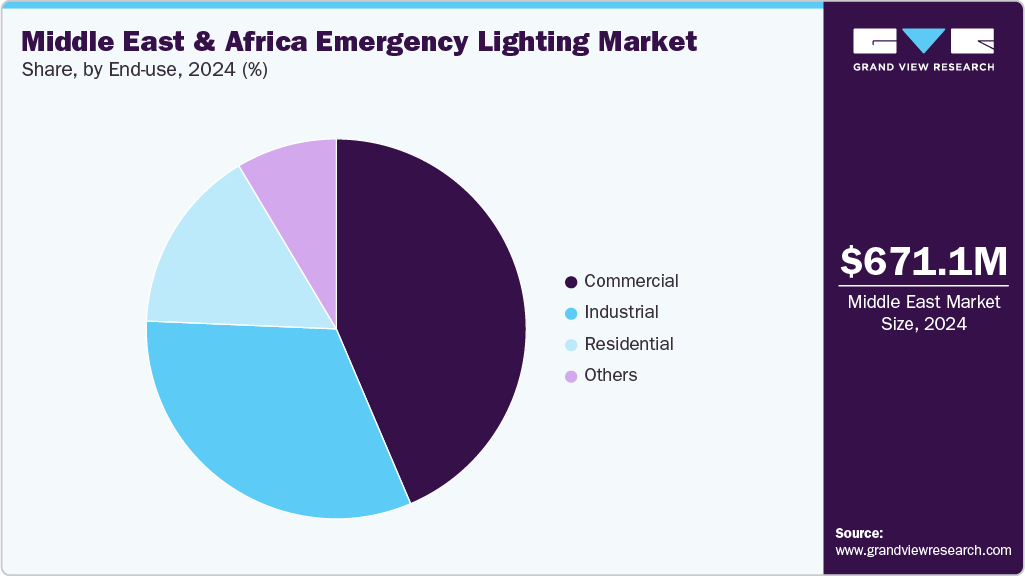
The industrial segment is expected to grow at the fastest CAGR during the forecast period, driven due to the region’s extensive oil and gas, mining, manufacturing, and logistics industries. Facilities within these sectors operate in high-risk environments where worker safety and regulatory compliance are paramount, necessitating the deployment of robust and reliable emergency lighting systems. In the GCC, oil and gas refineries, petrochemical plants, and large industrial complexes mandate adherence to strict fire and life safety standards, making advanced emergency lighting solutions an essential component of operational infrastructure.
Similarly, in African markets, expanding mining operations and industrial parks are driving strong demand for durable lighting systems capable of withstanding harsh conditions. Furthermore, programs such as Saudi Arabia’s Vision 2030, the UAE’s industrial diversification strategies, and Africa’s ongoing investment in special economic zones (SEZs) and industrial corridors are fueling the construction of new factories, processing plants, and logistics facilities, all of which require advanced emergency lighting systems. As MEA economies continue to diversify and industrial activity expands, the demand for reliable, scalable, and regulation-compliant emergency lighting solutions is expected to remain strong, reinforcing the industrial segment’s position as a cornerstone of the market.
Key Middle East And Africa Emergency Lighting Company Insight
Key players operating in the Middle East and Africa emergency lighting industry are Acuity Brands, Beghelli, Daisalux, Eaton, and others. Companies are focusing on various strategic initiatives, including new product development, partnerships & collaborations, and agreements to gain a competitive advantage over their rivals.
Key Middle East And Africa Emergency Lighting Companies:
- Acuity Brands
- Beghelli
- Daisalux
- Eaton
- Legrand
- OSRAM
- Schneider Electric
- Signify (Philips Lighting)
- Teknoware
- Zumtobel Group
Recent Developments
-
In August 2025, Signify Philips Lighting partnered with Smart Directions Group in Saudi Arabia to provide advanced, energy-efficient lighting products, systems, and services. Signify’s expertise in transforming light sources into data points supports smarter, safer, and more productive environments. This partnership underscores efforts to deliver innovative lighting solutions aligned with sustainability and quality of life improvements across the Kingdom.
-
In June 2025, Zumtobel Group launched the Tecton continuous-row lighting system, Tecton II, featuring enhanced functionality, design, and rapid installation capabilities. Developed in collaboration with Pininfarina, the system offers up to 210 lumens per watt efficiency, a tool-free plug-and-play design, and intelligent controls to minimise energy consumption. The rollout of Tecton II emphasizes sustainability through recycled materials and resource conservation practices.
Middle East And Africa Emergency Lighting Report Scope
Report Attribute
Details
Market size value in 2025
USD 732.7 million
Revenue forecast in 2030
USD 1,487.7 million
Growth rate
CAGR of 15.2% from 2025 to 2030
Base year for estimation
2024
Historical data
2018 - 2023
Forecast period
2025 - 2030
Quantitative units
Revenue in USD million/billion and CAGR from 2025 to 2030
Report Scope
Revenue forecast, company share, competitive landscape, growth factors, and trends
Segments covered
Component, light type, power system, end use, region
Regional scope
Middle East & Africa
Country scope
UAE; Saudi Arabia; South Africa; Qatar; Egypt
Key companies profiled
Acuity Brands; Beghelli; Daisalux; Eaton; Legrand; OSRAM; Schneider Electric; Signify (Philips Lighting); Teknoware; Zumtobel Group
Customization scope
Free report customization (equivalent to 8 analysts working days) with purchase. Addition or alteration to country, regional & segment scope.
Pricing and purchase options
Avail customized purchase options to meet your exact research needs. Explore purchase options
Middle East And Africa Emergency Lighting Market Report Segmentation
This report forecasts revenue growth at regional and country levels and provides an analysis of the latest industry trends in each of the sub-segments from 2018 to 2030. For this study, Grand View Research has segmented the Middle East and Africa emergency lighting market report based on component, light type, power system, end use, and region.
-
Component Outlook (Revenue, USD Million, 2018 - 2030)
-
Hardware
-
Software
-
Services
-
-
Light Type Outlook (Revenue, USD Million, 2018 - 2030)
-
Fluorescent
-
LED
-
Incandescent
-
Others
-
-
Power System Outlook (Revenue, USD Million, 2018 - 2030)
-
Self-Contained Power System
-
Central Power System
-
Hybrid Power System
-
-
End Use Outlook (Revenue, USD Million, 2018 - 2030)
-
Residential
-
Commercial
-
Industrial
-
Others
-
-
Country Outlook (Revenue, USD Million, 2018 - 2030)
-
UAE
-
Saudi Arabia
-
South Africa
-
Qatar
-
Egypt
-
Frequently Asked Questions About This Report
b. The Middle East and Africa emergency lighting market size was estimated at USD 671.1 million in 2024 and is expected to reach USD 732.7 million in 2025.
b. The Middle East & Africa emergency lighting market is expected to grow at a compound annual growth rate of 15.2% from 2025 to 2033 to reach USD 1,487.7 million by 2030.
b. Hardware segment dominated the market and accounted for the revenue share of over 64.5% in 2024 supported by expanding infrastructure projects, rising regulatory compliance, and a transition toward energy-efficient technologies.
b. Some key players operating in the market include Acuity Brands, Beghelli, Daisalux, Eaton, Legrand, OSRAM, Schneider Electric, Signify (Philips Lighting), Teknoware, Zumtobel Group, and Others.
b. Factors such as increasing adoption of energy-efficient technologies, such as LED-based systems, and advancements in battery backup solutions are enhancing the reliability and sustainability of emergency lighting installations plays a key role in accelerating the Middle East & Africa emergency lighting market.

Share this report with your colleague or friend.
Need a Tailored Report?
Customize this report to your needs — add regions, segments, or data points, with 20% free customization.


ISO 9001:2015 & 27001:2022 Certified
We are GDPR and CCPA compliant! Your transaction & personal information is safe and secure. For more details, please read our privacy policy.
Trusted market insights - try a free sample
See how our reports are structured and why industry leaders rely on Grand View Research. Get a free sample or ask us to tailor this report to your needs.













