
- Home
- »
- Medical Devices
- »
-
Middle East And Africa Peripheral Liquid Embolic Agents Market Report, 2036GVR Report cover
![Middle East And Africa Peripheral Liquid Embolic Agents Market (2026 - 2036)Report]()
Middle East And Africa Peripheral Liquid Embolic Agents Market (2026 - 2036)
Size, Share & Trends Analysis Report By Product (EVOH, Cyanoacrylates/Tissue Glues Combined), By Application, By End Use, By Country, And Segment Forecasts
Market Size, 2025
$19.5MMarket Estimate, 2026
$21.3MMarket Forecast, 2036
$49.6MCAGR, 2026–2036
8.8%Middle East And Africa Peripheral Liquid Embolic Agents Market Summary
The Middle East and Africa peripheral liquid embolic agents market size was valued at USD 19.5 million in 2025 and is projected to grow from USD 21.3 million in 2026 to USD 49.6 million by 2036, at a CAGR of 8.8% from 2026 to 2036. The market is driven by the rising prevalence of peripheral vascular disorders, increasing adoption of minimally invasive endovascular procedures, and growing use of embolization techniques in interventional oncology.
Key Market Trends & Insights
- By product: Ethylene vinyl alcohol copolymer (EVOH) segment held the largest market share of 85.6% in 2025.
- By application: Venous applications segment held the largest market share of 40.1% in 2025.
- By end use: Hospitals segment held the largest market share of 57.2% in 2025.
Market Size & Forecast
- Market size in 2025: USD 19.5 Million
- Estimated market size in 2026: USD 21.3 Million
- Projected market size by 2036: USD 49.6 Million
- CAGR (2026-2036): 8.8%
Increasing diagnosis and treatment of venous disorders is driving the use of peripheral liquid embolic agents across the Middle East, particularly for patients requiring minimally invasive endovascular procedures. Varicose veins account for a substantial proportion of venous disease cases, with factors such as aging, obesity, prolonged standing, physical inactivity, pregnancy, and chronic venous insufficiency contributing to the need for clinical intervention.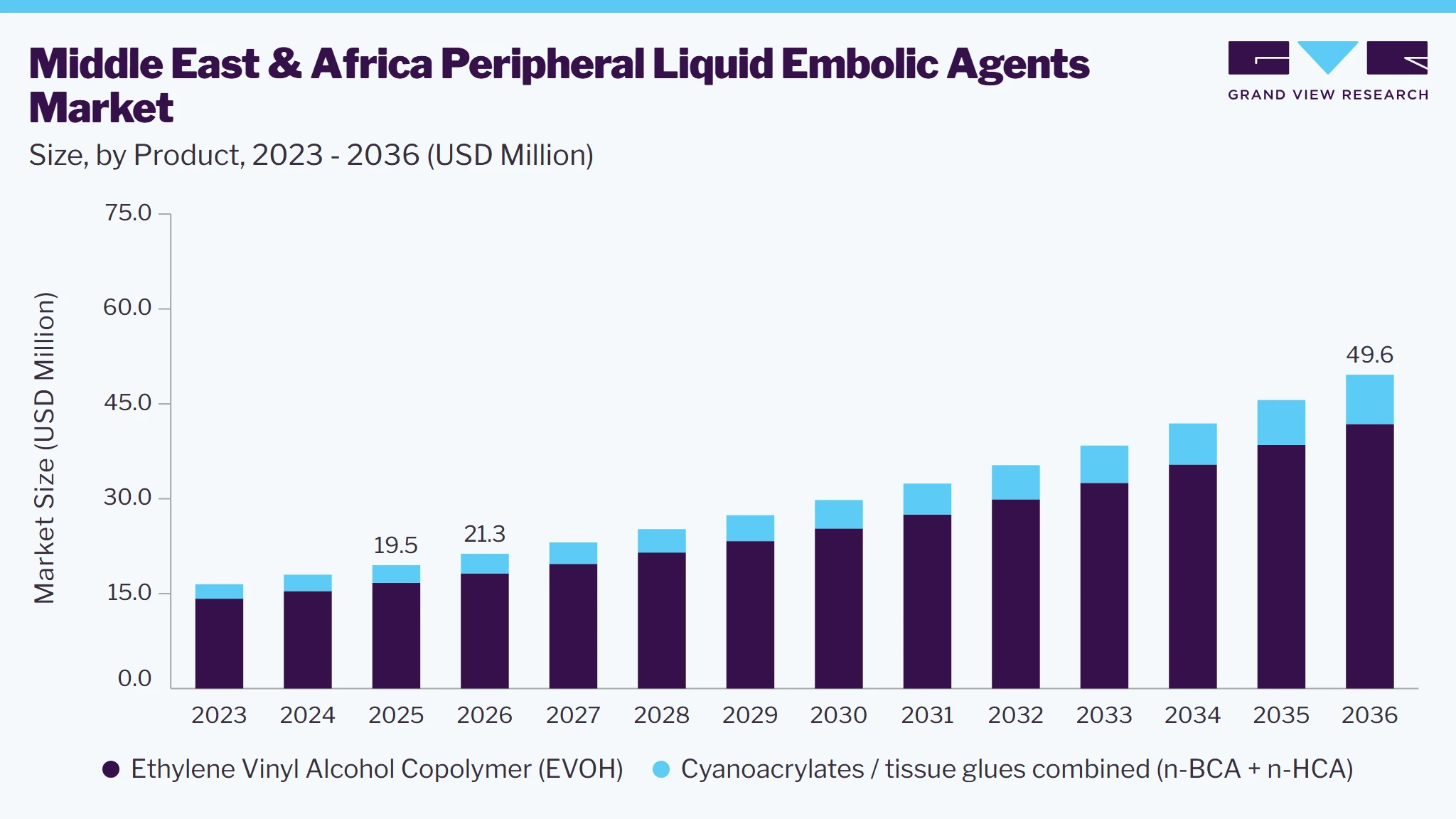
For instance, a study published by the MDPI in 2025, titled "Prevalence of Varicose Veins Among Teaching Professionals and Their Impact on Quality of Life and Job Performance." A cross-sectional study was conducted employing a stratified convenience sampling strategy among 400 school and university educators across different regions of Saudi Arabia. Data collection took place over four months, from mid-January to the end of April 2025.
Factors Associated with the Prevalence of Varicose Veins (VV) among Teaching Professionals (n = 400)
Variable
Category
Without Varicose Veins
With Varicose Veins
Frequency (n)
Frequency (n)
Gender
Female
52
19
Male
132
197
Age
25-30 years
30
20
35-40 years
69
82
40-45 years
23
30
45-50 years
37
55
55-60 years
19
25
Over 65 years
6
4
Teaching/Standing per Day (Hours)
≤1
8
6
1-3
81
83
4-6
22
70
≥6
73
57
Sitting per Day (Hours)
≤1
37
39
1-3
27
36
4-6
16
61
≥6
104
80
Sit for Long Periods During Working Hours
No
103
87
Yes
81
129
Exercise Frequency
2-3 times per week
22
23
Never
92
90
Weekly
27
34
Rarely
38
48
Daily
5
21
Smoking Status
No
168
197
Yes
16
19
Overweight or Obesity
No
126
115
Yes
58
101
Source: MDPI 2025
In addition, expansion of healthcare infrastructure and investment in interventional facilities: The expansion of healthcare infrastructure across the Middle East is supporting the adoption of advanced minimally invasive and image-guided procedures, including embolization interventions. For instance, in February 2026, Aster DM Healthcare announced a Dh1 billion investment in the UAE to expand its healthcare network, including the development of two new hospitals, capacity expansion at an existing facility, and the introduction of advanced medical services. The investment is expected to add approximately 372 beds and create more than 1,000 jobs over the next two to three years. Such investments are strengthening the region's hospital capacity and improving access to specialized and technology-intensive healthcare services. The expansion of advanced clinical infrastructure is expected to increase the availability of facilities capable of performing complex catheter-based and image-guided interventions, thereby creating opportunities for greater adoption of peripheral liquid embolic agents in the UAE and wider Middle East market.
Market Dynamics
The Middle East and Africa peripheral liquid embolic agents market is primarily driven by the increasing adoption of minimally invasive endovascular procedures, expansion of interventional radiology services, and growing demand for image-guided treatment of complex vascular conditions. Healthcare providers are adopting catheter-based approaches as alternatives to open surgery for selected cases involving peripheral vascular hemorrhage, vascular malformations, aneurysms, hypervascular tumors, and venous disorders. The expansion of specialized hospitals, angiography facilities, and interventional radiology units is improving physicians' ability to perform selective and complex embolization procedures.
The adoption of minimally invasive embolization procedures is increasing across the Middle East and Africa as healthcare systems expand access to interventional radiology and endovascular treatment. Embolization can provide a less invasive alternative to open surgery for selected conditions such as peripheral vascular bleeding, vascular malformations, hypervascular tumors, aneurysms, and venous disorders. Improvements in angiographic imaging, microcatheters, and liquid embolic technologies are also enabling physicians to treat smaller, and anatomically complex vessels with greater precision. In Saudi Arabia and the UAE, investment in advanced hospitals and specialist interventional radiology services is supporting wider availability of these procedures.
The shortage and uneven geographic distribution of trained interventional radiologists represents a key restraint for the MEA market. Complex embolization procedures require specialized expertise in vascular imaging, catheter navigation, embolic-agent selection, and management of procedure-related complications. While countries such as North Africa and South Africa have established interventional radiology capabilities in major tertiary hospitals, access to trained specialists and advanced angiography infrastructure remains more limited in several African countries and less-developed healthcare markets.
The development of physician training and technology-transfer programs represents a significant opportunity to expand the market in Africa. Increasing investment in healthcare infrastructure alone may not be sufficient where access to specialized interventional radiology expertise remains limited. Manufacturers, hospitals, academic institutions, and professional societies can support market development through hands-on physician training, fellowship programs, simulation-based education, visiting-specialist programs, and technology-transfer initiatives. Such programs can improve physicians' familiarity with microcatheter techniques, embolic-agent selection, and image-guided embolization procedures while strengthening local clinical capabilities. As more African hospitals develop interventional radiology services and physicians gain experience with minimally invasive embolization, procedures that currently require referral to major centers may performed locally.
Market Characteristics & Concentration
The Middle East and Africa peripheral liquid embolic agents industry is characterized by a moderate to high degree of innovation, supported by advancements in liquid embolic formulations, delivery systems, viscosity, polymerization characteristics, and catheter compatibility. Manufacturers and clinical users are focused on technologies that enable controlled delivery, predictable vessel occlusion, improved visualization, and treatment of complex or tortuous vascular anatomy.
The market is characterized by a low to moderate level of M&A activity, with companies primarily seeking to strengthen their interventional radiology and vascular portfolios through strategic partnerships, distribution agreements, licensing arrangements, and selective acquisitions. These activities can provide access to complementary embolization technologies, local regulatory expertise, established hospital relationships, and regional distribution networks. Partnerships are particularly important in the Middle East and Africa because market access varies considerably across countries.
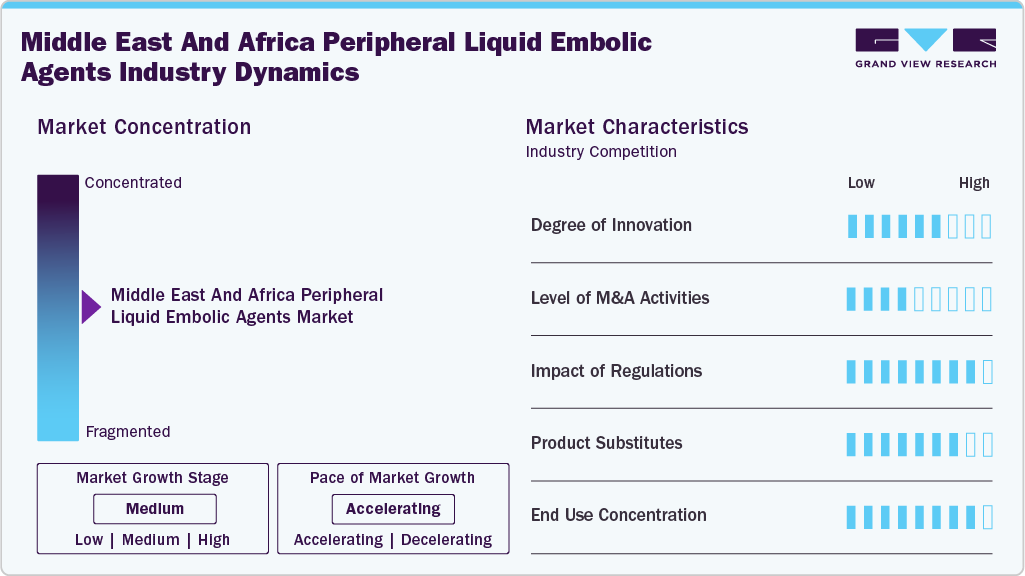
The market experiences a high regulatory impact because peripheral liquid embolic agents are specialized medical devices that require compliance with country-specific requirements related to safety, performance, clinical evidence, manufacturing quality, product registration, and post-market surveillance. Regulatory pathways differ across major MEA markets, including North Africa, South Africa, and other countries. These differences can increase registration costs, documentation requirements, distributor qualification requirements, and time to market.
The market faces moderate to high competition from substitute embolization technologies, including embolization coils, vascular plugs, particles, sclerosants, and other embolic materials. Product selection depends on vessel size, lesion characteristics, vascular anatomy, desired permanence of occlusion, procedural urgency, and physician preference. Coils and vascular plugs are commonly used for focal vessel occlusion, while particles and other agents may be selected for tumor embolization and specific vascular indications.
Demand for peripheral liquid embolic agents in the Middle East and Africa is highly concentrated in hospitals, academic medical centers, tertiary-care hospitals, and specialized interventional radiology and vascular centers. These facilities generally have angiography systems, advanced imaging equipment, catheterization laboratories, microcatheters, and trained specialists required for complex embolization procedures. Concentration is particularly evident in developed healthcare markets such as Saudi Arabia and the UAE, while adoption in several African and lower-resource markets remains more limited because of infrastructure, specialist availability, and equipment constraints.
Analyst Perspective
From an analyst’s perspective, the market is positioned for steady growth, supported by expanding interventional radiology infrastructure and increasing adoption of minimally invasive embolization. Opportunities are expected across hemorrhage, hypervascular tumors, AVMs, aneurysms/pseudoaneurysms, Type II endoleaks, PVE, and venous applications. Advances in EVOH and cyanoacrylate-based agents, delivery systems, and imaging technologies are expected to improve procedural control and clinical adoption. Manufacturers offering controlled delivery, radiopacity, biocompatibility, predictable occlusion, and strong clinical evidence are likely to gain an advantage. Growing tertiary hospitals, specialist training, vascular centers, and private healthcare investment will further support market penetration.
Product Insights
The Ethylene Vinyl Alcohol Copolymer (EVOH) segment dominated the market, accounting for 85.6% in 2025. The segment’s dominance is supported by the increasing use of EVOH-based non-adhesive liquid embolic agents in complex embolization procedures, particularly in advanced healthcare centers across Saudi Arabia, the UAE, and Qatar. EVOH-based agents offer controlled delivery, cohesive embolization, and radiopacity, making them suitable for peripheral hemorrhage, vascular malformations, and hypervascular tumors.
Cyanoacrylates/tissue glues combined segment is expected to witness fastest growth during the forecast period, driven by increasing demand for rapid and permanent vascular occlusion in emergency hemorrhage management and complex vascular lesions across the Middle East & Africa. Growing adoption of minimally invasive embolization procedures, expansion of interventional radiology capabilities, and increasing availability of image-guided vascular interventions are supporting the use of liquid embolic agents in regional healthcare facilities. n-Butyl cyanoacrylate (n-BCA) rapidly polymerizes upon contact with blood, enabling immediate and durable vessel occlusion, making it particularly suitable for small-caliber, tortuous, and high-flow vessels where rapid hemostasis is required.
Application Insights
The venous applications segment dominated market, accounting for 40.1% of the market in 2025. This dominance supported by the growing use of minimally invasive embolization procedures for conditions such as varicocele, pelvic congestion syndrome (PCS), and varicose veins. In South Africa, Fertility Solutions, in an article published on April 2026, reported that male factor infertility accounts for approximately 40% of South African couples struggling to conceive, while varicocele is present in approximately 40% of men investigated for infertility. These figures indicate a substantial underlying patient population for venous interventions such as varicocele embolization and support the demand potential for peripheral liquid embolic agents in the region.
Type II endoleaks is expected to grow at the fastest rate during the forecast period, driven by the increasing adoption of EVAR for abdominal aortic aneurysms and the occurrence of Type II endoleaks following these procedures. Type II endoleaks are the most common type of endoleak and require secondary embolization when persistent blood flow is associated with aneurysm sac enlargement. The growing adoption of minimally invasive endovascular procedures and advancements in liquid embolic technologies are supporting their use in the management of complex endoleaks. Liquid embolic agents, including ethylene-vinyl alcohol copolymers and n-butyl cyanoacrylate, can penetrate the endoleak cavity and small collateral vessels, providing an effective treatment option when selective catheterization of all feeding vessels is challenging.
End Use Insights
The hospitals segment dominated the market, accounting for 57.2% in 2025. The segment is supported by continued expansion of specialized healthcare infrastructure and increasing investment in facilities capable of providing minimally invasive procedures. For instance, in July 2026, Burjeel Holdings announced that it plans to expand its presence in Saudi Arabia through specialized day surgery centers, with the first facility planned for Khobar in early 2027, followed by Riyadh later in the year. The two centers are expected to involve approximately USD 100 million in investment, with the company targeting a potential network of up to 8-10 day surgery centers in Saudi Arabia. The expansion of specialized surgical and outpatient facilities is expected to increase access to minimally invasive vascular and interventional procedures, thereby supporting the adoption of peripheral liquid embolic agents across hospitals and specialized healthcare facilities in the region.
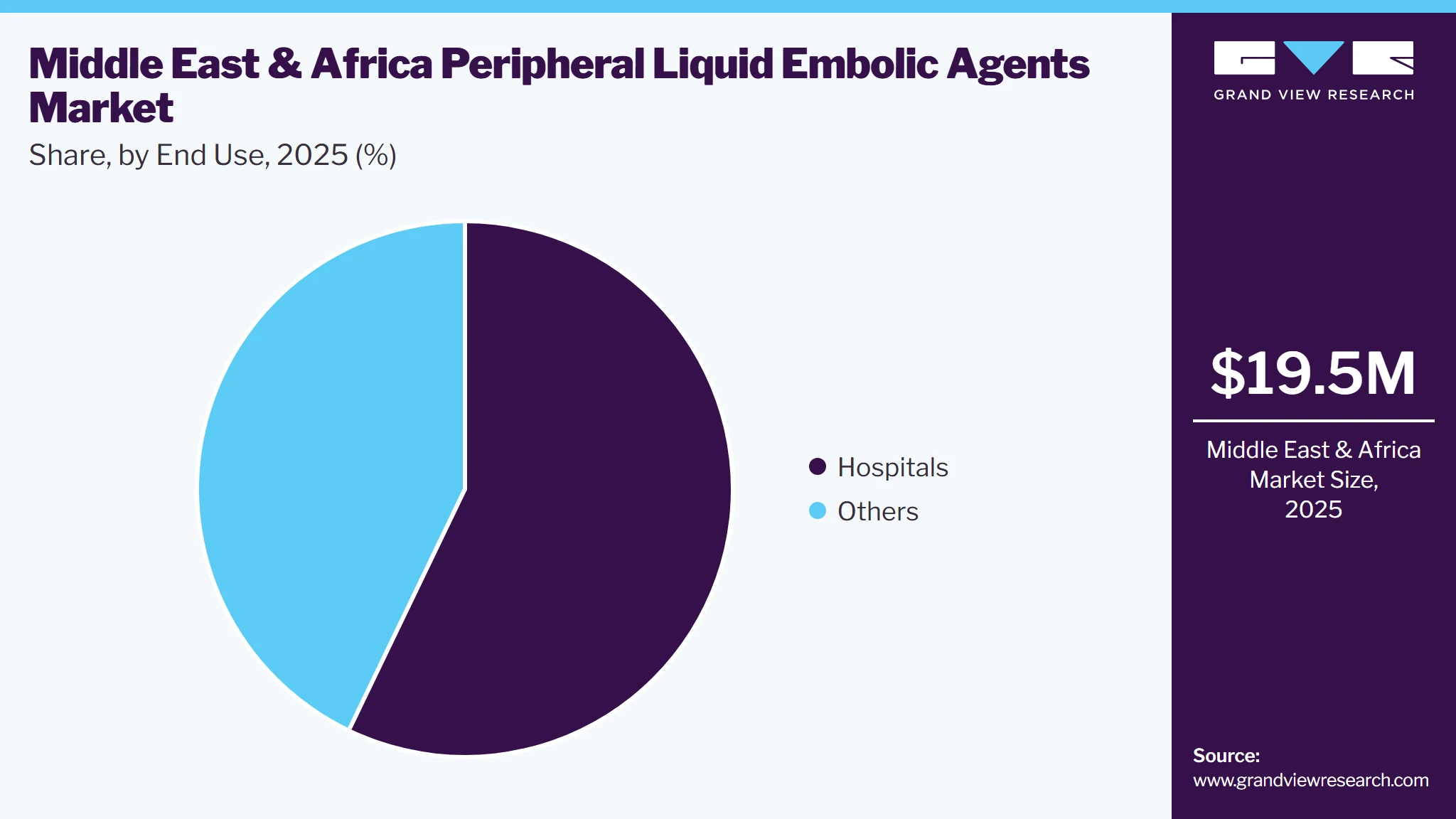
The others end use segment is expected to grow at the fastest rate during the forecast period. Growth is supported by the increasing adoption of outpatient interventional procedures, office-based laboratories (OBLs), ambulatory surgery centers (ASCs), and specialized vascular treatment facilities. The shift toward outpatient and same-day care is gaining momentum across the Middle East, particularly in Middle East, as healthcare providers expand specialized facilities designed to deliver minimally invasive procedures with shorter recovery times.
Country Insights
The Middle East peripheral liquid embolic agents market held the largest share 53.2% in 2025, supported by the region’s substantial cardiovascular disease burden and growing need for minimally invasive vascular interventions. For instance, Kuwait recorded an increase in cardiovascular disease prevalence from 258,385.0 in 2021 to 311,275.5 in 2024, while incidence increased from 18,167.9 to 22,014.8 during the same period, indicating a growing patient population requiring vascular disease management and supporting demand for minimally invasive embolization procedures. The continued burden of cardiovascular disease, combined with increasing availability of interventional radiology and image-guided vascular procedures, is expected to support adoption of peripheral liquid embolic agents across Middle Eastern healthcare systems.
North Africa Peripheral Liquid Embolic Agents Market Trends
The peripheral liquid embolic agents market in North Africa is witnessing the fastest rate during the forecast period, supported by the increasing adoption of minimally invasive endovascular procedures for managing complex peripheral vascular conditions, including peripheral vascular malformations/AVMs, aneurysms, pseudoaneurysms, peripheral vascular hemorrhage, portal vein embolization, and venous applications such as varicocele and pelvic venous disorders. The region is experiencing gradual development of vascular care infrastructure, with improved availability of angiography systems, interventional radiology facilities, and specialized clinicians capable of performing catheter-based embolization procedures.
Key Middle East And Africa Peripheral Liquid Embolic Agents Company Insights
Some of the key companies in the market include Medtronic, BALT Group (via Compass Medical Pty Ltd), and GEM S.r.l. (H.B. Fuller Company). Major players in the Middle East and Africa market are focusing on product innovation and development of advanced formulations with improved delivery control, penetration, visibility, and safety.
Key Middle East and Africa Peripheral Liquid Embolic Agents Companies
-
Medtronic
-
GEM S.r.l. (H.B. Fuller Company)
-
BALT Group (via Compass Medical Pty Ltd)
Competitive Benchmarking
Category
Operating Strategies
Competitive Edge
Weakness
Established Players (Medtronic)
Expands its embolization portfolio while strengthening relationships with hospitals, interventional radiologists, and vascular centers across developed and emerging MEA markets.
Supports adoption through clinical education, physician training, and expansion of liquid embolic applications across complex peripheral vascular procedures.- Strong global brand recognition, extensive R&D capabilities, broad peripheral vascular portfolio, and established regulatory and distribution capabilities across international markets.
- Its established liquid embolic technologies and physician relationships provide a strong platform for competing in specialized embolization procedures.
- Relatively higher product and procedural costs can restrict adoption in price-sensitive African and emerging Middle Eastern healthcare markets.
- Product utilization depends on specialized physicians, angiography infrastructure, and trained hospital teams, which remain unevenly available across MEA.
Emerging Players (BALT Group (via Compass Medical Pty Ltd), GEM S.r.l. (H.B. Fuller Company))
- Focuses on specialized cyanoacrylate-based embolization solutions and expansion of applications across peripheral vascular and interventional procedures.
- Uses regional commercial partnerships and distributors to improve product availability and reach hospitals and specialist centers across emerging MEA markets.
- Specialized expertise in cyanoacrylate-based embolization technologies provides a focused competitive position within liquid embolic applications.
- Product specialization can support flexibility in addressing selected peripheral vascular indications where tissue-adhesive embolization is clinically appropriate.
- Smaller global commercial scale compared with diversified multinational medtech companies may limit market visibility and physician reach across MEA.
- Dependence on distributors and specialist centers can constrain direct market development.
Middle East And Africa Peripheral Liquid Embolic Agents Market Report Scope
Report Attribute
Details
Market size in 2025
USD 19.5 million
Estimated market size in 2026
USD 21.3 million
Projected market size by 2036
USD 49.6 million
Growth rate
CAGR of 8.8% from 2026 to 2036
Actual data
2021 - 2025
Forecast period
2026 - 2036
Quantitative units
Revenue in USD million and CAGR from 2026 to 2036
Report coverage
Revenue forecast, company ranking, competitive landscape, growth factors, and trends
Segments covered
Product, application, end use, region
Country scope
Middle East; North Africa; South Africa
Key companies profiled
Medtronic; GEM S.r.l. (H.B. Fuller Company); BALT Group (via Compass Medical Pty Ltd.)
Customization scope
Free report customization (equivalent up to 8 analyst’s working days) with purchase. Addition or alteration to country, regional & segment scope
Pricing and purchase options
Avail customized purchase options to meet your exact research needs. Explore purchase options
Middle East and Africa Peripheral Liquid Embolic Agents Market Report Segmentation
This report forecasts revenue growth at country level and provides an analysis of the latest industry trends in each of the sub-segments from 2021 to 2036. For this study, Grand View Research has segmented the Middle East and Africa peripheral liquid embolic agents market report based on product, application and end use:
-
Product Outlook (Revenue, USD Million, 2021 - 2036)
-
Ethylene Vinyl Alcohol Copolymer (EVOH)
-
Cyanoacrylates/tissue glues combined
-
n-butyl cyanoacrylate (n-BCA)
-
n-hexyl cyanoacrylate (n-HCA)
-
-
Application Outlook (Revenue, USD Million, 2021 - 2036)
-
Peripheral Vascular Hemorrhage
-
Hypervascular Tumors
-
Peripheral Vascular Malformations/AVMs
-
Aneurysms/Pseudoaneurysms
-
Type II Endoleaks
-
Portal Vein Embolization (PVE)
-
Venous Applications (varicocele, PCS, varicose veins)
-
-
End Use Outlook (Revenue, USD Million, 2021 - 2036)
-
Hospitals
-
Others
-
-
Country Outlook (Revenue, USD Million, 2021-2036)
-
Middle East
-
North Africa
-
South Africa
-
Research Methodology
The Middle East and Africa peripheral liquid embolic agents market figures in this report are based on a proven research process that combines executive interviews with secondary research from proprietary databases, company filings, and recognized regulatory and institutional sources. Market size is built through value-chain sizing—reconciling supply-side and demand-side estimates—and triangulated with bottom-up and top-down approaches. Every estimate passes multiple levels of expert validation before publication, with each Middle East and Africa peripheral liquid embolic agents segment quantified using the revenue-capture definitions in the table below.
Segment Definition
Product
Revenue capture definition
Ethylene Vinyl Alcohol
Copolymer (EVOH)
Revenue generated from EVOH-based liquid embolic agents, consisting of ethylene vinyl alcohol copolymer dissolved in DMSO and typically containing radiopaque materials such as tantalum. These non-adhesive agents form a cohesive polymer cast within the target vessels and are used for controlled and permanent embolization of peripheral vascular lesions, including arteriovenous malformations, hypervascular tumors, bleeding, and Type II endoleaks.
Cyanoacrylates/tissue
glues combined
Revenue generated from the sale of cyanoacrylate-based liquid embolic agents and tissue glues containing n-butyl cyanoacrylate (n-BCA), N-hexyl cyanoacrylate (n-HCA), or formulations combining these agents, used for vascular embolization and tissue sealing procedures. Revenue includes the product value realized by manufacturers from these embolic/glue products, while excluding delivery catheters, ancillary devices, and procedure-related services.
Estimation Model
Stage
Description
Bottom-Up Estimation
The market is estimated by assessing the annual volume of peripheral embolization procedures performed across tertiary and multispecialty hospitals, interventional radiology centers, specialty vascular facilities, and ambulatory surgical centers across major Middle East and Africa countries. The analysis considers procedures involving EVOH-based agents, and cyanoacrylate-based agents, used for Type II endoleaks, peripheral AVMs, pseudoaneurysms, hemorrhage, and portal vein embolization.
Top-Down Approach
The market estimation begins with an assessment of the broader peripheral vascular intervention, embolization, and interventional radiology markets across the Middle East and Africa, followed by evaluating the proportion attributable to peripheral liquid embolic agents. The analysis incorporates key market indicators such as the prevalence of peripheral vascular diseases, volume of endovascular procedures, EVAR procedures and associated Type II endoleaks, vascular malformations, hemorrhage-related interventions, interventional oncology activity, and portal vein embolization.
Supply-Side Analysis
The supply-side assessment evaluates manufacturers' product portfolios, regional sales, shipment volumes, average selling prices, production capacity, regulatory approvals, product indications, and distribution networks across the Middle East and Africa. The analysis covers major product categories, including EVOH-based agents, cyanoacrylates/tissue glues, and other liquid embolics, with further assessment of n-BCA and n-HCA within the cyanoacrylate segment. Manufacturer-level revenue contribution is evaluated across major applications, including hemorrhage, hypervascular tumors, AVMs, and aneurysms/pseudoaneurysms.
Customization Table
This report has been delivered with the following In-depth customizations
Client Request
Customization Delivered
Value Adds
Peripheral Liquid Embolic Agents Product Portfolio & Application Analysis
Conducted a comprehensive assessment of peripheral liquid embolic agent portfolios, including EVOH-based embolics, cyanoacrylate/tissue glues. Evaluated adoption across key applications such as Type II endoleaks, portal vein embolization, peripheral AVMs, vascular malformations, hemorrhage, pseudoaneurysms, and tumor embolization. The analysis assessed product characteristics, delivery systems, clinical applications, and adoption patterns across major MEA markets, with particular emphasis on countries with established interventional radiology and vascular care capabilities.
Helps stakeholders identify high-growth product and application segments, assess differences in technology adoption across developed and emerging MEA markets, understand unmet clinical needs, and optimize product portfolios for regional embolization requirements.
End-user Adoption & Procurement Landscape Analysis
Analyzed adoption across tertiary and multispecialty hospitals, academic medical centers, interventional radiology centers, specialty vascular facilities, ambulatory surgical centers, and other healthcare settings. Assessed procurement criteria, product pricing, clinical preferences, availability of trained interventional specialists, angiography and imaging infrastructure, reimbursement conditions, import dependence, distributor networks, and public versus private healthcare procurement practices across MEA countries.
Enables manufacturers to identify high-potential end-user segments and priority countries, develop appropriate pricing and distribution strategies, improve procurement planning, and expand penetration in both established Gulf markets and emerging African healthcare markets.
Product Positioning & Manufacturer Competitiveness Assessment
Evaluated key manufacturers based on liquid embolic technology, portfolio breadth, clinical applications, controlled embolization, regulatory positioning, geographic presence, pricing strategies, distributor strength, clinical evidence, and physician adoption. The assessment also examined product launches, portfolio expansion, strategic partnerships, regulatory developments, and technology differentiation across major MEA markets.
Supports competitive benchmarking and identification of market gaps, enables differentiation between EVOH- and cyanoacrylate-based solutions, identifies opportunities for distributor partnerships and localized market development, and helps manufacturers strengthen go-to-market strategies and competitive positioning across high-potential MEA countries.
About the Author(s)
Medical Devices Research Team
Healthcare · Medical DevicesThis report was authored by the medical devices research team at Grand View Research - comprising two research analysts, one senior research analyst, and one industry expert - with specialized expertise in the medical devices segment of the healthcare industry. All findings are based on proprietary healthcare databases, executive interviews, and regulatory analysis, subject to internal peer review prior to publication.
Last Updated:
Speak to Analyst


Customize this report to your needs — add regions, segments, or data points, with 20% free customization.
Or view our licence options:


ISO 9001:2015 & 27001:2022 Certified
We are GDPR and CCPA compliant! Your transaction & personal information is safe and secure. For more details, please read our privacy policy.


