
- Home
- »
- Homecare & Decor
- »
-
Middle East Bike Market Size & Share, Industry Report, 2033GVR Report cover
![Middle East Bike Market Size, Share & Trends Report]()
Middle East Bike Market (2025 - 2033) Size, Share & Trends Analysis Report By Type (Conventional, Electric), By Product (City/Commuter Bikes, Road Bikes, Mountain Bikes), By Price Range, By End User, By Application, By Region, And Segment Forecasts
- Report ID: GVR-4-68040-750-7
- Number of Report Pages: 110
- Format: PDF
- Historical Range: 2021 - 2024
- Forecast Period: 2025 - 2033
- Industry: Consumer Goods
- Report Summary
- Table of Contents
- Segmentation
- Methodology
- Download FREE Sample
-
 Download Sample Report
Middle East Bike Market Summary
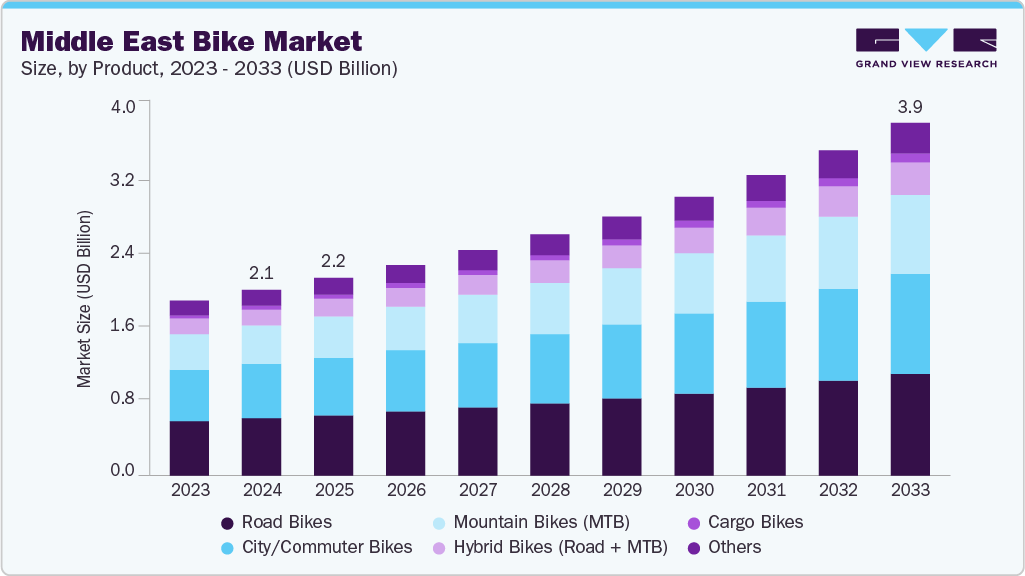
The Middle East bike market size was estimated at USD 2,065.3 million in 2024 and is projected to reach USD 3,912.8 million by 2033, growing at a CAGR of 7.5% from 2025 to 2033. The market is expanding as governments align cycling with broader sustainability and urban mobility goals.
Key Market Trends & Insights
- By type, the conventional bikes segment held the highest market share of 83.47% in 2024.
- By product, the road bikes segment held the highest market share in 2024.
- By end user, the men segment held the largest market share in 2024.
- By application, the personal/individual segment accounted for the highest market share in 2024.
Market Size & Forecast
- 2024 Market Size: USD 2,065.3 Million
- 2033 Projected Market Size: USD 3,912.8 Million
- CAGR (2025-2033): 7.5%
- Saudi Arabia: Largest market in 2024
In Dubai, more than 560 kilometers of cycling tracks are already operational, with plans to extend the network to 1,000 kilometers by 2030. Saudi Arabia is embedding bicycles into Vision 2030, with Medina introducing a large-scale bike-sharing system featuring 500 e-bikes and 60 charging stations. These infrastructure investments, coupled with rising fuel costs and greater public interest in active lifestyles, are helping to position cycling as both a commuter and leisure solution.Health-conscious residents and expatriate communities increasingly adopt cycling in cities such as Dubai, Riyadh, and Doha. The popularity of long-distance recreational routes, like Dubai’s Al Qudra desert cycling track, highlights the sport’s dual role in fitness and tourism. Bike-sharing and micro-mobility services are reducing entry barriers for casual riders, while cycling clubs and community events are building a strong base of regular participants. This blend of lifestyle appeal and practical mobility is reinforcing steady demand across both commuter and leisure categories.
Manufacturers and service providers are adapting to the region’s climate and urban layouts by introducing e-bikes with long-lasting batteries, integrated cooling technologies, and foldable frames for last-mile connectivity. Smart features such as GPS tracking, mobile app integration, and real-time diagnostics are being deployed by rental and subscription operators to ensure reliability in harsh conditions. Infrastructure projects such as the 13.5-kilometer multi-use track linking Al Sufouh to Dubai Hills further enable innovation in design, as lightweight frames and all-weather durability become selling points for premium bicycles.
The Middle East bike industry spans affordable entry-level bicycles used by students and delivery workers, mid-tier e-bikes for commuters, and high-end road or mountain bikes targeted at enthusiasts. Premium demand is particularly strong in the Gulf States, where consumers value brand prestige, advanced materials such as carbon fiber, and smart connectivity. In parallel, subscription models and bike-sharing systems make higher-value bicycles accessible at lower upfront cost, expanding the consumer base. This tiered structure allows manufacturers and mobility providers to capture a diverse audience, from budget-sensitive riders to affluent consumers seeking performance and lifestyle alignment.
Consumer Insights
Cycling’s rise in the Middle East has been strongly influenced by the region’s growing sports culture and government support for high-profile events. Annual competitions such as the UAE Tour, held under the UCI WorldTour, and the Saudi Tour have put professional cycling on the map for local audiences. These events not only showcase elite road bikes but also spark interest among residents in purchasing quality models for recreational use. Consumers exposed to such international races are motivated to invest in performance bikes that mirror those used by professionals, linking their buying decision to aspiration and participation.
Beyond professional races, community rides and endurance challenges are becoming regular features in Gulf cities. Initiatives like “Dubai Ride” during Dubai Fitness Challenge attract tens of thousands of participants, many of whom buy bicycles specifically to join. These events create immediate surges in retail sales as people seek entry-level road bikes, helmets, and accessories. The strong cycling association with fitness festivals and sporting occasions has embedded bicycles into the region’s wellness culture, making event participation a direct driver of purchase decisions.
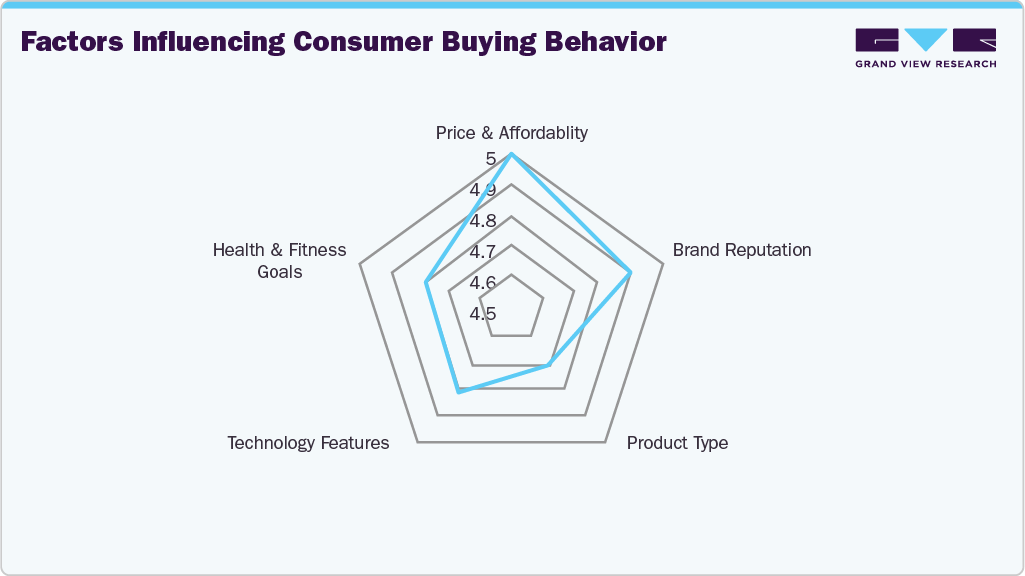
Furthermore, large sporting goods chains such as Decathlon, Adventure HQ, and Sun & Sand Sports stock both affordable commuter bikes and premium imported brands, giving buyers a wide range of options in one place. Specialty stores in Dubai and Riyadh offer access to global brands like Trek, Specialized, and Giant, catering to affluent consumers looking for high-performance or customized models. The visibility and availability of these products make ownership aspirational yet accessible.
E-commerce and mobile shopping are further influencing decisions. Platforms like Noon and Amazon now feature extensive bicycle ranges, with home delivery and financing options that reduce the friction of purchase. For many middle-income buyers, the convenience of online ordering, combined with promotional campaigns around fitness and wellness, can be decisive. At the same time, high-end consumers often prefer in-store experiences where they can test ride models and explore customization. This dual retail approach, digital convenience paired with premium physical outlets, directly shapes how and where consumers decide to purchase.
Type Insights
Conventional bikes led the Middle East bike market with a revenue share of 83.47% in 2024. Their affordability, broad retail presence, and straightforward mechanical design make them highly attractive to commuters, students, and recreational riders across both urban and suburban areas. Low maintenance requirements and minimal ownership costs further strengthen their appeal among cost-conscious consumers. In addition, the growing emphasis on fitness, sustainability, and environmentally friendly transport has reinforced demand for traditional pedal-only bicycles, ensuring their continued relevance despite the rapid rise of e-bikes in the region.
Electric bikes are projected to grow at a CAGR of 8.2% over the forecast period. Rising fuel prices, traffic congestion, and government-backed initiatives for greener cities are encouraging commuters to adopt e-bikes as practical alternatives to cars for short and mid-range travel. Their pedal-assist technology reduces physical strain, making them well-suited to the region’s hot climate, while longer battery life and improved charging infrastructure further enhance usability. Growing interest in fitness, tourism, and leisure cycling is also widening the consumer base, positioning e-bikes as one of the most dynamic segments in the regional market.
Product Insights
Road bikes led the Middle East bike industry with a revenue share of 30.99% in 2024. Their affordability and widespread availability through both specialty retailers and mass-market outlets make them accessible to commuters, students, and recreational riders alike. With simple mechanics, easy maintenance, and low long-term ownership costs, road bikes appeal strongly to cost-conscious buyers in both developed urban centers and smaller towns. At the same time, growing public awareness of health benefits, sustainable transport, and eco-friendly mobility has reinforced demand, ensuring road bikes continue to serve as the default choice for everyday cycling across the region.
The cargo bikes segment is projected to grow at a CAGR of 9.2% from 2025 to 2033. Growing e-commerce volumes and rising demand for sustainable logistics are encouraging businesses to replace small vans and motorcycles with electric cargo bikes for urban distribution. Their ability to navigate congested streets, reduce fuel dependency, and lower operational costs makes them attractive for both commercial operators and municipal initiatives. In addition, families are increasingly viewing cargo bikes as practical alternatives for school runs and short errands, supported by infrastructure investments that improve safety and accessibility.
End User Insights
The men segment dominated the Middle East bike market with a revenue share of 78.36% in 2024. Men show stronger interest in road bikes, mountain bikes, and high-performance e-bikes, categories that generally command higher price points and generate greater revenue. They are also more inclined to purchase advanced gear, accessories, and customization options, further increasing overall spending. With leading brands often tailoring product design, marketing campaigns, and sponsorship of sporting events to male audiences, the segment continues to dominate sales across both leisure and professional cycling markets.
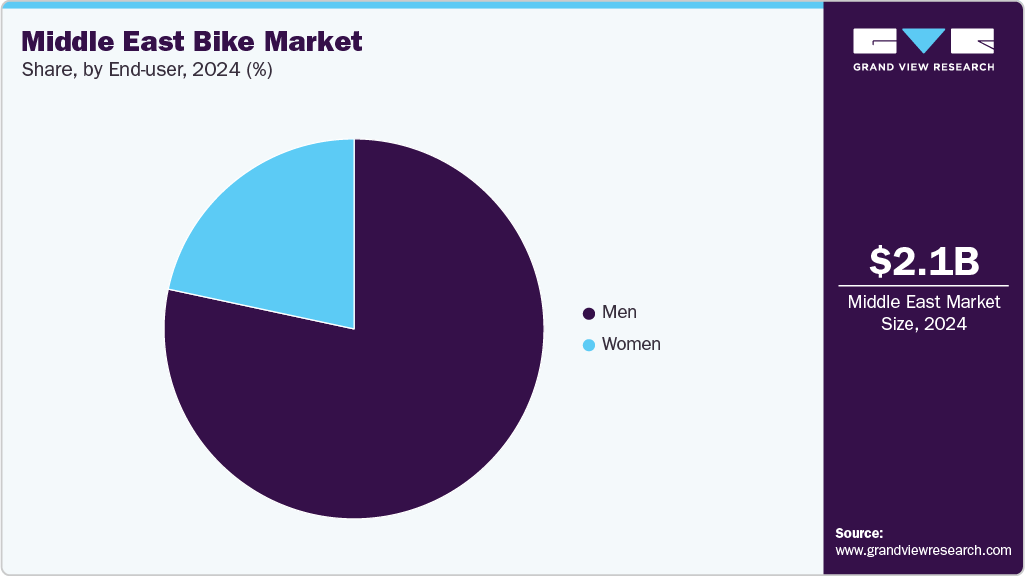
The women segment is projected to grow at a CAGR of 7.9% over the forecast period. Rising health awareness and interest in outdoor activities are encouraging more women to take up cycling for both fitness and leisure. Cities across the region are investing in safer infrastructure, including dedicated tracks and community programs, which have improved confidence in cycling as a daily mobility option. At the same time, manufacturers are introducing women-specific models with ergonomic frames, lighter materials, and enhanced comfort features. Combined with the influence of social fitness trends and organized community rides, these developments are driving greater adoption among female consumers and expanding their overall market share.
Application Insights
Personal/individual applications for bikes led the Middle East bike industry with a revenue share of 85.01% in 2024. With rising awareness of fitness and wellness, more people are choosing bicycles for commuting, recreation, and exercise, supported by the wide availability of models such as road, mountain, hybrid, and city bikes that cater to varied needs. Governments in the UAE, Saudi Arabia, and Qatar are also investing in dedicated cycling lanes and safe urban infrastructure, giving individuals greater confidence to use bikes as eco-friendly transport alternatives. At the same time, the influence of social fitness trends, organized community rides, and digital platforms like Strava has reinforced cycling as part of modern living, encouraging consistent engagement and making personal ownership the dominant growth driver in the regional market.
Commercial applications for bikes are projected to grow at a CAGR of 6.8% over the forecast period. The rapid growth of e-commerce and food delivery services is creating demand for bicycles and e-bikes as efficient, low-cost options for last-mile transport in congested city centers. Governments are also encouraging shared mobility platforms and bike-rental schemes, which serve tourism, commuting, and short-distance travel needs. Combined with the lower operating costs of bicycles compared to motorized vehicles and the appeal of sustainable transport aligned with national climate goals, these factors are expected to drive consistent growth in the commercial segment.
Regional Insights
Saudi Arabia Bike Market Trends
The Saudi Arabia bike industry held 52.00% of the regional revenue in 2024, supported by strong government backing, rising consumer demand, and rapid infrastructure development. Under Vision 2030, the Kingdom has invested heavily in sustainable mobility projects, including the integration of cycling tracks within new urban developments and the promotion of e-bikes as part of green transport initiatives. Large-scale community events such as the Saudi Tour and organized fitness campaigns have further popularized cycling, while growing interest among younger populations and expatriates has boosted sales of both recreational and commuter bikes. With increasing retail availability, expanding bike-sharing schemes, and alignment with national health and sustainability goals, Saudi Arabia has emerged as the dominant market driver in the regional industry.
UAE Bike Market Trends
The bike market in the UAE is expected to grow at a CAGR of 8.2% from 2025 to 2033, driven by urban development strategies that prioritize cycling as part of sustainable mobility. Large-scale infrastructure projects in Dubai and Abu Dhabi, including dedicated cycling lanes and multi-use tracks, have encouraged greater adoption for both commuting and leisure. Rising enthusiasm for electric bicycles, supported by a growing appetite for high-performance models such as road and mountain bikes, is broadening the consumer base across residents and expatriates. Well-established retail networks, the presence of leading international brands, and a growing shift toward eco-friendly transport further strengthen demand, positioning the UAE as one of the most dynamic cycling markets in the region.
Key Middle East Bike Company Insights
The Middle East bike market features a combination of well-established manufacturers and emerging brands that continue to innovate in design, performance, and sustainability to meet evolving consumer demands. Leading companies prioritize quality, durability, and rider comfort while integrating advanced materials and technology to enhance the cycling experience. By partnering with large-scale retailers, sporting goods stores, and mobility service providers, and strengthening their presence on e-commerce platforms, these players ensure wide accessibility and market penetration. Furthermore, strategic collaborations and agile manufacturing capabilities allow key industry participants to develop specialized bicycles, such as electric, folding, or cargo bikes, and effectively cater to niche segments and emerging urban mobility markets across the globe.
Key Middle East Bike Companies:
- Giant Manufacturing Co. Ltd.
- Trek Bicycle Corporation
- Merida Industry Co., Ltd.
- Specialized Bicycle Components
- Trinx Bikes
- Sandstorm Bikes
- Pon Holdings (Pon.Bike)
- Scott Sports SA
- Cube Bikes (Cube GmbH)
- Phoenix Bicycles
Recent Developments
-
In March 2024, Trinx Middle East launched its updated M136 and Tempo 1.0 series in Dubai, designed specifically for GCC conditions. The models feature reinforced frames to withstand higher temperatures, upgraded disc brakes for desert trails, and integrated mounts for accessories favored by urban commuters. The release marked the brand’s push to expand locally assembled and affordable performance bikes in the UAE market.
-
In May 2024, Sandstorm Bikes (UAE) introduced its Storm X e-MTB, a locally produced electric mountain bike tailored for off-road leisure riders in the Gulf. The model is equipped with a mid-drive motor, 500Wh removable battery, and heat-resistant paint finishes to adapt to desert riding conditions. The launch signaled the company’s ambition to compete with international e-MTB brands in the Middle East.
Middle East Bike Market Report Scope
Report Attribute
Details
Market size value in 2025
USD 2,195.0 million
Revenue forecast in 2033
USD 3,912.8 million
Growth rate
CAGR of 7.5% from 2025 to 2033
Actuals
2021 - 2024
Forecast period
2025 - 2033
Quantitative units
Revenue in USD million and CAGR from 2025 to 2033
Report coverage
Revenue forecast, volume forecast, company ranking, competitive landscape, growth factors, and trends
Segments covered
Type, product, price range, end user, application, region
Regional scope
Middle East
Country scope
Saudi Arabia; UAE
Key companies profiled
Giant Manufacturing Co. Ltd.; Trek Bicycle Corporation; Merida Industry Co., Ltd.; Specialized Bicycle Components; Trinx Bikes; Sandstorm Bikes; Pon Holdings (Pon.Bike); Scott Sports SA; Cube Bikes (Cube GmbH); Phoenix Bicycles
Customization scope
Free report customization (equivalent up to 8 analysts working days) with purchase. Addition or alteration to country, regional & segment scope
Pricing and purchase options
Avail customized purchase options to meet your exact research needs. Explore purchase options
Middle East Bike Market Report Segmentation
This report forecasts volume & revenue growth at the regional & country levels and provides an analysis of the latest trends and opportunities in each of the sub-segments from 2021 to 2033. For this study, Grand View Research has segmented the Middle East bike market report based on type, product, price range, end use, application, and region:
-
Type Outlook (Volume, Thousand Units; Revenue, USD Million, 2021 - 2033)
-
Conventional
-
Electric
-
-
Product Outlook (Volume, Thousand Units; Revenue, USD Million, 2021 - 2033)
-
City/Commuter Bikes
-
Road Bikes
-
Mountain Bikes (MTB)
-
Hybrid Bikes
-
Cargo Bikes
-
Others
-
-
Price Range Outlook (Volume, Thousand Units; Revenue, USD Million, 2021 - 2033)
-
City/Commuter Bikes
-
Low (USD 200 to 500)
-
Mid-Range (USD 500 to USD 1,000)
-
High End (Above USD 1,000)
-
-
Road Bikes
-
Low (USD 400 to 1,000)
-
Mid-Range (USD 1,000 to USD 2,500)
-
High End (Above USD 2,500)
-
-
Mountain Bikes (MTB)
-
Low (USD 300 to 7,00)
-
Mid-Range (USD 700 to USD 1,800)
-
High End (Above USD 1,800)
-
-
Hybrid Bikes (Road & MTB)
-
Low (USD 300 to 700)
-
Mid-Range (USD 700 to USD 1,500)
-
High End (Above USD 1,500)
-
-
Cargo Bikes
-
Low (USD 500 to 2,500)
-
Mid-Range (USD 2,500 to USD 4,500)
-
High End (Above USD 4,500)
-
-
Others
-
Low (USD 200 to 800)
-
Mid-Range (USD 800 to USD 1,200)
-
High End (Above USD 1,200)
-
-
-
End User Outlook (Volume, Thousand Units; Revenue, USD Million, 2021 - 2033)
-
Men
-
Women
-
-
Application Outlook (Volume, Thousand Units; Revenue, USD Million, 2021 - 2033)
-
Personal/Individual
-
Commercial
-
-
Regional Outlook (Volume, Thousand Units; Revenue, USD Million, 2021 - 2033)
-
Middle East
-
Saudi Arabia
-
UAE
-
-
Frequently Asked Questions About This Report
b. The Middle East bike market was estimated at USD 2,065.3 million in 2024 and is expected to reach USD 2.19 billion in 2025.
b. The Middle East bike market is expected to grow at a compound annual growth rate of 7.5% from 2025 to 2033 to reach USD 3.19 billion by 2033.
b. Conventional bikes accounted for a revenue share of 83.47% of the Middle East bike market in 2024, reflecting their affordability and easy availability across the region. Their dominance is also linked to everyday utility, low maintenance needs, and wider consumer familiarity compared to electric models.
b. Key players in the Middle East bike market include Giant Manufacturing Co. Ltd., Trek Bicycle Corporation, Merida Industry Co., Ltd., Specialized Bicycle Components, Trinx Bikes, Sandstorm Bikes, Pon Holdings (Pon.Bike), Scott Sports SA, Cube Bikes (Cube GmbH), Phoenix Bicycles
b. Key factors driving the Middle East bike market growth include increasing health and fitness awareness among consumers and supportive government initiatives promoting cycling. Expanding urban infrastructure with dedicated cycling tracks and rising demand for affordable mobility options are also strengthening the market.


Share this report with your colleague or friend.
Need a Tailored Report?
Customize this report to your needs — add regions, segments, or data points, with 20% free customization.


ISO 9001:2015 & 27001:2022 Certified
We are GDPR and CCPA compliant! Your transaction & personal information is safe and secure. For more details, please read our privacy policy.
Trusted market insights - try a free sample
See how our reports are structured and why industry leaders rely on Grand View Research. Get a free sample or ask us to tailor this report to your needs.













