
- Home
- »
- Advanced Interior Materials
- »
-
Middle East Construction Anchors Market Size Report 2033GVR Report cover
![Middle East Construction Anchors Market Size, Share & Trends Report]()
Middle East Construction Anchors Market (2025 - 2033) Size, Share & Trends Analysis Report By Product (Hangers, Mechanical, Chemical, Nail-in, Wall), By Material (Stainless Steel, Carbon Steel), By End Use (Residential, Commercial, Industrial, Infrastructural), By Country, And Segment Forecasts
- Report ID: GVR-4-68040-749-0
- Number of Report Pages: 107
- Format: PDF
- Historical Range: 2021 - 2023
- Forecast Period: 2025 - 2033
- Industry: Advanced Materials
- Report Summary
- Table of Contents
- Segmentation
- Methodology
- Download FREE Sample
-
 Download Sample Report
Middle East Construction Anchors Market Summary
The Middle East construction anchors market size was estimated at USD 97.4 million in 2024 and is expected to reach USD 130.7 million by 2033, growing at a CAGR of 3.3% from 2025 to 2033. The demand for construction anchors in the Middle East is experiencing significant growth due to rapid urbanization and large-scale infrastructure projects.
Key Market Trends & Insights
- Saudi Arabia dominated the Middle East construction anchors market with the largest revenue share of 17.1% in 2024.
- By product, the chemical segment is expected to grow at the fastest CAGR of 3.6% over the forecast period.
- By material, the carbon steel segment is expected to grow at the fastest CAGR of 3.5% over the forecast period.
- By end use, the infrastructural segment is expected to grow at the fastest CAGR of 3.6% over the forecast period.
Market Size & Forecast
- 2024 Market Size: USD 97.4 Million
- 2033 Projected Market Size: USD 130.7 Million
- CAGR (2025-2033): 3.3%
- Saudi Arabia: Largest market in 2024
- Egypt: Fastest market in 2024
Countries like Saudi Arabia, the UAE, and Qatar are investing heavily in smart cities, transportation networks, and tourism developments, which require robust anchoring solutions to ensure structural integrity. For instance, Saudi Arabia's Vision 2030 has led to the initiation of numerous mega-projects, including the Neom city and the Red Sea Project, driving the need for advanced anchoring systems.
Several factors are contributing to the rising demand for construction anchors in the region. The increasing complexity of architectural designs and the need for high-load-bearing capacity in structures necessitate the use of reliable anchoring systems. Additionally, the adoption of sustainable construction practices has led to a preference for corrosion-resistant anchors made from materials like stainless steel and galvanized steel, aligning with green building standards.
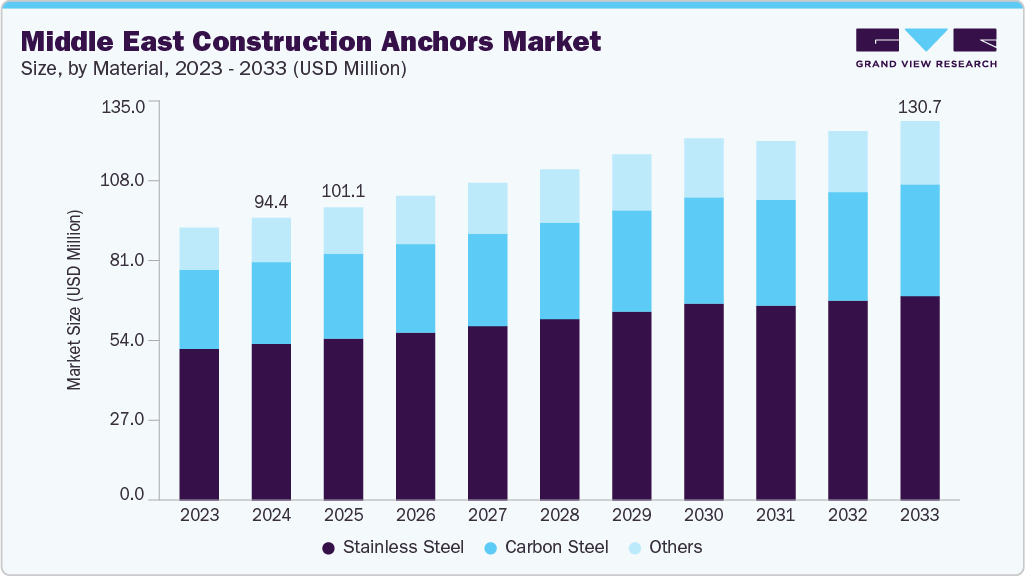
The Middle East construction anchor market is witnessing several key trends. There is a growing shift towards the use of chemical anchors, such as epoxy and polyester-based systems, due to their superior performance in high-load and complex structural applications. These anchors offer enhanced flexibility and strength compared to traditional mechanical anchors. Additionally, the market is seeing increased adoption of sustainable materials and corrosion-resistant anchors to meet green building standards. Technological advancements, including automation and AI-driven project management tools, are also influencing the market dynamics.
Market Concentration & Characteristics
The Middle East construction anchors market remains moderately fragmented. However, no single company dominates to the degree that it can unilaterally set pricing or fully control product innovation. The fragmented nature arises partly because local suppliers, regional regulatory requirements, varied environmental conditions, and project-specific demands create space for many players.
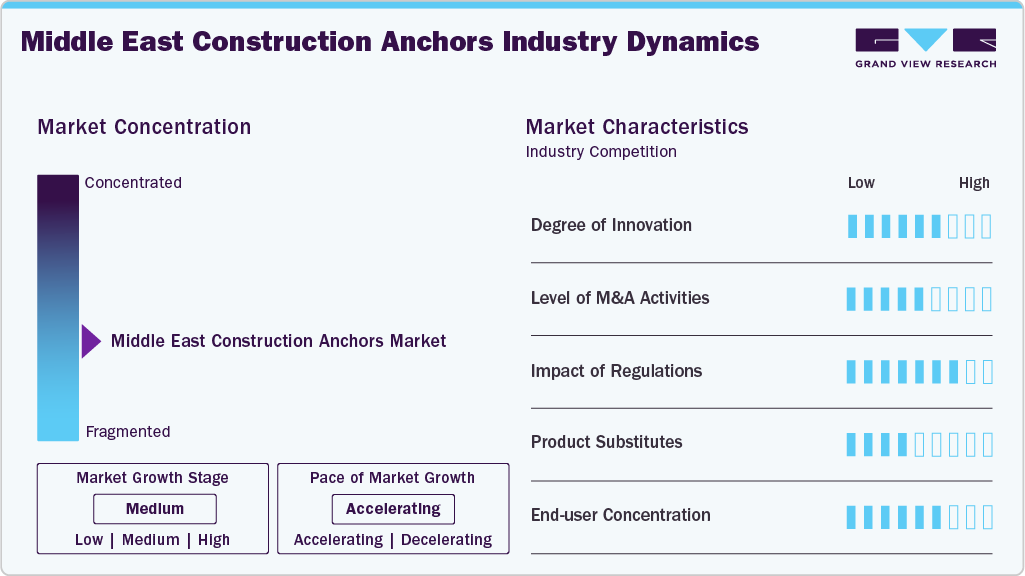
While construction anchors are essential for securing structural elements, alternative fastening methods exist, though they are often application-specific. Welding and adhesive systems, such as epoxy-based adhesives, can serve as substitutes in certain scenarios. For instance, welding is commonly used in steel structures, while adhesives are employed in non-structural applications or where drilling is undesirable. However, these alternatives may not offer the same load-bearing capacity or long-term durability as mechanical anchors, making them less suitable for high-stress applications.
Product Insights
The mechanical segment held the highest revenue market share of 40.0% in 2024, due to their wide acceptance, reliability, and ease of installation. Contractors across the region prefer mechanical anchors for large infrastructure and commercial projects because of their proven performance under heavy loads and compliance with established building codes. Their durability in concrete and masonry applications makes them the default choice for high-rise construction, bridges, and industrial facilities. Additionally, their cost-effectiveness compared to other solutions reinforces their stronghold in the market, keeping mechanical anchors as the primary fastening method across the region.
The chemical segment is expected to grow significantly at a CAGR of 3.6% over the forecast period in the Middle East, as construction projects become more complex and demanding. They are increasingly favored in applications where higher load capacity, flexibility in installation, and performance in cracked or damaged substrates are required. Their ability to bond effectively in seismic zones, coastal environments, and extreme weather conditions aligns well with the region’s diverse infrastructure needs. Moreover, advancements in resin and epoxy formulations are enhancing their reliability and expanding their use in high-value projects. This growing adoption reflects a shift toward advanced anchoring systems in the Middle East construction sector.
Material Insights
The stainless steel segment held the highest revenue market share of 55.4% in 2024. Their stronghold is due to inherent advantages such as superior corrosion resistance especially important in coastal zones and in infrastructure exposed to harsh weather, and compliance with demanding build and durability standards. The material’s long service life and relatively low maintenance make it the go-to choice in premium projects, high-visibility façades, marine applications, and iconic structures where performance and appearance are important. Because stainless steel is well accepted by regulators and designers in the region, it has become the benchmark for quality in many high-end or long-term infrastructure projects.
The carbon steel segment is expected to grow significantly at a CAGR of 3.5% over the forecast period in the Middle East, particularly in uses where the full benefits of stainless steel are not strictly necessary and cost savings matter. Advancements in coatings, galvanizing or protective treatments are improving carbon steel's durability in environments where they might have corroded too quickly, making it a viable alternative in more standard or budget-sensitive segments. As large infrastructure, industrial, and commercial builds continue proliferating, demand for lower-cost but sufficiently robust materials is driving growth of carbon steel anchors. Also, in internal structural applications (less exposed to weather), carbon steel is being favored because of its strength, lower cost, and more straightforward supply chain.
End Use Insights
The commercial segment held the highest revenue market share of 33.2% in 2024, due to the surge in office buildings, retail spaces, hospitality developments, and mixed-use complexes. Countries such as the UAE, Saudi Arabia, and Qatar have invested heavily in luxury malls, hotels, and business districts, all of which require reliable anchoring systems to ensure structural integrity and long-term durability. Developers in the commercial sector prioritize anchors that support heavy loads, provide safety under high footfall conditions, and comply with international building codes. This steady stream of high-value commercial projects has cemented the commercial segment as the leading contributor to anchor demand in the region.
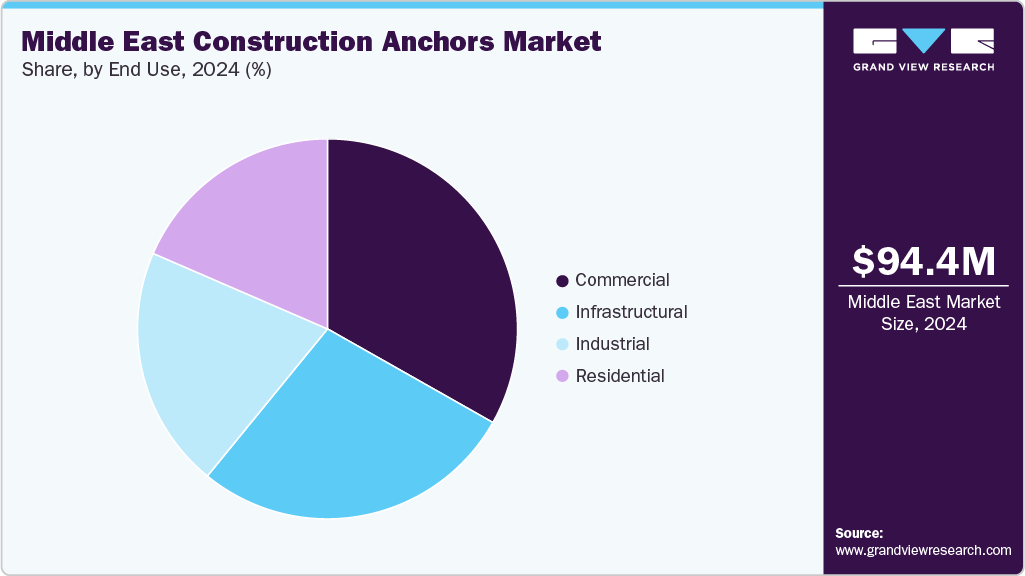
The infrastructural segment is expected to grow at a significant CAGR of 3.6% over the forecast period. Large-scale developments such as airports, metro expansions, bridges, and smart city projects demand anchors that can perform under extreme loads and challenging environmental conditions. The push for national diversification strategies, like Saudi Vision 2030 and the UAE’s infrastructure modernization, is creating new opportunities for advanced anchoring systems. With increasing focus on sustainable construction and long-lasting infrastructure, the infrastructural segment is rapidly expanding its share of the Middle East anchors market and is expected to become a key growth driver in the coming years.
Regional Insights
The Middle East construction anchors market is driven by mega-projects in smart cities, airports, tourism complexes, and large-scale real estate developments. Demand is shifting from purely mechanical anchors to a growing mix of chemical and advanced anchoring systems, especially in projects that require higher performance under extreme climate conditions. Sustainability and green building codes also influence anchor choices, pushing suppliers to offer more durable and corrosion-resistant solutions.
Saudi Arabia Construction Anchors Market Trends
Saudi Arabia dominated the Middle East with a revenue market share of 17.1% in 2024, shaped by Vision 2030, with giga-projects like NEOM, Qiddiya, and the Red Sea Project fueling heavy demand for anchors across commercial and infrastructure applications. Mechanical anchors remain dominant, but chemical anchors are growing quickly due to their higher performance in demanding structural applications. The government’s push for world-class infrastructure and urban development is creating consistent demand for high-quality anchoring systems.
UAE Construction Anchors Market Trends
The UAE market is highly focused on premium commercial, residential, and smart infrastructure projects requiring reliable and aesthetically compatible anchoring systems. Advanced chemical anchors and specialized fastenings are being adopted in luxury real estate, skyscrapers, and innovative architectural structures. The emphasis on sustainability, international building standards, and climate-resilient solutions is pushing demand toward higher-grade stainless steel and epoxy-based anchors.
Egypt Construction Anchors Market Trends
Egypt’s market is growing due to large-scale housing projects, mixed-use real estate, and new city developments like the New Administrative Capital. Anchors are in demand for both structural applications and façade or cladding works, with durability and cost-effectiveness being key priorities. Sustainability and efficiency in construction are slowly gaining importance, leading to the gradual adoption of advanced anchor types beyond basic mechanical systems.
Qatar Construction Anchors Market Trends
Qatar’s construction anchors market is transitioning from FIFA World Cup-related projects to broader long-term developments in transport, utilities, and real estate. The government is prioritizing metro expansions, port upgrades, and energy sector infrastructure, which are boosting demand for anchors with higher load-bearing capacity and durability. At the same time, commercial projects such as mixed-use complexes and luxury real estate continue to drive steady anchor usage. Increasing focus on sustainability, lifecycle efficiency, and advanced construction techniques is encouraging greater adoption of chemical anchors alongside traditional mechanical systems.
Kuwait Construction Anchors Market Trends
Kuwait’s market is expanding under Vision 2035, with residential housing demand and government-led infrastructure projects driving anchor consumption. Mechanical anchors remain widely used, but there is growing interest in chemical and coated carbon steel anchors for cost-effective, long-lasting performance. The adoption of digital tools and modular construction techniques in Kuwait is also shaping demand for flexible anchoring solutions that support faster installation and efficient project delivery.
Key Middle East Construction Anchors Company Insights
Some of the key players operating in the market include Sika AG, Fischer Middle East FZE
-
Sika AG is a global leader in specialty chemicals and construction materials, offering a wide portfolio of chemical anchors, grouts, and adhesives. In the Middle East, the company is strongly positioned in infrastructure and commercial projects, where high-performance and sustainable anchoring solutions are in demand.
-
Fischer Middle East FZE is a major provider of mechanical and chemical anchoring systems, known for its reliable fasteners and innovative solutions. With its regional hub in Dubai, Fischer plays a crucial role in supplying anchors for skyscrapers, metro systems, and large-scale real estate projects across the Gulf.
Saint-Gobain Weber and Husqvarna Construction Products are some of the emerging market participants in the construction anchors market.
-
Saint-Gobain Weber specializes in construction chemicals, mortars, and anchoring solutions that align with green building and durability standards. In the Middle East, the company’s anchors and grouts are widely used in commercial, residential, and infrastructure projects requiring corrosion-resistant and energy-efficient materials.
-
Husqvarna Construction Products, a subsidiary of the Husqvarna Group, provides advanced drilling, cutting, and anchoring solutions for concrete works. In the Middle East, it supports heavy construction and infrastructure sectors by offering anchors and fastening technologies tailored for high-load and precision applications.
Key Middle East Construction Anchors Companies:
- Sika AG
- MAPEI S.P.A.
- Saint-Gobain Weber
- Fischer Middle East FZE
- Hilti Middle East
- ITW Construction Products
- Husqvarna Construction Products
- MBCC Group
- Saudi Vetonit Co. Ltd.
- Celo Fixings Middle East
Recent Developments
-
In June 2025, Sika acquired Gulf Additive Factory LLC in Qatar. The company manufactures a wide range of construction chemical products and stands strongly in the fast-growing Qatar construction market. The acquisition strengthens Sika’s foothold in the country and provides exciting opportunities for further expansion.
-
In February 2025, Saint-Gobain completed the acquisition of FOSROC, a leading global construction chemicals player with a strong geographic footprint in India, the Middle East, and Asia-Pacific. Following the acquisitions of Chryso, GCP, and OVNIVER (Cemix brand), this represents another important step in establishing Saint-Gobain’s worldwide presence in construction chemicals.
Middle East Construction Anchors Market Report Scope
Report Attribute
Details
Market size value in 2025
USD 101.1 million
Revenue forecast in 2033
USD 130.7 million
Growth Rate
CAGR of 3.3% from 2025 to 2033
Base year for estimation
2024
Actual estimates/Historical data
2021 - 2023
Forecast period
2025 - 2033
Quantitative units
Revenue in USD million and CAGR from 2023 to 2033
Report coverage
Revenue forecast, company ranking, competitive landscape, growth factors, and trends
Segments covered
Product, material, end use, and region
Regional scope
Middle East
Country scope
Saudi Arabia, UAE, Egypt, Qatar, Kuwait
Key companies profiled
Sika AG; MAPEI S.P.A.; Saint-Gobain Weber; Fischer Middle East FZE; Hilti Middle East; ITW Construction Products; Husqvarna Construction Products; MBCC Group; Saudi Vetonit Co. Ltd.; Celo Fixings Middle East
Customization scope
Free report customization (equivalent up to 8 analysts working days) with purchase. Addition or alteration to country, regional & segment scope.
Pricing and purchase options
Avail customized purchase options to meet your exact research needs. Explore purchase options
Middle East Construction Anchors Market Report Segmentation
This report forecasts revenue growth at regional & country levels and provides an analysis of the industry trends in each of the sub-segments from 2021 to 2033. For the purpose of this study, Grand View Research has segmented the Middle East construction anchors market on the basis of product, material, end use, and country:
-
Product Outlook (Revenue, USD Million; 2021 - 2033)
-
Hangers
-
Mechanical
-
Chemical
-
Nail-in
-
Wall
-
Other Products
-
-
Material Outlook (Revenue, USD Million; 2021 - 2033)
-
Stainless Steel
-
Carbon Steel
-
Other Materials
-
-
End Use Outlook (Revenue, USD Million; 2021 - 2033)
-
Residential
-
Commercial
-
Industrial
-
Infrastructural
-
-
Regional Outlook (Revenue, USD Million; 2021 - 2033)
-
Middle East & Africa
-
Saudi Arabia
-
UAE
-
Egypt
-
Qatar
-
Kuwait
-
-
Frequently Asked Questions About This Report
b. The Middle East construction anchors market size was estimated at USD 97.4 million in 2024 and is expected to reach USD 101.1 million in 2025.
b. The Middle East construction anchors market is expected to grow at a compound annual growth rate of 3.3% from 2025 to 2033 to reach USD 130.7 million by 2033.
b. The mechanical segment held the highest revenue market share of 40.0% in 2024, due to their wide acceptance, reliability, and ease of installation.
b. Some of the key players operating in the construction anchors market include Sika AG, MAPEI S.P.A., Saint-Gobain Weber, Fischer Middle East FZE, Hilti Middle East, ITW Construction Products, Husqvarna Construction Products, MBCC Group, Saudi Vetonit Co. Ltd., and Celo Fixings Middle East.
b. The key factors driving the Middle East construction anchors market are rising mega-projects, urbanization, and demand for durable, corrosion-resistant fastening solutions.


Share this report with your colleague or friend.
Need a Tailored Report?
Customize this report to your needs — add regions, segments, or data points, with 20% free customization.


ISO 9001:2015 & 27001:2022 Certified
We are GDPR and CCPA compliant! Your transaction & personal information is safe and secure. For more details, please read our privacy policy.
Trusted market insights - try a free sample
See how our reports are structured and why industry leaders rely on Grand View Research. Get a free sample or ask us to tailor this report to your needs.













