Middle East Electronic Materials & Chemicals Market Summary
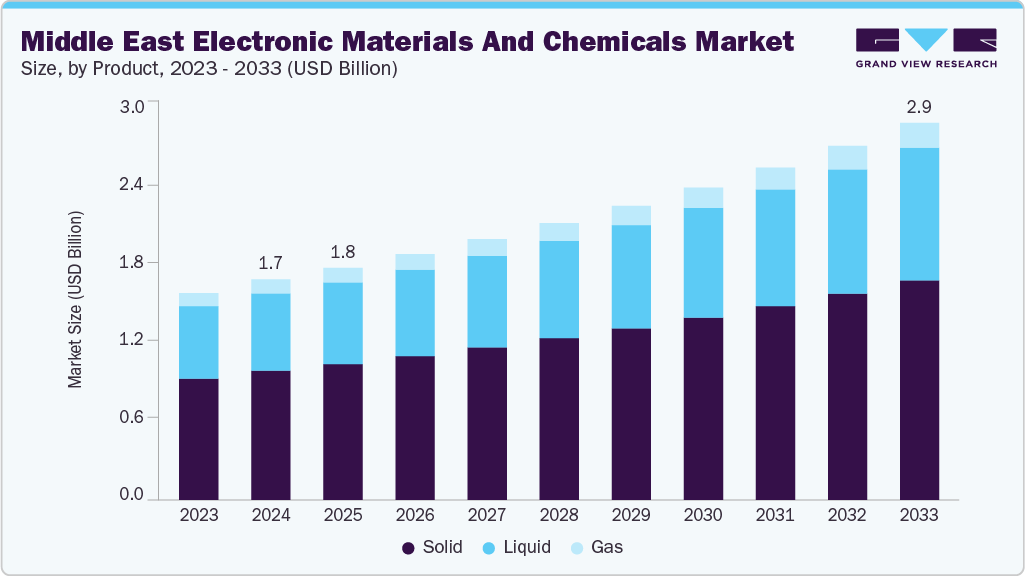
The Middle East electronic materials and chemicals market size was estimated at USD 1.69 billion in 2024 and is projected to reach USD 2.95 billion, growing at a CAGR of 6.4% from 2025 to 2033. Increasing product demand for manufacturing semiconductors, photolithographic printing, and flat panel displays is expected to propel market growth.
Key Market Trends & Insights
- Saudi Arabia dominated the Middle East electronic materials and chemicals market with the largest revenue share of 35.9% in 2024.
- The market in UAE is expected to grow at the fastest CAGR of 6.9% from 2025 to 2033.
- By product, the gas segment is expected to grow at the fastest CAGR of 7.1% from 2025 to 2033.
- By application, the silicon wafers segment held the largest revenue share of 45.3% in 2024.
- By end use, the semiconductors & integrated circuits segment held the largest revenue share of 62.1% in 2024.
Market Size & Forecast
- 2024 Market Size: USD 1.69 Billion
- 2033 Projected Market Size: USD 2.95 Billion
- CAGR (2025-2033): 6.4%
- Saudi Arabia: Largest market in 2024
- UAE: Fastest growing market
Saudi Arabia’s Vision 2030 targets world-class digital infrastructure, and the “Alat” initiative was launched to attract and develop local semiconductor and electronics manufacturing. The market features a mix of major global players with a regional presence and prominent national companies.
Product Insights
The solid segment dominated the market with a revenue share of 58.5% in 2024. This dominance is driven by its foundational role in electronics manufacturing. Solid materials include silicon wafers, laminates, and packaging materials, which form the structural foundation of electronic devices and are essential for producing basic and advanced components. Among these, silicon wafers are the most significant, serving as the base substrate for integrated circuits and microchips that drive consumer electronics, automotive systems, and renewable energy technologies.
The gas segment is expected to grow at the fastest CAGR of 7.1% over the forecast period. This growth is driven by the region’s semiconductor and advanced electronics manufacturing investments. The segment comprises ultra-high-purity atmospheric gases (nitrogen, argon, helium) and specialty process gases (silane, phosphine, arsine, nitrogen trifluoride (NF₃), sulfur hexafluoride (SF₆), fluorocarbons, etc.). These gases are fundamental inputs for semiconductor and advanced-electronics fabrication.
Application Insights
The silicon wafers segment held the highest revenue share, 45.3%, in 2024. This growth is primarily driven by its core application as the essential substrate for semiconductor devices. These ultra-pure crystalline slices of silicon are indispensable in manufacturing integrated circuits and microchips, supporting advanced fabrication methods such as photolithography, etching, and thin-film deposition.
The specialty gases segment is expected to grow at the fastest CAGR of 7.1% over the forecast period. The growth is driven by demand from several application sectors, including energy, the environment, healthcare, and electronics. Specialty gases are crucial in the electronics industry for various applications. These gases are used in relatively small quantities as precursors to deposit substances such as arsenic or tungsten onto a wafer or into a silicon lattice.
End Use Insights
The semiconductors and integrated circuits segment held the highest revenue share of 62.1% in 2024 and is expected to grow at the fastest CAGR over the forecast period. The growth is driven by regional governments' strategic efforts to diversify their economies and build a self-reliant, high-tech industrial base. The segment encompasses the entire value chain, from semiconductor design and fabrication to final integrated circuit assembly, with countries such as Saudi Arabia and Oman investing heavily to position themselves as regional technology hubs. In July 2025, Saudi Arabia's King Abdulaziz City for Science and Technology (KACST) successfully designed and manufactured 25 advanced electronic chips at its Cleanroom Lab. This initiative, part of the Semiconductor Specialization Program, aims to enable local chip production for the kingdom's growing electronics industries.
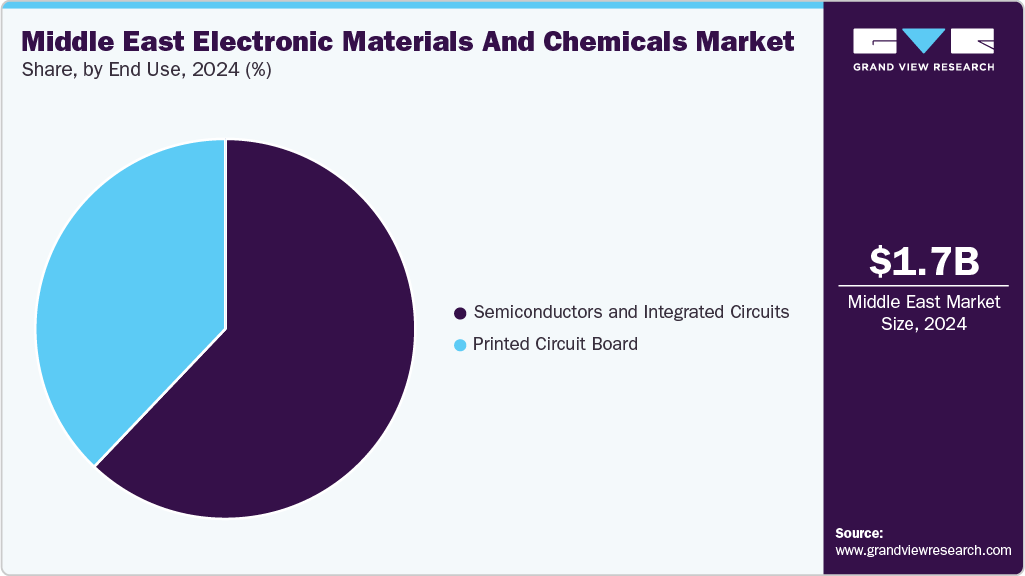
The printed circuit board (PCBs) segment is expected to grow significantly over the forecast period. The rate of technological advancement drives growth, invariably giving rise to more products requiring circuit boards. PCBs are foundational in electronic systems, providing mechanical support and electrical interconnection through copper tracks on an insulating substrate. Its performance is further shaped by dielectric materials, which serve as the embedding medium and are available in multiple forms, including resin-coated copper layers, glass-fiber fabrics, pre-impregnated sheets, or solid cores.
Country Insights
The Middle Eastelectronic materials and chemicals market is experiencing steady growth, supported by the region's push into semiconductor and high-tech manufacturing, and strategic economic diversification policies. The region benefits from abundant silicon resource reserves and low-cost renewable energy, positioning it favorably for capital-intensive semiconductor fabrication.
Saudi Arabia Electronic Materials And Chemicals Market Trends
Saudi Arabia dominated the market with a revenue share of 35.9% in 2024. It is actively building its electronic materials and chemicals market through the National Semiconductor Hub, launched under Vision 2030. It aims to attract at least 50 semiconductor design firms and train 5,000 engineers by 2030.
Key Middle East Electronic Materials And Chemicals Company Insights
Some key companies in the Middle East electronic materials and chemicals industry include BASF, Linde PLC, SABIC, and others.
BASF
-
BASF offers products to several industries, including agriculture, chemicals, construction, electronics and electric, energy and resources, pharmaceuticals, and automotive and transportation. It operates through five business segments: performance products, chemicals, agricultural solutions, functional materials and solutions, and oil and gas. The company provides advanced electronic-grade chemicals and materials essential for producing semiconductors, printed circuit boards, displays, LEDs, and photovoltaics. Its portfolio includes high-purity process chemicals, functional materials, and customized formulations. BASF also supplies specialty metal systems for consumer electronics and industrial devices and solutions for next-generation applications.
Key Middle East Electronic Materials And Chemicals Companies:
- BASF
- SABIC
- Linde PLC
- Borouge
- Saudi Aramco
- Dow
- DuPont
- Merck Group
- Evonik
- Clariant
Recent Developments
-
In August 2025, SABIC introduced its MEGAMOLDING platform, a high-performance, scalable solution enabling the efficient manufacture of large thermoplastic parts across sectors ranging from automotive and energy to consumer goods and electronics.
-
In August 2025, SABIC introduced its new LNP THERMOCOMP WFC061I compound, a non-halogenated flame-retardant material designed to enhance the safety and protection of electric vehicle control units (EVCUs).
Middle East Electronic Materials And Chemicals Market Report Scope
|
Report Attribute
|
Details
|
|
Market size value in 2025
|
USD 1.79 billion
|
|
Revenue forecast in 2033
|
USD 2.95 billion
|
|
Growth rate
|
CAGR of 6.4% from 2025 to 2033
|
|
Base year for estimation
|
2024
|
|
Historical data
|
2021 - 2023
|
|
Forecast period
|
2025 - 2033
|
|
Quantitative units
|
Revenue in USD million/billion and CAGR from 2025 to 2033
|
|
Report coverage
|
Revenue forecast, company ranking, competitive landscape, growth factors, and trends
|
|
Segments covered
|
Product, application, end use, country
|
|
Regional scope
|
Middle East & Africa
|
|
Country scope
|
Oman; Kuwait; Saudi Arabia; UAE; Qatar; Bahrain; Israel
|
|
Key companies profiled
|
BASF; SABIC; Linde PLC; Borouge; Saudi Aramco; Dow; DuPont; Merck Group; Evonik; Clariant
|
|
Customization scope
|
Free report customization (equivalent up to 8 analysts’ working days) with purchase. Addition or alteration to the country, regional & segment scope.
|
|
Pricing and purchase options
|
Avail customized purchase options to meet your exact research needs. Explore purchase options
|
Middle East Electronic Materials And Chemicals Market Report Segmentation
This report forecasts revenue growth at the regional and country levels and provides an analysis of the latest industry trends in each of the sub-segments from 2021 to 2033. For this study, Grand View Research has segmented the Middle East electronic materials and chemicals market report based on product, application, end use, and country:
-
Product Outlook (Revenue, USD Million, 2021 - 2033)
-
Application Outlook (Revenue, USD Million, 2021 - 2033)
-
End Use Outlook (Revenue, USD Million, 2021 - 2033)
-
Regional Outlook (Revenue, USD Million, 2021 - 2033)
-
Middle East
-
Oman
-
Kuwait
-
Saudi Arabia
-
UAE
-
Qatar
-
Bahrain
-
Israel
Frequently Asked Questions About This Report
b. The Middle East electronic materials and chemicals market size was estimated at USD 1.69 billion in 2024 and is expected to reach USD 1.79 billion in 2025.
b. The Middle East electronic materials and chemicals market is expected to grow at a compound annual growth rate of 6.4% from 2025 to 2033, reaching USD 2.95 billion by 2033.
b. The solid segment held the largest revenue share in 2024 due to its extensive applications in semiconductors, printed circuit boards, and displays, supporting strong regional demand from electronics manufacturing and technological infrastructure expansion.
b. Some of the key players operating in the Middle East electronic materials and chemicals market include BASF SE, SABIC, Linde PLC, Borouge, Saudi Aramco, Dow, DuPont, Merck Group, Evonik, Clariant.
b. The Middle East electronic materials and chemicals market is driven by rapid digitalization, rising semiconductor manufacturing, growing consumer electronics adoption, renewable energy investments, and government initiatives fostering advanced technologies, innovation, and sustainable industrial growth across the region.

 Download Sample Report
















