
- Home
- »
- Advanced Interior Materials
- »
-
Middle East Energy Efficient Buildings Market Report, 2033GVR Report cover
![Middle East Energy Efficient Buildings Market Size, Share & Trends Report]()
Middle East Energy Efficient Buildings Market (2025 - 2033) Size, Share & Trends Analysis Report By Material (Glass Wool, Mineral Wool, Expanded polystyrene), By End Use (Residential, Commercial), By Country, And Segment Forecasts
- Report ID: GVR-4-68040-728-2
- Number of Report Pages: 101
- Format: PDF
- Historical Range: 2018 - 2023
- Forecast Period: 2025 - 2033
- Industry: Advanced Materials
- Report Summary
- Table of Contents
- Segmentation
- Methodology
- Download FREE Sample
-
 Download Sample Report
Middle East Energy Efficient Buildings Market Summary
The Middle East energy efficient buildings market size was estimated at USD 772.8 million in 2024 and is projected to reach USD 2,582.2 million by 2033, growing at a CAGR of 14.5% from 2025 to 2033. The growth is driven by increasing government commitment to sustainability and environmental stewardship.
Key Market Trends & Insights
- By material, the expanded polystyrene (EPS) segment is expected to grow at the fastest CAGR of 15.6% over the forecast period.
- By end use, residential segment is expected to grow at the fastest CAGR of 14.7% over the forecast period.
- Egypt is expected to grow at the fastest CAGR of 15.0% over the forecast period.
Market Size & Forecast
- 2024 Market Size: USD 772.8 Million
- 2033 Projected Market Size: USD 2,582.2 Million
- CAGR (2025-2033): 14.5%
- Egypt: Fastest growing market
Countries such as the UAE, Saudi Arabia, and Qatar have introduced national visions and green building regulations that emphasize reduced energy consumption, lower emissions, and sustainable construction practices. These frameworks encourage developers to adopt energy-efficient materials, systems, and technologies. Compliance incentives, including tax benefits, expedited permitting, and mandatory energy codes, are accelerating market adoption across commercial, residential, and institutional sectors.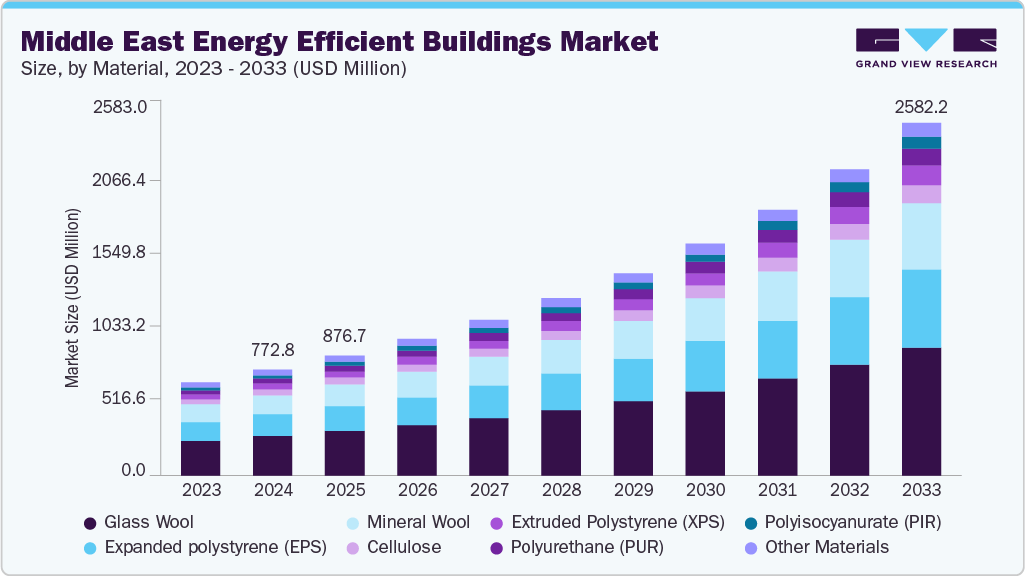
As energy consumption continues to climb in the region due to population growth and urban expansion, managing energy costs has become a critical priority. Mineral Wool efficient buildings help reduce long-term operational expenses, offering property owners a tangible return on investment. Technologies such as smart HVAC systems, high-performance insulation, and automated lighting are increasingly deployed to optimize energy use. With electricity demand peaking during extreme summer conditions, demand-side energy efficiency measures within buildings are gaining traction as a practical solution to reduce strain on national grids.
The Middle East’s ongoing urbanization and development of smart cities are driving the demand for energy-efficient infrastructure. Urban megaprojects such as NEOM in Saudi Arabia and Masdar City in the UAE are setting new benchmarks for environmentally sustainable and technologically advanced buildings. These developments are designed with integrated energy management systems, renewable energy sources, and sustainable architecture from the ground up. As urban planning becomes increasingly aligned with climate goals, energy-efficient construction standards are being embedded at the planning and design stage.
Market Concentration & Characteristics
The energy efficient buildings market in the Middle East is moderately fragmented, with a growing number of regional and international players contributing to rising competition. Innovation is steadily increasing, especially in smart building technologies, green construction materials, and integrated energy management systems. While major construction firms and technology providers lead advancements, local startups are emerging with niche energy optimization solutions. Mergers and joint ventures are becoming more common, particularly among engineering, procurement, and construction (EPC) firms collaborating with clean-tech companies. These alliances aim to enhance capabilities in delivering LEED-certified and zero-energy buildings. At the same time, governments are playing an active role in setting building performance standards, with energy codes and mandatory certifications gradually becoming stricter across the region.
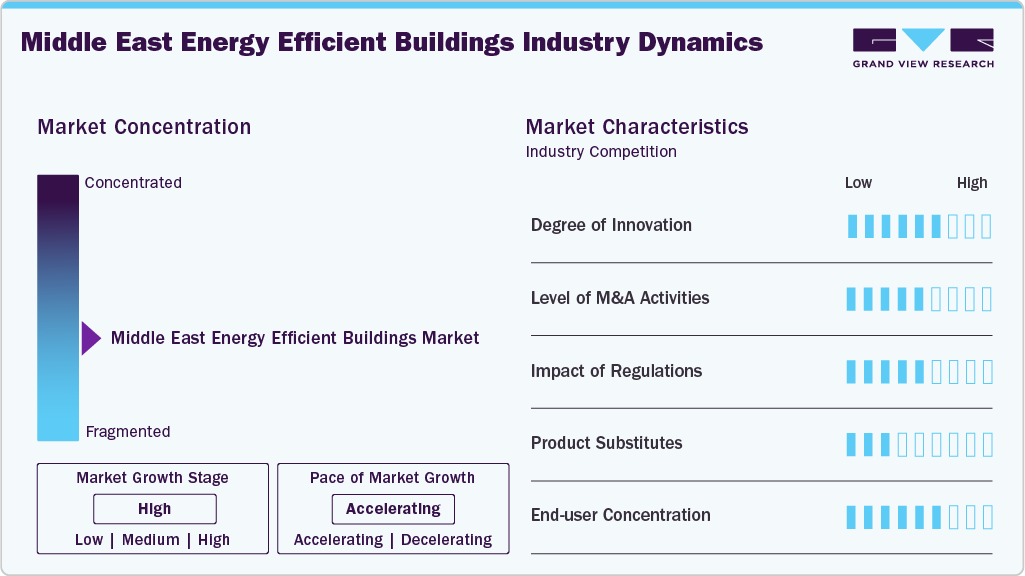
Service substitutes for energy efficient buildings, such as retrofitting traditional infrastructure or relying on off-grid renewables, exist but are often less scalable or cost-efficient in urban environments. As a result, integrated energy-saving designs remain the most viable long-term solution. End user concentration is evident in sectors like government, commercial real estate, and high-end residential developments, which are often the first to adopt new technologies due to greater financial and operational capacity. However, adoption is now expanding to mid-tier residential and educational facilities, supported by financial incentives and awareness campaigns. The market is transitioning from early adoption toward broader institutional acceptance, driven by both regulatory mandates and the economic value of long-term energy savings.
Material Insights
Glass wool segment dominated the market and accounted for the largest revenue share of 37.1% in 2024, driven by its excellent thermal insulation properties. Governments in the region are increasingly implementing strict energy efficiency codes, encouraging the use of high-performance insulation materials. In addition, glass wool's fire resistance and acoustic insulation capabilities make it a preferred choice in urban developments. The material is also lightweight and cost-effective, supporting widespread adoption in new constructions and retrofits. Rising awareness around sustainable building practices further strengthens the growth of this segment.
Expanded polystyrene (EPS) segment is expected to grow at the fastest CAGR of 15.6% over the forecast period, driven by its high insulation efficiency and low environmental impact. EPS is favored for its affordability, ease of installation, and moisture resistance, making it ideal for the Middle East’s harsh climate conditions. Moreover, it contributes significantly to reducing building cooling loads, which is crucial in regions with extremely high temperatures. The growing construction of green buildings and infrastructure modernization programs also boost demand. Government incentives for energy-efficient building materials further support the EPS segment.
End Use Insights
Residential segment dominated the market and accounted for the largest revenue share of 53.6% in 2024. Energy efficiency has become a central focus in the residential sector due to rising energy costs and growing environmental consciousness among homeowners. Increased urbanization and a surge in middle-class housing developments are pushing the demand for thermally insulated homes. Governments across the region are also encouraging the adoption of green building codes and energy-efficient designs. Moreover, residential retrofitting programs to upgrade insulation and HVAC systems are on the rise. These factors collectively drive the growth of energy-efficient technologies in the residential segment.
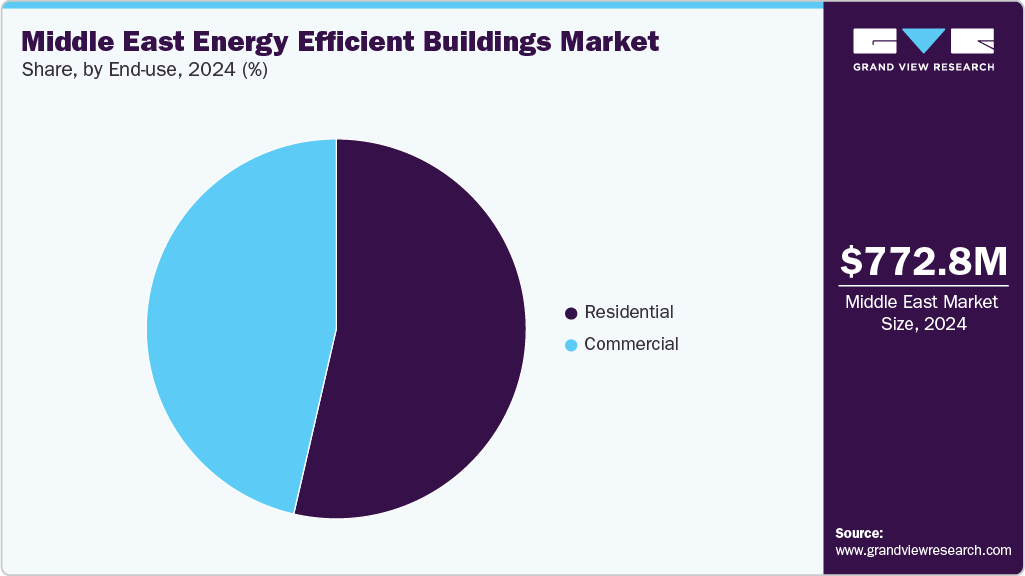
Commercial segment is expected to grow significantly at a CAGR of 14.2% over the forecast period, driven by the rapid expansion of smart cities and sustainable office spaces across the Middle East. Large-scale commercial properties are under pressure to comply with energy performance standards to reduce operational costs and carbon emissions. Corporations are also adopting green certifications like LEED and Estidama to boost their sustainability credentials. Demand for advanced insulation materials and energy management systems is growing in this segment. Furthermore, public-private partnerships in commercial infrastructure developments act as a catalyst for market expansion.
Country Insights
Saudi Arabia Energy Efficient Buildings Market Trends
Saudi Arabia's energy efficient buildings market is primarily driven by its Vision 2030 strategy, which promotes sustainable urban development and reduced energy dependency. The government is enforcing stricter building codes and incentivizing energy performance upgrades in both public and private infrastructures. Rapid expansion in residential and commercial construction, combined with extreme climate conditions, has made energy conservation a national priority. Major projects like NEOM are being designed with efficiency and renewable integration at their core. Furthermore, rising utility costs are encouraging property developers to adopt more sustainable design practices. These factors collectively strengthen demand for energy-saving technologies and green certifications.
UAE Energy Efficient Buildings Market Trends
The UAE is a regional leader in promoting energy efficient buildings, driven by ambitious sustainability goals such as the UAE Mineral Wool Strategy 2050 and the Green Building Regulations. Mega urban projects like Masdar City showcase the integration of smart systems, passive design, and renewable energy to reduce consumption. Government mandates require all new buildings in cities such as Dubai and Abu Dhabi to meet green standards. Public awareness and corporate ESG commitments also contribute to growing demand for energy-efficient designs. The UAE’s focus on smart city development amplifies the need for automation and real-time energy monitoring in buildings. This ecosystem encourages continual innovation in efficiency solutions.
Egypt Energy Efficient Buildings Market Trends
Egypt's drivers for energy efficient buildings stem from rapid urbanization and increasing pressure on its national energy grid. The government has begun implementing energy codes and encouraging energy-saving construction through policy reforms and incentives. Rising electricity demand, especially in high-density cities such as Cairo, has made energy efficiency a practical necessity. International cooperation, including support from development agencies, is helping promote best practices in sustainable design. The residential and commercial sectors are gradually adopting technologies such as LED lighting, insulation upgrades, and solar integration. These shifts are also aligned with Egypt’s broader climate commitments and energy subsidy reforms.
Qatar Energy Efficient Buildings Market Trends
Qatar’s energy efficient buildings market is driven by the country’s focus on sustainability as outlined in its National Vision 2030. With high per capita energy consumption and extreme climatic conditions, there is an increasing demand for building solutions that reduce cooling loads. The government has introduced green building standards, especially for public and commercial developments. Large infrastructure projects related to tourism and the World Cup have accelerated the adoption of efficient HVAC, smart lighting, and insulation technologies. Educational campaigns and regulatory compliance are further encouraging energy-saving practices across sectors. Qatar’s wealth and commitment to innovation support steady investment in green building systems.
Kuwait Energy Efficient Buildings Market Trends
In Kuwait, the drive for energy efficient buildings is influenced by the need to address rising electricity consumption, especially during the long, hot summers. The government is encouraging energy-saving measures through updated building codes and pilot initiatives in public sector construction. Mineral Wool efficiency is increasingly viewed as a long-term economic solution to reduce reliance on fuel subsidies and curb operational costs. With strong investment in housing and infrastructure, developers are exploring smart technologies and sustainable design. Collaboration with international consultants and research institutions supports knowledge transfer and capacity building. These trends indicate a gradual but committed shift toward more sustainable building practices.
Key Middle East Energy Efficient Buildings Company Insights
Some of the key players operating in market include LG Chem, Kumho Petrochemical
-
LG Chem is a leading chemical company involved in manufacturing a wide range of high-value-added products. It operates through a diverse business portfolio, including advanced materials, petrochemicals, and life sciences. The company has been expanding its presence in the energy efficient buildings market, focusing on applications in energy storage and electronics.
-
Kumho Petrochemical is engaged in several business sectors, including fine chemistry, synthetic rubber, synthetic resin, nanocarbon, energy, and construction materials. The company produces energy efficient buildings that are utilized in various applications, such as conductive polymers and advanced composites, enhancing material properties.
Cabot Corporation, Arkema S.A are some of the emerging market participants in Middle East energy efficient buildings market.
-
Cabot Corporation is a global specialty chemicals and performance materials company. It offers carbon nanotube solutions under the Enermax brand, targeting applications in energy storage devices, conductive plastics, and coatings. These products aim to improve performance and efficiency in various industrial applications.
-
Arkema is a French specialty chemicals and advanced materials company. It provides carbon nanotube products that enhance the mechanical and electrical properties of materials. Arkema's offerings cater to industries such as electronics, automotive, and energy, focusing on innovation and sustainability.
Key Middle East Energy Efficient Building Companies:
- Saint‑Gobain
- Gulf Glass Industries
- Zamil Industrial Investment Co.
- The National Mineral Wool Services Company (Tarshid)
- Amana Contracting and Steel Buildings
- Al‑Futtaim Engineering & Technologies (AFET)
- Design & Build Group
- LEAD Development
- Elsewedy Electric Co. S.A.E.
Middle East Energy Efficient Buildings Market Report Scope
Report Attribute
Details
Market size value in 2025
USD 876.7 million
Revenue forecast in 2033
USD 2,582.2 million
Growth rate
CAGR of 14.5% from 2025 to 2033
Base year for estimation
2024
Historical data
2018 - 2023
Forecast period
2025 - 2033
Quantitative units
Revenue in USD million/billion and CAGR from 2025 to 2033
Report coverage
Revenue forecast, company ranking, competitive landscape, growth factors, and trends
Segments covered
Material, end use, country
Region scope
Middle East
Key companies profiled
Saint‑Gobain; Gulf Glass Industries; Zamil Industrial Investment Co.; The National Mineral Wool Services Company (Tarshid); Amana Contracting and Steel Buildings; Al‑Futtaim Engineering & Technologies (AFET); Design & Build Group; LEAD Development; Elsewedy Electric Co. S.A.E.
Customization scope
Free report customization (equivalent up to 8 analysts’ working days) with purchase. Addition or alteration to country, regional & segment scope.
Pricing and purchase options
Avail customized purchase options to meet your exact research needs. Explore purchase options
Middle East Energy Efficient Buildings Market Report Segmentation
This report forecasts revenue growth at regional, and country levels and provides an analysis of the latest industry trends in each of the sub-segments from 2021 to 2033. For this study, Grand View Research has segmented the Middle East energy efficient buildings market report based on material, end use, and country:
-
Material Outlook (Revenue, USD Million, 2021 - 2033)
-
Glass Wool
-
Mineral Wool
-
Expanded polystyrene (EPS)
-
Extruded Polystyrene (XPS)
-
Cellulose
-
Polyisocyanurate (PIR)
-
Polyurethane (PUR)
-
Others
-
-
End Use Outlook (Revenue, USD Million, 2021 - 2033)
-
Residential
-
Commercial
-
-
Country Outlook (Revenue, USD Million, 2021 - 2033)
-
Middle East
-
Saudi Arabia
-
UAE
-
Egypt
-
Qatar
-
Kuwait
-
-
Frequently Asked Questions About This Report
b. The Middle East energy efficient buildings market size was estimated at USD 772.8 million in 2024 and is expected to reach USD 876.7 million in 2025.
b. The Middle East energy efficient buildings market is expected to grow at a compound annual growth rate of 14.5% from 2025 to 2033 to reach USD 2,582.5 million by 2033.
b. Glass wool segment dominated the market and accounted for the largest revenue share of 37.1% in 2024, driven by its excellent thermal insulation properties.
b. Some of the prominent companies in the Middle East energy efficient buildings market include Saint‑Gobain, Gulf Glass Industries, Zamil Industrial Investment Co., The National Mineral Wool Services Company (Tarshid), Amana Contracting and Steel Buildings, Al‑Futtaim Engineering & Technologies (AFET), Design & Build Group, LEAD Development, and Elsewedy Electric Co. S.A.E.
b. Key factors driving the Middle East energy efficient buildings market include government regulations, rising energy costs, growing awareness of sustainability, technological advancements, and increasing demand for green construction.


Share this report with your colleague or friend.
Need a Tailored Report?
Customize this report to your needs — add regions, segments, or data points, with 20% free customization.


ISO 9001:2015 & 27001:2022 Certified
We are GDPR and CCPA compliant! Your transaction & personal information is safe and secure. For more details, please read our privacy policy.
Trusted market insights - try a free sample
See how our reports are structured and why industry leaders rely on Grand View Research. Get a free sample or ask us to tailor this report to your needs.













