
- Home
- »
- Advanced Interior Materials
- »
-
Middle East Flat Steel Market Size, Industry Report, 2033GVR Report cover

Middle East Flat Steel Market (2025 - 2033) Size, Share & Trend Analysis Report; By Product (Sheets & Coils, Plates), By End Use (Building & Construction, Automotive & Aerospace), By Region, And Segment Forecasts
Middle East Flat Steel Market Summary
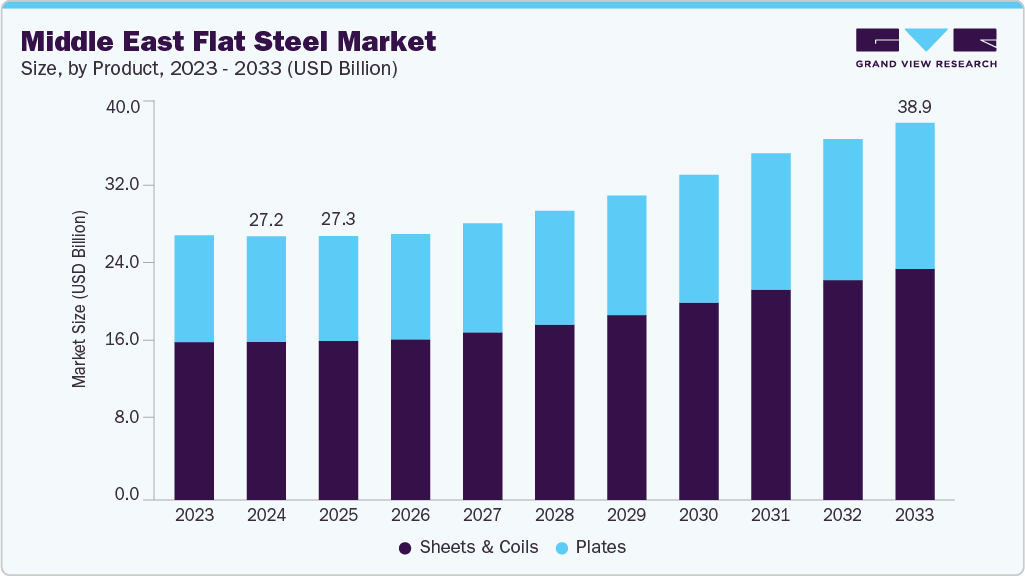
The Middle East flat steel market size was estimate at USD 27.22 billion in 2024 and is expected to reach USD 38.97 billion by 2033, at a CAGR of 4.6% from 2025 to 2033. The rapid expansion of the construction and infrastructure sectors across the region supports the growth of the Middle East flat steel market.
Key Market Trends & Insights
- Based on product, sheets & coils held the revenue share of 40.0% in 2024.
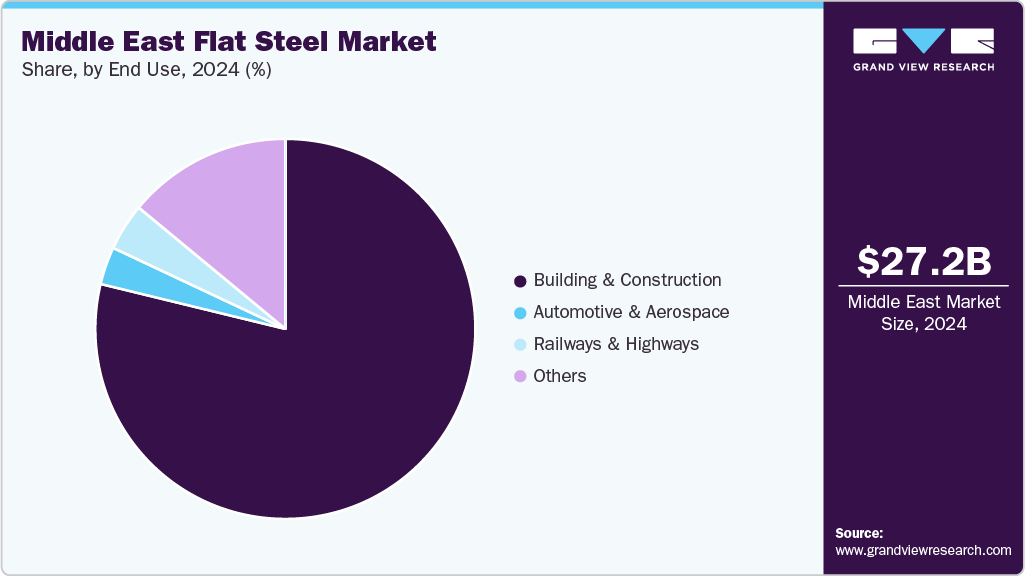
- Based on end use, the building & construction segment held the revenue share of 78.8% in 2024.
Market Size & Forecast
- 2024 Market Size: USD 27.22 Billion
- 2033 Projected Market Size: USD 38.97 Billion
- CAGR (2025-2033): 4.6%
Prism AI by Grand View Research Free to tryAsk a question about the middle east flat steel marketTry asking✓Every figure cited from GVR research Prefer the report? Download free sample →
Countries such as Saudi Arabia, the UAE, and Qatar are investing heavily in large-scale projects, including smart cities, industrial zones, and transport networks. Mega initiatives like Saudi Arabia’s NEOM city, Dubai’s infrastructure upgrades, and Qatar’s post-World Cup development plans require substantial flat steel products such as hot-rolled coils, cold-rolled coils, and galvanized sheets. The focus on urban development, modernization of transportation systems, and industrial diversification under government-led programs is creating sustained demand for high-quality flat steel products.The manufacturing sector in the Middle East is emerging as another key growth driver for flat steel demand. Industries such as automotive, shipbuilding, white goods, and machinery manufacturing rely extensively on flat steel for body panels, structural components, and specialized parts. The UAE and Saudi Arabia position themselves as regional manufacturing hubs, offering incentives to attract domestic and international investments. As manufacturing capacity grows, particularly in value-added industries, the requirement for flat steel with specific mechanical and surface properties is increasing, pushing producers to expand their product offerings and enhance quality standards.
 Source: Grand View Research, IR Documents, Primary Interviews, Paid DatabasesTo learn more about this report,
 Download Free Sample Report
The energy sector plays a significant role in driving flat steel consumption in the Middle East. The region’s oil and gas industry and emerging renewable energy projects demand flat steel for pipelines, pressure vessels, storage tanks, and structural frameworks. The growth of downstream petrochemical and refining capacities also contributes to steady steel usage. In addition, renewable energy initiatives such as solar and wind farms require flat steel for turbine structures, solar mounting systems, and ancillary equipment. This diversification of energy infrastructure ensures stable demand from multiple sub-sectors within the energy domain.
Trade and policy dynamics are further boosting the Middle East flat steel market. Several governments are implementing policies encouraging domestic steel production to reduce reliance on imports, improve self-sufficiency, and create employment opportunities. Free trade agreements, regional cooperation under the Gulf Cooperation Council (GCC), and favorable tax regimes attract investments in steel manufacturing facilities. Moreover, the strategic geographic location of Middle Eastern countries allows easy access to European, Asian, and African markets, making the region a potential export hub for flat steel products.
Technological advancements and product innovation are also contributing to market growth. Steel manufacturers in the Middle East are adopting advanced rolling technologies, surface treatment processes, and automation to enhance production efficiency and meet the stringent quality requirements of end users. The shift toward lightweight, corrosion-resistant, high-strength steel grades aligns with global sustainability trends and industry-specific performance needs. Additionally, the push for green steel production, driven by both environmental regulations and customer demand, is prompting investments in cleaner production methods, which are likely to create long-term growth opportunities for the flat steel market in the region.
Drivers, Opportunities & Restraints
The Middle East flat steel market is primarily driven by robust construction, infrastructure, and manufacturing growth. Dubai’s transport and real estate expansions, and Qatar’s industrial development initiatives, are creating significant demand for flat steel products, including hot-rolled, cold-rolled, and coated sheets. Expanding manufacturing industries such as automotive, appliances, shipbuilding, and machinery further strengthen demand. In addition, the oil and gas sector and renewable energy projects utilize large volumes of flat steel for pipelines, structural components, and equipment fabrication, making it a consistent demand generator.
Opportunities in the market stem from ongoing industrial diversification strategies, government-led localization programs, and investments in advanced steel production technologies. Countries in the region are encouraging domestic manufacturing to reduce import dependence, creating openings for new flat steel plants and value-added production lines. The shift toward high-strength, lightweight, and corrosion-resistant grades aligns with global trends. It opens up export potential to Europe, Asia, and Africa due to the Middle East’s strategic location. Moreover, the growing focus on sustainable and low-carbon steel production provides scope for innovation and long-term competitiveness in the global market.
Despite the positive outlook, the market faces restraints including fluctuating raw material prices, high energy costs for production, and dependency on imported iron ore and coking coal. Competitive pressure from low-cost imports, particularly from Asian producers, can affect local manufacturers’ profitability. Additionally, economic volatility in the region, geopolitical tensions, and cyclical downturns in construction activity can disrupt demand patterns.
Product Insights
Plates segment in the Middle East flat steel market is growing due to its critical role in heavy industries, infrastructure, and energy projects. Steel plates are extensively used to fabricate bridges, offshore platforms, shipbuilding, pressure vessels, and heavy machinery. The region’s large-scale oil and gas projects, including pipeline expansions, refinery upgrades, and LNG facilities, create consistent demand for thick, high-strength plates. Infrastructure initiatives such as industrial complexes, power plants, and transport hubs also require large volumes of plates for structural applications. The ongoing investments in shipbuilding and marine engineering in countries like the UAE and Oman further enhance the consumption of steel plates in the region.
The sheets and coils segment in the Middle East flat steel market is experiencing strong growth driven by rising demand from the construction, infrastructure, and manufacturing industries. Hot-rolled and cold-rolled coils are widely used in structural frameworks, roofing, cladding, and prefabricated building components for large-scale projects such as industrial parks, commercial complexes, and transport infrastructure. Government-backed initiatives like Saudi Arabia’s Vision 2030, the UAE’s infrastructure modernization, and Qatar’s industrial diversification programs generate sustained requirements for high-quality sheets and coils.
End Use Insights
The building and construction segment is a major driver of flat steel demand in the Middle East, supported by large-scale infrastructure and urban development projects. Rapid population growth, rising urbanization, and economic diversification efforts further fuel construction activity, which directly supports flat steel consumption. The increasing adoption of prefabricated and modular construction techniques also boosts demand for high-quality, precision-engineered flat steel components. Moreover, the focus on sustainable and energy-efficient building designs drives the use of advanced coated and treated steel products that provide improved thermal performance and corrosion resistance.
 To learn more about this report, Download Free Sample Report
The automotive and aerospace segment in the Middle East flat steel market is expanding as regional manufacturing capabilities develop and global players increase their presence. In the automotive sector, rising vehicle assembly operations in countries like the UAE, Saudi Arabia, and Morocco (as part of Middle East-North Africa trade integration) are driving demand for cold-rolled, galvanized, and high-strength steel sheets used in body panels, chassis components, and safety structures. Government initiatives to attract foreign direct investment in vehicle manufacturing and the growing demand for commercial, passenger, and electric vehicles create sustained opportunities for flat steel consumption.
Regional Insights
The flat steel market in Saudi Arabia is experiencing strong growth driven by the country’s ambitious giga-projects and infrastructure expansion under Vision 2030. Mega developments such as NEOM, Qiddiya, the Red Sea Project, Diriyah, and major transportation projects, including Riyadh and Jeddah Metros, new airports, and port expansions, create substantial demand for flat steel products. Investments by global players such as China’s Baosteel, partnering with Saudi Aramco and the Public Investment Fund, are expanding flat steel production through a major joint venture with an annual capacity of up to 1.5 million tonnes of steel plate. Plans for green integrated steel complexes (e.g., Essar’s Green Steel Arabia) and inbound investments from Tosyali further support market expansion and localization. These initiatives align with the Kingdom’s goal of moving from reliance on imports toward near self-sufficiency by 2030.
The UAE flat steel market is experiencing strong growth due to the country’s active pipeline of construction and infrastructure projects. Large-scale urban developments, commercial real estate, logistics hubs, and transport projects in Dubai, Abu Dhabi, and other emirates fuel demand for sheets, coils, and plates. High-rise buildings, airports, ports, and logistics facilities continue to require significant volumes of structural steel, ensuring a steady market for flat steel products across various construction segments.
Key Middle East Flat Steel Company Insights
Some key players operating in the market include Al-Ittefaq Steel, Emirates Steel, and others
-
Al-Ittefaq Steel Products Company is one of the largest privately held steel manufacturers in the GCC, operating as a fully integrated producer with advanced technology and skilled expertise. Established in 1989 with the acquisition of a small rolling mill, the company has expanded into a major steel producer with a capacity exceeding 2.5 million tonnes per year. Its operations span upstream and downstream segments, supported by subsidiaries such as National Steel Company, Arab Steel Company, and Direct Reduction Iron Company. The company follows stringent quality standards, holding certifications from SASO, ISO 9001, and UK CARES.
-
Emirates Steel, established in 1998 and owned by SENAAT, is the UAE’s only integrated steel plant and a key contributor to Abu Dhabi's industrial diversification. It has grown from a modest billet rolling facility to a large-scale producer with an annual capacity of around 3.5 million tonnes. The company has invested heavily in modern facilities and technology to enhance production efficiency and environmental performance, positioning itself as a reliable supplier to the regional and global steel markets.
Key Middle East Flat Steel Companies:
- Al-Ittefaq Steel
- ArcelorMittal
- Emirates Steel
- Ezz Steel
- Jindal Steel & Power
- Qatar Steel
- SABIC Hadeed
- Tata Steel
Recent Development
-
In February 2025, Essar Group is advancing its plans to build a state-of-the-art, 4 million tonnes per annum integrated flat green steel complex in Ras-Al-Khair, Saudi Arabia. The USD 4.5 billion project, spread over more than 315hectares, aims to set a new benchmark for sustainability with decarbonisation-conscious design and cutting-edge technology. With dedicated port facilities and robust supply agreements already in place for raw materials, including renewable energy initiatives and partnerships for supplying iron ore and pellets, the complex is poised to become the largest of its kind in the MENA region.
Middle East Flat Steel Market Report Scope
Report Attribute
Details
Market size value in 2025
USD 27.26 billion
Revenue forecast in 2033
USD 38.97 billion
Growth rate
CAGR of 4.6% from 2025 to 2033
Base year for estimation
2024
Historical data
2021 - 2023
Forecast period
2025 - 2033
Quantitative Units
Volume in kilotons, Revenue in USD million/billion, and CAGR from 2025 to 2033
Report coverage
Volume forecast, revenue forecast, competitive landscape, growth factors, and trends
Segments covered
Product, end use
Regional scope
Middle East
Country scope
Bahrain; Kuwait; Saudi Arabia; UAE; Omar; Qatar
Key companies profiled
Emirates Steel; SABIC Hadeed; ArcelorMittal; Tata Steel; Ezz Steel; Qatar Steel; Jindal Steel & Power; Al-Ittefaq Steel
Customization scope
Free report customization (equivalent up to 8 analysts working days) with purchase. Addition or alteration to country, regional & segment scope.
Pricing and purchase options
Avail customized purchase options to meet your exact research needs. Explore purchase options
Middle East Flat Steel Market Report Segmentation
This report forecasts revenue and volume growth at the regional and country levels and provides an analysis of the latest industry trends in each of the sub-segments from 2021 to 2033. For this study, Grand View Research has segmented the Middle East flat steel market report based on product, end use, and region.
-
Product Outlook (Volume, Kilotons; Revenue, USD Million, 2021 - 2033)
-
Sheets & Coils
-
Plates
-
-
End Use Outlook (Volume, Kilotons; Revenue, USD Million, 2021 - 2033)
-
Building & Construction
-
Automotive & Aerospace
-
Railways & Highways
-
Others
-
-
Regional Outlook (Volume, Kilotons; Revenue, USD Million, 2021 - 2033)
-
Middle East & Africa
-
Bahrain
-
Kuwait
-
Saudi Arabia
-
UAE
-
Qatar
-
Oman
-
-
Frequently Asked Questions About This Report
The Middle East flat steel market is expected to grow at a compound annual growth rate of 4.6% from 2025 to 2033 to reach USD 38.97 billion by 2033.
The plates segment dominated the market with a revenue share of 60.0% in 2024.
The Middle East flat steel market size was estimated at USD 27.22 billion in 2024 and is expected to reach USD 27.27 billion in 2025.
Some of the key players of the global flat steel market are Emirates Steel, SABIC Hadeed, ArcelorMittal, Tata Steel, Ezz Steel, Qatar Steel, Jindal Steel & Power, Al-Ittefaq Steel, and others.
The key factor driving the growth of the flat steel market is the increasing demand from construction, automotive, and manufacturing industries due to rapid urbanization and industrial expansion.
About the Author(s)
Advanced Interior Materials Research Team
Advanced Materials · Advanced Interior MaterialsThis report was authored by the advanced interior materials research team at Grand View Research - comprising two research analysts, one senior research analyst, and one industry expert - with specialized expertise in the advanced interior materials segment of the advanced materials industry. All findings are based on proprietary advanced materials databases, executive interviews, and regulatory analysis, subject to internal peer review prior to publication.
Last Updated:
Speak to Analyst

Customize this report to your needs - add regions, segments, or data points, with 20% free customization.
Or view our licence options:


ISO 9001:2015 & 27001:2022 Certified
We are GDPR and CCPA compliant! Your transaction & personal information is safe and secure. For more details, please read our privacy policy.


