Middle East Heat Treating Market Summary
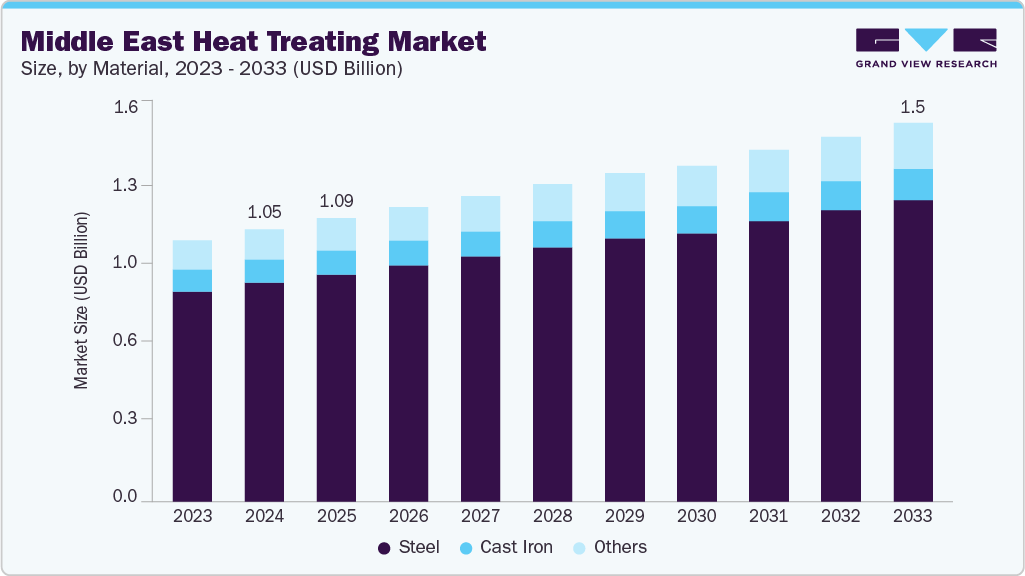
The Middle East heat treating market size was estimated at USD 1,055.1 million in 2024 and is expected to reach USD 1,467.8 million, growing at a CAGR of 3.7% from 2025 to 2033. The Middle East heat treating market is experiencing growth due to several key factors.
Key Market Trends & Insights
- The heat treating market in Saudi Arabia is expected to grow at a substantial CAGR of 4.1% from 2025 to 2033.
- By material, steel segment is expected to grow at a considerable CAGR of 3.6% from 2025 to 2033 in terms of revenue.
- By equipment, electrically heated furnace equipment segment is expected to grow at a considerable CAGR of 4.1% from 2025 to 2033 in terms of revenue.
- By application, aerospace segment is expected to grow at a considerable CAGR of 4.9% from 2025 to 2033 in terms of revenue.
Market Size & Forecast
- 2024 Market Size: USD 1,055.1 Million
- 2033 Projected Market Size: USD 1,467.8 Million
- CAGR (2025-2033): 3.7%
The automotive and aerospace industries are significant drivers, with increasing demand for heat-treated components that offer enhanced strength, durability, and resistance to wear. In addition, the region's expanding manufacturing sectors, particularly in countries such as Saudi Arabia and the UAE, are contributing to the market's expansion. Another factor propelling the market is the rise in crude steel production in emerging economies such as the UAE and Saudi Arabia. This growth in steel production leads to an increased need for heat treatment services to enhance the material properties of steel components. Furthermore, shifting consumer preferences towards energy-efficient technologies are influencing the adoption of advanced heat treatment processes. These factors collectively contribute to the positive outlook for the heat treating market in the Middle East.
Market Concentration & Characteristics
The heat treating industry in the Middle East exhibits a moderately fragmented structure. While global players contribute to technological advancements, local firms cater to regional demands, leading to a competitive yet diverse market landscape. This fragmentation fosters innovation and responsiveness to industry-specific needs. Strategic partnerships and joint ventures are common, allowing companies to leverage local expertise and global resources effectively.
The Middle East heat treating industry shows a moderate level of innovation, driven by demand for advanced material properties in automotive, aerospace, and construction sectors. Companies are increasingly adopting cutting-edge technologies such as vacuum and cryogenic treatment. This focus enhances product quality and performance. Continuous R&D investment is helping firms maintain a competitive edge in the region.
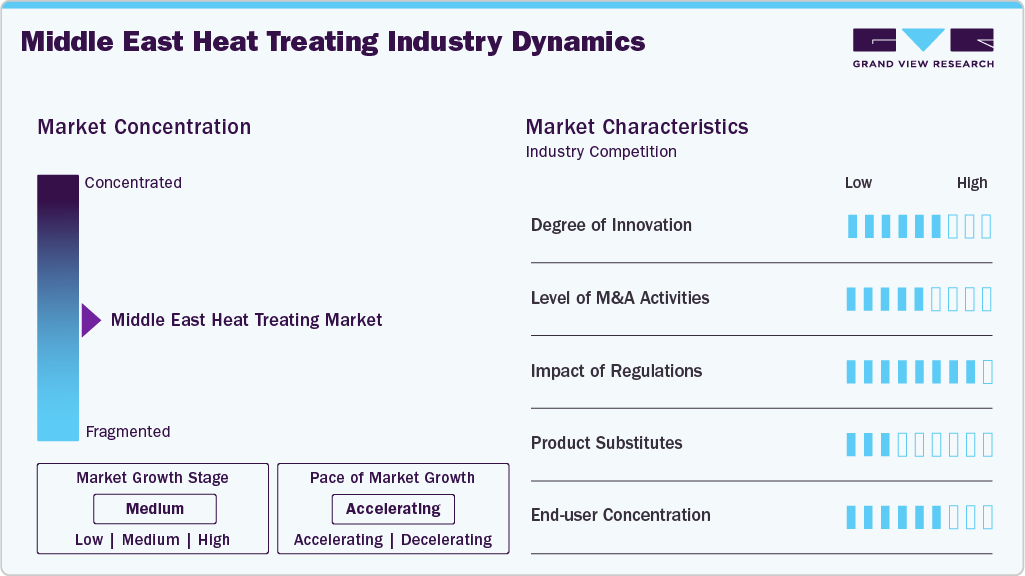
Mergers and acquisitions in the Middle East heat treating market are gradually increasing as firms aim to expand capabilities and market reach. International players often acquire or partner with local companies to gain regional access. This trend strengthens technological capabilities and service portfolios. It also helps in achieving economies of scale and operational efficiencies.
Regulations related to environmental standards, workplace safety, and energy efficiency significantly influence the heat treating industry. Compliance with these regulations drives investment in cleaner and more efficient technologies. Firms must adopt practices that minimize emissions and energy consumption. Regulatory adherence ensures sustainable growth and reduces operational risks.
Drivers, Opportunities & Restraints
The Middle East heat treating market is driven by rapid industrialization and the growth of automotive, aerospace, and construction sectors. Rising demand for high-strength, wear-resistant components fuels market expansion. Increasing steel production and adoption of advanced manufacturing techniques also support growth. Technological advancements in heat treatment processes further enhance efficiency and product quality.
The region presents opportunities through the adoption of energy-efficient and environmentally friendly heat treatment technologies. Expanding infrastructure projects and industrial hubs create demand for specialized services. Collaborations between global and local firms offer avenues for knowledge transfer and market penetration. Investment in R&D can lead to innovative solutions tailored to regional requirements.
High capital investment and operational costs pose challenges for new entrants and small players. Skilled labor shortages and technical expertise gaps limit industry scalability. Strict environmental regulations require continuous compliance and technology upgrades. Market growth can also be hindered by economic fluctuations and regional geopolitical uncertainties.
Material Insights
Steel remains the dominant material in the Middle East heat treating market and accounted for 80.5% share in 2024, due to its widespread use across automotive, construction, and industrial applications. Its demand is driven by the need for high-strength and wear-resistant components. Advanced heat treatment processes improve steel’s mechanical properties and durability. The material’s versatility and availability make it a preferred choice for manufacturers in the region.
Cast iron is witnessing growth in the heat treating market as industries seek cost-effective, durable components for machinery and infrastructure. Its enhanced wear resistance and thermal stability make it suitable for heavy-duty applications. The rising adoption of cast iron in manufacturing and construction fuels this demand. Improved processing techniques are further boosting its utilization in the region.
Process Insights
Case hardening processes dominate the Middle East heat treating market and accounted for 28.7% share, due to its ability to enhance surface hardness while maintaining a tough core. It is widely used in automotive and industrial components requiring wear resistance. The process improves the lifespan and performance of steel parts. Its efficiency and reliability make it a preferred choice among manufacturers.
Annealing is experiencing growth as industries increasingly focus on improving ductility and reducing material stresses in components. It is particularly useful for cast iron and specialty steels in construction and machinery applications. Rising demand for precision-engineered parts drives its adoption. Advances in annealing techniques are enhancing process efficiency and product quality.
Equipment Insights
Electrically heated furnaces lead the Middle East heat treating equipment market and accounted for 44.6% share, due to their precise temperature control and energy efficiency. They are widely used in automotive, aerospace, and industrial applications requiring uniform heating. The low emission and clean operation make them suitable for regulated environments. Their reliability and consistent performance drive widespread adoption among manufacturers.
Fuel-fired furnaces are witnessing growth as they offer cost-effective solutions for large-scale industrial and heavy-duty applications. They are preferred where high-temperature processing and flexibility in fuel choice are required. Increasing industrial expansion in the region supports their adoption. Technological improvements are enhancing energy efficiency and operational safety.
Application Insights
The automotive sector dominates the Middle East heat treating market and accounted for 31.8% share, due to the high demand for durable, wear-resistant components. Heat treatment enhances engine parts, gears, and shafts for improved performance. Growing vehicle production and modernization of assembly lines drive market growth. The need for quality and reliability in automotive components ensures continued adoption of heat treatment processes.
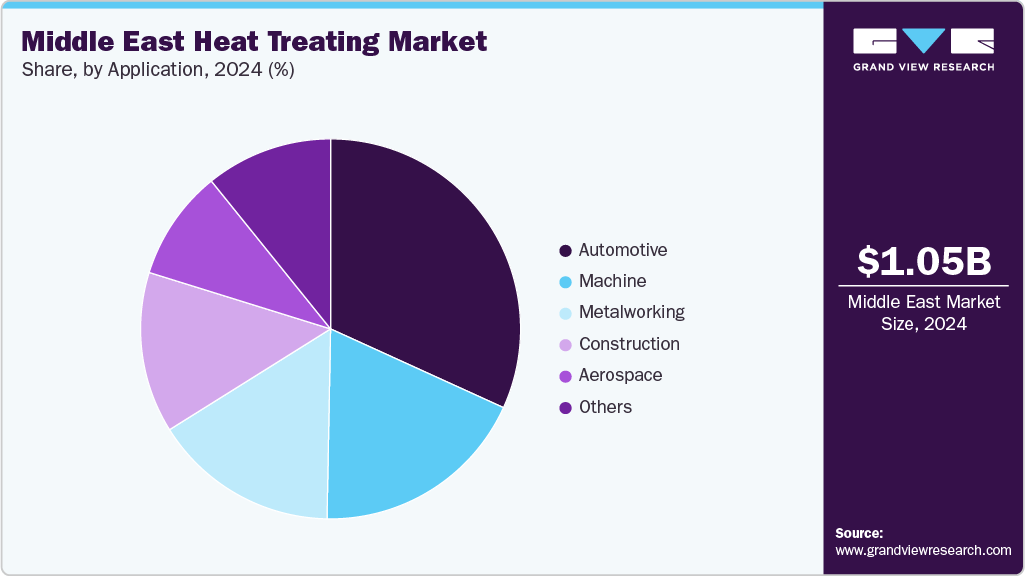
The aerospace sector is the fastest-growing application segment as it demands lightweight, high-strength, and fatigue-resistant materials. Heat treating improves the performance and safety of critical components such as turbines and structural parts. Rising aircraft manufacturing and maintenance activities in the region fuel growth. Technological advancements in precision heat treatment processes further accelerate adoption in aerospace.
Country Insights
Saudi Arabia Heat Treating Market Trends
Saudi Arabia dominates the Middle East heat treating market and accounted for 27.2% share, due to its large industrial base and extensive automotive and construction sectors. Significant investments in manufacturing infrastructure drive the demand for heat-treated components. The presence of major steel producers further supports market growth. Government initiatives promoting industrial diversification also boost adoption of advanced heat treatment technologies.
UAE Heat Treating Market Trends
The UAE market is growing as it expands its industrial and aerospace manufacturing capabilities. Increasing infrastructure projects and high-tech industries create demand for heat treatment services. Strategic partnerships with international firms enhance technological adoption. The country’s focus on innovation and industrial diversification supports steady market growth.
Key Middle East Heat Treating Company Insights
Some of the key players operating in the market include Bodycote, Nabertherm GmbH, and Carbolite Gero
-
Bodycote has built a strong presence in the Middle East by supporting oil & gas, aerospace, and automotive sectors with advanced heat-treatment services. The company’s regional operations focus on processes such as case hardening, vacuum heat treatment, and surface technology tailored to demanding industrial needs. It works closely with GCC clients to meet strict quality and reliability standards. By aligning with projects in Saudi Arabia and the UAE, Bodycote strengthens its role in the region’s industrial supply chain.
-
Nabertherm serves the Middle East market through authorized distributors and service partners in Saudi Arabia and the UAE. Its industrial furnaces are widely applied in metal processing, foundry, and R&D facilities across the region. The company emphasizes customized furnace solutions adapted for regional industries, including aerospace and construction materials. Its strong distribution network ensures after-sales support, making it a trusted supplier in the GCC.
Key Middle East Heat Treating Companies:
- Bodycote
- Unitherm Engineers
- Carbolite Gero
- AICHELIN Group
- East-Lind Heat Treat
- Nabertherm GmbH
- SECO/WARWICK Allied Pvt. Ltd.
- Alpha Metallurgical Resources Inc
- HighTemp Furnaces Limited
- Aterian Inc
Recent Developments
-
In August 2025, Aichelin Group will acquire Nitrex and NTS‑UPC to expand its heat-treatment offerings. The move strengthens its capabilities in vacuum and thermochemical processes. It enhances Aichelin’s presence in global and Middle East markets. The acquisition broadens its industrial technology portfolio.
-
In January 2024, SECO/WARWICK expanded its production capacity in 2023 to meet rising global demand for heat treating equipment. The company enhanced its facilities and added new production lines across key technology segments. This move aims to boost delivery efficiency and support long-term growth.
Middle East Heat Treating Market Report Scope
|
Report Attribute
|
Details
|
|
Market size value in 2025
|
USD 1,097.8 million
|
|
Revenue forecast in 2033
|
USD 1,467.8 million
|
|
Growth rate
|
CAGR of 3.7% from 2025 to 2033
|
|
Historical data
|
2021 - 2023
|
|
Forecast period
|
2025 - 2033
|
|
Quantitative units
|
Revenue in USD million/billion and CAGR from 2025 to 2033
|
|
Report coverage
|
Revenue forecast, company ranking, competitive landscape, growth factors, and trends
|
|
Segments covered
|
Material, process, equipment, application, country
|
|
Country scope
|
Saudi Arabia; UAE; Qatar; Oman; Israel; Kuwait
|
|
Key companies profiled
|
Bodycote; Unitherm Engineers; Carbolite Gero; AICHELIN Group; East-Lind Heat Treat; Nabertherm GmbH; SECO/WARWICK Allied Pvt. Ltd.; Alpha Metallurgical Resources Inc; HighTemp Furnaces Limited; Aterian Inc
|
|
Customization scope
|
Free report customization (equivalent up to 8 analysts working days) with purchase. Addition or alteration to country, regional & segment scope.
|
|
Pricing and purchase options
|
Avail customized purchase options to meet your exact research needs. Explore purchase options
|
Middle East Heat Treating Market Report Segmentation
This report forecasts revenue growth in the Middle East, and country levels and provides an analysis of the latest industry trends in each of the sub-segments from 2021 to 2033. For this study, Grand View Research has segmented the Middle East heat treating market report based on material, process, equipment, application, and country:
-
Material Outlook (Revenue, USD Million, 2021 - 2033)
-
Process Outlook (Revenue, USD Million, 2021 - 2033)
-
Case hardening
-
Hardening & tempering
-
Annealing
-
Normalizing
-
Others
-
Equipment Outlook (Revenue, USD Million, 2021 - 2033)
-
Application Outlook (Revenue, USD Million, 2021 - 2033)
-
Automotive
-
Machine
-
Construction
-
Aerospace
-
Metalworking
-
Others
-
Country Outlook (Revenue, USD Million, 2021 - 2033)
-
Saudi Arabia
-
UAE
-
Qatar
-
Oman
-
Israel
-
Kuwait
Frequently Asked Questions About This Report
b. Middle East heat treating market size was estimated at USD 1,055.1 million in 2024 and is expected to be USD 1,097.8 million in 2025.
b. The Middle East heat treating market, in terms of revenue, is expected to grow at a compound annual growth rate of 3.7% from 2024 to 2033 to reach USD 1,467.8 million by 2033.
b. Steel remains the dominant material in the Middle East heat treating market and accounted for 80.5% share in 2024, due to its widespread use across automotive, construction, and industrial applications. Its demand is driven by the need for high-strength and wear-resistant components. Advanced heat treatment processes improve steel’s mechanical properties and durability.
b. Some of the key player in Middle East heat trating market includes Bodycote; Unitherm Engineers; Carbolite Gero; AICHELIN Group; East-Lind Heat Treat; Nabertherm GmbH; SECO/WARWICK Allied Pvt. Ltd.; Alpha Metallurgical Resources Inc; HighTemp Furnaces Limited; Aterian Inc, among others.
b. The Middle East heat treating market is driven by rapid industrialization, growing demand from automotive and aerospace sectors, and increasing steel production. Advanced manufacturing processes and technological adoption further boost market growth. Rising infrastructure development and energy-efficient initiatives also support industry expansion.

 Download Sample Report
















