- Home
- »
- Plastics, Polymers & Resins
- »
-
Middle East Holographic Labels Market, Industry Report 2033GVR Report cover
![Middle East Holographic Labels Market Size, Share & Trends Report]()
Middle East Holographic Labels Market (2025 - 2033) Size, Share & Trends Analysis Report By Material (PET, BOPP / PP, Paper, PVC), By Application (Security / Authentication, Branding / Decorative), By End Use, By Country, And Segment Forecasts
- Report ID: GVR-4-68040-734-2
- Number of Report Pages: 120
- Format: PDF
- Historical Range: 2021 - 2023
- Forecast Period: 2025 - 2033
- Industry: Bulk Chemicals
- Report Summary
- Table of Contents
- Segmentation
- Methodology
- Download FREE Sample
-
 Download Sample Report
Middle East Holographic Labels Market Summary
The Middle East holographic labels market size was estimated at USD 89.7 million in 2024 and is projected to reach USD 154.7 million by 2033, expanding at a CAGR of 6.2% from 2025 to 2033. The industry is driven by an increasing demand for product authentication and brand protection, coupled with stringent government regulations against counterfeiting.
Key Market Trends & Insights
- Saudi Arabia dominated the Middle East holographic labels market with the largest revenue share of over 39.0% in 2024 and is expected to grow at a substantial CAGR of 6.6% from 2025 to 2033.
- By material, the PET segment is expected to grow at a considerable CAGR of 6.6% from 2025 to 2033 in terms of revenue.
- By application, the security/authentication segment is expected to grow at a considerable CAGR of 6.6% from 2025 to 2033 in terms of revenue.
- By end use, the pharmaceuticals & healthcare segment is expected to grow at a considerable CAGR of 6.8% from 2025 to 2033 in terms of revenue.
Market Size & Forecast
- 2024 Market Size: USD 89.7 Million
- 2033 Projected Market Size: USD 154.7 Million
- CAGR (2025-2033): 6.2%
- Saudi Arabia: Largest Market in 2024
The market is further propelled by the premium appeal and enhanced consumer engagement these advanced labels offer to brands. The region, with its high per capita income and concentration of luxury goods, pharmaceuticals, and premium electronics, is a lucrative target for counterfeiters. Holographic labels, with their complex optical patterns that are extremely difficult and costly to replicate, serve as a first-line visual authentication feature for consumers and supply chain inspectors. For example, a luxury perfume brand in the UAE can integrate a custom holographic stamp on its packaging that displays a 3D image and the brand's logo, which shifts when tilted. This instantly assures the customer of the product's authenticity, protecting both the consumer from fraud and the brand's reputation and revenue from sophisticated fakes flooding the market.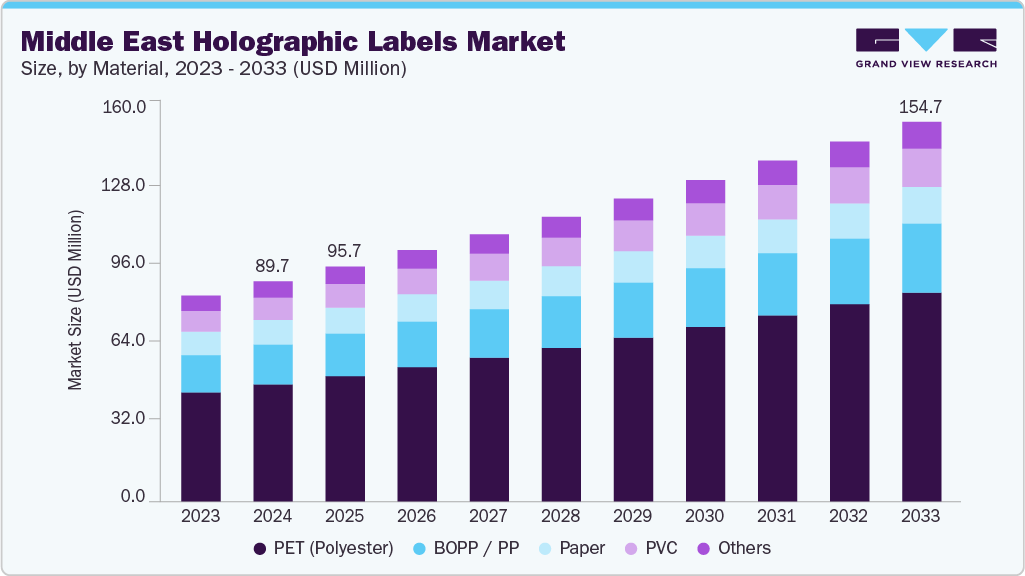
The market is further propelled by stringent government regulations and initiatives, particularly from the GCC (Gulf Cooperation Council) nations, mandating track-and-trace systems for specific product categories. Governments are implementing regulations that require tamper-evident and hard-to-replicate labelling to ensure product safety, collect taxes, and combat illicit trade. Saudi Arabia's Saudi Food and Drug Authority (SFDA), for instance, has implemented a serialization system for pharmaceuticals where each product pack must have a unique identifier. Holograms are a preferred technology, as they provide both an overt security feature (the visible hologram) and can covertly contain encrypted data, making them integral to complying with these mandatory traceability schemes and ensuring public health safety.
Moreover, the growth is significantly driven by the powerful marketing and aesthetic appeal of holographic labels. In a region known for its opulence and attraction to premium, eye-catching products, holograms offer a way for brands to enhance shelf presence and perceived value. The dynamic, light-diffracting quality of holograms conveys a message of innovation, quality, and exclusivity. This is evident in sectors like cosmetics, where a limited-edition makeup palette might feature a holographic outer label to signify its premium status, or in the confectionery industry, where a brand might use rainbow holographic effects on its packaging to attract younger consumers. This dual function, serving as both a security device and a high-value marketing tool, makes it a highly attractive investment for brands.
Market Concentration & Characteristics
A key characteristic is the heavy influence of government regulation and a top-down adoption model. Unlike many regions where market growth is primarily driven by private-sector brand owners, a significant portion of the demand in the Middle East is legislated. GCC-wide and country-specific initiatives, such as Saudi Arabia's SFDA pharmaceutical serialization and the UAE's digital tax stamp program for tobacco products, create large, stable, and non-negotiable demand streams. This makes government and regulatory bodies some of the most important end-clients, and suppliers must navigate complex tender processes and meet stringent technical and security certifications to qualify.
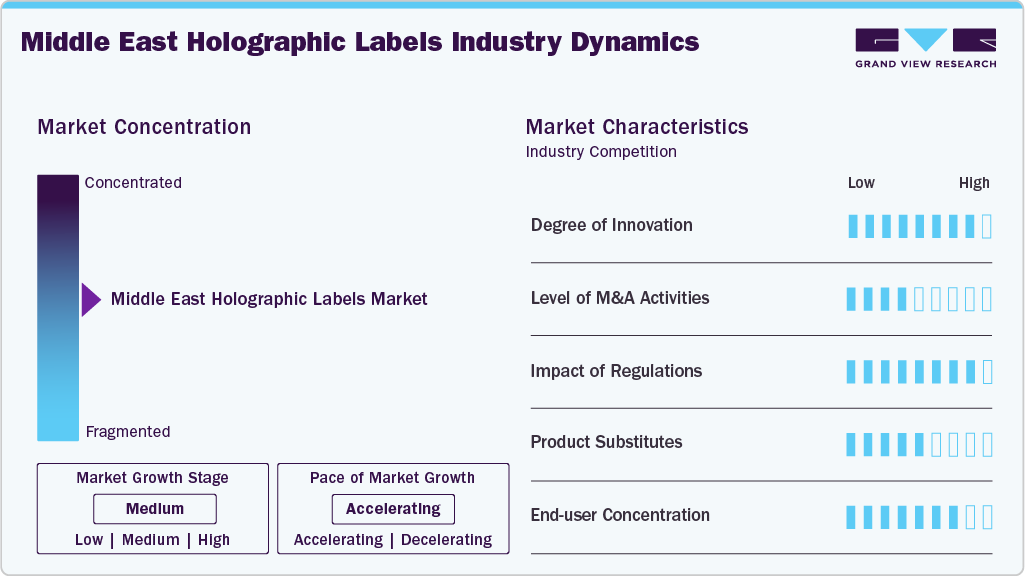
The competitive landscape is a mix of specialized international players and regional distributors. The market is dominated by a few large global security holography manufacturers who possess the proprietary technology and experience to execute high-security government contracts. However, the distribution and servicing for the vast decorative market are handled by a network of regional converters and label printers who import holographic foils and materials from global suppliers (including those in Europe and Asia) and then apply them for local brands. This creates a layered ecosystem where technology providers, converters, and end-users are distinct entities.
Material Insights
The PET segment recorded the largest market revenue share of over 53.0% in 2024 and is expected to grow at the fastest CAGR of 6.6% during the forecast period. PET is one of the most widely used materials in holographic labels due to its excellent clarity, strength, and dimensional stability. It offers a smooth surface that enhances the visibility of holographic patterns and provides durability against moisture, chemicals, and wear. PET-based holographic labels are commonly used in industries such as food & beverages, pharmaceuticals, and cosmetics, where long-lasting visual appeal and protection are required. The demand for PET holographic labels is driven by their durability, high resistance to tearing, and superior optical clarity, which make them ideal for premium packaging.
BOPP/PP materials are lightweight, cost-effective, and highly versatile for holographic label applications. They are preferred for products requiring resistance to moisture, oil, and chemicals. These labels maintain printability and can be designed with vibrant holographic effects, making them popular in food packaging, FMCG, and logistics industries. The growth of BOPP/PP holographic labels is mainly spurred by their cost-effectiveness and wide applicability in mass-market consumer goods. Their moisture-resistant property makes them ideal for food packaging, while their lightweight nature reduces transportation costs. Increasing usage in high-volume packaged goods and e-commerce shipments further supports demand.
Application Insights
The security / authentication segment accounted for the largest market revenue share of over 58.0% in 2024 and is expected to grow at the fastest CAGR of 6.6% during the forecast period. In the Middle East, the primary application of holographic labels includes security and authentication. These labels are used to verify the authenticity of high-value goods, sensitive documents, and products prone to illicit trade. Common uses include tax stamps on tobacco and alcohol, pharmaceutical packaging to combat fake medicines, government documents like passports and national ID cards, and brand protection for luxury items and automotive parts.
The branding and decorative segment leverages the aesthetic appeal of holography to enhance product visibility and brand perception. In a highly competitive consumer market such as the Middle East, brands use these labels not for security but as a powerful marketing tool. The growth of the cosmetics, personal care, and electronics industries in the Middle East, which heavily rely on attractive packaging, creates a sustained demand for decorative labels. Moreover, the rise of social media and visual marketing means products with photogenic, eye-catching packaging are more likely to be shared online, providing free advertising and amplifying the return on investment for decorative holographic labels.
End Use Insights
The food & beverage segment contributed the largest market share of over 28.0% in 2024. In the Middle East, holographic labels are crucial on imported food products and halal-certified items to guarantee authenticity and compliance with religious standards. They are used on premium dates, confectionery, and beverages to enhance shelf appeal in modern retail environments and assure consumers of product genuineness in a market with high import volumes. Driving factors include mandatory halal certification labeling, where holograms assure integrity. The need to combat counterfeit imported goods and the desire for premium, eye-catching packaging in competitive retail sectors such as the UAE and Saudi Arabia are also key drivers.
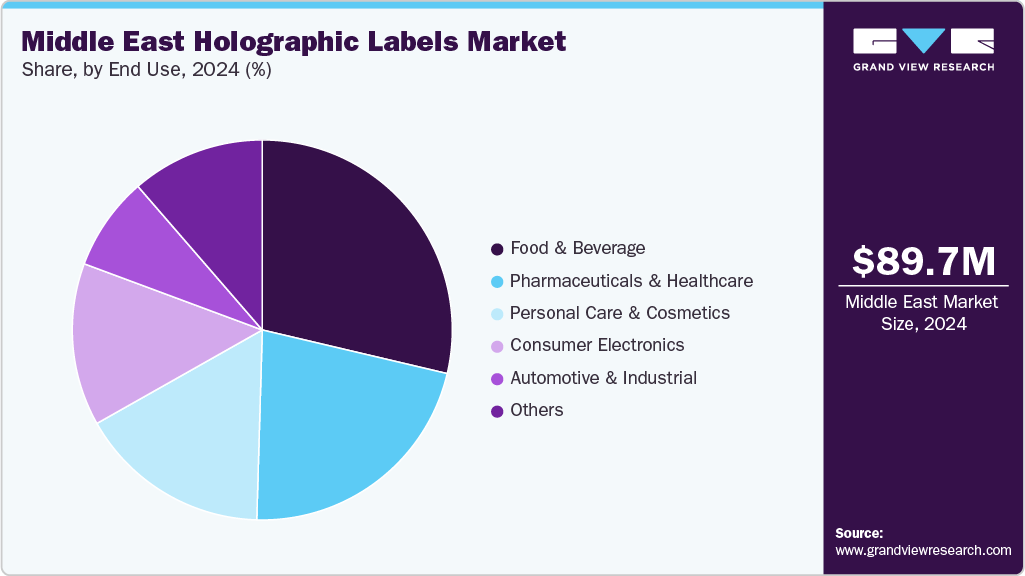
The pharmaceuticals & healthcare segment is projected to grow at the fastest CAGR of 6.8% during the forecast period. This is a critical segment due to the region's strict regulations against counterfeit medicines. GCC regulations drive the adoption of holographic labels for drug traceability and authentication. They are essential for packaging to ensure patient safety and comply with serialization and track-and-trace mandates implemented across the region. The primary driver is strict GCC regulatory compliance, requiring advanced track-and-trace systems. The fight against the proliferation of counterfeit drugs in the region makes holograms an essential security feature for ensuring patient safety and drug authenticity.
Country Insights
Saudi Arabia Holographic Labels Market Trends
The Saudi Arabia holographic labels industry led the market in 2024, accounting for over 39.0% of revenue, and is projected to register the fastest CAGR of 6.6% during the forecast period. This growth is largely fueled by the Kingdom's Vision 2030 economic diversification agenda. The market is heavily influenced by government-led initiatives to enhance product authentication, particularly in pharmaceuticals and food & beverage, to protect public health. Furthermore, the booming retail and construction sectors are increasingly using holographic labels for brand enhancement and anti-counterfeiting of high-value goods and building materials.
UAE Holographic Labels Market Trends
The holographic labels industry in the UAE, particularly Dubai and Abu Dhabi, represents the most advanced and largest market for holographic labels in the region. The industry is characterized by high adoption rates across luxury retail, pharmaceuticals, and government documentation. The market is sophisticated, with a strong demand for high-quality, custom-designed labels that serve both security and premium branding purposes. The driving factors are its status as a global trade and tourism hub, which creates a high concentration of luxury brands and a need for product authentication.
Qatar Holographic Labels Market Trends
The Qatar holographic labels industry is propelled by a high standard of living and a strong focus on imported goods. The need to verify the authenticity of luxury items, electronics, and automotive parts is a key driver. The market saw a significant boost from the infrastructure and branding requirements leading up to the FIFA World Cup 2022, where holograms were used for event merchandise, security access, and premium branding campaigns.
Key Middle East Holographic Labels Company Insights
The competitive environment of the holographic labels industry in the Middle East is characterized by a dynamic interplay between a few specialized international suppliers and a growing number of local and regional converters, all vying for contracts in key high-value sectors such as government documentation, pharmaceuticals, luxury goods, and FMCG. Competition is intensifying as governments, particularly in the GCC nations, enforce stricter anti-counterfeiting and traceability regulations (e.g., Saudi Arabia's SFDA requirements), driving demand for advanced and often integrated solutions that combine holography with other security features such as serialization and track-and-trace technology.
-
In June 2024, CCL Industries completed the acquisition of the remaining 50% equity interest in its Middle East joint venture, Pacman-CCL (PCCL), from Albwardy Investment LLC. PCCL is headquartered in Dubai and has operating label production facilities across the UAE, Oman, Egypt, Saudi Arabia, and Pakistan. Following the acquisition, the business now operates fully under the CCL Label name, reflecting CCL Industries' strengthened presence in the fast-growing Middle East market.
-
In May 2024, UFlex’s holography business launched customized holographic security labels for the pyrotechnics industry to combat counterfeiting, enhancing product authenticity, brand protection, and consumer trust. Featuring strong overt security elements, the labels have been well-received by the market and mark UFlex’s strategic expansion into a new sector, reinforcing its leadership in packaging and security solutions.
Key Middle East Holographic Labels Companies:
- Avery Dennison Corporation
- UFlex Limited
- 3M
- Huhtamaki
- CCL Industries
- Mazan Holo Tech
- Holoprint
- HOLOPROTECTION
- Cloudswood Technologies Pvt. Ltd.
- Kimohat
Middle East Holographic Labels Market Report Scope
Report Attribute
Details
Market size value in 2025
USD 95.7 million
Revenue forecast in 2033
USD 154.7 million
Growth rate
CAGR of 6.2% from 2025 to 2033
Historical data
2021 - 2023
Forecast period
2025 - 2033
Quantitative units
Revenue in USD million, and CAGR from 2025 to 2033
Report coverage
Revenue forecast, competitive landscape, growth factors, and trends
Segments covered
Material, application, end use, country
Country scope
UAE; Saudi Arabia; Oman; Kuwait; Qatar; Bahrain; Israel; Turkey
Key companies profiled
Avery Dennison Corporation; UFlex Limited; 3M; Huhtamaki; CCL Industries; Mazan Holo Tech; Holoprint; HOLOPROTECTION; Cloudswood Technologies Pvt. Ltd.; Kimohat
Customization scope
Free report customization (equivalent up to 8 analyst’s working days) with purchase. Addition or alteration to country, regional, and segment scope.
Pricing and purchase options
Avail customized purchase options to meet your exact research needs. Explore purchase options
Middle East Holographic Labels Market Report Segmentation
This report forecasts revenue growth at a regional level and provides an analysis of the latest industry trends in each of the sub-segments from 2021 to 2033. For this study, Grand View Research has segmented the Middle East holographic labels market report based on material, application, end use, and country:
-
Material Outlook (Revenue, USD Million 2021 - 2033)
-
PET
-
BOPP / PP
-
Paper
-
PVC
-
Others
-
-
Application Outlook (Revenue, USD Million 2021 - 2033)
-
Security / Authentication
-
Branding / Decorative
-
-
End Use Outlook (Revenue, USD Million 2021 - 2033)
-
Food & Beverage
-
Pharmaceuticals & Healthcare
-
Personal Care & Cosmetics
-
Consumer Electronics
-
Automotive & Industrial
-
Others
-
-
Country Outlook (Revenue, USD Million 2021 - 2033)
-
UAE
-
Saudi Arabia
-
Oman
-
Kuwait
-
Qatar
-
Bahrain
-
Israel
-
Turkey
-
Frequently Asked Questions About This Report
b. The Middle East holographic labels market was estimated at around USD 89.7 million in the year 2024 and is expected to reach around USD 95.7 million in 2025.
b. The Middle East holographic labels market is expected to grow at a compound annual growth rate of 6.2% from 2025 to 2033 to reach around USD 154.7 million by 2033.
b. Food & beverage segment emerged as the dominating end use segment in the Middle East holographic labels market due to stringent anti-counterfeiting regulations and the critical need for brand protection in a high-volume, consumer-driven industry.
b. The key players in the Middle East holographic labels market include Avery Dennison Corporation; UFlex Limited; 3M; Huhtamaki; CCL Industries; Mazan Holo Tech; Holoprint; HOLOPROTECTION; Cloudswood Technologies Pvt. Ltd.; Kimohat
b. The market is driven by an increasing demand for product authentication and brand protection, coupled with stringent government regulations against counterfeiting.


Share this report with your colleague or friend.
Need a Tailored Report?
Customize this report to your needs — add regions, segments, or data points, with 20% free customization.


ISO 9001:2015 & 27001:2022 Certified
We are GDPR and CCPA compliant! Your transaction & personal information is safe and secure. For more details, please read our privacy policy.
Trusted market insights - try a free sample
See how our reports are structured and why industry leaders rely on Grand View Research. Get a free sample or ask us to tailor this report to your needs.