Middle East Oat Oil Market Summary
The Middle East oat oil market size was estimated at USD 908.6 thousand in 2024, and is projected to reach USD 1,730.9 thousand by 2033, growing at a CAGR of 7.5% from 2025 to 2033. The market is gaining attention due to the strong alignment between its functional benefits and regional needs.
Key Market Trends & Insights
- The UAE dominated the Middle East oat oil market with the largest revenue share of over 55.0% in 2024.
- By product, the cold-pressed segment is expected to grow at the fastest CAGR of 7.4% from 2025 to 2033.
- By end use, the personal care & cosmetics segment held the largest revenue share of 59.0% in 2024.
Market Size & Forecast
- 2024 Market Size: USD 908.6 Thousand
- 2033 Projected Market Size: USD 1,730.9 Thousand
- CAGR (2025-2033): 7.5%
Consumers in GCC countries face dry, sun-exposed skin conditions, creating demand for gentle, barrier-repairing oils. Local personal care brands are actively positioning clean-label, halal-certified formulations, where oat oil’s lipid-rich, beta-glucan composition adds clinical credibility. Growth is further encouraged by dermatology-led skincare and the concentration of contract manufacturers in the UAE and Saudi Arabia. Oat oil stands out in high-value segments such as sun care, baby care, and post-procedure skin recovery. Its ceramide-like fatty acids and antioxidant profile make it suitable for premium skincare ranges, particularly products designed for dry climates. Regional formulators often combine oat oil with other oat-derived extracts to deliver synergistic skin health claims. E-commerce expansion, tourism-driven retail channels, and the growing number of formulation and packaging hubs in free zones also support demand. Importers and distributors see value in cold-pressed and organic-certified variants, which resonate with the positioning of regional premium brands.

Oats are not cultivated widely in the region, leaving processors dependent on European and North American suppliers. Import reliance leads to higher landed costs due to freight and currency fluctuations. Extraction yields for oat oil are relatively low, and stabilization with antioxidants is necessary to maintain shelf life, which increases formulation costs compared to alternatives such as almond or sunflower oil. Regulatory procedures, including halal compliance, cosmetic registrations, and restrictions on medical claims, require additional resources and time.
Product Insights
The cold-pressed segment dominated the Middle East oat oil industry with a revenue share of 56.5% in 2024. Cold-pressed oat oil retains a higher concentration of beta-glucans, antioxidants, and essential fatty acids, which are critical for premium skincare formulations. Regional formulators prefer it for halal-certified and clean-label products, as it aligns with consumer demand for minimally processed ingredients. Additionally, cold-pressed oils demonstrate better skin barrier repair properties, making them highly suitable for baby care and post-procedure dermatology products, which are growing segments in GCC markets. The minimal processing also allows manufacturers to market higher-value, traceable, and organic-certified products, commanding premium pricing.
The refined segment is expected to grow at the fastest CAGR of 7.9% during the forecast period. Refined oat oil is preferred for food and industrial applications where a neutral flavor, lighter color, and higher oxidative stability are necessary. Its compatibility with baking, frying, and large-scale cosmetic formulations makes it easier for manufacturers to standardize product quality. As food and beverage companies in Saudi Arabia and the UAE expand functional food and nutraceutical ranges, refined oat oil becomes attractive for mass production. Its longer shelf life and lower viscosity also reduce formulation complexity, enabling multi-ingredient blending and efficient transport, supporting faster adoption in emerging markets.
End Use Insights
The personal care & cosmetics segment dominated the Middle East oat oil industry with a revenue share of 59.0% in 2024. The high revenue share stems from widespread consumer awareness of oat oil’s skin-soothing and anti-inflammatory properties. It is increasingly incorporated in premium skincare, sun care, and baby care products to address dry, sun-exposed skin prevalent in GCC countries. Local cosmetic brands leverage oat oil to enhance product differentiation with claims such as barrier repair and antioxidant benefits.
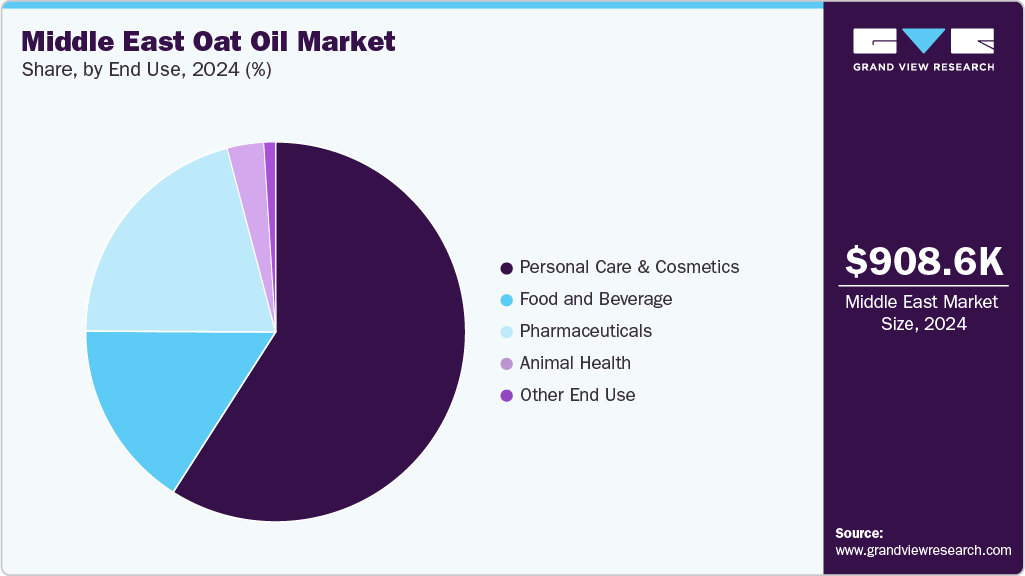
The food and beverage segment is expected to grow at the fastest CAGR of 8.2% during the forecast period. Growth is driven by functional food trends in Saudi Arabia and the UAE, where consumers seek ingredients with cholesterol-lowering, digestive, and antioxidant benefits. Oat oil is increasingly used in fortified snacks, beverages, and nutraceutical products. Its neutral taste and high stability during thermal processing allow easy incorporation into cooking oils, spreads, and bakery applications.
Country Insights
UAE Oat Oil Market Trends
The UAE oat oil market is dominated by personal care, cosmetics, and premium nutraceutical applications. The country’s position as a regional hub for cosmetic manufacturing and re-exports drives strong demand for cold-pressed and specialty oat oils. Consumers favor high-quality, halal-certified, and minimally processed oils, aligning with clean-label trends. Imports supply most of the market, with Dubai acting as a logistics and distribution center across the GCC. Growth is supported by rising skincare innovation, high per-capita disposable income, and an increasing focus on natural, functional ingredients. Regulatory frameworks ensure product quality, while competition from other plant oils moderates pricing.
Saudi Arabia Oat Oil Market Trends
The Saudi Arabia oat oil market is growing steadily, driven primarily by the food and beverage sector and functional nutrition products. Domestic demand is fueled by a large population seeking health-focused oils, while the cosmetic and personal care segment is emerging, particularly for premium skin-soothing formulations. Oat oil is mostly imported in refined form due to limited local processing capacity. Regulatory compliance with Saudi Food and Drug Authority (SFDA) standards ensures quality and safety. The market faces moderate barriers from high import costs and competition from other vegetable oils, yet increasing awareness of oat oil’s health benefits supports gradual adoption.
Key Middle East Oat Oil Company Insights
Key players operating in the Middle East oat oil industry include Charkit, Connoils, and O&3 Limited.
-
Charkit Chemical Company, based in the U.S., is a trusted manufacturer and supplier of specialty ingredients serving industries such as cosmetics, personal care, and nutrition. The company offers a broad portfolio of high-quality products, including oat oil, recognized for its performance and consistency. With a strong global presence and reliable supply chain, Charkit supports brands worldwide by delivering innovative ingredients tailored to evolving industry needs.
Key Middle East Oat Oil Companies:
- Charkit
- Connoils
- O&3 Limited
- Fazer Mills
- Nature In Bottle
- Naturex
- Oat Cosmetics
- Aromantic Ltd
- Aethon International LLP
Recent Developments
-
In September 2025, researchers at the University of South Australia unveiled a breakthrough oat oil extraction method, enabling high-quality, sustainable applications in food, skincare, and plant-based innovation with strong circular economy potential.
Middle East Oat Oil Market Report Scope
|
Report Attribute
|
Details
|
|
Market size value in 2025
|
USD 968.0 thousand
|
|
Revenue forecast in 2033
|
USD 1,730.9 thousand
|
|
Growth rate
|
CAGR of 7.5% from 2025 to 2033
|
|
Base year for estimation
|
2024
|
|
Historical data
|
2018 - 2023
|
|
Forecast period
|
2025 - 2033
|
|
Quantitative units
|
Revenue in USD thousand, volume in kilotons, and CAGR from 2025 to 2033
|
|
Report coverage
|
Revenue forecast, volume forecast, company ranking, competitive landscape, growth factors, and trends
|
|
Segments covered
|
product, end use, country
|
|
Regional scope
|
Middle East
|
|
Country scope
|
Saudi Arabia; UAE; Oman; Israel; Kuwait; Bahrain
|
|
Key companies profiled
|
Charkit; Connoils; O&3 Limited; Fazer Mills; Nature In Bottle; Naturex; Oat Cosmetics; Aromantic Ltd; Aethon International LLP
|
|
Customization scope
|
Free report customization (equivalent up to 8 analysts’ working days) with purchase. Addition or alteration to country, regional & segment scope.
|
|
Pricing and purchase options
|
Avail customized purchase options to meet your exact research needs. Explore purchase options
|
Middle East Oat Oil Market Report Segmentation
This report forecasts volume & revenue growth at the regional and country levels and analyzes the latest industry trends in each sub-segment from 2018 to 2033. For this study, Grand View Research has segmented the Middle East oat oil market report based on product, end use, and country:
-
Product Outlook (Volume, Kilotons; Revenue, USD Thousand, 2018 - 2033)
-
Cold-Pressed
-
Refined
-
Other Products
-
End Use Outlook (Volume, Kilotons; Revenue, USD Thousand, 2018 - 2033)
-
Country Outlook (Volume, Kilotons; Revenue, USD Thousand, 2018 - 2033)
-
Saudi Arabia
-
UAE
-
Oman
-
Israel
-
Kuwait
-
Bahrain
-
Rest of Middle East
Frequently Asked Questions About This Report
b. The Middle East oat oil size was estimated at USD 908.6 thousand in 2024 and is expected to reach USD 968.0 thousand in 2025.
b. The Middle East oat oil is expected to grow at a compound annual growth rate of 7.5% from 2025 to 2033, reaching USD 1,730.9 thousand by 2033.
b. The cold-pressed segment held the largest revenue share in 2024 due to rising consumer preference for natural extraction methods that preserve the oil's nutritional integrity and authentic flavor profile. This aligns with the regional market's growing health and wellness trends.
b. Some of the key players operating in the Middle East oat oil market include Charkit, Connoils, O&3 Limited, Fazer Mills, Nature In Bottle, Naturex, Oat Cosmetics, Aromantic Ltd, Aethon International LLP
b. The Middle East oat oil market is driven by rising health consciousness, its popularity in luxury skincare for its soothing properties, and government diversification plans boosting local manufacturing of natural and organic personal care products

 Download Sample Report
















