Middle East Ophthalmic Devices Market Summary
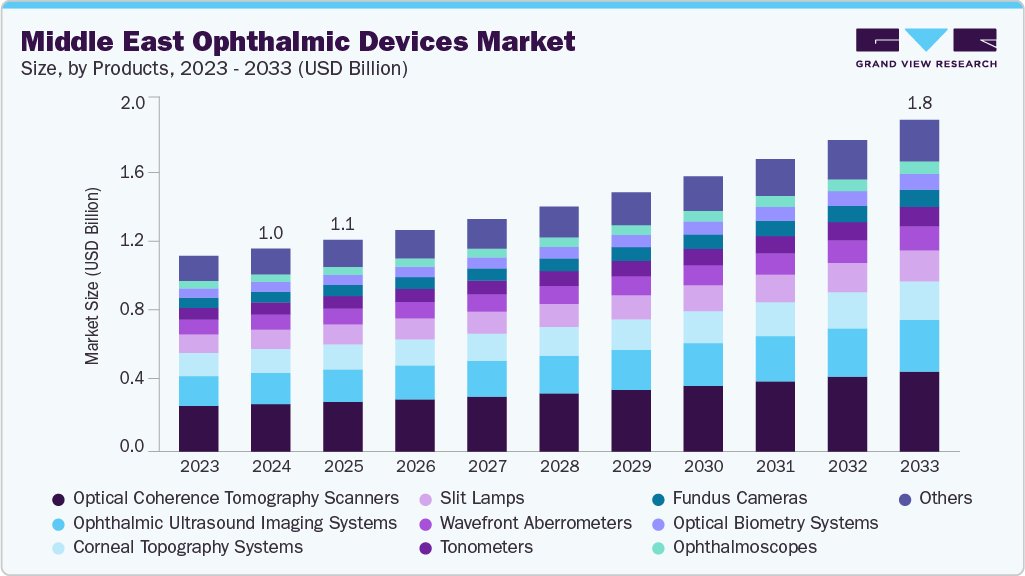
The Middle East ophthalmic devices market size was estimated at USD 1.09 billion in 2024 and is projected to reach USD 1.79 billion by 2033, growing at a CAGR of 5.8% from 2025 to 2033. Demographic, economic, and technological factors drive the expanding market.
Key Market Trends & Insights
- Saudi Arabia dominated the Middle East ophthalmic devices industry with the largest revenue share of 34.2% in 2024.
- The market in Kuwait is expected to grow at the fastest CAGR of 6.8% from 2025 to 2033.
- By product, the optical coherence tomography scanners segment dominated the market with a revenue share of 23.4% in 2024.
- By application, the cataract segment held the largest revenue share of 39.6% in 2024.
- By end use, the hospitals and eye clinics segment held the largest revenue share of 77.2% in 2024.
Market Size & Forecast
- 2024 Market Size: USD 1.09 Billion
- 2033 Projected Market Size: USD 1.79 Billion
- CAGR (2025-2033): 5.8%
- Saudi Arabia: Largest market in 2024
- Kuwait: Fastest-growing market from 2025 to 2033
The region's aging population and the prevalence of chronic conditions such as diabetes lead to a surge in vision-related disorders such as cataracts, glaucoma, and vitreo-retinal disorders. This increasing patient burden, rising health consciousness, and greater access to disposable income generate a strong demand for modern eye care services and the devices that support them. Governments and private entities also invest significantly in healthcare infrastructure, further fueling the growth of the Middle East ophthalmic devices industry. Innovation is a key catalyst for the market's evolution, with a focus on advanced diagnostic and surgical technologies that improve patient outcomes.
The ongoing integration of artificial intelligence (AI) is also a notable trend. These technologies facilitate screening and diagnosis, which is particularly beneficial for extending eye care to patients. For instance, in March 2025, the Oman Ministry of Health launched a national program for diabetic retinopathy screening, equipping 25 healthcare facilities with advanced retinal imaging devices integrated with AI-powered tools. This initiative positioned Oman as the third country globally to execute such a program. By August 2025, the program had already screened over 10,000 patients, demonstrating its success in enhancing the prevention of retinopathy.
Products Insights
The optical coherence tomography (OCT) scanners segment dominated the market with a revenue share of 23.4% in 2024 and is expected to grow at the fastest CAGR over the forecast period. The dominance is driven by the increasing need for advanced, noninvasive diagnostic tools that go beyond basic imaging to provide detailed, quantitative data for patient management. This has led to the adoption of sophisticated OCT variants, such as Angiography OCT (OCT-A), which visualizes the blood flow without the need for a dye injection, and Widefield OCT, which provides a broader scan of the retina and is a major advantage for diagnosing conditions such as diabetic retinopathy.
The growth is further fueled by the adoption of advanced technology across the region. For example, in Qatar, ophthalmology clinics such as Aster Group and Al-Rayhan Medical Complex utilize OCT devices to diagnose and manage conditions such as diabetic retinopathy and vitreoretinal diseases. The integration of AI with OCT is also a key development. For instance, the collaboration consisting of King Khalid Eye Specialist Hospital (KKESH), Saudi Authority for Data and Artificial Intelligence (SDAIA), Lean Business Services, and Saudi Company for Artificial Intelligence (SCAI) announced the development of the first AI-powered ophthalmic solution, “Eyenai,” invented by AI engineers and experts from Saudi Arabia. The solution has the power of AI to detect and diagnose diabetic retinopathy.
The ophthalmoscopes segment is expected to grow over the forecast period. A strong emphasis on preventative healthcare and the need for portable, affordable diagnostic tools across the region drives the growth in primary care settings. While advanced technologies such as OCT dominate specialized clinics, ophthalmoscopes remain essential for initial and routine eye examinations.
Applications Insights
The cataract segment held the highest revenue share of 39.6% in 2024 and is expected to grow at the fastest CAGR over the forecast period. The growth is driven by a rising prevalence of cataracts and significant technological advancements to improve eye care services. Cataracts are a common medical condition defined by the clouding of the eye's natural lens, which is typically caused by the breakdown of proteins in the lens due to aging. While aging is the primary cause, other risk factors such as diabetes, smoking, and prolonged exposure to UV light can also accelerate their development. This high prevalence creates a strong demand for advanced surgical solutions.
The refractive disorders segment is expected to grow over the forecast period. The growth is driven by a rising prevalence of refractive errors, including hypermetropia, myopia, astigmatism, and presbyopia, which are mainly caused by the eye's mismatch between axial length and refractive power. Many young individuals seek spectacle-free vision, and significant advancements in laser vision correction technologies further fuel the growth. Studies confirm that refractive errors are a major public health issue in the region, with astigmatism being the most common refractive error among children, followed by myopia and hyperopia.
End Use Insights
The hospitals and eye clinics segment held the highest revenue share of 77.2% in 2024 and is expected to grow at the fastest CAGR over the forecast period. The growth is driven by their role as the primary centers for specialized ophthalmic care, supported by significant government and private investment in regional healthcare infrastructure. These facilities dominate the market because they handle high patient volumes, employ specialized ophthalmologists, and acquire a wide range of capital-intensive medical devices beyond the scope of smaller clinics or general practices. Hospitals and eye clinics have extensive diagnostic, monitoring, and surgical devices.
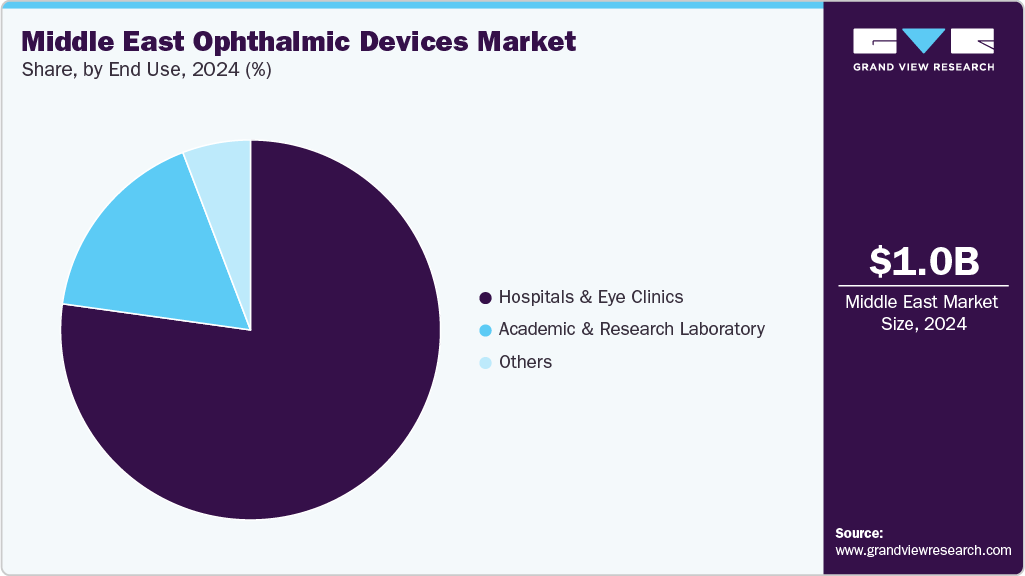
The academic and research laboratory segment is expected to grow over the forecast period. The growth is driven by an increasing focus on developing advanced ophthalmic solutions and a surge in government and private funding for scientific research across the Middle East. These laboratories are crucial for clinical trials and the innovation of new technologies, providing a dedicated research and development environment distinct from routine clinical practice. The segment is a focal point for collaboration between research institutions and global ophthalmic companies.
Country Insights
Saudi Arabia's ophthalmic devices industry held the largest revenue share of 34.2% in 2024. A potent combination of ambitious government initiatives and robust economic and demographic factors drives the growth. The country's leadership is primarily fueled by comprehensive healthcare reforms under Saudi Vision 2030, leading the charge in utilizing technology to revolutionize the delivery of healthcare services with ease and efficiency.
Kuwait Ophthalmic Devices Market Trends
The Kuwait ophthalmic devices industry is expected to grow at the fastest CAGR of 6.8% in 2024. The growth is driven by a high prevalence of chronic eye conditions and a growing demand for advanced surgical and diagnostic technologies. Kuwait's government has been actively investing in the healthcare sector under its New Kuwait 2035 vision, with a significant budget allocated to build and expand hospitals.
Qatar ophthalmic devices industry is on an accelerated growth trajectory, driven by increased prevalence of eye-related disorders, an aging population, and government investment in healthcare infrastructure. Government-led healthcare expansion and rising awareness of eye health and early detection initiatives have expanded the patient pool and stabilized market growth. Technological advancements, especially digital imaging systems and telemedicine, are rapidly adopted, promoting efficient diagnosis and treatment. Corrective procedures like LASIK and a rising preference for high-precision, minimally invasive surgical devices are key trends in this country. Qatar’s regional medical tourism hub strategy, high disposable income levels, and insurance penetration further accelerate innovation and market expansion.
Oman ophthalmic devices industry is witnessing sustained growth mainly due to the rising incidence of chronic eye diseases, expanding healthcare coverage, and steady government investment in the modernization of healthcare facilities. The increasing prevalence of refractive errors, cataracts, and diabetic retinopathy among the elderly and diabetic populations has boosted demand for advanced diagnostic, surgical, and vision correction devices. Oman’s healthcare reforms encourage the adoption of new ophthalmic technologies and focus on strengthening primary eye care services. Awareness programs targeting early detection and preventive eye care contribute to greater diagnostics and routine ocular health monitoring uptake. The country’s growing medical infrastructure and partnerships with leading industry players support market development and technology transfer in this segment.
The Turkish ophthalmic devices industry is characterized by rapid modernization, growing prevalence of eye diseases, and increasing demand for innovative surgical and diagnostic solutions. Demographic shifts, including an aging population and rising rates of diabetes, have led to heightened cases of cataract, glaucoma, and diabetic retinopathy, fueling the need for advanced ophthalmic devices. The government’s strong focus on the healthcare sector upgrades, including expansion of public and private eye care centers, has catalyzed the market’s adoption of state-of-the-art imaging systems, minimally invasive surgical tools, and tele-ophthalmology platforms. Turkey’s role as a regional health tourism hub, bolstered by investments in research and development and partnerships with international device manufacturers, continues to stimulate competitive innovation and broaden market access.
The ophthalmic devices industry in the UAE is recognized for its dynamic, innovative landscape and is projected to maintain strong growth in the coming years. The market is driven by high per capita healthcare spending, a technologically aware population, and major government initiatives to position the UAE as a global medical and health tourism destination. Prevalence of refractive errors and lifestyle-related eye conditions, coupled with a rapidly aging population, drive ongoing demand for advanced diagnostics, surgical devices, and vision correction products. Adopting digital health tools, including AI-powered imaging, telemedicine, and integrated electronic health records, is transforming eye care delivery. Strong partnerships between the public sector and global device suppliers and rigorous quality standards underpin the UAE market’s leadership in bringing next-generation ophthalmic solutions to the region.
Key Middle East Ophthalmic Devices Company Insights
Some key companies in the Middle East ophthalmic devices industry include Alcon Inc., Visionix, Norlase, among others.
- Alcon, Inc. is a global leader in eye care, with a significant presence in the Middle East. The company offers a wide array of surgical and vision care products, including advanced intraocular lenses (IOLs), surgical equipment for cataract and vitreoretinal procedures, and diagnostic devices such as the ARGOS Biometer, LenSx Laser System, LuxOR Revalia, and the NGENUITY 3D Visualization System.
Key Middle East Ophthalmic Devices Companies:
- Alcon Inc.
- Norlase
- Visionix
- Topcon Healthcare
- Ocular Instruments
- Bausch + Lomb
Recent Developments
-
In May 2025, Topcon Healthcare, Moorfields Eye Hospital, and the UCL Institute of Ophthalmology (IoO) announced the launch of a new medical technology company, Cascader Limited. It aims to transform the management & detection of eye disease using artificial intelligence (AI). Moorfields Eye Hospital NHS Foundation Trust treats people in 20 locations across the UK and operates a commercial division offering care to private patients in both the Middle East & London.
Middle East Ophthalmic Devices Market Report Scope
|
Report Attribute
|
Details
|
|
Market size value in 2025
|
USD 1.14 billion
|
|
Revenue forecast in 2033
|
USD 1.79 billion
|
|
Growth rate
|
CAGR of 5.8% from 2025 to 2033
|
|
Base year for estimation
|
2024
|
|
Historical data
|
2021 - 2023
|
|
Forecast period
|
2025 - 2033
|
|
Quantitative units
|
Revenue in USD million/billion and CAGR from 2025 to 2033
|
|
Report coverage
|
Revenue forecast, company ranking, competitive landscape, growth factors, and trends
|
|
Segments covered
|
Product, application, end use, country
|
|
Country scope
|
Kuwait; Saudi Arabia; UAE; Oman; Qatar; Turkey
|
|
Key companies profiled
|
Alcon Inc.; Norlase; Visionix; Topcon Healthcare; Ocular Instruments; Bausch + Lomb
|
|
Customization scope
|
Free report customization (equivalent up to 8 analysts’ working days) with purchase. Addition or alteration to the country, country & segment scope.
|
|
Pricing and purchase options
|
Avail customized purchase options to meet your exact research needs. Explore purchase options
|
Middle East Ophthalmic Devices Market Report Segmentation
This report forecasts revenue growth at the country level and provides an analysis of the latest industry trends in each of sub-segments from 2021 to 2033. For this study, Grand View Research has segmented the Middle East ophthalmic devices market report based on product, application, end use, and country.
-
Product Outlook (Revenue, USD Million, 2021 - 2033)
-
Optical Coherence Tomography Scanners
-
Fundus Cameras
-
Perimeters/Visual Field Analyzers
-
Autorefractors and Keratometers
-
Ophthalmic Ultrasound Imaging Systems
-
Ophthalmic A-Scan Ultrasound
-
Ophthalmic B-Scan Ultrasound
-
Ophthalmic Ultrasound Biomicroscopes
-
Ophthalmic Pachymeters
-
Tonometers
-
Slit Lamps
-
Phoropters
-
Wavefront Aberrometers
-
Optical Biometry Systems
-
Ophthalmoscopes
-
Lensmeters
-
Corneal Topography Systems
-
Specular Microscopes
-
Retinoscopes
-
Application Outlook (Revenue, USD Million, 2021 - 2033)
-
Cataract
-
Vitreo Retinal Disorders
-
Glaucoma
-
Refractive Disorders
-
End Use Outlook (Revenue, USD Million, 2021 - 2033)
-
Country Outlook (Revenue, USD Million, 2021 - 2033)
-
Middle East
-
Kuwait
-
Saudi Arabia
-
UAE
-
Oman
-
Qatar
-
Turkey

 Download Sample Report
















