Middle East Point of Use Water Treatment Systems Market Summary
The Middle East point of use water treatment systems market size was estimated at USD 1,642.1 million in 2024 and is projected to reach USD 4,065.4 million by 2033, growing at a CAGR of 11.4% from 2025 to 2033. Rising concerns over waterborne infections like E. coli and cholera are increasing demand for point-of-use water treatment systems.
Key Market Trends & Insights
- The point of use water treatment systems market in the Saudi Arabia is expected to grow at a substantial CAGR of 12.3% from 2025 to 2033.
- By technology, filtration methods segment is expected to grow at a considerable CAGR of 12.2% from 2025 to 2033 in terms of revenue.
- By device, the tabletop pitchers segment is expected to grow at a considerable CAGR of 12.0% from 2025 to 2033 in terms of revenue.
- By application, the commercial segment is expected to grow at a considerable CAGR of 11.9% from 2025 to 2033 in terms of revenue.
Market Size & Forecast
- 2024 Market Size: USD 1,642.1 Million
- 2033 Projected Market Size: USD 4,065.4 Million
- CAGR (2025-2033): 11.4%
Limited freshwater resources, aging infrastructure, and heightened awareness of water quality are driving households and businesses to adopt compact, reliable purification solutions. These systems offer safe drinking water, especially in areas facing inconsistent municipal supply or contamination risks.
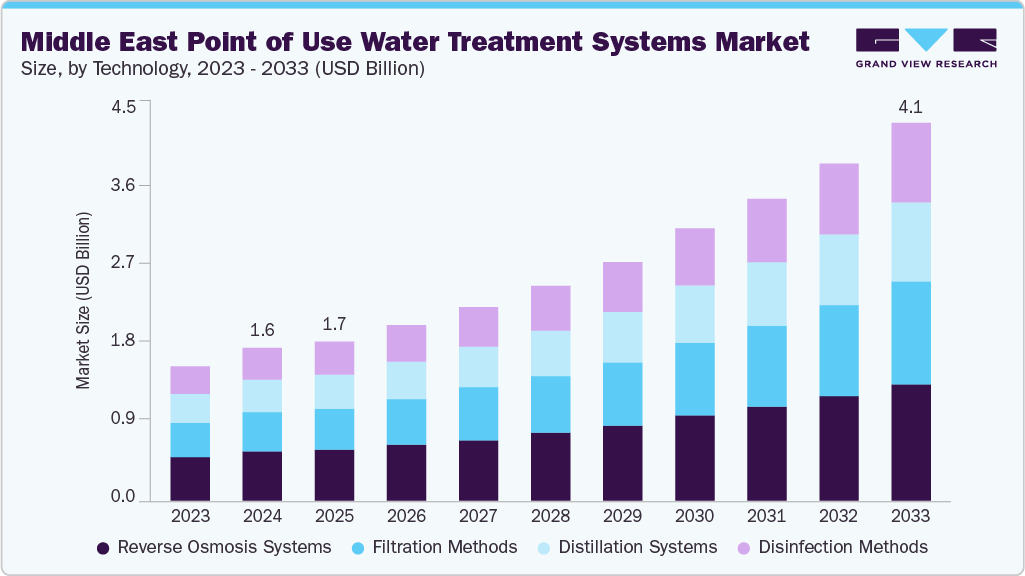
Growing industrial activity and commercial agriculture are introducing new pollutants into water sources, raising health concerns across the region. This has significantly increased demand for point-of-use water treatment systems to ensure safe drinking water. Additionally, rising mortality and illness linked to contaminated water is prompting households and institutions to adopt on-site purification solutions for improved health and safety.
Market Concentration & Characteristics
The point-of-use (PoU) water treatment market in the Middle East is moderately fragmented. While some large international brands hold significant market share in urban areas, many small and mid-sized local companies serve niche and budget-conscious segments. Diverse infrastructure, varying income levels, and regional regulatory differences create space for both global and regional players to compete, especially in household filtration and compact treatment units.
In the Middle East PoU water treatment market, innovation centers around membrane technologies, compact multi‑stage filtration, UV sterilization, and smart sensors for water quality monitoring. There is interest in localized materials and modular systems that reduce maintenance. Some ventures are exploring natural filters like zeolite. These tech improvements aim to make PoU u
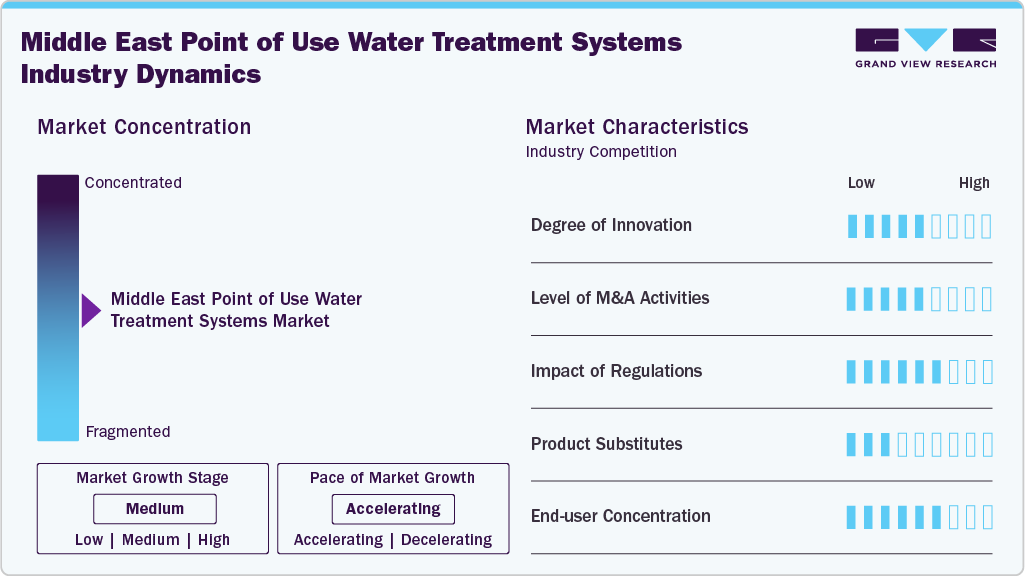
nits more effective, cheaper to run, and more suitable for variable water quality.
M&A in the Middle East water treatment sector is growing, with larger utilities, tech firms, and water service providers acquiring smaller companies. These moves help in acquiring manufacturing capabilities, expanding geographic reach, integrating advanced tech, and strengthening value‑chain control. Acquisitions also help established firms enter new service segments or regulatory markets more quickly.
Regulations in the Middle East are increasingly mandating safe drinking water standards, contaminant limits (bacteria, heavy metals), and regular testing. Governments are implementing policies requiring certification of PoU devices, proper labeling, and adherence to health guidelines. Subsidies or incentives sometimes support adoption of certified water treatment products. Enforcement of standards is pushing both manufacturers and users toward higher performance and reliability.
Drivers, Opportunities & Restraints
Middle East point-of-use water treatment market is growing significantly due to increasing concerns over contaminated water from aging infrastructure, industrial waste, and agricultural runoff. As urban populations expand and health awareness rises, households and institutions are turning to on-site purification systems. The demand is especially high in regions where municipal water supplies are inconsistent or perceived as unsafe.
The market is experiencing strong opportunity in expanding access to safe drinking water in remote, underserved, and rapidly urbanizing areas. With rising tourism, construction camps, and refugee populations, there’s growing demand for portable, easy-to-maintain systems. Additionally, the region’s interest in smart and sustainable technologies is opening doors for innovative PoU solutions tailored to both premium and cost-sensitive segments.
Despite strong growth, the market is experiencing key challenges, particularly a dependence on imported technologies and components, which elevates costs and delivery times. Diverse water quality across the region complicates standardization and product fit. Additionally, limited consumer education, irregular maintenance, and weak after-sales support in some areas hinder long-term adoption and system performance, especially in lower-income and rural communities.
Technology Insights
The reverse osmosis systems segment dominated the market in 2024 by accounting for a share of 32.2%. Their ability to effectively remove bacteria, viruses, dissolved solids, and chemicals makes them well-suited for treating brackish or contaminated municipal supplies, especially in regions with limited freshwater access. Compact design and energy efficiency further support adoption in urban households, villas, and commercial kitchens. Under-sink RO units are particularly popular for residential use, providing safe drinking water in areas with variable tap quality.
Filtration-based point-of-use systems are expected to grow significantly in the Middle East, driven by increasing concerns over water quality and health risks associated with contaminants. Advances in filtration materials, including those capable of removing PFAS, heavy metals, and microplastics, are improving system effectiveness. As regional awareness grows and regulations tighten, demand is rising for advanced, affordable filtration solutions tailored to local water challenges.
Device Insights
The tabletop pitchers segment dominated the market in 2024 accounting for 34.0% market share. Their compact, portable design suits the region’s growing urban households and rental properties, offering convenient, on-the-spot water purification. Easy to use and maintain, these pitchers are favored in areas with intermittent tap water quality and where space or plumbing modifications are limited.
Under-the-sink filters are gaining traction in Middle Eastern homes, particularly in urban areas where clean water is a priority. These systems provide thorough filtration of contaminants like sediments, chlorine, and heavy metals directly at the kitchen faucet. Their discreet installation beneath the sink helps maintain clutter-free kitchens, appealing to consumers seeking effective, space-saving solutions amid growing health awareness and rising demand for safe drinking water.
Application Insights
The industrial segment dominated the market in 2024 by accounting for a share of 40.4% driven by strict government regulations targeting contaminants like PFAS and other industrial pollutants. Industries such as petrochemicals, manufacturing, and pharmaceuticals are adopting advanced purification systems to meet environmental standards. Integration of smart IoT devices, enabling real-time water quality monitoring and remote system management, is enhancing operational efficiency and reliability in industrial water treatment processes.
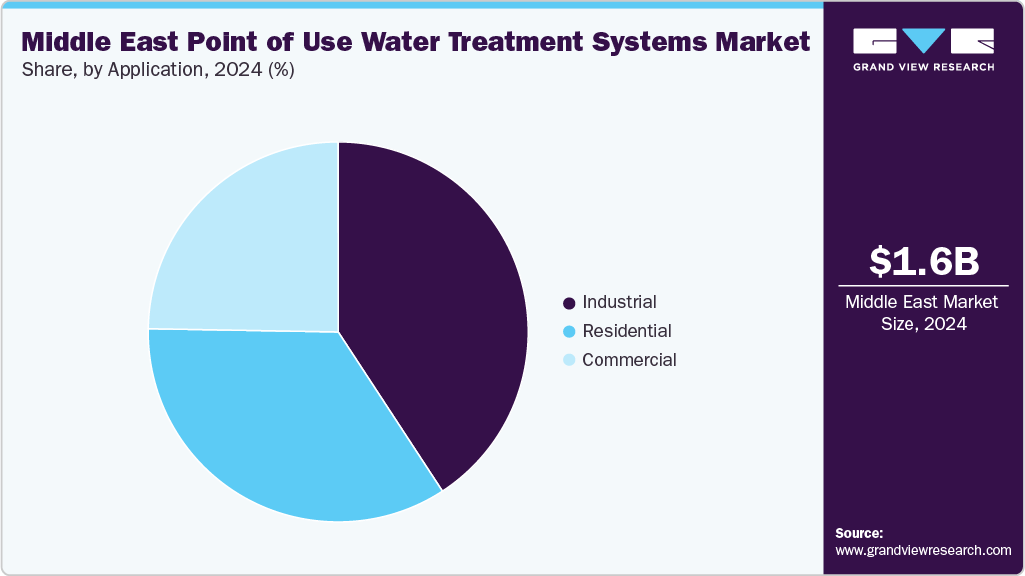
Commercial sector in the Middle East is expected to experience the fastest growth in point-of-use water treatment systems. Hotels, restaurants, and office buildings are increasingly installing localized purification solutions like reverse osmosis, UV disinfection, and advanced filtration to ensure water quality for drinking, cooking, and cleaning. Rising tourism and hospitality demand, along with a focus on guest safety and operational efficiency, are key drivers supporting market growth in this segment.
Country Insights
Saudi Arabia Point of Use Water Treatment Systems Market Trends
Saudi Arabia dominated point of use water treatment systems market over the forecast period accounting for 33.4% market share in 2024, due to increasing industrial regulations, rapid urbanization, and government initiatives promoting clean water access. Expansion in the oil & gas, petrochemical, and hospitality sectors is driving demand for advanced purification systems, while rising health awareness among households supports growth in residential PoU water treatment solutions.
Qatar Point of Use Water Treatment Systems Market Trends
The point of use water treatment systems market in the Qatar is expected to grow at a CAGR of 12.1% from 2025 to 2033 supported by rapid urban development, expanding industrial sectors, and increasing health awareness. Government investments in water infrastructure and sustainability initiatives are driving demand for advanced purification systems. Additionally, the growing hospitality industry and rising expatriate population create a strong need for reliable, efficient, and easy-to-use water treatment solutions in homes and businesses.
Key Middle East Point of Use Water Treatment Systems Company Insights
Some of the key players operating in the market include 3M, Koninklijke Philips N.V., Pentair, Panasonic.
-
3M offers advanced water filtration and purification technologies widely used in the Middle East’s residential, commercial, and industrial sectors. Known for durable and efficient point-of-use systems, 3M’s solutions address contaminants such as sediments, chlorine, and microbial impurities. Their products cater to growing water quality concerns, supporting health and safety through reliable, easy-to-install filtration units in homes and businesses.
-
Philips provides innovative water purification solutions combining filtration and UV sterilization, targeting health-conscious consumers in the Middle East. Their point-of-use systems are designed for ease of use, compactness, and energy efficiency, suitable for urban households and hospitality sectors. Philips focuses on integrating smart technology and sustainable designs to meet rising demand for clean, safe drinking water across the region.
Key Middle East Point of Use Water Treatment Systems Companies:
- 3M
- Koninklijke Philips N.V.
- Pentair
- Panasonic Corporation
- Unilever
- LG Electronics
- EcoWater
- A.O. Smith
- Toray
- Kinetico Incorporated
Recent Developments
-
In June 2025, Toray launched a Water Treatment Technology Center in Saudi Arabia to advance water purification solutions, support local innovation, and strengthen its presence in the Middle East’s growing water treatment market.
-
In February 2025, Purunity, a key sustainable water solutions provider in the UAE and Oman, launched Nativus+, an NSF-certified advanced countertop water purifier that improves water quality while helping reduce single-use plastic waste, promoting eco-friendly drinking habits across the region.
Middle East Point of Use Water Treatment Systems Market Report Scope
|
Report Attribute
|
Details
|
|
Market size in 2025
|
USD 1,709.4 million
|
|
Revenue forecast in 2033
|
USD 4,065.4 million
|
|
Growth rate
|
CAGR of 11.4% from 2025 to 2033
|
|
Historical data
|
2021 - 2023
|
|
Forecast period
|
2025 - 2033
|
|
Quantitative units
|
Revenue in USD million/billion and CAGR from 2025 to 2033
|
|
Report coverage
|
Revenue forecast, company market position analysis, competitive landscape, growth factors, and trends
|
|
Segments covered
|
Technology, device, application, country
|
|
Country scope
|
Saudi Arabia; UAE; Oman ;Qatar;Kuwait; Israel
|
|
Key companies profiled
|
3M; Koninklijke Philips N.V.; Pentair; Panasonic Corporation; Unilever; LG Electronics; EcoWater; A.O. Smith; Toray; Kinetico Incorporated
|
|
Customization scope
|
Free report customization (equivalent up to 8 analysts working days) with purchase. Addition or alteration to country, regional & segment scope.
|
|
Pricing and purchase options
|
Avail customized purchase options to meet your exact research needs. Explore purchase options
|
Middle East Point Of Use Water Treatment Systems Market Report Segmentation
This report forecasts revenue growth at a country level and provides an analysis on the industry trends in each of the sub-segments from 2021-2033. For the purpose of this study, Grand View Research has segmented the Middle East point of use water treatment systems market on the basis of on technology, device, application and country:
-
Device Outlook (Revenue, USD Million; 2021 - 2033)
-
Tabletop Pitchers
-
Faucet-Mounted Filters
-
Counter-top Units
-
Under-the-sink Filters
-
Application Outlook (Revenue, USD Million; 2021 - 2033)
-
Residential
-
Commercial
-
Offices
-
Hotels
-
Restaurants
-
Café
-
Hospitals
-
Schools
-
Others
-
Industrial
-
Country Outlook (Revenue, USD Million, 2021 - 2033)
-
Saudi Arabia
-
UAE
-
Oman
-
Qatar
-
Israel
-
Kuwait
Frequently Asked Questions About This Report
b. The Middle East point of use water treatment systems market size was estimated at USD 1,642.1 million in 2024 and is expected to reach USD 1,709.4 million in 2025.
b. The Middle East point of use water treatment systems market, in terms of revenue, is expected to grow at a compound annual growth rate of 11.4% from 2025 to 2033, reaching USD 4,065.4 million by 2033.
b. The reverse osmosis systems segment dominated the market in 2024 by accounting for a share of 32.2% due to their ability to effectively remove bacteria, viruses, dissolved solids, and chemicals that makes them well-suited for treating brackish or contaminated municipal supplies, especially in regions with limited freshwater access.
b. Some of the key players operating in the Middle East point of use water treatment systems market include 3M, Koninklijke Philips N.V., Pentair, Panasonic Corporation, Unilever, LG Electronics, EcoWater, A.O. Smith, Toray, Kinetico Incorporated.
b. Key drivers of the Middle East point-of-use water treatment market include rising concerns over water contamination, increasing health awareness, rapid urbanization, and stringent government regulations. Additionally, limited access to clean municipal water and growing demand for convenient, efficient, and compact purification solutions in homes and businesses fuel market growth.

 Download Sample Report
















