
- Home
- »
- Biotechnology
- »
-
Middle East Single-use Bioprocessing Market Report, 2033GVR Report cover
![Middle East Single-use Bioprocessing Market Size, Share & Trends Report]()
Middle East Single-use Bioprocessing Market (2025 - 2033) Size, Share & Trends Analysis Report By Product (Simple & Peripheral Elements, Apparatus & Plants), By Workflow (Upstream, Downstream), By End Use, By Country, And Segment Forecasts
- Report ID: GVR-4-68040-712-8
- Number of Report Pages: 150
- Format: PDF
- Historical Range: 2021 - 2023
- Forecast Period: 2025 - 2033
- Industry: Healthcare
- Report Summary
- Table of Contents
- Segmentation
- Methodology
- Download FREE Sample
-
 Download Sample Report
Middle East Single-use Bioprocessing Market Summary
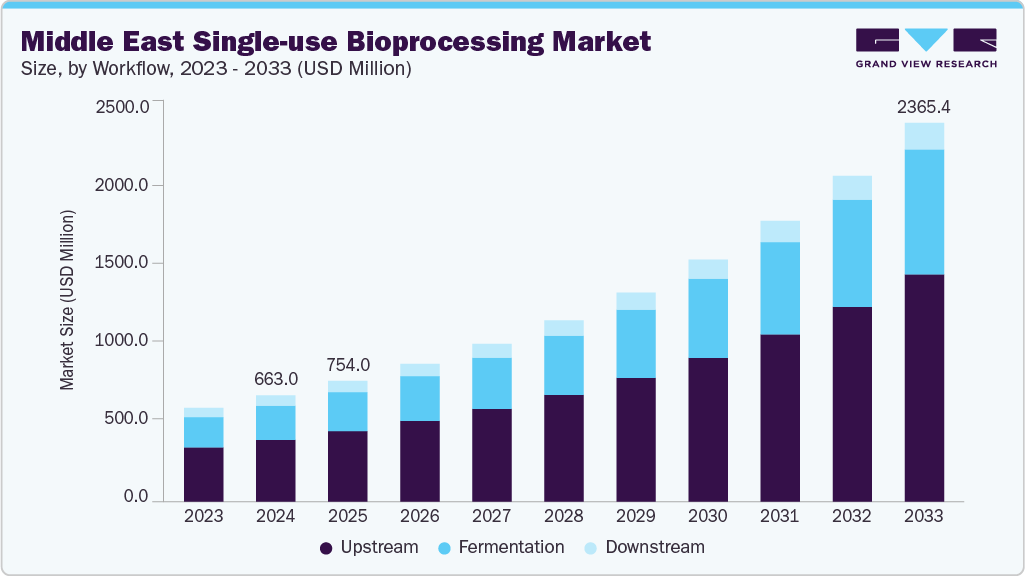
The Middle East single-use bioprocessing market size was estimated at USD 663.0 million in 2024 and is expected to reach USD 2.37 billion by 2033, expanding at a CAGR of 15.36% from 2025 to 2033. Market growth is driven by increasing biologics manufacturing, rising investments in biopharmaceutical R&D, and government initiatives supporting advanced healthcare infrastructure. Adopting flexible, scalable single-use systems, growing contract manufacturing capabilities, and collaborations with global technology providers further accelerate market expansion across countries such as Saudi Arabia, UAE, Qatar, and Kuwait.
Expansion of Biologics Manufacturing in the Middle East
The Middle East is witnessing a significant expansion in biologics manufacturing, driven by growing demand for advanced therapeutics, including vaccines, monoclonal antibodies, and recombinant proteins. Countries such as Saudi Arabia, the UAE, and Qatar are investing heavily in state-of-the-art biomanufacturing facilities to strengthen local production capabilities. This strategic push aims to reduce dependency on imports while supporting the region’s broader healthcare and life sciences ambitions. Single-use bioprocessing systems play a crucial role in these facilities by enabling flexible and scalable production that meets stringent quality standards.
The rising biologics production is closely linked to increasing biopharmaceutical R&D activities. Leading pharmaceutical companies and emerging biotech startups are focusing on developing novel therapies for oncology, autoimmune disorders, and infectious diseases. This surge in research and clinical programs necessitates efficient, cost-effective, and scalable manufacturing platforms. Single-use technologies allow manufacturers to rapidly adapt to changing production volumes, shorten turnaround times, and minimize contamination risks, making them ideal for meeting the dynamic demands of the Middle East’s evolving biopharmaceutical market.
Moreover, government support and strategic partnerships are accelerating this expansion. Initiatives such as Saudi Vision 2030 and the UAE’s advanced healthcare programs have encouraged foreign investments and facilitated collaborations with global bioprocessing technology providers. These efforts have established contract manufacturing organizations (CMOs) and biopharma clusters, further strengthening the supply chain and production ecosystem. As a result, biologics manufacturing expansion continues to be a primary driver of the Middle East single-use bioprocessing industry, underpinning the region’s transition into a hub for advanced biologics production.
Rising Outsourcing to Contract Manufacturing Organizations (CMOs)
The Middle East is experiencing rapid growth in contract manufacturing, driven by the rising outsourcing of biopharmaceutical production to specialized Contract Manufacturing Organizations (CMOs). As domestic and international pharmaceutical companies seek cost-efficient, scalable, and flexible production solutions, CMOs increasingly leverage single-use bioprocessing systems to meet diverse manufacturing requirements. Single-use technologies allow CMOs to quickly adapt to changing production volumes, minimize cross-contamination risks, and reduce capital expenditure on stainless-steel infrastructure. This flexibility is particularly valuable for biologics production, where demand for vaccines, monoclonal antibodies, and recombinant proteins continues to expand across the region.
Government initiatives and investments in biopharma infrastructure further fuel CMO growth in the Middle East. Countries such as Saudi Arabia, the UAE, and Qatar are promoting biopharmaceutical clusters and industrial zones to attract global partners and foster local manufacturing capabilities. Collaborations with leading international technology providers enable CMOs to adopt advanced single-use platforms, enhancing efficiency and regulatory compliance. As outsourcing continues to rise, the deployment of single-use systems is expected to accelerate, reinforcing the Middle East as an emerging hub for flexible and scalable biomanufacturing solutions. This trend positions contract manufacturing as a key driver of market expansion, supporting the region’s broader objectives in healthcare innovation and self-reliance in biologics production.
Market Concentration & Characteristics
The moderate degree of innovation in single-use bioprocessing is a key driver of market growth in the Middle East, enabling cost-efficient, flexible, and scalable biologics production. Continuous improvements in system design, ease of use, and integration with upstream and downstream processes support faster adoption across biopharmaceutical manufacturers and CMOs, enhancing production efficiency and meeting the region’s growing therapeutic demand.
M&A activity in the Middle East single-use bioprocessing industry is low to moderate, reflecting a market still in the growth and adoption phase. While international players are expanding through partnerships and strategic collaborations, full-scale mergers and acquisitions are limited due to the region’s developing biopharmaceutical infrastructure and the high cost of advanced manufacturing assets.

Regulations greatly impact the Middle East single-use bioprocessing industry, shaping market entry, product approval, and operational compliance. Variations in country-specific guidelines, licensing requirements, and quality standards affect the adoption of single-use systems. Manufacturers must navigate these regulatory frameworks carefully to ensure safety, efficacy, and alignment with international GMP standards, which can either accelerate or constrain market growth.
Product expansion drives growth in the Middle East single-use bioprocessing industry by introducing advanced, flexible, and scalable solutions tailored to regional biopharmaceutical needs. Companies continually develop new consumables, components, and integrated systems to enhance process efficiency, reduce contamination risks, and support diverse biologics production. This innovation attracts adoption among manufacturers and CMOs, strengthening market penetration.
The Middle East single-use bioprocessing industry is expanding across countries like the UAE, Saudi Arabia, and Qatar, driven by increasing biologics production, growing investments in biopharmaceutical R&D, and supportive government initiatives. Adopting flexible, scalable single-use systems and collaborations with global technology providers further accelerates market growth in these key regional hubs.
Workflow Insights
The upstream segment dominated the market with a revenue share of 58.20% in 2024 and is anticipated to grow at the fastest CAGR over the forecast period. This is driven by increasing adoption of single-use systems in cell culture and biologics production, offering flexibility, scalability, and reduced contamination risk. Rising biologics manufacturing, expanding contract manufacturing capabilities, and supportive government initiatives in Saudi Arabia, UAE, and Qatar further accelerate adoption. The segment’s continued innovation and efficiency advantages are expected to sustain its leading position over the forecast period.
The fermentation segment is projected to witness a significant CAGR of 15.65% over the forecast period. This growth is driven by increasing demand for biologics, vaccines, and monoclonal antibodies produced through scalable fermentation processes. Adoption of single-use systems enhances operational efficiency, reduces contamination risks, and enables flexible production volumes. These factors position fermentation as a key growth segment in the regional market.
Product Insights
The simple & peripheral elements segment dominated the market with 49.17% in 2024 and is anticipated to grow at the fastest CAGR over the forecast period. Critical roles in flexible and cost-efficient bioprocessing, seamless integration with upstream and downstream workflows, and support for scalable biologics production drive this. Their versatility and ease of use make them highly adopted by biopharmaceutical manufacturers and CMOs across the region. As demand for efficient, contamination-free processes rises, this segment is poised to remain a key growth driver throughout the forecast period.
Theapparatus & plants segment will witness a significant CAGR over the forecast period. This growth is fueled by increasing investment in advanced biomanufacturing facilities, rising adoption of single-use systems for scalable and flexible production, and the need for efficient, contamination-free operations. Expansion of biologics manufacturing and collaborations with global technology providers are further driving the deployment of apparatus and plant solutions across key regional markets.
End Use Insights
The biopharmaceutical manufacturer segment dominated the market in 2024 and is anticipated to grow at the fastest CAGR over the forecast period. This is driven by increasing biologics production, rising investments in R&D, and expanding contract manufacturing capabilities. Adopting flexible, scalable single-use systems enables manufacturers to meet growing demand efficiently while reducing contamination risks. As regional biopharmaceutical activities expand, this segment is poised to remain a primary contributor to market growth throughout the forecast period.
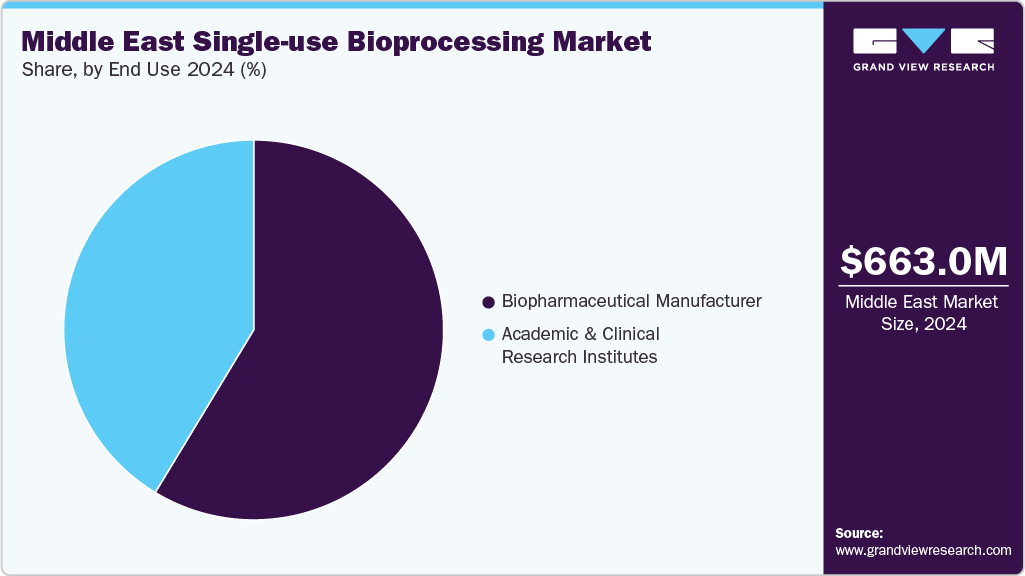
The academic & clinical research institutes’ segment is estimated to witness a significant CAGR of 6.98% throughout the forecast period. This growth is driven by increasing adoption of single-use systems for research, pilot-scale biologics production, and laboratory applications. Expansion of biotechnology programs, government-backed research initiatives, and collaborations with global technology providers further support the deployment of single-use solutions in academic and clinical settings.
Country Insights
The single-use bioprocessing market in Kuwait is gradually growing, supported by rising investments in biopharmaceutical R&D and advanced healthcare and laboratory infrastructure development. Increasing demand for biologics, vaccines, and cell-based therapies is driving the adoption of flexible, scalable single-use systems. Government initiatives and collaborations with global technology providers further enhance the deployment of these systems across the country.
UAE Single-use Bioprocessing Market Trends
The single-use bioprocessing market in the UAE is a regional leader, driven by significant investments in advanced biopharmaceutical infrastructure, growing biologics and vaccine production, and supportive government initiatives. Manufacturers and contract development organizations' adoption of flexible, scalable single-use systems, along with collaborations with global technology providers, further accelerates market growth and reinforces the UAE’s position as a hub for bioprocessing innovation in the Middle East.
Key Middle East Single-use Bioprocessing Company Insights
The Middle East market is dominated by a mix of global and regional players that provide advanced solutions to support the region’s growing biopharmaceutical sector. Leading multinational companies such as Sartorius AG, Danaher Corporation, Thermo Fisher Scientific, Merck KGaA, Avantor, Eppendorf SE, Corning Incorporated, Boehringer Ingelheim, Lonza, and Infors AG are highly active in the region. These companies offer a comprehensive portfolio of single-use technologies, including simple and peripheral elements, apparatus and plants, and integrated systems. This enables manufacturers to achieve flexible, scalable, and contamination-free biologics production. Their strong technological capabilities and established distribution networks give them a significant competitive edge in the Middle East market.
Sartorius AG and Thermo Fisher Scientific are among the key market leaders, particularly in the UAE and Saudi Arabia, leveraging partnerships with local distributors and healthcare organizations to expand their footprint. Danaher Corporation has strengthened its presence through its subsidiaries across the Gulf countries, while Merck KGaA and Avantor provide a wide range of consumables and process solutions across multiple Middle Eastern markets, including Qatar, Kuwait, and Oman. These companies focus on innovation and continuous product development, enabling rapid adoption of single-use systems in upstream and downstream bioprocessing applications.
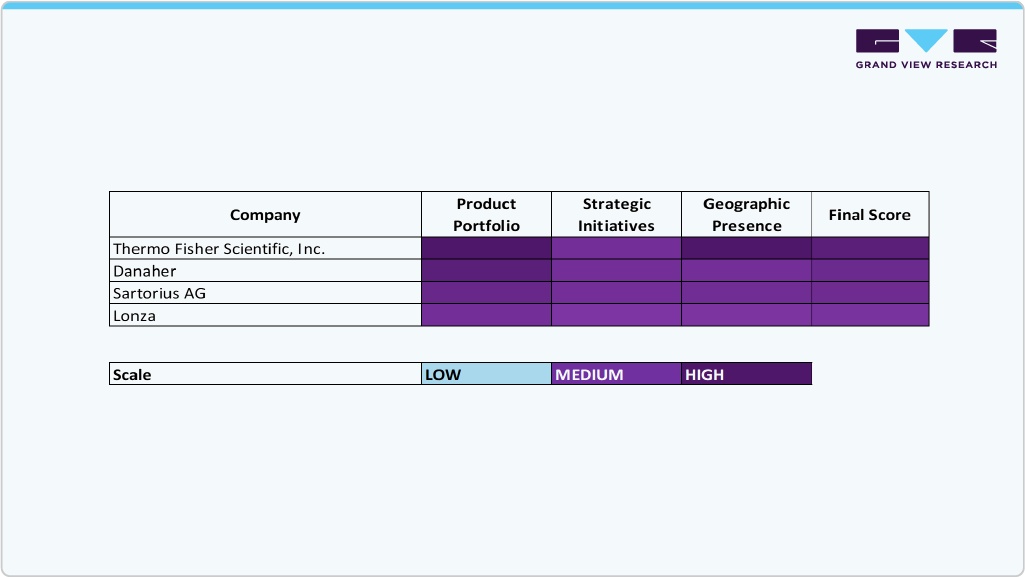
Regional adoption is further supported by contract manufacturing organizations (CMOs) and biopharmaceutical manufacturers, who prefer single-use technologies for their flexibility, reduced capital expenditure, and ability to scale production efficiently. The simple and peripheral elements segment dominates the product landscape, while upstream processes account for the largest workflow share. Biopharmaceutical manufacturers lead in end-use adoption, with academic and clinical research institutes gradually increasing their share due to rising biotech research activities. Market leaders are leveraging these trends by introducing new products and expanding service offerings to cater to the evolving needs of the region’s biopharmaceutical ecosystem.
Market share distribution in the Middle East reflects technological capability, regional presence, and strategic collaborations. Companies with strong local representation in key hubs such as the UAE, Saudi Arabia, and Qatar capture a significant portion of the market, while smaller international players operate through distributors to serve emerging markets like Kuwait and Oman. Overall, the market remains highly competitive, with key players focusing on product innovation, regional expansion, strategic partnerships, and customer-centric solutions to consolidate their positions and capture market growth.
Key Middle East Single-use Bioprocessing Companies:
- Sartorius AG
- Danaher Corporation
- Thermo Fisher Scientific, Inc.
- Merck KGaA
- Avantor, Inc.
- Eppendorf SE
- Corning Incorporated
- Boehringer Ingelheim International GmbH
- Lonza
- Infors AG
Recent Developments
-
In November 2021, Merck KGaA partnered with SaudiVax to support Saudi Arabia’s first halal vaccine and biotherapeutics facility, providing GMP expertise, equipment, and development services for local biologics production.
-
In June 2023, Saudi Arabia’s Public Investment Fund launched Lifera, a commercial-scale CDMO, to enhance local biologics and vaccine production, reduce import dependence, and strengthen the country’s biomanufacturing infrastructure, supporting the broader national biotechnology strategy.
Middle East Single-use Bioprocessing Market Report Scope
Report Attribute
Details
Market size value in 2025
USD 754.0 million
Revenue forecast in 2033
USD 2.37 billion
Growth rate
CAGR of 15.36% from 2025 to 2033
Base year for estimation
2024
Historical data
2021 - 2023
Forecast period
2025 - 2033
Quantitative units
Revenue in USD million/billion and CAGR from 2025 to 2033
Report coverage
Revenue forecast, company ranking, competitive landscape, growth factors, and trends
Segments covered
Product, workflow, end use, country
Country scope
Saudi Arabia; UAE; Kuwait;Qatar; Oman
Key companies profiled
Sartorius AG; Danaher Corporation; Thermo Fisher Scientific, Inc.; Merck KGaA; Avantor, Inc.; Eppendorf SE; Corning Incorporated; Boehringer Ingelheim International GmbH; Lonza; Infors AG
Customization scope
Free report customization (equivalent up to 8 analyst’s working days) with purchase. Addition or alteration to country, regional & segment scope.
Middle East Single-use Bioprocessing Market Report Segmentation
This report forecasts revenue growth and provides an analysis of the latest trends in each of the sub-segments from 2021 to 2033. For this report, Grand View Research has segmented the Middle East single-use bioprocessing market based on product, workflow, end use, and country:
-
Product Outlook (Revenue, USD Million, 2021 - 2033)
-
Simple & Peripheral Elements
-
Tubing, Filters, Connectors, & Transfer Systems
-
Bags
-
Sampling Systems
-
Probes, Sensors, & Flow Meters
-
pH Sensor
-
Oxygen Sensor
-
Pressure Sensors
-
Temperature Sensors
-
Conductivity Sensors
-
Flow Meters & Sensors
-
Others
-
-
Others
-
-
Apparatus & Plants
-
Bioreactors
-
Upto 1000L
-
Above 1000L to 2000L
-
Above 2000L
-
-
Mixing, Storage, & Filling Systems
-
Filtration System
-
Chromatography Systems
-
Pumps
-
Others
-
-
Work Equipment
-
Cell Culture System
-
Syringes
-
Others
-
-
-
Workflow Outlook (Revenue, USD Million, 2021 - 2033)
-
Upstream
-
Fermentation
-
Downstream
-
-
End Use Outlook (Revenue, USD Million, 2021 - 2033)
-
Biopharmaceutical Manufacturer
-
CMOs & CROs
-
In-house Manufacturer
-
-
Academic & Clinical Research Institutes
-
-
Country Outlook (Revenue, USD Million, 2021 - 2033)
-
Saudi Arabia
-
UAE
-
Kuwait
-
Qatar
-
Oman
-
Frequently Asked Questions About This Report
b. The Middle East single-use bioprocessing market size was estimated at USD 663.0 million in 2024 and is expected to reach USD 754.0 million in 2025.
b. The Middle East single-use bioprocessing market is expected to grow at a compound annual growth rate of 15.36% from 2025 to 2033 to reach USD 2.37 billion by 2033.
b. The simple & peripheral elements segment dominated the Middle East single-use bioprocessing market with a share of 49.17% in 2024. This is attributable to their cost-effectiveness, ease of integration, and broad applicability across workflows.
b. Some key players operating in the Middle East single-use bioprocessing market include Sartorius AG; Danaher Corporation; Thermo Fisher Scientific, Inc.; Merck KGaA; Avantor, Inc.; Eppendorf SE; Corning Incorporated; Boehringer Ingelheim International GmbH; Lonza; Infors AG.
b. Key factors driving the Middle East single-use bioprocessing market growth include expanding biologics manufacturing capacity, rising adoption of contract manufacturing, increased vaccine and therapeutic demand, supportive government investments, and technological advancements in bioprocessing systems.


Share this report with your colleague or friend.
Need a Tailored Report?
Customize this report to your needs — add regions, segments, or data points, with 20% free customization.


ISO 9001:2015 & 27001:2022 Certified
We are GDPR and CCPA compliant! Your transaction & personal information is safe and secure. For more details, please read our privacy policy.
Trusted market insights - try a free sample
See how our reports are structured and why industry leaders rely on Grand View Research. Get a free sample or ask us to tailor this report to your needs.













