
- Home
- »
- Automotive & Transportation
- »
-
Middle East Tower Cranes Market Size, Industry Report 2033GVR Report cover
![Middle East Tower Cranes Market Size, Share & Trends Report]()
Middle East Tower Cranes Market (2026 - 2033) Size, Share & Trends Analysis Report By Product (Flat Top, Hammerhead), By Design (Top Slewing Crane, Bottom Slewing Crane), By Lifting Capacity, By Application, By Country, And Segment Forecasts
- Report ID: GVR-4-68040-852-7
- Number of Report Pages: 120
- Format: PDF
- Historical Range: 2021 - 2024
- Forecast Period: 2026 - 2033
- Industry: Technology
- Report Summary
- Table of Contents
- Segmentation
- Methodology
- Download FREE Sample
-
 Download Sample Report
Middle East Tower Cranes Market Summary
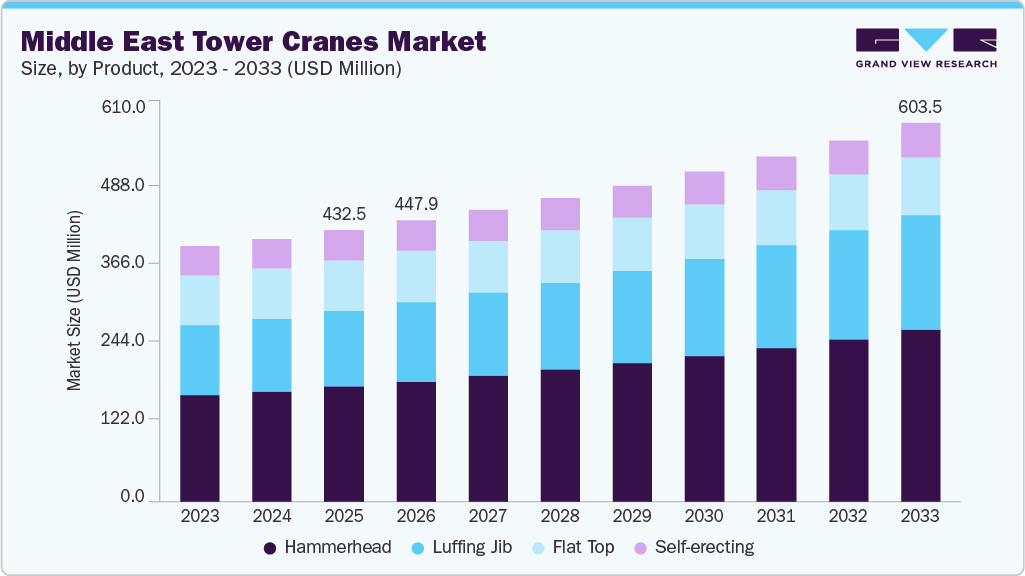
The Middle East tower cranes market size was estimated at USD 432.5 million in 2025, and is projected to reach USD 603.5 million by 2033, growing at a CAGR of 4.4% from 2026 to 2033. The market is witnessing steady growth, driven by sustained investments in large-scale infrastructure and real estate development across the region.
Key Market Trends & Insights
- UAE dominated the Middle East tower crane market with the largest revenue share of 50.8% in 2025.
- By product, the hammerhead segment accounted led the market with the largest revenue share of 42.4% in 2025.
- By design, the top slewing crane segment accounted for the largest market revenue share in 2025.
- By lifting capacity, the 6 to 80 metric tons segment accounted for the largest market revenue share in 2025.
Market Size & Forecast
- 2025 Market Size: USD 432.5 Million
- 2033 Projected Market Size: USD 603.5 Million
- CAGR (2026-2033): 4.4%
- UAE: Largest market share in 2025
Governments in the Middle East continue to prioritize mega construction projects, including high-rise residential and commercial complexes, transportation infrastructure, industrial facilities, and mixed-use urban developments, which are significantly increasing the demand for tower cranes with higher lifting capacity and extended reach. Large-scale government-backed construction programs across Saudi Arabia, the UAE, and Qatar continue to define demand dynamics for tower cranes. National development agendas such as Saudi Vision 2030 and Qatar National Vision 2030 prioritize the delivery of high-density urban districts, cultural complexes, and landmark real estate developments. These programs involve extensive vertical construction, including super-tall residential towers, mixed-use precincts, and large public buildings, all of which require high-capacity tower cranes with long jib lengths and advanced load-handling capabilities. The scale and technical complexity of these projects sustain consistent utilization of tower cranes across prolonged construction timelines.Government investment in mass transit and rail infrastructure across the Middle East is shaping sustained demand for tower cranes. Projects such as Etihad Rail in the UAE, Riyadh Metro, and Doha Metro involve the construction of elevated stations, viaducts, depots, and intermodal hubs that require precise vertical lifting and material placement. Tower cranes are increasingly deployed in station construction and associated commercial developments surrounding transit corridors, reflecting the integration of transport infrastructure with urban real estate development driven by public authorities.
The growing adoption of structured public-private partnership frameworks by Middle Eastern governments is reinforcing long-term construction pipelines. Saudi Arabia’s National Center for Privatization and PPP, and similar entities in the UAE and Oman, are facilitating private-sector participation in housing, healthcare, education, and mixed-use infrastructure projects. These PPP-led developments typically follow phased execution models, leading to extended construction durations and stable equipment requirements. As a result, tower cranes remain integral to project delivery, particularly in multi-storey institutional and residential developments.
Tourism-led development programs initiated by regional governments are contributing to sustained vertical construction activity. Authorities such as the Saudi Tourism Authority and the UAE Ministry of Economy are overseeing the development of large hospitality clusters, waterfront resorts, convention centers, and entertainment districts. These developments include high-rise hotels, branded residences, and mixed-use leisure complexes that require continuous deployment of tower cranes for structural work. The concentration of tourism projects in coastal and urban zones further increases reliance on tower cranes, given limited site footprints and vertical design constraints.
Product Insights
The hammerhead segment led the market with the largest revenue share of 42.4% in 2025. This dominance is attributed to the widespread use of hammerhead tower cranes in large-scale commercial, residential, and infrastructure construction projects across the Middle East, where high lifting capacity, long horizontal reach, and stable load handling are critical. Hammerhead cranes are particularly preferred for dense urban construction sites and high-rise developments due to their ability to lift heavy materials such as steel structures, precast concrete components, and formwork with precision and safety. In addition, their suitability for repetitive lifting operations, ease of integration with climbing systems, and proven performance on mega projects and public infrastructure developments make hammerhead cranes the preferred choice among contractors and project developers, reinforcing their leading market share in the region.
The luffing jib segment is expected to grow at the fastest CAGR during the forecast period. Rapid urban densification and the increasing number of high-rise construction projects in space-constrained city centers are driving the preference for luffing jib tower cranes across the Middle East. These cranes are particularly suited for congested construction sites, as their adjustable jib angle minimizes oversailing risks and enables safe operation near existing buildings and infrastructure.
Design Insights
The top slewing crane segment accounted for the largest market revenue share in 2025 and is expected to grow at the fastest CAGR during the forecast period. This leadership is attributed to the extensive deployment of top slewing cranes in high-rise and large-scale construction projects across the Middle East, where superior lifting height, greater load capacity, and enhanced operational stability are required. Top slewing cranes are widely preferred for complex urban developments and mega infrastructure projects due to their ability to operate efficiently at greater heights while supporting heavy-duty lifting applications.
The bottom slewing crane segment is expected to grow at a significant CAGR during the forecast period. This growth is supported by the rising number of low- to mid-rise construction projects, including residential housing, warehouses, and light commercial buildings across the Middle East. Bottom-slewing cranes are widely adopted for projects requiring faster installation, lower capital expenditure, and greater flexibility in mobility, particularly in suburban and semi-urban development zones. In addition, their suitability for short-term construction activities and ease of transportation between sites make them an attractive option for small- and mid-sized contractors, contributing to steady adoption across cost-sensitive, time-bound construction projects.
Lifting Capacity Insights
The 6 to 80 metric tons segment accounted for the largest market revenue share in 2025 and is expected to grow at the fastest CAGR during the forecast period. This dominance is attributed to the broad applicability of mid-capacity tower cranes across a wide range of construction activities, including residential high-rises, commercial complexes, mixed-use developments, and public infrastructure projects in the Middle East. Cranes within this load capacity range offer an optimal balance between lifting performance, operational flexibility, and cost efficiency, making them suitable for both urban and non-urban construction sites.
The below 5 metric tons segment is projected to grow at a significant CAGR over the forecast period. This growth is driven by rising construction activity for low-rise residential buildings, small commercial facilities, renovation projects, and utility infrastructure across the Middle East. Tower cranes in this capacity range are favored for their compact design, lower acquisition and operating costs, and ease of installation in confined or short-duration project sites.
Application Insights
The construction segment led the market with the largest revenue share of 51.1% in 2025. This dominance is attributed to the high concentration of ongoing and planned building activities across residential, commercial, and mixed-use developments in the Middle East, supported by government-led infrastructure programs and urban expansion initiatives. Tower cranes remain essential equipment for construction projects that require vertical material handling, particularly in high-rise structures, dense urban developments, and large public buildings. The continued execution of mega projects, real estate developments, and large-scale urban infrastructure has reinforced the reliance on tower cranes within the construction sector, resulting in its leading share within the overall market.
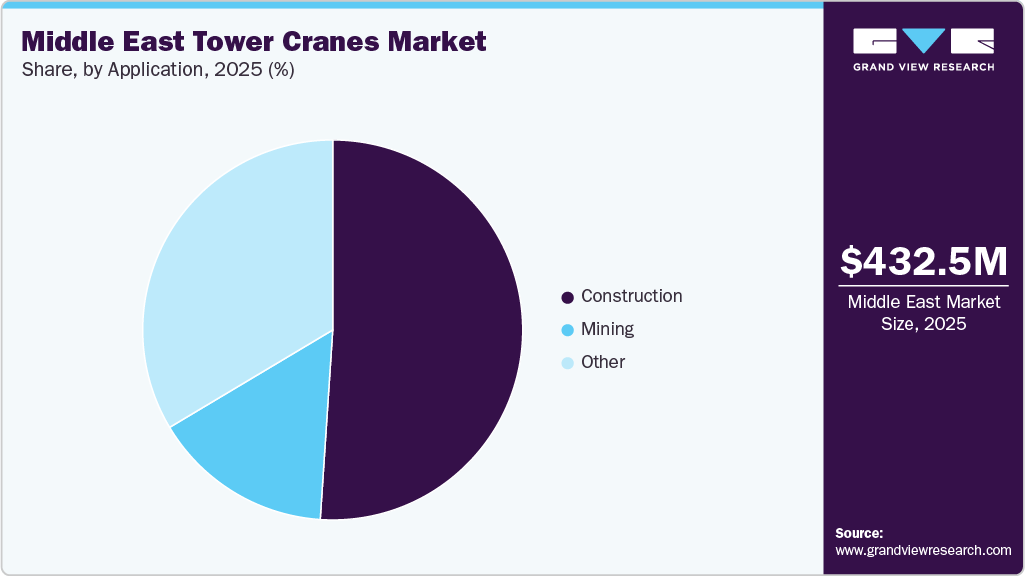
The mining segment is expected to register at the fastest CAGR over the forecast period. This growth is supported by increased investment in mineral extraction and processing projects across the Middle East, particularly in non-oil sectors such as metals, aggregates, and industrial minerals. Governments in the region are prioritizing mining as part of economic diversification strategies, leading to the development of new mining facilities and the expansion of existing sites. Tower cranes are increasingly used in the construction of processing plants, material-handling infrastructure, and associated industrial buildings, where precise lifting and assembly of heavy components are required, contributing to rising demand from the mining sector.
Country Insight
UAE Tower Cranes Market Trends
The UAE dominated the Middle East tower cranes market with the largest revenue share of 50.8% in 2025, driven by the country’s sustained focus on high-density urban development, large-scale real estate projects, and advanced infrastructure construction. The presence of continuous high-rise residential, commercial, and mixed-use developments in cities such as Dubai and Abu Dhabi has resulted in strong demand for tower cranes with higher lifting capacity and extended reach. In addition, government-backed investments in transportation infrastructure, tourism-related projects, and smart city initiatives, combined with a mature construction ecosystem and high adoption of technologically advanced construction equipment, have reinforced the UAE’s leading position in the regional tower cranes market.
Qatar Tower Cranes Market Trends
The tower cranes market in Qatar is expected to register at the fastest CAGR over the forecast period. This growth is supported by continued government investment in infrastructure development, urban expansion, and economic diversification initiatives to strengthen non-hydrocarbon sectors. Ongoing construction activity related to transportation networks, residential and commercial developments, and large public infrastructure projects is sustaining demand for tower cranes across the country. In addition, the focus on long-term urban planning, redevelopment of existing districts, and expansion of industrial and logistics facilities is increasing the requirement for efficient vertical lifting solutions, supporting accelerated adoption of tower cranes in Qatar.
Key Middle East Tower Cranes Company Insights
Some of the key companies in the Middle East tower cranes industry include Liebherr, Potain (The Manitowoc Company), Comansa, Raimondi, WOLFFKRAN, XCMG, Zoomlion, Sany, Favelle Favco, and Terex (Tower Cranes). These companies have established a strong presence in the region through a combination of direct operations, regional subsidiaries, distributor networks, and equipment rental partnerships, enabling them to support large-scale construction and infrastructure projects across major Middle Eastern markets.
-
Liebherr is a globally recognized manufacturer of construction machinery and equipment, with a strong reputation in the tower cranes segment for its engineering excellence, product reliability, and broad portfolio covering hammerhead, luffing jib, and flat-top tower cranes. The company serves a wide range of construction applications, including high-rise buildings, infrastructure, and complex urban projects, supported by advanced safety systems and high lifting performance. Liebherr maintains an established presence in the Middle East through regional subsidiaries and service centers, enabling close support for large-scale construction and infrastructure developments across the region.
-
Potain, a leading tower crane brand under The Manitowoc Company, is widely known for its specialized focus on tower crane solutions and long-standing expertise in the sector. Potain offers a comprehensive range of hammerhead, luffing jib, and topless tower cranes designed for efficiency, reliability, and ease of assembly across diverse construction environments. Backed by Manitowoc’s global manufacturing and service capabilities, Potain has developed a strong footprint in the Middle East through regional offices, distributors, and rental partners, supporting major commercial, residential, and infrastructure projects throughout the region.
Key Middle East Tower Cranes Companies:
- Liebherr
- Potain (The Manitowoc Company)
- Comansa
- Raimondi
- WOLFFKRAN
- XCMG
- Zoomlion
- Sany
- Favelle Favco
- Terex (Tower Cranes)
Recent Developments
-
In November 2024, WOLFFKRAN announced a joint venture with the Zamil Group to establish tower-crane manufacturing and rental capacity in Saudi Arabia, strengthening its local production and service footprint.
-
In November 2024, XCMG marked a strategic expansion in the UAE with the launch of a regional business centre and multi-million-dollar contracts that reinforce its position in Middle East lifting equipment markets.
Middle East Tower Cranes Market Report Scope
Report Attribute
Details
Market size value in 2026
USD 447.9 million
Revenue forecast in 2033
USD 603.5 million
Growth rate
CAGR of 4.4% from 2026 to 2033
Base year for estimation
2025
Historical data
2021 - 2024
Forecast period
2026 - 2033
Quantitative units
Revenue in USD million/billion, & Volume in Units and CAGR from 2026 to 2033
Report coverage
Revenue forecast, company ranking, competitive landscape, growth factors, and trends
Segments covered
Product, design, lifting capacity, application, country
Regional scope
Middle East
Country scope
KSA; UAE; Turkey; Qatar
Key companies profiled
Liebherr; Potain (The Manitowoc Company); Comansa; Raimondi; WOLFFKRAN; XCMG; Zoomlion; Sany; Favelle Favco; Terex (Tower Cranes)
Customization scope
Free report customization (equivalent up to 8 analysts working days) with purchase. Addition or alteration to country, regional & segment scope.
Pricing and purchase options
Avail customized purchase options to meet your exact research needs. Explore purchase options
Middle East Tower Cranes Market Report Segmentation
This report forecasts revenue and volume growth at Middle East and country levels and provides an analysis of the latest industry trends in each of the sub-segments from 2021 to 2033. For this study, Grand View Research has segmented the Middle East tower cranes market report based on product, design, lifting capacity, and application.
-
Product Outlook (Volume, Units; Revenue, USD Million, 2021 - 2033)
-
Flat top
-
Hammerhead
-
Luffing Jib
-
Self-erecting
-
-
Design Outlook (Volume, Units; Revenue, USD Million, 2021 - 2033)
-
Top Slewing Crane
-
Bottom Slewing Crane
-
-
Lifting Capacity Outlook (Volume, Units; Revenue, USD Million, 2021 - 2033)
-
Below 5 Metric Tons
-
6 to 80 Metric Tons
-
Above 80 Metric Tons
-
-
Application Outlook (Volume, Units; Revenue, USD Million, 2021 - 2033)
-
Construction
-
Mining
-
Other
-
-
Country Outlook (Volume, Units; Revenue, USD Million, 2021 - 2033)
-
Middle East
-
KSA
-
UAE
-
Turkey
-
Qatar
-
-
Frequently Asked Questions About This Report
b. The Middle East tower cranes market size was estimated at USD 432.5 million in 2025 and is expected to reach USD 447.9 million in 2026.
b. The Middle East tower cranes market size is expected to grow at a significant CAGR of 4.4% to reach USD 603.5 million in 2033.
b. UAE held the largest market share of 50.8% in 2025, driven by the country’s sustained focus on high-density urban development, large-scale real estate projects, and advanced infrastructure construction.
b. Some of the players in the market are Liebherr, Potain (The Manitowoc Company), Comansa, Raimondi, WOLFFKRAN, XCMG, Zoomlion, Sany, Favelle Favco, and Terex (Tower Cranes).
b. The key driving trend in the Middle East tower cranes market is the ongoing boom in large-scale construction and infrastructure development, fueled by government-led megaprojects and rapid urbanization. This trend is pushing strong demand for tower cranes to support high-rise buildings, mixed-use developments, transportation networks, and smart city initiatives across countries like the UAE, Saudi Arabia, and Qatar.


Share this report with your colleague or friend.
Need a Tailored Report?
Customize this report to your needs — add regions, segments, or data points, with 20% free customization.


ISO 9001:2015 & 27001:2022 Certified
We are GDPR and CCPA compliant! Your transaction & personal information is safe and secure. For more details, please read our privacy policy.
Trusted market insights - try a free sample
See how our reports are structured and why industry leaders rely on Grand View Research. Get a free sample or ask us to tailor this report to your needs.













