
- Home
- »
- Automotive & Transportation
- »
-
Middle East Transportation Management System Market Report, 2033GVR Report cover
![Middle East Transportation Management System Market Size, Share & Trends Report]()
Middle East Transportation Management System Market (2026 - 2033) Size, Share & Trends Analysis Report By Solution (Operational Planning, Payment & Claims management, Monitoring & Tracking), By Deployment, By Mode Of Transportation, By End User, By Country, And Segment Forecasts
- Report ID: GVR-4-68040-853-7
- Number of Report Pages: 100
- Format: PDF
- Historical Range: 2021 - 2024
- Forecast Period: 2026 - 2033
- Industry: Technology
- Report Summary
- Table of Contents
- Segmentation
- Methodology
- Download FREE Sample
-
 Download Sample Report
Middle East Transportation Management System Market Summary
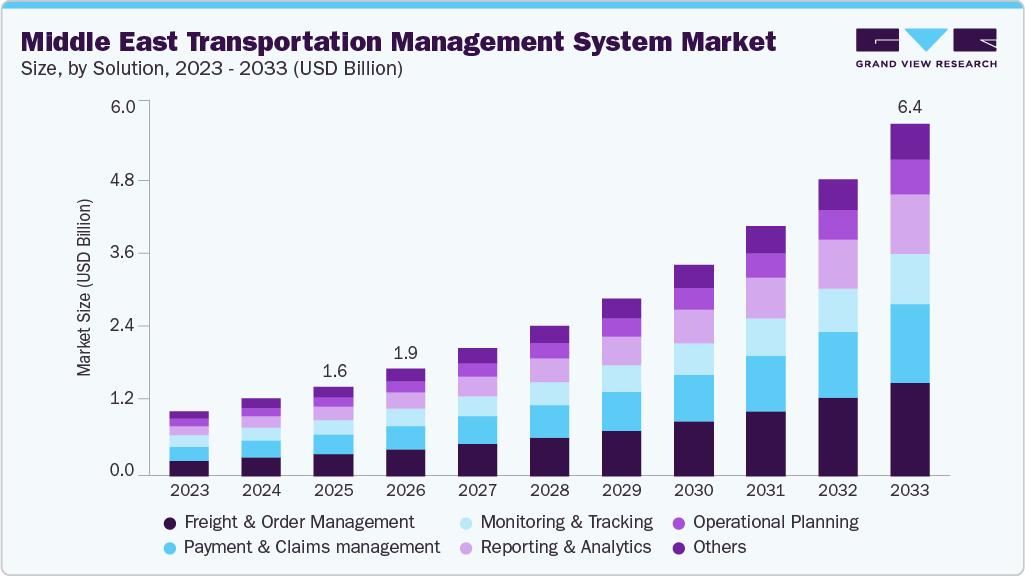
The Middle East transportation management system market size was estimated at USD 1.64 billion in 2025 and is projected to reach USD 6.41 billion by 2033, growing at a CAGR of 18.4% from 2026 to 2033.Large-scale investments in transportation infrastructure are a key driver of growth in the Middle East transportation market.
Key Market Trends & Insights
- The KSA transportation management system market accounted for a 44.2% share of the overall market in 2025.
- By solution, the freight & order management segment accounted for the largest share of 24.9% in 2025.
- By deployment, the on-premise segment held the largest market share in 2025.
- By mode of transportation, the roadways segment dominated the market in 2025.
Market Size & Forecast
- 2025 Market Size: USD 1.64 Billion
- 2033 Projected Market Size: USD 6.41 Billion
- CAGR (2026-2033): 18.4%
- KSA: Largest market in 2025
- UAE: Fastest Market
Governments are expanding airports, modernizing seaports, developing rail corridors, and upgrading highway networks to strengthen regional and international connectivity. These projects support economic diversification strategies and position the region as a global logistics and trade hub. Improved infrastructure enhances cargo handling capacity, reduces transit times, and attracts foreign investment. Urban transit systems are also being expanded to improve mobility within rapidly growing cities. Collectively, infrastructure expansion is creating a strong foundation for long-term market development.Accelerating urbanization and population growth are significantly increasing transportation demand across the Middle East. Expanding metropolitan areas require efficient public transit, road networks, and freight distribution systems to support daily mobility and commercial activity. Rising household incomes and higher vehicle ownership are further contributing to traffic volumes and transport service utilization. Governments are responding by promoting integrated urban transport solutions and multimodal connectivity. The growing concentration of economic activity in cities continues to drive sustained investment in transportation systems. This trend is strengthening both passenger and freight transportation segments.
Digital transformation is reshaping transportation operations across the region through the adoption of intelligent transport systems and data-driven platforms. Technologies such as real-time tracking, automated traffic control, predictive maintenance, and mobile ticketing are improving network efficiency and service reliability. Transport operators are leveraging analytics to optimize routes, manage fleets, and enhance asset utilization. Smart mobility solutions are also improving passenger experience through seamless booking and journey planning. The integration of digital tools is reducing operational costs and improving service quality. This technology-led shift is accelerating modernization across transportation networks.
The rapid growth of e-commerce and cross-border trade is driving strong demand for transportation and logistics services. Increasing parcel volumes and faster delivery expectations are stimulating investments in road freight, air cargo, and last-mile distribution networks. Logistics providers are expanding warehousing capacity and enhancing multimodal connectivity to support rising trade flows. Improved customs procedures and regional trade integration are further strengthening freight movement across borders. Transportation networks are becoming more flexible and responsive to shifting demand patterns. This expansion of digital commerce is emerging as a major growth catalyst for the market.
Sustainability initiatives are increasingly influencing transportation development strategies in the Middle East. Governments and operators are investing in electric buses, low-emission vehicles, rail electrification, and alternative fuels to reduce environmental impact. Green mobility programs are being integrated into urban planning and public transport development. These efforts are supported by regulatory frameworks promoting energy efficiency and carbon reduction. Adoption of cleaner technologies is also improving fuel efficiency and lowering long-term operating costs. The transition toward sustainable transport systems is creating new opportunities across infrastructure, vehicles, and services.
Solution Insights
The freight & order management segment accounted for the largest share of 24.9% in 2025. Key drivers behind its leading market share include expanded logistics operations, increased demand for real-time order visibility, and the optimization of freight allocation across road, air, and sea transport. The segment also benefits from investments in transportation technologies that enhance routing efficiency, reduce dwell times, and improve supply chain responsiveness. Furthermore, growing cross-border commerce and strategic initiatives to develop regional logistics hubs have amplified the need for robust freight and order management solutions, reinforcing its position at the forefront of market demand.
The reporting & analytics segment is expected to grow at the fastest CAGR during the forecast period. Organizations are increasingly adopting advanced analytics, business intelligence tools, and performance dashboards to extract actionable insights from large volumes of operational data. This trend is driven by the need to optimize asset utilization, monitor service KPIs in real time, forecast demand patterns, and improve cost efficiency across transportation networks. Enhanced reporting capabilities are enabling stakeholders to pinpoint bottlenecks, anticipate disruptions, and implement predictive planning, thereby improving both strategic planning and tactical execution.
Deployment Insights
The on-premise deployment segment accounted for the largest share of the Middle East transportation management systems market in 2025, driven by strong adoption among manufacturing, trading, and distribution enterprises that prioritize data security, system reliability, and operational control. Many large organizations in the region continue to prefer on-premise solutions due to stringent compliance requirements, ease of direct server access, and the ability to customize platforms according to complex logistics workflows. On-premise deployments also offer greater control over sensitive shipment, pricing, and customer data, which is particularly critical for government entities and regulated industries.
The cloud-based segment is expected to register the fastest CAGR during the forecast period. Cloud-based TMS platforms are gaining traction due to their rapid deployment, lower upfront investment, and reduced reliance on physical IT infrastructure. These solutions enable vendors, shippers, and logistics providers to access real-time data, optimize route planning, and improve shipment visibility with minimal implementation complexity. With the rising volume of operational and tracking data, enterprises are increasingly adopting cloud platforms to reduce licensing expenses, data storage costs, and technical labor requirements.
Mode of Transportation Insights
The roadways segment held the largest market in 2025. Road transport remains the most widely used and cost-effective mode across the region due to its operational flexibility and ability to provide door-to-door connectivity across urban, industrial, and remote areas. It enables efficient loading and unloading at multiple destinations, supporting time-sensitive and last-mile deliveries. However, road transportation continues to face structural constraints such as limited carrying capacity, congestion in major urban corridors, regulatory checkpoints, and variability in road quality across countries. Despite these challenges, ongoing government initiatives to expand highways, develop logistics corridors, and enhance cross-border road connectivity are strengthening road freight efficiency.
The railways segment is expected to register the fastest CAGR during the forecast period. Governments across the region are actively promoting railway expansion through large-scale modernization programs and Public-Private Partnership (PPP) models aimed at improving freight capacity and network efficiency. Rail transport plays an increasingly important role in handling bulk commodities and high-volume consignments, offering cost advantages and lower transit times over long distances compared to road transport. The development of dedicated freight corridors and intermodal terminals is further strengthening rail’s position within regional logistics networks.
End User Insights
The manufacturing segment dominated the market in 2025. Large-scale investments in industrial zones, economic cities, and special manufacturing clusters have significantly increased the movement of raw materials, semi-finished goods, and finished products across regional and international supply chains. Growing participation in cross-border trade and the diversification of production bases have intensified demand for efficient freight planning, inventory coordination, and shipment visibility. In addition, national industrialization programs and localization strategies are encouraging manufacturers to strengthen domestic supply chains, further increasing reliance on structured transportation management platforms.
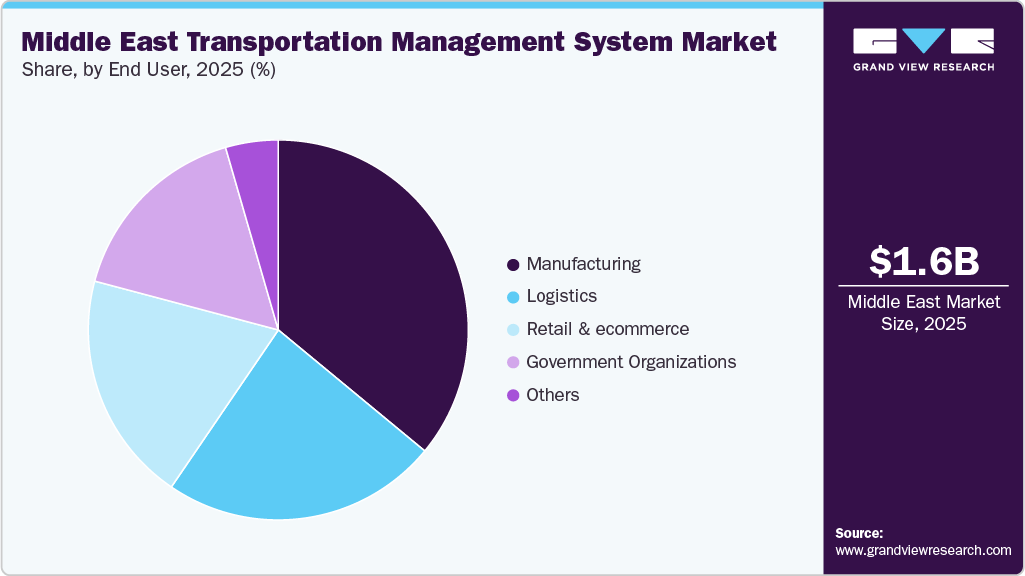
The retail & ecommerce segment is anticipated to grow rapidly during the forecast period. Retailers are increasingly deploying TMS platforms to manage order fulfillment, optimize last-mile delivery, and gain real-time visibility across complex omnichannel supply chains. The expansion of organized retail formats and the rapid rise of online marketplaces are increasing shipment volumes and delivery frequency across urban centers. To remain competitive, retailers are adopting advanced technologies such as cloud-based platforms, analytics-driven demand planning, and multi-cloud architectures to improve operational efficiency and enhance customer experience. As same-day and next-day delivery expectations continue to rise, the retail and e-commerce segment is emerging as a major growth engine for transportation management solutions in the region.
Country Insights
Saudi Arabia Transportation Management System Market Trends
The Kingdom of Saudi Arabia (KSA) dominated the Middle East transportation management system industry and accounted for a share of 44.1% in 2025.The country’s strong focus on economic diversification and industrial growth has significantly increased freight volumes and supply chain complexity. Expansion of manufacturing clusters, logistics zones, and industrial cities has accelerated demand for advanced shipment planning and freight optimization solutions. Growing cross-border trade activity and rising imports and exports are further strengthening the need for integrated transportation platforms. In addition, investments in port modernization, railway corridors, and highway networks are enhancing multimodal connectivity across the kingdom.
UAE Middle East Transportation Management System Market Trends
The UAE transportation management system market is expected to grow at the fastest CAGR of 20.9% from 2026 to 2033. The country’s role as a regional trade and re-export hub is driving high demand for real-time shipment visibility, route optimization, and integrated logistics platforms. Rapid expansion of e-commerce, free trade zones, and multimodal logistics hubs is increasing the complexity of freight operations, encouraging enterprises to adopt advanced TMS solutions. Smart city programs and investments in intelligent transport infrastructure are further strengthening technology adoption across transportation networks. Moreover, the presence of global logistics providers and technology-driven supply chains is accelerating cloud-based and analytics-enabled TMS deployment.
Key Middle East Transportation Management System Company Insights
Some of the key companies in the Middle East transportation management system market include Oracle Corporation, SAP SE, and IBM Corporation, among others. In this market, enterprises across logistics, manufacturing, retail, and energy sectors are increasingly prioritizing the adoption of advanced digital platforms to improve freight visibility, optimize routing, and enhance operational efficiency across complex regional supply chains.
-
Oracle Corporation offers Oracle Transportation Management (OTM), a comprehensive platform widely adopted by large enterprises and logistics service providers in the region. OTM enables end-to-end transportation planning, execution, and settlement across multimodal networks, enabling organizations reduce freight costs, improve delivery performance, and automate complex cross-border and regional transportation processes.
-
SAP SE provides its SAP Transportation Management solution as part of its integrated supply chain portfolio, enabling organizations to connect fleet operations, freight execution, and logistics planning within a single digital environment. In the Middle East, SAP’s TMS supports enhanced network visibility, real-time decision-making, and sustainability initiatives, helping enterprises improve agility and resilience while managing increasing shipment volumes across regional and international routes.
Key Middle East Transportation Management System Companies:
- Oracle Corporation
- SAP SE
- IBM Corporation
- Manhattan Associates
- Infor Inc.
- MercuryGate International, Inc.
- Blue Yonder
- TachyonTMS
- QuickMove
- Fleetsu
Recent Developments
-
In October 2025, ACCIONA successfully developed and deployed its Digital Transport Solutions (DTS) platform in Qatar, marking a significant milestone in sustainable and efficient logistics management in the Middle East. The platform integrated digitalization and intelligent optimization to enhance visibility, efficiency, and adaptability across logistics operations through a centralized operational center and a dedicated driver application. DTS enabled real-time monitoring, automated performance reporting, optimized route planning, and fair workload distribution, helping organizations reduce costs and improve sustainability. The deployment demonstrated ACCIONA’s capability to scale the solution across fleets of varying sizes while improving competitiveness and operational control. Through this initiative, ACCIONA reinforced its leadership in smart logistics and strengthened its long-standing presence across GCC infrastructure and facility management projects.
-
In December 2024, Dubai’s Roads and Transport Authority (RTA), in partnership with TruKKer, launched the ‘Logisty’ digital logistics platform to provide on-demand freight transport services, fleet management, and tracking solutions for businesses and customers. The platform integrates advanced technologies, including an AI-powered CBM Calculator, to estimate shipment volumes and optimize logistics operations, enhancing efficiency and transparency. The initiative aligns with Dubai’s Commercial Road Transport & Logistics Strategy 2030, which includes 17 projects aimed at increasing technology adoption, operational efficiency, and sector competitiveness.
Middle East Transportation Management System Market Report Scope
Report Attribute
Details
Market size value in 2026
USD 1.96 billion
Revenue forecast in 2033
USD 6.41 billion
Growth rate
CAGR of 18.4% from 2026 to 2033
Base year for estimation
2025
Historical data
2021 - 2024
Forecast period
2026 - 2033
Quantitative units
Revenue in USD million/billion and CAGR from 2026 to 2033
Report coverage
Revenue forecast, company ranking, competitive landscape, growth factors, and trends
Segments covered
Solution, deployment, mode of transportation, end user, and country
Regional scope
Middle East
Country scope
KSA; UAE; Qatar; Kuwait
Key companies profiled
Oracle Corporation; SAP SE; IBM Corporation; Manhattan Associates; Infor Inc.; MercuryGate International Inc.; Blue Yonder; TachyonTMS; QuickMove; Fleetsu
Customization scope
Free report customization (equivalent up to 8 analysts working days) with purchase. Addition or alteration to country, regional & segment scope.
Pricing and purchase options
Avail customized purchase options to meet your exact research needs. Explore purchase options
Middle East Transportation Management System Market Report Segmentation
This report forecasts revenue growth at regional, and country levels and provides an analysis of the latest Application trends in each of the sub-segments from 2021 to 2033. For this study, Grand View Research has segmented the Middle East transportation management system market report based on solution, deployment, mode of transportation, end user, and country.
-
Solution Outlook (Revenue, USD Million, 2021 - 2033)
-
Operational Planning
-
Freight & Order Management
-
Payment & Claims management
-
Monitoring & Tracking
-
Reporting & Analytics
-
Others
-
-
Deployment Outlook (Revenue, USD Million, 2021 - 2033)
-
On-premise
-
Cloud
-
-
Mode of Transportation Outlook (Revenue, USD Million, 2021 - 2033)
-
Roadways
-
Railways
-
Waterways
-
Airways
-
-
End User Outlook (Revenue, USD Million, 2021 - 2033)
-
Retail & Ecommerce
-
Manufacturing
-
Logistics
-
Government Organizations
-
Others
-
-
Country Outlook (Revenue, USD Million, 2021 - 2033)
-
Middle East and Africa (MEA)
-
KSA
-
UAE
-
South Africa
-
-
Frequently Asked Questions About This Report
b. The Middle East transportation management system market size was estimated at USD 1.64 billion in 2025 and is expected to reach USD 1.96 billion in 2026.
b. The Middle East transportation management system market is expected to grow at a compound annual growth rate of 18.4% from 2026 to 2033 to reach USD 6.41 billion by 2033.
b. The freight & order management segment accounted for the largest share of 24.9% in 2025. Key drivers behind its leading market share include expanded logistics operations, increased demand for real-time order visibility, and the optimization of freight allocation across road, air, and sea transport.
b. Some key players operating in the Middle East transportation management system market include Oracle Corporation, SAP SE, IBM Corporation, Manhattan Associates, Infor Inc., MercuryGate International, Inc., Blue Yonder, TachyonTMS, QuickMove, and Fleetsu.
b. The market is being driven by rapid digitalization of logistics, rising e-commerce activity, and strategic investments in modern transportation infrastructure to improve efficiency, real-time visibility, and supply chain optimization across the region.


Share this report with your colleague or friend.
Need a Tailored Report?
Customize this report to your needs — add regions, segments, or data points, with 20% free customization.


ISO 9001:2015 & 27001:2022 Certified
We are GDPR and CCPA compliant! Your transaction & personal information is safe and secure. For more details, please read our privacy policy.
Trusted market insights - try a free sample
See how our reports are structured and why industry leaders rely on Grand View Research. Get a free sample or ask us to tailor this report to your needs.













