
- Home
- »
- Renewable Energy
- »
-
Middle East Waste To Energy Market, Industry Report, 2033GVR Report cover

Middle East Waste To Energy Market (2025 - 2033) Size, Share & Trends Analysis Report By Technology (Biological, Thermal), By Country (UAE, Saudi Arabia, Oman, Qatar, Kuwait), And Segment Forecasts
Middle East Waste To Energy Market Summary
The Middle East waste to energy market size was estimated at USD 1.78 billion in 2024 and is projected to reach USD 2.48 billion by 2033, growing at a CAGR of 3.7% from 2025 to 2033. The market is gaining momentum as governments across Saudi Arabia, the UAE, Qatar, and Egypt implement waste management reforms and sustainability strategies to reduce landfill dependency and convert municipal solid waste into clean energy.
Key Market Trends & Insights
- UAE waste to energy market accounted for the largest market revenue share of 46.75% in Middle East in 2024.
- The waste to energy market in the Middle East is expected to grow at the fastest CAGR over the forecast period.
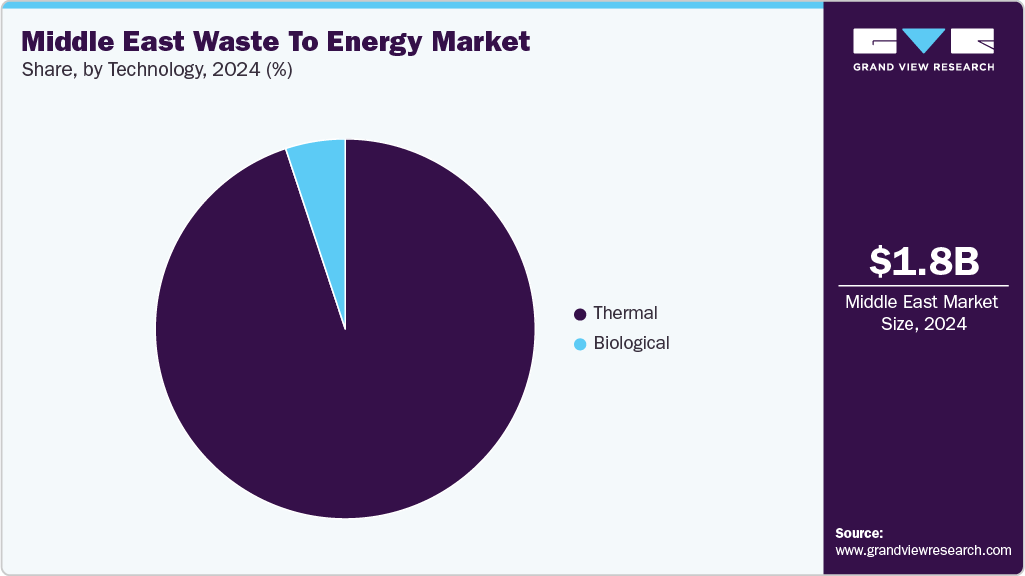
- By technology, the thermal segment led the market with the largest revenue share of 94.92% in 2024.
Market Size & Forecast
- 2024 Market Size: USD 1.78 Billion
- 2033 Projected Market Size: USD 2.48 Billion
- CAGR (2025-2033): 3.7%
Three ways to get this report
Buy it, customize it, or ask a question.Ask an Analyst
Analyst response in 1 business day
- AccessReport author, directly
- Reply timeWithin 1 working day
- No sales callDirect answer only
- FormatEmail reply
- CostFree, no cost
Get the Full Report
What the study covers
- FormatsPDF · Excel · Dashboard
- Timeline2025–2033 annual, 2024 base
- Coverage20+ countries, 5 regions
- Companies10+ key players profiled
Customize the Report
20% free customization
- IncludeCountries, segments, points
- TailorTo your product definition
- ExtendDeeper competitor detail
- OrA fully bespoke study
- Turnaround5–10 working days
Growing urbanization and industrialization in the region are driving large volumes of waste generation, while national visions such as Saudi Vision 2030 and the UAE Circular Economy Policy are fostering waste to energy adoption to support energy diversification, lower greenhouse gas emissions, and contribute to sustainable infrastructure development.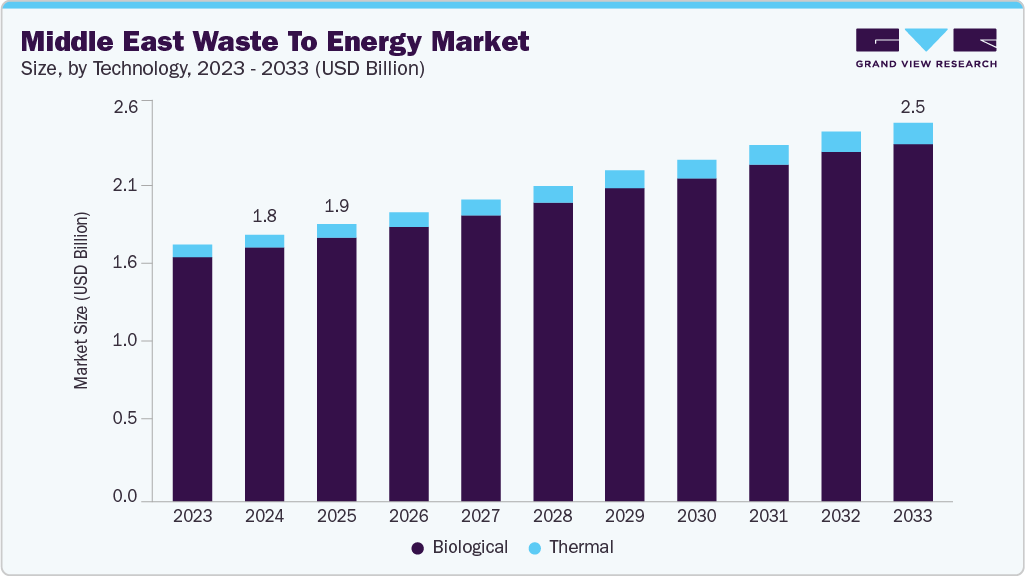 Source: Grand View Research, IR Documents, Primary Interviews, Paid DatabasesTo learn more about this report,
 Download Free Sample Report
Rising electricity demand, stringent environmental regulations, and the push for renewable and alternative energy sources fuel the market’s growth. Modern waste to energy technologies, including incineration, gasification, and anaerobic digestion, are deployed to enhance energy recovery, reduce land usage, and lower environmental impacts associated with conventional waste disposal. Integrating smart grid and district heating systems further improves efficiency and resource optimization. Key players such as Veolia, Suez, ACWA Power, Masdar, and Bee’ah are actively investing in WtE projects across the region, with flagship developments in the UAE and Saudi Arabia setting benchmarks for sustainable waste management. With increasing public-private partnerships, supportive regulatory frameworks, and strong government commitment, the Middle East waste-to-energy industry is expected to advance the region’s clean energy transition and circular economy objectives over the next decade.
Drivers, Opportunities & Restraints
The Middle East waste-to-energy industry is driven by rapid urbanization, rising municipal solid waste volumes, and governments’ strategic focus on sustainability, energy diversification, and reducing landfill dependence. National agendas such as Saudi Vision 2030, the UAE Circular Economy Policy, and Egypt’s 2030 Sustainable Development Strategy emphasize integrated waste management, renewable energy adoption, and reduced greenhouse gas emissions. Waste to energy technologies such as incineration, gasification, and anaerobic digestion are gaining traction to address growing waste generation, meet renewable energy targets, and enhance energy security. Increasing investments in large-scale infrastructure projects and public awareness of environmental sustainability are accelerating the deployment of WtE facilities across the region.
The opportunities in the Middle East waste-to-energy industry include developing advanced conversion technologies, integrating WtE plants with smart grid systems, and expanding public-private partnerships to fund large-scale projects. International collaborations with technology providers are expected to bring expertise, accelerate innovation, and support the region’s circular economy goals. The growing emphasis on waste segregation, recycling, and hybrid renewable energy projects further creates avenues for waste-to-energy expansion. However, the market faces high capital investment requirements, long project development timelines, and challenges in establishing consistent waste supply chains. Regulatory hurdles, varying policies across countries, and limited awareness of advanced WtE benefits may restrain adoption. In addition, technological integration with existing energy infrastructure and environmental concerns related to emissions could slow the pace of market expansion.
Technology Insights
The thermal segment led the market with the largest revenue share of 94.92% in 2024. Thermal technologies, including incineration, pyrolysis, and gasification, dominate due to their proven efficiency in handling large volumes of municipal solid waste and generating stable electricity output. Countries such as the UAE, Saudi Arabia, and Qatar are investing heavily in large-scale thermal WtE facilities to address growing urban waste challenges while diversifying their energy mix. High-profile projects such as Dubai's 200 MW Waste-to-Energy plant and Sharjah's integrated WtE facility highlight the region's strategic focus on thermal conversion methods to reduce landfill dependency and meet sustainability targets.
 To learn more about this report, Download Free Sample Report
Strong government support, national circular economy initiatives, and partnerships with global technology providers that bring advanced thermal treatment systems to the region further reinforce the segment's leadership. Integrating thermal WtE with district heating, desalination, and grid infrastructure enhances operational efficiency while contributing to net-zero goals. Despite challenges such as high capital investment and the need for stringent emissions controls, advancements in combustion efficiency, flue gas treatment, and energy recovery technologies ensure the segment's cost-effectiveness and long-term role in the Middle East's clean energy transition.
Country Insights
UAE Waste To Energy Market Trends
UAE dominated the Middle East waste to energy market with the largest revenue share of 46.75% in 2024, driven by its ambitious sustainability goals under the UAE Energy Strategy 2050 and the Circular Economy Policy 2031. Flagship projects such as the Dubai Waste Management Centre, the world’s largest single-site WtE facility, are central to reducing landfill dependence and generating renewable electricity from municipal waste. In Sharjah, Bee’ah and Masdar’s WtE plant further illustrates the country’s leadership in deploying advanced incineration and energy recovery technologies. Strong government backing, favorable policies, and strategic partnerships with global technology providers have positioned the UAE as a hub for regional waste valorization.
The UAE’s commitment to net-zero emissions by 2050 further accelerates investments in integrated WtE projects linked with district heating, desalination, and smart grid systems. With rising urbanization and population growth, waste volumes continue to expand, reinforcing the importance of scalable WtE solutions. While high upfront capital costs and emissions control requirements remain challenges, the country’s proactive regulatory framework and access to low-cost financing ensure sustained growth in the thermal waste to energy segment.
Saudi Arabia Waste To Energy Market Trends
The waste to energy market in Saudi Arabia remains a key growth driver in the Middle East market, underlining its role as a major player in advancing sustainable energy solutions. Under Vision 2030, the Kingdom is prioritizing WtE projects as part of its broader strategy to diversify its energy mix, reduce landfill usage, and address rising waste generation from urban and industrial expansion. The Renewable Energy Project Development Office (REPDO) has introduced structured auctions and competitive bidding to attract private investment in WtE facilities, particularly in Riyadh, Jeddah, and Makkah.
Mega-projects like NEOM and the Red Sea Development also explore integrated WtE systems to support their sustainability mandates. Sovereign-backed funding, strong investor interest, and government-led initiatives provide a favorable environment for WtE expansion, though challenges such as project execution timelines and technological adaptability persist. Nonetheless, Saudi Arabia’s combination of policy support and large-scale infrastructure commitments ensures its continued leadership in the regional market.
Oman Waste To Energy Market Trends
The Oman waste to energy market is emerging as a promising player in the Middle East market, aligning with Oman Vision 2040 and the government’s target of increasing the renewable energy share in electricity generation. The Muscat WtE plant, developed in partnership with international firms, highlights the country’s move toward large-scale incineration and energy recovery systems. Growing municipal waste volumes, particularly in urban centers, make WtE a critical solution to address landfill overcapacity while providing reliable baseload electricity.
Although Oman’s regulatory frameworks and financing mechanisms are still maturing, pilot WtE projects and foreign partnerships are laying the groundwork for long-term sector growth. To maximize efficiency, the integration of WtE with district cooling and desalination is also being explored. With continuous policy refinements and rising demand for sustainable waste management solutions, Oman is steadily positioning itself as a growth market in the region.
Qatar Waste To Energy Market Trends
The waste to energy market in Qatar is strengthening its WtE capacity under the Qatar National Vision 2030, with the Domestic Solid Waste Management Centre in Mesaieed serving as a cornerstone project. This integrated facility combines incineration, composting, and recycling to minimize landfill reliance while generating clean electricity. With rapid urbanization and industrial activity driving waste volumes, the country prioritizes modern WtE solutions to support sustainable growth.
The government also fosters collaborations with international technology providers to deploy advanced incineration and flue gas treatment systems, ensuring compliance with strict environmental standards. While fossil fuels remain dominant in Qatar’s energy system, WtE adoption is expected to improve waste management efficiency, reduce emissions, and complement the country’s broader sustainability agenda.
Kuwait Waste To Energy Market Trends
The Kuwait waste to energy market is investing in WtE facilities as part of its New Kuwait Vision 2035, focusing on reducing landfill dependency and improving urban waste management. The planned Kabd Waste-to-Energy project, one of the largest in the region, will process thousands of tons of municipal solid waste daily while generating electricity for the national grid. This project reflects Kuwait’s strategy to address rising urban waste volumes while advancing renewable energy adoption.
Strong government support and partnerships with international developers and financiers enable the implementation of large-scale WtE plants. Although challenges such as financing complexities, regulatory delays, and high construction costs persist, Kuwait’s growing emphasis on sustainable waste management and energy diversification positions it as a key emerging market for WtE in the Middle East.
Key Middle East Waste To Energy Company Insights
Some of the key players operating in the Middle East waste-to-energy industry include Tadweer Group, BEEAH Energy / Emirates Waste to Energy Company, Masdar, Bee’ah Group, Keppel Seghers Qatar, Veolia Middle East, Suez Middle East Recycling LLC, Averda, Enviroserve, and BESIX Group, among others. These companies are actively developing and operating WtE facilities to convert municipal solid waste into electricity and heat, supporting the region’s circular economy goals and reducing reliance on landfills.
Key Middle East Waste To Energy Companies:
- Tadweer Group
- BEEAH Energy
- Masdar
- Bee’ah Group
- Keppel Seghers Qatar
- Veolia Middle East
- Suez Middle East Recycling LLC
- Averda
- Enviroserve
- BESIX Group
Recent Developments
-
In February 2025, BEEAH Energy, in partnership with Masdar, announced the expansion of the Sharjah Waste-to-Energy plant to increase its processing capacity from 300,000 to 450,000 tons of municipal solid waste annually. The project integrates advanced incineration technology to generate up to 45 MW of clean electricity, further reducing landfill dependency and supporting the UAE’s Circular Economy Policy.
Middle East Waste To Energy Market Report Scope
Report Attribute
Details
Market size value in 2025
USD 1.86 million
Revenue forecast in 2033
USD 2.48 million
Growth rate
CAGR of 3.7% from 2025 to 2033
Base year for estimation
2024
Historical data
2021 - 2023
Forecast period
2025 - 2033
Quantitative units
Revenue in USD million/billion and CAGR from 2025 to 2033
Report coverage
Revenue forecast, competitive landscape, growth factors, and trends
Segments covered
Technology, country
Region scope
Middle East
Country scope
UAE; Saudi Arabia; Oman; Qatar; Kuwait
Key companies profiled
Tadweer Group; BEEAH Energy; Masdar; Bee’ah Group; Keppel Seghers Qatar; Veolia Middle East; Suez Middle East Recycling LLC; Averda; Enviroserve; BESIX Group
Customization scope
Free report customization (equivalent up to 8 analysts working days) with purchase. Addition or alteration to country, regional & segment scope.
Pricing and purchase options
Avail customized purchase options to meet your exact research needs. Explore purchase options
Middle East Waste To Energy Market Report Segmentation
This report forecasts revenue growth at country levels and provides an analysis of the latest industry trends in each of the sub-segments from 2021 to 2033. For this study, Grand View Research has segmented the Middle East waste to energy market report based on the technology and country:
-
Technology Outlook (Revenue, USD Million, 2021 - 2033)
-
Biological
-
Thermal
-
Incineration
-
Pyrolysis
-
Gasification
-
-
-
Country Outlook (Revenue, USD Million, 2021 - 2033)
-
Middle East
-
UAE
-
Saudi Arabia
-
Oman
-
Qatar
-
Kuwait
-
-
Frequently Asked Questions About This Report
The Middle East waste to energy market size was estimated at USD 1.78 million in 2024 and is expected to reach USD 1.86 million in 2025.
The Middle East waste to energy market is expected to grow at a compound annual growth rate of 3.7% from 2025 to 2033 to reach USD 2.48 million by 2033.
Based on technology, the Thermal segment held the largest revenue share of 94.92% in the Middle East Waste-to-Energy (WtE) market in 2024, driven by its proven efficiency in large-scale municipal solid waste processing and reliable power generation. Thermal conversion methods such as incineration, pyrolysis, and gasification dominate the region due to their scalability and ability to reduce landfill dependency while producing electricity and heat.
Some of the key vendors operating in the Middle East waste to energy market include Tadweer Group, BEEAH Energy, Masdar, Bee’ah Group, and Keppel Seghers Qatar, among others.
The key factors driving the Middle East waste to energy (WtE) market include ambitious national sustainability agendas, surging urban waste volumes, and the strategic need to diversify energy sources while reducing reliance on landfills. Governments across the region, particularly in the UAE, Saudi Arabia, and Qatar, prioritize WtE as part of broader circular economy and renewable energy initiatives.
About the Author(s)
Renewable Energy Research Team
Energy & Power · Renewable EnergyThis report was authored by the renewable energy research team at Grand View Research - comprising two research analysts, one senior research analyst, and one industry expert - with specialized expertise in the renewable energy segment of the energy & power industry. All findings are based on proprietary energy & power databases, executive interviews, and regulatory analysis, subject to internal peer review prior to publication.
Last Updated:
Speak to Analyst

Customize this report to your needs - add regions, segments, or data points, with 20% free customization.
Or view our licence options:


ISO 9001:2015 & 27001:2022 Certified
We are GDPR and CCPA compliant! Your transaction & personal information is safe and secure. For more details, please read our privacy policy.


