Middle East Water & Wastewater Treatment Equipment Market Summary
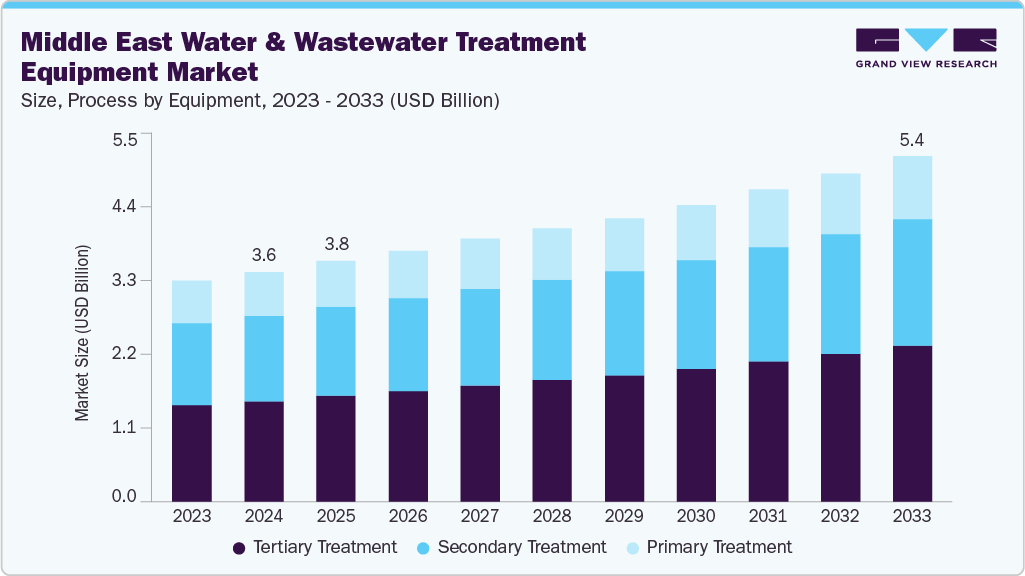
The Middle East water & wastewater treatment equipment market was estimated at USD 3,607.4 million in 2024 and is projected to reach USD 5,427.3 million, growing at a CAGR of 4.7% from 2025 to 2033. The market is growing due to increasing water scarcity, rapid urbanization, and industrial development.
Key Market Trends & Insights
- The water & wastewater treatment equipment industry in the Saudi Arabia is expected to grow at a substantial CAGR of 4.8% from 2025 to 2033.
- By process by equipment, the tertiary treatment segment is expected to grow at a considerable CAGR of 5.0% from 2025 to 2033 in terms of revenue.
- By application, the industrial segment is expected to grow at a considerable CAGR of 5.0% from 2025 to 2033 in terms of revenue.
Market Size & Forecast
- 2024 Market Size: USD 3,607.4 Million
- 2033 Projected Market Size: USD 5,427.3 Million
- CAGR (2025-2033): 4.7%
With limited freshwater resources, countries across the region are investing in advanced treatment technologies to ensure a sustainable water supply and meet the rising demand from residential, commercial, and industrial sectors. Governments are implementing stricter environmental regulations and encouraging public-private partnerships to improve water infrastructure. Smart city initiatives and infrastructure upgrades are driving the adoption of energy-efficient and automated treatment systems. The need for water reuse and recycling in agriculture, manufacturing, and municipal applications further accelerates market growth. As sustainability becomes a regional priority, the demand for reliable, scalable, and innovative water treatment equipment is expected to grow in the forecast years.
Market Concentration & Characteristics
The water and wastewater treatment equipment market in the Middle East is moderately fragmented, with a mix of global corporations and regional players operating across various segments. Large companies such as Veolia, Suez, and Xylem, dominate major municipal and industrial projects, while numerous smaller firms cater to niche applications and local needs, such as packaged treatment systems. This competitive landscape allows for innovation, regional customization, and flexibility in project execution, creating a balanced market where no single player holds an overwhelming share.
The Middle East is rapidly adopting smart technologies such as IoT systems, AI-driven monitoring, and real-time analytics. These digital tools enhance efficiency and predictive maintenance. Innovation also spans sustainable methods such as energy-efficient membrane filtration, solar-powered systems, and modular decentralized setups, enabling better resource recovery and adaptability across both urban and remote applications.
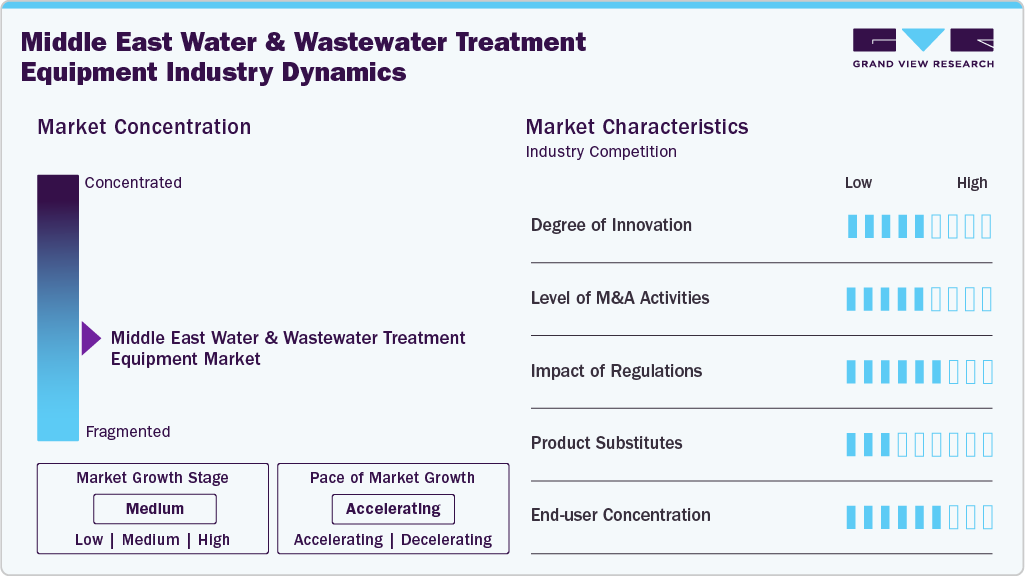
M&A activity in the Middle East water and wastewater treatment industry is gaining traction, as large regional utilities, technology companies, and engineering firms consolidate capabilities. These mergers and acquisitions help expand service offerings, enhance technological expertise, and improve market reach, fostering collaboration and enabling organizations to compete more effectively in infrastructure-driven segments such as desalination and modular treatment systems.
Regulatory frameworks in the Middle East are significantly shaping the market. Stringent discharge standards, environmental impact assessments, and recycled water quality guidelines drive the adoption of advanced treatment systems. Enforcement mechanisms and clear licensing requirements encourage compliance, while incentives for water reuse and tighter effluent controls promote investment in sustainable treatment infrastructure across both municipal and industrial sectors.
Drivers, Opportunities & Restraints
Water scarcity is a primary driver in the Middle East, where arid climates and growing populations intensify demand for sustainable water solutions. Governments are investing heavily in desalination and wastewater treatment infrastructure to ensure long-term water security. This increasing dependence on advanced treatment technologies fuels steady demand for modern equipment across both municipal and industrial applications.
There is a strong opportunity in decentralized and modular water treatment systems, especially for remote and underserved areas. As smart cities and industrial parks expand, demand for flexible, scalable solutions grows. Companies offering energy-efficient, compact, and easy-to-deploy systems can tap into emerging markets, particularly where centralized infrastructure is limited or under development.
One key challenge in the market is the high capital cost of installing advanced treatment systems, which can deter adoption, particularly in smaller municipalities or private sector projects. In addition, maintaining technical expertise for operating complex systems and navigating regulatory approvals can be difficult. This limits implementation speed and creates barriers for smaller or newer market entrants.
Process By Equipment Insights
Tertiary treatment dominated the market in 2024, accounting for the largest revenue share at 43.8%due to growing demand for high-quality reclaimed water, especially in water-scarce regions. Governments and industries are prioritizing advanced treatment processes such as membrane filtration, UV disinfection, and reverse osmosis, to meet strict discharge regulations and support water reuse initiatives. The need for ultra-purified water in sectors such as agriculture, industrial cooling, and municipal supply is driving widespread adoption of tertiary equipment across the region.
The secondary treatment segment is expected to witness steady growth during the forecast period, driven by increasing urbanization and expanding municipal infrastructure. This process, primarily involving biological treatment methods like activated sludge systems and biofilters, is crucial for removing organic matter before reuse or discharge. As cities invest in centralized wastewater facilities and regulatory pressure intensifies, the demand for efficient and cost-effective secondary treatment equipment continues to rise, particularly in new residential and industrial developments.
Application Insights
The municipal segment dominated the market in 2024, accounting for the highest revenue share at 66.4%due to rising urban populations and increased demand for clean water and sanitation. Governments are investing heavily in centralized treatment plants, desalination facilities, and wastewater reuse systems to support urban infrastructure. National sustainability goals and water reuse regulations further drive the deployment of advanced treatment technologies. Public-sector funding and large-scale projects make the municipal sector the largest and most stable contributor to market growth.
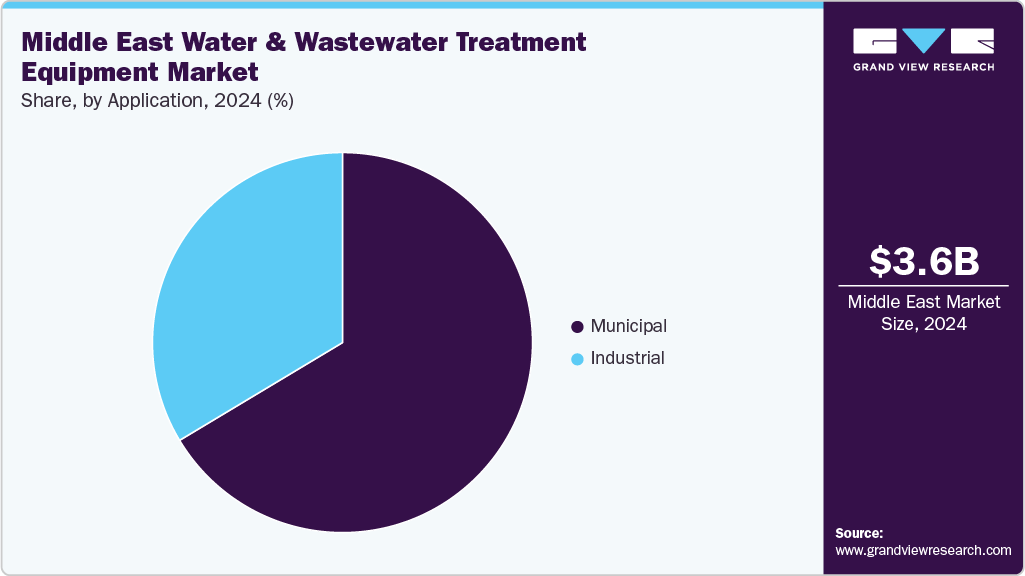
The industrial segment is witnessing strong growth as manufacturing, oil and gas, and food processing industries expand across the Middle East. Stricter environmental regulations and water reuse mandates are pushing industries to adopt on-site treatment systems. Sectors with high water usage are investing in advanced, energy-efficient equipment to reduce operational costs and meet compliance standards. Growing awareness of sustainability and the need for secure water sources also contribute to the segment’s increasing demand for treatment solutions.
Country Insights
Saudi Arabia water & wastewater treatment equipment industry dominated the Middle East market, accounting for 48.7% market share in 2024, owing to rapid urbanization, industrial expansion, and the government’s Vision 2030 initiative focused on sustainable water management. Significant investments in municipal infrastructure and industrial sectors like oil and gas are driving demand. The country is enhancing water treatment capabilities through large-scale projects and the adoption of advanced technologies, supporting long-term water security and environmental goals.
The water & wastewater treatment equipment industry in Qatar is expected to grow at a CAGR of 5.0% from 2025 to 2033, driven by its heavy reliance on seawater desalination as a primary water source. Expansion of major desalination plants and adoption of advanced, energy-efficient technologies are key factors. The country is focused on improving sustainability and operational efficiency, supporting national water security, and meeting increasing demand from both municipal and industrial sectors.
Key Middle East Water & Wastewater Treatment Company Insights
Some of the key players operating in the market include Veolia, Xylem Inc., and Pentair Inc.
-
Veolia is a global environmental services company that designs and operates water treatment and desalination systems. In the Middle East, it develops and manages large-scale desalination plants using technologies like reverse osmosis and thermal processes. Veolia works with municipalities and industries to provide sustainable water solutions, often integrating energy recovery and efficiency into its plant operations.
-
Xylem, Inc. is a global water technology company headquartered in Washington, D.C., established in 2011 as a spin-off from ITT Corporation. It specializes in innovative solutions for water and wastewater management across public utilities, industrial, commercial, agricultural, and residential sectors. With about 23,000 employees operating in over 150 countries, Xylem offers a broad portfolio including pumps, treatment systems, analytics, and smart infrastructure technologies. The company focuses strongly on sustainability, aiming to reduce global water demand. Strategic acquisitions have strengthened its market position and expanded its technology offerings worldwide.
Key Middle East Water & Wastewater Treatment Companies:
- Xylem, Inc.
- Pentair plc.
- Aquatech International LLC
- Ecolab Inc.
- DuPont
- Toshiba Water Solutions Private Limited (TOSHIBA CORPORATION)
- Veolia Group
- Evonik Industries AG
- Parkson Corporation
- WETICO
Recent Developments
-
In June 2025, Toray launched a Water Treatment Technology Center in Saudi Arabia to provide advanced technical support for the region’s growing water needs. The center focuses on membrane technologies and complete treatment systems, offering R&D, testing, and training capabilities.
-
In March 2025, WETICO expanded into the UAE, delivering a comprehensive water infrastructure package that includes seawater desalination, demineralization, condensate polishing, and effluent treatment systems. This expansion supports growing regional demand for sustainable water solutions, enhancing WETICO’s footprint and fueling the Middle East water and wastewater treatment equipment industry.
Middle East Water & Wastewater Treatment Equipment Market Report Scope
|
Report Attribute
|
Details
|
|
Market size value in 2025
|
USD 3,772.2 million
|
|
Revenue forecast in 2033
|
USD 5,427.3 million
|
|
Growth rate
|
CAGR of 4.7% from 2025 to 2033
|
|
Historical data
|
2021 - 2023
|
|
Forecast period
|
2025 - 2033
|
|
Quantitative units
|
Revenue in USD million/billion and CAGR from 2025 to 2033
|
|
Report coverage
|
Revenue forecast, company ranking, competitive landscape, growth factors, and trends
|
|
Segments covered
|
Process by equipment, application, country.
|
|
Country scope
|
Saudi Arabia; UAE; Kuwait; Israel; Qatar; Rest of Middle East
|
|
Key companies profiled
|
Xylem, Inc.; Pentair plc.; Aquatech International LLC; Ecolab Inc.; DuPont; Toshiba Water Solutions Private Limited (TOSHIBA CORPORATION); Veolia Group; Evonik Industries AG; Parkson Corporation; WETICO
|
|
Customization scope
|
Free report customization (equivalent up to 8 analysts working days) with purchase. Addition or alteration to country, regional & segment scope.
|
|
Pricing and purchase options
|
Avail customized purchase options to meet your exact research needs. Explore purchase options
|
Middle East Water & Wastewater Treatment Equipment Market Report Segmentation
This report forecasts revenue growth at global, regional, and country levels and provides an analysis of the latest industry trends in each of the sub-segments from 2021 to 2033. For this study, Grand View Research has segmented the Middle East water & wastewater treatment equipment market report based on process by equipment, application, and country.
-
Process By Equipment Outlook (Revenue, USD Million, 2021 - 2033)
-
Primary Treatment
-
Primary clarifier
-
Sludge removal
-
Grit removal
-
Pre-treatment
-
Others
-
Secondary Treatment
-
Activated sludge
-
Sludge treatment
-
Others
-
Tertiary Treatment
-
Tertiary clarifier
-
Filters
-
Chlorination systems
-
Others
-
Application Outlook (Revenue, USD Million, 2021 - 2033)
-
Country Outlook (Revenue, USD Million, 2021 - 2033)
-
Saudi Arabia
-
UAE
-
Kuwait
-
Israel
-
Qatar
-
Rest of Middle East
Frequently Asked Questions About This Report
b. The Middle East water & wastewater treatment equipment market size was estimated at USD 3,607.4 million in 2024 and is expected to be USD 3,772.2 million in 2025.
b. The Middle East water & wastewater treatment equipment market, in terms of revenue, is expected to grow at a compound annual growth rate of 4.7% from 2025 to 2033 to reach USD 5,427.3 million by 2033.
b. Tertiary treatment dominated the market in 2024, accounting for the highest revenue share of 43.8% due to growing demand for high-quality reclaimed water, especially in water-scarce regions. Governments and industries are prioritizing advanced treatment processes like membrane filtration, UV disinfection, and reverse osmosis to meet strict discharge regulations and support water reuse initiatives.
b. Some of the key players operating in the Middle East water & wastewater treatment equipment market include Xylem, Inc., Pentair plc., Aquatech International LLC, Ecolab Inc., DuPont, Toshiba Water Solutions Private Limited (TOSHIBA CORPORATION), Veolia Group, Evonik Industries AG, Parkson Corporation, WETICO.
b. Key factors driving the Middle East water and wastewater treatment equipment market include rising water scarcity, rapid urbanization, industrial expansion, and strict environmental regulations. Government initiatives promoting water reuse, investment in desalination technologies, and growing demand for sustainable infrastructure also contribute significantly to the increasing adoption of advanced treatment solutions across the region.

 Download Sample Report
















