
- Home
- »
- Next Generation Technologies
- »
-
Military Electro-Optical And Infrared Systems Market Report 2033GVR Report cover

Military Electro-Optical And Infrared Systems Market (2026 - 2033) Size, Share & Trends Analysis Report By Platform, By Application, By Imaging Technology, By Colling Technology, By Sensor Technology, By Component, By Region, And Segment Forecasts
Market Size, 2025
$8.7BMarket Estimate, 2026
$9.0BMarket Forecast, 2033
$12.7BCAGR, 2026–2033
4.9%Military Electro-Optical And Infrared Systems Market Summary
The global military electro-optical and infrared systems market size was valued at USD 8.7 billion in 2025 and is projected to grow from USD 9.0 billion in 2026 to USD 12.7 billion by 2033, at a CAGR of 4.9% from 2026 to 2033. The North America military electro-optical and infrared systems market held the largest share of 36.0% of the global market in 2025. This market expansion is driven by the increasing deployment of unmanned aerial vehicles (UAVs), autonomous ground vehicles, and naval defense systems equipped with next-generation EO/IR payloads.
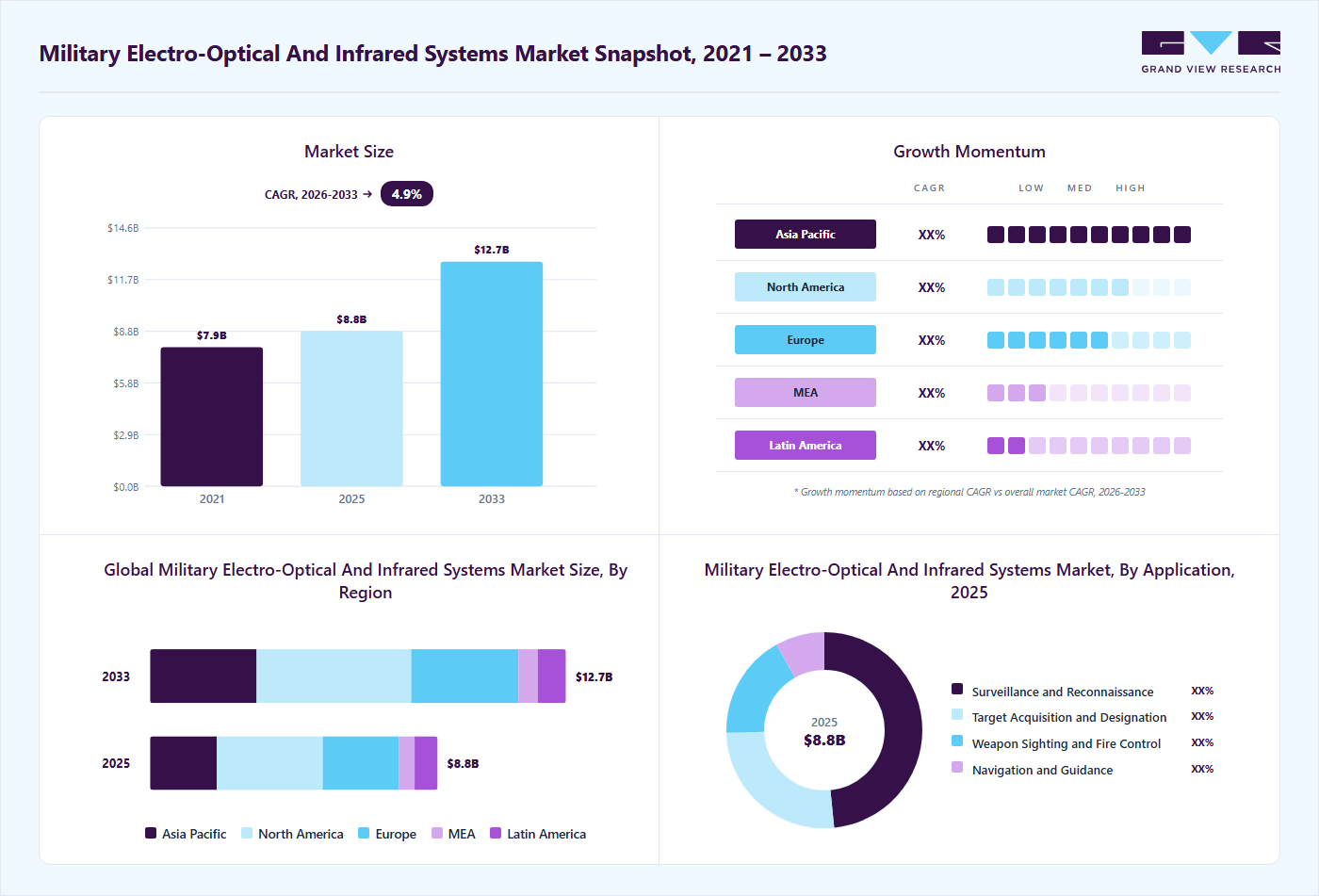 Source: Grand View Research, IR Documents, Primary Interviews, Paid DatabasesTo learn more about this report,
 Download Free Sample Report
 Key Market Trends & Insights
- Based on platform, the airborne segment accounted for the largest revenue share of over 62% in 2025.
- Based on application, the surveillance and reconnaissance segment is expected to grow at the highest CAGR of 5.5% in 2025.
- Based on imaging technology, the infrared (IR) systems segment accounted for the highest market share in 2025.
Regional Insights
- Largest regional market: North America (36.0% revenue share, 2025)
- Fastest-growing regional market: Asia Pacific (highest CAGR, 2026-2033)
- The military electro-optical and infrared systems industry in the U.S. held the largest revenue share in 2025.
Market Size & Forecast
- Market size in 2025: USD 8.7 Billion
- Estimated market size in 2026: USD 9.0 Billion
- Projected market size by 2033: USD 12.7 Billion
- CAGR (2026-2033): 4.9%
Three ways to get this report
Buy it, customize it, or ask a question.Ask an Analyst
Analyst response in 1 business day
- AccessReport author, directly
- Reply timeWithin 1 working day
- No sales callDirect answer only
- FormatEmail reply
- CostFree, no cost
Get the Full Report
What the study covers
- FormatsPDF · Excel · Dashboard
- Timeline2026–2033 annual, 2025 base
- Coverage20+ countries, 5 regions
- Companies10+ key players profiled
Customize the Report
20% free customization
- IncludeCountries, segments, points
- TailorTo your product definition
- ExtendDeeper competitor detail
- OrA fully bespoke study
- Turnaround5–10 working days
The expanding investments in electronic warfare and battlefield intelligence systems across major defense economies, and the growing emphasis on all-weather, day-and-night operational capabilities to enhance mission effectiveness, force protection, and tactical superiority in modern military environments.
 To learn more about this report, Download Free Sample Report
 The increasing emphasis on network-centric warfare and real-time battlefield connectivity is significantly transforming the military electro-optical and infrared systems industry. Advancements in secure communication protocols, edge computing, and sensor interoperability have improved the responsiveness and coordination of defense operations. The rising demand for persistent surveillance and border monitoring solutions has encouraged the deployment of long-endurance EO/IR systems capable of continuous intelligence gathering. These developments are expanding the operational capabilities of defense forces and accelerating the adoption of advanced electro-optical and infrared technologies, thereby driving the market growth.
The accelerating shift toward multi-domain operations and integrated battlefield management systems is significantly driving the adoption of advanced military electro-optical and infrared (EO/IR) systems. Armed forces are increasingly deploying sensor-equipped platforms that can operate seamlessly across land, air, sea, cyber, and space domains, enabling synchronized mission planning and enhanced situational awareness. Advancements in real-time data analytics, secure communication networks, and sensor fusion architectures are improving threat detection accuracy and operational coordination during complex missions. These developments are encouraging defense agencies to invest in interoperable EO/IR solutions capable of supporting joint operations and combat environments, thereby strengthening the long-term growth of the military electro-optical and infrared systems industry.
In addition, the growing emphasis on modernization of armored vehicles, naval fleets, and airborne surveillance assets is creating strong demand for ruggedized and high-durability EO/IR systems designed to withstand extreme combat and environmental conditions. Defense organizations are prioritizing technologies that offer enhanced reliability, extended operational lifecycles, and reduced maintenance requirements to ensure mission readiness in harsh terrains and maritime environments. The integration of advanced stabilization systems, long-range detection capabilities, and automated target tracking features is enabling more effective monitoring of critical infrastructure, coastal regions, and contested borders. This sustained investment in platform survivability and mission endurance is reinforcing the adoption of next-generation electro-optical and infrared technologies.
Moreover, the increasing focus on electronic countermeasure resistance and stealth detection capabilities is expanding the role of sophisticated EO/IR systems in modern defense strategies. Military forces are investing in advanced imaging technologies capable of detecting low-signature targets, camouflaged assets, and emerging aerial threats in complex operational scenarios. Continuous advancements in thermal contrast enhancement, adaptive imaging algorithms, and secure signal processing are enabling defense systems to maintain effectiveness even in electronically contested environments. This growing requirement for resilient sensing and surveillance technologies is encouraging manufacturers to develop highly secure and interference-resistant EO/IR platforms, further accelerating innovation in the military electro-optical and infrared systems industry.
Furthermore, the rising importance of rapid deployment and expeditionary warfare capabilities is driving demand for portable, modular, and quickly deployable EO/IR systems. Defense units and special operations forces are increasingly relying on compact surveillance and targeting equipment that can be rapidly installed on temporary bases, tactical vehicles, and mobile command units. The development of flexible mounting configurations, energy-efficient power systems, and user-friendly interfaces is enabling faster operational setup and improved mission responsiveness. This shift toward agile and mobile defense capabilities is creating new growth opportunities for advanced electro-optical and infrared technologies across global military operations.
Platform Insights
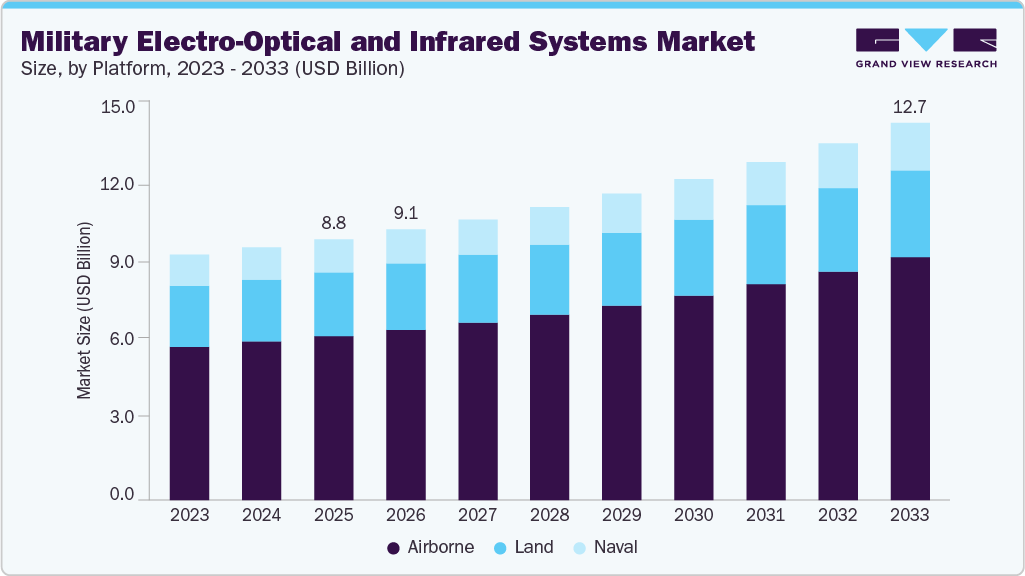
The airborne segment dominated the market, accounting for over 62.8% in 2025, driven by the increasing deployment of intelligence, surveillance, and reconnaissance (ISR) missions requiring persistent aerial monitoring across contested and remote regions. Defense forces are prioritizing investments in advanced electro-optical and infrared payloads capable of delivering wide-area surveillance, rapid target acquisition, and enhanced mission flexibility from high-altitude and long-endurance aircraft. The growing integration of EO/IR systems into next-generation combat aircraft, airborne early warning platforms, and tactical unmanned aerial systems further reinforces the segment’s leading position in modern defense operations.
The naval segment in the market is estimated to record a significant CAGR of 4.0% from 2025 to 2033, fueled by the expanding adoption of shipborne electro-optical and infrared systems designed to enhance maritime domain awareness and protect critical sea lanes. Naval forces are increasingly investing in advanced imaging and tracking technologies capable of detecting low-profile surface threats, monitoring congested coastal zones, and supporting search-and-rescue and anti-submarine missions. The rising focus on safeguarding offshore energy infrastructure, strengthening coastal surveillance networks, and integrating EO/IR sensors into next-generation frigates, patrol vessels, and unmanned maritime platforms is expected to accelerate market growth.
Application Insights
The surveillance and reconnaissance segment accounted for the largest revenue share in 2025, driven by the increasing deployment of persistent monitoring systems to support early threat detection and strategic intelligence operations across high-risk regions. Defense agencies are prioritizing investments in long-endurance observation platforms capable of delivering continuous wide-area coverage and automated anomaly detection in dynamic operational environments. The growing adoption of advanced border management systems, remote sensing technologies, and real-time command-and-control integration further reinforces the segment’s leading position within the military electro-optical and infrared systems industry.
The weapon sighting and fire control segment is expected to record a significant CAGR from 2025 to 2033. This growth is fueled by the rising emphasis on enhancing battlefield accuracy and reducing response time in high-intensity combat scenarios. Armed forces are increasingly investing in advanced targeting technologies capable of delivering rapid threat engagement, improved hit probability, and enhanced coordination between sensor platforms. The growing integration of stabilized imaging systems and automated targeting interfaces enables more precise engagement of moving and concealed targets under complex operational conditions. This expanding focus on mission effectiveness, force survivability, and operational precision is expected to accelerate growth in the weapon sighting and fire control segment.
Cooling Technology Insights
The cooled segment accounted for the largest market share in 2025, driven by the increasing deployment of high-end targeting and missile seeker systems that require ultra-precise thermal detection for long-range engagement. Defense agencies are prioritizing investments in advanced cooled electro-optical and infrared payloads for fighter aircraft, airborne early warning systems, and ground-based air defense radars, where superior detection range and rapid response capabilities are mission-critical. The growing integration of cooled sensors into ballistic missile defense networks and long-range surveillance towers further reinforces the segment’s leading market position.
The uncooled segment is expected to record the highest CAGR from 2026 to 2033. This growth is owing to the expanding adoption of soldier-worn thermal sights, handheld surveillance devices, and compact unmanned aerial vehicle payloads. The rising use of uncooled sensors in short-range reconnaissance drones, vehicle-mounted perimeter security systems, and portable night observation equipment is enabling broader deployment across distributed combat units. This growing emphasis on scalable, field-ready thermal imaging solutions tailored for tactical mobility and decentralized operations is expected to accelerate growth in the uncooled segment of the market.
Sensor Technology Insights
The staring segment accounted for the largest market share in 2025, driven by the increasing deployment of persistent surveillance and missile warning systems that require continuous target monitoring. Defense forces are prioritizing investments in advanced staring sensor architectures for applications such as airborne threat detection, counter-rocket and artillery warning systems, and space-based observation platforms. The growing use of staring arrays in integrated air and missile defense systems, particularly for detecting high-speed aerial threats, further reinforces the segment’s leading position within the market.
The scanning segment is expected to record a significant CAGR from 2025 to 2033, propelled by the expanding use of long-range perimeter surveillance and border monitoring systems designed to cover extensive geographic areas. The rising integration of scanning sensors into mobile reconnaissance vehicles, ground-based radar support systems, and unattended ground sensor networks is enabling efficient coverage of large operational zones with improved detection consistency. This growing demand for structured area surveillance and strategic asset protection is expected to accelerate growth in the scanning segment of the market.
Imaging Technology Insights
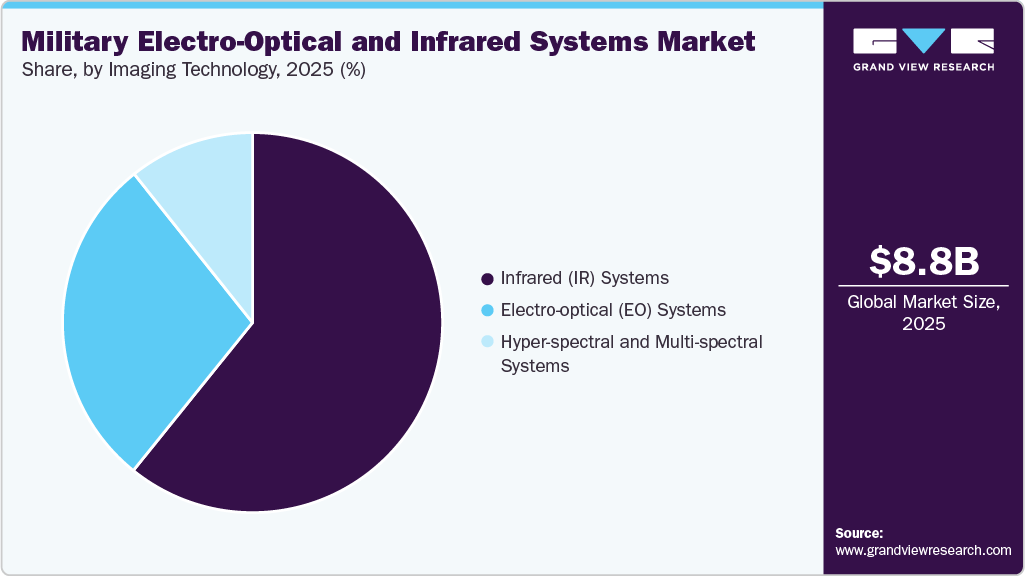
The infrared (IR) systems segment accounted for the largest market share in 2025, driven by the increasing deployment of all-weather sensing technologies capable of supporting continuous military operations. Defense forces are prioritizing investments in advanced infrared detection systems that enable reliable monitoring of concealed threats, equipment performance, and troop movements in complex operational environments. The growing integration of infrared sensors into perimeter defense systems and battlefield surveillance networks further reinforces the segment’s position within the military electro-optical and infrared systems industry.
 To learn more about this report, Download Free Sample Report
 The hyperspectral and multispectral systems segment is expected to record a significant CAGR from 2025 to 2033. The growth is propelled by the expanding use of advanced spectral imaging technologies for strategic intelligence analysis and environmental monitoring. Defense agencies are increasingly investing in next-generation sensing systems capable of distinguishing subtle variations in terrain composition, detecting hazardous materials, and supporting mission planning through detailed geospatial intelligence. This growing focus on enhanced data-driven defense strategies and advanced sensing capabilities is expected to accelerate growth in the hyperspectral and multispectral systems segment in the market.
Regional Insight
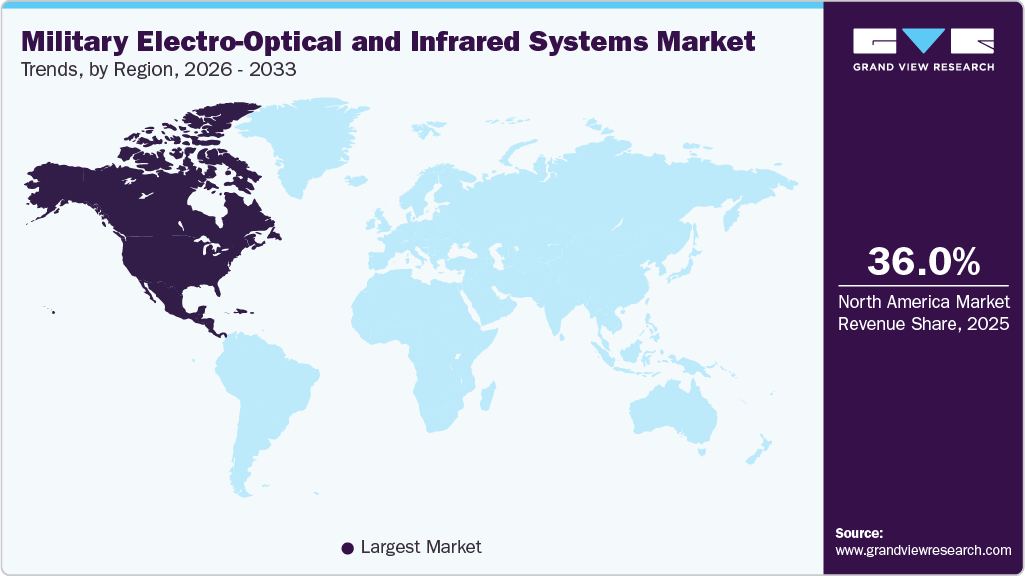
North America military electro-optical and infrared systems market accounted for a dominant share of over 36% in 2025, driven by the region’s strong defense technology ecosystem and the continuous deployment of advanced battlefield surveillance and missile defense systems. The region is witnessing substantial procurement of next-generation EO/IR sensors for multi-domain operations, including airborne intelligence, naval threat detection, and ground-based perimeter security. The increasing focus on strengthening homeland defense capabilities, modernizing legacy military platforms, and enhancing real-time situational awareness across joint forces is further reinforcing market growth across North America.
 To learn more about this report, Download Free Sample Report
 U.S. Military Electro-Optical And Infrared Systems Market Trends
The military electro-optical and infrared systems market in the U.S. dominated the market in 2025, fueled by sustained investments in advanced defense technologies such as counter-unmanned aerial systems (C-UAS), hypersonic threat detection, and integrated battlefield management platforms. The growing deployment of EO/IR payloads on next-generation fighter aircraft, long-endurance surveillance drones, and space-based early warning systems is encouraging large-scale adoption of high-performance imaging technologies. The expansion of domestic defense manufacturing programs and increasing collaboration between defense agencies and private contractors are supporting continuous innovation in the electro-optical and infrared solutions across the country.
Europe Military Electro-Optical And Infrared Systems Market Trends
The military electro-optical and infrared systems market in Europe accounted for a significant share in 2025. The market growth is driven by the rising demand for advanced border surveillance and battlefield monitoring systems amid evolving regional security dynamics. The region is experiencing increasing investments in integrated defense networks and sensor-based monitoring solutions designed to enhance rapid response capabilities and cross-border intelligence coordination. The adoption of advanced targeting and reconnaissance technologies across multinational defense alliances is supporting improved operational readiness and strengthening the role of electro-optical and infrared technologies in modern European defense strategies.
The UK military electro-optical and infrared systems market is expected to grow significantly in the coming years, driven by the country’s ongoing naval modernization initiatives and the expansion of maritime surveillance capabilities. Increasing investments in advanced sensing technologies for Royal Navy vessels, coastal monitoring stations, and airborne reconnaissance platforms are supporting the deployment of high-precision EO/IR systems. The growing emphasis on strengthening rapid-response defense units and improving threat detection capabilities in complex maritime environments is indirectly boosting demand for the military electro-optical and infrared systems industry across the country.
The military electro-optical and infrared systems market in Germanyis fueled by the country’s increasing focus on upgrading armored vehicle fleets and enhancing land-based defense capabilities. Germany is witnessing rising demand for ruggedized EO/IR systems integrated into infantry fighting vehicles, mobile artillery platforms, and battlefield command units to improve operational coordination and mission effectiveness. Strong emphasis on defense technology development, system reliability, and interoperability is encouraging the deployment of high-performance electro-optical and infrared solutions.
Asia Pacific Military Electro-Optical And Infrared Systems Market Trends
The military electro-optical and infrared systems market in the Asia Pacific is expected to grow at the highest CAGR of 6.2% from 2025 to 2033, owing to the rapid expansion of regional defense capabilities and increasing procurement of advanced surveillance technologies to address evolving security challenges. The region is experiencing rising adoption of EO/IR systems across naval fleets, border monitoring installations, and aerial reconnaissance platforms to strengthen territorial defense and maritime security. The growing development of indigenous defense manufacturing programs and the expansion of joint military exercises are enhancing demand for advanced electro-optical and infrared technologies in the market.
Japan military electro-optical and infrared systems marketis gaining traction, owing to the country’s increasing investments in missile defense systems and early warning technologies designed to address regional security concerns. Japan is focusing on integrating advanced EO/IR sensors into coastal surveillance networks, airborne patrol aircraft, and maritime self-defense vessels to enhance real-time threat detection. The growing emphasis on strengthening national resilience, improving maritime domain awareness, and supporting rapid-response defense operations is encouraging sustained adoption of high-reliability electro-optical and infrared systems across the country.
The military electro-optical and infrared systems market in Chinais rapidly expanding, driven by the country’s large-scale defense modernization programs and the accelerated development of indigenous surveillance and targeting technologies. The deployment of advanced EO/IR systems across unmanned combat aerial vehicles, naval destroyers, and integrated air defense networks to enhance strategic deterrence and operational effectiveness. The expansion of domestic defense manufacturing capabilities and increasing investments in advanced sensor research and battlefield automation are accelerating demand for high-volume, technologically sophisticated electro-optical and infrared systems across the country.
Key Military Electro-optical And Infrared Systems Company Insights
Some of the key players operating in the market include Lockheed Martin Corporation and Northrop Grumman Corporation, among others.
-
Lockheed Martin Corporation is an aerospace and defense company with operations across air, land, sea, and space domains. The company provides advanced military electro-optical and infrared (EO/IR) systems, including targeting pods, infrared search and track sensors such as IRST21, and multi-sensor suites like the F-35 Electro-Optical Targeting System (EOTS), delivering long-range detection, tracking, and precision engagement capabilities for air, land, and maritime platforms.
-
Northrop Grumman Corporation is a defense technology company active in aeronautics, mission systems, and space systems. The company provides EO/IR sensors and payloads integrated into missile warning, targeting, and ISR architecture, supplying infrared detectors, targeting systems, and space-based payloads that enhance situational awareness, precision engagement, and persistent surveillance.
Some of the emerging market players include Teledyne FLIR LLC and Leonardo DRS, Inc.
-
Teledyne FLIR LLC is a subsidiary of Teledyne Technologies focused on sensing and imaging solutions. The company offers a wide range of EO/IR products, including thermal imaging cameras, gimballed sensor payloads, and soldier-borne and vehicle-mounted sights that support day/night surveillance, target acquisition, and force protection for ground, airborne, and unmanned platforms used by defense and security agencies.
-
Leonardo DRS, Inc. is a defense electronics company that is majority-owned by Leonardo S.p.A. The company provides military EO/IR solutions, including thermal weapon sights, long-range surveillance systems, and infrared sensors, which are integrated into ground combat vehicles, aircraft, and naval platforms. This support enables military forces to enhance their targeting, reconnaissance, and situational awareness capabilities.
Key Military Electro-Optical And Infrared Systems Companies:
The following key companies have been profiled for this study on the military electro-optical and infrared systems market.
- Lockheed Martin Corporation
- Northrop Grumman Corporation
- Raytheon Technologies Corporation
- Thales Group, Leonardo S.p.A.
- L3Harris Technologies, Inc.
- Teledyne FLIR LLC
- BAE Systems Plc
- Leonardo S.p.A.
- Rheinmetall AG
- Saab AB
Recent Developments
-
In October 2025, Lockheed Martin Corporation was awarded a USD 233 million contract by the U.S. Navy and Air National Guard (ANG) to initiate full-rate production of its IRST21 Block II systems and associated spares. The IRST21 Block II is an advanced long-wave infrared search and track sensor that operates passively, allowing it to detect and track airborne targets at extended ranges without emitting a radar signal, thus ensuring effectiveness in radar-denied or heavily jammed environments.
-
In October 2025, Northrop Grumman Corporation partnered with Red 6 to integrate its Advanced Tactical Augmented Reality System (ATARS) into Northrop’s Beacon autonomous mission testbed. This collaboration enables the creation of realistic virtual training environments that replicate complex, near-peer threat scenarios, while reducing safety risks and airspace limitations. The partnership aims to accelerate the development of autonomous systems and enhance mission readiness for future combat operations.
-
In June 2025, Leonardo DRS, Inc. secured a USD 41 million contract to continue delivering critical combat management system hardware for the U.S. Navy and allied forces, including multi-screen consoles and displays. Although primarily a hardware/computing contract, these systems are essential components that process and display the massive amounts of data collected by the Navy's advanced sensing systems, including EO/IR surveillance and targeting systems deployed on surface combatants.
Military Electro-Optical And Infrared Systems Market Report Scope
Report Attribute
Details
Market size in 2025
USD 8.7 billion
Estimated market size in 2026
USD 9.0 billion
Projected market size by 2033
USD 12.7 billion
Growth rate
CAGR of 4.9% from 2026 to 2033
Actual data
2021 - 2025
Forecast period
2026 - 2033
Quantitative units
Revenue in USD million/billion and CAGR from 2026 to 2033
Report coverage
Revenue forecast, company ranking, competitive landscape, growth factors, and trends
Segments covered
Platform, application, imaging technology, cooling technology, sensor technology, region
Regional scope
North America; Europe; Asia Pacific; Latin America; MEA
Country scope
U.S.; Canada; UK; Germany; France; China; Japan; India; Brazil; South Korea; Australia; Mexico; Saudi Arabia; UAE; South Africa
Key companies profiled
Lockheed Martin Corporation; Northrop Grumman Corporation; Raytheon Technologies Corporation; Thales Group; Leonardo S.p.A.; L3Harris Technologies, Inc.; Teledyne FLIR LLC; BAE Systems Plc; Leonardo S.p.A.; Rheinmetall AG; Saab AB
Customization scope
Free report customization (equivalent up to 8 analysts working days) with purchase. Addition or alteration to country, regional & segment scope.
Pricing and purchase options
Avail customized purchase options to meet your exact research needs. Explore purchase options
Global Military Electro-optical And Infrared Systems Market Report Segmentation
This report forecasts revenue growth at global, regional, and country levels and provides an analysis of the latest industry trends in each of the sub-segments from 2021 to 2033. For this study, Grand View Research has segmented the global military electro-optical and infrared systems market report based on platform, application, imaging technology, cooling technology, sensor technology, and region:
-
Platform Outlook (Revenue, USD Million, 2021 - 2033)
-
Airborne
-
Land
-
Naval
-
-
Application Outlook (Revenue, USD Million, 2021 - 2033)
-
Surveillance and Reconnaissance
-
Target Acquisition and Designation
-
Weapon Sighting and Fire Control
-
Navigation and Guidance
-
-
Imaging Technology Outlook (Revenue, USD Million, 2021 - 2033)
-
Electro-optical (EO) Systems
-
Infrared (IR) Systems
-
Hyper-Spectral and Multi-Spectral Systems
-
-
Cooling Technology Outlook (Revenue, USD Million, 2021 - 2033)
-
Cooled
-
Uncooled
-
-
Sensor Technology Outlook (Revenue, USD Million, 2021 - 2033)
-
Staring
-
Scanning
-
-
Regional Outlook (Revenue, USD Million, 2021 - 2033)
-
North America
-
U.S.
-
Canada
-
Mexico
-
-
Europe
-
Germany
-
UK
-
France
-
-
Asia Pacific
-
China
-
Japan
-
India
-
South Korea
-
Australia
-
-
Latin America
-
Brazil
-
-
Middle East and Africa (MEA)
-
Kingdom of Saudi Arabia
-
UAE
-
South Africa
-
-
Frequently Asked Questions About This Report
North America dominated with a 36.0% revenue share in 2025.
Asia Pacific is the fastest-growing region over the forecast period.
The global military electro-optical and infrared systems market is expected to grow at a compound annual growth rate of 4.9% from 2026 to 2033 to reach USD 12.7 billion by 2033.
The global military electro-optical and infrared systems market size was estimated at USD 8.7 billion in 2025 and is expected to reach USD 9.0 billion in 2026.
Some of the key players operating in the military electro-optical and infrared systems market include Lockheed Martin Corporation, Northrop Grumman Corporation, Raytheon Technologies Corporation, Thales Group, Leonardo S.p.A., L3Harris Technologies, Inc., FLIR Systems, Inc. BAE Systems Plc, Leonardo S.p.A. and Rheinmetall AG and Saab AB.
Military Electro-Optical and Infrared (EO/IR) Systems market is driven by the increasing need for advanced surveillance and reconnaissance capabilities. As global tensions rise, and asymmetric warfare becomes more prevalent, military forces require enhanced situational awareness to effectively monitor and respond to potential threats. Additionally, the growing focus on precision targeting and intelligence gathering has further fuelled the adoption of EO/IR systems across various platforms, including aircraft, naval vessels, and ground vehicles. The ability of these systems to operate in diverse environmental conditions, including low visibility and night-time scenarios, makes them indispensable for modern military operations
The airborne segment dominated the market, accounting for over 62% of the market share in 2025, driven by the increasing deployment of intelligence, surveillance, and reconnaissance (ISR) missions requiring persistent aerial monitoring across contested and remote regions. Defense forces are prioritizing investments in advanced electro-optical and infrared payloads capable of delivering wide-area surveillance, rapid target acquisition, and enhanced mission flexibility from high-altitude and long-endurance aircraft. The growing integration of EO/IR systems into next-generation combat aircraft, airborne early warning platforms, and tactical unmanned aerial systems further reinforces the segment’s leading position in modern defense operations.
About the Author(s)
Next Generation Technologies Research Team
Technology · Next Generation TechnologiesThis report was authored by the next generation technologies research team at Grand View Research - comprising two research analysts, one senior research analyst, and one industry expert - with specialized expertise in the next generation technologies segment of the technology industry. All findings are based on proprietary technology databases, executive interviews, and regulatory analysis, subject to internal peer review prior to publication.
Last Updated:
Speak to Analyst

Customize this report to your needs - add regions, segments, or data points, with 20% free customization.
Or view our licence options:


ISO 9001:2015 & 27001:2022 Certified
We are GDPR and CCPA compliant! Your transaction & personal information is safe and secure. For more details, please read our privacy policy.


