
- Home
- »
- Next Generation Technologies
- »
-
Military Transport Aircraft Market Size & Share Report, 2033GVR Report cover

Military Transport Aircraft Market (2026 - 2033)
Size, Share & Trends Analysis Report By Aircraft Type (Fixed-wing Aircraft, Rotorcraft), By Propulsion (Turbofan, Turboprop), By Application, By End-user (Air Force, Army Aviation, Special Operations), By Region, And Segment Forecasts
Market Size, 2025
$7.1BMarket Estimate, 2026
$7.4BMarket Forecast, 2033
$9.7BCAGR, 2026–2033
4.0%Military Transport Aircraft Market Summary
The global military transport aircraft market size was valued at USD 7.1 billion in 2025 and is projected to grow from USD 7.4 billion in 2026 to USD 9.7 billion by 2033, at a CAGR of 4.0% from 2026 to 2033. Asia Pacific dominated the global market, accounting for a revenue share of 36.9% in 2025. The market growth is driven by increasing demand for long-range troop and cargo airlifting, replacement and life-extension of aging transport aircraft, rising investments in avionics and mission-system upgrades, growing requirements for rapid military deployment and logistics support, increasing use of transport aircraft for humanitarian and disaster-relief missions, and continued emphasis on improving aircraft availability, interoperability, and mission readiness.
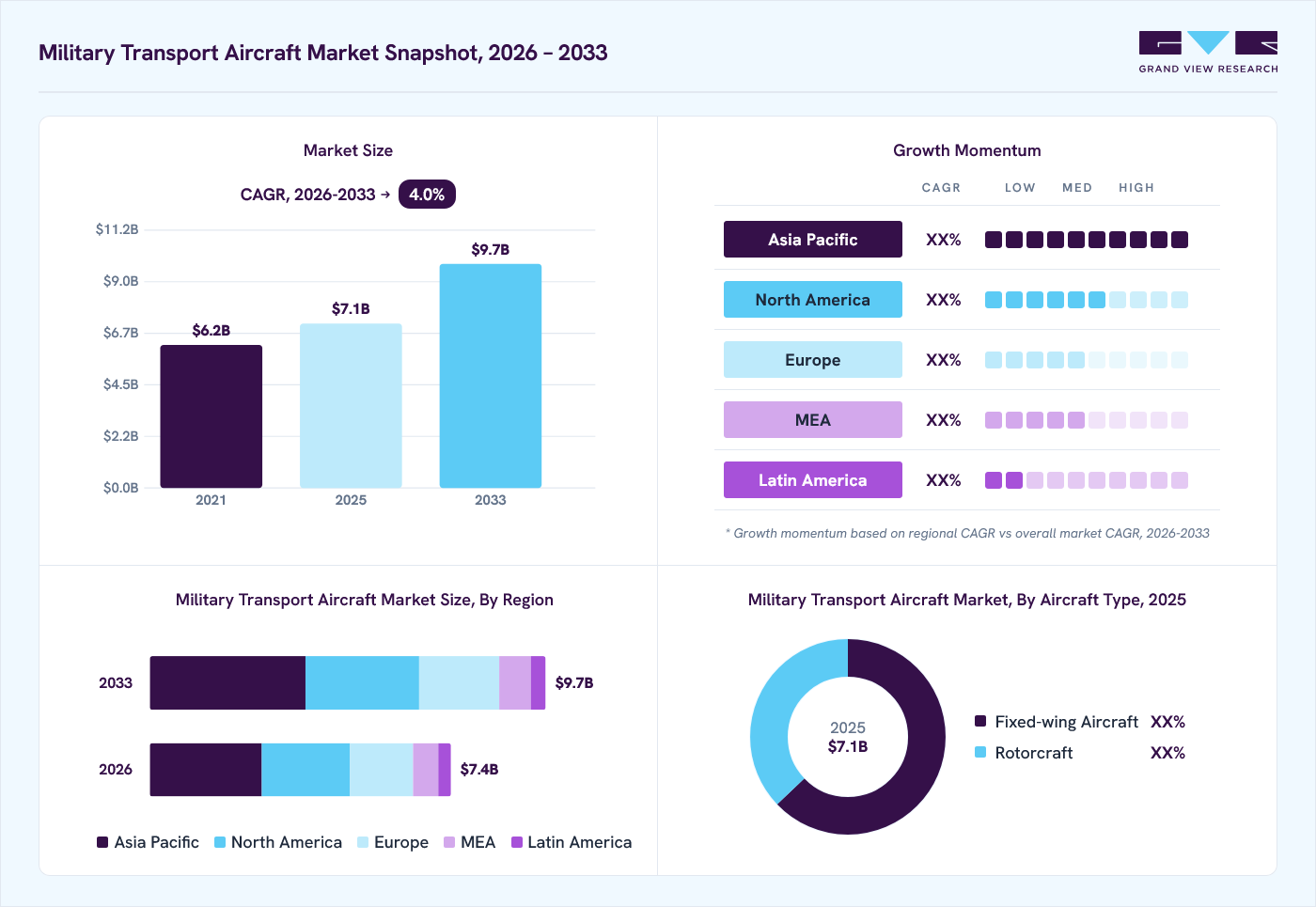 Source: Grand View Research, IR Documents, Primary Interviews, Paid DatabasesTo learn more about this report,
 Download Free Sample Report
Key Market Trends & Insights
- By aircraft type: Fixed-wing aircraft segment held the largest revenue share of 62.8% in 2025.
- By propulsion: Turbofan segment held the largest revenue share of over 53.0% in 2025
- By end-user: Air force segment held the largest revenue share of 48.2% in 2025
- By application: Troop and cargo airlifting segment led the military transport aircraft industry with a 46.7% revenue share in 2025.
Regional Highlights
- Largest regional market: Asia Pacific (36.9% revenue share, 2025)
- By country: China led Asia Pacific with the largest revenue share in 2025.
Market Size & Forecast
- Market size in 2025: USD 7.1 Billion
- Estimated market size in 2026: USD 7.4 Billion
- Projected market size by 2033: USD 9.7 Billion
- CAGR (2026-2033): 4.0%
Prism AI by Grand View Research Free to tryAsk a question about the military transport aircraft marketTry asking✓Every figure cited from GVR research Prefer the report? Download free sample →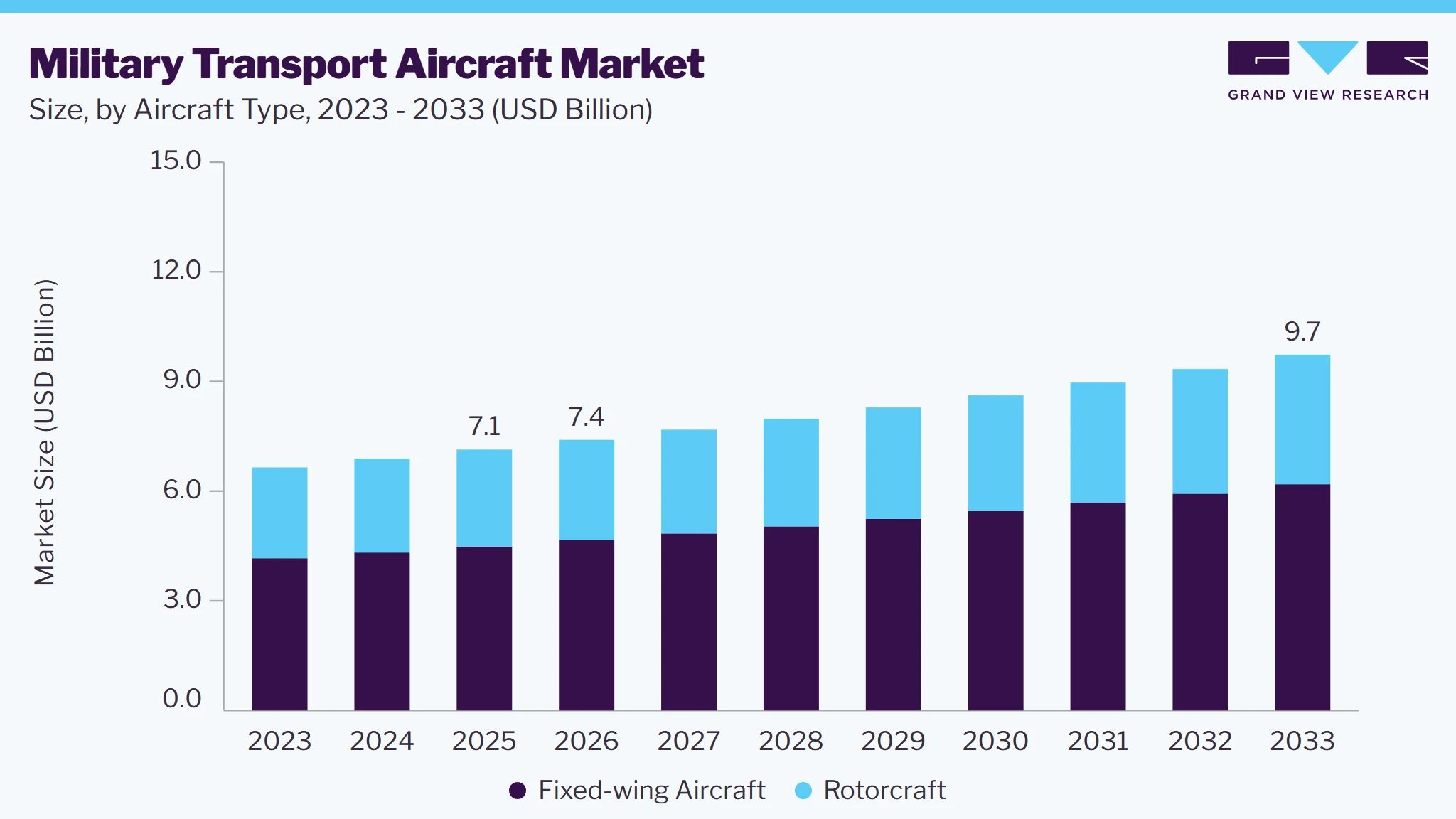 To learn more about this report, Download Free Sample Report
The demand for military transport aircraft is increasing as defense forces accelerate the modernization and expansion of strategic and tactical airlift capabilities for troop deployment, military logistics, humanitarian assistance, and special missions. Military organizations are investing in advanced fixed-wing transport aircraft, rotorcraft, high-payload platforms, turbofan and turboprop propulsion systems, and upgraded avionics and mission systems to enable the rapid movement of personnel and supplies over long distances and in challenging operational environments. At the same time, the growing adoption of digital avionics, defensive systems, autonomous technologies, and real-time aircraft health monitoring is improving mission readiness, fleet availability, operational flexibility, and lifecycle efficiency, strengthening demand for next-generation military transport aircraft.
Market Dynamics
The military transport aircraft market is experiencing significant growth, driven by increasing demand for strategic and tactical airlift capabilities, fleet modernization programs, and rising investments in advanced military mobility platforms. Defense forces are procuring and upgrading fixed-wing transport aircraft and rotorcraft to support troop deployment, cargo transportation, medical evacuation, humanitarian assistance, disaster relief, and special missions. The integration of advanced avionics, secure communication systems, modern navigation technologies, defensive systems, digital mission systems, and improved propulsion technologies is further enhancing aircraft performance, mission flexibility, and operational readiness. However, high aircraft acquisition and lifecycle costs, complex maintenance requirements, stringent certification and defense standards, and challenges associated with integrating advanced systems into legacy fleets remain key restraints. At the same time, the development of next-generation transport aircraft, autonomous technologies, advanced materials, digital aircraft systems, and enhanced fleet-management capabilities is creating significant opportunities for market participants.
The military transport aircraft market is primarily driven by increasing requirements for the rapid movement of military personnel, equipment, vehicles, ammunition, and supplies across long distances. Defense organizations are strengthening strategic and tactical airlift capabilities to support rapid military deployment, overseas operations, disaster response, and logistics missions. The modernization of aging transport fleets and growing investments in high-payload, long-range, and multi-role aircraft are further supporting market growth. In parallel, the adoption of advanced turbofan and turboprop propulsion systems, improved avionics, secure communications, advanced navigation, and enhanced cargo-handling systems is enabling military transport aircraft to operate more efficiently across diverse and challenging environments.
Despite strong growth prospects, the military transport aircraft market faces challenges associated with the high acquisition, operation, maintenance, and lifecycle costs of advanced transport aircraft. Military transport platforms require sophisticated airframes, propulsion systems, avionics, mission systems, communication equipment, defensive technologies, and specialized cargo-handling infrastructure, resulting in substantial procurement and sustainment expenditures. Integrating advanced technologies into legacy aircraft can also require extensive structural modifications, avionics upgrades, software integration, and testing. In addition, lengthy procurement cycles, stringent military certification requirements, supply chain constraints, skilled workforce requirements, and the complexity of maintaining aging fleets can increase program costs and deployment timelines.
The increasing development of next-generation military transport aircraft, autonomous systems, advanced avionics, digital twins, AI-enabled maintenance, and advanced propulsion technologies is creating substantial opportunities for market participants. AI and predictive analytics can analyze aircraft performance and maintenance data to identify anomalies, predict component failures, and optimize maintenance schedules, improving fleet availability and mission readiness. Digital twin technologies can support continuous monitoring and simulation of aircraft systems, enabling more efficient lifecycle management and maintenance planning. Furthermore, the integration of secure communications, advanced navigation, autonomous flight capabilities, enhanced defensive systems, and network-centric mission technologies is creating opportunities for aircraft OEMs, propulsion manufacturers, avionics suppliers, defense technology companies, and MRO providers.
Market Concentration & Characteristics
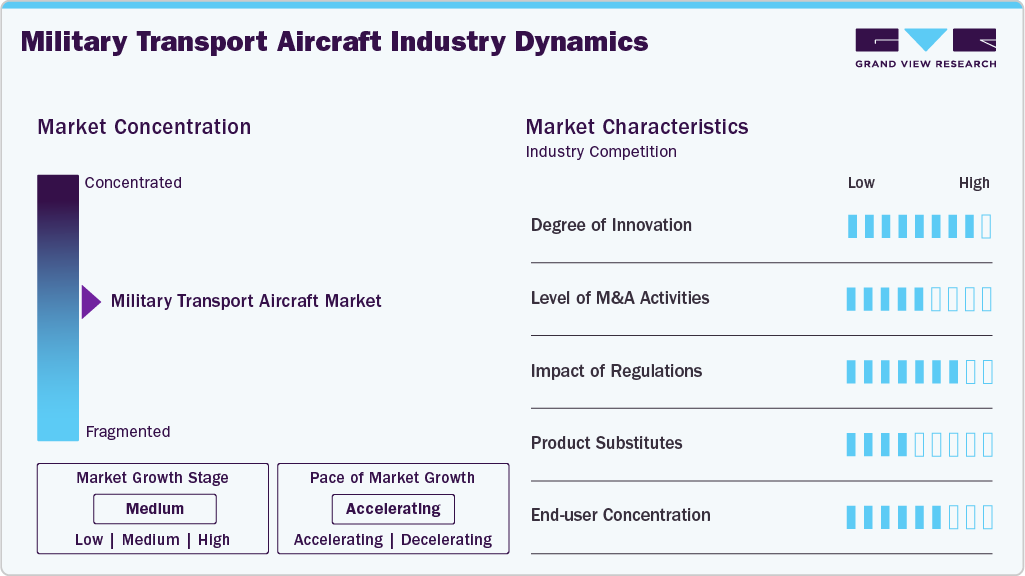
The military transport aircraft market is moderately concentrated, with competition led by established aerospace and defense companies with strong capabilities in aircraft design, manufacturing, propulsion, avionics, mission systems, and lifecycle support. The market is characterized by continuous advancements in strategic and tactical airlift platforms, high-payload transport aircraft, advanced rotorcraft, propulsion systems, avionics, secure communication systems, navigation technologies, defensive systems, autonomous capabilities, and digital aircraft technologies. High aircraft development and manufacturing costs, stringent military qualification and certification requirements, complex system integration, long procurement cycles, and the need for extensive testing and validation create significant barriers to entry. These factors enable established aerospace and defense companies to maintain strong competitive positions through technological innovation, government contracts, strategic partnerships, joint development programs, fleet modernization agreements, and long-term maintenance and support contracts.
 To learn more about this report, Download Free Sample Report
Major players such as Lockheed Martin Corporation, Airbus SE, The Boeing Company, Embraer S.A., Leonardo S.p.A., Kawasaki Heavy Industries, Ltd., and Antonov State Company compete across different segments of the military transport aircraft industry, through investments in next-generation transport aircraft, advanced propulsion, avionics, mission systems, cargo-handling technologies, and fleet modernization. Companies are increasingly focused on improving payload capacity, range, fuel efficiency, aircraft survivability, operational flexibility, interoperability, and mission readiness. The growing requirement for rapid military deployment, strategic mobility, humanitarian assistance, disaster relief, and special operations is encouraging defense organizations to invest in both new-generation transport aircraft and the modernization of existing fleets.
Analyst Perspective
The military transport aircraft market is expected to grow steadily, driven by rising defense spending, fleet modernization, and increasing demand for strategic and tactical airlift capabilities. Defense forces are investing in advanced fixed-wing aircraft, rotorcraft, high-payload platforms, modern propulsion, avionics, secure communications, and mission systems to improve the movement of personnel, equipment, and supplies. Fleet replacement and growing requirements for humanitarian assistance, disaster relief, medical evacuation, and special operations will further support demand. Despite high acquisition and lifecycle costs, complex maintenance, lengthy procurement cycles, and stringent certification requirements, advances in digital avionics, AI-enabled predictive maintenance, autonomous capabilities, advanced materials, and next-generation propulsion are expected to create new growth opportunities.
Aircraft Type Insights
The fixed-wing aircraft segment dominated the military transport aircraft industry, accounting for a revenue share of 62.8% in 2025, driven by the widespread deployment of fixed-wing transport platforms for strategic and tactical military airlift missions. These aircraft are extensively used for troop transportation, cargo and equipment movement, military logistics, humanitarian assistance, disaster relief, and long-range deployment operations. Their higher payload capacity, extended range, greater operational endurance, and suitability for transporting heavy military equipment make fixed-wing aircraft essential to modern military mobility.
The rotorcraft segment is witnessing significant growth, driven by increasing demand for flexible, runway-independent military transportation capabilities. Military forces are increasingly deploying transport helicopters and other rotorcraft for troop movement, tactical logistics, medical evacuation, search and rescue, special operations, and operations in remote or challenging terrain where conventional fixed-wing aircraft face operational limitations.
Propulsion Insights
The turbofan segment dominated the military transport aircraft market, accounting for a revenue share of 53.0% in 2025, driven by the extensive use of turbofan-powered aircraft for strategic and tactical airlift missions requiring high thrust, long-range capabilities, and substantial payload capacity. Turbofan propulsion is widely deployed across large and medium military transport aircraft used for troop transportation, cargo movement, military logistics, rapid deployment, and long-distance operations.
The turboprop segment is witnessing significant growth, supported by increasing demand for efficient tactical airlift and transport capabilities. Turboprop-powered military transport aircraft are well-suited for short- and medium-range missions, troop transportation, cargo movement, tactical resupply, medical evacuation, and operations from short or semi-prepared runways.
Application Insights
The troop and cargo airlifting segment led the military transport aircraft industry with a 46.7% revenue share in 2025, driven by the increasing need for rapid and reliable transportation of military personnel, equipment, vehicles, ammunition, and essential supplies. Military transport aircraft play a critical role in strategic and tactical airlift operations, enabling defense forces to rapidly deploy troops and logistical resources across domestic and international operational areas.
The humanitarian and disaster relief segment is witnessing significant growth, driven by the increasing deployment of military transport aircraft for rapid disaster response, emergency logistics, evacuation, and delivery of essential supplies. These aircraft enable defense forces to quickly transport food, medical supplies, rescue equipment, personnel, and emergency resources to areas affected by natural disasters, conflicts, and humanitarian crises.
End-user Insights
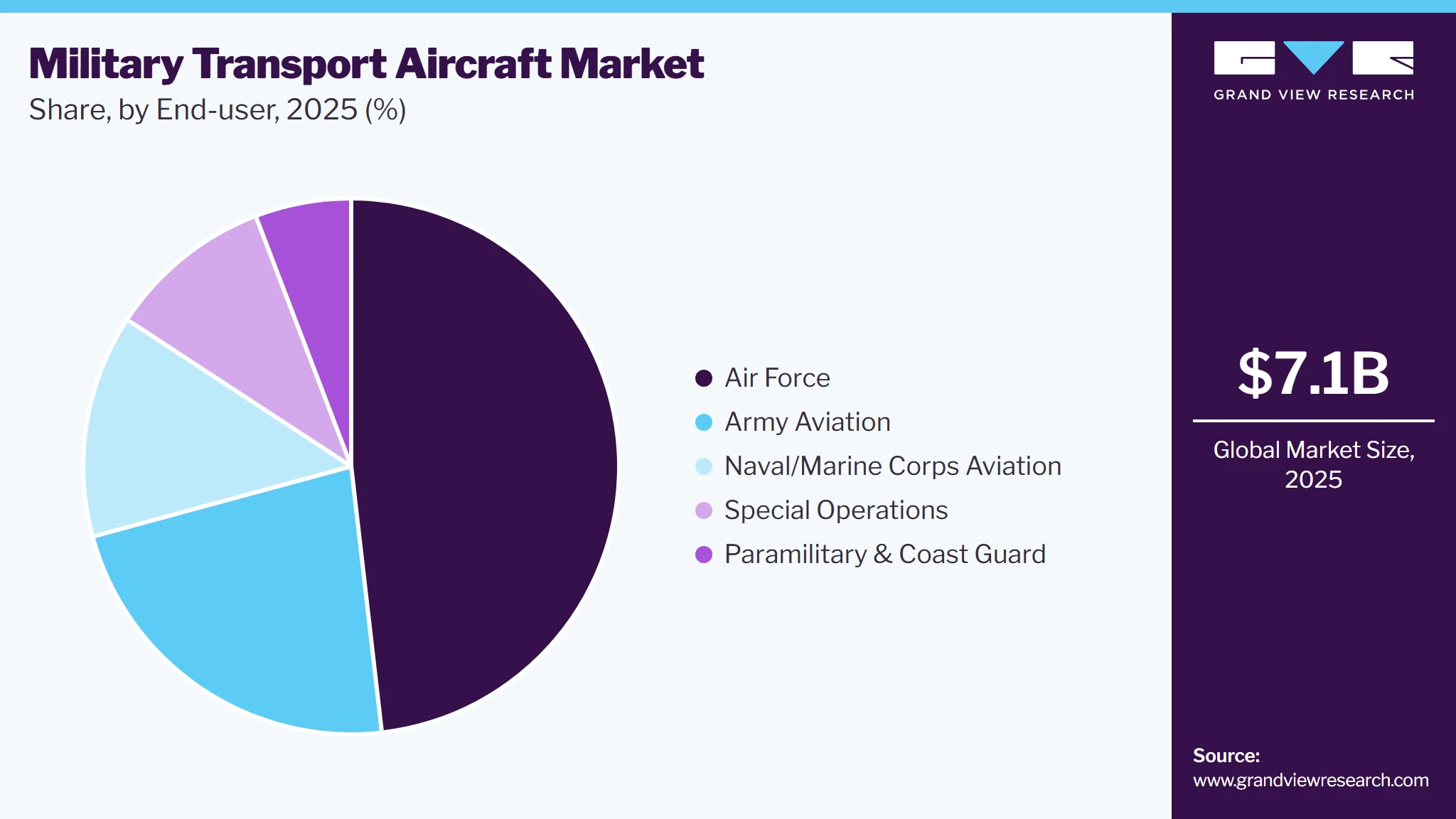
The air force segment dominated the military transport aircraft market with a 48.2% revenue share in 2025, driven by the critical role of military transport aircraft in strategic airlift, troop deployment, cargo transportation, tactical resupply, and rapid force projection. Air forces operate a large proportion of fixed-wing transport fleets to move personnel, military equipment, vehicles, ammunition, and essential supplies across domestic and international operational areas.
 To learn more about this report, Download Free Sample Report
The special operations segment is witnessing significant growth, driven by increasing demand for rapid, flexible, and highly specialized air mobility for special forces missions. Military transport aircraft support troop insertion and extraction, tactical resupply, medical evacuation, personnel recovery, and covert or time-sensitive operations in complex and contested environments.
Regional Insights
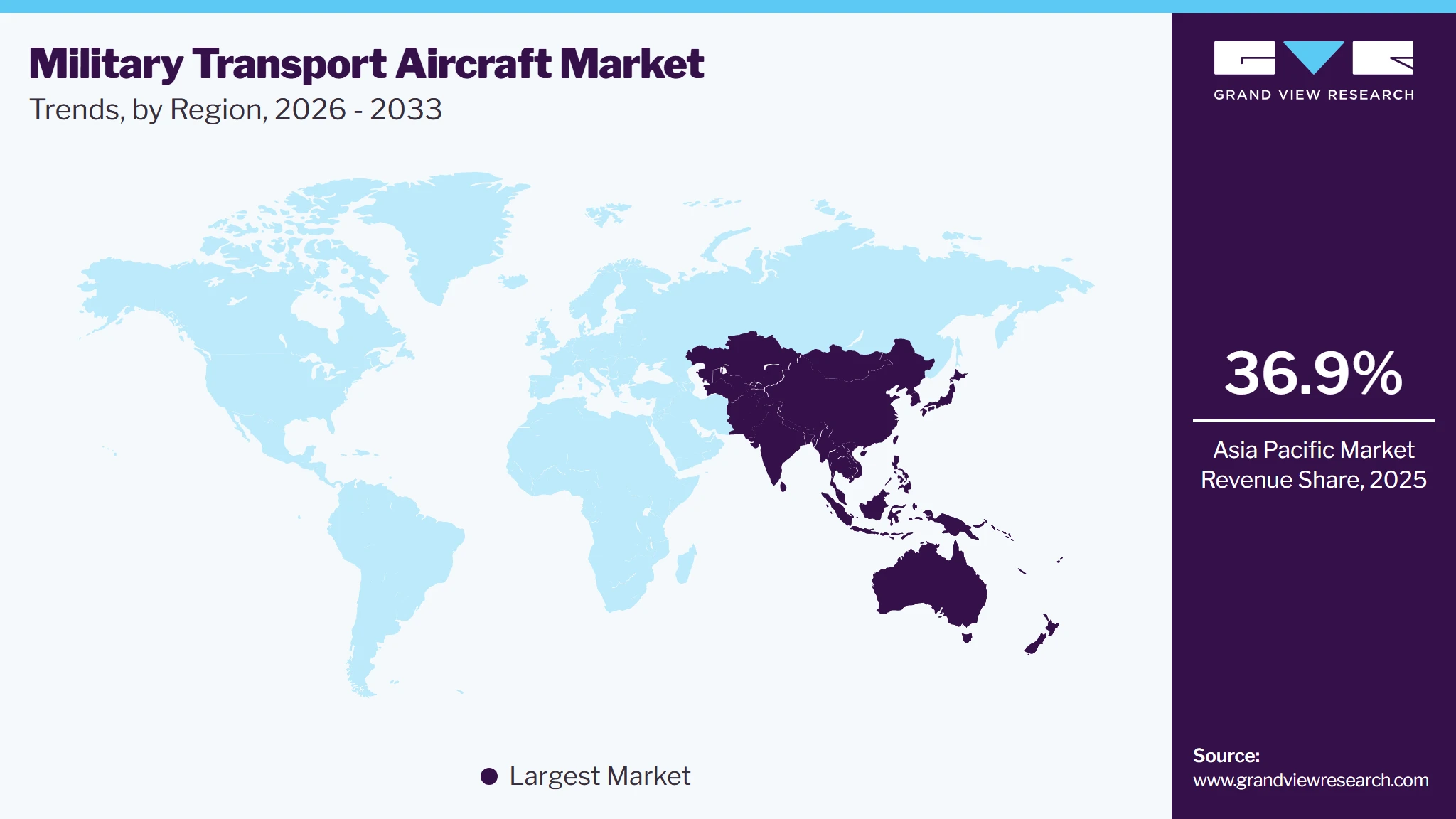
The Asia Pacific military transport aircraft industry dominated with a global revenue share of 36.9% in 2025, driven by increasing defense modernization, fleet expansion, and rising investments in strategic and tactical military mobility capabilities across China, India, Japan, South Korea, and Australia. Defense forces across the region are investing in fixed-wing transport aircraft, rotorcraft, high-payload platforms, advanced propulsion systems, modern avionics, secure communication systems, and mission technologies to strengthen troop deployment, military logistics, and rapid force projection capabilities.
 To learn more about this report, Download Free Sample Report
China Military Transport Aircraft Market Trends
The China military transport aircraft market is expanding due to increasing defense modernization, indigenous aircraft development, and rising demand for advanced strategic and tactical airlift capabilities. The country is investing in fixed-wing military transport aircraft, rotorcraft, advanced propulsion systems, avionics, secure communication systems, navigation technologies, and mission-support systems to strengthen troop deployment and military logistics.
North America Military Transport Aircraft Market Trends
The North America military transport aircraft market is witnessing steady growth, supported by continued investments in defense modernization, fleet replacement, and strategic airlift capabilities. The region, led by the United States, benefits from the presence of major aerospace and defense manufacturers, established military aviation infrastructure, and extensive transport aircraft fleets. Increasing investments in advanced fixed-wing transport aircraft, rotorcraft, high-payload platforms, modern propulsion systems, avionics, secure communication systems, and mission technologies are strengthening the region’s military transport capabilities.
The U.S. is witnessing strong growth in the North America military transport aircraft industry, supported by its extensive military transport aircraft fleet, advanced defense infrastructure, and continued investments in strategic and tactical air mobility capabilities. The country benefits from a strong ecosystem of aerospace and defense companies, aircraft manufacturers, propulsion suppliers, avionics providers, and MRO organizations, supporting the development, procurement, modernization, and lifecycle management of military transport platforms.
Europe Military Transport Aircraft Market Trends
The Europe military transport aircraft market is witnessing steady growth, driven by increasing defense modernization, fleet replacement programs, and rising investments in advanced military airlift capabilities. European defense forces are strengthening their strategic and tactical mobility capabilities through the procurement and modernization of fixed-wing transport aircraft, rotorcraft, advanced propulsion systems, avionics, secure communication systems, and mission technologies. Increasing requirements for rapid troop deployment, military logistics, humanitarian assistance, disaster relief, and multinational operations are further supporting demand for military transport aircraft.
The UK military transport aircraft market is witnessing steady growth, driven by increasing defense modernization, fleet enhancement, and investments in advanced military air mobility capabilities. The country is strengthening its military transport fleet through investments in fixed-wing transport aircraft, advanced avionics, secure communication systems, navigation technologies, propulsion systems, and mission-support technologies to improve strategic and tactical mobility.
The military transport aircraft market in Germany is experiencing significant growth, supported by increasing defense modernization, fleet renewal initiatives, and investments in advanced military mobility capabilities. Germany is strengthening its military transport capabilities through investments in fixed-wing transport aircraft, advanced avionics, secure communications, modern propulsion systems, navigation technologies, and mission-support systems to enhance strategic and tactical airlift operations.
Key Military Transport Aircraft Company Insights
The military transport aircraft market is characterized by the presence of established aerospace and defense companies with strong capabilities across aircraft design, manufacturing, propulsion, avionics, mission systems, and lifecycle support. Competition is driven by continuous innovation in strategic and tactical transport aircraft, advanced propulsion systems, avionics, secure communications, navigation systems, defensive technologies, cargo-handling systems, and digital aircraft technologies. Established players maintain strong market positions through extensive R&D capabilities, large-scale manufacturing expertise, long-standing relationships with defense ministries and armed forces, strategic partnerships, government contracts, fleet modernization programs, and comprehensive MRO and lifecycle-support capabilities.
-
Airbus SE is a major player in the military transport aircraft industry, offering military airlift platforms such as the A400M Atlas, which supports strategic and tactical transportation of troops, cargo, vehicles, and humanitarian supplies. The company continues to strengthen its position through investments in advanced aircraft systems, enhanced mission capabilities, fleet modernization, and lifecycle support.
-
The Boeing Company is a prominent military transport aircraft manufacturer, with platforms such as the C-17 Globemaster III supporting heavy strategic airlift, troop deployment, cargo transportation, and humanitarian missions. Boeing's strong position is supported by advanced aircraft technologies, global defense contracts, modernization programs, and extensive aftermarket and sustainment capabilities.
Key Military Transport Aircraft Companies
The following key companies have been profiled for this study of the military transport aircraft market.
-
Airbus SE
-
The Boeing Company
-
Lockheed Martin Corporation
-
Embraer S.A.
-
Leonardo S.p.A.
-
Kawasaki Heavy Industries, Ltd.
-
Textron Inc.
-
Israel Aerospace Industries Ltd.
-
Northrop Grumman Corporation
-
Hindustan Aeronautics Limited (HAL)
-
Aviation Industry Corporation of China (AVIC)
-
BAE Systems plc
-
Saab AB
-
Dassault Aviation
-
Thales Group
Competitive Benchmarking
Category
Operating Strategies
Competitive Edge
Weakness
Mature Players: Airbus SE; The Boeing Company; Lockheed Martin Corporation; Leonardo S.p.A.; Kawasaki Heavy Industries, Ltd.; Textron Inc.; Northrop Grumman Corporation; BAE Systems plc; Saab AB; Dassault Aviation; Thales Group
• Invest in next-generation military transport aircraft, advanced propulsion, avionics, secure communications, navigation, defensive systems, and mission technologies.
• Expand capabilities through government contracts, international defense partnerships, joint development programs, fleet modernization, and long-term MRO agreements.
• Strong aerospace and defense engineering capabilities.
• Extensive R&D and aircraft integration expertise.
• Established relationships with defense ministries and armed forces.
• High aircraft development and R&D costs.
• Long development, testing, qualification, and procurement cycles.
• Complex integration of advanced systems and technologies.
• Dependence on government defense budgets and procurement programs
Emerging Players: Embraer S.A.; Israel Aerospace Industries Ltd.; Hindustan Aeronautics Limited (HAL); Aviation Industry Corporation of China (AVIC)
• Focus on developing and expanding indigenous military transport aircraft and multi-mission platforms.
• Invest in advanced avionics, propulsion, digital aircraft systems, mission technologies, and aircraft modernization.
• Strong domestic government support and defense relationships.
• Growing indigenous aircraft-development capabilities.
• Competitive cost structures in selected platforms.
• Smaller global installed base compared with leading Western OEMs.
• More limited international support and MRO networks in some markets.
• Dependence on government programs and domestic procurement cycles.
Recent Developments
-
In June 2026, Airbus Defence and Space signed a contract with OCCAR, on behalf of the French Directorate General of Armaments, to develop new ISR capabilities for the A400M. The upgrade will integrate a new mission system, tactical situational-awareness consoles, additional sensors and communication systems, and an optronic sensor, expanding the A400M’s role beyond conventional troop and cargo transport toward multi-mission ISR and tactical command-and-control operations.
-
In May 2026, Embraer signed an MoU with Hellenic Aerospace Industry to strengthen strategic cooperation and develop sustainment capabilities for the C-390 Millennium in Greece. The agreement is intended to establish greater operational and support autonomy for the Hellenic Air Force and strengthen local MRO capabilities for its future C-390 fleet, supporting long-term fleet readiness and lifecycle management.
Military Transport Aircraft Market Report Scope
Report Attribute
Details
Market size in 2025
USD 7.1 billion
Estimated market size in 2026
USD 7.4 billion
Projected market size by 2033
USD 9.7 billion
Growth rate
CAGR of 4.0% from 2026 to 2033
Actual data
2021 - 2025
Forecast period
2026 - 2033
Quantitative units
Revenue in USD Million and CAGR from 2026 to 2033
Report coverage
Revenue forecast, company ranking, competitive landscape, growth factors, and trends
Segments covered
Aircraft type, propulsion, application, end-user, region
Regional scope
North America; Europe; Asia Pacific; Latin America; MEA
Country scope
U.S.; Canada; Mexico; Germany; UK; France; China; India; Japan; Australia; South Korea; Brazil; UAE; South Africa; KSA
Key companies profiled
Airbus SE; The Boeing Company; Lockheed Martin Corporation; Embraer S.A.; Leonardo S.p.A.; Kawasaki Heavy Industries, Ltd.; Textron Inc.; Israel Aerospace Industries Ltd.; Northrop Grumman Corporation; Hindustan Aeronautics Limited (HAL); Aviation Industry Corporation of China (AVIC); BAE Systems plc; Saab AB; Dassault Aviation; Thales Group
Customization scope
Free report customization (equivalent up to 8 analysts working days) with purchase. Addition or alteration to country, regional & segment scope.
Pricing and purchase options
Avail customized purchase options to meet your exact research needs. Explore purchase options
Global Military Transport Aircraft Market Report Segmentation
This report forecasts revenue growth at the global, regional, and country levels and provides an analysis of the latest industry trends in each of the sub-segments from 2021 to 2033. For this study, Grand View Research has segmented the global military transport aircraft market report based on aircraft type, propulsion, application, end-user, and region:
-
Aircraft Type Outlook (Revenue, USD Million, 2021 - 2033)
-
Fixed-wing Aircraft
-
Rotorcraft
-
-
Propulsion Outlook (Revenue, USD Million, 2021 - 2033)
-
Turbofan
-
Turboprop
-
Turboshaft
-
-
Application Outlook (Revenue, USD Million, 2021 - 2033)
-
Troop and Cargo Airlifting
-
Humanitarian and Disaster Relief
-
Special Missions
-
-
End-user Outlook (Revenue, USD Million, 2021 - 2033)
-
Air Force
-
Army Aviation
-
Naval/Marine Corps Aviation
-
Special Operations
-
Paramilitary and Coast Guard
-
-
Regional Outlook (Revenue, USD Million, 2021 - 2033)
-
North America
-
U.S.
-
Canada
-
Mexico
-
-
Europe
-
UK
-
Germany
-
France
-
-
Asia Pacific
-
China
-
Japan
-
India
-
Australia
-
South Korea
-
-
Latin America
-
Brazil
-
-
Middle East and Africa (MEA)
-
KSA
-
UAE
-
South Africa
-
-
Research Methodology
The military transport aircraft market figures in this report are based on a proven research process that combines executive interviews with secondary research from proprietary databases, company filings, and recognized regulatory and institutional sources. Market size is built through value-chain sizing-reconciling supply-side and demand-side estimates-and triangulated with bottom-up and top-down approaches. Every estimate passes multiple levels of expert validation before publication, with each military transport aircraft segment quantified using the revenue-capture definitions in the table below.
Segment Definition
Segment - Aircraft Type
Revenue capture definition
Fixed-wing Aircraft
Revenue in the Fixed-wing Aircraft segment is generated through the sale and delivery of military fixed-wing transport aircraft designed to transport personnel, military equipment, vehicles, ammunition, and other cargo. These aircraft include strategic and tactical airlifters, medium- and heavy-lift transport aircraft, and multi-role fixed-wing platforms used for troop and cargo airlifting, military logistics, humanitarian assistance, disaster relief, medical evacuation, and special mission
Rotorcraft
Revenue in the Rotorcraft segment is generated through the sale and delivery of military rotorcraft designed to provide troop transportation, tactical cargo movement, medical evacuation, search and rescue, special operations, and logistical support. These platforms primarily include military transport helicopters, medium- and heavy-lift helicopters, and other rotary-wing transport platforms equipped with turboshaft propulsion, advanced avionics, navigation systems, secure communications, mission systems, and cargo-handling capabilities
Segment - Propulsion
Revenue capture definition
Turbofan
Revenue in the Turbofan segment is generated through the sale and delivery of military transport aircraft powered by turbofan engines, primarily used for strategic and tactical airlift, troop transportation, cargo movement, rapid military deployment, and long-range logistics operations. Turbofan-powered transport aircraft are characterized by high thrust, extended range, high payload capacity, and efficient high-speed flight, making them suitable for medium- and heavy-duty military airlift missions
Turboprop
Revenue in the Turboprop segment is generated through the sale and delivery of military transport aircraft powered by turboprop engines, primarily used for tactical troop transportation, cargo airlifting, military logistics, medical evacuation, and short- to medium-range transport missions. Turboprop-powered aircraft are well suited for operations requiring high fuel efficiency, strong low-speed performance, short takeoff and landing capabilities, and access to semi-prepared or austere runways
Turboshaft
Revenue in the Turboshaft segment is generated through the sale and delivery of military transport rotorcraft powered by turboshaft engines, primarily used for troop transportation, tactical cargo movement, medical evacuation, search and rescue, special operations, and battlefield logistics. Turboshaft propulsion enables rotorcraft to deliver the high power-to-weight ratio required for vertical take-off and landing, hovering, rapid maneuvering, and operations in remote or austere environments.
Segment - Application
Revenue capture definition
Troop and Cargo Airlifting
Revenue in the Troop and Cargo Airlifting segment is generated through the sale and delivery of military transport aircraft and associated systems designed to transport military personnel, equipment, vehicles, ammunition, supplies, and other cargo. These platforms support strategic and tactical airlift missions, including rapid troop deployment, military resupply, logistical transportation, airborne operations, and force projection.
Humanitarian and Disaster Relief
Revenue in the Humanitarian and Disaster Relief segment is generated through the sale and delivery of military transport aircraft and associated systems used to support emergency response, disaster relief, humanitarian assistance, evacuation, and delivery of essential supplies. These aircraft enable the rapid transportation of relief personnel, medical teams, food, water, medicines, rescue equipment, and other critical supplies to areas affected by natural disasters, conflicts, and humanitarian emergencies.
Special Missions
Revenue in the Special Missions segment is generated through the sale and delivery of military transport aircraft and associated systems configured to support specialized missions, including medical evacuation (MEDEVAC), search and rescue (SAR), personnel recovery, VIP transport, special operations, and tactical support. These platforms are equipped with specialized mission systems, secure communications, advanced navigation, surveillance and sensing equipment, medical facilities, flexible cabin configurations, and defensive technologies to support operations in complex and high-risk environments.
Segment - End User
Revenue capture definition
Air Force
Revenue in the Air Force segment is generated through the procurement, sale, and delivery of military transport aircraft and associated systems operated by national air forces for strategic and tactical airlift, troop deployment, cargo transportation, military logistics, and rapid force projection. These platforms support the movement of personnel, vehicles, equipment, ammunition, and essential supplies across domestic and international operational areas.
Army Aviation
Revenue in the Army Aviation segment is generated through the procurement, sale, and delivery of military transport aircraft and associated systems operated by army aviation units for tactical troop movement, battlefield logistics, cargo transportation, medical evacuation, resupply, and personnel recovery. These platforms enable the rapid movement of soldiers, weapons, ammunition, vehicles, equipment, and essential supplies to and from operational areas, including remote and austere environments
Naval/Marine Corps Aviation
Revenue in the Naval/Marine Corps Aviation segment is generated through the procurement, sale, and delivery of military transport aircraft and associated systems operated by naval and Marine Corps aviation units for troop transportation, logistical support, equipment movement, medical evacuation, search and rescue, and amphibious operations.
Special Operations
Revenue in the Special Operations segment is generated through the procurement, sale, and delivery of military transport aircraft and associated systems specifically configured to support special forces deployment, tactical insertion and extraction, personnel recovery, covert mobility, medical evacuation, and specialized resupply missions
Paramilitary and Coast Guard
Revenue in the Paramilitary and Coast Guard segment is generated through the procurement, sale, and delivery of military transport aircraft and associated systems operated by paramilitary organizations and coast guard agencies for personnel transportation, logistical support, maritime patrol support, search and rescue, medical evacuation, disaster response, and emergency operations
Estimation Model
Layer Name
Key Question
Description
Addressable Military Transport Aircraft Base Layer
Which military transport aircraft are in operation or require transport capabilities?
Estimate the global installed fleet and annual procurement/deliveries of fixed-wing military transport aircraft and rotorcraft used for troop and cargo airlifting, humanitarian and disaster relief, special missions, and military logistics. The assessment considers aircraft type, payload capacity, fleet age, replacement cycles, operational requirements, defense budgets, and regional military mobility needs.
Military Transport Aircraft Adoption Layer
Which types of military transport aircraft and mission capabilities are deployed?
Apply adoption and deployment rates across fixed-wing aircraft and rotorcraft, considering strategic and tactical airlift requirements, troop and cargo transportation, humanitarian missions, special operations, medical evacuation, search and rescue, and other military transport applications.
Aircraft Content & Configuration Layer
What aircraft systems and capabilities are incorporated into each military transport platform?
Estimate the aircraft value based on the integration and configuration of airframes, propulsion systems, avionics, navigation systems, secure communication systems, cargo-handling systems, mission systems, defensive systems, and other onboard equipment.
Revenue Generation Layer
How is revenue generated from military transport aircraft?
Estimate market revenue from new aircraft procurement, aircraft upgrades and modernization, MRO and lifecycle support, spare parts, mission-system integration, and related services.
Regional & End-User Allocation Layer
Where are military transport aircraft investments concentrated?
Allocate the estimated market value across North America, Europe, Asia-Pacific, Middle East & Africa, and Latin America, considering defense expenditure, military transport fleet size, aircraft procurement programs, fleet modernization, geopolitical requirements, and strategic mobility priorities.
Delivered Customizations
This report has been delivered with the following In-depth customizations
Client Request
Customization Delivered
Value Adds
Military Transport Aircraft Market Entry & Growth Strategy
• Assessment of demand for military transport aircraft across strategic and tactical airlift, troop and cargo transportation, humanitarian and disaster relief, and special missions.
• Analysis of opportunities across fixed-wing aircraft, rotorcraft, turbofan, turboprop, and turboshaft platforms.
• Identified high-growth aircraft types, applications, propulsion technologies, end-user segments, and geographic markets.
• Supported market entry, product positioning, customer targeting, partnership identification, and long-term expansion strategies.
• Highlighted opportunities across new aircraft procurement, fleet modernization, MRO, and lifecycle support.Next-Generation Military Transport Aircraft & Capability Assessment
• Evaluation of capability requirements across Air Force, Army Aviation, Naval/Marine Corps Aviation, Special Operations, and Paramilitary & Coast Guard applications.
• Assessment of next-generation requirements related to payload, range, fuel efficiency, survivability, interoperability, and multi-mission capabilities.
• Identified technology gaps and high-potential innovation areas within the military transport aircraft ecosystem.
• Supported technology roadmap development, R&D prioritization, aircraft capability enhancement, and next-generation platform strategies.Frequently Asked Questions About This Report
The global military transport aircraft Market size was valued at USD 7.1 billion in 2025 and is estimated at USD 7.4 billion in 2026
Asia Pacific dominated the market with a revenue share of 36.9% in 2025.
The global military transport aircraft is expected to grow at a CAGR of 4.0% from 2026 to 2033 to reach USD 9.7 billion by 2033.
The air force segment dominated the military transport aircraft market with a 48.2% revenue share in 2025, while special operations segment is the fastest growing end-user.
Key factors driving the Military Transport Aircraft Market include increasing defense spending and military modernization programs, rising demand for strategic and tactical airlift capabilities, replacement of aging transport aircraft fleets, growing requirements for rapid troop and cargo deployment, increasing adoption of advanced propulsion and avionics technologies, and rising demand for multi-mission aircraft supporting humanitarian relief, medical evacuation, special operations, and disaster response missions worldwide.
Some key players operating in the Military Transport Aircraft Market include Airbus SE; The Boeing Company; Lockheed Martin Corporation; Embraer S.A.; Leonardo S.p.A.; Kawasaki Heavy Industries, Ltd.; Textron Inc.; Israel Aerospace Industries Ltd.; Northrop Grumman Corporation; Hindustan Aeronautics Limited (HAL); Aviation Industry Corporation of China (AVIC); BAE Systems plc; Saab AB; Dassault Aviation; and Thales Group.
The turbofan segment dominated the market accounting for a revenue share of 53.0% in 2025, while turboprop is the fastest growing segment.
Fixed-wing aircraft leads the market with revenue share of 62.8% in 2025 & is the fastest growing segment in the market.
Troop and cargo airlifting leads the market with revenue share of 46.7% in 2025 & is the fastest growing segment in the market
About the Author(s)
Next Generation Technologies Research Team
Technology · Next Generation TechnologiesThis report was authored by the next generation technologies research team at Grand View Research - comprising two research analysts, one senior research analyst, and one industry expert - with specialized expertise in the next generation technologies segment of the technology industry. All findings are based on proprietary technology databases, executive interviews, and regulatory analysis, subject to internal peer review prior to publication.
Last Updated:
Speak to Analyst

Customize this report to your needs - add regions, segments, or data points, with 20% free customization.
Or view our licence options:


ISO 9001:2015 & 27001:2022 Certified
We are GDPR and CCPA compliant! Your transaction & personal information is safe and secure. For more details, please read our privacy policy.


