
- Home
- »
- Plastics Polymers & Resins
- »
-
Milk Packaging Market Size & Share Report, 2026-2033GVR Report cover
![Milk Packaging Market (2026 - 2033)Report]()
Milk Packaging Market (2026 - 2033)
Size, Share & Trends Analysis Report By Material (Plastic, Metal, Paper & Paperboard, Glass), By Packaging Type (Cartons, Plastic Bottles, Pouches, Cans), By Milk Type, By Region, And Segment Forecasts
Market Size, 2025
$39.9BMarket Estimate, 2026
$43.6BMarket Forecast, 2033
$86.5BCAGR, 2026–2033
10.3%Milk Packaging Market Summary
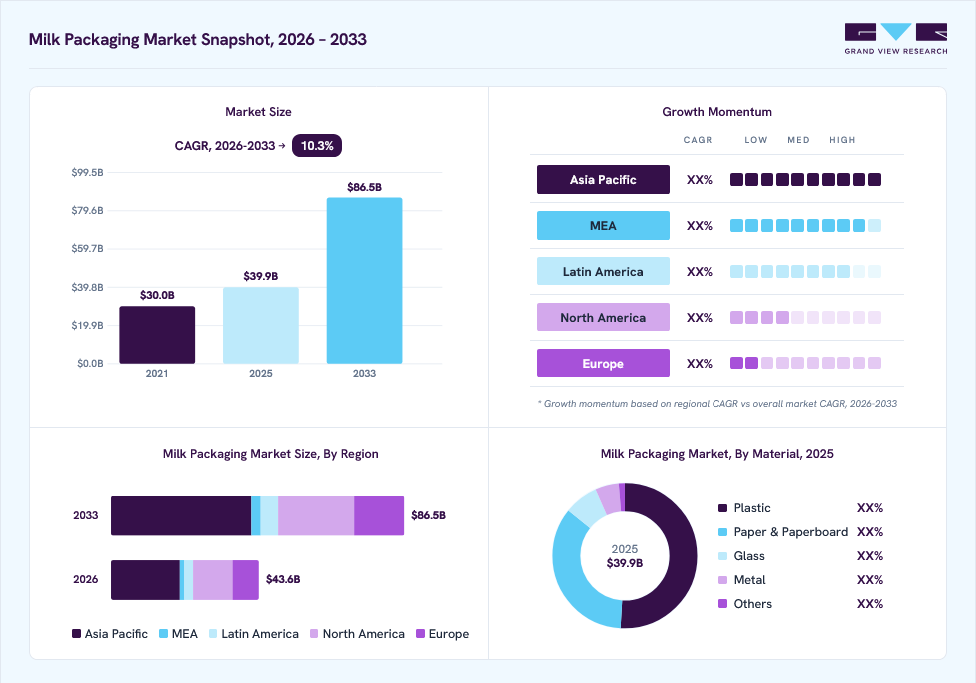
The global milk packaging market size was valued at USD 39.9 billion in 2025 and is projected to grow from USD 43.6 billion in 2026 to USD 86.5 billion by 2033, at a CAGR of 10.3% from 2026 to 2033. Asia Pacific dominated the market, accounting for the highest revenue share of 46.3% in 2025. The market is primarily driven by rising milk consumption, expansion of the dairy processing industry, increasing demand for hygienic and extended-shelf-life packaging, and growing adoption of aseptic cartons, HDPE/PET bottles, and flexible pouches.
Key Market Trends & Insights
- By milk type: Fresh/pasteurized milk segment led the milk packaging market with the largest revenue share of 55.7% in 2025.
- By material: Paper plastic segment led the milk packaging market with the largest revenue share of 50.9% in 2025.
- By packaging type: Cartons segment led the milk packaging market with the largest revenue share of 42.9% in 2025.
Regional Highlights
- Largest regional market: Asia Pacific (46.3% revenue share, 2025)
- Fastest-growing regional market: Asia Pacific (highest CAGR, 2026-2033)
- By county: China held the largest market share in 2025
Market Size & Forecast
- Market Size in 2025: USD 39.87 Billion
- Estimated market size in 2026: USD 43.2 Billion
- Projected Market Size by 2033: USD 86.53 Billion
- CAGR (2026-2033): 10.3%
Rising urbanization, organized retail, cold-chain development, and demand for convenient packaged milk further support market growth. Asia Pacific dominated with a 46.3% revenue share in 2025, supported by its large consumer base and expanding packaged dairy sector.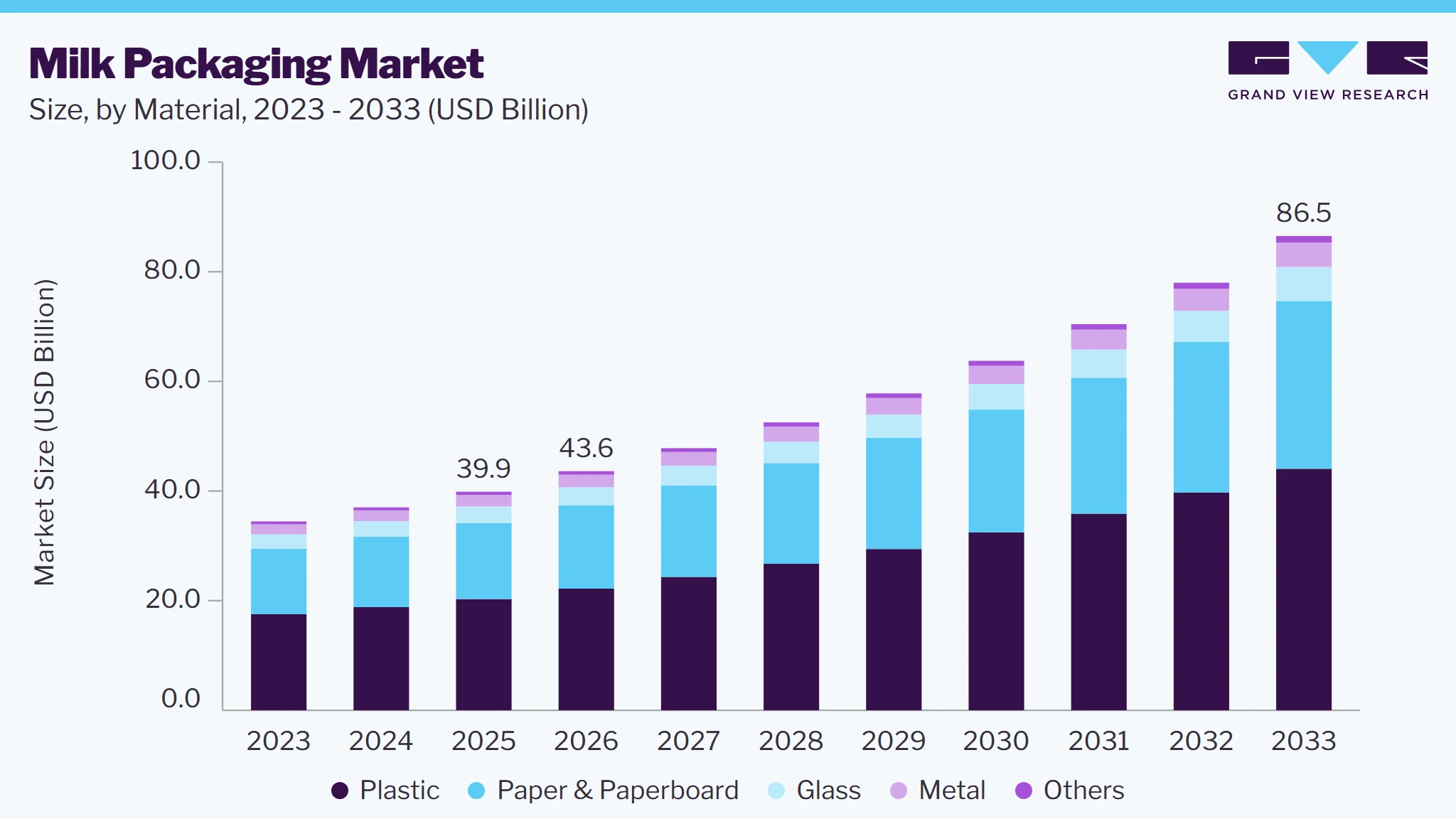
The milk packaging market is driven by the rising consumption of packaged milk and the continued expansion of the global dairy processing industry. As dairy producers increasingly focus on maintaining product quality, extending shelf life, and improving distribution efficiency, there is growing demand for packaging formats that provide strong barrier protection, leak resistance, hygiene, and convenient handling. Plastic packaging accounted for the largest share of the market, reaching USD 20.3 billion in 2025, supported by the widespread use of HDPE and PET bottles due to their lightweight construction, durability, cost efficiency, and suitability for fresh and processed milk. At the same time, paper and paperboard packaging is gaining traction as dairy companies adopt carton formats that support efficient transportation, branding, and improved sustainability performance.
An increasing focus on food safety, extended shelf life, and convenient milk consumption is expected to boost market growth in the coming years. Fresh and pasteurized milk represented the largest milk-type segment, accounting for 55.7% of the market in 2025, while UHT and aseptic milk is expanding steadily due to its longer shelf life and reduced dependence on continuous refrigeration during distribution. Packaging formats such as cartons, plastic bottles, and pouches are increasingly being adopted across retail and foodservice channels to protect milk from contamination, light, moisture, and oxygen while providing convenient storage and dispensing. The growing penetration of modern retail, urban lifestyles, and packaged dairy products is further encouraging dairy manufacturers to invest in efficient primary packaging solutions.
Sustainability initiatives and the transition toward circular economy packaging systems are also significantly contributing to market development. A defining trend in the Milk Packaging industry is the increasing shift toward recyclable materials, lightweight packaging structures, recycled plastics, and paperboard-based cartons as manufacturers seek to reduce material consumption and packaging waste. Paper and paperboard packaging is projected to grow at a CAGR of 10.5% from 2026 to 2033, supported by increasing demand for fiber-based and recyclable packaging alternatives. Similarly, the adoption of lightweight PET and HDPE containers with improved recyclability is helping dairy producers reduce packaging material usage and transportation-related emissions while maintaining the required protection and shelf-life performance.
Market Dynamics
The Milk Packaging market is witnessing strong growth, driven by increasing consumption of packaged milk, expansion of the dairy processing industry, rising demand for hygienic and extended-shelf-life packaging, and growing adoption of convenient packaging formats. Manufacturers are increasingly focusing on lightweight, recyclable, and high-barrier packaging solutions to preserve milk quality and meet evolving food safety and sustainability requirements. In addition, the expansion of organized retail, cold-chain infrastructure, and UHT and flavored milk products is supporting market expansion, while environmental concerns related to plastic packaging are encouraging the development of recyclable and fiber-based alternatives.
The increasing consumption of packaged milk worldwide is a key driver of the Milk Packaging market. Population growth, urbanization, rising disposable incomes, and growing consumer preference for hygienically packed dairy products are increasing demand for fresh, pasteurized, UHT, and flavored milk. The expansion of organized retail, supermarkets, convenience stores, and modern dairy distribution networks is further increasing the requirement for reliable primary packaging that protects milk from contamination and maintains product quality throughout distribution.
Dairy manufacturers are also expanding their product portfolios and investing in efficient packaging formats to improve shelf life, convenience, and transportation efficiency. The growing adoption of cartons, plastic bottles, and pouches, along with increasing demand for aseptic packaging for UHT milk, is creating sustained demand for milk packaging solutions. In addition, improvements in packaging materials, lightweight designs, closures, and barrier technologies are helping manufacturers reduce material consumption while maintaining the required protection and shelf-life performance. Restraint - Environmental Concerns and Regulations on Plastic Packaging
A significant restraint for the Milk Packaging market is the growing concern over plastic waste and stringent regulations aimed at reducing single-use plastics and packaging waste. Increasing requirements for recyclability, recycled content, and sustainable materials can raise compliance and production costs for manufacturers. In addition, the recycling challenges associated with multilayer cartons, pouches, and composite structures may limit material recovery and create pressure on dairy companies to invest in alternative packaging solutions.
A major opportunity for the Milk Packaging market lies in the growing adoption of sustainable and recyclable packaging solutions, including recycled PET and HDPE, lightweight bottles, recyclable cartons, and responsibly sourced paperboard. Rising environmental awareness and circular economy initiatives are encouraging dairy manufacturers to reduce material consumption and improve packaging recyclability. The increasing share and growth of paper and paperboard packaging, which is projected to reach USD 30.6 billion by 2033, further creates opportunities for manufacturers offering fiber-based and environmentally preferable milk packaging solutions.
Market Concentration & Characteristics
The Milk Packaging market is characterized by high-volume production, strong demand for cost-efficient packaging, and the need to maintain milk quality, hygiene, and shelf life throughout the distribution process. The industry relies on economies of scale, particularly in the production of plastic bottles, paperboard cartons, pouches, closures, and aseptic packaging formats. Manufacturers prioritize lightweighting, automation, efficient filling technologies, and bulk procurement of materials such as HDPE, PET, paperboard, aluminum foil, and polymers to optimize production costs. As milk is a frequently consumed dairy product, packaging design focuses on leak resistance, barrier protection, convenience, durability, and efficient transportation. Leading companies have developed specialized packaging solutions for fresh, pasteurized, UHT, flavored, and other liquid milk products.
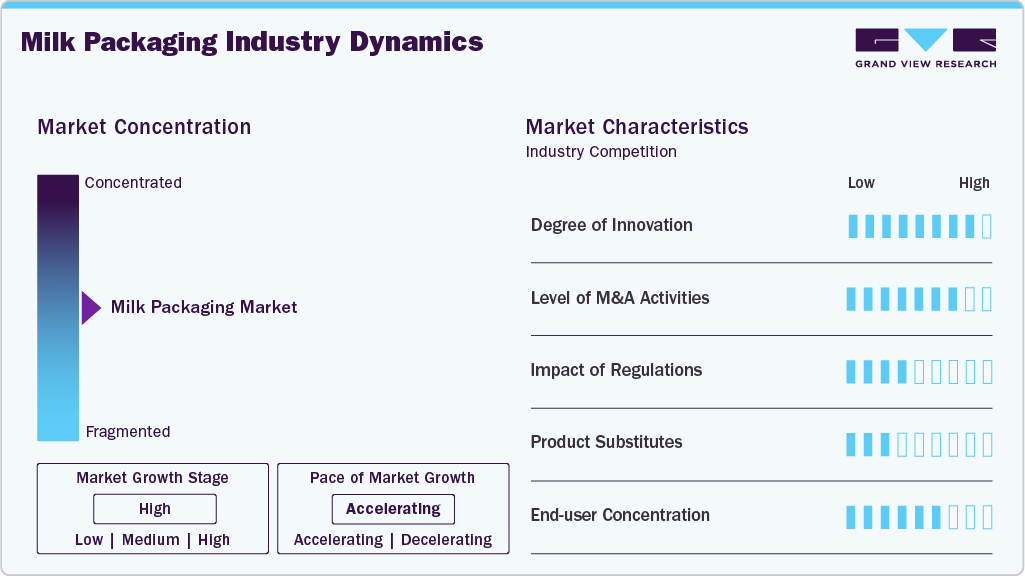
A defining feature of the industry is its reliance on plastic and paper-based packaging materials, supported by their availability, processing efficiency, protective properties, and suitability for different milk distribution requirements. However, increasing environmental awareness and packaging regulations are encouraging manufacturers to shift toward recyclable, lightweight, and recycled-content materials. Innovations in recycled plastics, fiber-based cartons, recyclable aseptic structures, and reduced-material packaging formats are gaining traction as dairy companies seek to reduce packaging waste and improve sustainability performance. At the same time, the growing demand for extended-shelf-life and aseptic milk is supporting investment in high-barrier packaging technologies that protect products from contamination and maintain quality throughout distribution.
Analyst Perspective
The global milk packaging market has progressed from traditional glass and rigid plastic containers toward cartons, pouches, aseptic packs, and lightweight packaging formats that improve product protection, convenience, and distribution efficiency. Market growth is supported by increasing milk consumption, urbanization, changing consumer lifestyles, and the rising adoption of UHT and flavored milk products. Currently, manufacturers are placing greater emphasis on recyclable materials, lightweighting, improved barrier properties, and packaging designs that extend shelf life while reducing material usage. Looking ahead, continued innovation in sustainable packaging, aseptic technologies, and efficient packaging formats is expected to support steady market expansion through 2033, particularly as dairy producers seek solutions that balance product quality, cost efficiency, convenience, and environmental performance.
Material Insights
Based on material, the plastic segment led the milk packaging market with the largest revenue share of 50.9% in 2025. Plastic is widely used in milk packaging, particularly in HDPE and PET bottles, due to its lightweight nature, durability, cost-effectiveness, and suitability for fresh, pasteurized, and flavored milk. Plastic packaging provides good resistance to moisture and physical damage while supporting efficient filling, storage, transportation, and dispensing. Its scalability, relatively low production cost, and compatibility with modern recycling systems continue to support its widespread adoption across dairy supply chains.
The Paper & Paperboard segment is expected to grow at the fastest CAGR of 10.5% during the forecast period. Paperboard-based cartons are increasingly adopted for fresh, UHT, and aseptic milk due to their lightweight construction, efficient use of storage and transportation space, printability, and growing sustainability appeal. The segment is benefiting from increasing demand for recyclable and fiber-based packaging, along with investments in improved barrier coatings and carton structures that provide the required protection against moisture, oxygen, and light.
Packaging Type Insights
Based on packaging type, the cartons segment led the milk packaging market with the largest revenue share of 42.9% in 2025. Cartons are extensively used for fresh, UHT, and aseptic milk because of their lightweight structure, efficient storage, convenient handling, and strong product protection. Their ability to incorporate high-barrier layers and closures helps preserve milk quality and extend shelf life, while their large printable surface supports product differentiation and brand visibility. Growing consumer preference for convenient and sustainable dairy packaging is further strengthening the position of cartons in the market.
The Pouches segment is expected to grow at the fastest CAGR of 11.0% during the forecast period. Pouches are increasingly adopted for milk packaging because they require relatively less packaging material, offer lightweight and flexible structures, and reduce storage and transportation requirements. Their cost efficiency makes them particularly attractive for high-volume milk distribution, while improvements in multilayer films, sealing technologies, and barrier performance are enhancing product protection. Rising demand for affordable, convenient, and lightweight milk packaging is expected to support the rapid expansion of pouches.
Milk Type Insights
Based on milk type, the fresh/pasteurized milk segment led the milk packaging market with the largest revenue share of 55.7% in 2025. Fresh and pasteurized milk represents the largest packaged milk category due to its widespread household consumption and established distribution through supermarkets, convenience stores, and other retail channels. Packaging for this segment requires strong hygiene, leak protection, light and oxygen resistance, and reliable cold-chain compatibility to maintain product freshness and quality.
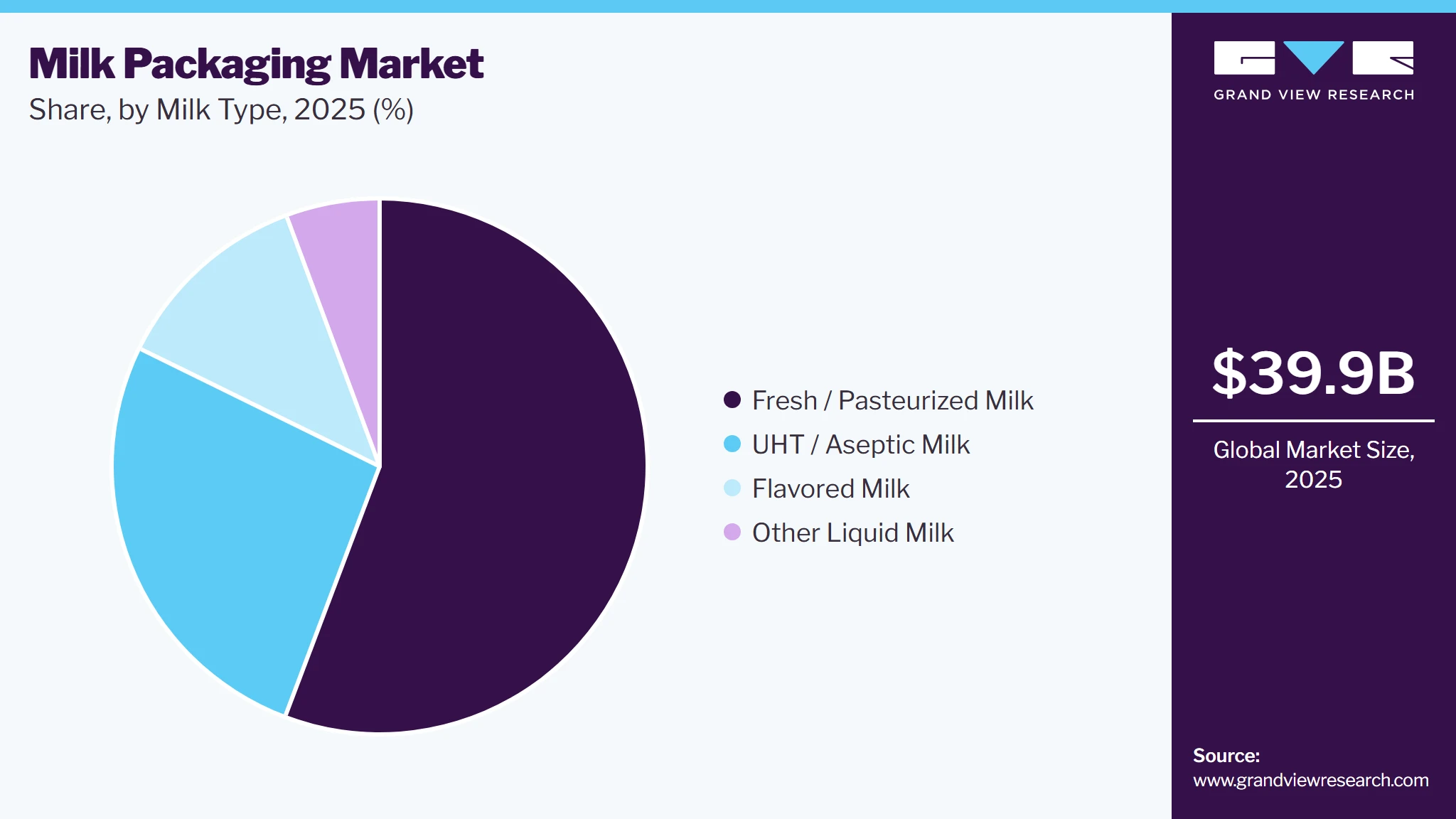
The flavored milk segment is expected to grow at the fastest CAGR of 10.9% during the forecast period. Rising consumer interest in convenient and ready-to-consume dairy beverages, particularly among younger consumers, is supporting demand for flavored milk products. Manufacturers are increasingly using attractive, portable, and easy-to-handle packaging formats to improve product appeal and support on-the-go consumption. Growing product innovation across chocolate, vanilla, fruit, and other flavored milk varieties is expected to further drive demand for specialized packaging solutions.
Regional Insights
The Asia Pacific milk packaging market dominated globally, accounting for the highest revenue share of 46.3% in 2025, and is projected to register the fastest CAGR of 10.7% during 2026-2033. Regional growth is supported by the large consumer base, increasing milk consumption, rapid urbanization, and expansion of organized retail and dairy processing industries. Rising adoption of packaged fresh, UHT, and flavored milk, along with investments in modern cold-chain and distribution infrastructure, is strengthening demand for efficient and hygienic packaging solutions across the region.

China milk packaging market represents a major share of the Asia Pacific market, supported by its large dairy consumption base, expanding processed milk industry, and growing penetration of packaged dairy products. Increasing urbanization and the development of modern retail and cold-chain infrastructure are encouraging dairy producers to adopt efficient cartons, plastic bottles, and flexible packaging formats.
India milk packaging market is expected to witness strong growth during the forecast period, driven by rising packaged milk consumption, expanding dairy processing capacity, increasing disposable incomes, and rapid urbanization. Growing demand for convenient, hygienic, and affordable milk packaging, particularly cartons, plastic bottles, and pouches, is expected to create significant opportunities for packaging manufacturers.
North America Milk Packaging Market Trends
The North America milk packaging market is expected to grow steadily during the forecast period, supported by established dairy processing capabilities, strong packaged milk consumption, and widespread refrigerated distribution networks. Increasing demand for convenient packaging, extended-shelf-life products, and lightweight containers is encouraging manufacturers to improve packaging efficiency. Sustainability initiatives and growing adoption of recyclable materials are also influencing packaging development across the region.
U.S. milk packaging market accounts for a significant share of the North American market due to its large-scale dairy processing industry and highly developed retail and distribution infrastructure. Demand for cartons, HDPE bottles, and flexible packaging is supported by widespread milk consumption and the growing availability of UHT, flavored, and value-added dairy products. Increasing focus on recyclable and lightweight packaging is also shaping market development.
Europe Milk Packaging Market Trends
The Europe Milk Packaging market is projected to experience consistent growth, driven by its mature dairy industry, established retail networks, and strong emphasis on food safety and packaging sustainability. Increasing adoption of recyclable cartons, lightweight plastic containers, and reduced-material packaging is supporting market development. Circular economy initiatives and environmental regulations are further encouraging dairy companies to improve packaging recyclability and resource efficiency.
Germany Milk Packaging market represents an important share of the European market, supported by its advanced dairy processing industry, developed retail infrastructure, and strong emphasis on sustainable packaging. Demand for recyclable cartons, lightweight bottles, and efficient packaging formats is expected to support continued market growth.
The UK milk packaging market is expected to grow steadily, driven by established dairy consumption, widespread supermarket distribution, and increasing demand for convenient and environmentally responsible packaging. Dairy producers are increasingly focusing on recyclable materials, lightweight structures, and packaging formats that support improved resource efficiency.
Latin America Milk Packaging Market Trends
The Latin America milk packaging market is expected to expand steadily, supported by increasing packaged dairy consumption, urbanization, and improvements in modern retail and food distribution infrastructure. Growing investment in dairy processing is increasing demand for affordable, durable, and hygienic packaging formats. Flexible pouches, plastic bottles, and cartons are gaining importance across both traditional and organized retail channels.
Brazil milk packaging market represents a significant share of the Latin American market due to its large dairy industry, expanding processed milk consumption, and developing modern retail sector. Increasing demand for cost-efficient and convenient packaging, combined with investments in dairy processing and distribution, is expected to support future market growth.
Argentina milk packaging market is expected to witness steady growth, driven by its established dairy production base and demand for packaged fresh and processed milk. Increasing modernization of dairy processing and distribution channels is supporting the adoption of efficient cartons, plastic bottles, and flexible packaging.
Middle East & Africa Milk Packaging Market Trends
The Middle East & Africa milk packaging market is projected to register strong growth during the forecast period, supported by increasing urbanization, expanding dairy production, and rising consumption of packaged and shelf-stable milk. Growing demand for UHT products is creating opportunities for aseptic cartons and other extended-shelf-life packaging formats, while improvements in food retail and distribution infrastructure are strengthening regional demand.
Key Milk Packaging Company Insights
Some key companies in the milk packaging market include Tetra Pak, SIG, NIPPON PAPER INDUSTRIES CO., LTD., ELOPAK, Mondi, Nampak Ltd., Novolex, Stora Enso, Stanpac Inc., IPI S.r.l., Greatview, Parksons Packaging Ltd., and UFlex Limited. The market is characterized by strong competition in aseptic cartons, liquid packaging solutions, flexible packaging, paper-based formats, and recyclable materials. Leading participants are focusing on extending milk shelf life, improving packaging efficiency, reducing material consumption, and developing recyclable and renewable packaging solutions to meet the evolving requirements of dairy producers and consumers.
-
Tetra Pak is a major dairy packaging solutions provider offering integrated packaging, processing, and distribution systems for milk and other liquid dairy products. Its portfolio includes carton packaging solutions designed for fresh, chilled, UHT, and extended shelf-life milk, with emphasis on product protection, efficient filling, and sustainable material use.
-
SIG provides aseptic and flexible packaging systems for dairy and liquid food applications. The company focuses on carton formats that enable extended shelf life without refrigeration, while incorporating lightweight structures, renewable materials, and recycling-oriented packaging designs for milk producers.
Key Milk Packaging Companies
The following key companies have been profiled for this study on the milk packaging market:
-
Tetra Pak
-
SIG
-
NIPPON PAPER INDUSTRIES CO., LTD.
-
ELOPAK
-
Mondi
-
Nampak Ltd.
-
Novolex
-
Stora Enso
-
Stanpac Inc
-
IPI S.r.l.
-
Greatview
-
Parksons Packaging Ltd.
-
UFlex Limited
Company Categorization
Category
Operating Strategies
Competitive Edge
Weakness
Established Players (Tetra Pak; SIG; NIPPON PAPER INDUSTRIES CO., LTD.; ELOPAK; Mondi; Stora Enso; Novolex)
Focus on expanding milk packaging portfolios through aseptic cartons, paper-based packaging, flexible formats, barrier technologies, lightweighting, and recyclable material solutions. These companies invest in packaging innovation, filling technologies, renewable materials, recycling initiatives, and long-term partnerships with dairy producers to address shelf-life, product protection, convenience, and sustainability requirements.
Strong global manufacturing and distribution networks, extensive expertise in dairy and liquid-food packaging, established customer relationships, advanced R&D capabilities, and diversified packaging portfolios provide significant competitive advantages. Integrated packaging and filling capabilities also strengthen their ability to serve large-scale dairy producers.
High capital requirements for manufacturing facilities, packaging technology, and R&D can increase operating costs. Exposure to fluctuations in paper, polymer, aluminum, and other raw material prices, together with increasing recyclability requirements and complex multilayer packaging structures, can create operational and regulatory challenges.
Emerging Players (Nampak Ltd.; Stanpac Inc.; IPI S.r.l.; Greatview; Parksons Packaging Ltd.; UFlex Limited)
Focus on strengthening specialized milk and liquid-food packaging capabilities through carton packaging, flexible packaging, aseptic solutions, paperboard conversion, and customized formats. These companies emphasize regional expansion, customer-specific packaging development, manufacturing efficiency, and sustainability-oriented material solutions to capture opportunities in growing dairy markets.
Specialized expertise in selected packaging formats, strong regional market knowledge, customized product capabilities, flexible customer service, and established relationships with dairy and food manufacturers provide competitive advantages. Their focused operating models allow them to respond efficiently to specific packaging requirements.
Relatively smaller global scale, limited geographic coverage compared with major multinational players, and lower financial resources for large-scale R&D and capacity expansion may restrict international growth. Dependence on selected regional markets and exposure to raw material cost fluctuations can also affect competitiveness.
Recent Development:
-
In June 2026, SIG and Seoul Dairy Cooperative received recognition at the World Dairy Innovation Awards 2026 for Seoul Dairy’s white milk packaged in SIG Terra Alu-free + Full barrier aseptic carton packaging. The solution is positioned as the first full-barrier aseptic carton packaging material without an aluminum layer, highlighting the industry's shift toward lower-material-complexity and more recyclable packaging structures while maintaining the barrier protection required for long-life milk.
-
In June 2025, SIG announced an additional investment of approximately EUR 100 million in India to expand its dairy and liquid-food packaging operations. The investment builds on SIG's earlier commitments in the country and is aimed at strengthening local manufacturing and supporting growing demand for aseptic packaging solutions from India's dairy and beverage industries.
Milk Packaging Market Report Scope
Report Attribute
Details
Market size in 2025
USD 39.9 billion
Estimated market size in 2026
USD 43.62 billion
Projected market size by 2033
USD 86.53 billion
Growth rate
CAGR of 10.3%from 2026 to 2033
Base year for estimation
2025
Historical data
2021 - 2024
Forecast period
2026 - 2033
Quantitative units
Revenue in USD million/billion and CAGR from 2026 to 2033
Report coverage
Revenue forecast, company ranking, competitive landscape, growth factors, and trends
Segments covered
Material, packaging type, milk type, and region
Regional scope
North America; Europe; Asia Pacific; Latin America; Middle East & Africa
Country scope
U.S.; Canada; Mexico; Germany; France; UK; Italy; Spain; China; India; Japan; South Korea; Australia; Brazil; Argentina; Saudi Arabia; UAE; South Africa
Key companies profiled
Tetra Pak International S.A.; SIG Group AG; Elopak ASA; NIPPON PAPER INDUSTRIES CO., LTD.; Mondi plc; Nampak Ltd.; Stora Enso Oyj; Stanpac Inc.; Greatview Aseptic Packaging Company Limited; IPI S.r.l.; Parksons Packaging Ltd.; UFlex Limited; Pactiv Evergreen Inc.
Customization scope
Free report customization (equivalent up to 8 analysts working days) with purchase. Addition or alteration to country, regional & segment scope.
Pricing and purchase options
Avail of customized purchase options to meet your exact research needs. Explore purchase options
Global Milk Packaging Market Report Segmentation
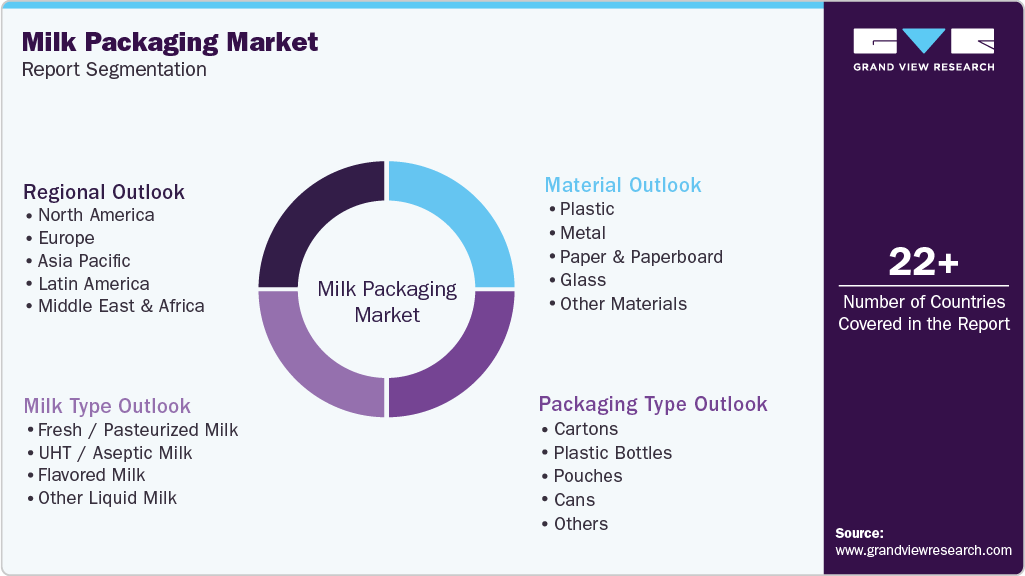
This report forecasts revenue growth at the regional, and country levels and provides an analysis on the latest industry trends and opportunities in each of the sub-segments from 2021 to 2033. For this study, Grand View Research has segmented the milk packaging market report on the basis of material, packaging type, milk type, and region:
-
Material Outlook (Revenue, USD Million, 2021 - 2033)
-
Plastic
-
Metal
-
Paper & Paperboard
-
Glass
-
Other Materials
-
-
Packaging Type Outlook (Revenue, USD Million, 2021 - 2033)
-
Cartons
-
Plastic Bottles
-
Pouches
-
Cans
-
Others
-
-
Milk Type Outlook (Revenue, USD Million, 2021 - 2033)
-
Fresh / Pasteurized Milk
-
UHT / Aseptic Milk
-
Flavored Milk
-
Other Liquid Milk
-
-
Regional Outlook (Revenue, USD Million, 2021 - 2033)
-
North America
-
U.S.
-
Canada
-
Mexico
-
-
Europe
-
Germany
-
France
-
UK
-
Italy
-
Spain
-
-
Asia Pacific
-
China
-
India
-
Japan
-
South Korea
-
Australia
-
-
Latin America
-
Brazil
-
Argentina
-
-
Middle East & Africa
-
Saudi Arabia
-
UAE
-
South Africa
-
-
Research Methodology
The milk packaging market figures in this report are based on a proven research process that combines executive interviews with secondary research from proprietary databases, company filings, and recognized regulatory and institutional sources. Market size is built through value-chain sizing—reconciling supply-side and demand-side estimates—and triangulated with bottom-up and top-down approaches. Every estimate passes multiple levels of expert validation before publication, with each milk packaging segment quantified using the revenue-capture definitions in the table below.
Segment Definition
Segment - Material
Revenue capture definition
Plastic
Revenue generated from the sale of plastic-based milk packaging, including HDPE, PET, PP, and other polymer packaging formats used for fresh, pasteurized, UHT, flavored, and other liquid milk products. Includes bottles, containers, pouches, and other plastic packaging designed to provide product protection, durability, convenience, and efficient distribution.
Paper & Paperboard
Revenue generated from the sale of paper and paperboard-based milk packaging, including carton packs and aseptic packaging structures used for fresh, pasteurized, UHT, and other liquid milk products. Includes coated, laminated, and barrier-treated paperboard formats that provide protection against moisture, oxygen, light, and external contamination while supporting extended shelf life and sustainable packaging objectives.
Glass
Revenue generated from the sale of glass milk packaging, including glass bottles, jars, and other rigid glass containers used for fresh, pasteurized, premium, and specialty milk products. Includes packaging designed to provide strong product protection, chemical stability, premium presentation, and suitability for reusable or recyclable packaging systems.
Metal
Revenue generated from the sale of metal-based milk packaging, including aluminum, steel, and other metal containers used for selected milk and dairy applications. Includes cans and specialty metal formats offering durability, strong barrier protection, light protection, and extended product preservation for specific milk packaging requirements.
Others
Revenue generated from the sale of other milk packaging materials not classified under plastic, paper & paperboard, glass, or metal. Includes emerging and specialty materials such as bio-based materials, biodegradable packaging substrates, and other innovative material combinations used for milk packaging applications.
Segment - Packaging Type
Revenue capture definition
Cartons
Revenue generated from the sale of carton-based milk packaging, including aseptic, gable-top, and other paperboard carton formats used for fresh, pasteurized, UHT, and flavored milk. Includes cartons designed for extended shelf life, product protection, convenient handling, efficient transportation, and reduced material usage.
Plastic Bottles
Revenue generated from the sale of plastic bottles used for packaging fresh, pasteurized, UHT, flavored, and other liquid milk products. Includes HDPE, PET, PP, and other polymer-based bottles designed to provide durability, lightweighting, leak resistance, product protection, and convenience across retail and foodservice applications.
Pouches
Revenue generated from the sale of flexible pouch packaging used for liquid milk and dairy products. Includes single-layer and multilayer pouch formats designed for lightweight distribution, material efficiency, easy dispensing, and cost-effective packaging of fresh, pasteurized, and other liquid milk products.
Cans
Revenue generated from the sale of metal cans used for milk and selected dairy applications. Includes aluminum, steel, and other rigid metal formats providing durability, strong barrier protection, and resistance to light and external environmental conditions.
Others
Revenue generated from the sale of milk packaging formats not classified as cartons, plastic bottles, pouches, or cans. Includes glass bottles, bag-in-box systems, specialty containers, and emerging packaging formats used for fresh, UHT, flavored, and other liquid milk products.
Segment - Milk Type
Revenue capture definition
Fresh / Pasteurized Milk
Revenue generated from the sale of packaging solutions used for fresh and pasteurized milk products that typically require refrigerated storage and distribution. Includes cartons, plastic bottles, pouches, and other packaging formats designed to protect milk from contamination, leakage, light exposure, and quality deterioration throughout the cold chain.
UHT / Aseptic Milk
Revenue generated from the sale of packaging solutions used for ultra-high-temperature (UHT) and aseptically processed milk products. Includes aseptic cartons, bottles, pouches, and other high-barrier formats designed to protect milk from microorganisms, oxygen, light, and external contamination while enabling extended shelf life and ambient distribution.
Flavored Milk
Revenue generated from the sale of packaging solutions used for flavored milk products, including chocolate, strawberry, vanilla, and other flavored formulations. Includes cartons, plastic bottles, pouches, and other packaging formats designed to provide product protection, convenience, attractive presentation, and compatibility with chilled or ambient distribution.
Other Liquid Milk
Revenue generated from the sale of packaging solutions used for other liquid milk products not classified as fresh/pasteurized, UHT/aseptic, or flavored milk. Includes packaging for specialty, fortified, lactose-free, organic, and other value-added liquid milk products, with formats selected according to shelf-life, protection, convenience, and distribution requirements.
Estimation Model
Layer No.
Layer Name
Key Question
Description
01
Milk Consumption & Dairy Industry Layer
What drives packaging demand?
Estimate demand generated by the dairy industry based on milk production, consumption patterns, growth of organized dairy processing, urbanization, and increasing demand for packaged fresh, UHT, aseptic, flavored, and other liquid milk products.
02
Packaging Adoption Layer
Which packaging formats are preferred?
Assess the adoption of cartons, plastic bottles, pouches, cans, and other packaging formats according to milk type, shelf-life requirements, distribution conditions, product protection, convenience, and sustainability considerations.
03
Material & Packaging Consumption Layer
Which materials and formats generate demand?
Evaluate consumption of plastic, paper & paperboard, glass, metal, and other materials across major milk packaging formats, considering factors such as barrier performance, lightweighting, recyclability, durability, filling-line compatibility, and transportation efficiency.
04
Revenue Layer
How is market revenue generated?
Revenue is generated through the sale of milk packaging products and solutions, including cartons, plastic bottles, pouches, cans, and other formats supplied to dairy processors, milk producers, beverage manufacturers, and related food-service channels.
Delivered Customizations
We have successfully delivered the following deep-dive customizations:
Client Request
Customization Delivered
Value Adds
Regional Segmentation Analysis
Detailed assessment of the milk packaging market across North America, Europe, Asia Pacific, Latin America, and Middle East & Africa, covering regional demand patterns, packaging preferences, milk consumption trends, sustainability initiatives, and growth outlook across key countries.
Enables identification of high-growth regions, evolving packaging preferences, regional demand variations, and strategic expansion opportunities.
Cross-Segmentation Analysis
Comprehensive analysis of market opportunities across combinations of Material (Plastic, Paper & Paperboard, Glass, Metal, Others), Packaging Type (Cartons, Plastic Bottles, Pouches, Cans, Others), Milk Type (Fresh/Pasteurized Milk, UHT/Aseptic Milk, Flavored Milk, Other Liquid Milk), and regional markets.
Helps identify high-potential material-packaging combinations, emerging milk categories, demand pockets, and opportunities for targeted product and market strategies.
Opportunity Assessment
In-depth assessment of growth opportunities in the milk packaging market based on sustainable packaging adoption, expansion of UHT and aseptic milk, demand for lightweight formats, increasing use of recyclable materials, and packaging innovation across emerging and developed markets.
Helps companies prioritize attractive opportunities, identify emerging demand areas, align product development with market trends, and formulate effective expansion and investment strategies.
Frequently Asked Questions About This Report
The milk packaging market is primarily driven by increasing packaged milk consumption, expanding dairy processing and distribution networks, rising demand for convenient and hygienic packaging, growth of UHT and aseptic milk products, improvements in cold-chain infrastructure, and increasing adoption of recyclable and lightweight packaging solutions.
Asia Pacific dominated the milk packaging market with a 46.3% revenue share in 2025, supported by high milk consumption, expanding dairy industries, urbanization, and growing adoption of packaged dairy products.x
Asia Pacific is also the fastest-growing region in the milk packaging market, with a CAGR of 10.7% from 2026 to 2033.
The Paper & Paperboard segment is the fastest-growing material segment in the milk packaging market, with a CAGR of 10.5% over the forecast period.
The Plastic segment led the milk packaging market with a 50.9% revenue share in 2025, supported by its lightweight, durable, cost-effective, and versatile characteristics.
The Cartons segment led the milk packaging market with a 42.9% revenue share in 2025, owing to its widespread use for fresh, UHT, and aseptic milk products.
Key players in the milk packaging market include Tetra Pak, SIG, NIPPON PAPER INDUSTRIES CO., LTD., ELOPAK, Mondi, Nampak Ltd., Novolex, Stora Enso, Stanpac Inc., IPI S.r.l., Greatview, Parksons Packaging Ltd., and UFlex Limited.
The global milk packaging market size was valued at USD 39.9 billion in 2025 and is estimated at USD 43.6 billion in 2026.
The global milk packaging market is expected to grow at a CAGR of 10.3% from 2026 to 2033, reaching USD 86.5 billion by 2033.
About the Author(s)
Plastics Polymers & Resins Research Team
Industry · Plastics Polymers & ResinsThis report was authored by the plastics polymers & resins research team at Grand View Research - comprising two research analysts, one senior research analyst, and one industry expert - with specialized expertise in the plastics polymers & resins segment of the industry industry. All findings are based on proprietary industry databases, executive interviews, and regulatory analysis, subject to internal peer review prior to publication.
Last Updated:
Speak to Analyst


Customize this report to your needs — add regions, segments, or data points, with 20% free customization.
Or view our licence options:


ISO 9001:2015 & 27001:2022 Certified
We are GDPR and CCPA compliant! Your transaction & personal information is safe and secure. For more details, please read our privacy policy.


