
- Home
- »
- Advanced Interior Materials
- »
-
Mine Closure And Restoration Market Size Report, 2033GVR Report cover

Mine Closure And Restoration Market (2026 - 2033)
Size, Share & Trends Analysis Report By Mine Type (Coal Mines, Metal Mines), By Service (Land Reclamation, Tailings Management, Water Treatment), By Region (North America, Europe, Asia Pacific), And Segment Forecasts
Market Size, 2025
$623.0MMarket Estimate, 2026
$648.2MMarket Forecast, 2033
$898.0MCAGR, 2026–2033
4.8%Mine Closure And Restoration Market Summary
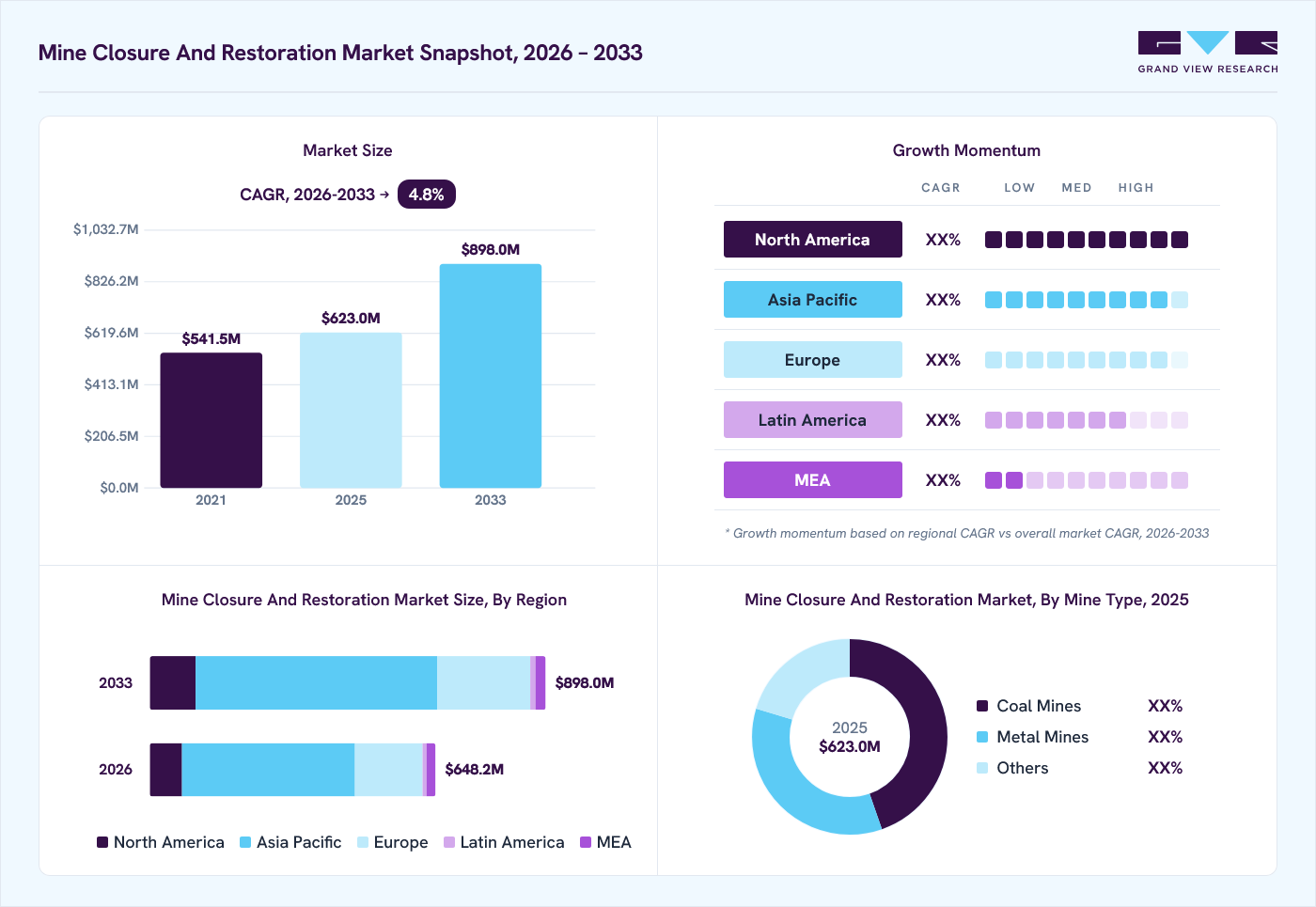
The global mine closure and restoration market size was valued at USD 623.0 million in 2025 -and is projected to grow from USD 648.2 million in 2026 to USD 898.0 million by 2033, at a CAGR of 4.8% from 2026 to 2033. Asia Pacific dominated the market, accounting for a revenue share of 60.4% in 2025. The market growth is driven by increasing regulatory pressure worldwide.
 Source: Grand View Research, IR Documents, Primary Interviews, Paid DatabasesTo learn more about this report,
 Download Free Sample Report
Key Market Trends & Insights
- By mine type: Coal mines segment led the market with the largest revenue share of 44.6% in 2025.
- By service insights: land reclamation led the market with the largest revenue share of 32.5% in 2025.
Regional Highlights
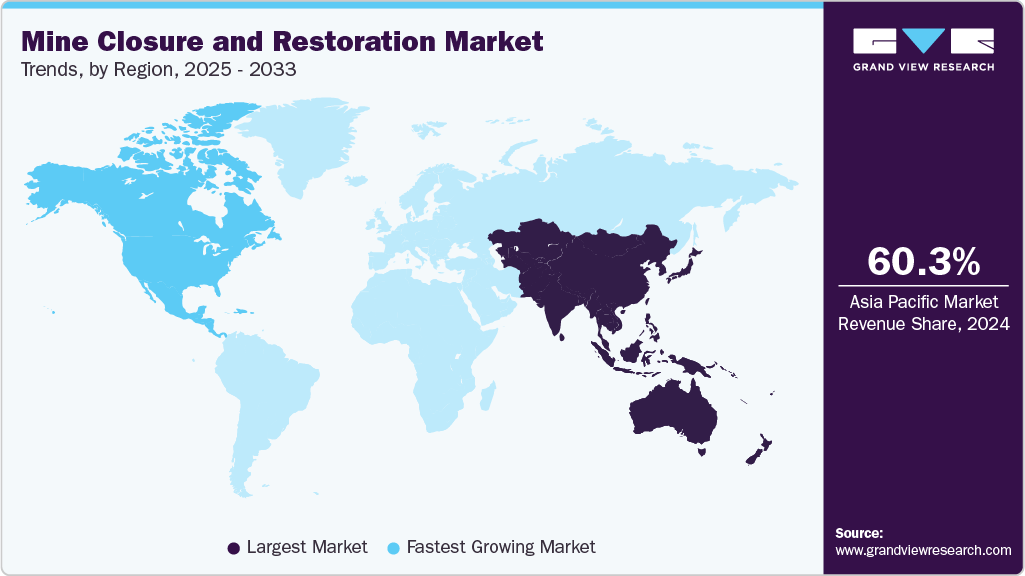
- Largest regional market: Asia Pacific (60.4% revenue share, 2025)
- Fastest-growing regional market: North America (highest CAGR, 2026-2033)
- By country: Australia held the largest market share in 2025.
Market Size & Forecast
- Market size in 2025: USD 623.0 Million
- Estimated market size in 2026: USD 648.2 Million
- Projected market size by 2033: USD 898.0 Million
- CAGR (2026-2033): 4.8%
Prism AI by Grand View Research Free to tryAsk a question about the mine closure and restoration marketTry asking✓Every figure cited from GVR research Prefer the report? Download free sample →
Governments and environmental agencies are enforcing stricter policies requiring mining companies to close and rehabilitate mining sites responsibly. These regulations are designed to minimize environmental damage, including soil degradation, water contamination, and biodiversity loss. Compliance with these laws compels mining operators to invest in closure planning, site restoration, and post-mining land management, creating a consistent demand for specialized services and technologies in this sector. Sustainability and corporate social responsibility initiatives are emerging as key drivers for the market. Mining companies are increasingly aware that responsible closure practices enhance their public image, attract investment, and reduce long-term liability. Investors and stakeholders favour companies that demonstrate environmental stewardship, motivating mining operators to adopt the best reclamation, waste management, and ecosystem restoration practices. This shift towards sustainable mining practices fosters professional closure and market growth for restoration services.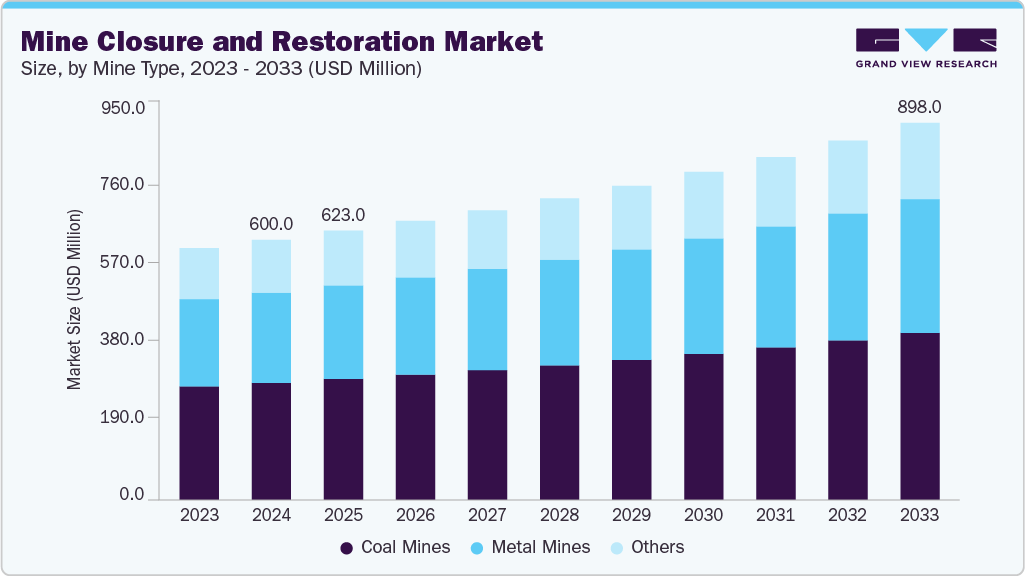 To learn more about this report, Download Free Sample Report
Technological advancements are playing a pivotal role in market growth. Innovative solutions such as remote sensing, geographic information systems, and drone-based monitoring enable more efficient planning and execution of mine closure projects. Advanced soil remediation techniques, vegetation management strategies, and water treatment technologies improve the success rate of rehabilitation efforts, making the process faster, cost-effective, and environmentally compliant. The adoption of these technologies drives demand for specialized equipment and expertise, boosting market expansion.
Economic considerations also influence market growth. Mining companies are increasingly factoring in closure costs during the operational phase to avoid unexpected financial liabilities later. Efficient closure and restoration processes can reduce long-term monitoring and maintenance expenses. In addition, governments and financial institutions are introducing financial assurance and bonding requirements, ensuring sufficient funds are allocated for post-mining rehabilitation, further stimulating market demand.
Furthermore, the rising awareness of environmental and social impacts associated with abandoned or poorly restored mines contributes to market growth. Public concern about landscape degradation, water pollution, and health risks drives demand for professionally managed closure and restoration projects. Communities living near mining sites often demand effective rehabilitation, prompting mining companies to engage restoration and land reclamation experts. This increasing social pressure ensures a steady requirement for mine closure services across developed and emerging mining regions.
Market Dynamics
Increasingly stringent environmental regulations and mine rehabilitation obligations are a primary driver of the mine closure and restoration market. Governments across major mining jurisdictions, including Australia, Canada, Chile, South Africa, and the European Union, require mining companies to prepare closure plans, establish financial assurance mechanisms, and restore land after mining operations cease. Companies are therefore integrating closure planning into the early stages of mine development to ensure regulatory compliance, reduce long-term environmental liabilities, and secure future mining permits. This regulatory landscape has created sustained demand for services such as land reclamation, tailings management, water treatment, revegetation, and long-term environmental monitoring.
Stringent environmental regulations and mine closure policies implemented by governments worldwide are driving the mine closure and restoration market. Mining companies are required to restore disturbed land, stabilize waste facilities, manage water quality, and rehabilitate ecosystems before and after mine closure. Compliance with these regulations has significantly increased investment in closure planning and long term environmental management.
Growing emphasis on sustainable mining practices and environmental, social, and governance (ESG) commitments is further supporting market growth. Mining companies are integrating progressive rehabilitation, biodiversity restoration, and land reclamation into their operational strategies to reduce environmental liabilities, maintain their social license to operate, and meet investor expectations for responsible resource development.
Mine closure and restoration projects require substantial financial resources for land reclamation, water treatment, waste management, environmental monitoring, and post closure maintenance. The long project timelines, technical complexity, and uncertainty associated with restoring heavily disturbed mine sites increase overall costs, particularly for operators managing aging or abandoned mines.
The increasing use of remote sensing, drones, geographic information systems, artificial intelligence based environmental monitoring, and nature based restoration techniques is creating significant opportunities in the mine closure and restoration market. These technologies improve rehabilitation planning, reduce project risks, and enhance long term ecosystem recovery, enabling mining companies to achieve regulatory compliance while improving the efficiency and effectiveness of restoration programs.
Analyst Perspective
The mine closure and restoration market is expected to witness steady long-term growth, driven by increasingly stringent environmental regulations, mandatory mine rehabilitation requirements, and the mining industry's growing commitment to sustainable resource development. As more mines approach the end of their operational life, demand is rising for comprehensive closure services, including land reclamation, tailings management, water treatment, biodiversity restoration, and long-term environmental monitoring.
Mine Type Insights
Based on mine type, coal mines segment led the market with the largest revenue share of 44.6% in 2025. The coal mines segment is witnessing strong growth due to the increasing global shift toward cleaner energy sources and the gradual phase-out of coal-based power generation. Governments are introducing strict environmental regulations that mandate proper closure, rehabilitation, and post-mining land use of coal sites. This has created a consistent need for professional restoration services involving land reclamation, soil stabilization, water treatment, and vegetation recovery. In addition, several countries are launching transition funds and policy frameworks to support the sustainable closure of coal mines, which is driving investments in mine remediation projects.
The metal mines segment is anticipated to register the fastest CAGR over the forecast period. Regulatory agencies are mandating detailed closure plans that include soil and water remediation, tailings stabilization, and long-term monitoring to ensure minimal ecological damage. The growing focus on sustainable mining practices has prompted companies to invest in closure strategies from the early stages of mine planning. In addition, the increased scrutiny from investors and environmental groups is compelling mining firms to demonstrate their commitment to responsible closure and post-mining land rehabilitation.
Service Insights
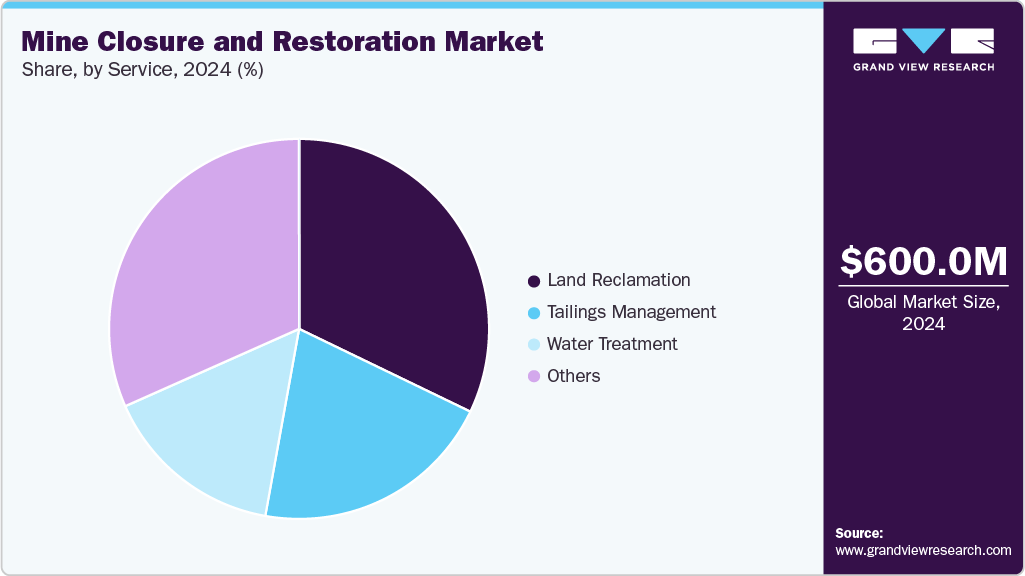
Based on stakeholder complex land reclamation led the market with the largest revenue share of 32.5% in 2025. The land reclamation segment under the service category is experiencing strong growth due to the increasing emphasis on restoring land disturbed by stockpiled materials such as overburden, tailings, and waste rock. Growing interest in recovering value from legacy stockpiles and advances in reclamation technology are creating additional growth for the land reclamation segment under stockpiling entities. Interest in secondary resource recovery, such as reprocessing stockpiled ore and tailings for critical minerals, turns previously abandoned stockpiles into commercial opportunities, making reclamation economically attractive. New techniques in soil amendment, ecological restoration, and remote monitoring lower long-term maintenance costs and improve success rates for revegetation and habitat restoration, which increases the number of projects that proceed from planning to execution.
 To learn more about this report, Download Free Sample Report
Tailings management is anticipated to register the fastest CAGR over the forecast period. Mining companies are increasingly required to implement robust tailings containment, monitoring, and rehabilitation measures to prevent soil and water contamination, dam failures, and long-term environmental liabilities. Investor and community pressure for sustainable mining practices also pushes companies to adopt advanced tailings management solutions that reduce risk and improve site safety, thereby creating higher demand for professional tailings management services.
Regional Insights
Asia Pacific dominated the mine closure and restoration market with the largest revenue share of 60.4% in 2025. The mine closure and restoration market in the Asia Pacific region is experiencing robust growth, driven by regulatory frameworks, technological advancements, and increasing environmental awareness. Governments across the region are implementing stringent environmental regulations that mandate comprehensive mine closure and rehabilitation plans. For instance, China's "Green Mine" program aims to reclaim over 8,000 abandoned mines by 2025, promoting environmentally friendly mining practices and reclamation efforts. Similarly, India's Maharashtra state has introduced new mining regulations to transform abandoned coal mines into safe and stockpiling production community assets, emphasizing land restoration and safety measures.
 To learn more about this report, Download Free Sample Report
North America Mine Closure And Restoration Market Trends
The mine closure and restoration market in North America is experiencing significant growth due to strict environmental regulations and an increased focus on sustainability. In the U.S., laws require mining companies to restore mined lands to their original condition or an approved alternative use, which has driven mining operators to invest in comprehensive closure and rehabilitation programs. Growing awareness of environmental degradation caused by mining activities has encouraged public and private sectors to prioritize ecological restoration, creating steady demand for specialized services and technologies.
The U.S. mine closure and restoration market is expected to grow significantly over the forecast period. The U.S. government has implemented comprehensive policies that mandate the restoration of mined lands, compelling mining companies to invest in reclamation efforts. For instance, the Surface Mining Control and Reclamation Act (SMCRA) requires operators to restore mined areas to their original or equivalent condition, ensuring that land is returned to beneficial use. In addition, the U.S. Interior Department has introduced measures to enhance the recovery of critical minerals from mine waste, including streamlining federal regulations and making mine waste projects eligible for federal funding. This initiative supports environmental cleanup and strengthens domestic mineral stockpiling production, reducing reliance on foreign sources.
Europe Mine Closure And Restoration Market Trends
The mine closure and restoration market in Europe is experiencing significant growth, propelled by stringent environmental regulations, technological advancements, and a heightened emphasis on sustainability. The European Union has implemented comprehensive policies that mandate the restoration of mined lands, compelling mining companies to invest in reclamation efforts. For instance, the EU's Directive on Environmental Liability requires operators to restore mined areas to their original or equivalent condition, ensuring that land is returned to beneficial use. In addition, countries such as the United Kingdom, Germany, and France are investing heavily in mine reclamation projects to address the legacy of historic mining activities, further driving market expansion.
Middle East & Africa Mine Closure And Restoration Market Trends
The mine closure and restoration market in the MEA is experiencing significant growth, driven by several key factors. Governments in the region are implementing stringent environmental regulations, compelling mining companies to invest in sustainable practices and post-mining land rehabilitation. For instance, the UAE's Federal Law No. 24 of 1999 mandates environmental protection, influencing mining operations to adopt responsible closure and restoration strategies. In addition, the increasing awareness of environmental degradation caused by mining activities is prompting both public and private sectors to prioritize ecological restoration, leading to a surge in demand for specialized services and technologies.
Latin America Mine Closure And Restoration Market Trends
The mine closure and restoration market in Latin America is experiencing significant growth, driven by regulatory frameworks, environmental concerns, and technological advancements. Governments across the region are implementing stringent environmental regulations that mandate the restoration of mined lands, compelling mining companies to invest in reclamation efforts. For instance, Brazil has introduced progressive restoration mandates, while Chile and Peru show accelerating growth in ecological restoration services. These regulatory frameworks create a favorable environment for market development.
Australia Mine Closure And Restoration Market Trends
The mine closure and restoration market in the Australia held the largest share in the Asia Pacific region in 2025.
Key Mine Closure And Restoration Company Insights
Some key players operating in the market include Tetra Tech, WSP, and others.
-
Tetra Tech is a global consulting and engineering firm specializing in water, environment, infrastructure, resource management, and energy projects. With a strong presence across North America, Europe, and Asia-Pacific, the company leverages scientific expertise and technological solutions to address complex environmental challenges. Tetra Tech provides comprehensive services in the mine closure and restoration sector, including environmental impact assessments, closure planning, reclamation design, waste management, and post-closure monitoring.
-
WSP is an international professional services firm with expertise in engineering, design, and environmental consulting. The company operates in over 40 countries and delivers infrastructure, energy, resources, and environmental solutions. WSP emphasizes sustainability and resilience, providing strategic planning, technical consulting, and project management services to help clients address complex environmental and engineering challenges. Its multidisciplinary teams combine local knowledge with global expertise to support large-scale projects and regulatory compliance initiatives.
Key Mine Closure And Restoration Companies:
The following key companies have been profiled for this study on the mine closure and restoration market.
- AECOM
- Forgen
- Geosyntec Consultants
- RESPEC
- SLR Consulting
- Sovereign Consulting
- Stantec
- Tetra Tech
- Veolia
- WSP
Competitive Benchmarking
Category
Operating Strategies
Competitive Edge
Weakness
Established Players (e.g. AECOM, Geosyntec Consultants)
- Mature participants in the mine closure and restoration market primarily focus on providing integrated end-to-end solutions covering closure planning, environmental remediation, land reclamation, tailings management, water treatment, ecological restoration, and long-term post-closure monitoring.
- Their strategies emphasize early engagement with mining companies to incorporate closure planning during the mine development and operational phases, enabling regulatory compliance, cost optimization, and reduced long-term environmental liabilities.
- Established players possess significant competitive advantages through decades of experience in environmental consulting, engineering design, mine rehabilitation, and regulatory compliance across diverse mining jurisdictions.
- Their ability to provide integrated technical services covering engineering, environmental science, permitting, construction management, and long-term monitoring enables efficient execution of complex closure projects.
- Despite their strong market positions, mature players face challenges related to lengthy project timelines, evolving environmental regulations, and high project execution costs.
- Mine closure and restoration projects often require long-term commitments extending over several decades, increasing financial exposure and operational complexity.
Emerging & Regional Players (e.g., Forgen, RESPEC, Sovereign Consulting)
- Emerging participants in the mine closure and restoration market generally focus on specialized environmental services, innovative restoration technologies, and region-specific rehabilitation solutions.
- Rather than competing directly with established engineering firms across the entire project lifecycle, these companies target niche areas such as passive water treatment, ecological restoration, tailings stabilization, revegetation, drone-based environmental monitoring, and carbon-focused land rehabilitation.
- Emerging companies benefit from operational agility and the ability to adopt modern environmental technologies without extensive legacy systems.
- Their services often incorporate digital monitoring platforms, automated environmental data collection, advanced ecological assessment tools, and innovative remediation techniques that improve project efficiency and decision-making.
- Emerging participants face significant challenges related to limited financial resources, restricted project portfolios, and lower technical capacity for executing large, multi-disciplinary closure programs.
- Competing against established environmental engineering firms with extensive global experience, regulatory expertise, and comprehensive service offerings can be difficult, particularly for large mine closure contracts involving complex environmental liabilities.
Recent Development
-
In July 2025, India’s mining sector marked a significant milestone by initiating scientific closure of mines, with ten sites closed under updated frameworks and 147 more planned for closure using advanced restoration techniques. These closures embraced the “6Rs” approach-focusing on reclamation, rehabilitation, reuse, and restoration, while the sector adopted the new ‘Reclaim Framework’ to ensure community participation and transparent, sustainable recovery of mining lands.
Mine Closure & Restoration Market Report Scope
Report Attribute
Details
Market definition
The market size refers to the revenue generated from services that safely close mines and restore the land after mining operations end.
Market size in 2025
USD 623.0 million
Estimated market size in 2026
USD 648.2 million
Projected market size by 2033
USD 898.0 million
Growth rate
CAGR of 4.8% from 2026 to 2033
Base year for estimation
2025
Historical data
2021 - 2024
Forecast period
2026 - 2033
Quantitative units
Revenue in USD million and CAGR from 2026 to 2033
Report coverage
Revenue forecast, company ranking, competitive landscape, growth factors, and trends
Segments covered
Mine type, Service Insights, region.
Regional scope
North America; Europe; Asia Pacific; Latin America; Middle East & Africa
Country scope
U.S., Canada, Mexico, Finland, Germany, Poland, China, India, Australia, Chile, Peru, Brazil, Saudi Arabia, South Africa
Key companies profiled
AECOM; Forgen; Geosyntec Consultants; RESPEC; SLR Consulting; Sovereign Consulting; Stantec; Tetra Tech; Veolia; WSP
Customization scope
Free report customization (equivalent up to 8 analysts' working days) with purchase. Addition or alteration to country, regional & segment scope.
Pricing and purchase options
Avail customized purchase options to meet your exact research needs. Explore purchase options
Global Mine Closure And Restoration Market Report Segmentation
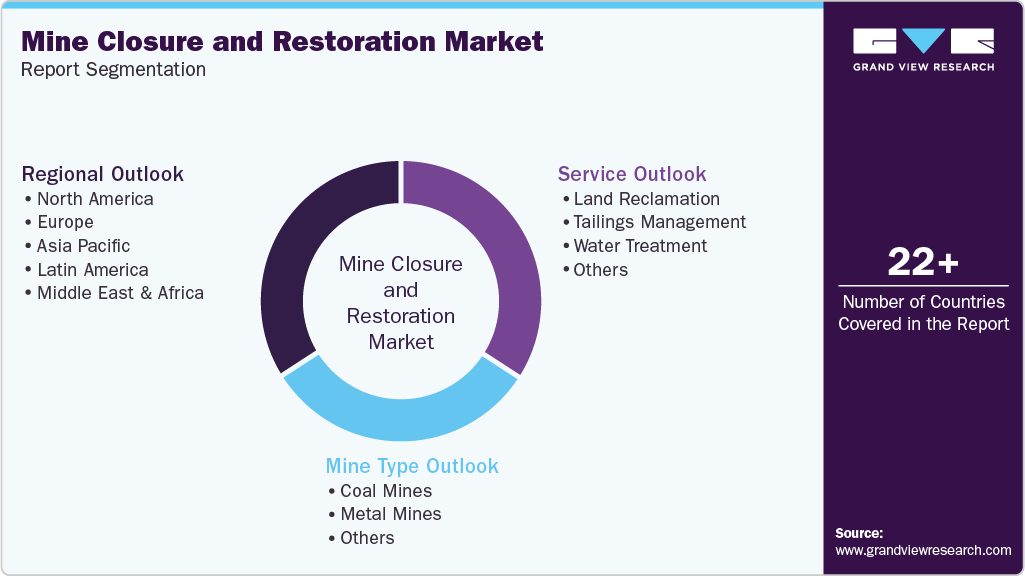
This report forecasts revenue growth at global, regional, and country levels and provides an analysis of the latest industry trends in each of the sub-segments from 2021 to 2033. For this study, Grand View Research has segmented the global mine closure and restoration market report based on mine type, service, and region:
 To learn more about this report, Download Free Sample Report
-
Mine Type Outlook (Revenue, USD Million, 2021 - 2033)
-
Coal Mines
-
Metal Mines
-
Others
-
-
Service Outlook (Revenue, USD Million, 2021 - 2033)
-
Land Reclamation
-
Tailings Management
-
Water Treatment
-
Others
-
-
Regional Outlook (Revenue, USD Million, 2021 - 2033)
-
North America
-
U.S.
-
Canada
-
Mexico
-
-
Europe
-
Germany
-
UK
-
France
-
-
Asia Pacific
-
China
-
India
-
Japan
-
-
Latin America
-
Brazil
-
-
Middle East & Africa
-
Saudi Arabia
-
UAE
-
-
Research Methodology
The mine closure and restoration market figures in this report are based on a proven research process that combines executive interviews with secondary research from proprietary databases, company filings, and recognized regulatory and institutional sources. Market size is built through value-chain sizing - reconciling supply-side and demand-side estimates - and triangulated with bottom-up and top-down approaches. Every estimate passes multiple levels of expert validation before publication, with each mine closure and restoration segment quantified using the revenue-capture definitions in the table below.
egment Definition
Mine Type
Revenue Capture Definition
Coal Mines
The coal mines segment captures revenue generated from mine closure, reclamation, environmental remediation, and post-mining land restoration services associated with surface and underground coal mining operations.
Metal Mines
The metal mines segment represents revenue generated from closure and restoration projects for mines producing iron ore, copper, gold, nickel, zinc, bauxite, lithium, and other metallic minerals.
Others
The other segment includes revenue generated from mine closure and restoration services for industrial minerals, quarrying, rare earth, phosphate, potash, gemstone, and other non-metallic mining operations.
Stakeholder
Revenue Capture Definition
Land Reclamation
The land reclamation segment captures revenue from activities that restore disturbed mine sites to stable, productive, and environmentally sustainable conditions following mine closure.
Tailings Management
The tailings management segment represents revenue generated from the stabilization, remediation, monitoring, and long-term management of mine tailings storage facilities during and after mine closure.
Water Treatment
The water treatment segment includes revenue from the treatment and management of mine-affected water, such as acid mine drainage, contaminated groundwater, and surface water.
Others
The other segment captures revenue generated from additional mine closure and restoration activities such as infrastructure decommissioning, waste rock management, biodiversity conservation, environmental monitoring, carbon sequestration, community transition programs, and post-closure site maintenance.
Estimation Model
Layer Name
Key Question
Description
Mine Closure Demand Base Layer
What forms the demand base?
Identify the global base of active, inactive, abandoned, and depleted mines across coal, metal, and industrial mineral mining. Assess mine life cycles, regulatory closure requirements, environmental liabilities, and the growing number of mines reaching end-of-life to establish the total addressable demand for mine closure and restoration services.
Closure & Restoration Application Penetration Layer
Where are mine closure and restoration services utilized?
Estimate the penetration of closure and restoration activities across key applications including land reclamation, tailings management, water treatment, revegetation, waste stabilization, biodiversity restoration, and long-term environmental monitoring. Analyze the adoption of these services across coal mines, metal mines, and other mining operations in different regions based on regulatory compliance and sustainability commitments.
Restoration Intensity Layer
How much restoration activity is required?
Analyze restoration intensity based on mine area, volume of tailings and waste rock, contaminated land, water treatment requirements, and post-mining environmental obligations. Evaluate the extent of reclamation, rehabilitation, and monitoring activities required for different mine types. Restoration intensity varies according to mine size, mining method, environmental sensitivity, regulatory standards, and closure objectives.
Revenue Layer
How is market revenue generated?
Revenue generation is driven by mandatory regulatory compliance, environmental restoration projects, mine owner sustainability initiatives, and government-funded abandoned mine rehabilitation programs. Market value is influenced by closure project complexity, site conditions, environmental regulations, restoration technologies, and investments in responsible mine closure practices.
Delivered Customizations
This report has been delivered with the following In-depth customization
Client Request
Customization Delivered
Value Adds
Regional Segmentation
Detailed regional analysis of the mine closure and restoration market across North America, Europe, Asia Pacific, Latin America, and Middle East & Africa. Included evaluation of abandoned and active mine closure projects, environmental regulations, government rehabilitation programs, mining liabilities, reclamation funding mechanisms, and investments in ecological restoration and post mining land use.
Identified high priority closure markets, regulatory driven investment opportunities, and regions with significant rehabilitation requirements. Enabled strategic market entry, regional demand forecasting, and resource allocation planning.
Cross Segmentation
Comprehensive cross segmentation analysis by mine type, stakeholder, and region, including coal mines, metal mines, and other mine types across land reclamation, tailings management, water treatment, and other restoration activities. Evaluated regional project pipelines, environmental compliance requirements, rehabilitation technologies, and stakeholder investment priorities across government agencies, mining companies, engineering firms, and environmental service providers.
Enabled identification of the most attractive mine type and restoration service combinations. Supported service portfolio optimization, customer targeting, and investment prioritization strategies.
Opportunity Assessment
Identification of high growth opportunities across abandoned mine rehabilitation, critical mineral mine closure, tailings storage facility remediation, acid mine drainage treatment, biodiversity restoration, carbon sequestration through land rehabilitation, renewable energy development on reclaimed mine sites, and digital monitoring technologies for post closure management.
Enabled prioritization of high return investment opportunities and emerging restoration services. Supported long term business planning, technology adoption, service diversification, and strategic growth aligned with environmental sustainability and responsible mining objectives.
Frequently Asked Questions About This Report
The mine closure and restoration market size was estimated at USD 623.0 million in 2025 and is expected to reach USD 648.2 million in 2026.
Asia Pacific dominated the market with revenue share of 60.4% in 2025.
Australia dominated the Asia Pacific market in 2025.
North America is anticipated to register the fastest CAGR over the forecast period.
Land reclamation accounted for largest revenue share of 32.5% in 2025.
The mine closure and restoration market is expected to grow at a compound annual growth rate of 4.8% from 2026 to 2033 to reach USD 898.0 million by 2033.
Based on type, coal mines accounted for largest revenue share of 44.6% in 2025.
The key players operating in the mine closure and restoration market are AECOM; Forgen; Geosyntec Consultants; RESPEC; SLR Consulting; Sovereign Consulting; Stantec; Tetra Tech; Veolia; WSP
The key factor driving the growth of the global mine closure and restoration market is the increasing emphasis on environmental sustainability and regulatory compliance, which compels mining companies to adopt comprehensive closure and rehabilitation practices to mitigate ecological impact and ensure safe land reuse.
About the Author(s)
Advanced Interior Materials Research Team
Advanced Materials · Advanced Interior MaterialsThis report was authored by the advanced interior materials research team at Grand View Research - comprising two research analysts, one senior research analyst, and one industry expert - with specialized expertise in the advanced interior materials segment of the advanced materials industry. All findings are based on proprietary advanced materials databases, executive interviews, and regulatory analysis, subject to internal peer review prior to publication.
Last Updated:
Speak to Analyst

Customize this report to your needs - add regions, segments, or data points, with 20% free customization.
Or view our licence options:


ISO 9001:2015 & 27001:2022 Certified
We are GDPR and CCPA compliant! Your transaction & personal information is safe and secure. For more details, please read our privacy policy.


