
- Home
- »
- Advanced Interior Materials
- »
-
Mine Rehabilitation Market Size & Share Report, 2026-2033GVR Report cover

Mine Rehabilitation Market (2026 - 2033)
Size, Share & Trends Analysis Report By Mine Type (Coal Mines, Metal Mines), By Stakeholder (Mining Companies, Environmental Contractors), By Region, And Segment Forecasts
Market Size, 2025
$7.6BMarket Estimate, 2026
$8.0BMarket Forecast, 2033
$12.1BCAGR, 2026–2033
6.1%Mine Rehabilitation Market Summary
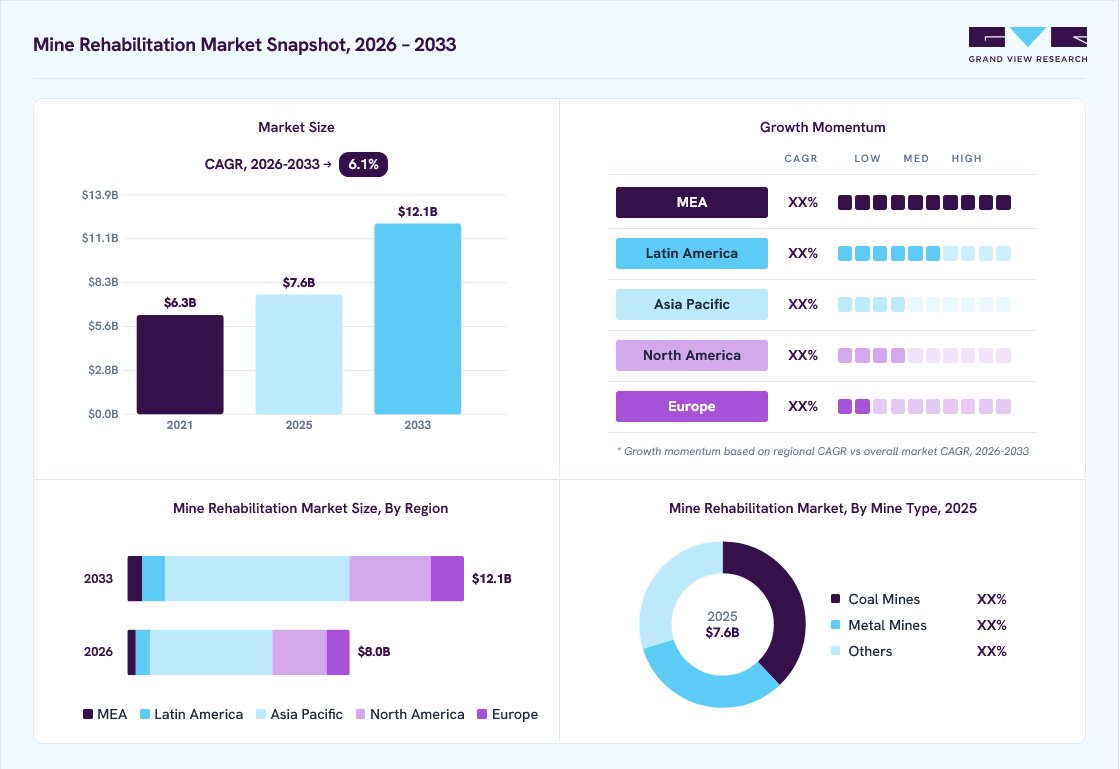
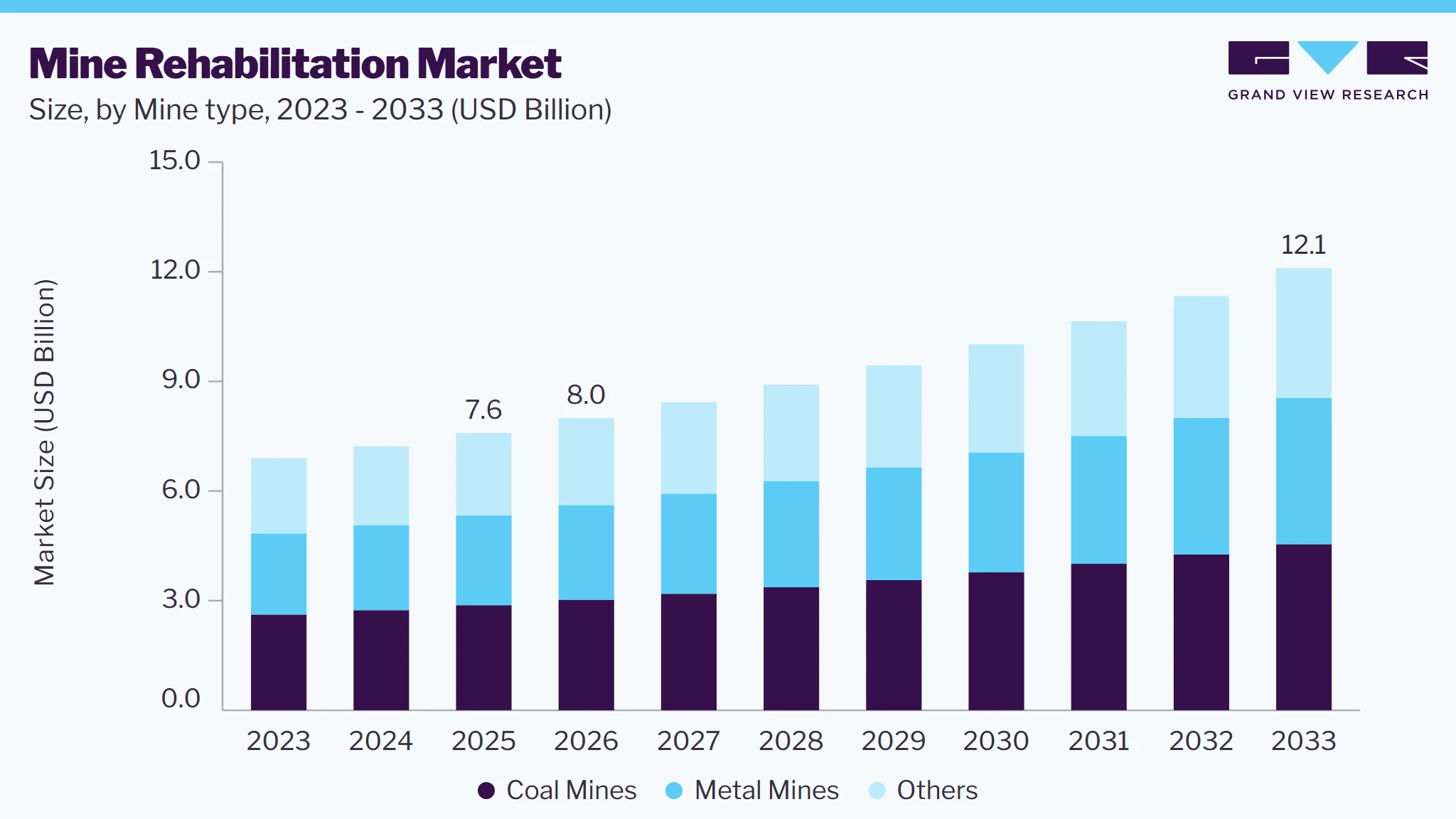
The mine rehabilitation market size was valued at USD 7.6 billion in 2025 and is projected to grow from USD 8.0 billion in 2026 to USD 12.1 billion by 2033, at a CAGR of 6.1% from 2026 to 2033. Asia Pacific dominated the mine rehabilitation market with the largest revenue share of 55.1% in 2025. The increasing focus on environmental sustainability and regulatory compliance across the mining sector primarily drives market growth.
 Source: Grand View Research, IR Documents, Primary Interviews, Paid DatabasesTo learn more about this report,
 Download Free Sample Report
Key Market Trends & Insights
- By mine type: Coal mine rehabilitation segment held the largest market share of 37.9% in 2025.
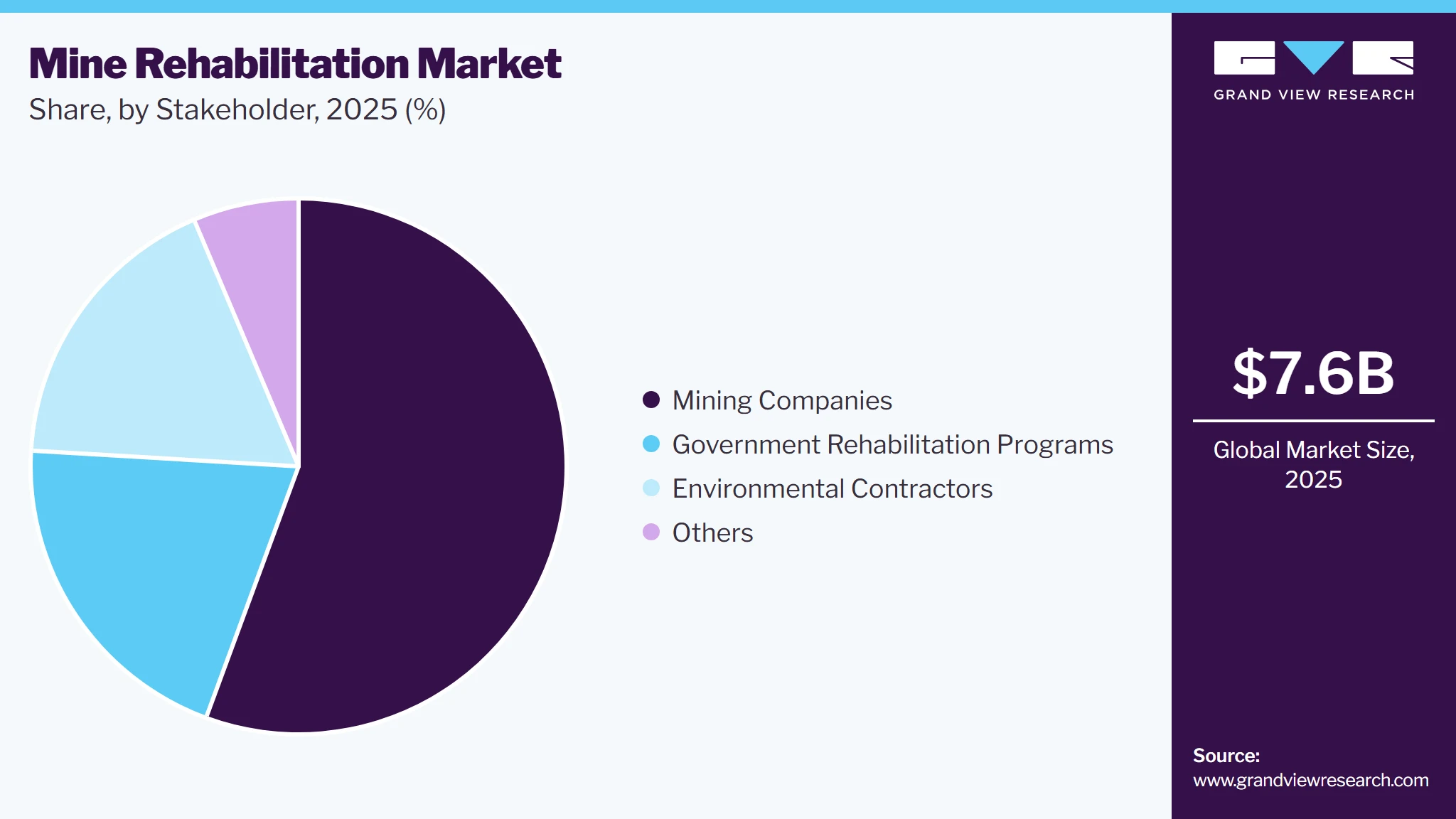
- By stakeholder: Mining companies segment held the largest market share of 55.6% in 2025.
Regional Highlights
- Largest regional market: Asia Pacific (55.1% revenue share, 2025)
- Fastest-growing regional market: Middle East & Africa (highest CAGR, 2026-2033)
- By country: Australia held the largest market share in 2025
Market Size & Forecast
- Market size in 2025: USD 7.6 Billion
- Estimated market size in 2026: USD 8.0 Billion
- Projected market size by 2033: USD 12.1 Billion
- CAGR (2026-2033): 6.1%
Prism AI by Grand View Research Free to tryAsk a question about the mine rehabilitation marketTry asking✓Every figure cited from GVR research Prefer the report? Download free sample →
Governments and environmental agencies across regions such as Australia, Canada, and the U.S. have implemented strict regulations mandating the restoration of mined lands to their natural or economically usable state. These policies compel mining companies to invest in rehabilitation projects, including re-vegetation, soil stabilization, and water management, to reduce the long-term ecological impact of mining operations. The enforcement of closure bonds and penalties for non-compliance further reinforces market growth. Another key factor contributing to market expansion is the rising awareness among mining firms regarding corporate social responsibility and long-term ecological stewardship. Companies recognize the importance of maintaining their social license to operate, which relies on sustainable post-mining land use. As a result, major players in the mining industry are partnering with environmental engineering firms to develop rehabilitation strategies that balance economic recovery with biodiversity conservation. This trend is evident in the growing number of voluntary restoration projects and industry-led sustainability commitments, especially in regions with intensive mining activity.Technological advancements in soil remediation, vegetation recovery, and geospatial mapping drive the market forward. Modern rehabilitation practices leverage remote sensing, drone-based land assessment, and artificial intelligence to monitor site conditions and evaluate rehabilitation success. These innovations enhance precision, reduce costs, and improve long-term project outcomes, making rehabilitation more efficient and financially viable for mining operators. Using biodegradable materials and native plant species has further strengthened the effectiveness of post-mining recovery processes.
 To learn more about this report, Download Free Sample Report
Rising investments in mine closure planning are another major driver of market growth. Mining companies increasingly allocate some of their operational budgets to early-stage closure planning, integrating rehabilitation activities into the mine lifecycle. This proactive approach minimizes future liabilities and ensures smoother transitions from active mining to land restoration phases. Furthermore, expanding funding programs by governments and financial institutions that promote responsible mine closure practices encourages greater participation from small and mid-sized mining companies.
Lastly, the global energy transition indirectly fuels the need for mine rehabilitation. The demand for critical minerals such as lithium, nickel, and cobalt has led to the establishment of new mines, increasing the volume of sites requiring rehabilitation. Simultaneously, the closure of aging coal and metal mines presents significant opportunities for specialized rehabilitation service providers. As the mining landscape evolves toward sustainable resource management, the market for mine rehabilitation services is expected to experience steady growth supported by innovation, regulation, and environmental accountability.
Market Dynamics
The mine rehabilitation market is expanding steadily as governments, mining companies, and investors place greater emphasis on sustainable resource development and responsible mine closure practices. Increasing environmental accountability, stricter mine closure regulations, and the integration of environmental, social, and governance (ESG) principles into mining operations are driving investments in rehabilitation activities. Mining companies are increasingly adopting progressive rehabilitation throughout the operational life of mines to minimize long-term environmental impacts, reduce closure liabilities, and facilitate post-mining land use for agriculture, forestry, renewable energy projects, and community development.
Governments across major mining regions have strengthened regulatory frameworks requiring mining operators to restore disturbed land, manage waste responsibly, and rehabilitate ecosystems following extraction activities. Regulatory authorities increasingly mandate comprehensive mine closure plans, financial assurance mechanisms, and long-term environmental monitoring before approving new mining projects. Mine operators are allocating higher budgets toward land reclamation, revegetation, water management, and biodiversity restoration to ensure compliance and reduce environmental risks.
Growing investor focus on ESG performance is encouraging mining companies to adopt sustainable rehabilitation practices beyond regulatory requirements. Effective rehabilitation programs improve corporate reputation, support social license to operate, and enhance access to financing from institutions prioritizing sustainable investments. This shift is driving greater adoption of advanced rehabilitation technologies, ecological restoration techniques, and continuous environmental monitoring across both active and closed mining sites.
Mine rehabilitation projects often require significant financial investment and specialized technical expertise due to the complexity of restoring landscapes altered by decades of mining activity. Activities such as landform reconstruction, soil stabilization, tailing management, water treatment, and ecosystem restoration involve substantial capital expenditure and long-term maintenance commitments. Rehabilitation costs can vary considerably depending on mine type, geographic conditions, contamination levels, and regulatory requirements.
The growing focus on circular land use and sustainable regional development is creating significant opportunities within the mine rehabilitation market. Rehabilitated mining sites are increasingly being repurposed for solar farms, wind energy projects, pumped hydro energy storage, industrial developments, agriculture, forestry, recreational facilities, and wildlife conservation areas. These alternative land-use strategies enable mining companies and governments to maximize the long-term economic and environmental value of previously disturbed land.
Analyst Perspective
The mine rehabilitation market is transitioning from a regulatory compliance function to a strategic component of sustainable mining operations. As governments tighten environmental standards and investors increasingly evaluate mining companies based on ESG performance, rehabilitation is becoming an integral part of mine planning, operational risk management, and corporate value creation. Future market growth will be driven by the adoption of progressive rehabilitation practices, digital monitoring technologies, and nature-based restoration solutions that improve rehabilitation outcomes while reducing long-term closure liabilities.
Drivers, Opportunities & Restraints
The key drivers of the mine rehabilitation industry include stringent government regulations, increasing environmental awareness, and growing emphasis on sustainable mining practices. Many countries have established strict policies that require mining companies to restore land after closure, promoting ecological balance and community safety. Companies are also motivated by maintaining their environmental reputation and social license. Technological advancements in monitoring systems, soil treatment, and vegetation recovery make rehabilitation more efficient, cost-effective, and measurable, further propelling market growth.
Opportunities in the mine rehabilitation industry arise from the global transition toward cleaner energy and responsible mining. The expansion of mining activities to meet the rising demand for critical minerals such as lithium, nickel, and cobalt has created a need for sustainable closure solutions. This has opened new business prospects for environmental consultants, engineering firms, and technology providers specializing in rehabilitation. Moreover, the growing focus on biodiversity restoration, carbon sequestration, and the reuse of post-mining land for agriculture or renewable energy projects is creating new value streams within the sector.
Despite positive developments, the market faces restraints such as high rehabilitation costs, complex regulatory frameworks, and a lack of expertise in developing regions. Small and mid-sized mining operators often find allocating sufficient funds for long-term rehabilitation commitments challenging. Inconsistencies in regulatory enforcement across countries also limit effective implementation. Furthermore, technical difficulties related to soil degradation, water contamination, and habitat restoration extend project timelines and add to financial burdens.
Mine Type Insights
Coal mine rehabilitation led the market with the largest revenue share of 37.9% in 2025. The growth of the coal mines is driven mainly by stricter environmental regulations and closure standards. Governments across coal-producing countries enforce mandatory land restoration, water treatment, and post-closure monitoring, making mine rehabilitation a key part of mining operations. Companies must now submit detailed closure plans before obtaining new licenses, which boosts demand for specialized rehabilitation contractors and environmental consultants.
The metal mines segment is anticipated to register the fastest CAGR over the forecast period. Mining companies are required to restore land, manage waste, and monitor water and soil quality after metal extraction. These rules ensure that mining operations leave minimal long-term impact on the environment, which has increased the demand for specialized rehabilitation services and contractors. Metal mines often generate heavy metal contamination, acid mine drainage, and degraded landscapes that require extensive remediation. Rehabilitation activities such as soil stabilization, water treatment, and revegetation are essential to prevent pollution and restore ecosystems.
Stakeholder Insights
By stakeholder, the mining companies segment led the market with the largest revenue share of 55.6% in 2025. Mining companies are responsible for ensuring that their operations meet environmental and safety standards, which include proper closure and rehabilitation of mined lands. Increasingly strict laws and penalties for non-compliance encourage companies to invest in rehabilitation projects, creating steady demand for specialized services and technical expertise. Mining companies are under pressure from investors, communities, and ESG frameworks to reduce environmental impact and restore ecosystems.
 To learn more about this report, Download Free Sample Report
Environmental contractors is anticipated to register the fastest CAGR over the forecast period. Mining sites often require specialized soil stabilization, water treatment, waste management, and ecosystem restoration expertise. Environmental contractors bring technical knowledge and experience, enabling mining companies to meet regulatory requirements and execute effective rehabilitation programs. Rising environmental awareness and stricter regulations are also major growth drivers. Governments and regulatory bodies enforce rigorous standards for post-mining land use, pollution control, and ecosystem restoration.
Regional Insights
Asia Pacific dominated the mine rehabilitation market with the largest revenue share of 55.1% in 2025. The increasing focus on environmental sustainability and stringent government regulations primarily drives the growth of the mine rehabilitation market in the Asia Pacific region. Countries such as Australia, China, and India emphasize restoring mined lands to prevent long-term ecological damage, soil degradation, and water contamination. Mining companies must implement structured rehabilitation plans before, during, and after mining operations, which is boosting demand for specialized rehabilitation services. Additionally, stakeholders' growing awareness about the importance of social responsibility encourages investment in restoring ecosystems and improving community livelihoods affected by mining activities.
 To learn more about this report, Download Free Sample Report
North America Mine Rehabilitation Market Trends
The mine rehabilitation market in North America is closely linked to federal and state-level regulations that enforce strict land reclamation standards. The United States’ Surface Mining Control and Reclamation Act (SMCRA) and similar provincial regulations in Canada mandate that mining companies restore land and water resources affected by mining activities. Before mine closure, these laws required operators to implement detailed rehabilitation plans, including soil stabilization, reforestation, and water treatment. Heightened public scrutiny and pressure from environmental advocacy groups in North America further encourage mining firms to adopt sustainable rehabilitation practices to maintain their social license to operate.
The U.S. mine rehabilitation market is strongly driven by stringent federal regulations, particularly the Surface Mining Control and Reclamation Act (SMCRA), which requires mining operators to restore land, water, and ecosystems affected by mining activities. The law enforces comprehensive reclamation plans before mine closure, covering soil stabilization, reforestation, and water management. Compliance with these regulations creates consistent demand for specialized rehabilitation services. Heightened public awareness and pressure from environmental groups also push mining companies to implement sustainable practices, ensuring long-term ecological protection and maintaining community support.
Europe Mine Rehabilitation Market Trends
The mine rehabilitation market in Europe is primarily driven by strict environmental policies and regulations established by the European Union and individual countries. Directives such as the EU Mine Waste Directive and the Habitats Directive require mining companies to restore landscapes, prevent soil and water contamination, and protect biodiversity after mining operations. Compliance with these laws creates a strong demand for professional rehabilitation services. Public awareness and pressure from environmental organizations further encourage mining operators to adopt sustainable land restoration practices, ensuring long-term ecological and social benefits.
Middle East & Africa Mine Rehabilitation Market Trends
The mine rehabilitation market in the Middle East and Africa is driven by increasing regulatory focus on environmental sustainability and land restoration. Countries such as South Africa, Morocco, and Saudi Arabia have introduced stricter mining and environmental regulations that require companies to rehabilitate mined lands, manage water usage, and prevent soil degradation. Compliance with these regulations encourages mining firms to adopt structured rehabilitation practices. Growing public awareness of environmental issues and pressure from local communities also motivates mining operators to invest in land restoration and ecological conservation.
Latin America Mine Rehabilitation Market Trends
The mine rehabilitation market in Latin America is largely driven by increasing regulatory requirements and government initiatives aimed at sustainable mining. Countries such as Brazil, Chile, Peru, and Mexico have introduced stricter environmental laws that require mining companies to restore land, manage water resources, and prevent soil erosion after mining activities. Compliance with these regulations creates a strong demand for professional rehabilitation services. Growing public awareness of environmental impacts and pressure from local communities further motivates mining operators to implement structured land restoration and ecological conservation practices. The mine rehabilitation market in Australia held the largest share in the Asia Pacific region in 2025.
Key Mine Rehabilitation Company Insights
Some key players operating in the market include Thiess Rehabilitation, WSP, and others.
-
Thiess Rehabilitation is a specialized division of Thiess, a leading global mining services provider. The company focuses on sustainable mine closure and land rehabilitation, aiming to restore mined areas to safe and productive conditions. Leveraging decades of experience in mining operations, Thiess Rehabilitation combines environmental planning, engineering expertise, and local ecological knowledge to manage complex rehabilitation projects efficiently. Their approach emphasizes compliance with regulatory requirements, environmental stewardship, and community engagement to ensure long-term land usability.
-
WSP is a global professional services firm with a strong presence in the mining sector. It offers expertise in environmental consulting and mine rehabilitation. The company works on projects ranging from mine closure planning to post-mining land restoration, providing solutions that balance operational, environmental, and social considerations. WSP’s approach focuses on risk management, regulatory compliance, and sustainability, helping mining companies meet their closure responsibilities while promoting ecosystem recovery.
Key Mine Rehabilitation Companies
The following key companies have been profiled for this study on the mine rehabilitation market.
-
Forgen
-
Geosyntec Consultants
-
Iluka Resources
-
RESPEC
-
SLR Consulting
-
Stantec
-
Tetra Tech
-
Thiess Rehabilitation
-
Veolia
-
WSP
Competitive Benchmarking
Category
Operating Strategies
Competitive Edge
Weakness
Established Players (Stantec, Tetra Tech, WSP, Veolia, SLR Consulting)
- Deliver integrated mine closure solutions covering planning, engineering, environmental restoration, and long-term monitoring.
- Expand capabilities through acquisitions, multidisciplinary consulting services, and digital environmental management platforms.
- Leverage advanced technologies such as GIS, remote sensing, drones, and predictive environmental modeling to improve project execution.
- Extensive global project portfolio across diverse mining jurisdictions and commodities.
- Strong technical expertise is supported by multidisciplinary engineering, hydrogeology, ecology, and environmental science teams.
- Long-standing relationships with major mining companies and government agencies, enabling participation in large-scale rehabilitation projects.
- Dependence on large infrastructure and mining capital expenditure cycles can affect project pipelines.
- Complex project execution across multiple regulatory jurisdictions increases operational risks and costs.
- High reliance on skilled technical personnel may create workforce constraints during periods of strong market demand.
Emerging & Regional Players (Forgen, Geosyntec Consultants, RESPEC, Thiess Rehabilitation, Iluka Resources)
- Focus on niche rehabilitation services such as contaminated site remediation, revegetation, tailings stabilization, and mine closure engineering.
- Build strategic partnerships with mining operators, local contractors, and government agencies to secure regional rehabilitation projects.
- Differentiate offerings through site-specific restoration approaches and innovative ecological rehabilitation techniques.
- Strong understanding of regional environmental regulations and local site conditions.
- Greater operational flexibility enables customized rehabilitation solutions for individual mining projects.
- Ability to mobilize quickly for specialized or mid-sized rehabilitation contracts with lower organizational complexity.
- Limited international presence compared to global environmental consulting firms.
- Smaller financial resources can restrict participation in large, multi-year rehabilitation programs.
- Greater dependence on regional mining activity and government-funded restoration projects may result in revenue volatility.
Recent Development
-
In July 2025, American Tungsten accelerated the rehabilitation of the historic IMA Mine in Patterson, Idaho, focusing on boosting North America’s tungsten ore supply. The company expanded its drilling program to explore deeper molybdenum-bearing zones beneath previously mined tungsten areas and began substantial efforts to re-establish safe access and assess underground infrastructure.
Mine Rehabilitation Market Report Scope
Report Attribute
Details
Market definition
The mine rehabilitation market size represents the total annual revenue generated by companies providing mine rehabilitation services, along with the rehabilitation expenditure incurred by mine operators, for restoring and closing mining sites during a given year.
Market size in 2025
USD 7.6 billion
Estimated market size in 2026
USD 8.0 billion
Projected market size by 2033
USD 12.1 billion
Growth rate
CAGR of 6.1% from 2026 to 2033
Base year for estimation
2025
Historical data
2021 - 2024
Forecast period
2026 - 2033
Quantitative units
Revenue in USD million and CAGR from 2026 to 2033
Report coverage
Revenue forecast, company ranking, competitive landscape, growth factors, and trends
Segments covered
Stakeholder, mine type, region
Regional scope
North America; Europe; Asia Pacific; Latin America; Middle East & Africa
Country scope
U.S.; Canada; Mexico; Germany; Finland; Poland; China; India; Australia; Chile; Peru; Brazil; Saudi Arabia, South Africa
Key companies profiled
Forgen; Geosyntec Consultants; Iluka Resources; RESPEC; SLR Consulting; Stantec; Tetra Tech; Thiess Rehabilitation; Veolia; WSP
Customization scope
Free report customization (equivalent up to 8 analysts' working days) with purchase addition or alteration to country, regional & segment scope.
Pricing and purchase options
Avail customized purchase options to meet your exact research needs. Explore purchase options
Global Mine Rehabilitation Market Report Segmentation
This report forecasts revenue growth at global, regional, and country levels and provides an analysis of the latest industry trends in each of the sub-segments from 2021 to 2033. For this study, Grand View Research has segmented the global mine rehabilitation market report based on mine type, stakeholder, and region.
 To learn more about this report, Download Free Sample Report
-
Mine Type Outlook (Revenue, USD Million, 2021 - 2033)
-
Coal Mines
-
Metal Mines
-
Others
-
-
Stakeholder Outlook (Revenue, USD Million, 2021 - 2033)
-
Mining Companies
-
Government Rehabilitation Programs
-
Environmental Contractors
-
Others
-
-
Regional Outlook (Revenue, USD Million, 2021 - 2033)
-
North America
-
U.S.
-
Canada
-
Mexico
-
-
Europe
-
Germany
-
UK
-
France
-
-
Asia Pacific
-
China
-
India
-
Japan
-
-
Latin America
-
Brazil
-
-
Middle East & Africa
-
Saudi Arabia
-
UAE
-
-
Research Methodology
The mine rehabilitation market figures in this report are based on a proven research process that combines executive interviews with secondary research from proprietary databases, company filings, and recognized regulatory and institutional sources. Market size is built through value-chain sizing - reconciling supply-side and demand-side estimates - and triangulated with bottom-up and top-down approaches. Every estimate passes multiple levels of expert validation before publication, with each mine rehabilitation segment quantified using the revenue-capture definitions in the table below.
Segment Definition
Mine Type
Revenue Capture Definition
Coal Mines
This segment includes revenue generated from rehabilitation activities at active, inactive, and abandoned coal mining sites. Services include landform reconstruction, overburden stabilization, top-soil replacement, revegetation, water treatment, mine closure planning, and long-term environmental monitoring to restore ecological function and comply with regulatory requirements.
Metal Mines
This segment comprises revenue generated from the rehabilitation of metal mining operations, including iron ore, copper, gold, nickel, bauxite, zinc, lead, and other metal mines. Revenue is derived from contaminated land remediation, tailings and waste rock management, acid mine drainage treatment, biodiversity restoration, and post-closure environmental monitoring.
Others
This segment includes revenue generated from the rehabilitation of industrial minerals, rare earths, lithium, phosphates, potash, sand, gravel, and quarry operations. Activities include soil restoration, slope stabilization, revegetation, water resource management, ecosystem restoration, and redevelopment of mined land for alternative commercial, agricultural, recreational, or renewable energy applications.
Stakeholder
Revenue Capture Definition
Mining Companies
Revenue is generated from expenditures by mining operators on mine closure planning, progressive rehabilitation, land reclamation, waste management, environmental compliance, biodiversity restoration, and long-term monitoring throughout the mine lifecycle and after mine closure.
Government Rehabilitation Programs
Revenue is generated through publicly funded initiatives focused on restoring abandoned and legacy mine sites, mitigating environmental hazards, reclaiming degraded land, improving water quality, and supporting ecosystem recovery in accordance with national and regional environmental restoration programs.
Environmental Contractors
Revenue is generated from providing specialized rehabilitation services, including environmental consulting, engineering design, earthworks, soil remediation, water treatment, revegetation, ecological restoration, environmental monitoring, and regulatory compliance support for mining companies and government agencies.
Others
Revenue is generated from services provided by environmental consultants, research institutions, technology providers, non-governmental organizations (NGOs), and land developers involved in ecological restoration, digital environmental monitoring, carbon sequestration projects, biodiversity conservation, and redevelopment of rehabilitated mining sites for productive end uses.
Estimation Model
Layer No.
Layer Name
Key Question
Description
01
Mine Footprint & Closure Liability Assessment
What establishes the rehabilitation opportunity?
Quantify the total land disturbed by mining activities across coal, metal, and industrial mineral operations. Evaluate active, suspended, abandoned, and closed mines, closure liabilities, remaining mine life, disturbed land area, and reclamation obligations to estimate the potential rehabilitation workload across regions.
02
Regulatory & Sustainability Compliance Assessment
Which factors influence rehabilitation investments?
Assess country-specific mine closure legislation, financial assurance requirements, environmental permitting frameworks, ESG commitments, biodiversity conservation mandates, and corporate sustainability targets. Analyze how regulatory enforcement and environmental compliance drive rehabilitation spending by mining operators and public agencies.
03
Rehabilitation Activity & Service Demand Assessment
Which rehabilitation activities generate market demand?
Evaluate expenditure across major rehabilitation activities, including earthworks, landform reconstruction, topsoil replacement, revegetation, erosion control, tailings stabilization, acid mine drainage treatment, water management, habitat restoration, and post-closure environmental monitoring. Assess contractor participation, technology adoption, and project execution models to determine demand across service categories.
04
Revenue Modeling & Regional Market Assessment
How is the market size estimated?
Estimate market revenues by integrating rehabilitation expenditure per hectare or per project, mine closure timelines, service intensity, regional labor and equipment costs, environmental restoration complexity, and stakeholder investments. Validate the estimates using historical rehabilitation spending, announced closure projects, government restoration programs, and mining company environmental capital expenditures across key regions.
Delivered Customizations
This report has been delivered with the following In-depth customizations
Client Request
Customization Delivered
Value Adds
Mine Closure Liability & Rehabilitation Cost Assessment
Detailed evaluation of mine closure obligations across major mining jurisdictions, including rehabilitation cost estimates, financial assurance requirements, closure timelines, and expenditure by mine type (coal, metal, and industrial minerals).
Enables budgeting for closure liabilities, improves financial planning, and supports regulatory compliance and risk management.
Country-wise Rehabilitation Regulatory Framework Analysis
Comprehensive assessment of mine rehabilitation regulations, permitting requirements, reclamation standards, environmental compliance obligations, biodiversity policies, and post-closure monitoring requirements across key mining countries.
Assists in regulatory planning, market entry decisions, and identification of regions with favorable rehabilitation policies.
Mine Rehabilitation Project Pipeline Assessment
Evaluation of ongoing, planned, and announced mine rehabilitation and closure projects by country, mine type, project scale, investment value, and implementation timeline.
Helps identify business opportunities, prioritize target markets, and strengthen project development strategies.
Frequently Asked Questions About This Report
Asia Pacific dominated the mine rehabilitation market with the largest revenue share of 55.1% in 2025.
The mine rehabilitation market in Australia held the largest share in the Asia Pacific region in 2025
The Middle East & Africa is anticipated to register the fastest CAGR of 8.6% over the forecast period.
By stakeholder, the mining companies segment led the market with the largest revenue share of 55.6% in 2025.
The mine rehabilitation market is expected to grow at a compound annual growth rate of 6.1% from 2026 to 2033 to reach USD 12.1 billion by 2033.
The mine rehabilitation market size was estimated at USD 7.6 billion in 2025 and is expected to reach USD 8.0 billion in 2026.
Coal mine rehabilitation led the market with the largest revenue share of 37.9% in 2025.
The key players operating in the mine rehabilitation market are Forgen, Geosyntec Consultants, Iluka Resources, RESPEC, SLR Consulting, Stantec, Tetra Tech, Thiess Rehabilitation, Veolia, and WSP, among others.
Growing regulatory emphasis on sustainable mine closure, increasing environmental restoration requirements, and rising adoption of ESG-driven mining practices are the primary factors driving the growth of the global mine rehabilitation market.
About the Author(s)
Advanced Interior Materials Research Team
Advanced Materials · Advanced Interior MaterialsThis report was authored by the advanced interior materials research team at Grand View Research - comprising two research analysts, one senior research analyst, and one industry expert - with specialized expertise in the advanced interior materials segment of the advanced materials industry. All findings are based on proprietary advanced materials databases, executive interviews, and regulatory analysis, subject to internal peer review prior to publication.
Last Updated:
Speak to Analyst

Customize this report to your needs - add regions, segments, or data points, with 20% free customization.
Or view our licence options:


ISO 9001:2015 & 27001:2022 Certified
We are GDPR and CCPA compliant! Your transaction & personal information is safe and secure. For more details, please read our privacy policy.


