
- Home
- »
- Advanced Materials
- »
-
Mining Dust Control Market Size, Share Report, 2025-2033GVR Report cover
![Mining Dust Control Market (2025 - 2033) Report]()
Mining Dust Control Market (2025 - 2033)
Size, Share & Trends Analysis Report By Product (Water-Based Systems, Airborne Dust Collection Systems), By Service Mode (Stationary), By End-use (Surface Mining, Mineral Processing), By Region, And Segment Forecasts
Market Size, 2024
$3.2BMarket Estimate, 2026
$3.4BMarket Forecast, 2033
$4.9BCAGR, 2025–2033
5.2%Mining Dust Control Market Summary
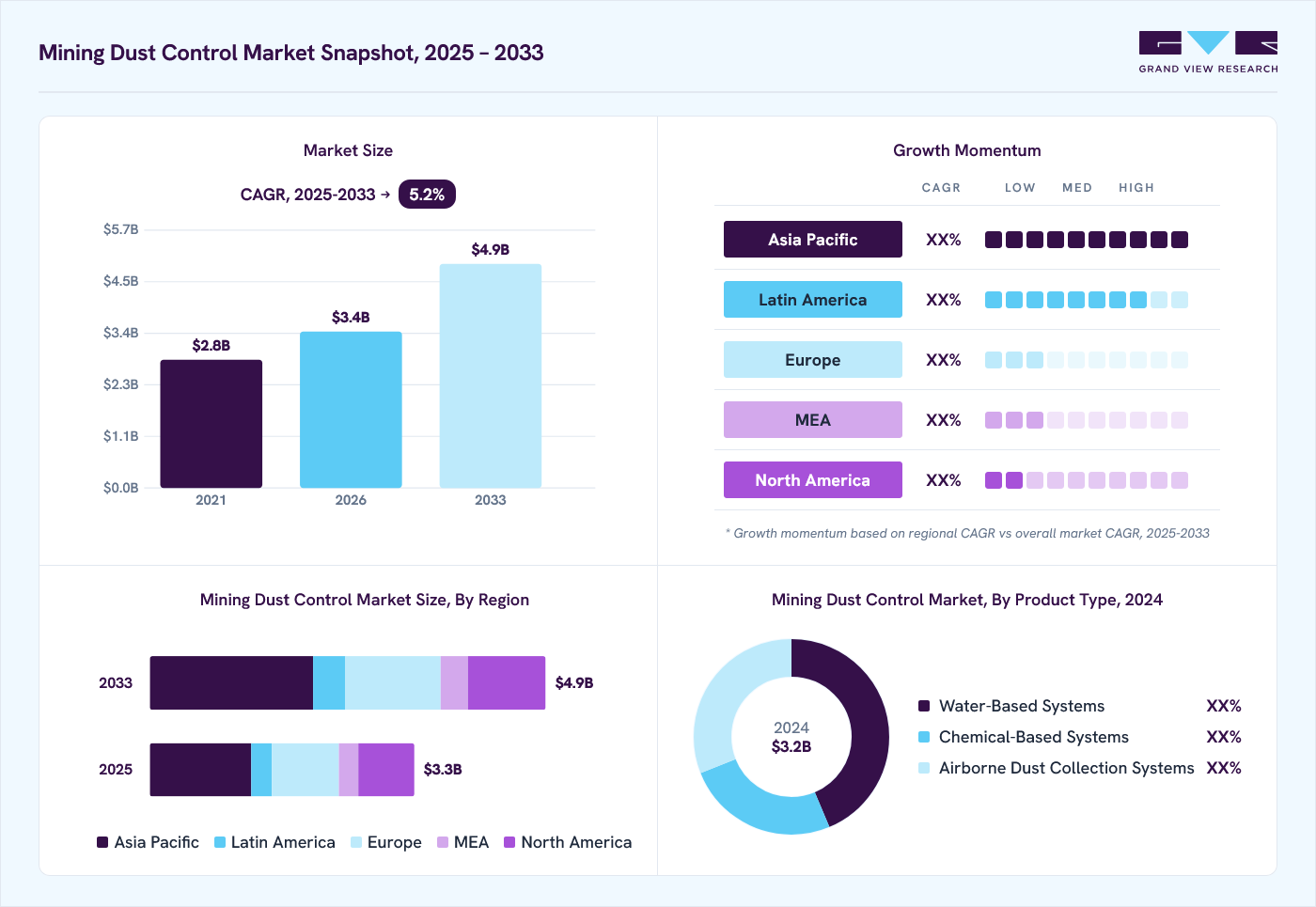
The global mining dust control market size was valued at USD 3.2 billion in 2024 and is projected to grow from USD 3.4 billion in 2026 to USD 4.9 billion by 2033, at a CAGR of 5.2% from 2025 to 2033. Asia Pacific dominated the market, accounting for a revenue share of 37.9% in 2024. The rise in stringent health and safety regulations globally is driving the demand for effective dust control solutions in mining operations.
Key Market Trends & Insights
- The mining dust control industry in China has risen due to its extensive mining activities and large-scale industrial operations.
- By product, the water-based dust control systems currently dominate the mining sector and accounted for a share of 43.6% in 2024.
- By service mode, the stationary dust control systems dominate the market, accounting for a share of 60.6% in 2024.
- By end-use, the surface mining remains the dominant end use segment as it accounted for a share of 53.6% in 2024.
Market Size & Forecast
- 2024 Market Size: USD 3.2 Billion
- 2033 Projected Market Size: USD 4.9 Billion
- CAGR (2025-2033): 5.2%
- Asia Pacific: Largest market in 2024
Companies are focusing on reducing workers’ exposure to harmful dust particles. Regulatory compliance encourages the adoption of advanced dust collection systems. Innovations in dust collection technologies, such as high-efficiency filtration and automated monitoring systems, are boosting market growth.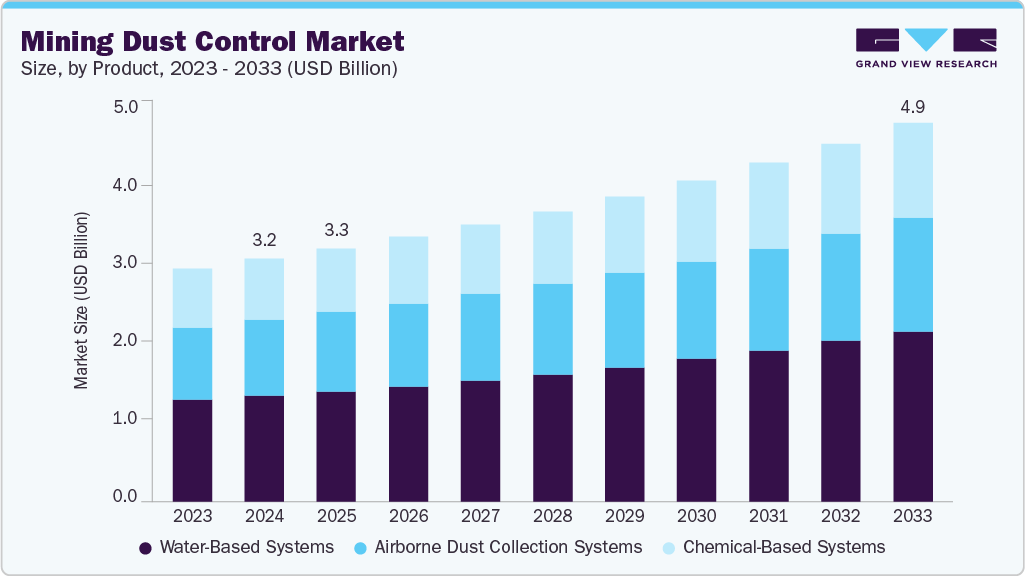
Mining companies are adopting smart solutions to optimize dust control and reduce operational costs. Enhanced system efficiency improves air quality and environmental compliance. This technological evolution is a key factor fueling market expansion.
Market Concentration & Characteristics
The market for mining dust control is moderately concentrated, with a few key players holding significant market share through advanced technologies and strong distribution networks. Leading companies focus on innovation, strategic partnerships, and regional expansion to maintain dominance. Despite the presence of several smaller players, the industry is largely influenced by major manufacturers setting industry standards. This concentration drives competitive pricing, continuous product development, and higher barriers for new entrants.
The mining dust control industry is characterized by a moderate to high degree of innovation. Companies continuously develop advanced filtration systems, automated monitoring, and energy-efficient solutions. Innovation focuses on improving operational efficiency while ensuring compliance with health and environmental standards. This drives market differentiation and encourages adoption of next-generation dust control technologies.
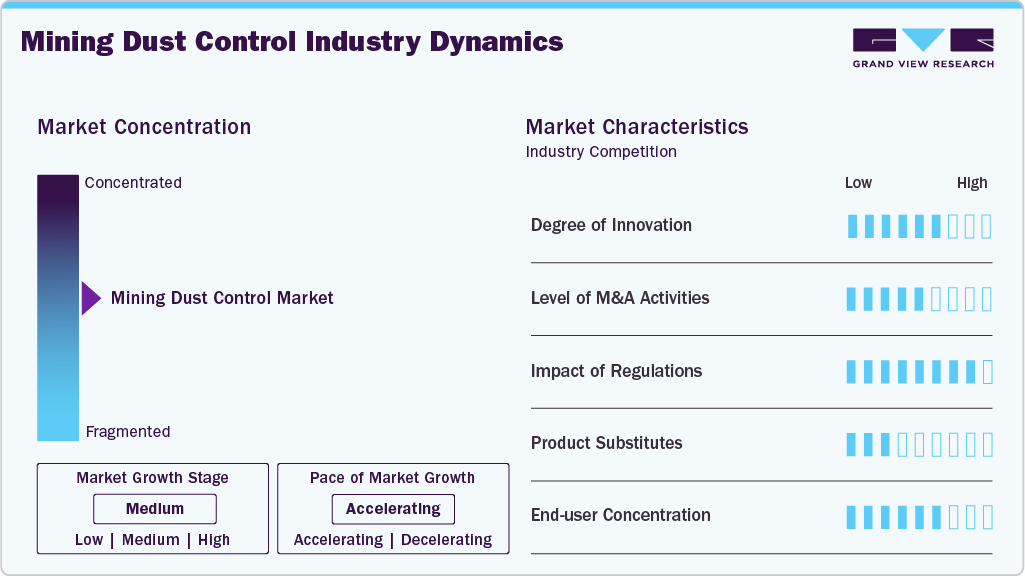
M&A activity is relatively steady, with major players acquiring smaller firms to expand regional presence and technology portfolios. Strategic acquisitions help companies enhance product offerings and access new customer segments. These consolidations also strengthen competitive positioning and operational synergies. Overall, M&A contributes to market stability and accelerated growth.
Regulatory frameworks strongly influence the industry, as companies must comply with stringent health and environmental standards. Governments across regions enforce dust emission limits, driving demand for advanced control systems. Compliance ensures worker safety, reduces environmental impact, and promotes sustainable mining practices. Regulatory pressure remains a key factor shaping market strategies.
Drivers, Opportunities & Restraints
Rising health and safety concerns in mining operations are driving the demand for advanced dust control solutions. Stringent environmental regulations push companies to adopt efficient filtration and monitoring systems. Technological advancements enhance system effectiveness and reduce operational costs. Increasing awareness of occupational hazards further fuels market growth.
The market presents significant opportunities through the adoption of smart dust collection technologies and automation. Expansion into emerging economies with growing mining activities offers new revenue streams. The development of eco-friendly and energy-efficient systems can attract environmentally conscious clients. Collaborations and partnerships with local distributors can strengthen market reach.
High initial investment costs for advanced dust control systems can limit adoption, especially among small-scale miners. Maintenance and operational complexity pose additional challenges for end users. Variability in regional regulations may create compliance uncertainties. Limited awareness in certain regions about dust-related health risks can slow market penetration.
Product Insights
Water-based dust control systems currently dominate the mining sector and accounted for a share of 43.6% in 2024, due to their efficiency in suppressing airborne particles. These systems are cost-effective, easy to operate, and environmentally safer compared to chemical alternatives. High adoption in large-scale mining operations drives consistent market demand. Their proven reliability in reducing dust exposure makes them the preferred choice globally.
Chemical-based systems segment is expected to grow at a notable CAGR of 5.1% from 2025 to 2033 in terms of revenue. Chemical-based dust control solutions are witnessing pronounced growth due to their enhanced effectiveness in challenging mining environments. These systems provide longer-lasting dust suppression and are suitable for arid and high-dust conditions. Innovations in eco-friendly chemical formulations are boosting market acceptance. Increasing awareness of operational efficiency and regulatory compliance is further driving adoption.
Service Mode Insights
Stationary dust control systems dominate the market, accounting for a share of 60.6% in 2024, due to their ability to handle large-scale operations efficiently. They offer continuous dust suppression and are integrated into permanent infrastructure for long-term use. High reliability and minimal manual intervention make them ideal for major mining sites. Their proven performance in improving air quality drives widespread adoption globally.
The portable segment is expected to grow at a significant CAGR of 5.1% from 2025 to 2033 in terms of revenue. Portable dust control systems are experiencing significant growth because of their flexibility and ease of deployment. These systems are suitable for temporary or mobile mining operations where stationary solutions are impractical. Advances in lightweight, energy-efficient designs have increased their operational efficiency. Growing demand for adaptable solutions in smaller or remote mining sites is boosting market acceptance.
End-use Insights
Surface mining remains the dominant end use segment as it accounted for a share of 53.6% in 2024, due to its large-scale operations and high dust generation. Dust control systems are essential to ensure worker safety and regulatory compliance. Continuous exposure to dust in open-pit mining drives the adoption of advanced suppression technologies. The need for efficient and reliable solutions makes this segment the largest contributor to market demand.
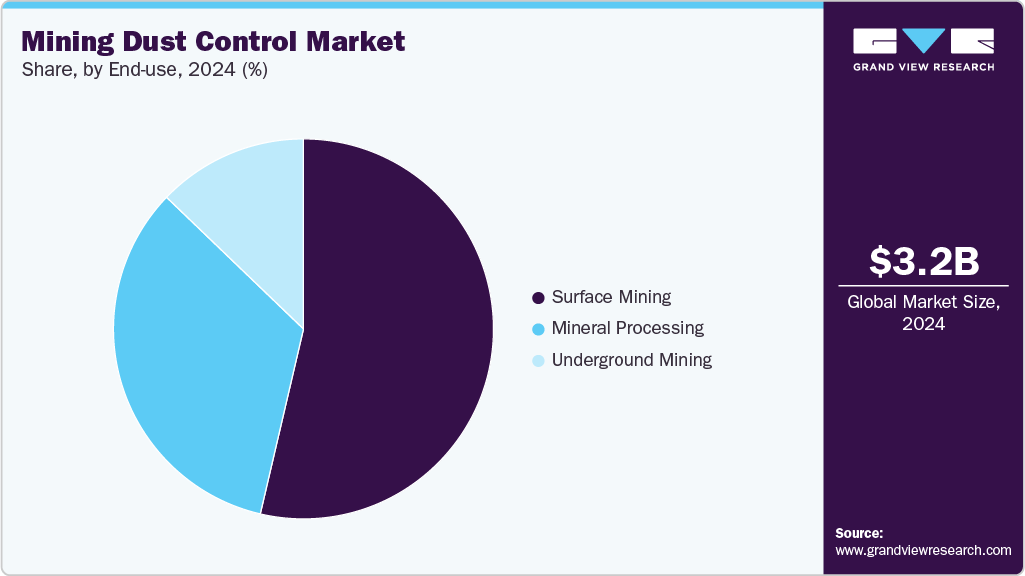
Mineral processing segment is expected to grow at a considerable CAGR of 5.6% from 2025 to 2033 in terms of revenue. Mineral processing is the fastest-growing segment as operations increasingly focus on efficiency and environmental compliance. High-speed machinery and material handling generate significant dust, creating demand for effective control solutions. Technological innovations in filtration and monitoring systems are enhancing adoption in this sector. Expanding processing facilities and stricter regulations are accelerating market growth.
Regional Insights
The Asia Pacific mining dust control industry accounted for a 37.9% share in 2024, owing to extensive mining activities in countries such as China, India, and Australia. High demand for regulatory-compliant dust suppression systems drives market growth. The presence of major mining companies adopting advanced technologies further strengthens regional dominance. Rapid industrialization and urbanization continue to fuel the need for effective dust control solutions.
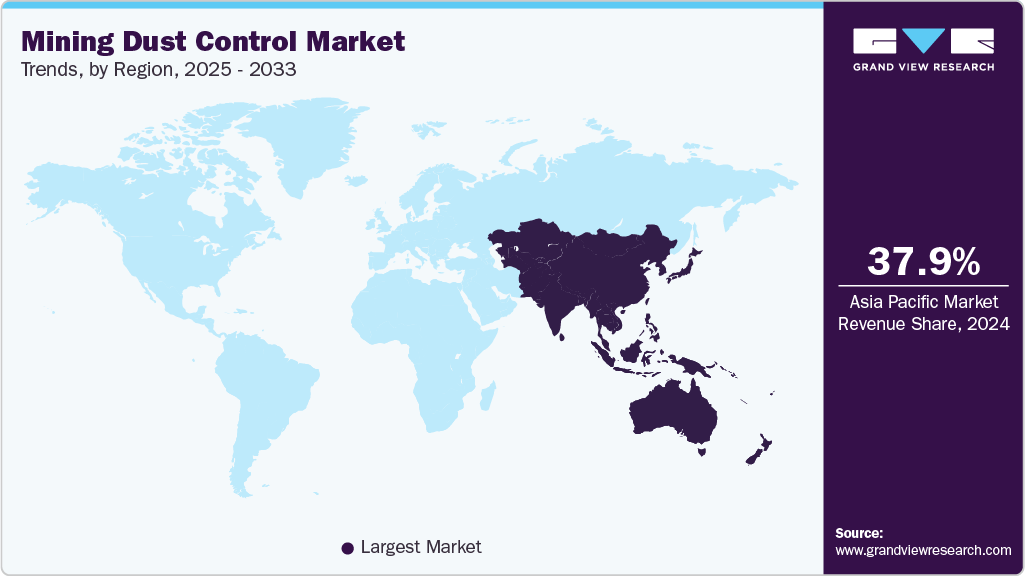
The mining dust control industry in China has risen due to its extensive mining activities and large-scale industrial operations. Strict government regulations on environmental protection drive the adoption of advanced dust suppression systems. Companies focus on integrating high-efficiency technologies to improve air quality and worker safety. Continuous investment in mining infrastructure reinforces China’s leadership in the region.
The India mining dust control industry is witnessing rapid growth, driven by expanding mineral extraction and industrialization. Adoption of modern dust collection and suppression systems is increasing across both large and small mining operations. Regulatory initiatives to ensure worker safety and environmental compliance support market expansion. Rising awareness of operational efficiency and sustainable practices further fuels demand in the country.
North America Mining Dust Control Market Trends
The North America mining dust control industry is expected to grow at a CAGR of 4.2% during the forecast period, largely attributed to modernization of mining infrastructure and strict environmental regulations. Investments in advanced filtration and automated dust control systems are increasing. Companies are focusing on sustainable practices to reduce environmental impact. Growing awareness of worker safety is boosting the adoption of innovative dust suppression technologies.
U.S. Mining Dust Control Market Trends
The mining dust control industry in the U.S. dominates the North American market due to advanced mining infrastructure and stringent regulatory standards. Companies are increasingly adopting high-efficiency dust suppression and monitoring systems. Focus on worker safety and environmental compliance has driven consistent demand. Technological innovations and investments in large-scale mining operations further strengthen market leadership.
The Mexico mining dust control industry is witnessing growth in the wake of expanding mineral exploration and production activities. Adoption of modern dust suppression technologies is increasing across small and mid-scale mining sites. Government initiatives promoting worker safety and environmental protection support market development. Rising awareness of operational efficiency and regulatory compliance fuels market expansion in the country.
Europe Mining Dust Control Market Trends
The Europe mining dust control industry is supported by stringent EU regulations and a focus on sustainable mining operations. Technological advancements and government initiatives promote the use of high-efficiency dust control systems. Companies are investing in eco-friendly solutions to meet emission standards. Continuous innovation in dust monitoring and suppression enhances market expansion.
The mining dust control industry in Germany dominates the regional market due to its well-established mining sector and strict environmental regulations. Companies focus on adopting advanced dust collection and monitoring systems to ensure compliance. High emphasis on worker safety and sustainable operations drives consistent demand. Technological innovation and government incentives strengthen Germany’s leadership in the region.
The UK mining dust control industry is witnessing growth owing to increased investment in mineral processing and underground mining projects. Adoption of efficient and eco-friendly dust suppression systems is rising across the country. Regulatory pressure to maintain air quality and worker safety supports market expansion. Growing awareness of operational efficiency and sustainable mining practices fuels continued demand.
Middle East & Africa Mining Dust Control Market Trends
The mining dust control industry in the Middle East and Africa is experiencing growth driven by large-scale mining projects and infrastructural developments. Adoption of advanced dust collection and suppression systems is increasing to meet safety standards. Investment in mechanized and automated mining processes is boosting demand. The need for compliance with environmental and occupational safety regulations fuels regional expansion.
The Saudi Arabia mining dust control industry is witnessing growth due to expanding mining and infrastructure projects. Government initiatives promoting worker health and sustainable practices support market development. Rising awareness of operational efficiency and regulatory compliance further drives demand in the country.
Latin America Mining Dust Control Market Trends
The mining dust control industry in Latin America is growing on the back of rising mining activities and demand for productivity-enhancing solutions. Countries like Brazil and Chile are investing in modern dust control technologies. Expansion of mineral exploration projects increases the need for reliable suppression systems. Regulatory emphasis on worker health and environmental protection supports market growth.
The Brazil mining dust control industry is witnessing growth due to increased mineral exploration and large-scale mining operations. Adoption of modern dust suppression and collection systems is rising to ensure worker safety and regulatory compliance. Investments in technologically advanced solutions enhance operational efficiency across mining sites. Growing environmental awareness and government regulations further drive market demand in the country.
Key Mining Dust Control Company Insights
Some of the key players operating in the market include Donaldson Company, RoboVent, Lechler USA
-
Donaldson Company is a worldwide provider of filtration and dust collection solutions for industrial environments. They offer products such as baghouse systems, cartridge collectors, and cyclone separators to manage dust, fumes, and mist. Their Downflo Evolution and Torit RF Series are designed for long-term reliability and high efficiency. The iCue technology enables real-time monitoring and predictive maintenance for optimal performance. Donaldson serves industries including mining, automotive, and food processing, focusing on safety and environmental compliance.
-
RoboVent designs and manufactures customizable dust collection systems for a wide range of industries. Their product lines, including the Senturion and Fusion Series, provide modular, adaptable solutions for different operational needs. Energy efficiency and low maintenance are key features of their systems, helping reduce operational costs. The company also offers services such as system design, installation, and ongoing support. RoboVent serves sectors like metalworking, mining, and construction, aiming to improve workplace air quality and safety.
Key Mining Dust Control Companies:
The following are the leading companies in the mining dust control market. These companies collectively hold the largest market share and dictate industry trends.
- Donaldson Company
- RoboVent
- Lechler USA
- BossTek
- Carroll Technologies Group
- Xylem
- Camfil APC
- Benetech, Inc.
- Dust Solutions, Inc.
- Griffin Filters
- C&W DustTech
- Imperial Systems, Inc.
- Cargill, Incorporated.
- Ecolab
- BASF
Recent Developments
-
In March 2025, BossTek launched the DustBoss DB-45 Surge to provide an effective solution for suppressing airborne dust at mining sites. It sprays atomized mist over long distances, helping mines comply with safety and environmental regulations. Adjustable oscillation and remote control enhance coverage efficiency in operational areas. Its mobility and durability make it a practical choice for large-scale and temporary mining operations.
-
In March 2024, Camfil APC introduced a user-friendly pulse-jet cleaning control solution known as Gold Series Timer (GST), for industrial dust control systems. The GST features expandable pulse output modules, compliant with several dust collector sizes and solenoid valve types. An incorporated differential pressure sensor allows pulse-on-demand cleaning and high-pressure alarms. The system comprises a UV-resistant LCD, front panel controls, and optional GoldLink cellular connection for cloud-based remote monitoring of key dust collector parameters.
Mining Dust Control Market Report Scope
Report Attribute
Details
Market size in 2024
USD 3.2 billion
Estimated market size in 2026
USD 3.4 billion
Projected market size by 2033
USD 4.9 billion
Growth rate
CAGR of 5.2% from 2025 to 2033
Historical data
2021 - 2023
Forecast period
2025 - 2033
Quantitative units
Revenue in USD million and CAGR from 2025 to 2033
Report coverage
Revenue forecast, company ranking, competitive landscape, growth factors, and trends
Segments covered
Product, service mode, end-use, region
Regional scope
North America; Europe; Asia Pacific; Latin America; Middle East & Africa
Country scope
U.S.; Canada; Mexico; UK; Germany; France; Spain; Italy; China; Japan; India; Australia; South Korea; Brazil; Argentina; Saudi Arabia; South Africa; UAE
Key companies profiled
Donaldson Company; RoboVent; Lechler USA; BossTek; Carroll Technologies Group; Xylem; Camfil APC; Benetech, Inc.; Dust Solutions, Inc.; Griffin Filters; C&W DustTech; Imperial Systems, Inc.; Cargill, Incorporated; Ecolab; BASF.
Customization scope
Free report customization (equivalent up to 8 analysts working days) with purchase. Addition or alteration to country, regional & segment scope.
Pricing and purchase options
Avail customized purchase options to meet your exact research needs. Explore purchase options
Global Mining Dust Control Market Report Segmentation
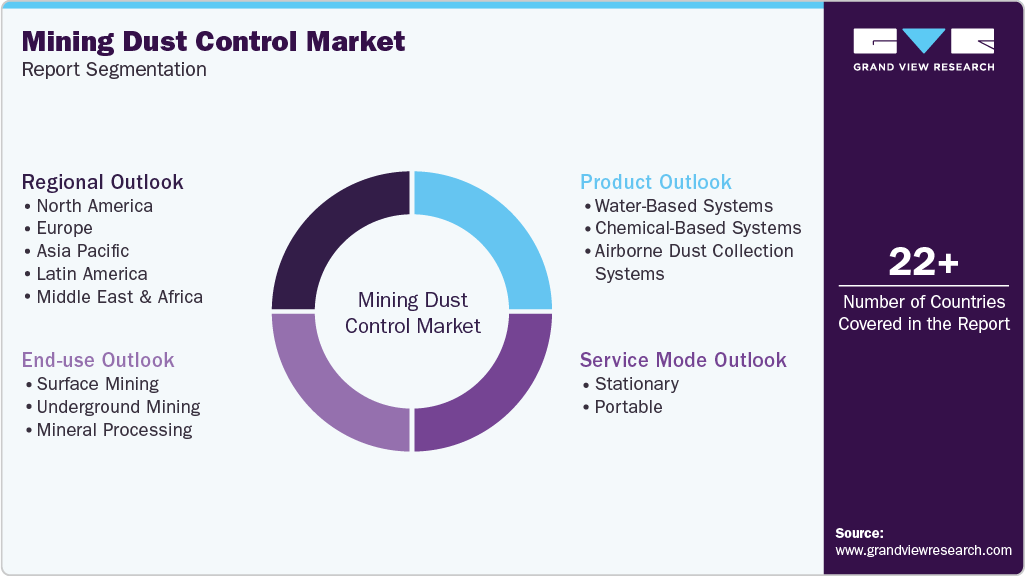
This report forecasts revenue growth at global, regional, and country levels and provides an analysis of the latest industry trends in each of the sub-segments from 2021 to 2033. For this study, Grand View Research has segmented the global mining dust control market report based on product,service mode, end-use, and region:
-
Product Outlook (Revenue, USD Million, 2021 - 2033)
-
Water-Based Systems
-
Chemical-Based Systems
-
Airborne Dust Collection Systems
-
Baghouse Filters
-
Cyclone Separators
-
Electrostatic Precipitators
-
-
-
Service Mode Outlook (Revenue, USD Million, 2021 - 2033)
-
Stationary
-
Portable
-
-
End-use Outlook (Revenue, USD Million, 2021 - 2033)
-
Surface Mining
-
Underground Mining
-
Mineral Processing
-
-
Regional Outlook (Revenue, USD Million, 2021 - 2033)
-
North America
-
U.S.
-
Canada
-
Mexico
-
-
Europe
-
Germany
-
France
-
Italy
-
Spain
-
UK
-
-
Asia Pacific
-
China
-
India
-
Japan
-
South Korea
-
Australia
-
-
Latin America
-
Brazil
-
Argentina
-
-
Middle East and Africa
-
Saudi Arabia
-
UAE
-
South Africa
-
-
Frequently Asked Questions About This Report
The global mining dust control market size was valued at USD 3.2 billion in 2024 and is estimated at USD 3.4 billion for 2026.
The global mining dust control market is expected to grow at a CAGR of 5.2% from 2025 to 2033, reaching USD 4.9 billion by 2033.
Stationary dust control systems dominate the mining market and accounted for a share of 60.6% in 2024, due to their ability to handle large-scale operations efficiently. They offer continuous dust suppression and are integrated into permanent infrastructure for long-term use. High reliability and minimal manual intervention make them ideal for major mining sites.
Some of the key players operating in the global mining dust control market include Donaldson Company, RoboVent, Lechler USA, BossTek, Carroll Technologies Group, Xylem, Camfil APC, Benetech, Inc., Dust Solutions, Inc., Griffin Filters, C&W DustTech, Imperial Systems, Inc., Cargill, Incorporated, Ecolab, and BASF.
The global mining dust control market is driven by stringent health and safety regulations, increasing awareness of occupational hazards, and the need for environmental compliance. Growing mining activities and adoption of advanced dust suppression technologies further boost demand. Technological innovations in automated and efficient dust control systems also support market growth.
About the Author(s)
Advanced Materials Research Team
Research · Advanced MaterialsThis report was authored by the advanced materials research team at Grand View Research - comprising two research analysts, one senior research analyst, and one industry expert - with specialized expertise in the advanced materials segment of the research industry. All findings are based on proprietary research databases, executive interviews, and regulatory analysis, subject to internal peer review prior to publication.
Last Updated:
Speak to Analyst


Need a Tailored Report?
Customize this report to your needs — add regions, segments, or data points, with 20% free customization.
Or view our licence options:


ISO 9001:2015 & 27001:2022 Certified
We are GDPR and CCPA compliant! Your transaction & personal information is safe and secure. For more details, please read our privacy policy.












