
- Home
- »
- Automotive & Transportation
- »
-
Mining Truck Market Size, Share & Trends Report 2026-2033GVR Report cover
![Mining Truck Market (2026 - 2033)Report]()
Mining Truck Market (2026 - 2033)
Size, Share & Trend Analysis By Truck Type (Haul Trucks, Dump Trucks) By Power Source (Diesel-Powered, Electric-Powered), By Load Capacity, By Application, By Region, And Segment Forecasts
Market Size, 2025
$21.2BMarket Estimate, 2026
$22.2BMarket Forecast, 2033
$33.1BCAGR, 2026–2033
5.9%Mining Truck Market Summary
The global mining truck market size was valued at USD 21.2 billion in 2025 and is projected to grow from USD 22.2 billion in 2026 to USD 33.1 billion by 2033, at a CAGR of 5.9% from 2026 to 2033. The Asia Pacific market led the global market and accounted for 43.3% of the global revenue in 2025. The expansion of surface mining activities is driving the market growth.

Key Market Trends & Insights
- By truck type: Dump trucks type segment led the market and accounted for 50.7% of the global revenue in 2025
- By power source: Diesel-powered segment led the market and accounted for 86.0% of the global revenue in 2025.
- By load capacity: Heavy-duty (200-400 tons) segment accounted for the largest share of 38.2% in 2025.
- By applications: Surface mining segment accounted for the largest market revenue share of 59.7% in 2025.
Regional Highlights
- Largest regional market: Asia Pacific (43.3% revenue share, 2025)
- By country: China held the largest market share in 2025.
Market Size & Forecast
- Market size in 2025: USD 21.2 Billion
- Estimated market size in 2026: USD 22.2 Billion
- Projected market size by 2033: USD 33.1 Billion
- CAGR (2026-2033): 5.9%
Increasing demand for higher mining productivity is driving the adoption of high-capacity mining trucks. Mining operators are focusing on moving larger quantities of ore and waste in fewer trips. This is increasing demand for trucks with higher payload capacity, improved fuel efficiency, and greater operating reliability. The expansion of large-scale surface mining projects is further increasing the need for efficient material transportation. Moreover, the growing focus on improving material-handling efficiency is driving growth in the mining trucks market.The growing adoption of autonomous technology is emerging as a major trend in the mining trucks market. Mining operators are increasingly using automated hauling systems to improve vehicle utilization and reduce operational risks. Advanced sensors, fleet-management systems, and real-time monitoring are enabling trucks to operate with less human intervention. Autonomous technology is also helping improve consistency in repetitive hauling operations. As a result, the integration of automation and digital technologies is reshaping mining truck operations.

Stricter environmental regulations are encouraging mining operators to reduce emissions from heavy-duty mining equipment. Regulatory authorities are increasing requirements related to diesel emissions, air quality, and greenhouse gas reduction. These requirements are encouraging the development and adoption of electric, hybrid, and other lower-emission mining trucks. Mining companies are also increasing their focus on reducing fuel consumption to meet environmental targets. Moreover, tightening emission requirements are supporting the transition toward cleaner mining truck technologies.
High initial costs can restrain the adoption of advanced mining trucks. Large mining trucks require significant investment in vehicles, maintenance systems, charging infrastructure, and supporting equipment. Electric and autonomous models can require additional infrastructure and specialized technologies. These high upfront costs can limit adoption among smaller mining operators.
Market Dynamics
The market is being shaped by rising mineral extraction activity, growing demand for high-productivity material handling, and the transition toward safer, lower-emission mining operations. Mining companies are increasingly investing in high-capacity haulage equipment, autonomous driving systems, battery-electric trucks, trolley-assist technologies, and digital fleet-management solutions. At the same time, high equipment costs, charging infrastructure requirements, and operational complexity remain important barriers to adoption. Moreover, the market is moving toward connected, automated, and electrified mining truck fleets, with equipment manufacturers expanding their technology portfolios to support the transition.
Mining companies are increasingly adopting autonomous equipment to improve productivity, enhance operator safety, and maintain continuous operations in demanding mine environments. Conventional truck operations depend heavily on skilled operators and can expose personnel to risks associated with heavy vehicles, blasting, dust, and difficult terrain. The need to operate mines continuously while controlling labor and operating costs is therefore increasing interest in autonomous haulage systems. Autonomous capabilities are also expanding beyond large open-pit mines into smaller mining, quarrying, and material-handling applications. This broader applicability is increasing the addressable market for autonomous mining trucks.
Mining truck manufacturers are integrating autonomous driving, fleet management, collision avoidance, remote control, and route optimization technologies into their truck platforms. These technologies enable trucks to operate more consistently while reducing operator exposure to hazardous mining environments. Autonomous systems can also improve truck utilization, optimize haul cycles, reduce idle time, and support continuous material transportation. As mining companies increasingly prioritize safety, productivity, and operational efficiency, the growing deployment of autonomous haulage technologies is expected to accelerate demand for autonomous mining trucks.
Mining trucks require substantial upfront investment because of their large size, high-capacity powertrains, specialized components, and demanding operating requirements. The investment increases further when mines transition from conventional diesel trucks to battery-electric or trolley-assisted systems, as operators may also need charging stations, electrical distribution systems, power-management equipment, and maintenance capabilities. These requirements can make advanced mining trucks less economically attractive for smaller mining companies and operations with limited infrastructure. The complexity of integrating new technologies with existing mine fleets can further extend purchasing and deployment timelines.
The restraint is particularly significant for smaller mines, quarrying operations, and developing mining regions where access to high-capacity electrical infrastructure and specialized technical support may be limited. Electrification also requires operators to consider charging time, battery management, fleet scheduling, and site-specific power availability. Although electric systems can reduce operating costs over time, the initial infrastructure investment can delay fleet replacement decisions. Moreover, adoption of high-capacity electric and autonomous trucks is expected to progress faster among large mining companies with substantial capital budgets and long-term decarbonization programs.
The transition toward lower-emission mining operations is creating significant opportunities for manufacturers of electric and hybrid mining trucks. Mining companies are under increasing pressure to reduce diesel consumption, greenhouse-gas emissions, ventilation requirements, and operating costs. This is encouraging the development of battery-electric, trolley-assisted, and diesel-electric mining trucks for both surface and underground applications. Growing investment in mine electrification, charging infrastructure, and renewable energy integration is further supporting the adoption of low-emission mining equipment.
The opportunity spans high-capacity surface trucks, underground haul trucks, electric articulated haulers, charging infrastructure, and associated fleet-management systems. Electric and hybrid mining trucks can improve energy efficiency, reduce fuel consumption, and lower emissions while meeting the operational requirements of large-scale mining operations. The expansion of autonomous and connected technologies alongside electrification is also creating opportunities for integrated mining truck solutions. As mining companies increase their investments in sustainable and efficient fleets, manufacturers with strong electrification capabilities, comprehensive product portfolios, and aftermarket services are well-positioned to capture this growing opportunity.
Market Concentration & Characteristics
The mining truck industry is moderately concentrated, with several established global manufacturers offering rigid haul trucks, articulated trucks, and underground mining trucks, as well as specialized high-capacity hauling solutions for surface and underground mining, quarrying, and construction applications. Companies are focusing on expanding production capacity, developing higher-capacity, fuel-efficient trucks, and investing in autonomous driving, electrification, digital fleet management, and advanced safety technologies. As mining companies increase investments in fleet replacement and modernization, manufacturers continue to compete on product performance, payload capacity, technology integration, customization, and comprehensive aftermarket support rather than through full market consolidation.

Moderate market concentration is further supported by the strong presence of established companies such as Caterpillar Inc., Komatsu Ltd., Liebherr Group, Hitachi Construction Machinery Co., Ltd., and Epiroc AB, which continue to strengthen their positions through product innovation, automation, electrification, strategic partnerships, and relationships with global mining customers. At the same time, companies including XCMG Group, SANY Group, Sandvik AB, AB Volvo, and Hyundai Construction Equipment Co., Ltd. are expanding their presence through competitive pricing, specialized mining equipment, electric trucks, articulated haulers, and advanced technology solutions. Market participants primarily compete on payload capacity, fuel efficiency, equipment durability, automation, electrification, operating costs, safety, customization, and aftermarket services, thereby maintaining the mining truck industry’s moderately concentrated nature.
Analyst Perspective
The market is shifting from conventional diesel fleets toward automated, connected, and electrified haulage systems. Autonomous technologies are improving safety, productivity, and truck utilization across mining operations. Battery-electric and trolley-assisted trucks are gaining importance as operators seek to reduce emissions, fuel consumption, and operating costs. Investment is increasingly focused on electric powertrains, charging infrastructure, autonomous fleet-management systems, and digital solutions. Competitive advantage is expected to depend on the integration of high-capacity trucks with automation, electrification, connectivity, and lifecycle support.
Truck Type Insights
The dump truck segment accounted for the largest share of global revenue in 2025, at 50.7%. Growth in the dump trucks segment is primarily driven by increasing demand for efficient material transportation across mining operations. Articulated trucks are in demand because they can transport heavy loads over uneven, difficult terrain, while underground mining trucks move ore and waste in confined underground environments. Mining companies are also investing in higher-capacity and more efficient dump trucks to improve productivity and reduce operating costs. The adoption of electric, automated, and advanced haulage technologies is further supporting the growth of the dump trucks segment.
The haul trucks type segment is projected to grow at the fastest CAGR over the forecast period. This segment is witnessing strong demand as mining operators focus on increasing material movement and improving fleet productivity. The expansion of large-scale surface mining activities is increasing the need for high-capacity hauling solutions. The rising adoption of automation and advanced fleet management systems is further improving truck utilization and operational efficiency. Moreover, continued investment in mine expansion and productivity improvements is driving growth in the haul trucks segment.
Power Source Insights
The diesel-powered segment accounted for 86.0% of the largest share of global revenue in 2025. Growth in the diesel-powered segment of the market is primarily driven by its proven performance, high power output, and suitability for heavy-duty mining operations. Diesel engines remain widely used in haul trucks, dump trucks, and underground mining trucks, particularly for demanding applications requiring high payload capacity and long operating hours. Their established refueling infrastructure, long operating range, and reliability in remote mining locations make diesel-powered trucks a practical choice for large-scale mining operations.
The hydrogen-powered segment is projected to grow at the fastest CAGR over the forecast period. The hydrogen-powered segment is gaining attention as mining companies seek lower-emission alternatives for heavy-duty material transportation. Hydrogen-powered mining trucks can support long operating hours while reducing direct carbon emissions compared with conventional diesel equipment. Advances in hydrogen fuel cell technology, refueling infrastructure, and clean hydrogen production are enhancing the potential of these trucks for large-scale mining operations. Growing decarbonization targets and demand for cleaner heavy-duty equipment are expected to support the adoption of hydrogen-powered mining trucks.
Load Capacity Insights
The heavy-duty (200-400 tons) segment accounted for the largest share of global revenue in 2025. Growth in the heavy-duty (200-400 tons) segment is driven by its suitability for large-scale surface mining operations requiring high-volume material transport. Mining trucks in this capacity range provide a strong balance between payload capacity, productivity, and operating efficiency for moving ore, overburden, and waste rock. Mining companies increasingly prefer heavy-duty trucks to improve haulage productivity without the higher capital and infrastructure requirements associated with ultra-class trucks. The expansion of large open-pit mining operations is therefore supporting demand for heavy-duty mining trucks.
The ultra-class (above 400 tons) segment is expected to grow at a significant CAGR over the forecast period. The Ultra-Class (Above 400 tons) segment is expanding rapidly, driven by the growing need for high-capacity mining trucks to support large-scale open-pit mining operations. As major mining companies focus on maximizing throughput and operational efficiency, demand for ultra-class haul trucks continues to rise. These trucks are essential for handling massive volumes of overburden, ore, and waste rock while reducing haul cycles in high-production environments. Demand is particularly strong in large-scale mining operations involving commodities such as iron ore, copper, and coal.
Application Insights
The surface mining segment accounted for the largest market revenue share in 2025. Growth in the surface mining segment is driven by the continued expansion of large-scale open-pit mining operations for coal, iron ore, copper, and other bulk minerals. Mining companies are increasingly using high-capacity haul trucks, dump trucks, and articulated trucks to efficiently transport large volumes of ore, overburden, and waste rock. The focus on improving productivity, reducing haulage costs, and modernizing mining fleets is further supporting demand for advanced surface mining trucks. Growing mineral production and new open-pit mining projects are therefore expected to sustain demand for surface mining trucks.
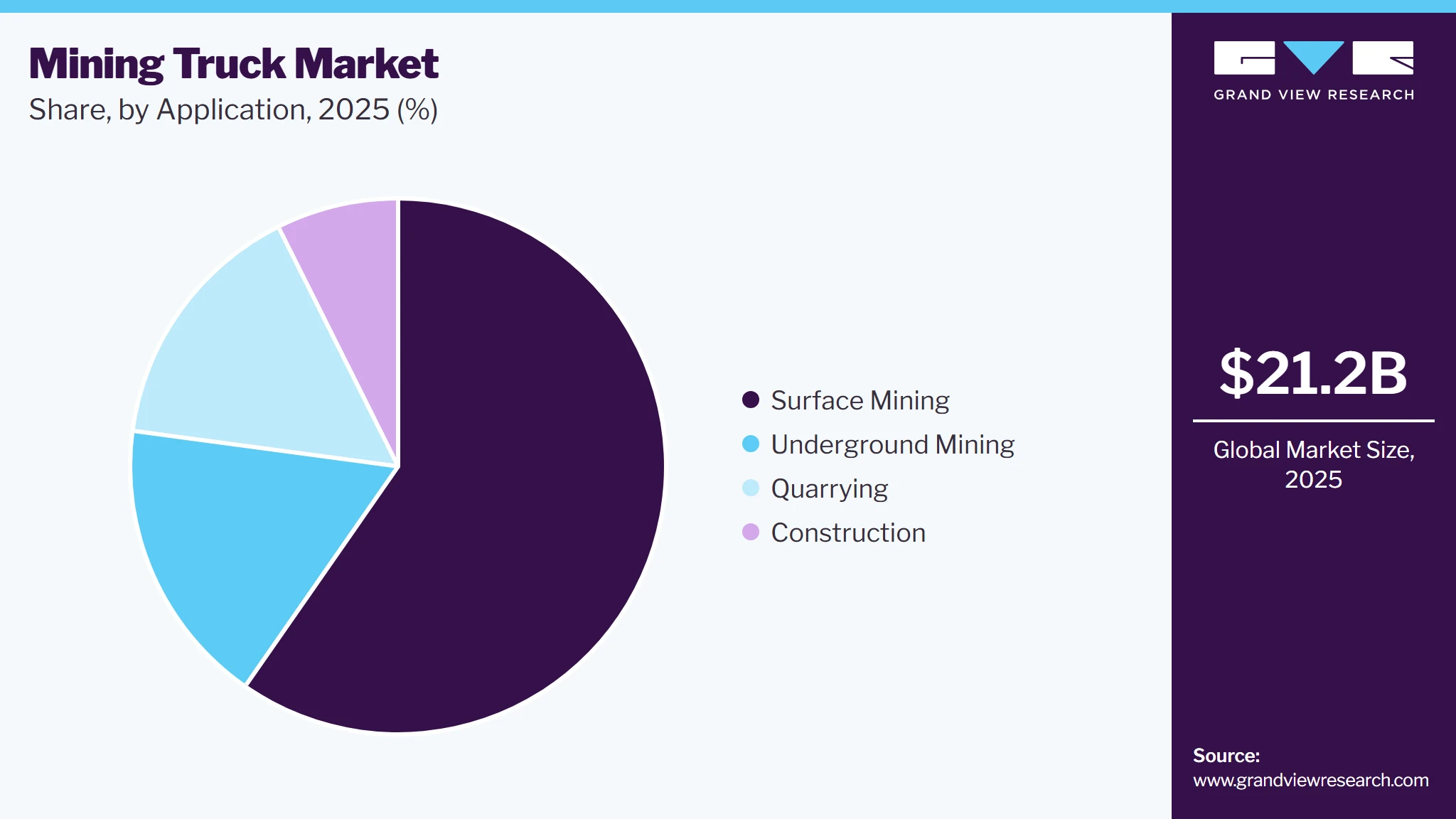
The underground mining segment is projected to grow at the fastest CAGR over the forecast period, driven by rising demand for metals and minerals that require deeper, more complex extraction methods. As accessible surface deposits decline, mining companies are expanding underground operations to access deeper ore bodies, increasing the need for specialized haulage equipment. This is supporting demand for underground mining trucks that can transport ore and waste efficiently through confined mine environments. The growing adoption of electric and automated underground trucks is further improving productivity, safety, and operational efficiency.
Regional Insights
The Asia Pacific mining truck market led the global market, accounting for 43.3% of global revenue in 2025, and is projected to grow at the fastest CAGR over the forecast period. Asia Pacific is experiencing increasing deployment of smart mining technologies that combine autonomous transportation, connectivity, and electrification. Mining operators are using these technologies to improve productivity, reduce safety risks, and optimize material movement. The expansion of intelligent mine infrastructure is therefore supporting demand for autonomous and digitally connected mining trucks.

China Mining Truck Market Trends
The mining truck market in China held a dominant share in the Asia Pacific market. China is rapidly integrating autonomous electric trucks into large-scale mining and quarrying operations. Limestone quarries are increasingly deploying unmanned electric mining trucks supported by 5G connectivity, combining electrification with autonomous haulage. This development is encouraging the adoption of battery-electric haul trucks and autonomous systems, as well as supporting charging infrastructure.
Japan mining truck market is expected to grow at a significant CAGR over the forecast period. Japan is increasingly focusing on automation and connected transportation technologies. These developments are supporting the use of autonomous and remotely operated vehicles in industrial applications. Mining operators can benefit from these technologies through improved vehicle coordination, safety, and operational efficiency. This is creating opportunities for connected, automated, and remotely controlled mining trucks in Japan.
North America Mining Truck Market Trends
The mining truck market in North America held a significant share of the market in 2025. North America is witnessing increasing investment in critical mineral projects, supporting demand for material extraction and transportation equipment. In the U.S., large-scale mining operations require high-capacity haul trucks for moving ore, waste rock, and overburden. This expansion of domestic mineral development is supporting demand for mining trucks across surface and underground applications.
The U.S. mining truck market holds the largest market share. The U.S. mining industry is increasingly adopting autonomous haulage to improve safety, productivity, and truck utilization. For instance, in April 2026, Komatsu Ltd. announced the deployment of its 1,000th autonomous ultra-class haul truck. This milestone highlights the growing adoption of autonomous haulage in large-scale mining. The company also combining autonomous and electric-drive technologies to improve safety and productivity. This development is supporting the adoption of advanced mining trucks across major mining operations.
Europe Mining Truck Market Trends
The mining truck market in Europe poised significant growth from 2026 to 2033. Europe is strengthening domestic and international critical-mineral supply chains to support clean-energy and industrial requirements. Germany is also deepening cooperation on critical minerals, including initiatives with Canada to strengthen supply-chain resilience and investment. This focus is expected to support mining activity and the associated demand for high-productivity material-transportation equipment.
The UK mining truck market is driven by the development of domestic critical mineral resources, creating opportunities for the mining equipment market. Government efforts to strengthen local mineral supply and reduce supply-chain dependence are encouraging investment in extraction activities. This is expected to increase the need for material-handling equipment, including mining trucks, across emerging mining projects.
The mining truck market in Germany held a substantial share in Europe. Germany is strengthening its focus on modernizing mining and industrial equipment. This is encouraging operators to replace conventional diesel equipment with more efficient alternatives. Mining trucks with electric and energy-efficient powertrains can help reduce fuel consumption and operating costs. The shift is also supporting the development of advanced haulage technologies for quarrying and mining applications. As modernization continues, demand for next-generation mining trucks is expected to increase.
Key Mining Truck Company Insights
Key players operating in the market include Caterpillar Inc., Komatsu Ltd., Liebherr Group, XCMG Group, Epiroc AB, Hitachi Construction Machinery Co., Ltd., AB Volvo, SANY Group, Sandvik AB, and Hyundai Construction Equipment Co., Ltd. Key players in the market are expanding their portfolios with high-capacity, fuel-efficient, autonomous, and electric mining trucks while strengthening partnerships with mining operators and technology providers. Companies are focusing on improving payload capacity, enhancing safety, integrating automation and electrification, and supporting the growing demand for surface mining, underground mining, quarrying, construction, and low-emission mining.
-
Komatsu Ltd. is a global manufacturer of construction, mining, and material-handling equipment. The company offers a range of construction equipment, including hydraulic excavators, bulldozers, wheel loaders, forklifts, and forestry machinery. Komatsu Ltd.'s strategy focuses on driving sustainable growth by creating new value to address social issues, improve profitability, and fulfill corporate social responsibility.
-
Sandvik AB is an engineering group specializing in mining and rock excavation equipment, tools, and digital solutions for the mining and infrastructure sectors. In the market, the company offers a broad portfolio of underground and surface mining equipment, including drill rigs, loaders, trucks, rock tools, crushing and screening systems, and mine automation technologies. Sandvik AB focuses on enhancing mining productivity through advanced automation, electrification, and digital mining solutions, supported by data-driven analytics platforms.
Key Mining Truck Companies
The following key companies have been profiled for this study on the mining truck market.
-
Caterpillar Inc.
-
Komatsu Ltd.
-
Liebherr Group
-
XCMG Group
-
Epiroc AB
-
Hitachi Construction Machinery Co., Ltd.
-
AB Volvo
-
SANY Group
-
Sandvik AB
-
Hyundai Construction Equipment Co., Ltd.
Competitive Benchmarking
Operating Strategies
Competitive Edge
Weaknesses
Mature Players: Caterpillar Inc., Komatsu Ltd., Liebherr Group, Hitachi Construction Machinery Co., Ltd., Epiroc AB
- Mature players in the mining truck industry are focus on broad mining-equipment portfolios, long-term relationships with mining companies, continuous product development, autonomous haulage, electrification, digital fleet-management solutions, and extensive aftermarket support.
- Mature players gain a competitive advantage through strong global presence, established installed fleets, high-capacity truck portfolios, technology capabilities, dealer/service networks, and strong customer relationships.
- These companies often face challenges related to high product and development costs can result in premium equipment pricing. Large organizational structures can also make product customization and rapid entry into niche applications slower than smaller competitors.
Emerging Players: Sandvik AB, XCMG Group
- Emerging players in the mining truck industry are focusing on specialized mining equipment, electrification, automation, competitive pricing, and expansion into new geographic markets.
- Emerging players gain market traction through strong underground mining expertise and electric equipment capabilities provide a competitive advantage. Manufacturing scale, competitive pricing, and autonomous electric truck technologies further strengthen market positioning.
- Emerging players face limitations due to compared with the largest established mining OEMs; these companies have relatively less extensive global installed fleets and service networks in some major mining markets. This can create challenges in gaining customer trust, providing localized aftermarket support, and competing for large long-term fleet contracts.
Recent Developments
-
In January 2025, AB Volvo (Volvo Construction Equipment) launched a new lineup of articulated haulers from A25 to A60, including a new A50 model. The updated features include advanced electronics, a redesigned cab, and an improved transmission, boosting productivity, fuel efficiency, and safety. Built with sustainability in mind, these trucks are ideal for mining and heavy construction.
-
In February 2025, Komatsu Ltd. and Bridgestone Corporation launched a proof-of-concept collaboration to improve fuel efficiency and extend tire life for large mining trucks. The initiative integrates Bridgestone’s tire monitoring data with Komatsu’s machine operation and health data to help mining operators optimize performance, reduce operating costs, and lower CO₂ emissions.
Mining Truck Market Report Scope
Report Attribute
Details
Market size in 2025
USD 21.2 billion
Estimated market size in 2026
USD 22.2 billion
Projected market size by 2033
USD 33.1 billion
Growth rate
CAGR of 5.9% from 2026 to 2033
Historical data
2021 - 2025
Forecast period
2026 - 2033
Quantitative units
Revenue in USD billion and CAGR from 2026 to 2033
Report coverage
Revenue forecast, company ranking, competitive landscape, growth factors, and trends
Segments covered
Truck type, power source, load capacity, application, region
Regional scope
North America; Europe; Asia Pacific; Latin America; MEA
Country scope
U.S.; Canada; Mexico; Germany; UK; France; China; Japan; India; South Korea; Australia; Brazil; KSA; UAE; South Africa
Key companies profiled
Caterpillar Inc.; Komatsu Ltd.; Liebherr Group; XCMG Group; Epiroc AB; Hitachi Construction Machinery Co., Ltd.; AB Volvo; SANY Group; Sandvik AB; Hyundai Construction Equipment Co., Ltd.
Customization scope
Free report customization (equivalent up to 8 analysts working days) with purchase. Addition or alteration to country, regional & segment scope.
Pricing and purchase options
Avail customized purchase options to meet your exact research needs. Explore purchase options
Global Mining Truck Market Report Segmentation
The report forecasts revenue growth at global, regional, and country levels and provides an analysis of the latest industry trends in each of the sub-segments from 2021 to 2033. For this study, Grand View Research has segmented the global mining truck market based on truck type, power source, load capacity, application, and region:
-
Truck Type Outlook (Revenue, USD Billion, 2021 - 2033)
-
Haul Trucks
-
Dump Trucks
-
Articulated Trucks
-
Underground Mining Trucks
-
-
Power Source Outlook (Revenue, USD Billion, 2021 - 2033)
-
Diesel-Powered
-
Electric-Powered
-
Hybrid (Diesel-Electric)
-
Hydrogen-Powered
-
-
Load Capacity Outlook (Revenue, USD Billion, 2021 - 2033)
-
Light-Duty (Up to 100 tons)
-
Medium-Duty (100-200 tons)
-
Heavy-Duty (200-400 tons)
-
Ultra-Class (Above 400 tons)
-
-
Application Outlook (Revenue, USD Billion, 2021 - 2033)
-
Surface Mining
-
Underground Mining
-
Quarrying
-
Construction
-
-
Regional Outlook (Revenue, USD Billion, 2021 - 2033)
-
North America
-
U.S.
-
Canada
-
Mexico
-
-
Europe
-
Germany
-
UK
-
France
-
-
Asia Pacific
-
China
-
India
-
Japan
-
South Korea
-
Australia
-
-
Latin America
-
Brazil
-
-
Middle East & Africa (MEA)
-
UAE
-
Kingdom of Saudi Arabia (KSA)
-
South Africa
-
-
Research Methodology
The mining truck market figures in this report are based on a proven research process that combines executive interviews with secondary research from proprietary databases, company filings, and recognized regulatory and institutional sources. Market size is built through value-chain sizing-reconciling supply-side and demand-side estimates-and triangulated with bottom-up and top-down approaches. Every estimate passes multiple levels of expert validation before publication, with each mining truck segment quantified using the revenue-capture definitions in the table below.
Segment Definition
Segment - Truck Type
Revenue capture definition
Haul Trucks
The segment revenue is generated from the sale of rigid-frame and off-highway haul trucks used to transport ore, waste rock, overburden, and other mined materials in surface mining operations.
Dump Trucks
The segment revenue is generated from the sale of dump trucks equipped with tipping bodies for transporting and unloading bulk materials across mining, quarrying, and construction sites. The segment includes truck types such as articulated trucks and underground mining trucks
- Articulated Trucks: The segment revenue is generated from the sale of articulated dump trucks and haulers designed to transport materials across uneven, steep, and challenging terrain in mining, quarrying, and construction applications.
- Underground Mining Trucks: The segment revenue is generated from the sale of articulated dump trucks and haulers designed to transport materials across uneven, steep, and challenging terrain in mining, quarrying, and construction applications.
Segment - Power Source
Revenue capture definition
Diesel-Powered
The segment revenue is generated from mining trucks powered primarily by internal-combustion diesel engines, including rigid haul trucks, dump trucks, articulated trucks, and underground trucks sold with conventional diesel powertrains.
Electric-Powered
The segment revenue is generated from mining trucks powered primarily by battery-electric or externally supplied electrical energy, including battery-electric trucks, trolley-assisted trucks, and associated factory-integrated electric-drive systems.
Hybrid (Diesel-Electric)
The segment revenue is generated from mining trucks combining a diesel engine with an electric drivetrain or electrical power system to improve energy efficiency, traction, productivity, or fuel utilization.
Hydrogen-Powered
The segment revenue is generated from mining trucks using hydrogen fuel-cell or hydrogen-based power systems as the primary energy source, including trucks incorporating hydrogen power modules and associated vehicle-specific energy systems.
Segment - Load Capacity
Revenue capture definition
Light-Duty (Up to 100 tons)
The segment revenue is generated from mining trucks with rated payload capacities of up to 100 tons, including smaller haul trucks and articulated trucks used for material transportation.
Medium-Duty (100-200 tons)
The segment revenue is generated from mining trucks with rated payload capacities between 100 and 200 tons, primarily used for medium- to large-scale surface mining and quarrying operations.
Heavy-Duty (200-400 tons)
The segment revenue is generated from mining trucks with rated payload capacities between 200 and 400 tons, including high-capacity rigid haul trucks used in large-scale open-pit mining.
Segment - Application
Revenue capture definition
Surface Mining
The segment revenue is generated from mining trucks used to transport ore, overburden, waste rock, and other materials within open-pit and surface mining operations.
Underground Mining
The segment revenue is generated from specialized mining trucks used to transport ore, waste, and excavated materials through underground mining.
Quarrying
The segment revenue is generated from mining trucks and articulated haulers used to transport aggregates, limestone, stone, sand, gravel, and other quarry materials.
Construction
The segment revenue is generated from dump trucks and articulated haulers used to transport excavated soil, rock, aggregates, and other bulk materials at construction and infrastructure sites.
Estimation Model
Layer Name
Key Question
Description
Mining Activity & Fleet Demand
How much mining activity generates truck demand?
This layer evaluates mining production, mineral extraction volumes, mine development, quarrying activity, and construction material movement. It identifies the underlying requirement for material transportation across surface and underground operations. The analysis considers the number and scale of operating mines and the expansion or replacement of mining fleets. These factors establish the fundamental demand pool for mining trucks.
Truck Fleet & Replacement Analysis
How many trucks are required or replaced?
This layer estimates demand based on existing mining truck fleets, fleet age, utilization rates, replacement cycles, mine capacity, and fleet expansion requirements. Replacement demand is assessed separately from incremental demand generated by new mining projects. The analysis also considers changes in truck capacity as operators move toward higher-productivity equipment. This layer converts mining activity into estimated truck-unit requirements.
Revenue per Truck & Technology Mix
What value is captured per truck?
This layer determines the revenue value associated with different mining truck types, load capacities, power sources, and applications. Pricing differences between conventional diesel, diesel-electric, battery-electric, autonomous, and specialized underground trucks are considered. Premium technology content, including autonomous systems, electric drivetrains, telematics, and fleet-management systems, can increase revenue captured per unit. The layer therefore converts estimated truck demand into market revenue.
Market Revenue & Validation
Does the estimated market value align with industry activity?
This layer consolidates truck-unit demand and revenue per unit to derive the overall mining truck market value. The resulting estimates are cross-checked against manufacturer product portfolios, production announcements, fleet deployments, major mining equipment orders, and regional mining investment activity. Differences between top-down mining activity estimates and bottom-up manufacturer or fleet estimates are investigated and reconciled. The final output provides a validated market size and forecast by truck type, power source, load capacity, application, and region.
Delivered Customization
We have successfully delivered the following deep-dive customizations
Client Request
Customization Delivered
Value Adds
Regional Mining Truck Market Opportunity Assessment
Country/region-wise market sizing and forecasts
Analysis of demand, adoption trends, and regulatory landscape
Identification of high-growth regions and investment hotspots
Identified region-specific growth opportunities
Supported expansion and go-to-market strategy
Enabled informed regional investment decisions
Cross-Segmentation Analysis for the Mining Truck Market
Criss-cross market analysis by truck type, power source, load capacity, application
Demand and adoption assessment across key segments
Segment attractiveness and growth potential benchmarking
Identified high-potential market segments
Supported targeted truck type positioning and marketing strategy
Improved customer and segment prioritization
Competitive Benchmarking and Strategic Positioning in the Mining Truck Market
Benchmarking of key competitors across truck types, pricing, partnerships, and innovation
Comparative assessment of market share, capabilities, and strategies
Analysis of competitive strengths, gaps, and differentiation areas
Identified competitive white spaces and growth gaps
Supported strategic positioning and differentiation
Enabled data-driven competitive strategy development
Frequently Asked Questions About This Report
The global mining truck market size was estimated at USD 21.2 billion in 2025 and is expected to reach USD 22.2 billion in 2026.
The global mining truck market is expected to grow at a CAGR of 5.9% from 2026 to 2033, reaching USD 33.9 billion by 2033.
Dump trucks segment accounted for 50.7% of the largest share of global revenue in 2025. Growth in the dump trucks segment is primarily driven by increasing demand for efficient material transportation across mining operations.
The Asia Pacific mining truck market led the global market and accounted for 43.3% of the global revenue in 2025 and is projected to grow at the fastest CAGR over the forecast period. Asia Pacific is experiencing increasing deployment of smart mining technologies that combine autonomous transportation, connectivity, and electrification
The increasing expansion of surface mining activities is driving the growth of the mining truck market.
Some key players operating in the mining truck market include Caterpillar Inc., Komatsu Ltd., Liebherr Group, XCMG Group, Epiroc AB, Hitachi Construction Machinery Co., Ltd., AB Volvo, SANY Group, Sandvik AB, and Hyundai Construction Equipment Co., Ltd.
Diesel-powered segment accounted for 86.0% of the largest share of global revenue in 2025, while hydrogen-powered segment is projected to grow at the fastest CAGR over the forecast period.
Heavy-duty (200-400 tons) segment accounted for the largest share of global revenue in 2025, while ultra-class (above 400 tons) segment is expected to grow at a significant CAGR over the forecast period,
Surface mining segment accounted for the largest market revenue share of 59.7% in 2025, while underground mining segment is projected to grow at the fastest CAGR over the forecast period
About the Author(s)
Automotive & Transportation Research Team
Technology · Automotive & TransportationThis report was authored by the automotive & transportation research team at Grand View Research - comprising two research analysts, one senior research analyst, and one industry expert - with specialized expertise in the automotive & transportation segment of the technology industry. All findings are based on proprietary technology databases, executive interviews, and regulatory analysis, subject to internal peer review prior to publication.
Last Updated:
Speak to Analyst


Customize this report to your needs — add regions, segments, or data points, with 20% free customization.
Or view our licence options:


ISO 9001:2015 & 27001:2022 Certified
We are GDPR and CCPA compliant! Your transaction & personal information is safe and secure. For more details, please read our privacy policy.


