
- Home
- »
- Automotive & Transportation
- »
-
Electric Powertrain Market Size & Share Report, 2026-2033GVR Report cover
![Electric Powertrain Market (2026 - 2033)Report]()
Electric Powertrain Market (2026 - 2033)
Size, Share & Trends Analysis Report By Electric Vehicle (BEV, HEV/PHEV), By Component (Motor/Generator, Battery, Power Electronics Controller), By Region, And Segment Forecasts
Market Size, 2025
$121.7BMarket Estimate, 2026
$139.5BMarket Forecast, 2033
$436.9BCAGR, 2026–2033
17.7%Electric Powertrain Market Report Summary
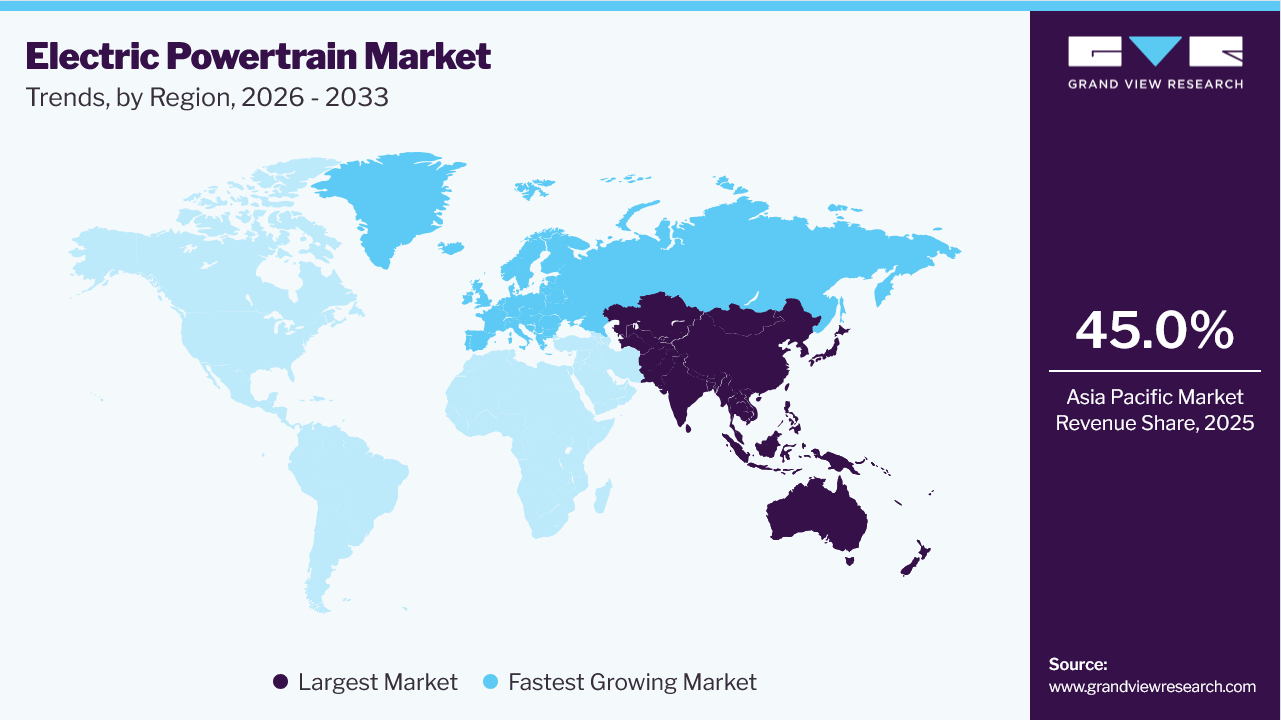
The global electric powertrain market size was valued at USD 121.7 billion in 2025 and is projected to grow from USD 139.5 billion in 2026 to USD 436.9 billion in 2033, at a CAGR of 17.7% from 2026 to 2033. Asia Pacific dominated the global market, accounting for the largest revenue share of 45.0% in 2025. The market is primarily driven by the accelerating adoption of battery electric vehicles (BEVs) and the growing commitment of automotive manufacturers toward vehicle electrification.
Key Market Trends & Insights
- By electric vehicle: The BEV segment held the largest market share of more than 70.0% in 2025.
- By component: The battery segment held the largest market share of around 63.5% in 2025.
Regional Insights
- Largest regional market: Asia Pacific (45.0% revenue share, 2025)
- Fastest-growing regional market: Europe (highest CAGR, 2026-2033)
Market Size & Forecast
- Market size in 2025: USD 121.7 Billion
- Estimated market size in 2026: USD 139.5 Billion
- Projected market size by 2033: USD 436.9 Billion
- CAGR (2026-2033): 17.7%
Three ways to get this report
Buy it, customize it, or ask a question.Ask an Analyst
A direct answer, usually in 1 working day
- AccessReport author, directly
- Reply timeWithin 1 working day
- No sales callDirect answer only
- FormatEmail reply
- CostFree, no cost
Get the Full Report
What the study covers
- FormatsPDF · Excel · Dashboard
- Timeline2026–2033 annual, 2025 base
- Coverage20+ countries, 5 regions
- Companies10+ key players profiled
Customize the Report
20% free customization
- IncludeCountries, segments, points
- TailorTo your product definition
- ExtendDeeper competitor detail
- OrA fully bespoke study
- Turnaround5–10 working days
The electric powertrain industry is driven by the strong growth and adoption of battery electric vehicles (BEVs), which is expected to be supported by manufacturers through electrification strategies and advanced innovation in electric powertrain technologies. The expansion of OEMs' all-electric vehicle portfolios is expected to drive investment in EV platforms, advanced battery systems, and electric drive technologies to support and improve vehicle efficiency.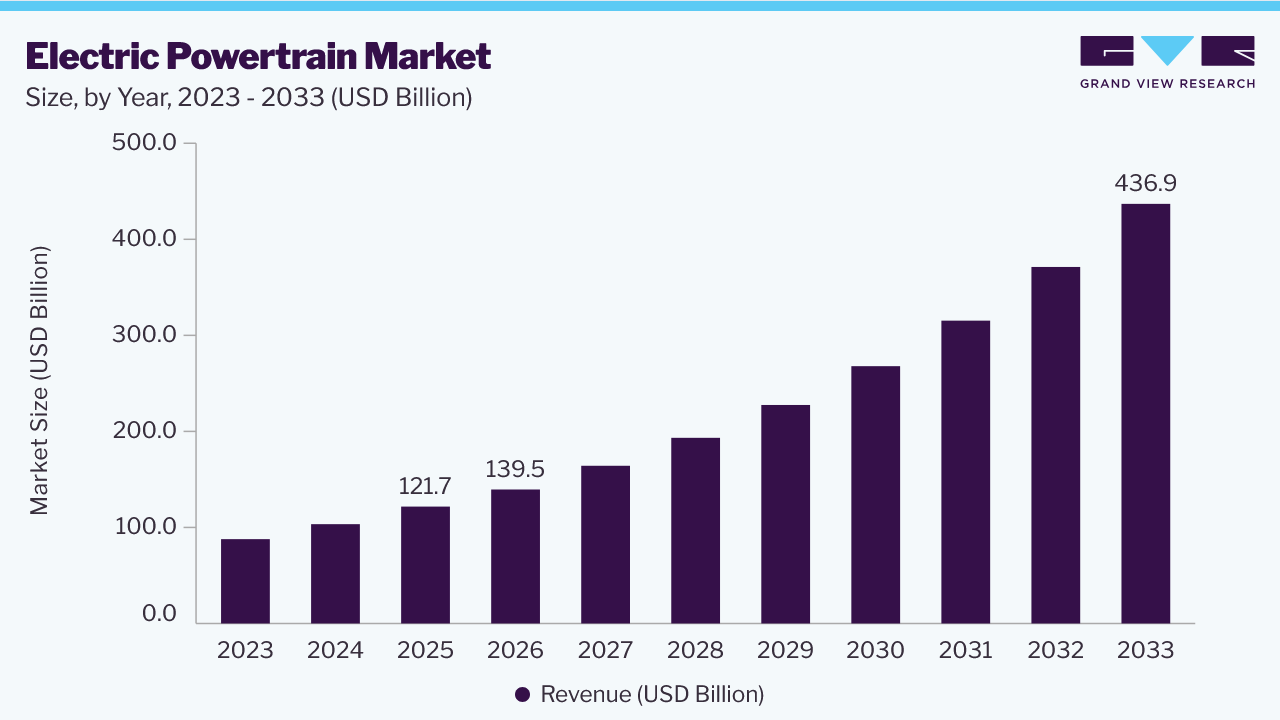
In addition, emission regulations and government policies that promote zero-emission mobility continue to accelerate the transition away from internal combustion engine vehicles. Furthermore, as the manufacturer introduces more technologies in advanced electric vehicles, which is expected to grow the demand for electric powertrain components, including electric motors, inverters, batteries, and power electronics, is expected to increase significantly.
For instance, in March 2026, Volkswagen Group announced that cumulative deliveries of its all-electric vehicles surpassed four million units globally. The company highlighted that approximately USD 3 million of these vehicles were built on its Modular Electric Drive Matrix (MEB) platform, reflecting the growing adoption of dedicated electric-vehicle architectures and supporting demand for advanced electric-powertrain technologies.
Analyst Perspective
The electric powertrain industry is increasingly developing at scale and with efficiency rather than as a pure electrification story. While vehicle electrification remains the primary driver of demand, long-term value creation will concentrate among manufacturers capable of integrating motors, power electronics, battery systems, and software architectures into a unified platform at scale. The next competitive advantage is unlikely to come from vehicle range alone, but from reducing system complexity, lowering cost per kilowatt, and improving energy efficiency across the drivetrain. As EV adoption broadens beyond early adopters into mass-market segments, companies that achieve manufacturing scale while maintaining powertrain efficiency will be best positioned to capture market share and defend profitability.
Electric Vehicle Insights
The BEV segment led the market with the largest revenue share of more than 70.0% in 2025. The segment dominance is driven by accelerating consumer adoption of fully electric vehicles and increasing investments by automakers in dedicated EV platforms. Stringent emission regulations, government incentive programs, and the continued expansion of charging infrastructure are encouraging the transition toward battery-electric mobility. In addition, ongoing advancements in battery technology are improving vehicle range, charging performance, and energy efficiency, strengthening demand for electric powertrain systems. Automakers are also expanding all-electric vehicle portfolios, further supporting the adoption of advanced electric motors, batteries, inverters, and power electronics.
The HEV/PHEVs segment is projected to grow at the fastest CAGR during the forecast period. Hybrid and plug-in hybrid vehicles offer a balance between conventional and electric propulsion technologies, enabling improved fuel efficiency and lower emissions while reducing range anxiety. Plug-in hybrid vehicles offer greater operational flexibility through larger battery packs that can be charged from external power sources. Growing consumer preference for transitional electrification technologies, especially in regions with developing charging infrastructure, continues to support demand for hybrid electric powertrain systems.
Component Insights
The battery segment led the market with the largest revenue share of around 63.5% in 2025. Batteries represent the core component of electric vehicle powertrains and play a critical role in determining vehicle range, performance, charging capability, and overall efficiency. Increasing investments in battery manufacturing, cell chemistry innovation, and localized supply chains are supporting broader EV adoption worldwide. Advancements in lithium-ion technologies, energy density improvements, and battery management systems are further enhancing vehicle performance, strengthening demand for advanced battery systems across electric vehicle platforms.
The motor/generator segment is projected to grow at the fastest CAGR during the forecast period. Rising production of battery-electric and hybrid-electric vehicles is increasing demand for high-efficiency electric motors and integrated drive systems. Manufacturers are investing in advanced motor technologies to improve vehicle performance, energy efficiency, and power delivery. In addition, collaborations between suppliers and automotive manufacturers are accelerating innovation and local production capabilities. For instance, in March 2026, Bosch Ltd and Tata AutoComp Systems Ltd announced a joint venture to engineer, manufacture, and supply electric motors and eAxle systems in India, supporting the development of next-generation electric powertrain technologies.
Regional Insights
The electric powertrain market in North America is expected to grow at a significant CAGR during the forecast period, due to increasing electric vehicle production, expanding charging infrastructure, and growing investments in battery manufacturing and vehicle electrification. The region benefits from the presence of major EV manufacturers and technology developers that continue to invest in advanced electric propulsion systems. Rising consumer adoption of electric vehicles, coupled with the expansion of charging networks and domestic battery supply chains, is contributing to demand for electric powertrain components, including batteries, electric motors, inverters, and power electronics.
Asia Pacific Electric Powertrain Market Trends
Asia Pacific dominated the global electric powertrain market with the largest revenue share of approximately 45.0% in 2025. The region's dominance is supported by strong electric vehicle adoption, large-scale manufacturing capabilities, and expanding investments in charging infrastructure across major economies such as China, India, Japan, and South Korea. Government initiatives promoting vehicle electrification and domestic EV production continue to support market expansion. For instance, in March 2025, BYD launched its Super e-Platform and announced plans to deploy approximately 4,000 ultra-fast charging stations across China. The initiative strengthens the EV ecosystem and supports broader adoption of advanced electric powertrain technologies.
Europe Electric Powertrain Market Trends
The electric powertrain market in Europe is expected to grow at the fastest CAGR during the forecast period, supported by strong electric-vehicle penetration and the presence of leading automotive manufacturers. Stringent emission regulations, vehicle electrification targets, and investments in sustainable mobility continue to accelerate the adoption of electric vehicles across the region. Germany remains one of the world's largest automotive manufacturing hubs, with companies such as Volkswagen, BMW, and Audi expanding their electric vehicle portfolios and investing in dedicated EV platforms. High adoption of electric vehicles across Norway, Sweden, France, and the Netherlands continues to support demand for electric motors, battery systems, and power electronics.
Key Electric Powertrain Company Insights
The electric powertrain industry is highly competitive, with companies focusing on improving powertrain efficiency, vehicle range, and system integration capabilities. Market participants are investing in electric motors, eAxles, battery technologies, and power electronics while pursuing strategic partnerships, joint ventures, and manufacturing expansion initiatives to strengthen their position in the rapidly evolving electric mobility industry.
Key Electric Powertrain Companies
The following key companies have been profiled for this study on the global electric powertrain market:
-
BorgWarner
-
Bosch Limited
-
Mitsubishi Electric Corp
-
Magna International Inc.
-
Schaeffler AG
-
ZF Friedrichshafen AG
-
Valeo
-
Nidec Corporation
-
Continental AG
-
Marelli Holdings Co., Ltd.
Recent Developments
- In April 2026, Valeo launched its electric powertrain manufacturing capabilities to support Mahindra’s Born Electric vehicle platform. The company’s integrated 3-in-1 powertrain solution combines the electric motor, inverter, and transmission within a compact eAxle architecture, supporting the development of next-generation electric vehicles.
- In February 2025, Magna expanded its long-standing collaboration with Mercedes-Benz through the production of the eDS Duo electric drive system for the automaker’s latest electric off-road vehicle. The development strengthens Magna’s position in advanced electric propulsion technologies and supports the growing demand for integrated electric powertrain solutions.
Electric Powertrain Market Report Scope
Report Attribute
Details
Market size in 2025
USD 121.7 billion
Estimated market size in 2026
USD 139.5 billion
Projected market size by 2033
USD 436.9 billion
Growth rate
CAGR of 17.7% from 2026 to 2033
Base year for estimation
2025
Historical data
2021 – 2024
Forecast period
2026 – 2033
Quantitative units
Revenue in USD million/billion, and CAGR from 2026 to 2033
Report coverage
Revenue forecast, company ranking, competitive landscape, growth factors, and trends
Segments covered
Electric vehicle, component, region
Regional scope
North America; Europe; Asia Pacific; Latin America; Middle East & Africa
Country scope
U.S.; Canada; UK; Germany; China; Japan; South Korea; India
Key companies profiled
BorgWarner; Bosch Limited; Mitsubishi Electric Corp; Magna International Inc.; Schaeffler AG; ZF Friedrichshafen AG; Valeo; Nidec Corporation; Continental AG; Marelli Holdings Co., Ltd.
Customization scope
Free report customization (equivalent up to 8 analysts working days) with purchase. Addition or alteration to country, regional & segment scope.
Pricing and purchase options
Avail of customized purchase options to meet your exact research needs. Explore purchase options
Global Electric Powertrain Market Report Segmentation
This report forecasts revenue and volume growth at the global, regional, and country levels and provides an analysis of the latest industry trends in each of the sub-segments from 2021 to 2033. For this study, Grand View Research has segmented the global electric powertrain market report based on electric vehicle, component, and region:
- Electric Vehicle Outlook (Revenue, USD Billion, 2021 - 2033)
- BEV
- HEV/PHEV
- Component Outlook (Revenue, USD Billion, 2021 - 2033)
- Motor/Generator
- Battery
- Power Electronics Controller
- Converter
- Transmission
- On-Board Charger
- Regional Outlook (Revenue, USD Billion, 2021 - 2033)
- North America
- U.S.
- Canada
- Europe
- UK
- Germany
- Asia Pacific
- China
- Japan
- India
- South Korea
- Latin America
- Middle East and Africa
- North America
Frequently Asked Questions About This Report
Some key players operating in the electric powertrain market include BorgWarner Inc.; Continental AG; Cummins Inc.; Hitachi Ltd; Magna International Inc.; Marelli Holdings Co., Ltd.
Key factors that are driving the electric powertrain market growth include increasing demand for electric vehicles, increasing stringent norms, and modernization of conventional engines across the world.
The global electric powertrain market size was valued at USD 121.7 billion in 2025 and is estimated at USD 139.5 billion for 2026.
The global electric powertrain market is expected to grow at a CAGR of 17.7% from 2026 to 2033, reaching USD 436.9 billion by 2033.
Asia Pacific dominated with a revenue share of approximately 45.0% in 2025.
About the Author(s)
Automotive & Transportation Research Team
Technology · Automotive & TransportationThis report was authored by the automotive & transportation research team at Grand View Research - comprising two research analysts, one senior research analyst, and one industry expert - with specialized expertise in the automotive & transportation segment of the technology industry. All findings are based on proprietary technology databases, executive interviews, and regulatory analysis, subject to internal peer review prior to publication.
Last Updated:
Speak to Analyst


Customize this report to your needs - add regions, segments, or data points, with 20% free customization.
Or view our licence options:


ISO 9001:2015 & 27001:2022 Certified
We are GDPR and CCPA compliant! Your transaction & personal information is safe and secure. For more details, please read our privacy policy.


