
- Home
- »
- Advanced Interior Materials
- »
-
Mist Collector Market Size, Share & Trends Report, 2033GVR Report cover

Mist Collector Market (2026 - 2033)
Size, Share & Trends Analysis Report By Product (Media / Fiberbed Filtration, Centrifugal), By Installation (Machine-mounted, Floor / Stand-mounted), By End Use (Metalworking & Machining, Food Processing), By Region, And Segment Forecasts
Market Size, 2025
$1.3BMarket Estimate, 2026
$1.4BMarket Forecast, 2033
$2.2BCAGR, 2026–2033
6.5%Mist Collector Market Summary
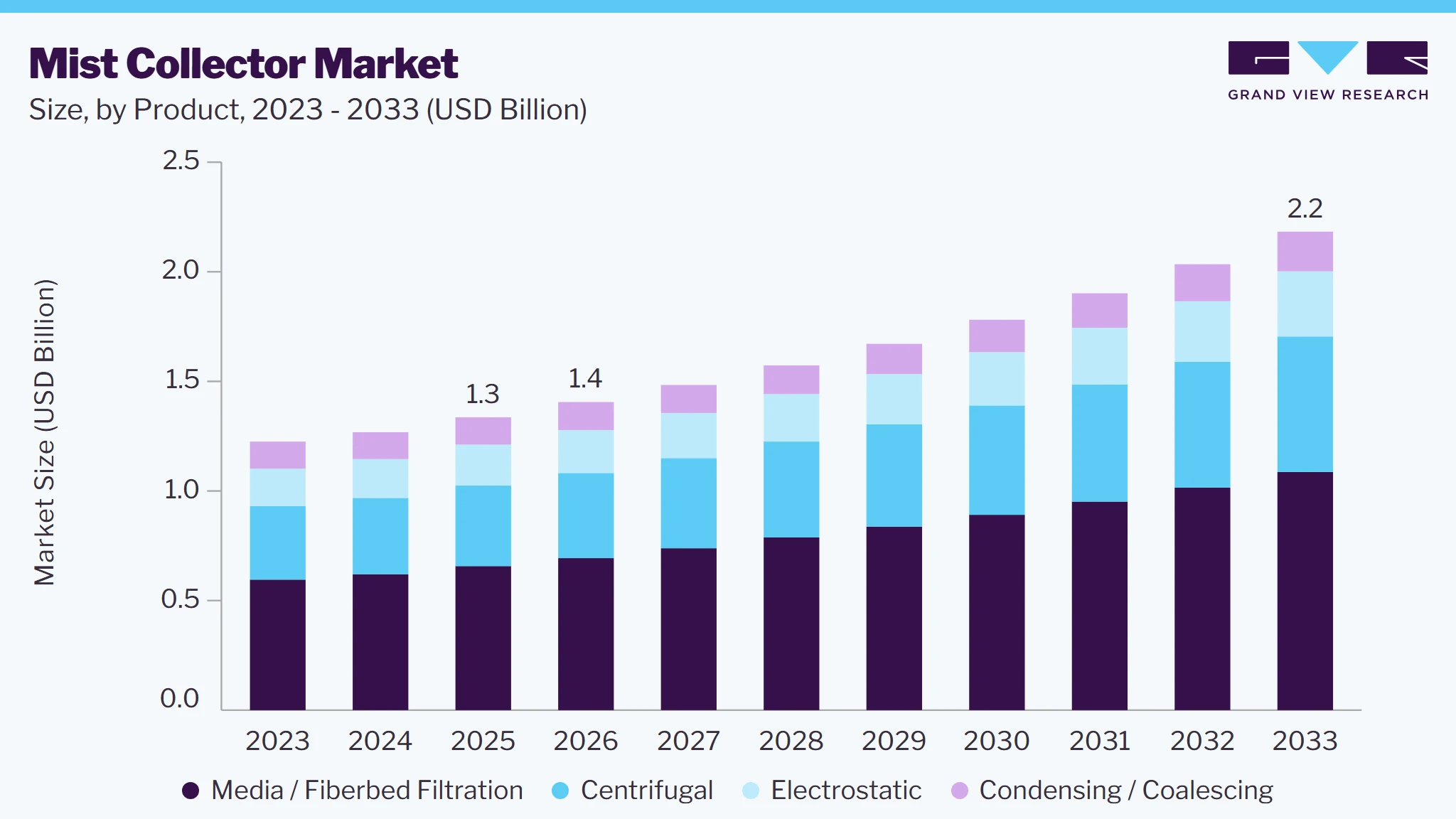
The global mist collector market size was valued at USD 1.3 billion in 2025 and is projected to grow from USD 1.4 billion in 2026 to USD 2.2 billion by 2033, at a CAGR of 6.5% from 2026 to 2033. Asia Pacific dominated the market, accounting for a revenue share of 43.4% in 2025. The market is driven by the increasing generation of airborne oil and coolant mist across metalworking and machining operations.
 Source: Grand View Research, IR Documents, Primary Interviews, Paid DatabasesTo learn more about this report,
 Download Free Sample Report
 Key Market Trends & Insights
- By product: The centrifugal segment is projected to grow at 6.9% CAGR during the forecast period.
- By installation: The machine-mounted segment dominated the market in 2025, accounting for 47.0% market share.
- By end use: The food processing segment is expected to grow at the fastest CAGR of 7.0% from 2026 to 2033.
Regional Highlights
- Largest regional market: Asia Pacific (43.4% revenue share, 2025)
- Fastest-growing regional market: MEA (highest CAGR, 2026-2033)
- By country: China held the largest share in the Asia Pacific region in 2025
Market Size & Forecast
- Market Size in 2025: USD 1.3 Billion
- Estimated Market Size in 2026: USD 1.4 Billion
- Projected Market Size by 2033: USD 2.2 Billion
- CAGR (2026-2033): 6.5%
Three ways to get this report
Buy it, customize it, or ask a question.Ask an Analyst
A direct answer, usually in 1 working day
- AccessReport author, directly
- Reply timeWithin 1 working day
- No sales callDirect answer only
- FormatEmail reply
- CostFree, no cost
Get the Full Report
What the study covers
- FormatsPDF · Excel · Dashboard
- Timeline2026–2033 annual, 2025 base
- Coverage20+ countries, 5 regions
- Companies10+ key players profiled
Customize the Report
20% free customization
- IncludeCountries, segments, points
- TailorTo your product definition
- ExtendDeeper competitor detail
- OrA fully bespoke study
- Turnaround5–10 working days
 To learn more about this report, Download Free Sample Report
Processes such as cutting, turning, milling, grinding, and drilling release fine oil and coolant aerosols that can accumulate in production areas, affecting workplace air quality, equipment cleanliness, and operating conditions. Demand for mist collectors is also supported by greater emphasis on workplace air quality and occupational exposure control across automotive, aerospace, heavy machinery, and general metalworking facilities. Regulatory requirements concerning airborne oil mist and other contaminants encourage manufacturers to install or upgrade local exhaust and filtration systems, particularly where machining operations generate persistent aerosol concentrations.Market Dynamics
The market is influenced by the need to capture and remove airborne oil, coolant, lubricant, and other liquid aerosols generated during industrial processes. Demand is closely linked to the intensity of mist-generating operations, investment in production equipment, replacement of existing collection systems, and requirements for effective industrial air management. Manufacturers are also focusing on improving collection efficiency, reducing energy consumption, extending filter life, and developing compact systems suitable for space-constrained production environments.
The extensive use of cutting fluids, lubricants, coolants, and forming oils in machining, grinding, metalworking, die casting, and forming processes generates airborne liquid aerosols in production environments. As industrial operations expand and fluid-intensive processes remain widely used, the need for dedicated mist-collection equipment continues to grow. Demand is further supported by manufacturers seeking to maintain cleaner production areas and minimize the accumulation and recirculation of oil and coolant aerosols.
Mist collection systems can entail high upfront costs, particularly for centralized installations that require ductwork, multiple collection points, customized engineering, and integration with existing ventilation systems. Operating costs associated with filter replacement, cleaning, inspection, and system maintenance can further increase the total cost of ownership. These factors can limit adoption among smaller manufacturers and facilities where investment decisions are primarily driven by short-term equipment costs.
Technological advances in electrostatic, centrifugal, coalescing, and media-based filtration are creating opportunities for manufacturers to develop systems suited to different mist concentrations, particle sizes, airflow requirements, and operating conditions. Demand for higher collection efficiency, lower power consumption, longer filter service intervals, compact designs, and reduced maintenance can encourage replacement of conventional equipment. Manufacturers offering application-specific configurations and improved lifecycle performance can capture opportunities across new installations and equipment upgrades.
Market Concentration & Characteristics
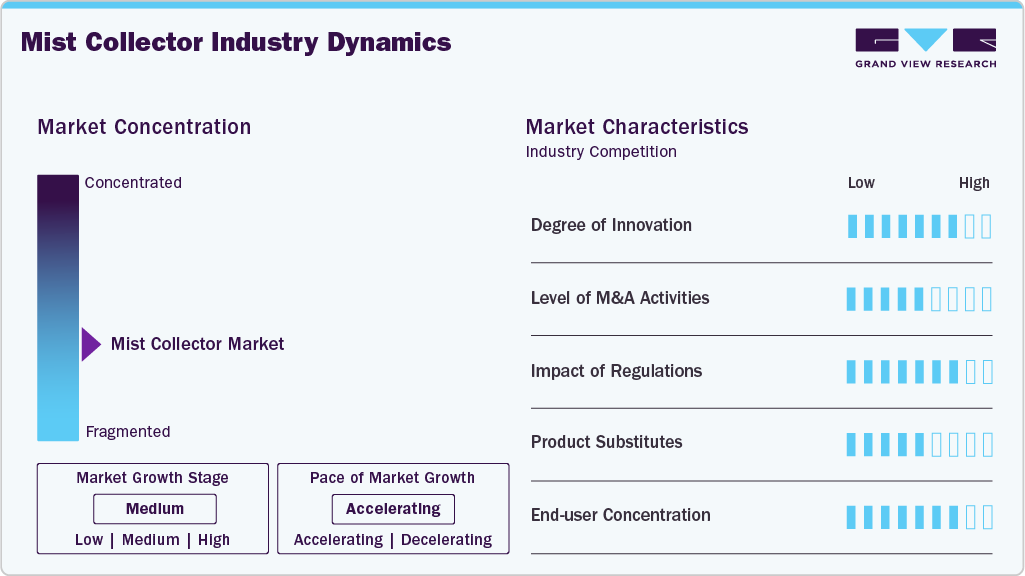
The market has a moderately fragmented competitive structure, with a mix of specialized mist collection manufacturers, diversified industrial filtration companies, and regional equipment suppliers. Market concentration varies by application and geography, as established manufacturers have stronger positions in high-volume machine-tool and industrial applications, while regional suppliers compete through customized configurations, localized service capabilities, and cost competitiveness.
Product demand is characterized by a high degree of application customization, with system configuration determined by mist concentration, aerosol particle size, fluid composition, airflow requirements, machine configuration, and operating conditions. The market encompasses source-capture units installed directly on individual machines as well as centralized systems designed to serve multiple machines or production areas. Technology selection ranges from conventional mechanical and centrifugal separation to electrostatic and multi-stage filtration, with higher-performance configurations generally targeted toward applications requiring fine aerosol removal and stringent air-quality control.
 To learn more about this report, Download Free Sample Report
 The market also has a significant replacement, retrofit, and consumables component, particularly in established manufacturing facilities where mist collectors require periodic filter replacement, servicing, refurbishment, or technological upgrades. Purchasing decisions, therefore, extend beyond the initial equipment cost and increasingly consider total operating expenditure, energy use, maintenance frequency, replacement filter requirements, and system service life. Demand is concentrated in manufacturing-intensive industries such as metalworking, automotive, aerospace, machinery, and precision engineering, while supplier competitiveness is influenced by the ability to provide application engineering, installation support, maintenance services, and aftermarket availability alongside core mist-collection equipment.
Analyst Perspective
The market is fundamentally linked to industrial processes that generate oil, coolant, lubricant, and other liquid aerosols, with machining, metalworking, grinding, die casting, and forming representing important sources of equipment demand. Market revenue is generated through both new installations and the replacement of existing collection systems, creating opportunities across new production facilities and established industrial sites. Technology selection is influenced by multiple characteristics, including required collection efficiency, airflow capacity, installation configuration, energy consumption, and maintenance requirements. As industrial operators place greater emphasis on efficient process-air management, suppliers that combine effective aerosol capture with lower operating and maintenance requirements are positioned to address evolving equipment demand.
Product Insights
Media/fiberbed filtration accounted for the largest revenue share, at 49.2% in 2025, reflecting its widespread use in controlling oil and coolant aerosols generated during industrial machining operations. Technology uses fibrous media to coalesce fine mist into larger droplets that can be separated and drained, enabling effective contaminant removal while retaining the collected fluid for potential recovery. Its established performance across continuous-duty manufacturing environments and compatibility with different mist concentrations contribute to its strong market position.
Centrifugal filtration is projected to register the fastest CAGR during the forecast period, driven by demand for compact, machine-level mist-collection solutions. Centrifugal collectors use rotational forces to separate liquid droplets from contaminated air, allowing systems to be installed close to individual equipment and reducing the need for extensive extraction infrastructure. Their suitability for decentralized installations, relatively compact design, and applicability to oil- and coolant-based processes are expected to support broader adoption across machining-intensive facilities.
Installation Insights
Machine-mounted mist collectors held the largest revenue share in 2025, reflecting the preference for source-level control of oil and coolant aerosols generated by individual machine tools. Installation directly on or near the equipment enables contaminants to be captured before dispersion into the surrounding workspace, while the modular configuration allows manufacturers to deploy collection capacity according to individual machine requirements.
Centralized/ducted systems are projected to grow at a CAGR of 6.4% during the forecast period, driven by adoption across large-scale production facilities with multiple mist-generating operations. A common duct network connects several collection points to a centralized filtration unit, enabling airflow and contaminant management across multiple machines through a unified system. The ability to consolidate filtration, simplify system-level monitoring, and accommodate expansion of production lines makes this configuration increasingly relevant for high-capacity manufacturing facilities.
End Use Insights
Metalworking & machining accounted for the largest revenue share of 68.2% in 2025, owing to the extensive generation of oil and coolant mist during machining operations. Processes such as turning, milling, grinding, and cutting involve continuous use of metalworking fluids, resulting in aerosol formation that requires localized collection to prevent accumulation within production areas. The large installed base of machine tools across automotive, aerospace, industrial machinery, and precision engineering applications drives demand for mist collectors, particularly in operations with continuous machining and high production throughput, which increases the need for effective aerosol control.
 To learn more about this report, Download Free Sample Report
 Food processing is projected to register the fastest CAGR during the forecast period, as mist-collection requirements expand across processing and packaging environments where airborne oil, lubricants, and other process aerosols can compromise equipment cleanliness and controlled production conditions. The increasing automation of food-processing lines and the use of high-speed rotating equipment are creating more points at which aerosol control may be required. The adoption of dedicated collection systems is therefore gaining relevance for facilities seeking to manage airborne contaminants at their source while maintaining stringent cleanliness standards and uninterrupted production.
Regional Insights
Asia Pacific dominated the mist collectors market with the largest revenue share of 43.4 in 2025. Asia Pacific represents a significant market for mist collectors, supported by its extensive manufacturing base and concentration of metalworking, automotive, machinery, electronics, and other industrial operations. Processes involving cutting fluids, lubricants, and coolants generate substantial quantities of airborne mist, creating demand for effective collection and filtration systems. Increasing adoption of enclosed production environments and advanced industrial filtration solutions is further creating opportunities across the region.
 To learn more about this report, Download Free Sample Report
 China Mist Collector Market Trends
The mist collector market in China is important in the Asia-Pacific region, supported by its large machinery, automotive, metalworking, and electronics manufacturing sectors. The extensive use of oil- and coolant-intensive processes creates opportunities for mist collection systems, while upgrades to industrial filtration infrastructure enable the use of advanced equipment.
India mist collector market offers considerable growth opportunities, supported by expansion in the automotive, engineering, metal fabrication, machinery, and industrial processing sectors. The development of modern manufacturing facilities and the increasing adoption of dedicated air filtration systems are creating additional applications for mist collectors.
North America Mist Collector Market Trends
The mist collector market in North America is characterized by an established industrial base and broad use of mist collection systems across machining, automotive, aerospace, machinery, and metalworking operations. Demand is influenced by the need to control oil, coolant, and lubricant aerosols generated during production. Replacement of existing equipment and upgrades toward higher-efficiency filtration systems provide opportunities across mature industrial facilities.
The U.S. mist collector market is significant in the region, supported by its diversified automotive, aerospace, precision manufacturing, and industrial machinery sectors. The established base of industrial operations creates demand for both replacement systems and new installations, particularly where production processes generate substantial quantities of liquid aerosols.
The mist collector market in Canada offers opportunities for mist collector suppliers through its automotive, aerospace, machinery, metalworking, and food processing industries. Investments in industrial production and improvements to manufacturing infrastructure are creating demand for efficient aerosol collection and filtration equipment.
Europe Mist Collector Market Trends
The mist collector market in Europe is well-established, supported by the automotive, machinery, aerospace, precision engineering, and metalworking industries. Demand is influenced by stringent occupational and environmental requirements governing industrial air quality, as well as manufacturers' focus on efficient control of oil and coolant aerosols. Energy-efficient filtration and high collection performance are increasingly relevant in equipment selection.
Germany mist collector market represents an important European market, supported by its strong automotive, machinery, metalworking, and precision engineering industries. The widespread use of industrial processes that generate oil and coolant mist provides diverse applications for collection systems, while facility upgrades create opportunities for technologically advanced equipment.
The mist collector market in France offers growth opportunities in aerospace, automotive, machinery, and industrial manufacturing. Investments in production infrastructure and increasing emphasis on effective process-air management are supporting the adoption of mist collection systems.
Middle East & Africa Mist Collector Market Trends
The mist collector market in MEA is developing alongside industrial diversification and expansion of manufacturing and processing activities. Metalworking, machinery, automotive, and food processing operations are creating new applications for mist collectors as industrial production becomes more diversified. The development of new facilities also provides opportunities to install dedicated aerosol-control systems.
Saudi Arabia is an important market in the region, supported by investments in industrial diversification and the expansion of manufacturing capabilities. The development of machinery, automotive, metalworking, and other non-oil industries is broadening the potential applications for mist collection equipment.
Latin America Mist Collector Market Trends
The mist collector market in Latin America is supported by established automotive, metalworking, machinery, and food processing industries. Demand is primarily associated with processes involving cutting fluids, lubricants, oils, and other liquids that generate airborne aerosols. Industrial investments and upgrades to production infrastructure are gradually expanding the application of dedicated mist collection systems.
Brazil mist collector market is important in the region, supported by its diversified automotive, machinery, metalworking, and food processing industries. The range of mist-generating industrial processes creates applications across multiple manufacturing environments, while modernization of production operations provides opportunities for new and replacement equipment.
Key Mist Collector Company Insights
Some of the key players operating in the market include Filtermist Limited and Absolent Air Care Group, among others.
-
Filtermist Limited is a UK-based manufacturer of industrial air filtration and extraction equipment, with expertise in oil mist, fume, and dust collection technologies. The company develops solutions for manufacturing environments across metalworking, automotive, aerospace, and general engineering, serving applications ranging from individual machine tools to larger production facilities. Its business includes equipment design, application engineering, installation support, and aftermarket services, enabling customers to address process-emission control and workplace air-quality requirements.
-
Absolent Air Care Group is a Sweden-based industrial air purification company specializing in the control of oil mist, coolant mist, dust, and other airborne contaminants generated by manufacturing processes. The company serves customers across metalworking, automotive, aerospace, precision engineering, and related industrial sectors, offering engineered air-cleaning systems for diverse production environments. Its capabilities span product development, systems solutions, technical support, and lifecycle services, with an international presence serving industrial customers across multiple regions.
Key Mist Collector Companies
The following key companies have been profiled for this study on the mist collector market
-
Filtermist Limited
-
Absolent Air Care Group
-
3nine AB
-
Losma S.p.A.
-
Keller Lufttechnik GmbH + Co. KG
-
Donaldson Company, Inc.
-
Nederman Holding AB
-
Air Quality Engineering, Inc.
-
Aeroex Technologies Inc.
-
Diversitech Inc.
-
NDSR Engineering India Pvt. Ltd.
-
Air Pel Technic
-
Cleantek
-
United Enviro System
-
Drasla Technology
Competitive Benchmarking
Category
Operating Strategies
Competitive Edge
Weakness
Established Players (e.g., Filtermist Limited; Absolent Air Care Group; 3nine AB; Losma S.p.A.; Keller Lufttechnik GmbH + Co. KG; Donaldson Company, Inc.; Nederman Holding AB)
- Broaden oil and coolant mist collector portfolios across machine-mounted, standalone, and centralized configurations to address varying aerosol loads and production requirements.
- Invest in filtration efficiency, energy optimization, application engineering, and global sales and service capabilities to strengthen customer retention and expand industrial coverage.
- Established expertise in industrial aerosol filtration and the ability to engineer systems around different mist characteristics, airflow requirements, and machining conditions.
- Strong distribution, technical support, and aftermarket capabilities provide advantages in system installation, filter replacement, maintenance, and long-term customer servicing.
- Higher engineering, equipment, and lifecycle costs can make advanced systems less accessible to small and medium-sized manufacturers.
- Broad product portfolios and established operating structures may result in longer customization and deployment cycles for highly specialized applications.
Emerging & Regional Players (e.g., Air Quality Engineering, Inc.; Aeroex Technologies Inc.; Diversitech Inc.; NDSR Engineering India Pvt. Ltd.; Air Pel Technic; Cleantek; United Enviro System; Drasla Technology)
- Develop application-specific mist collectors for oil, coolant, and process-mist removal, with emphasis on compact configurations and adaptable filtration arrangements.
- Strengthen regional penetration through competitive pricing, customized engineering, local manufacturing, direct customer engagement, and responsive maintenance support.
- Greater flexibility in modifying collector capacity, filtration stages, mounting arrangements, and system configurations according to individual customer requirements.
- Regional presence and lower-cost manufacturing can support faster quotations, localized service, and competitive solutions for small and mid-sized machining facilities.
- More limited geographic coverage, brand visibility, and technical resources can restrict participation in large multinational projects.
- Smaller production and R&D capabilities may limit the development of highly specialized filtration technologies and comprehensive global aftermarket networks.
Recent Developments
-
In January 2025, Span Filtration Systems showcased its new Vayu Mist Collector 25 Series at IMTEX 2025, held in Bengaluru from January 23–29, featuring an integrated filter-clog indicator designed to improve maintenance and operating performance. The product received strong interest from manufacturing industry delegates, including international visitors, who highlighted its enhanced functionality, advanced features, and reliability.
-
In October 2025, Filtermist launched F Save, a smart system designed to reduce energy consumption associated with oil mist collectors by automatically operating the unit only when the machine tool’s coolant pump is active. The system uses a sensor and F Save Hub to switch the collector off during periods when mist is not being generated, helping manufacturers reduce energy usage by up to 80% while maintaining protection against airborne oil mist. Designed for quick retrofitting without electrical interfacing with the machine tool, F Save also supports lower operating costs and improved environmental performance.
Mist Collector Market Report Scope
Report Attribute
Details
Market size in 2025
USD 1.3 billion
Estimated market size in 2026
USD 1.4 billion
Projected market size by 2033
USD 2.2 billion
Growth rate
CAGR of 6.5% from 2026 to 2033
Historical data
2021-2025
Forecast period
2026 - 2033
Quantitative units
Revenue in USD billion and CAGR from 2026 to 2033
Report coverage
Revenue forecast, company market position analysis, competitive landscape, growth factors, and trends
Segments covered
Product, installation, end use, region
Regional scope
North America; Europe; Asia Pacific; Latin America; MEA
Country Scope
U.S.; Canada; Mexico; Germany; UK; Italy; Spain; France; China; Japan; India; Australia; South Korea; Brazil; Argentina; Saudi Arabia; UAE; South Africa
Key companies profiled
Filtermist Limited; Absolent Air Care Group; 3nine AB; Losma S.p.A.; Keller Lufttechnik GmbH + Co. KG; Donaldson Company, Inc.; Nederman Holding AB; Air Quality Engineering, Inc.; Aeroex Technologies Inc.; Diversitech Inc.; NDSR Engineering India Pvt. Ltd.; Air Pel Technic; Cleantek; United Enviro System; Drasla Technology
Customization scope
Free report customization (equivalent up to 8 analysts working days) with purchase. Addition or alteration to country, regional & segment scope.
Pricing and purchase options
Avail customized purchase options to meet your exact research needs. Explore purchase options
Global Mist Collector Market Report Segmentation
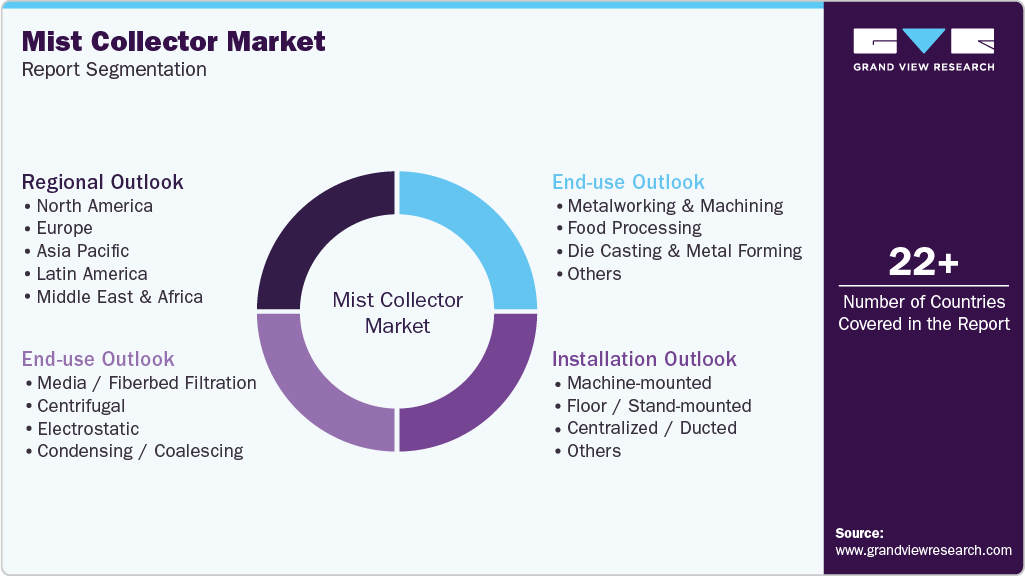
This report forecasts revenue growth at global, regional & country levels and provides an analysis of the industry trends in each of the sub-segments from 2021 to 2033. For this study, Grand View Research has segmented the global mist collector market report based on product, installation, end use, and region:
 To learn more about this report, Download Free Sample Report
 -
Product Outlook (Revenue, USD Billion, 2021 - 2033)
-
Media / Fiberbed Filtration
-
Centrifugal
-
Electrostatic
-
Condensing / Coalescing
-
-
Installation Outlook (Revenue, USD Billion, 2021 - 2033)
-
Machine-mounted
-
Floor / Stand-mounted
-
Centralized / Ducted
-
Others
-
-
End Use Outlook (Revenue, USD Billion, 2021 - 2033)
-
Metalworking & Machining
-
Food Processing
-
Die Casting & Metal Forming
-
Others
-
-
Regional Outlook (Revenue, USD Billion, 2021 - 2033)
-
North America
-
U.S.
-
Canada
-
Mexico
-
-
Europe
-
Germany
-
France
-
UK
-
Spain
-
Italy
-
-
Asia Pacific
-
China
-
India
-
Japan
-
South Korea
-
Australia
-
-
Latin America
-
Brazil
-
Argentina
-
-
Middle East & Africa
-
Saudi Arabia
-
UAE
-
South Africa
-
-
Research Methodology
The mist collector market figures in this report are based on a proven research process that combines executive interviews with secondary research from proprietary databases, company filings, and recognized regulatory and institutional sources. Market size is built through value-chain sizing—reconciling supply-side and demand-side estimates—and triangulated with bottom-up and top-down approaches. Every estimate passes multiple levels of expert validation before publication, with each mist collector segment quantified using the revenue-capture definitions in the table below.
Segment Definition
Product
Revenue Capture Definition
Media / Fiberbed Filtration
Revenue generated through the sale of mist collectors incorporating media or fiberbed filtration technology. Includes complete systems designed for liquid aerosol separation and collection.
Centrifugal
Revenue generated through the sale of centrifugal mist collection systems using rotational separation mechanisms. Includes complete collector units and integrated separation assemblies.
Electrostatic
Revenue generated through the sale of electrostatic mist collectors utilizing electrically charged collection elements. Includes complete systems for fine aerosol capture.
Condensing / Coalescing
Revenue generated through the sale of mist collectors using condensation or coalescence-based separation. Includes complete collection and separation systems.
Installation
Revenue Capture Definition
Machine-mounted
Revenue generated through the sale of mist collectors configured for direct installation on individual machines. Includes integrated units supplied with the equipment.
Floor / Stand-mounted
Revenue generated through the sale of freestanding mist collectors installed on floors or dedicated support structures. Includes complete standalone systems.
Centralized / Ducted
Revenue generated through the sale of centralized mist collection systems serving multiple collection points. Includes primary collectors and integrated system configurations.
Others
Revenue generated through the sale of mist collectors using installation configurations outside the defined categories. Includes specialized system designs.
End Use
Revenue Capture Definition
Metalworking & Machining
Revenue generated through sales of mist collection systems supplied for metalworking and machining operations. Includes equipment configured for process-generated mist removal.
Food Processing
Revenue generated through sales of mist collection systems supplied for food-processing operations. Includes equipment designed for process-related aerosol and mist control.
Die Casting & Metal Forming
Revenue generated through sales of mist collection systems supplied for die casting and metal-forming processes. Includes equipment configured for process-generated mist capture.
Others
Revenue generated through sales of mist collection systems supplied for industrial applications outside the defined end-use categories. Includes specialized application requirements.
Estimation Model
Layer Name
Key Question
Description
Mist-Generating Equipment Demand Layer
Where are mist collectors required?
Analyze demand across CNC machining centers, turning machines, grinding machines, die-casting equipment, and other mist-generating industrial equipment. Assess equipment installations, production volumes, replacement cycles, and operating conditions to establish the addressable demand for mist collectors.
Manufacturing Capacity & Installation Layer
Where is new demand for mist collectors being created?
Evaluate investments across metalworking, automotive, aerospace, machinery, food processing, and other manufacturing industries. Assess new production lines, machine installations, capacity expansions, plant modernization, and workplace air-quality requirements that create demand for mist collection systems.
Product Adoption Layer
Which mist collector technologies are being deployed?
Segment demand by filtration technology, installation configuration, and end-use industry. Apply adoption rates based on mist characteristics, particle size, collection efficiency, airflow requirements, machine configuration, operating conditions, and required filtration performance.
Revenue Generation Layer
How much market revenue is generated?
Estimate annual shipments of mist collectors by product, installation, end-use industry, and region. Quantify revenue generated exclusively from the sale of new mist collector systems supplied to equipment manufacturers, system integrators, distributors, and industrial users.
Delivered Customizations
This report has been delivered with the following In-depth customizations
Client Request
Customization Delivered
Value Adds
Competitive Benchmarking
A competitive benchmarking analysis was conducted by evaluating leading mist collector manufacturers based on product portfolios, filtration technologies, collection efficiency, airflow capacity, installation configurations, machine compatibility, energy efficiency, service capabilities, and strategic developments.
The benchmarking provided insights into product differentiation, filtration capabilities, configuration options, application suitability, service networks, and competitive positioning, enabling stakeholders to evaluate supplier strengths and formulate informed procurement and market strategies.
Regional Segmentation
A comprehensive regional assessment was conducted by analyzing mist collector demand across new machine installations, manufacturing capacity additions, plant expansions, equipment replacement, and facility modernization. The analysis evaluated investments across metalworking, machining, automotive, aerospace, food processing, and other mist-generating industries in major regional markets.
The regional assessment enabled stakeholders to identify high-growth markets, evaluate regional demand patterns, prioritize expansion opportunities, and align business strategies with evolving requirements for industrial mist collection systems.
Opportunity Assessment
A detailed opportunity assessment was conducted by evaluating opportunities arising from the replacement of legacy mist collectors, the installation of new machining equipment, adoption of centralized collection systems, advanced filtration technologies, energy-efficient systems, and stricter industrial air-quality requirements.
The assessment enabled stakeholders to identify future revenue opportunities, prioritize technology and product investments, support product development, and align expansion strategies with evolving requirements for efficient mist collection across industrial applications.
Frequently Asked Questions About This Report
The global mist collector market size was valued at USD 1.3 billion in 2025 and is estimated at USD 1.4 billion in 2026.
Asia Pacific dominated the market with a 43.4% revenue share in 2025.
MEA is the fastest-growing region over the forecast period.
The global mist collector market is expected to grow at a CAGR of 6.5% from 2026 to 2033, reaching USD 2.2 billion by 2033.
The mist collector market is driven by increasing machining and metalworking activities, stricter workplace air-quality requirements, and growing demand for effective control of oil and coolant aerosols.
The centrifugal segment is projected to grow at 6.9% CAGR during the forecast period.
The food processing segment is expected to grow at the fastest CAGR of 7.0% from 2026 to 2033.
Major players include Filtermist Limited, Absolent Air Care Group, 3nine AB, Losma S.p.A., Keller Lufttechnik GmbH + Co. KG, Donaldson Company, Inc., and Nederman Holding AB, among others.
The machine-mounted segment dominated the market in 2025, accounting for 47.0% market share.
About the Author(s)
Advanced Interior Materials Research Team
Advanced Materials · Advanced Interior MaterialsThis report was authored by the advanced interior materials research team at Grand View Research - comprising two research analysts, one senior research analyst, and one industry expert - with specialized expertise in the advanced interior materials segment of the advanced materials industry. All findings are based on proprietary advanced materials databases, executive interviews, and regulatory analysis, subject to internal peer review prior to publication.
Last Updated:
Speak to Analyst

Customize this report to your needs - add regions, segments, or data points, with 20% free customization.
Or view our licence options:


ISO 9001:2015 & 27001:2022 Certified
We are GDPR and CCPA compliant! Your transaction & personal information is safe and secure. For more details, please read our privacy policy.


