
- Home
- »
- Organic Chemicals
- »
-
Metalworking Fluids Market Size And Share Report, 2033GVR Report cover

Metalworking Fluids Market (2026 - 2033)
Size, Share & Trends Analysis Report By Product (Mineral, Synthetic, Bio-based), By Application (Neat Cutting Oils, Water Cutting Oils, Corrosion Preventive Oils), By End Use, By Industrial End Use, By Region, And Segment Forecasts
Market Size, 2025
$11.9BMarket Estimate, 2026
$12.2BMarket Forecast, 2033
$15.9BCAGR, 2026–2033
3.8%Metalworking Fluids Market Summary
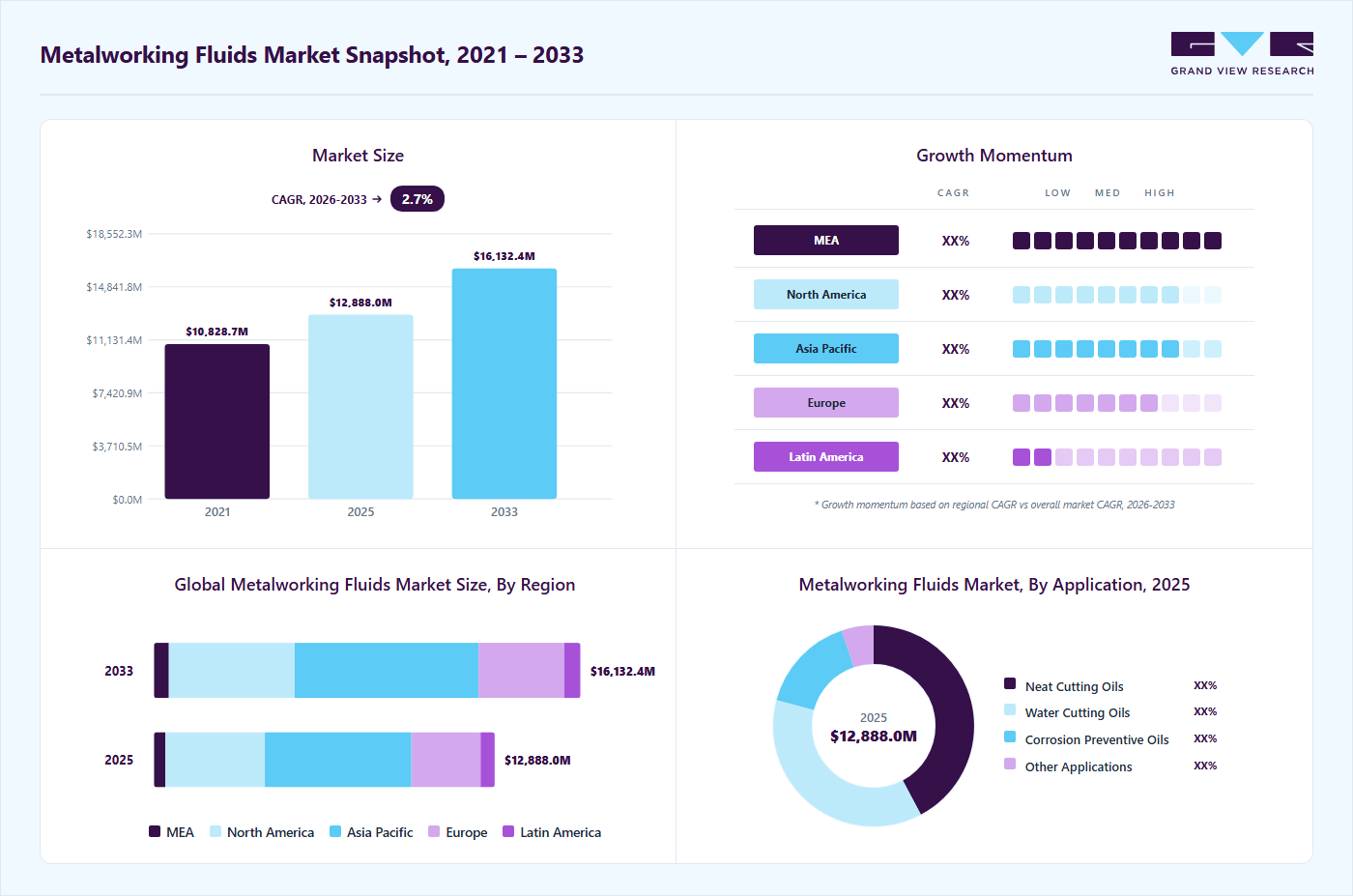
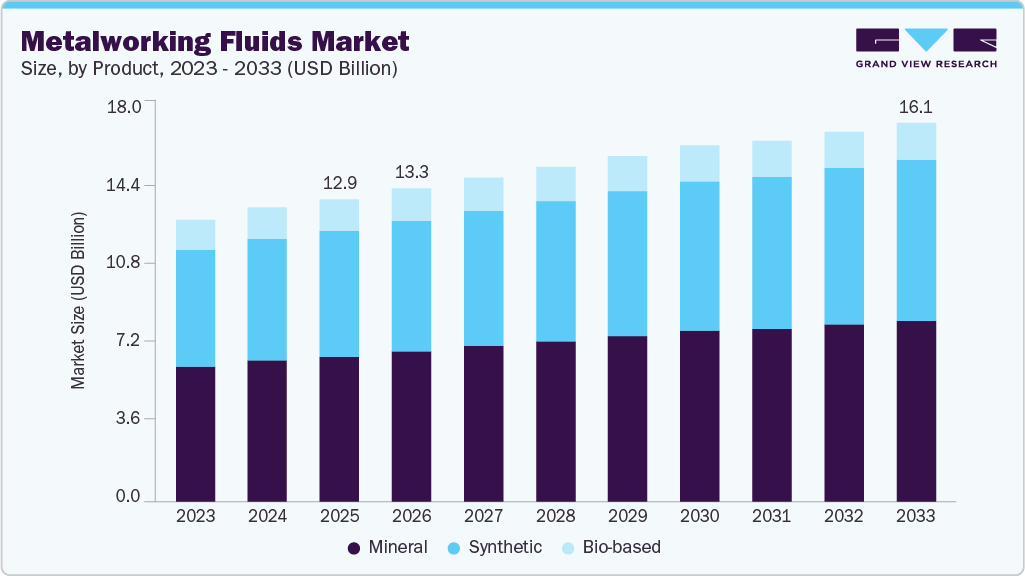
The global metalworking fluids market size was valued at USD 11.9 billion in 2025 and is projected to grow from USD 12.2 billion in 2026 to USD 15.9 billion by 2033, at a CAGR of 3.8% from 2026 to 2033. Asia Pacific dominated the market, accounting for a revenue share of 42.4% in 2025. Market growth is supported by the increasing adoption of sustainable manufacturing practices, as manufacturers seek metalworking fluids with lower environmental impact, improved service life, reduced consumption, and enhanced worker safety.
 Source: Grand View Research, IR Documents, Primary Interviews, Paid DatabasesTo learn more about this report,
 Download Free Sample Report
 Key Market Trends & Insights
- By product: The mineral segment held the largest market share of 58.6% in 2025.
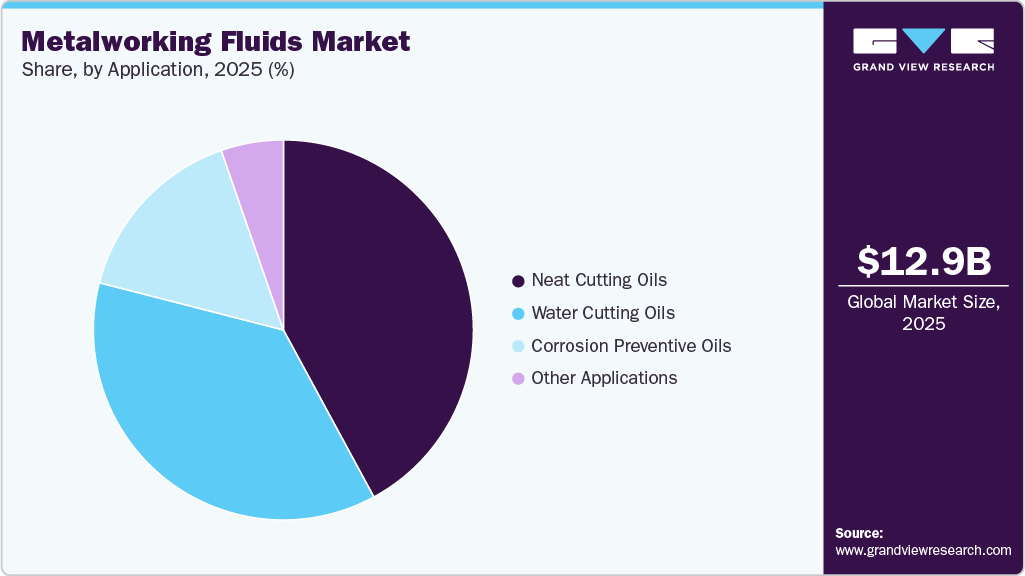
- By application: The neat cutting oils segment held the largest market share of 42.1% in 2025.
- By end use: The machinery segment held the largest market share of 41.6% in 2025.
- By industrial end use: The automotive segment held the largest market share of 34.5% in 2025.
Regional Highlights
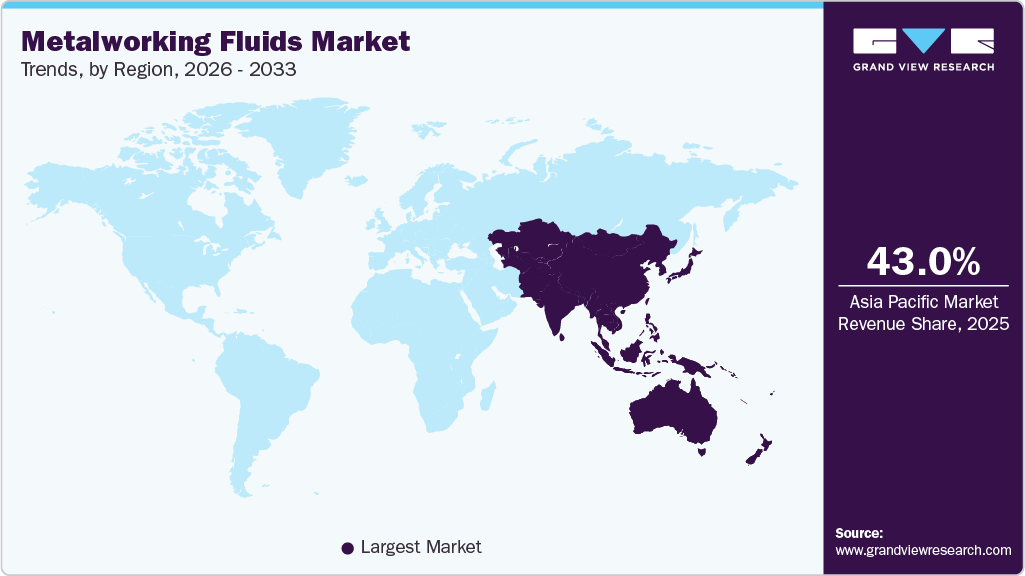
- Largest regional market: Asia Pacific (42.4% revenue share, 2025)
- Fastest-growing regional market: Middle East & Africa (highest CAGR, 2026-2033)
- By country: China held the largest market share in 2025.
Market Size & Forecast
- Market size in 2025: USD 11.9 Billion
- Estimated market size in 2026: USD 12.2 Billion
- Projected market size by 2033: USD 15.9 Billion
- CAGR (2026-2033): 3.8%
Three ways to get this report
Buy it, customize it, or ask a question.Ask an Analyst
Analyst response in 1 business day
- AccessReport author, directly
- Reply timeWithin 1 working day
- No sales callDirect answer only
- FormatEmail reply
- CostFree, no cost
Get the Full Report
What the study covers
- FormatsPDF · Excel · Dashboard
- Timeline2026–2033 annual, 2025 base
- Coverage20+ countries, 5 regions
- Companies10+ key players profiled
Customize the Report
20% free customization
- IncludeCountries, segments, points
- TailorTo your product definition
- ExtendDeeper competitor detail
- OrA fully bespoke study
- Turnaround5–10 working days
The shift toward bio-based and advanced fluid formulations is further supporting demand across automotive, machinery, metal fabrication, and other industrial applications. Regulatory bodies and manufacturers are increasingly emphasizing reduced use of hazardous chemicals, lower emissions, and more sustainable raw materials across industrial processes. Environmental regulations, corporate sustainability objectives, and growing demand for safer, longer-lasting, and lower-impact metalworking fluids support this transition. Regulatory developments are also increasing pressure on manufacturers to reformulate products. In March 2026, the European Chemicals Agency (ECHA) supported an EU-wide restriction on per- and polyfluoroalkyl substances (PFAS), subject to targeted derogations and measures to minimize emissions. Such regulatory developments are encouraging manufacturers to evaluate alternative chemistries and develop metalworking fluids with improved environmental and occupational health profiles.Automotive and machinery manufacturing remain important applications for metalworking fluids, as machining, forming, grinding, and other metalworking operations require effective cooling, lubrication, corrosion protection, and chip removal. Manufacturers are increasingly adopting advanced formulations that can extend fluid life, improve tool performance, reduce fluid consumption, and support safer working environments. In July 2026, FUCHS announced approval of Boeing BAC 5008 Sections 5-6 for ECOCOOL GLOBAL 1000, a water-miscible metalworking fluid developed for aerospace machining of titanium, nickel-based alloys, aluminum, and superalloys. The formulation was free of boron, sulfur, chlorine, secondary amines, MEA, TEA, and registered biocides, illustrating the industry's shift toward high-performance fluids with improved environmental, health, and safety characteristics.
 To learn more about this report, Download Free Sample Report
 Aerospace and precision engineering applications are also driving demand for advanced water-miscible and synthetic metalworking fluids that meet stringent machining requirements. These formulations can provide cooling, lubricity, corrosion protection, cleanliness, and biological control while supporting longer fluid service life. Their adoption is particularly relevant for high-precision machining of difficult-to-process materials, including titanium and nickel-based alloys. Meanwhile, energy, heavy machinery, and industrial equipment manufacturers are increasingly focusing on fluid-management practices that reduce consumption and waste. Improved fluid monitoring, recycling, reconditioning, and longer-life formulations can help manufacturers lower operating costs and resource use while supporting circular manufacturing objectives. Together, these developments are strengthening demand for sustainable metalworking fluids across industrial applications.
Market Dynamics
The metalworking fluids market is driven by expanding automotive, machinery, aerospace, and metal fabrication activities, as well as demand for improved machining efficiency, tool life, and fluid performance. However, stringent environmental and occupational safety requirements, rising disposal costs, and concerns surrounding hazardous chemicals can constrain the adoption of conventional formulations. Opportunities are emerging from the development of bio-based, biodegradable, low-toxicity, and high-performance fluids that reduce environmental impact while maintaining machining efficiency. Advances in fluid monitoring, recycling, reconditioning, and minimum quantity lubrication are also creating opportunities to reduce fluid consumption and waste. In addition, manufacturers are increasingly seeking formulations that support regulatory compliance, longer service intervals, and more sustainable production processes.
Expansion of automotive, industrial machinery, metal fabrication, and precision engineering activities is increasing demand for metalworking fluids used in cutting, grinding, forming, and machining operations. Rising production volumes and greater use of automated and high-speed machining equipment are creating requirements for fluids that provide effective cooling, lubrication, corrosion protection, and chip removal while supporting productivity and tool life. The increasing machining of advanced materials and complex components is further encouraging manufacturers to adopt higher-performance formulations that maintain process stability under demanding operating conditions.
Stringent regulations governing hazardous chemicals, worker exposure, emissions, and industrial waste can constrain the use of conventional metalworking fluid formulations. Fluid disposal and treatment can also increase operating costs, particularly for manufacturers handling large volumes of spent fluids. Concerns regarding skin irritation, respiratory exposure, microbial contamination, and hazardous constituents are encouraging stricter fluid-management practices and increasing compliance requirements. These factors can raise formulation, monitoring, maintenance, and disposal costs, limiting the adoption of certain conventional products and creating challenges for smaller manufacturers with limited resources.
The shift toward sustainable manufacturing is creating opportunities for bio-based, biodegradable, low-toxicity, and longer-life metalworking fluids. Manufacturers are investing in formulations that reduce hazardous chemical content while maintaining cooling, lubrication, corrosion protection, and machining performance. Opportunities are also emerging from minimum quantity lubrication, fluid recycling, reconditioning, and digital monitoring technologies that can reduce fluid consumption and waste generation. As automotive, aerospace, and industrial manufacturers strengthen environmental targets and seek greater resource efficiency, suppliers offering high-performance fluids with improved environmental and occupational profiles are positioned to address evolving customer and regulatory requirements.
Market Concentration & Characteristics
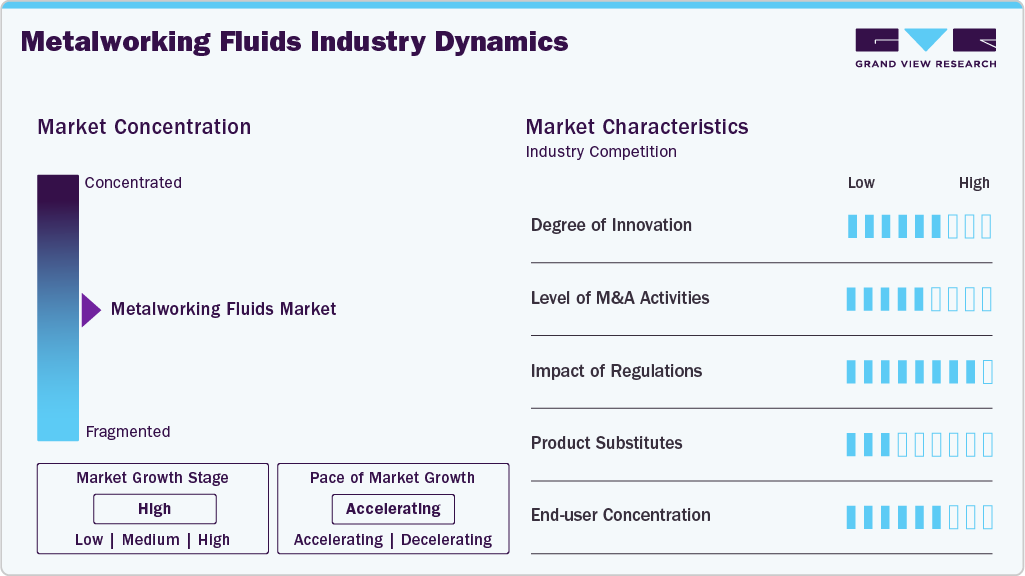
The metalworking fluids industry is moderately fragmented, with competition spanning global lubricant and specialty chemical manufacturers as well as regional suppliers. Established companies benefit from broad product portfolios, formulation expertise, established distribution networks, and long-standing relationships with automotive, aerospace, machinery, and metal fabrication customers. Their capabilities across metal removal, forming, corrosion protection, cleaning, and specialized fluid applications enable them to address diverse machining requirements while improving supply reliability and product consistency. Increasing emphasis on sustainable manufacturing is also encouraging established suppliers to develop formulations with lower environmental and occupational impacts, including bio-based and reduced-hazard chemistries.
Regional manufacturers, particularly across Asia Pacific and other industrializing markets, are strengthening their presence by responding to growing domestic demand and localized customer requirements. Proximity to manufacturing clusters, competitive production costs, and shorter supply chains can provide regional suppliers with advantages in price-sensitive applications. At the same time, investment in formulation capabilities and specialized production facilities is enabling these companies to compete beyond conventional commodity fluids. The competitive landscape is therefore characterized by a combination of global suppliers leveraging scale and technical capabilities and regional manufacturers competing through cost efficiency, customization, and market proximity.
 To learn more about this report, Download Free Sample Report
 Environmental and chemical regulations remain an important competitive consideration. Increasing scrutiny of hazardous substances and worker exposure is encouraging suppliers to reformulate products and strengthen product stewardship capabilities. Regulations governing chemical registration, workplace exposure, waste management, and environmental releases can increase compliance and reformulation costs while influencing customer purchasing decisions. Consequently, competitive differentiation is increasingly linked not only to machining performance and price but also to regulatory compliance, formulation transparency, fluid longevity, and environmental performance.
Analyst Perspective
The metalworking fluids market is evolving alongside industrial manufacturing, particularly in the automotive, aerospace, machinery, and metal fabrication sectors. Demand is shifting toward longer-lasting, high-performance formulations that improve machining efficiency and equipment protection while meeting environmental and worker-safety requirements. Manufacturers are developing low-toxicity, bio-based, and advanced fluids that reduce consumption and maintenance without compromising productivity. Automation, precision manufacturing, and high-speed machining are raising performance requirements for coolants, lubricants, and forming fluids, while fluid monitoring is gaining importance for optimizing usage and costs. Competitive positioning will increasingly depend on formulation expertise, raw material security, application-specific solutions, and the ability to balance machining performance with environmental compliance.
Product Insights
The mineral-based metalworking fluids segment accounted for the largest revenue share of 58.6% in 2025, driven by their broad availability, relatively low cost, and versatility across machining and metal-forming operations. Derived from refined petroleum, these fluids are extensively used in cutting, grinding, and forming applications, where they provide effective lubrication, cooling, and corrosion protection. Meanwhile, synthetic and bio-based metalworking fluids are gaining adoption as manufacturers increasingly seek formulations offering enhanced performance and lower environmental impact. Their growing use is supported by advances in fluid formulation and increasing emphasis on sustainable manufacturing practices across industrial applications.
The bio-based metalworking fluids segment is projected to register the fastest CAGR of 8.5% during the forecast period. Growth is being supported by the increasing adoption of environmentally responsible manufacturing practices and tighter requirements related to worker safety, chemical exposure, and industrial emissions. Manufacturers in automotive, aerospace, and precision engineering are increasingly evaluating bio-based alternatives to conventional mineral oil-based fluids to reduce hazardous waste, improve workplace conditions, and address evolving environmental and regulatory requirements.
End Use Insights
The machinery segment dominated the metalworking fluids industry, accounting for a revenue share of 41.6% in 2025, supported by the extensive use of metalworking fluids across machine tool operations, heavy equipment manufacturing, and industrial machinery production. These fluids play an important role in improving machining efficiency, limiting tool wear, enhancing surface finish, and maintaining process reliability across demanding machinery applications. Their ability to provide effective cooling, lubrication, and corrosion protection further supports their widespread adoption in machinery manufacturing and other industrial metalworking processes.
The transportation equipment segment is projected to grow at the fastest CAGR of 4.3% during the forecast period, supported by the rising production of automobiles, aerospace components, and electric vehicles. Manufacturers are increasingly adopting high-performance metalworking fluids to improve machining precision, minimize tool wear, and enhance overall production efficiency. Growth is further supported by stringent quality, performance, and safety requirements across the automotive and aerospace industries, which encourage the use of specialized fluid formulations that enable complex manufacturing processes and the machining of advanced materials.
Industrial End Use Insights
The automotive segment dominated the metalworking fluids market, accounting for a revenue share of 34.5% in 2025, reflecting the extensive use of metalworking fluids in machining, grinding, stamping, drilling, and forming operations to produce engine components, transmissions, chassis, and precision metal parts. Continued vehicle production, together with growing adoption of lightweight materials and high-precision machining technologies, supported demand for advanced metalworking fluid formulations. These fluids help extend tool life, improve surface finish, enhance machining efficiency, and maintain consistent production quality across automotive manufacturing processes.
The aerospace segment is expected to grow at the fastest CAGR of 5.0% during the forecast period, supported by the rising production of commercial aircraft, defense platforms, and aerospace components that require precision machining of titanium, aluminum alloys, and other advanced materials. Metalworking fluids are essential for maintaining dimensional accuracy, minimizing tool wear, and achieving superior surface finishes during complex machining operations. Increasing manufacturing complexity and stringent performance requirements are further driving the adoption of specialized metalworking fluid formulations to support demanding aerospace production processes and machining of advanced materials.
Application Insights
The neat cutting oils segment dominated the metalworking fluids market, accounting for a revenue share of 42.1% in 2025, supported by their widespread use in precision machining and high-performance cutting applications. Typically used without water dilution, these oils provide effective lubrication, minimize tool wear, and enhance surface finish, making them well-suited for demanding metalworking processes, including turning, milling, threading, and other precision cutting operations.
 To learn more about this report, Download Free Sample Report
 The water-cutting oils segment is projected to grow at the fastest CAGR of 4.2% during the forecast period, driven by their effective cooling, lubrication, and heat-dissipation capabilities in high-speed machining applications. These emulsifiable fluids are widely used across precision cutting, milling, grinding, and turning operations in automotive, aerospace, and industrial machinery manufacturing. Their water-based formulations help manage friction and heat, reduce thermal deformation, improve surface quality, and support longer tool life in demanding machining environments.
Regional Insights
In 2025, the Asia Pacific metalworking fluids market held the largest global revenue share of 42.4%. This growth is attributed to an expanding manufacturing sector and an increasing adoption of sustainable, bio-based fluids. Eco-friendly solutions are becoming more prevalent in the automotive, industrial machinery, aerospace, and precision engineering sectors, as they improve efficiency while minimizing environmental impact. Government initiatives, regulatory reforms, and innovations in countries such as China, Japan, and India, including the development of biodegradable fluids and closed-loop recycling, are further accelerating this trend and solidifying the region’s leadership in sustainable industrial practices.
 To learn more about this report, Download Free Sample Report
 The China metalworking fluids market accounted for the largest revenue share of Asia Pacific in 2025. This is driven by the strength of its automotive, industrial machinery, and precision engineering sectors. The rising use of eco-friendly, biodegradable fluids in machining, forming, and finishing processes is attributed to their superior performance, lower toxicity, and alignment with regulatory standards. Leading manufacturers are incorporating bio-based additives to extend tool life, reduce waste, and promote safer working environments, reinforcing China’s position as a hub for sustainable industrial practices in the region.
North America Metalworking Fluids Market Trends
The North America metalworking fluids industry is experiencing significant growth in 2025, driven by strict environmental regulations, increasing corporate sustainability initiatives, and the rising adoption of eco-friendly fluid solutions across various industries. Regulatory oversight from agencies such as the U.S. Environmental Protection Agency (EPA) and Environment and Climate Change Canada is promoting the transition to bio-based, biodegradable, and low-toxicity metalworking fluids.
These sustainable solutions are widely utilized in sectors such as automotive, aerospace, industrial machinery, and precision engineering, where they contribute to emission reduction, improve operational safety, and enhance manufacturing efficiency. The automotive and machinery industries, in particular, are key contributors to this trend, as they adopt green fluids for high-performance machining, cutting, and forming operations.
Moreover, significant investments in research and development, green manufacturing technologies, and circular economy initiatives are accelerating the commercialization of these products. The growing demand for environmentally responsible products and transparent supply chains further strengthens North America's position as a leading market for sustainable metalworking fluids.
U.S. Metalworking Fluids Market Trends
The U.S. metalworking fluids industry has experienced significant growth due to strict environmental regulations, an increasing awareness of sustainable manufacturing, and the automotive and industrial sectors' transition toward eco-friendly practices. There is increasing adoption of biodegradable, low-toxicity metalworking fluids in machining, cutting, and finishing operations. These fluids provide effective lubrication, cooling, and corrosion protection while minimizing environmental and health risks. Products such as bio-based cutting oils, synthetic lubricants, and eco-friendly corrosion preventives offer safe, high-performance alternatives to traditional petroleum-based fluids. This shift enables manufacturers to comply with EPA and OSHA standards.
Europe Metalworking Fluids Market Trends
The metalworking fluids industry in Europe is experiencing steady growth, driven by strict environmental regulations, sustainability initiatives, and the increasing adoption of bio-based, low-toxicity fluids. Policies such as REACH, the EU Green Deal, and the Circular Economy Action Plan are encouraging manufacturers to replace petroleum-based fluids with biodegradable alternatives. These environmentally friendly fluids are widely used across sectors such as automotive, industrial machinery, aerospace, and construction, contributing to emission reductions, workplace safety, and efficient manufacturing practices. Strong research and development efforts, supportive policies, and collaborations between industry and research institutions are bolstering Europe’s global leadership in sustainable metalworking fluid practices.
The Germany metalworking fluids market is also witnessing consistent growth, propelled by stringent environmental regulations and strong commitments to industrial sustainability. The automotive and machinery sectors are increasingly shifting towards low-emission and resource-efficient practices. Germany’s robust manufacturing base is adopting bio-based metalworking fluids, green cutting oils, and low-toxicity lubricant formulations across various applications, including machining, forming, finishing, and surface treatment. Eco-friendly fluid solutions are gaining traction in automotive production, component processing, and industrial maintenance, while still providing high performance.
Middle East & Africa Metalworking Fluids Market Trends
The Middle East & Africa metalworking fluids industry is projected to grow at the fastest CAGR of 3.8% during the forecast period, driven by sustainability initiatives, regulatory focus, and industrial expansion. Adoption of bio-based and low-toxicity fluids is rising across automotive, construction, machinery, and precision engineering sectors. In the Middle East, cost-competitive energy and feedstocks support scalable production, while in Africa, growing demand for sustainable manufacturing and industrial services is boosting market uptake. Foreign investment, technology partnerships, and circular economy practices are expected to accelerate further the adoption of eco-friendly metalworking fluids in the region.
Latin America Metalworking Fluids Market Trends
The Latin America metalworking fluids industry is steadily growing, driven by abundant renewable feedstocks such as biomass and sugarcane, expanding sustainability initiatives, and stricter environmental regulations. Brazil and Mexico lead adoption through bio-refinery programs, industrial decarbonization, and export-oriented manufacturing. The increasing use of biodegradable and eco-friendly fluids across the automotive, agriculture, and industrial sectors, along with investments and collaborations between local and global producers, is strengthening the region’s role in the global metalworking fluids industry.
Key Metalworking Fluids Company Insights
Key players operating in the metalworking fluids market include IPS, Newcastle Ltd.; BP plc; TotalEnergies SE; FUCHS; Chevron Corporation; China Petroleum & Chemical Corporation (Sinopec); and Exxon Mobil Corporation, among others. These companies offer specialty chemical and lubricant solutions serving diverse metalworking applications, with capabilities spanning fluid formulation, performance additives, lubrication, cooling, and corrosion protection. Their product development efforts increasingly focus on improving machining efficiency, formulation performance, and environmental compatibility.
Key Metalworking Fluids Companies
The following key companies have been profiled for this study of the metalworking fluids market.
-
IPS, Newcastle Ltd.
-
BP plc
-
TotalEnergies SE
-
FUCHS
-
China Petroleum & Chemical Corporation
-
Kuwait Petroleum Corp.
-
Idemitsu Kosan Co., Ltd.
-
Exxon Mobil Corporation
Competitive Benchmarking
Operating Strategies
Competitive Edge
Weakness
Mature Players: IPS, Newcastle Ltd.; BP plc; TotalEnergies SE; FUCHS; Chevron Corporation; China Petroleum & Chemical Corporation (Sinopec); Exxon Mobil Corporation
- Focus on global manufacturing expansion, continuous product innovation, development of sustainable and high-performance metalworking fluids, strategic acquisitions, long-term customer partnerships, and investments in technical service capabilities.
- Strong global brand recognition, extensive distribution networks, diversified product portfolios, advanced R&D capabilities, large-scale production capacity, and long-standing relationships with automotive, aerospace, and industrial manufacturers.
- Higher operating costs, slower adaptation to niche market requirements, and increased exposure to regulatory compliance and raw material price volatility across global markets.
Emerging Players: Blaser Swisslube AG; Kuwait Petroleum Corporation; Idemitsu Kosan Co., Ltd.
- Focus on specialized metalworking fluid solutions, regional market expansion, customer-specific product development, strengthening distributor partnerships, and enhancing technical support for precision manufacturing industries.
- Strong expertise in niche applications, greater operational flexibility, customized product offerings, and the ability to respond quickly to evolving customer requirements in targeted markets.
- Comparatively smaller global market presence, limited distribution reach in certain regions, lower production scale than multinational competitors, and relatively lower brand visibility in emerging markets.
Recent Developments
-
In July 2026, Oemeta and Bharat Petroleum Corporation Limited (BPCL) signed an MoU to establish a strategic partnership covering metalworking fluids and industrial manufacturing solutions in India. The collaboration combines Oemeta’s fluid technology expertise with BPCL’s local manufacturing infrastructure and lubricant distribution capabilities.
-
In February 2025, Zavenir Daubert inaugurated an integrated manufacturing facility in Binola, Haryana, focused on corrosion protection and metalworking fluids. The facility is expected to expand production capacity and support the company’s domestic and overseas markets.
-
In May 2025, Quaker Houghton and PETRONAS Lubricants International formed a strategic partnership covering India and Malaysia. PETRONAS became the exclusive distributor of Quaker Houghton’s metalworking fluids in Malaysia, while Quaker Houghton began offering PETRONAS industrial lubricants to steel mill customers in India.
Metalworking Fluids Market Report Scope Table
Report Attribute
Details
Market size in 2025
USD 11.9 billion
Estimated market size in 2026
USD 12.2 billion
Projected market size by 2033
USD 15.9 billion
Growth rate
CAGR of 3.8% from 2026 to 2033
Actual data
2021 - 2025
Forecast period
2026 - 2033
Quantitative units
Revenue in USD million/billion, volume in kilotons, and CAGR from 2026 to 2033
Report coverage
Revenue forecast, volume forecast, company ranking, competitive landscape, growth factors, and trends
Segments covered
Product, application, end use, industrial end use, and region
Country scope
U.S.; Canada; Mexico; Germany; Russia; France; Spain; Italy; UK; Switzerland; Denmark; Norway; Belgium; Poland; Czech Republic; Turkey; Sweden; Finland; China; India; Japan; South Korea; Singapore; Malaysia; Thailand; Australia; New Zealand; Brazil; Argentina; Saudi Arabia; South Africa
Key companies profiled
Houghton International, Inc.; Blaser Swisslube AG; BP plc; TotalEnergies SE; FUCHS; Chevron Corporation; China Petroleum & Chemical Corporation; Kuwait Petroleum Corp.; Idemitsu Kosan Co., Ltd.; Exxon Mobil Corporation
Customization scope
Free report customization (equivalent up to 8 analysts' working days) with purchase. Addition or alteration to country, regional & segment scope.
Pricing and purchase options
Avail customized purchase options to meet your exact research needs. Explore purchase options
Global Metalworking Fluids Market Report Segmentation
This report forecasts revenue & volume growth and provides an analysis of the latest trends in each of the sub-segments from 2021 to 2033. For this study, Grand View Research has segmented the metalworking fluids market report based on product, application, end use, industrial end use, and region:
-
Product Outlook (Volume, Kilotons; Revenue, USD Million/Billion, 2021 - 2033)
-
Mineral
-
Synthetic
-
Bio-based
-
-
Application Outlook (Volume, Kilotons; Revenue, USD Million/Billion, 2021 - 2033)
-
Neat Cutting Oils
-
Water Cutting Oils
-
Corrosion Preventive Oils
-
Other Applications
-
-
End Use Outlook (Volume, Kilotons; Revenue, USD Million/Billion, 2021 - 2033)
-
Metal fabrication
-
Transportation equipment
-
Machinery
-
Other End Use
-
-
Industrial End Use Outlook (Volume, Kilotons; Revenue, USD Million/Billion, 2021 - 2033)
-
Construction
-
Electrical & Power
-
Agriculture
-
Automobile
-
Aerospace
-
Rail
-
Marine
-
Telecommunications
-
Healthcare
-
-
Regional Outlook (Volume, Kilotons; Revenue, USD Million/Billion, 2021 - 2033)
-
North America
-
U.S.
-
Canada
-
Mexico
-
-
Europe
-
Germany
-
Russia
-
France
-
Spain
-
Italy
-
UK
-
Switzerland
-
Denmark
-
Norway
-
Belgium
-
Poland
-
Czech Republic
-
Turkey
-
Sweden
-
Finland
-
-
Asia Pacific
-
China
-
India
-
Japan
-
South Korea
-
Singapore
-
Malaysia
-
Thailand
-
Australia
-
New Zealand
-
-
Latin America
-
Brazil
-
Argentina
-
-
Middle East & Africa
-
Saudi Arabia
-
South Africa
-
-
Frequently Asked Questions About This Report
The global metalworking fluids market is expected to grow at a compound annual growth rate of 3.8% from 2026 to 2033 to reach USD 15.9 billion by 2033.
Key factors that are driving the metalworking fluids market growth include the growth of the heavy machinery industry in the developing economies of Asia Pacific and Latin America.
The mineral segment held the largest share of over 58.6% in 2025. The high share has been attributed to the consumption of mineral-based oils owing to their low cost. Due to price-conscious consumers, small- and medium-scale manufacturers typically use mineral oil-based MWFs. Over the forecast period, this is expected to impact the market growth.
Asia Pacific dominated the global metalworking fluids market with the largest revenue share of 42.4% in 2025.
Machinery segment held the largest revenue share of 41.6% in 2025, driven by the widespread adoption of metalworking fluids in machine tool operations, heavy equipment manufacturing, and industrial machinery production.
Automotive segment led the market with the largest revenue share of 34.5% in 2025
The global metalworking fluids market size was valued at USD 11.9 billion in 2025 and is expected to reach USD 12.2 billion in 2026.
Some of the key players operating in the metalworking fluids market include Exxon Mobil Corp., Houghton International, Inc., Blaser Swisslube AG, BP plc, Total S.A., FUCHS, Chevron Corporation, China Petroleum & Chemical Corporation, Kuwait Petroleum Corp., Idemitsu Kosan Co., Ltd.
Middle East & Africa is the fastest-growing region over the forecast period.
Metalworking Fluids Market By Country
- U.S. Metalworking Fluids Market
- Canada Metalworking Fluids Market
- Mexico - North America Metalworking Fluids Market
- Germany Metalworking Fluids Market
- France Metalworking Fluids Market
- Italy Metalworking Fluids Market
- Spain Metalworking Fluids Market
- Switzerland Metalworking Fluids Market
- Belgium Metalworking Fluids Market
- Denmark Metalworking Fluids Market
- Russia Metalworking Fluids Market
- Sweden Metalworking Fluids Market
- Finland Metalworking Fluids Market
- Norway Metalworking Fluids Market
- Japan Metalworking Fluids Market
- China Metalworking Fluids Market
- India Metalworking Fluids Market
- Australia Metalworking Fluids Market
- South Korea Metalworking Fluids Market
- Malaysia Metalworking Fluids Market
- Singapore Metalworking Fluids Market
- Thailand Metalworking Fluids Market
- New Zealand Metalworking Fluids Market
- Brazil Metalworking Fluids Market
- U.K. Metalworking Fluids Market
- Poland Metalworking Fluids Market
- Czech Republic Metalworking Fluids Market
- Turkey - Europe Metalworking Fluids Market
About the Author(s)
Organic Chemicals Research Team
Bulk Chemicals · Organic ChemicalsThis report was authored by the organic chemicals research team at Grand View Research - comprising two research analysts, one senior research analyst, and one industry expert - with specialized expertise in the organic chemicals segment of the bulk chemicals industry. All findings are based on proprietary bulk chemicals databases, executive interviews, and regulatory analysis, subject to internal peer review prior to publication.
Last Updated:
Speak to Analyst

Customize this report to your needs - add regions, segments, or data points, with 20% free customization.
Or view our licence options:


ISO 9001:2015 & 27001:2022 Certified
We are GDPR and CCPA compliant! Your transaction & personal information is safe and secure. For more details, please read our privacy policy.


