
- Home
- »
- Communication Services
- »
-
Mobile Virtual Network Aggregator Market Size Report, 2033GVR Report cover
![Mobile Virtual Network Aggregator Market Size, Share & Trends Report]()
Mobile Virtual Network Aggregator Market (2026 - 2033) Size, Share & Trends Analysis Report By Service (Voice, Data, Messaging, Value Added Services), By End Use (Consumer MVNOs, Enterprise MVNOs, IoT/M2M MVNOs), By Region, And Segment Forecasts
- Report Summary
- Table of Contents
- Segmentation
- Methodology
- Download FREE Sample
-
 Download Sample Report
Market Size, 2025
$1.1BMarket Estimate, 2026
$1.2BMarket Forecast, 2033
$2.4BCAGR, 2026–2033
10.6%Mobile Virtual Network Aggregator Market Summary
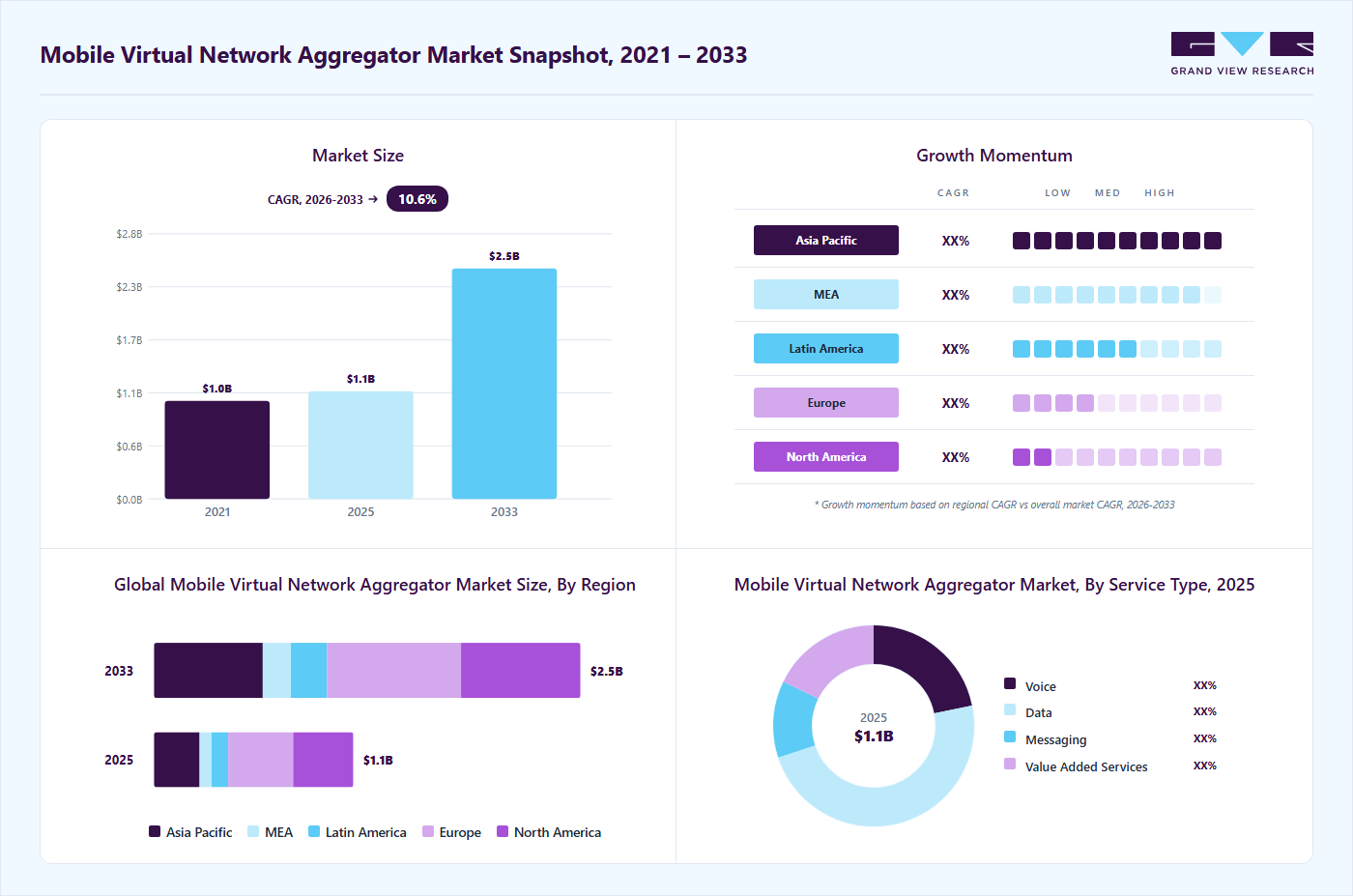
The global mobile virtual network aggregator market size was valued at USD 1.1 billion in 2025 and is projected to grow from USD 1.2 billion in 2026 to USD 2.4 billion by 2033, at a CAGR of 10.6% from 2026 to 2033. The Europe mobile virtual network aggregator market held the largest share of 32.6% of the global market in 2025. The growing demand for seamless, secure, and scalable mobile connectivity across industries such as IoT, enterprise mobility, and digital services is driving growth of the market.
Key Market Trends & Insights
- By service: The data segment accounted for the largest share of 48.1% in 2025.
- By end use: The consumer MVNOs segment accounted for the largest share in 2025.
Regional Highlights
- Largest regional market: Europe (32.6% revenue share, 2025)
- Fastest-growing regional market: Asia Pacific (highest CAGR, 2026-2033)
- The mobile virtual network aggregator industry in the Germany held the largest revenue share in 2025.
Market Size & Forecast
- Market size in 2025: USD 1.1 Billion
- Estimated market size in 2026: USD 1.2 Billion
- Projected market size by 2033: USD 2.4 Billion
- CAGR (2026-2033): 10.6%
The increasing focus on cost efficiency in the mobile services ecosystem is driving the adoption of mobile virtual network aggregators. By aggregating network capacity from MNOs, mobile virtual network aggregator (MVNA) reduce MVNOs' infrastructure investment requirements and leverage economies of scale to secure more favorable wholesale pricing. In addition, MVNAs manage network operations, lowering ongoing costs and enabling MVNOs to enter the market faster and offer competitively priced services. This cost-effective operating model supports broader market participation while strengthening competition and innovation across the telecommunications industry.
The expansion of 5G networks is accelerating growth in the mobile virtual network aggregator market. By providing access to advanced 5G capabilities, MVNAs allow mobile virtual network operators (MVNOs) to offer high-speed, low-latency services without investing in their own infrastructure. This is essential for supporting emerging applications such as IoT solutions, smart city systems, and other data-intensive services. By managing network access and integration, MVNAs enable service providers to deliver next-generation connectivity and pursue new revenue opportunities in the evolving telecommunications sector.
The regulatory environment around data protection and privacy continues to grow as greater emphasis is placed on safeguarding personal data and ensuring responsible data handling. In the European Union, these requirements are mainly governed by the General Data Protection Regulation (GDPR), which requires that personal data must be stored, processed, and transferred. Regulations focus on ensuring transparency, accountability, and protection of personal data throughout its lifecycle. In addition, related concepts such as data sovereignty and data localization influence organizations in designing their data storage and processing strategies, particularly in countries with strict storage requirements. By adopting robust data governance frameworks and leveraging digital compliance tools, organizations can reduce regulatory risk, streamline compliance efforts, and strengthen overall data protection.
High operational complexity and regulatory constraints pose challenges for MVNOs operating across multiple Mobile Network Operators (MNOs). While partnering with several MNOs helps improve coverage and service quality, differences in network footprints, management platforms, and SIM configurations increase integration and management complexity. In addition, MVNO performance can vary significantly depending on the strength of commercial agreements and the quality of local network infrastructure. Technical limitations, such as higher latency when using SIMs designed for other regions, and regulatory barriers, such as permanent roaming restrictions, further hinder seamless service delivery and can limit successful deployment in certain markets.
Service Insights
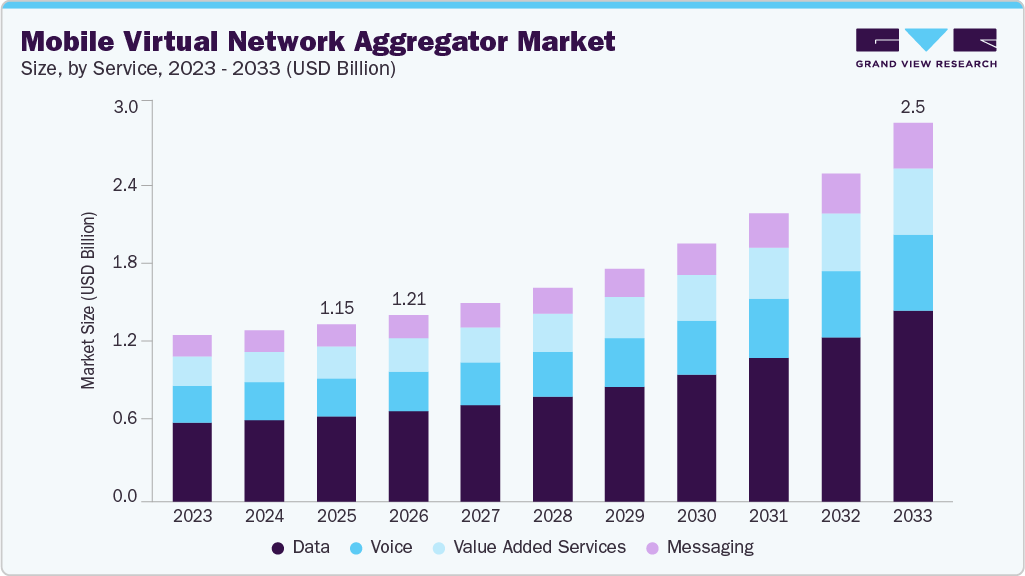
The data segment accounted for the largest share of 48.1% in 2025. The data segment within the MVNA market emphasizes high-volume mobile internet services, including IoT, enterprise connectivity, cloud computing, and streaming. This segment dominates the market due to the shift toward data-driven mobile usage over traditional voice services. MVNAs leverage this segment to provide large-scale, flexible connectivity solutions for MVNOs and enterprises, facilitating efficient management of connected devices and the deployment of advanced 5G applications.
The value-added services segment is expected to grow at a significant CAGR over the forecast period. The growth of the segment is driven by the increasing need for differentiated offerings among MVNOs operating in highly competitive telecom markets. As traditional voice and messaging services become commoditized, MVNOs are relying on VAS such as digital content subscriptions, loyalty programs, mobile entertainment, and personalized bundles to attract and retain customers. MVNAs enable these operators to integrate such services quickly through shared platforms, reducing development costs and accelerating time-to-market. This ability to create unique customer experiences significantly supports the expansion of the VAS segment.
End Use Insights
The consumer MVNOs segment accounted for the largest share in 2025. The consumer MVNO segment contributes to the MVNA market, as MVNAs enable MVNOs to efficiently deliver mobile services such as voice, data, SMS, and eSIM-based connectivity to end uses. Consumers widely prefer these services due to their affordability, flexible plans, and ease of digital onboarding, which are essential for prepaid and budget-conscious users. MVNAs support consumer MVNOs by aggregating network capacity from multiple MNOs, enabling better coverage, improved service quality, and faster market entry without infrastructure investment. They also facilitate rapid scaling through centralized provisioning, billing, and customer management systems. With increasing demand for digital-first mobile services, eSIM adoption, and flexible data plans, consumer MVNOs continue to expand their subscriber base, making them the largest end-user segment in the MVNA market.
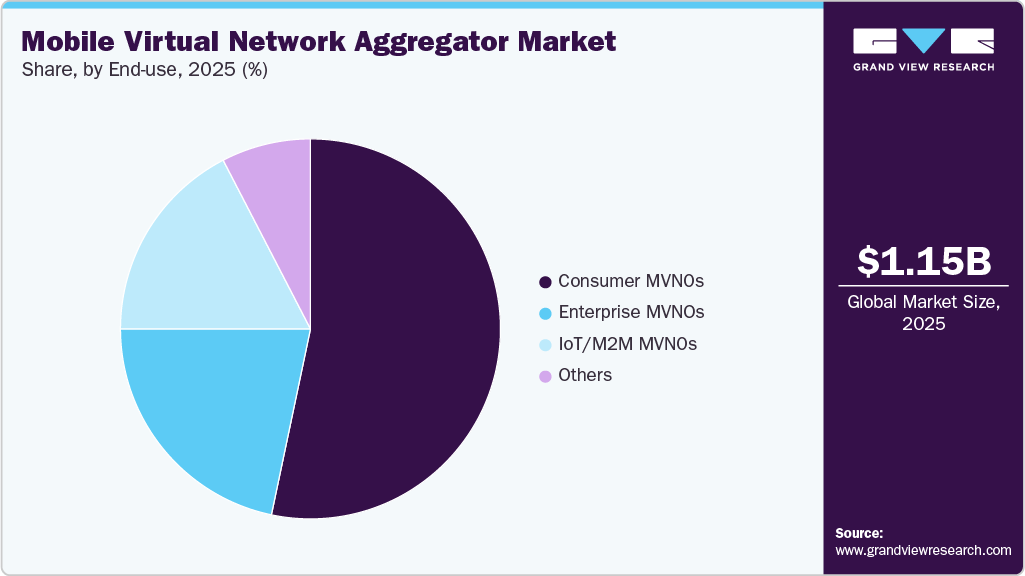
The IoT/M2M MVNOs segment is expected to grow at the fastest CAGR over the forecast period. The rapid expansion of connected devices across industries is driving the growth of the market. Sectors such as automotive, manufacturing, healthcare, agriculture, utilities, and logistics are deploying sensors, trackers, smart meters, and connected equipment at a large scale. These deployments require reliable cellular connectivity across thousands or even millions of devices. MVNAs help IoT/M2M MVNOs manage this demand by providing ready-made network access, multi-operator agreements, billing systems, and SIM management platforms, allowing faster market entry and scalable operations.
Regional Insights
The North America mobile virtual network aggregators industry held a significant share in 2025. The market in the region is characterized by a mature telecommunications ecosystem, high mobile penetration, and strong demand for flexible wholesale connectivity models. Enterprises and digital-first brands are increasingly partnering with MVNAs to launch niche MVNO offerings focused on value pricing, enterprise mobility, and IoT connectivity.
U.S. Mobile Virtual Network Aggregator Market Trends
The mobile virtual network aggregators industry in the U.S. held a significant share in 2025. The growth is supported by strong competition among wireless carriers and a well-established MVNO ecosystem. Demand for prepaid wireless services, private-label telecom brands, and enterprise connectivity solutions continues to create opportunities for MVNA providers.
Europe Mobile Virtual Network Aggregator Market Trends
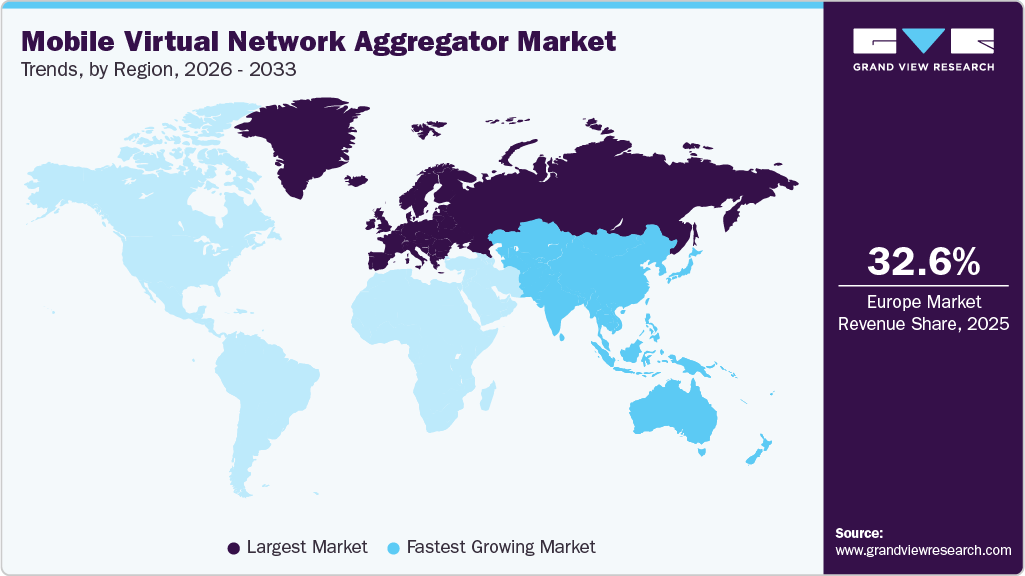
The mobile virtual network aggregators industry in Europe held a dominant position in the market. The market in the region is highly developed, driven by favorable telecom regulations, strong MVNO penetration, and cross-border mobile service requirements. Several countries in the region have established wholesale access frameworks that encourage competition and support new entrant brands through aggregator partnerships. Demand for roaming management, multilingual customer platforms, and multi-country enterprise connectivity solutions is particularly strong.
The UK mobile virtual network aggregators industry held a dominant position in the regional market. The growth is supported by a competitive mobile landscape and high consumer acceptance of alternative telecom brands. MVNAs benefit from demand for low-cost consumer plans, branded reseller models, and flexible B2B connectivity solutions. The country is also seeing increased interest in eSIM-based services and digital-only mobile propositions.
Asia Pacific Mobile Virtual Network Aggregator Market Trends
The mobile virtual network aggregators industry in the Asia Pacific is the fastest growing at a CAGR of 12.1% during the forecast period. The market is expanding rapidly due to rising smartphone adoption, increasing mobile data consumption, and supportive digitalization initiatives across emerging and developed economies. The region presents strong opportunities for aggregators serving price-sensitive consumers, fintech-led telecom models, and IoT connectivity providers.
The China MVNA industry is expected to grow rapidly in the coming years due to its large mobile subscriber base, advanced digital economy, and growing industrial IoT ecosystem. Demand for enterprise-grade connectivity, smart manufacturing solutions, and connected logistics services is creating new use cases for aggregation platforms.
The MVNA industry in Japan held a substantial market share in 2025. The MVNA market in Japan is supported by a technologically advanced telecom sector, high service quality expectations, and strong demand for niche mobile offerings. MVNAs are increasingly enabling low-cost mobile brands, enterprise mobility services, and IoT-focused connectivity models in the country.
Key Mobile Virtual Network Aggregator Company Insights
Some of the key companies in the mobile virtual network aggregator market include Plintron, Transatel, BICS SA, iBASIS, and others. Organizations are focusing on increasing customer base to gain a competitive edge in the industry. Therefore, key players are taking several strategic initiatives, such as mergers and acquisitions, and partnerships with other major companies.
-
Plintron is a multi-country end-to-end mobile virtual networking aggregation provider, powering over 170 million mobile connections across 175+ MVNO brands in 31+ countries through integrations with 40+ MNOs on six continents. Its Telecom-as-a-Service (TaaS) and SaaS platform delivers comprehensive MVNA/MVNE solutions, including OSS/BSS, core networks, roaming, billing, customer care, and IoT, enabling rapid MVNO launches with minimal capex.
-
Transatel is a player in the mobile virtual network aggregator (MVNA) market, acting as a leading European MVNE/MVNA with expertise in enabling over 250 MVNOs across France, the UK, Switzerland, Belgium, and beyond on networks such as Orange and BT. Its platform supports white-label mobile services for B2B/B2C, including provisioning, prepaid/postpaid billing, fixed-mobile convergence, and global connectivity via roaming agreements with 300+ operators in 200+ countries, powering 1.6 million+ SIMs and, in 2024, 12 new UK MVNOs.
Key Mobile Virtual Network Aggregator Companies:
The following key companies have been profiled for this study on the mobile virtual network aggregator market.
- Plintron
- Transatel
- Reach
- BICS SA
- iBASIS
- floLIVE
- Movaco
- Effortel
- Telna
- Lifecycle Software
Recent Developments
-
In February 2026, Telna launched a USD 100 million investment fund to accelerate the growth of the travel eSIM ecosystem, focusing on digital-first travel eSIM brands, regional MVNOs, and super apps. The fund provides minority investments, growth capital, partnerships, and acquisition support to help companies scale, expand into new markets, and enhance eSIM-based roaming solutions, while strengthening technical and commercial integration across Telna’s global connectivity ecosystem.
-
In March 2026, Lifecycle Software launched NEXUS IQ at Mobile World Congress Barcelona 2026, a new AI-driven analytics and customer journey platform for telecom operators and MVNOs. The solution uses real-time event data from customers, competitors, and market activity to generate insights that help improve acquisition, retention, cross-sell/upsell, and reduce churn. It includes a built-in campaign manager for personalized, automated outreach, with early claims of measurable impacts such as reduced churn and increased customer lifetime value. The launch underscores a broader industry shift toward data-driven AI solutions that transform raw telecom data into actionable revenue growth strategies.
Mobile Virtual Network Aggregator Market Report Scope
Report Attribute
Details
Market size in 2025
USD 1.1 billion
Estimated market size in 2026
USD 1.21 billion
Projected market size by 2033
USD 2.45 billion
Growth rate
CAGR of 10.6% from 2026 to 2033
Base year for estimation
2025
Historical data
2021 - 2025
Forecast period
2026 - 2033
Quantitative units
Revenue in USD million/billion, Volume in Thousand Units, and CAGR from 2026 to 2033
Report industry
Revenue forecast, company ranking, competitive landscape, growth factors, and trends
Segments covered
Service, end use, region
Regional scope
North America; Europe; Asia Pacific; Latin America; MEA
Country scope
U.S.; Canada; Mexico; Germany; UK; France; China; Japan; India; South Korea; Australia; Brazil; KSA; UAE; South Africa
Key companies profiled
Plintron; Transatel; Reach, BICS SA; iBASIS; floLIVE; Movaco; Effortel; Telna; Lifecycle Software
Customization scope
Free report customization (equivalent up to 8 analysts working days) with purchase. Addition or alteration to country, regional & segment scope.
Pricing and purchase options
Avail customized purchase options to meet your exact research needs. Explore purchase options
Global Mobile Virtual Network Aggregator Market Report Segmentation
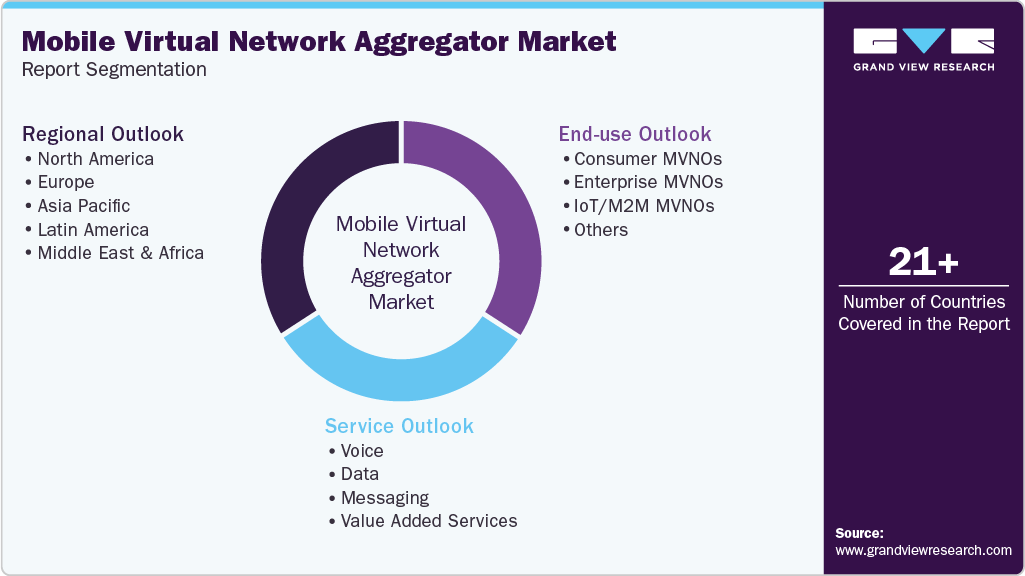
This report offers forecasts in terms of revenue growth at global, regional, and country levels and provides an analysis of the latest industry trends in each of the sub-segments from 2021 to 2033. For this study, Grand View Research has segmented the global mobile virtual network aggregator market report based on service, end use, and region:
-
Service Outlook (Revenue, USD Billion, 2021 - 2033)
-
Voice
-
Data
-
Messaging
-
Value Added Services
-
-
End Use Outlook (Revenue, USD Billion, 2021 - 2033)
-
Consumer MVNOs
-
Enterprise MVNOs
-
IoT/M2M MVNOs
-
Others
-
-
Regional Outlook (Revenue, USD Billion, 2021 - 2033)
-
North America
-
U.S.
-
Canada
-
Mexico
-
-
Europe
-
Germany
-
UK
-
France
-
-
Asia Pacific
-
China
-
Japan
-
India
-
South Korea
-
Australia
-
-
Latin America
-
Brazil
-
-
Middle East and Africa (MEA)
-
KSA
-
UAE
-
South Africa
-
-
Frequently Asked Questions About This Report
Europe dominated with a 32.6% revenue share in 2025.
Asia Pacific is the fastest-growing region over the forecast period.
The global mobile virtual network aggregator market size was estimated at USD 1.1 billion in 2025 and is expected to reach USD 1.2 billion in 2026.
The data segment accounted for the largest share of 60.0% in 2025. This segment dominates the market due to the shift toward data driven mobile usage over traditional voice services.
Some key players operating in the mobile virtual network aggregator market include Plintron; Transatel; Reach, BICS SA; iBASIS; floLIVE; Movaco; Effortel; Telna; and Lifecycle Software
The growing demand for seamless, secure, and scalable mobile connectivity across industries such as IoT, enterprise mobility, and digital services is anticipated to fuel the market growth.
The consumer MVNOs held the largest revenue share in 2025, while IoT/M2M MVNOs is the fastest-growing segment.
The global mobile virtual network aggregator market size is expected to grow at a significant CAGR of 10.6% to reach USD 2.4 billion in 2033.
About the Author(s)
Communication Services Research Team
Technology · Communication ServicesThis report was authored by the communication services research team at Grand View Research - comprising two research analysts, one senior research analyst, and one industry expert - with specialized expertise in the communication services segment of the technology industry. All findings are based on proprietary technology databases, executive interviews, and regulatory analysis, subject to internal peer review prior to publication.
Last Updated:
Speak to Analyst


Share this report with your colleague or friend.
Need a Tailored Report?
Customize this report to your needs — add regions, segments, or data points, with 20% free customization.


ISO 9001:2015 & 27001:2022 Certified
We are GDPR and CCPA compliant! Your transaction & personal information is safe and secure. For more details, please read our privacy policy.












