
- Home
- »
- Communication Services
- »
-
Mobile Virtual Network Enabler Market Size, Share Report, 2033GVR Report cover

Mobile Virtual Network Enabler Market (2026 - 2033) Size, Share & Trends Analysis Report By Service Type (Infrastructure Services, Business Support Systems), By Deployment Model (On-premise, Cloud-based / SaaS-based), By End User Industry, By Region, And Segment Forecasts
Market Size, 2025
$3.8BMarket Estimate, 2026
$4.0BMarket Forecast, 2033
$7.9BCAGR, 2026–2033
10.2%Mobile Virtual Network Enabler Market Summary
The global mobile virtual network enabler market size was valued at USD 3.8 billion in 2025 and is projected to grow from USD 4.0 billion in 2026 to USD 7.9 billion by 2033, at a CAGR of 10.2% from 2026 to 2033. The market in Europe dominated with a revenue share of 34.2% in 2025. The industry is experiencing steady growth due to the expanding global presence of mobile virtual network operators and the increasing preference for outsourced telecom operating models.
 Source: Grand View Research, IR Documents, Primary Interviews, Paid DatabasesTo learn more about this report,
 Download Free Sample Report
 Key Market Trends & Insights
- By service type: The infrastructure services segment accounted for the largest share of 32.1% in 2025.
- By deployment model: The cloud-based / SaaS-based segment held the largest market share in 2025.
- By end user industry: The enterprises segment dominated the market in 2025.
Regional Highlights
- Largest regional market: Europe (34.2% revenue share, 2025)
- Fastest-growing regional market: Asia Pacific (highest CAGR, 2026-2033)
- By country: The UK held the largest market share in 2025.
Market Size & Forecast
- Market size in 2025: USD 3.8 Billion
- Estimated market size in 2026: USD 4.0 Billion
- Projected market size by 2033: USD 7.9 Billion
- CAGR (2026-2033): 10.2%
Three ways to get this report
Buy it, customize it, or ask a question.Ask an Analyst
A direct answer, usually in 1 working day
- AccessReport author, directly
- Reply timeWithin 1 working day
- No sales callDirect answer only
- FormatEmail reply
- CostFree, no cost
Get the Full Report
What the study covers
- FormatsPDF · Excel · Dashboard
- Timeline2026–2033 annual, 2025 base
- Coverage20+ countries, 5 regions
- Companies10+ key players profiled
Customize the Report
20% free customization
- IncludeCountries, segments, points
- TailorTo your product definition
- ExtendDeeper competitor detail
- OrA fully bespoke study
- Turnaround5–10 working days
New market entrants, digital brands, retailers, financial institutions, and enterprises are seeking to launch mobile services without building their own network infrastructure, driving demand for MVNE platforms. Rising mobile data consumption, competitive prepaid offerings, and the need for faster time-to-market are further supporting adoption. In addition, growing enterprise demand for branded connectivity and managed mobility services is widening the commercial opportunity for MVNE providers. To learn more about this report, Download Free Sample Report
 Technological advancement is reshaping the market through the adoption of cloud-native architectures, API-led integration models, and automated telecom operations. MVNE vendors are increasingly offering SaaS-based platforms that enable faster deployment, flexible scaling, and lower upfront investment for clients. The expansion of eSIM technology, digital onboarding tools, AI-enabled customer service, and real-time analytics is enhancing platform value. Growth in 5G networks is also creating new opportunities for advanced charging systems, private wireless services, and IoT connectivity management within the MVNE ecosystem.
Investment activity in the MVNE market is rising as telecom operators, private equity firms, and technology companies seek exposure to recurring-revenue digital infrastructure models. Capital is being directed toward platform modernization, regional expansion, cybersecurity enhancement, and product development focused on billing, automation, and customer engagement. Strategic partnerships between MVNE vendors and mobile network operators are also increasing to accelerate MVNO launches and enterprise mobility offerings.
Despite positive momentum, the industry faces several restraints that may hinder growth. Dependence on host mobile network operators can create pricing pressure, limited wholesale access flexibility, and margin constraints for MVNO clients and their enablement partners. Integration with legacy OSS/BSS systems can be costly and time-consuming, especially for complex multi-country deployments. Intense competition among vendors may compress service pricing, while evolving regulatory obligations can increase compliance costs. In addition, some large operators continue to develop in-house capabilities, reducing outsourcing opportunities for independent MVNE providers.
Service Type Insights
The infrastructure services segment accounted for the largest share of 32.1% in 2025. The growth of the segment is driven by the increasing number of mobile virtual network operators seeking faster market entry without investing in their own telecom network assets. MVNE providers supply the foundational technology layer, including core network integration, SIM lifecycle management, connectivity platforms, and service provisioning systems. This model significantly reduces capital expenditure and operational complexity for new entrants, making infrastructure outsourcing an attractive option.
The billing & charging solutions segment is expected to grow at the fastest CAGR during the forecast period. The growth of the segment is attributed to the increasing complexity of telecom pricing models and customer monetization strategies. Modern MVNOs require real-time billing systems capable of managing prepaid, postpaid, hybrid, subscription-based, and usage-driven charging models. MVNE providers that offer advanced rating engines, invoicing platforms, and partner settlement systems enable operators to launch differentiated plans more efficiently. This has made billing platforms a strategic component of revenue generation and customer retention.
Deployment Model Insights
The cloud-based / SaaS-based segment held the largest market share in 2025. The growth of the segment is fueled by the increasing need for faster and lower-cost market entry for mobile virtual network operators. Cloud deployment significantly reduces upfront capital investment by replacing heavy infrastructure spending with subscription-based operating models. This enables emerging operators, digital brands, retailers, and enterprise-led MVNOs to launch services more rapidly.
The on-premise segment is expected to grow at a significant CAGR during the forecast period. The growth of the segment is supported by telecom operators and MVNOs that require high levels of control, customization, and direct ownership of mission-critical systems. Large established operators often maintain complex legacy environments where integrating a new cloud platform may be operationally disruptive or commercially inefficient. On-premise deployments allow deeper customization of billing workflows, customer databases, network interfaces, and regulatory reporting tools. This makes them particularly relevant for large-scale operations with unique internal requirements.
End User Industry Insights
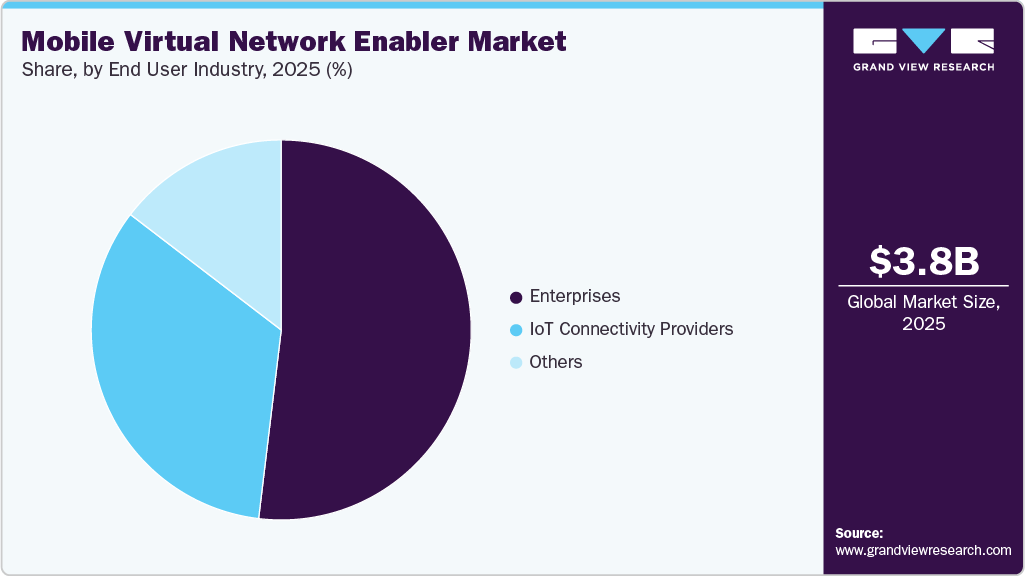
The enterprises segment dominated the market in 2025. Growth of mobile virtual network enabler adoption among enterprises is being driven by the increasing need for customized and branded connectivity solutions. Companies in sectors such as retail, banking, logistics, healthcare, and travel are using MVNE platforms to launch private-label mobile services, employee mobility plans, and customer loyalty connectivity offerings. This enables enterprises to strengthen customer engagement, create new revenue streams, and differentiate their digital ecosystems without owning telecom infrastructure. The ability to outsource technical complexity while maintaining brand ownership makes MVNE models commercially attractive.
 To learn more about this report, Download Free Sample Report
 The IoT connectivity providers segment is projected to grow at the fastest CAGR of 10.6% over the forecast period. The growth is supported by the rapid increase in connected devices across industrial, commercial, and consumer environments. Applications such as fleet telematics, smart meters, asset tracking, connected vehicles, industrial automation, healthcare monitoring, and smart city infrastructure require scalable and reliable connectivity management platforms. MVNE solutions help IoT providers manage SIM provisioning, device activation, network switching, usage monitoring, and lifecycle administration across large deployments. This significantly reduces operational complexity while enabling faster rollout of IoT services.
Regional Insights
The North America mobile virtual network enabler market held a significant share in 2025. The market in the region is characterized by a mature telecom ecosystem, high smartphone penetration, and strong adoption of outsourced digital connectivity platforms. Demand is supported by established MVNO brands, enterprise mobility solutions, and rising requirements for flexible billing and customer management systems.
U.S. Mobile Virtual Network Enabler Market Trends
The mobile virtual network enabler market in the U.S. held a dominant position in 2025 due to the presence of major MVNO brands, advanced telecom infrastructure, and strong enterprise demand for managed connectivity solutions. The market benefits from high adoption of prepaid and value-focused mobile plans, which create recurring opportunities for enablement platforms.
Europe Mobile Virtual Network Enabler Industry Trends
The mobile virtual network enabler industry in Europe was identified as a lucrative market in 2025. The growth in the region is supported by favorable regulatory frameworks that encourage MVNO participation and wholesale network access. The region has a broad base of niche, discount, ethnic, and digital-first MVNO brands that rely on third-party enablement platforms for rapid market entry.
 To learn more about this report, Download Free Sample Report
 The UK mobile virtual network enabler market is expected to grow rapidly in the coming years, driven by a highly competitive mobile sector and strong consumer acceptance of alternative network brands. Multiple retail, media, and value-led MVNOs rely on outsourced platforms for billing, provisioning, and customer lifecycle management.
The mobile virtual network enabler industry in Germany held a substantial share in 2025. The growth in the country is attributed to its large telecom subscriber base, stable regulatory environment, and strong demand for efficient wholesale mobile models. The country has an established presence of discount and branded MVNOs, creating sustained demand for scalable enablement platforms.
Asia Pacific Mobile Virtual Network Enabler Industry Trends
The mobile virtual network enabler market in Asia Pacific is anticipated to grow at a CAGR of 11.6% during the forecast period. The growth in the region is supported by expanding mobile subscriber bases, rising digital service adoption, and increasing telecom liberalization. Emerging economies are creating new opportunities for low-cost and niche MVNO models, while developed markets are accelerating enterprise and IoT connectivity deployments.
The India mobile virtual network enabler industry is expected to grow rapidly in the coming years, fueled by its large mobile user base, rapid digital transformation, and increasing enterprise demand for managed connectivity solutions. Growth opportunities are emerging in IoT applications such as smart metering, fleet management, logistics tracking, and industrial automation.
The mobile virtual network enabler market in China held a substantial share in 2025. The country's growth is influenced by its massive telecom scale, a strong industrial IoT ecosystem, and the rapid deployment of advanced network technologies. Enterprise connectivity, smart manufacturing, and connected mobility initiatives are creating demand for sophisticated enablement platforms capable of managing high-volume device ecosystems.
Key Mobile Virtual Network Enabler Companies Insights
Some of the key companies in the mobile virtual network enabler market include Plintron, Transatel, Effortel, Circles Aspire, and others. Organizations are focusing on increasing their customer base to gain a competitive edge in the industry. Therefore, key players are taking several strategic initiatives, such as mergers and acquisitions, and partnerships with other major companies.
-
Plintron is a digital communications technology company, specializing as the multi-country end-to-end Mobile Virtual Network Enabler (MVNE), Aggregator (MVNA), Communications Platform as a Service (CPaaS), and IoT solutions provider. It offers Telecom-as-a-Service (TaaS) and SaaS platforms that simplify mobile services for Mobile Network Operators (MNOs), MVNOs, enterprises, IoT players, and OTT innovators, with integrations across 40+ MNOs in 31+ countries spanning six continents.
-
Effortel is a Brussels-based telecommunications company operating as a Mobile Virtual Network Enabler (MVNE) and provider of OSS/BSS (Operations Support System/Business Support System) solutions for Communication Service Providers (CSPs), including MVNOs and MNOs. It specializes in cloud-native platforms for billing, customer care, network management, service orchestration, real-time charging, and value-added services such as eSIM, IoT connectivity, and private networks.
Key Mobile Virtual Network Enabler Companies:
The following key companies have been profiled for this study on the mobile virtual network enabler market.
- Plintron
- Transatel
- Effortel
- Circles Aspire
- Telgoo5
- MDS Global
- iQsim
- Telenabler
- MVN-X
- KORE Wireless
Recent Developments
-
In December 2025, Viper Networks and Choice Wireless, a mobile virtual network enabler (MVNE), announced a joint venture agreement to co-market innovative mobile services addressing gaps in customer demand, including MVNO on-ramps for niche geographic and cultural markets, enterprise communication suites replacing complex VoIP with native mobile consolidation, and secure mobile data services forming global virtual private networks. Viper's subsidiary 0Wire Communications will adopt Choice's VirtuoLink platform as the core for its mobile deployments, enabling focus on radio access network builds while outsourcing complex MVNE operations.
-
In August 2025, Consumer Cellular, a U.S. wireless provider, expanded its multi-year partnership with Amdocs to integrate advanced AI capabilities into its EnablerIQ MVNE (Mobile Virtual Network Enabler) platform, building on the recent deployment of Amdocs' connectX SaaS solution. The agreement introduces Amdocs' AI & Data Platform (AIDP), Customer Experience Insights (CXI), and amAIz Suite, leveraging generative AI to automate MVNO onboarding and operations, and to deliver personalized customer experiences through real-time predictive analytics and actionable telecom insights.
Mobile Virtual Network Enabler Market Report Scope
Report Attribute
Details
Market size in 2025
USD 3.8 billion
Estimated market size in 2026
USD 4.0 billion
Projected market size by 2033
USD 7.9 billion
Growth rate
CAGR of 10.2% from 2026 to 2033
Base year for estimation
2025
Historical data
2021 - 2025
Forecast period
2026 - 2033
Quantitative units
Revenue in USD million/billion and CAGR from 2026 to 2033
Report deployment model
Revenue forecast, company ranking, competitive landscape, growth factors, and trends
Segments covered
Service type, deployment model, end user industry, region
Regional scope
North America; Europe; Asia Pacific; Latin America; MEA
Country scope
U.S.; Canada; Mexico; Germany; UK; France; China; Japan; India; South Korea; Australia; Brazil; KSA; UAE; South Africa
Key companies profiled
Plintron; Transatel; Effortel; Circles Aspire; Telgoo5; MDS Global; iQsim; Telenabler; MVN-X; KORE Wireless
Customization scope
Free report customization (equivalent up to 8 analysts working days) with purchase. Addition or alteration to country, regional & segment scope.
Pricing and purchase options
Avail customized purchase options to meet your exact research needs. Explore purchase options
Global Mobile Virtual Network Enabler Market Report Segmentation
This report forecasts revenue growth at global, regional, and country levels and provides an analysis of the latest industry trends in each of the sub-segments from 2021 to 2033. For this study, Grand View Research has segmented the global mobile virtual network enabler market report based on service type, deployment model, end user industry, and region.
 To learn more about this report, Download Free Sample Report
 -
Service Type Outlook (Revenue, USD Million, 2021 - 2033)
-
Infrastructure Services
-
Business Support Systems (BSS)
-
Operational Support Systems (OSS)
-
Billing & Charging Solutions
-
Others
-
-
Deployment Model Outlook (Revenue, USD Million, 2021 - 2033)
-
On-premise
-
Cloud-based / SaaS-based
-
-
End User Industry Outlook (Revenue, USD Million, 2021 - 2033)
-
Enterprises
-
IoT Connectivity Providers
-
Others
-
-
Regional Outlook (Revenue, USD Million, 2021 - 2033)
-
North America
-
U.S.
-
Canada
-
Mexico
-
-
Europe
-
Germany
-
UK
-
France
-
-
Asia Pacific
-
China
-
Japan
-
India
-
South Korea
-
Australia
-
-
Latin America
-
Brazil
-
-
Middle East and Africa (MEA)
-
KSA
-
UAE
-
South Africa
-
-
Frequently Asked Questions About This Report
Asia Pacific is the fastest-growing region over the forecast period.
The infrastructure services held the largest revenue share 32.1% in 2025, while billing & charging solutions is the fastest-growing area.
The cloud-based / SaaS-based segment led revenue share in 2025.
The expanding global presence of mobile virtual network operators and the increasing preference for outsourced telecom operating models is driving growth of the market.
The global mobile virtual network enabler market size was estimated at USD 3.8 billion in 2025 and is expected to reach USD 4.0 billion in 2026.
The global mobile virtual network enabler market is expected to witness a compound annual growth rate of 10.2% from 2026 to 2033 to reach USD 7.9 billion by 2033.
Europe region held the largest share of 34.2% in 2025.
The enterprises held the largest share in 2025 and IoT connectivity providers is the fastest-growing market.
Key players include Plintron; Transatel; Effortel; Circles Aspire; Telgoo5; MDS Global; iQsim; Telenabler; MVN-X; KORE Wireless.
About the Author(s)
Communication Services Research Team
Technology · Communication ServicesThis report was authored by the communication services research team at Grand View Research - comprising two research analysts, one senior research analyst, and one industry expert - with specialized expertise in the communication services segment of the technology industry. All findings are based on proprietary technology databases, executive interviews, and regulatory analysis, subject to internal peer review prior to publication.
Last Updated:
Speak to Analyst

Customize this report to your needs - add regions, segments, or data points, with 20% free customization.
Or view our licence options:


ISO 9001:2015 & 27001:2022 Certified
We are GDPR and CCPA compliant! Your transaction & personal information is safe and secure. For more details, please read our privacy policy.


