
- Home
- »
- Organic Chemicals
- »
-
Mold Flux Market Size, Share & Growth Report, 2026-2033GVR Report cover

Mold Flux Market (2026 - 2033)
Size, Share & Trends Analysis Report By Form (Powder, Granule), By Product (Synthetic Mould Powders, Pre-fused/Fritted Mould Powders ), By Steel Grade (Carbon Steel), By Casting Application, By Region, And Segment Forecasts
Market Size, 2025
$854.3MMarket Estimate, 2026
$876.1MMarket Forecast, 2033
$1,184.2MCAGR, 2026–2033
4.4%Mold Flux Market Summary
The global mold flux market size was valued at USD 854.3 million in 2025 and is projected to grow from USD 876.1 million in 2026 to USD 1,184.2 million by 2033, at a CAGR of 4.4% from 2026 to 2033. Asia Pacific dominated the market, accounting for the largest revenue share of 64.1% in 2025. The market is driven by the need to improve casting stability, steel surface quality, and operational efficiency across continuous steelmaking processes.
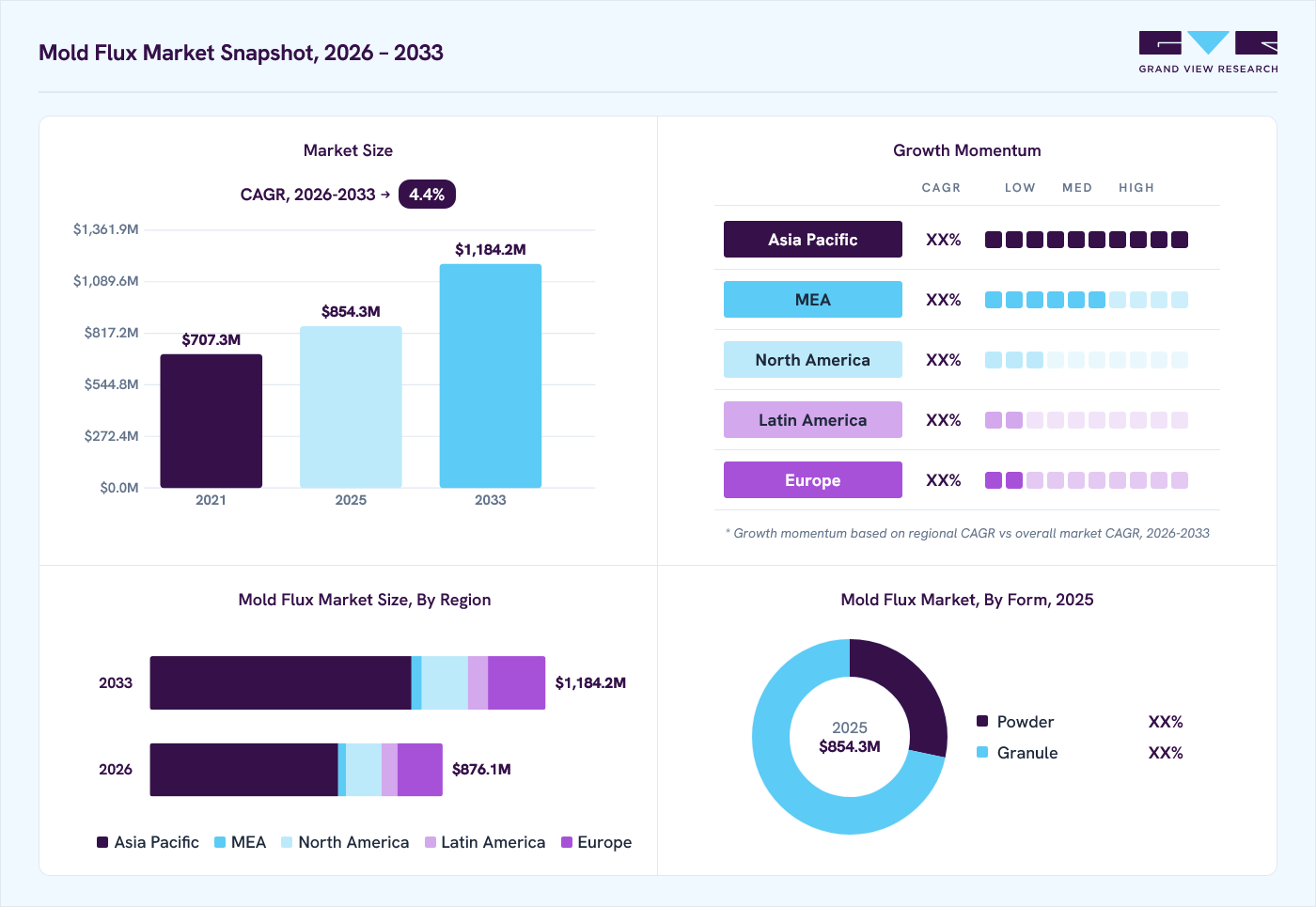 Source: Grand View Research, IR Documents, Primary Interviews, Paid DatabasesTo learn more about this report,
 Download Free Sample Report
Key Market Trends & Insights
- By form: Granule segment held the dominating revenue share of 71.6% in 2025.
- By product: Synthetic mould powders accounted for the largest revenue share of 61.3%, in 2025.
- By steel grade: Carbon steel represented the largest application segment in 2025, capturing an 80.9% revenue share.
- By casting application: Slab casting held the leading position, accounting for 66.2% of total revenue in 2025.
Regional Highlights
- Largest regional market: Asia Pacific (64.1% revenue share, 2025)
- By country: China held the largest market share in 2025
Market Size & Forecast
- Market size in 2025: USD 854.3 Million
- Estimated market size in 2026: USD 876.1 Million
- Projected market size by 2033: USD 1,184.2 Million
- CAGR (2026-2033): 4.4%
Prism AI by Grand View Research Free to tryAsk a question about the mold flux marketTry asking✓Every figure cited from GVR research Prefer the report? Download free sample →
Mold flux facilitates lubrication between the steel strand and the mold while regulating heat transfer during solidification. Its ability to support inclusion absorption and reduce casting-related defects makes it an important consumable for steel producers. Continued demand for consistent steel quality across industrial applications sustains market consumption.The broader use of continuous casting across integrated steel plants and mini mills supports recurring procurement of mold flux products. Steelmakers require formulations suited to different casting speeds, mold geometries, and steel compositions to maintain process stability. Growing pressure to minimize production losses and improve material yield also increases attention to flux performance. These requirements create opportunities for manufacturers offering consistent formulations and application-specific technical support.
 To learn more about this report, Download Free Sample Report
The development of advanced mold flux formulations offers opportunities to address the increasingly diverse requirements of modern steelmaking operations. Manufacturers can optimize viscosity, melting behavior, crystallization characteristics, and chemical composition to match individual casting conditions. These improvements can help steel producers manage heat transfer and lubrication while addressing quality requirements for demanding steel grades. Suppliers that validate products through mill trials and application engineering can build stronger customer relationships and differentiate their portfolios.
Market Dynamics
Demand for mold flux is closely linked to steel output, continuous-casting utilization, and the product specifications required by individual mills. Formulation requirements vary according to steel grade, casting format, and operating parameters, making product suitability a key purchasing consideration. Changes in mineral input costs, energy expenses, and manufacturing efficiency affect supplier margins and commercial pricing. Competition consequently depends on product consistency, technical expertise, customer qualification, and reliable supply.
Steel producers increasingly prioritize higher first-pass yield and lower rejection rates to improve manufacturing economics. Mold flux contributes to these objectives by supporting strand lubrication, absorbing non-metallic inclusions, and controlling thermal conditions within the mold. Appropriate flux selection can help reduce surface imperfections and casting instability when matched to the operating conditions. This reinforces demand for products that deliver dependable performance throughout extended production campaigns.
The importance of defect prevention is particularly relevant where steel quality requirements are stringent and downstream processing costs are high. Flux manufacturers must account for differences in casting speed, steel chemistry, and cooling conditions when designing formulations. Products that help maintain consistent surface quality can support customer retention and repeat procurement. Technical collaboration with steelmakers therefore represents an important competitive advantage.
Mold flux manufacturers depend on mineral-based inputs and chemical constituents whose availability and prices can fluctuate with energy costs, mining output, transportation expenses, and regional supply conditions. Sudden increases in input costs can compress margins, particularly where customer contracts limit the ability to adjust selling prices quickly. Procurement uncertainty can also complicate production planning and inventory management. These pressures create challenges for suppliers seeking to maintain stable pricing and consistent product availability.
The production of specialized steels creates scope for mold flux products engineered around metallurgical and casting requirements. Manufacturers can develop differentiated formulations for applications where surface integrity, thermal control, and consistent solidification are critical. This enables suppliers to compete through technical performance rather than relying exclusively on price. Higher-value product development can also deepen collaboration with steelmakers seeking dependable solutions for demanding applications.
Customization creates opportunities for application testing, technical consultancy, and long-term supply arrangements with steel producers. Suppliers with formulation laboratories and access to casting-performance data can respond more effectively to customer-specific challenges. Successful qualification can establish barriers to substitution and strengthen commercial relationships. Over time, this approach can help manufacturers expand into specialty applications and improve product portfolio value.
Market Concentration & Characteristics
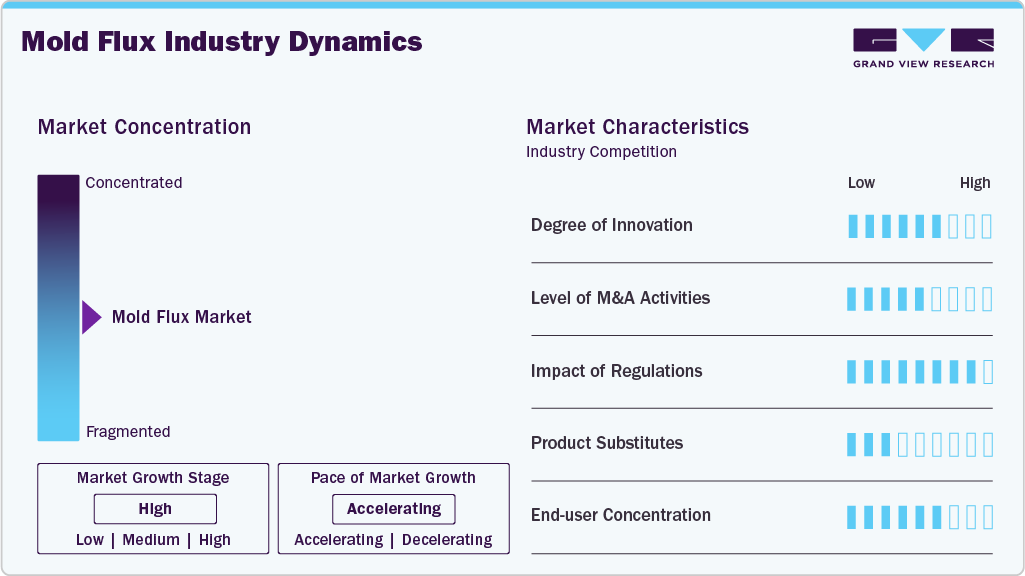
The mold flux market serves an industrial customer base in which technical qualifications, product consistency, and reliable deliveries are important selection criteria. Manufacturers compete through formulation capabilities, quality assurance, application support, and their ability to meet the operational requirements of individual steel mills. Established suppliers can benefit from longstanding customer relationships and experience different casting processes. Regional production and distribution capabilities also influence responsiveness to mill requirements.
 To learn more about this report, Download Free Sample Report
Customer qualification requirements and the consequences of casting defects can make supplier replacement technically demanding. Steelmakers generally need confidence that a new product will perform consistently before introducing it into routine operations. Competition therefore extends beyond the initial purchase price to include process compatibility, troubleshooting support, and supply reliability. Specialized formulations and customer-specific technical service provide potential routes to differentiation.
Analyst Perspective
The market is fundamentally linked to continuous-casting performance and the economic priorities of steel producers. While established steel grades support a broad consumption base, specialized casting requirements create opportunities for technically differentiated products. Manufacturers must balance formulation quality, raw material exposure, and customer-specific service expectations. Competitive positioning will depend on the ability to deliver reliable performance while adapting to changing steelmaking processes.
Form Insights
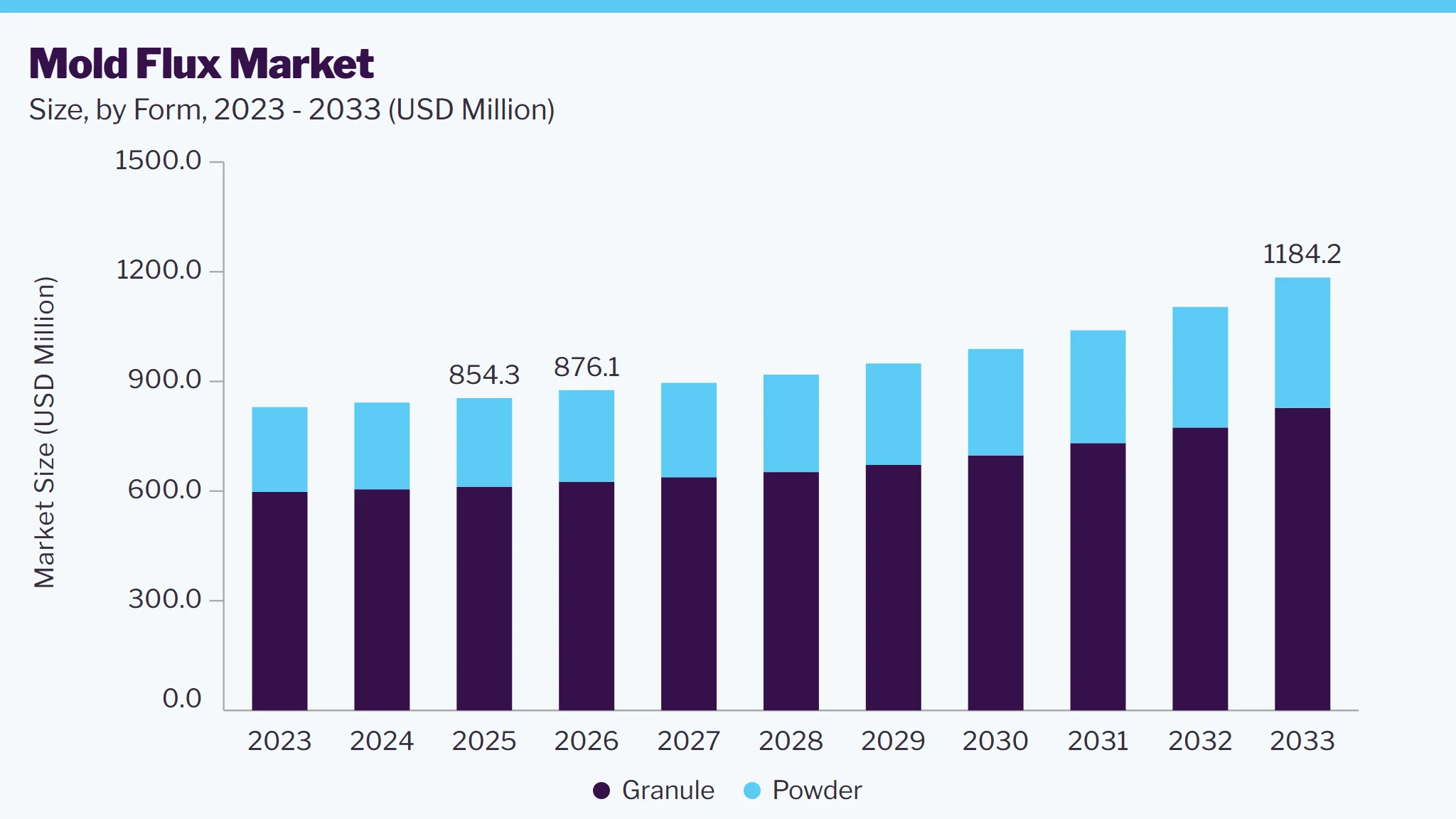
Granular held the largest revenue share of 71.6% in 2025, due to its compatibility with established handling, storage, and charging practices at steel plants. Its physical form supports practical material management in facilities operating high-volume casting lines. Standardized handling procedures also help mills maintain consistent flux application during routine production. These operational advantages support sustained adoption across conventional steelmaking facilities.
Powder is the fastest growing form segment, with a CAGR of 5.2% from 2026 to 2033, as steelmakers seek products suited to specific mold conditions and casting requirements. Its formulation can be adjusted to achieve targeted melting characteristics, viscosity, and thermal behavior. Such flexibility supports the development of products for specialized production environments and demands quality specifications. Increasing interest in process-specific consumables provides a basis for growth in this segment.
Product Insights
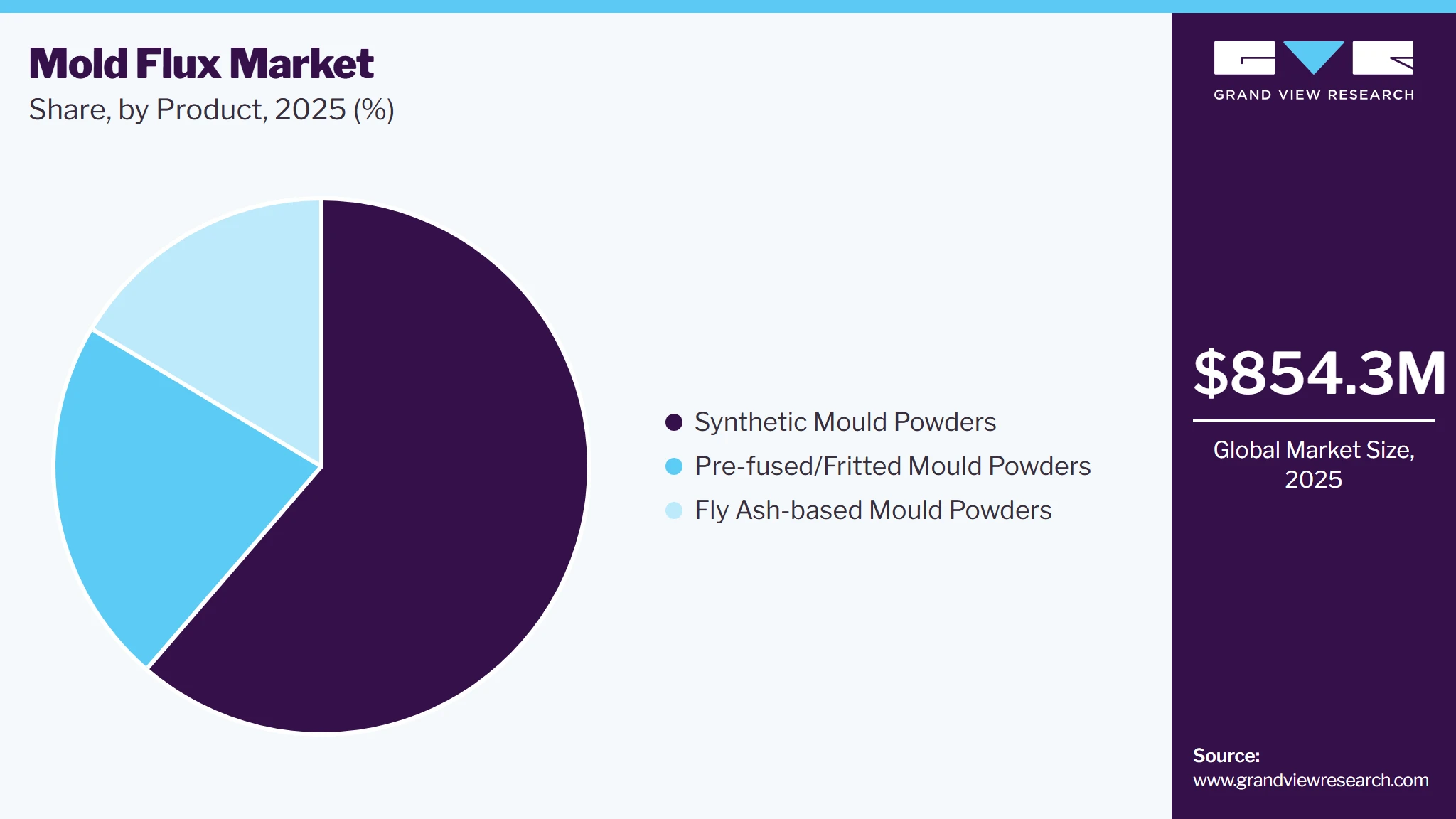
Synthetic mould powders accounted for 61.3% in 2025, because manufacturers can engineer their chemical composition to achieve defined operating characteristics. Controlled formulation enables adjustments to melting temperature, viscosity, lubrication, and heat-transfer behavior. These properties allow suppliers to serve different steel grades and continuous-casting configurations through differentiated product portfolios.
 To learn more about this report, Download Free Sample Report
Pre-fused/fritted mould powders are growing at a CAGR of 3.6% from 2026 to 2033. Pre-fused and fritted mould powders support improved compositional consistency through controlled pre-processing of raw materials. This helps reduce variability during heating and promotes predictable melting behavior. Their consistent performance supports stable casting conditions, encouraging adoption among steelmakers seeking reliable process control and product quality.
Steel Grade Insights
Carbon steel held the largest revenue share of 80.9% in 2025, because of its extensive use in construction, automotive components, pipelines, machinery, and general manufacturing. Large-scale production of these materials generates substantial requirements for casting consumables across integrated and independent steel producers.
Alloy and specialty steel is projected to be the fastest-growing segment with a CAGR of 6.4% from 2026 to 2033. It creates demand for flux formulations adapted to distinctive metallurgical properties and processing conditions. Variations in alloy composition and casting behavior can require more specialized control of lubrication, heat transfer, and solidification. Manufacturers that develop application-specific products can address these technical requirements more effectively than suppliers relying solely on standardized formulations.
Casting Applications Insights
In 2025, slab casting accounted for 66.2% of total market revenue, because it supplies semi-finished steel for flat products, including plates and hot-rolled coils. These materials serve automotive manufacturing, heavy equipment, construction, energy infrastructure, and industrial fabrication. Slab-casting operations require mold flux capable of maintaining appropriate lubrication and thermal conditions across production campaigns.
The billet casting segment is expected to be the fastest-growing application segment expanding at a CAGR of 5.2% during 2026-2033, supported by construction activity, infrastructure development, and manufacturing requirements. Casting conditions and billet dimensions influence the flux characteristics needed for stable operation and acceptable surface quality. Growing requirements for reliable long-product production create opportunities for formulations tailored to billet-casting processes.
Regional Insights
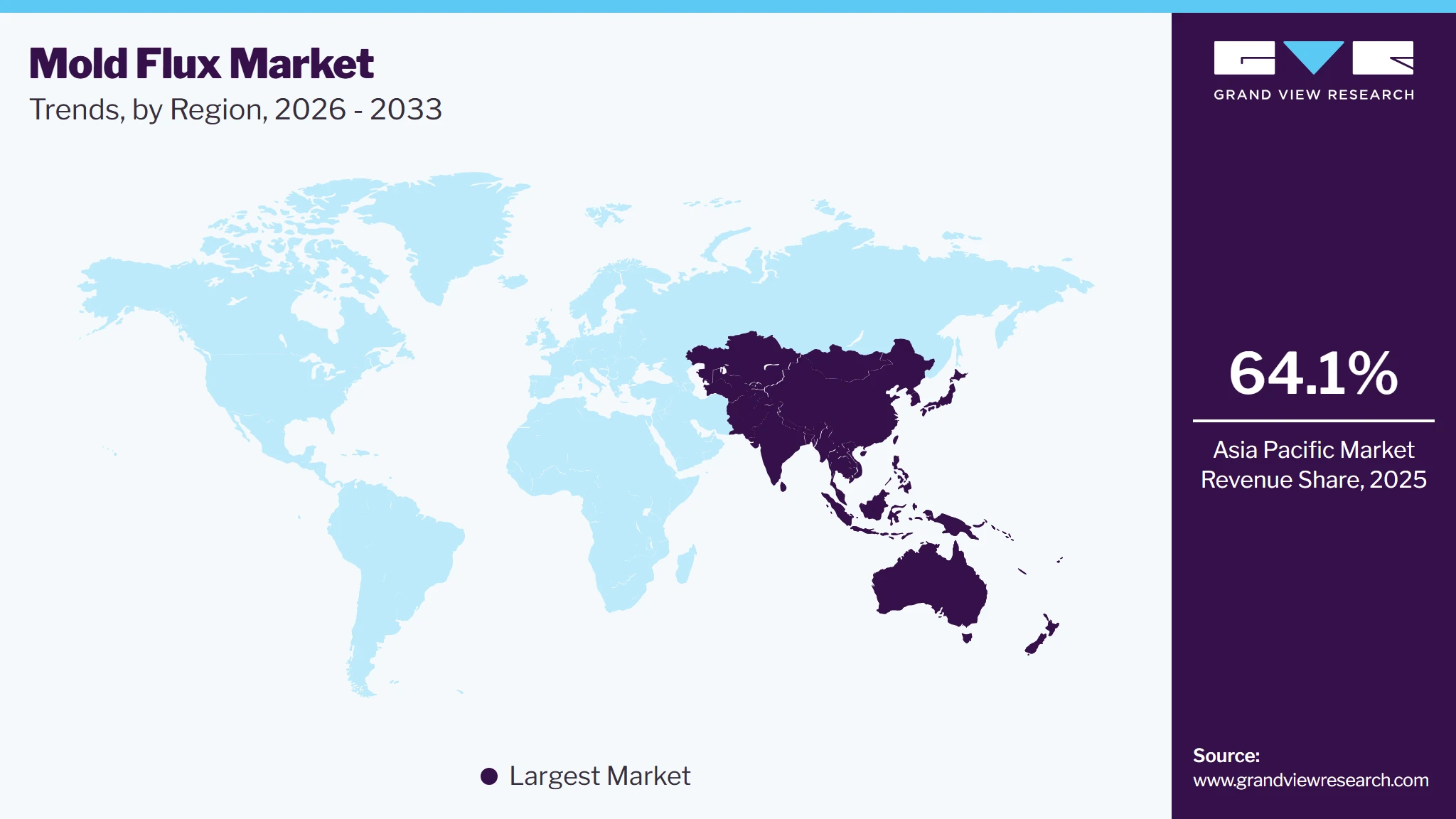
Asia Pacific held the largest revenue share of 64.1% in 2025. The region contains major producers of construction steel, flat steel, and engineering materials, supporting consumption across several casting applications. Large production volumes create recurring requirements for mold flux and related metallurgical consumables. Domestic manufacturing networks and established steel-industry supply chains further reinforce regional demand.
 To learn more about this report, Download Free Sample Report
China Mold Flux Market Trends
China is growing with revenue CAGR of 4.4% during forecast period. China is a major contributor to regional mold flux demand because of its large steel production base and extensive continuous-casting infrastructure. Its steel industry supplies domestic construction, machinery, transportation, and industrial manufacturing markets. The scale of production creates demand for flux products across different steel grades and casting formats. Local suppliers and established procurement channels also contribute to a competitive market environment.
North America Mold Flux Market Trends
North America represents an established market where steel producers focus on productivity, product consistency, and the efficient use of existing manufacturing assets. Demand for mold flux reflects requirements across flat-steel and long-steel production operations. The region's industrial customer base encourages suppliers to meet technical specifications and maintain dependable delivery schedules. Modernization of casting facilities provides additional scope for specialized consumables.
The U.S. market benefits from steel demand across automotive manufacturing, energy infrastructure, construction, and industrial equipment. Domestic producers require mold flux products compatible with their casting equipment, steel grades, and production targets. Emphasis on manufacturing efficiency and quality assurance creates opportunities for suppliers with strong technical service capabilities. Reliable sourcing and product qualification remain important considerations for purchasing decisions.
Europe Mold Flux Market Trends
Europe's Mold Flux Market is shaped by established steelmaking operations, demanding product specifications, and continued efforts to improve industrial efficiency. Automotive, engineering, machinery, and construction applications contribute to requirements for different steel grades. Manufacturers must address diverse casting conditions while maintaining consistency and compliance with customer specifications. Modernization initiatives and specialized steel production support demand for technically differentiated flux products.
Germany’s mold flux market is supported by its established steel manufacturing base and demand for high-quality continuous casting operations. The country’s automotive, machinery, and industrial equipment sectors require consistent steel quality and reliable casting performance, supporting the use of mold fluxes to regulate heat transfer, provide lubrication, and control inclusions during steel solidification.
Latin America Mold Flux Market Trends
Latin America's mold flux demand is linked to regional steel production, infrastructure development, and manufacturing activity. Construction-related steel products and industrial applications contribute to the need for consumables across casting facilities. Market prospects vary with steel output, investment conditions, and the utilization of local production capacity. Suppliers able to provide dependable regional service and competitive product offerings can strengthen their presence.
Middle East & Africa Mold Flux Market Trends
The Middle East & Africa region offers development opportunities associated with industrial diversification, infrastructure investment, and the expansion of domestic steelmaking capabilities. Construction and urban development support demand for reinforcing steel and other semi-finished materials. New or upgraded casting operations require suitable flux products to maintain production quality and operational reliability.
Key Global Mold Flux Company Insights
The global mold flux market is characterized by established manufacturers with specialized product portfolios, technical expertise, and strong relationships with steel producers. Key companies compete through formulation development, product quality, manufacturing capabilities, and application-specific solutions tailored to different casting processes and steel grades. Investments in production capacity, geographic expansion, and strategic acquisitions further strengthen their competitive positioning.
-
IFGL Refractories is a manufacturer of specialized refractory products and casting fluxes for the iron and steel industry. Under its Flowtherm brand, the company offers granular and powder-form casting fluxes for multiple steel grades and continuous casting applications, including slabs, billets, blooms, and beam blanks. Its competitive positioning is supported by tailored flux formulations, quality-control capabilities, research and development, and dedicated manufacturing facilities in India, including an automated granular flux plant with an installed capacity of 18,000 tons per annum.
-
Vesuvius is a global producer of specialized materials and technologies for steelmaking, with a dedicated mold flux portfolio under its Metallurgica product line. Its offerings include fine mould powders, spray-dried granular fluxes, and exothermic starting powders for different continuous casting applications, including slabs, billets, blooms, and other cast sections. The company emphasize customized formulations, product consistency, and process solutions that support mold lubrication, heat-transfer control, and steel quality.
Key Global Mold Flux Companies
The following key companies have been profiled for the study on the mold flux market.
-
Vesuvius
-
IFGL Refractories
-
Prosimet
-
Guru Corporation
-
SHINAGAWA REFRA CO., LTD
-
Krosaki Harima Corporation
-
Dynamix Casting Fluxes
-
Jharkhand Grind-Chem Private Limited
-
Minex
-
Metallium
Competitive Benchmarking
Operating Strategies
Competitive Edge
Weaknesses
Mature Players: Vesuvius, IFGL Refractories, Prosimet, Shinagawa Refractories Co., Ltd., Krosaki Harima Corporation, Dynamix Casting Fluxes
- Mature players focus on product portfolio expansion, formulation development, and long-term relationships with steel producers. Their strategies include supplying fluxes for multiple casting formats and steel grades, investing in manufacturing capabilities, and providing technical assistance to optimize casting performance. Geographic expansion, strategic acquisitions, and localized production also support customer coverage and supply reliability.
- These companies benefit from established customer relationships, technical expertise, and experience serving demanding continuous-casting applications. Their broader product portfolios and manufacturing networks support supply to different steelmaking facilities and geographic markets. Established product qualification experience and application-specific support can strengthen customer retention and reduce supplier-switching risk.
- Large established suppliers may face higher operating costs associated with manufacturing networks, technical services, and product development. Serving multiple markets and steel grades can also increase portfolio complexity and require continued investment in product qualification. Their established operating structures may limit responsiveness in certain niche applications compared with smaller, more specialized manufacturers.
Emerging Players: Guru Corporation, Jharkhand Grind-Chem Private Limited, Minex Mincast, Metallium
- Emerging players generally emphasize specialized product offerings, competitive pricing, and responsiveness to individual steelmaker requirements. Their strategies include developing customized formulations, supplying powder and granular fluxes, and building relationships with regional steel plants. Expanding production capabilities and strengthening distribution networks can help these companies increase visibility and access new customers.
- These manufacturers can compete through flexible production arrangements, customer-specific formulations, and close engagement with regional steel producers. A focused product portfolio may enable faster responses to particular casting requirements and procurement needs. Regional manufacturing and comparatively direct customer relationships can also provide advantages in selected markets.
- Emerging players may have more limited international reach, brand recognition, and technical-service infrastructure than established global suppliers. Smaller manufacturing footprints can constrain their ability to serve large steelmakers requiring consistent volumes across multiple facilities. Limited resources for research, product qualification, and overseas expansion may also slow entry into technically demanding applications.
Recent Developments
-
In March 2026, Shinagawa Refractories announced plans to acquire a 51% ownership interest in Dynamix Casting Fluxes, a U.S.-based manufacturer of mold flux for continuous steel casting. The acquisition strengthening Shinagawa's global mold flux platform and expanding its presence in the North American market.
Mold Flux Market Report Scope
Report Attribute
Details
Market Definition
The market comprises the production and supply of specialized flux materials used in continuous steel casting to regulate heat transfer, provide lubrication between the steel strand and mold, prevent oxidation, and control the formation of inclusions. Available in forms such as granules and powders, mold flux products are formulated according to casting processes, steel grades, and operational requirements to support stable casting performance, improve surface quality, and enhance production efficiency across steel manufacturing facilities.
Market size value in 2025
USD 854.3 million
Market size value in 2026
USD 876.1 million
Revenue forecast in 2033
USD 1,184.2 million
Growth rate
CAGR of 4.4% from 2026 to 2033
Base year for estimation
2025
Historical data
2021 - 2024
Forecast period
2026 - 2033
Quantitative units
Revenue in USD million/billion, volume in kilotons, and CAGR from 2026 to 2033
Report coverage
Revenue forecast, volume forecast, company ranking, competitive landscape, growth factors, and trends
Segments covered
Form, product, steel grade, casting application, region
Country scope
U.S.; Canada; Mexico; Germany; UK; France; Italy; Spain; China; India; Japan; South Korea; Brazil; Argentina; Saudi Arabia; South Africa
Key companies profiled
Vesuvius; IFGL Refractories; Prosimet; Guru Corporation; SHINAGAWA REFRA CO., LTD; Krosaki Harima Corporation; Dynamix Casting Fluxes; Jharkhand Grind-Chem Private Limited Ltd; Minex; Metallium
Customization scope
Free report customization (equivalent up to 8 analysts’ working days) with purchase. Addition or alteration to country, regional & segment scope.
Pricing and purchase options
Avail customized purchase options to meet your exact research needs. Explore purchase options
Global Mold Flux Market Report Segmentation
This report forecasts volume & revenue growth at regional and country levels and provides an analysis of the latest industry trends in each of the sub-segments from 2021 to 2033. For this study, Grand View Research has segmented the global mold flux market report based on form, product, steel grade, casting application, and region:
-
Form Outlook (Revenue, USD Million; Volume, Kilotons, 2021 - 2033)
-
Powder
-
Granule
-
-
Product Outlook (Revenue, USD Million; Volume, Kilotons, 2021 - 2033)
-
Fly Ash-based Mould Powders
-
Synthetic Mould Powders
-
Pre-fused/Fritted Mould Powders
-
-
Steel Grade Outlook (Revenue, USD Million; Volume, Kilotons, 2021 - 2033)
-
Carbon steel
-
Stainless steel
-
Alloy / specialty steel
-
Other Steel Grades (if any)
-
-
Casting Application Outlook (Revenue, USD Million; Volume, Kilotons, 2021 - 2033)
-
Slab casting
-
Billet casting
-
Bloom casting
-
Other Casting Applications
-
-
Region Outlook (Revenue, USD Million; Volume, Kilotons, 2021 - 2033)
-
North America
-
U.S.
-
Canada
-
Mexico
-
-
Europe
-
Germany
-
UK
-
France
-
Italy
-
Spain
-
-
Asia Pacific
-
China
-
India
-
Japan
-
South Korea
-
-
Latin America
-
Brazil
-
Argentina
-
-
Middle East & Africa
-
Saudi Arabia
-
South Africa
-
-
Research Methodology
The mold flux market figures in this report are based on a proven research process that combines executive interviews with secondary research from proprietary databases, company filings, and recognized regulatory and institutional sources. Market size is built through value-chain sizing-reconciling supply-side and demand-side estimates-and triangulated with bottom-up and top-down approaches. Every estimate passes multiple levels of expert validation before publication, with each mold flux segment quantified using the revenue-capture definitions in the table below.
Segment Definition
Segment - Form
Revenue capture definition
Powder
Captures revenue generated from mould flux supplied in powder form for continuous steel casting. Revenue includes products used to provide thermal insulation, control heat transfer, lubricate the mould-steel interface, and absorb non-metallic inclusions, supporting stable casting operations and surface quality.
Granule
Captures revenue generated from granular mould flux products designed for controlled feeding and consistent distribution across the molten steel surface. Revenue includes granular formulations used to improve application uniformity, reduce dust generation during handling, and maintain effective mould lubrication and thermal control.
Segment - Product
Revenue capture definition
Fly Ash-based Mould Powders
Captures revenue from mould flux products formulated using fly ash as a primary or significant raw material component. Revenue includes formulations designed to provide the required melting characteristics, viscosity, lubrication, insulation, and inclusion absorption during continuous steel casting.
Synthetic Mould Powders
Captures revenue from engineered mould flux formulations produced using selected raw materials to achieve specific chemical compositions and performance characteristics. Revenue includes products tailored to casting conditions, steel grades, and operational requirements, particularly where consistent flux properties and controlled casting performance are critical.
Pre-fused/Fritted Mould Powders
Captures revenue from mould flux products manufactured using pre-fused or fritted raw materials that are subsequently processed into the required product form. Revenue includes formulations designed to improve compositional uniformity and control melting behaviour, viscosity, and lubrication performance during continuous casting.
Segment - Steel Grade
Revenue capture definition
Carbon steel
Captures revenue from mould flux products used in the continuous casting of carbon steel grades. Revenue includes formulations developed to meet grade-specific requirements for mould lubrication, heat transfer, inclusion absorption, and surface quality across the production of slabs, billets, and blooms.
Stainless steel
Captures revenue from mould flux products designed for casting stainless steel grades, considering their distinct chemical compositions, solidification characteristics, and surface-quality requirements. Revenue includes formulations tailored to provide suitable melting behaviour, lubrication, and thermal control under stainless steel casting conditions.
Alloy / specialty steel
Captures revenue from mould flux products used in casting alloy steels and specialty steel grades that require specific flux properties to accommodate variations in composition, solidification behaviour, and casting conditions. Revenue includes grade-specific formulations designed to maintain lubrication, thermal stability, and casting quality.
Other Steel Grades (if any)
Captures revenue from mould flux products used for steel grades not classified under carbon steel, stainless steel, or alloy/specialty steel within the adopted segmentation. Revenue includes formulations serving other steelmaking requirements where distinct casting conditions or product specifications apply.
Segment - Casting Application
Revenue capture definition
Slab casting
Captures revenue from mould flux products consumed in the continuous casting of slabs, primarily for flat steel products such as hot-rolled coils, plates, and sheets. Revenue includes flux formulations designed to support mould lubrication, controlled heat transfer, inclusion absorption, and surface quality during high-throughput slab casting.
Billet casting
Captures revenue from mould flux products used in the continuous casting of billets, which serve as feedstock for long steel products such as bars, wire rods, and reinforcing steel. Revenue includes formulations suited to billet mould dimensions, casting speeds, and operating conditions, supporting lubrication, thermal control, and defect reduction.
Bloom casting
Captures revenue from mould flux products consumed in the continuous casting of blooms, which are typically used to manufacture structural sections, rails, and other large-section steel products. Revenue includes formulations designed to accommodate bloom mould geometry and casting conditions while maintaining effective lubrication, heat transfer, and surface quality.
Other Casting Application
Captures revenue from mould flux products used in continuous casting applications outside slab, billet, and bloom casting, where applicable. Revenue includes formulations supplied for other casting formats or specialized operating requirements, based on the scope of products covered by the market assessment.
Estimation Model
Layer Name
Key Question
Description
Global Production Baseline
What is the global volume of mold flux produced?
Establishes the 2025 global mould flux production baseline in metric tons using manufacturer disclosures, production capacity data, steel industry statistics, trade statistics, and other credible primary industry sources. The assessment reconciles estimated production with apparent consumption and international trade flows to establish a consistent global volume baseline.
Country Production Assessment
How much mold flux is produced in each country?
Develops country-level mould flux production estimates by identifying domestic manufacturers, assessing disclosed production capacities and manufacturing activities, and reconciling available industry statistics with import and export data. The assessment considers domestic supply capabilities and dependence on imported mould flux to estimate production by country.
Steel Grade Allocation
How is mould flux production or consumption distributed across steel grades?
Allocates estimated mould flux volume across carbon steel, stainless steel, alloy/specialty steel, and other steel grades, where applicable. The allocation considers continuous casting output by steel grade, grade-specific flux requirements, casting practices, manufacturer product portfolios, and relevant industry data to estimate the volume associated with each steel grade.
Product Allocation
What proportion of mould flux volume is attributable to each product type?
Splits the estimated mould flux market volume across fly ash-based mould powders, synthetic mould powders, and pre-fused/fritted mould powders. The assessment considers manufacturer product portfolios, commercial availability, formulation characteristics, application requirements, and product specifications to estimate the contribution of each product category.
Delivered Customizations
This report has been delivered with the following In-depth customizations
Client Request
Customization Delivered
Value Adds
Cross-Segmentation Analysis
The analysis assessed the relationship between mould flux forms, including powder and granule, and product categories comprising fly ash-based mould powders, synthetic mould powders, and pre-fused/fritted mould powders. It also evaluated demand distribution across carbon steel, stainless steel, alloy/specialty steel, and other steel grades, alongside slab, billet, bloom, and other casting applications.
Provides visibility into high-value product, form, steel grade, and casting application combinations, supporting product portfolio optimization, demand assessment, production planning, and segment prioritization.
Competitive Benchmarking
Leading mould flux manufacturers were benchmarked based on production capacity, product portfolio, powder and granule availability, formulation capabilities, steel grade and casting application coverage, manufacturing footprint, geographic presence, distribution network, raw material sourcing, manufacturing integration, sustainability initiatives, and recent strategic developments.
Helps identify competitive strengths, operational advantages, product portfolio gaps, and strategic positioning opportunities. Supports competitive differentiation, partnership assessment, capacity planning, and market entry decisions.
Opportunity Assessment
Growth opportunities were assessed across carbon steel, stainless steel, and alloy/specialty steel applications, as well as slab, billet, and bloom casting. Additional evaluation covered demand for powder and granular mould flux products, including fly ash-based, synthetic, and pre-fused/fritted formulations, to identify opportunities aligned with steel production trends, casting requirements, and evolving product specifications.
Supports the identification of priority growth segments, emerging demand areas, and investment opportunities, enabling informed decisions on capacity expansion, product diversification, formulation development, manufacturing optimization, and geographic market development.
About the Author(s)
Organic Chemicals Research Team
Bulk Chemicals · Organic ChemicalsThis report was authored by the organic chemicals research team at Grand View Research - comprising two research analysts, one senior research analyst, and one industry expert - with specialized expertise in the organic chemicals segment of the bulk chemicals industry. All findings are based on proprietary bulk chemicals databases, executive interviews, and regulatory analysis, subject to internal peer review prior to publication.
Last Updated:
Speak to Analyst

Customize this report to your needs - add regions, segments, or data points, with 20% free customization.
Or view our licence options:


ISO 9001:2015 & 27001:2022 Certified
We are GDPR and CCPA compliant! Your transaction & personal information is safe and secure. For more details, please read our privacy policy.


