
- Home
- »
- Consumer F&B
- »
-
Moringa Juice Market Size, Share, Trends Report, 2026-2033GVR Report cover

Moringa Juice Market (2026 - 2033)
Size, Share & Trends Analysis Report By Product (Pure Juice, Blended Juice), By Ingredient (Conventional, Organic), By Distribution Channel (Supermarkets/Hypermarkets, Drugstore and Pharmacies, Convenience Stores, Online), By Region, And Segment Forecasts
Market Size, 2025
$299.8MMarket Estimate, 2026
$330.6MMarket Forecast, 2033
$710.3MCAGR, 2026–2033
10.7%Moringa Juice Market Summary
The global moringa juice market size was valued at USD 299.8 million in 2025 and is projected to grow from USD 330.6 million in 2026 to USD 710.3 million by 2033, at a CAGR of 10.7% from 2026 to 2033. Asia Pacific dominated the market, accounting for a revenue share of 47.2% in 2025. The increasing consumer awareness about the health benefits of moringa oleifera, often referred to as the "miracle tree," has significantly boosted the demand for moringa juice.
 Source: Grand View Research, IR Documents, Primary Interviews, Paid DatabasesTo learn more about this report,
 Download Free Sample Report
 Key Market Trends & Insights
- By product: Pure juice segment dominated the market, with a revenue share of 73.4% in 2025.
- By ingredient: Conventional segment held the largest market share of 86.8% in 2025.
- By distribution channel: Supermarkets/Hypermarkets segment held the largest revenue share of 36.0% in 2025.
Regional Highlights
- Largest regional market: Asia Pacific (47.2% revenue share, 2025)
- By country: The U.S. held the largest market share in 2025.
Market Size & Forecast
- Market size in 2025: USD 299.8 Million
- Estimated market size in 2026: USD 330.6 Million
- Projected market size by 2033: USD 710.3 million
- CAGR (2026-2033): 10.7%
Three ways to get this report
Buy it, customize it, or ask a question.Ask an Analyst
A direct answer, usually in 1 working day
- AccessReport author, directly
- Reply timeWithin 1 working day
- No sales callDirect answer only
- FormatEmail reply
- CostFree, no cost
Get the Full Report
What the study covers
- FormatsPDF · Excel · Dashboard
- Timeline2026–2033 annual, 2025 base
- Coverage20+ countries, 5 regions
- Companies10+ key players profiled
Customize the Report
20% free customization
- IncludeCountries, segments, points
- TailorTo your product definition
- ExtendDeeper competitor detail
- OrA fully bespoke study
- Turnaround5–10 working days
This nutrient-dense superfood is packed with vitamins, minerals, antioxidants, and essential amino acids, which have propelled its adoption in various health and wellness products, including juices. One of the primary drivers of moringa juice's popularity is its extensive health benefits. Moringa juice is known to boost energy levels, improve digestion, enhance skin health, and support immune function. These benefits are attributed to its rich content of vitamins A, C, and E, calcium, potassium, and proteins. The juice's anti-inflammatory and detoxifying properties have made it a popular choice among health-conscious consumers seeking natural remedies for various ailments. This growing consumer base is particularly evident in regions such as North America, Europe, and parts of Asia, where health and wellness trends are strongly embraced.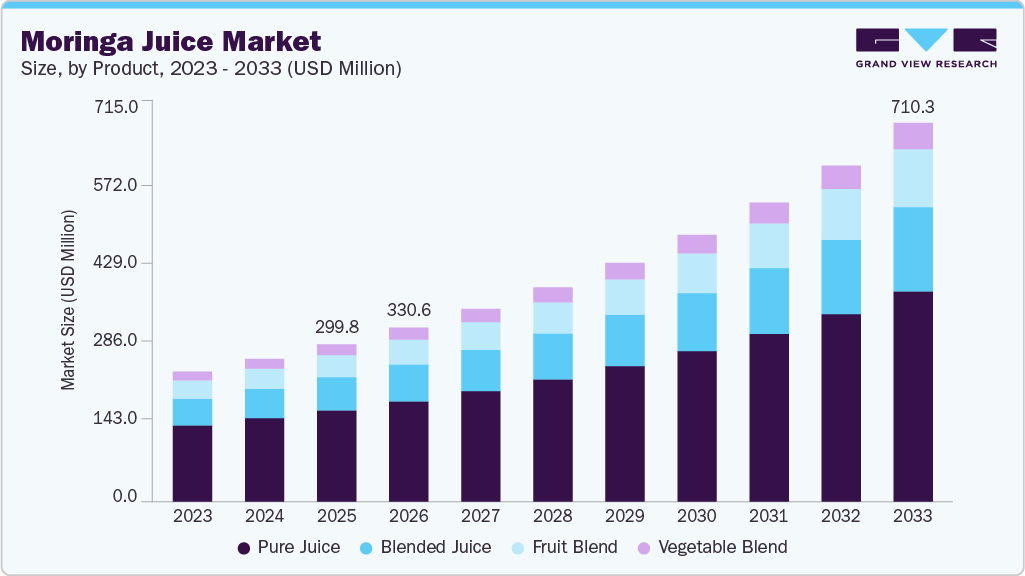 To learn more about this report, Download Free Sample Report
 Consumer trends indicate a shift towards natural and organic products, which has further fueled the demand for moringa juice. With increasing health consciousness and a preference for plant-based diets, this juice has found its place in the daily routines of many individuals.
Product innovation has played a crucial role in the expansion of the market. Companies are continuously exploring new ways to enhance the appeal and convenience of moringa juice. Innovations include the introduction of flavored moringa juices, ready-to-drink formats, and blends with other superfoods like turmeric and ginger. These innovations cater to diverse consumer preferences and have made moringa juice more accessible and enjoyable. For instance, brands such as Kuli Kuli and Aduna offer a range of flavored moringa juices that cater to different taste profiles, thereby broadening their customer base.
The adoption of subscription models by moringa juice companies has significantly contributed to market growth. Subscription services offer consumers the convenience of regular delivery of their favorite moringa juice products, ensuring they never run out of supply. This model not only boosts customer retention but also provides companies with a steady revenue stream. Brands such as Maju Superfoods and Healthy Leaf have successfully implemented subscription models, offering discounts and exclusive deals to their subscribers, which enhances customer loyalty and market penetration.
Consumer awareness campaigns and educational initiatives have also played a vital role in promoting moringa juice. Companies and health organizations have invested in awareness programs to educate consumers about the health benefits of this juice. Social media platforms, blogs, and health forums are abuzz with information on how moringa juice can improve overall well-being. This widespread dissemination of knowledge has helped demystify the benefits of moringa juice and has encouraged more people to incorporate it into their daily lives.
Moreover, the rise in e-commerce has made moringa juice more accessible to consumers worldwide. Online platforms provide a convenient way for consumers to purchase moringa juice products, compare prices, and read reviews. The digital marketplace has also enabled smaller brands to reach a global audience without significant investment in physical retail infrastructure. This accessibility has contributed to the widespread adoption of moringa juice
Market Dynamics
Moringa juice is gaining increasing popularity among health-conscious consumers due to its rich nutritional profile and functional health benefits. Derived from the leaves of the moringa plant, the beverage contains essential vitamins, minerals, antioxidants, and bioactive compounds that support immunity, energy levels, digestive health, and overall wellness. Growing consumer preference for plant-based nutrition, clean-label products, and natural functional beverages has accelerated market adoption across both developed and emerging economies. Furthermore, expanding product availability through organized retail channels and e-commerce platforms, coupled with rising awareness of preventive healthcare and superfood ingredients, is expected to continue driving growth in the moringa juice market.
The growing shift toward preventive healthcare and wellness-oriented lifestyles is significantly driving demand for moringa juice. Consumers are increasingly seeking functional beverages that provide nutritional benefits beyond basic hydration, including antioxidant support, immunity enhancement, and overall well-being. Moringa juice contains vitamins, minerals, amino acids, and bioactive plant compounds that align with the increasing preference for plant-based and clean-label products. Additionally, rising awareness regarding natural ingredients and healthy dietary habits is encouraging consumers to incorporate nutrient-dense beverages into their daily routines, supporting market growth.
Limited shelf life and low consumer awareness remain key challenges restraining the growth of the moringa juice market. Fresh moringa juice is highly perishable due to its natural composition and susceptibility to microbial spoilage, requiring manufacturers to invest in preservation technologies, specialized packaging solutions, and cold-chain logistics to maintain product quality and extend shelf life. These additional requirements increase production and distribution costs, particularly in regions with underdeveloped cold-storage infrastructure. Furthermore, compared to established functional beverages such as green tea, kombucha, and coconut water, moringa juice remains relatively unfamiliar to many consumers, limiting its adoption in mainstream markets. As a result, challenges related to product stability, distribution, and consumer education may hinder market expansion during the forecast period.
The rapid growth of the organic beverage industry presents significant opportunities for moringa juice manufacturers. Consumers are increasingly willing to pay premium prices for organic, non-GMO, and sustainably sourced products. Product innovation involving moringa juice blends with fruits, herbs, and superfoods is expanding consumer appeal and creating new revenue streams. Furthermore, increasing distribution through e-commerce platforms, health food stores, and specialty retail chains is improving product accessibility. Growing interest in immunity-boosting and nutrient-dense beverages is expected to create favorable growth prospects for the moringa juice market over the forecast period.
Analyst Perspective
The moringa juice market is evolving from a niche health beverage category into a broader wellness-driven segment, supported by increasing consumer interest in nutrient-rich, plant-derived products. Market growth is being reinforced by shifting dietary preferences, growing awareness of natural functional ingredients, and rising demand for beverages perceived to support overall health and vitality. The companies best positioned for long-term success will be those that secure reliable moringa supply chains, maintain product consistency, and effectively communicate nutritional benefits to consumers. As competition intensifies, differentiation through product innovation, organic positioning, and expanded distribution reach will become increasingly important in building brand loyalty and sustaining market share.
Product Insights
Based on product, the pure juice segment led the market with the largest revenue share of 73.4% in 2025. The demand for pure juice is driven by consumers seeking concentrated health benefits, such as boosted immunity and enhanced energy levels. Brands such as Kuli Kuli offer 100% pure moringa juice that appeals to health enthusiasts looking for unadulterated, nutrient-rich beverages.
The blended moringa juice is projected to grow at a CAGR of 11.8% over the forecast period of 2024-2030. Blended moringa juice, which combines moringa with other fruits or superfoods, is growing in popularity due to its improved taste and additional health benefits. For instance, Aduna offers moringa juice blended with baobab and pineapple, catering to consumers who prefer flavorful and versatile health drinks.
Ingredient Insights
Based on ingredient, the conventional segment led the market with the largest revenue share of 86.8% in 2025. Conventional moringa juice remains a significant market segment, primarily driven by its affordability and accessibility. This segment targets budget-conscious consumers who want to experience the benefits of moringa without the premium price tag associated with organic products.
The organic moringa juice is projected to grow at a CAGR of 14.4% over the forecast period of 2024-2030. The organic moringa juice segment is expanding rapidly as consumers increasingly prioritize organic and non-GMO products. Companies such as Organic India emphasize their organic certification and sustainable farming practices, attracting eco-conscious consumers who are willing to pay a premium for organic products.
Distribution Channel Insights
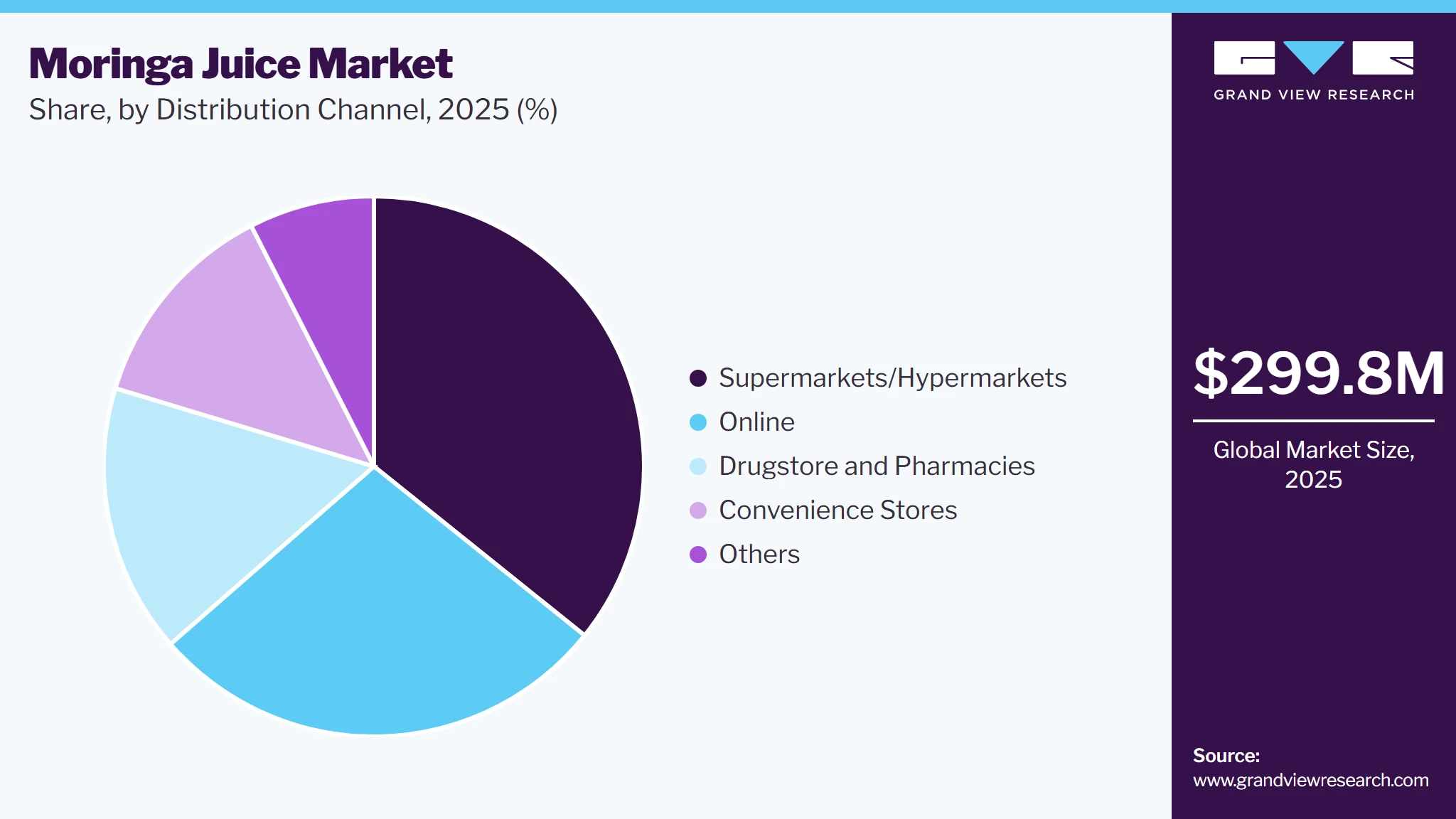
Based on distribution channel, supermarkets/hypermarkets segment led the market with the largest revenue share of 36.0% in 2025. Supermarkets and hypermarkets are crucial distribution channels for moringa juice, offering convenience and visibility to a broad consumer base. Retail giants such as Walmart and Whole Foods stock a variety of moringa juice products, making them easily accessible to mainstream shoppers.
 To learn more about this report, Download Free Sample Report
 Sales of moringa juice through online retail stores is estimated is projected to grow at a CAGR of 11.9% over the forecast period of 2024-2030. The online sales segment is witnessing significant growth, driven by the convenience of home delivery and the ability to reach a global audience. E-commerce platforms such as Amazon and niche health websites such as iHerb provide extensive selections of moringa juice, catering to tech-savvy consumers and those with limited access to physical stores.
Regional Insights
The moringa juice market in North America held 16.4% of the global revenue in 2023. The North American moringa juice market is driven by a growing interest in health and wellness, with consumers increasingly seeking natural and plant-based supplements. The region's well-developed distribution channels, both offline and online, facilitate easy access to moringa juice products.
U.S. Moringa Juice Market Trends
The moringa juice market in the U.S. held the largest share in the North America region in 2025. In the U.S., the moringa juice market benefits from high consumer awareness of superfoods and nutritional supplements. The trend towards veganism and plant-based diets further propels the demand for moringa juice. Companies capitalize on these trends, offering a variety of moringa juice products that cater to health-conscious Americans looking for natural ways to boost their nutrition.
Asia Pacific Moringa Juice Market Trends
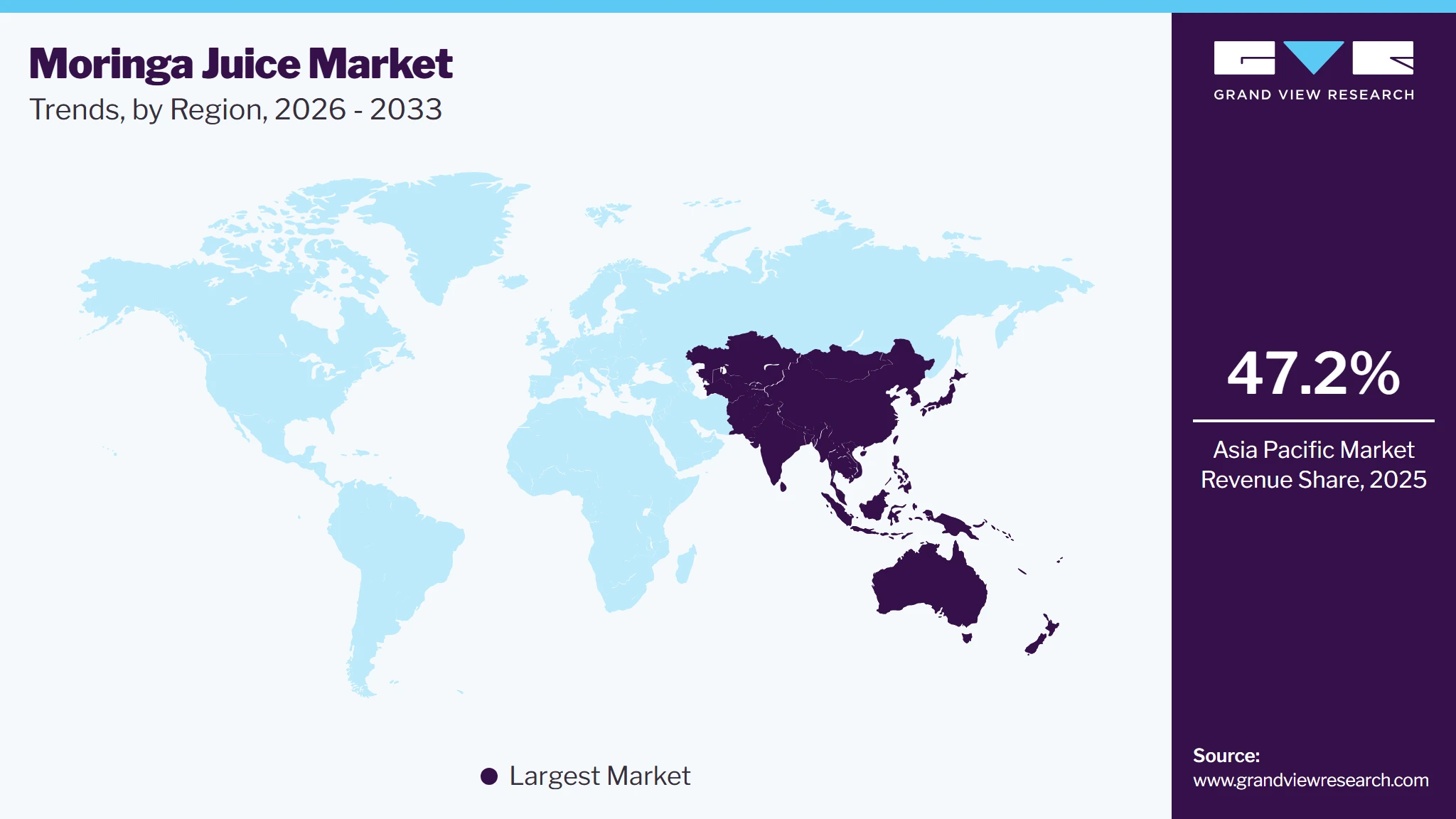
Asia Pacific dominated the moringa juice market with the largest revenue share of 47.2% in 2025. The Asia Pacific region is experiencing rapid growth in the moringa juice market due to the traditional use of moringa in herbal medicine and the increasing adoption of Western health trends. Countries such as India and the Philippines are significant producers and consumers of moringa juice.
 To learn more about this report, Download Free Sample Report
 Europe Moringa Juice Market Trends
Europe is projected to grow at a CAGR of 11.0% from 2024 to 2030. In Europe, the moringa juice market is driven by the rising demand for organic and ethically sourced products. European consumers are highly conscious of food quality and origin, leading to a preference for certified organic moringa juice.
Key Moringa Juice Company Insights
The market features both established global firms and emerging players. Key industry leaders prioritize product innovation, differentiation, and distinctive designs in line with evolving consumer preferences. Leveraging extensive global distribution networks, these major players effectively reach diverse customer bases and tap into emerging markets.
Key Moringa Juice Companies:
The following key companies have been profiled for this study on the moringa juice market.
-
Flavours Avenue
-
Dynamic Health
-
Basic Ayurveda Limited
-
Soronko.
-
Sri Sri Tattva Europe B.V.
-
Organic To Your Door
-
The Berry Company
-
Bella All Natural
-
VINUT Beverage
-
Vedic Juices
Competitive Benchmarking
Category
Operating Strategies
Competitive Edge
Weakness
Established Players (Dabur India Ltd., Patanjali Ayurved Limited, Sri Sri Tattva, Dynamic Health Laboratories, Organic India Pvt. Ltd.)
- Expand product portfolios through the introduction of functional beverages, herbal juices, and organic wellness products. Strengthen distribution networks across supermarkets, pharmacies, specialty stores, and e-commerce platforms.
- Invest in product certifications, quality assurance programs, and brand-building initiatives to enhance consumer trust.
- Strong brand recognition, extensive distribution reach, and established customer loyalty.
- Greater manufacturing capabilities, procurement networks, and financial resources enable large-scale production and market penetration.
- Higher operational costs associated with manufacturing, quality compliance, and distribution management. Slower product development cycles and reduced flexibility in responding to emerging consumer preferences compared to smaller competitors.
Emerging Players (Grenera Nutrients Pvt. Ltd., Vedic Juices, Basic Ayurveda Pvt. Ltd., Medikonda Nutrients, Prime Herbonix Health Products Pvt. Ltd.)
- Focus on moringa-based and plant-based wellness products targeting health-conscious consumers. Utilize digital marketing, direct-to-consumer sales channels, and niche health and wellness positioning to increase market visibility. Emphasize product innovation, organic sourcing, and specialized formulations.
- Greater flexibility in product innovation and the ability to address niche consumer demands. Strong focus on natural, organic, and specialty health products with targeted marketing strategies.
- Limited brand awareness and smaller distribution networks compared to established companies. Challenges in scaling production, expanding market presence, and competing with larger players on pricing and promotional activities.
Recent Developments
-
In August 2021, Amway has announced a strategic partnership with Sri Sri Tattva to enhance its Ayurvedic product portfolio. This collaboration aims to deliver healthcare and wellness products rooted in the principles of Ayurveda. The partnership leveraged Sri Sri Tattva's expertise in Ayurvedic science and Amway's innovative product development to promote a lifestyle based on Ayurvedic practices.
-
In September, 2019, Sri Sri Tattva, a premier provider of health and wellness products, has announced the launch of its organic and natural Ayurvedic products in retail locations across the U.S. This nationwide rollout includes availability in Dallas, Texas, specifically at all India Bazaar stores.
Moringa Juice Market Report Scope
Report Attribute
Details
Market size in 2025
USD 299.8 million
Estimated market size in 2026
USD 330.6 million
Projected market size by 2033
USD 710.3 million
Growth rate
CAGR of 10.7% from 2026 to 2033
Base year for estimation
2025
Historical data
2021 - 2024
Forecast period
2026 - 2033
Quantitative units
Revenue in USD million/billion and CAGR from 2026 to 2033
Report coverage
Revenue forecast, company ranking, competitive landscape, growth factors, and trends
Segments covered
Product, ingredient, distribution channel, region
Regional scope
North America; Europe; Asia Pacific; Latin America; MEA
Country scope
U.S.; Canada; Mexico; Germany; UK; France; Italy; Spain; China; Japan; India; South Korea; Australia; Brazil; Saudi Arabia; South Africa
Key companies profiled
Dynamic Health Laboratories; Basic Ayurveda Private Limited; Sri Sri Tattva; Organic India Private Limited; Dabur India Limited; Patanjali Ayurved Limited; Baidyanath Group; Grenera Nutrients Private Limited; Vinayak Ayurveda Private Limited; Wheezal Homoeo Pharma Pvt. Ltd.
Customization scope
Free report customization (equivalent up to 8 analysts' working days) with purchase. Addition or alteration to country, regional & segment scope.
Pricing and purchase options
Avail customized purchase options to meet your exact research needs. Explore purchase options
Global Moringa Juice Market Report Segmentation
This report forecasts revenue growth at global; regional & country levels and provides an analysis on the latest trends and opportunities in each of the sub-segments from 2021 to 2030. For the purpose of this study, Grand View Research has segmented the moringa juice market on the basis of product, ingredient, distribution channel, and region.
-
Product Outlook (Revenue, USD Million, 2021 - 2033)
-
Pure Juice
-
Blended Juice
-
Fruit Blend
-
Vegetable Blend
-
-
-
Ingredient Outlook (Revenue, USD Million, 2021 - 2033)
-
Conventional
-
Organic
-
-
Distribution Channel Outlook (Revenue, USD Million, 2021 - 2033)
-
Supermarkets/Hypermarkets
-
Drugstore and Pharmacies
-
Convenience Stores
-
Online
-
Others
-
-
Regional Outlook (Revenue, USD Million, 2021 - 2033)
-
North America
-
U.S.
-
Canada
-
Mexico
-
-
Europe
-
UK
-
Germany
-
France
-
Italy
-
Spain
-
-
Asia Pacific
-
China
-
India
-
Japan
-
Australia
-
South Korea
-
-
Central & South America
-
Brazil
-
-
Middle East & Africa (MEA)
-
South Africa
-
-
Research Methodology
The moringa juice market figures in this report are based on a proven research process that combines executive interviews with secondary research from proprietary databases, company filings, and recognized regulatory and institutional sources. Market size is built through value-chain sizing - reconciling supply-side and demand-side estimates - and triangulated with bottom-up and top-down approaches. Every estimate passes multiple levels of expert validation before publication, with each moringa juice segment quantified using the revenue-capture definitions in the table below.
Segment Definition
Segment - Product
Revenue capture definition
Pure Juice
This segment includes the sales of moringa juice prepared primarily from moringa leaves or extracts without the addition of significant fruit blends or flavoring ingredients. These products are consumed for their nutritional properties and are commonly marketed as natural health and wellness beverages.
Blended Juice
This segment includes the sales of beverages that combine moringa with fruits, vegetables, herbs, or other functional ingredients to improve taste, nutritional value, and consumer appeal. Blended formulations are widely offered to attract consumers seeking both health benefits and enhanced flavor profiles.
Segment- Ingredient
Revenue capture definition
Conventional
This segment includes the sales of moringa juice products manufactured using conventionally cultivated moringa and other ingredients that may be produced through standard agricultural practices. These products are generally positioned toward mass-market consumers and are widely available across retail channels.
Organic
This segment includes the sales of moringa juice products made from organically cultivated moringa and ingredients produced without the use of synthetic pesticides, chemical fertilizers, or genetically modified organisms. Products in this category are typically targeted toward health-conscious consumers seeking natural and sustainably sourced beverages.
Segment - Distribution Channel
Revenue capture definition
Supermarkets/Hypermarkets
This segment includes the sales of moringa juice through large-format retail stores that offer a broad selection of food, beverage, and wellness products. These outlets provide consumers with convenient access to multiple product brands and varieties in a single location.
Drugstores and Pharmacies
This segment includes the sales of moringa juice through pharmacies, health stores, and drug retail chains where consumers often purchase wellness-oriented products, nutritional supplements, and functional beverages.
Convenience Stores
This segment includes the sales of moringa juice through small-format retail outlets that focus on quick and convenient purchases. These stores typically cater to on-the-go consumers seeking ready-to-drink beverage options.
Online
This segment includes the sales of moringa juice through e-commerce platforms, company-owned websites, online marketplaces, and digital retail channels. Online distribution enables consumers to access a wider variety of products and delivery options.
Others
This segment includes the sales of moringa juice through specialty health food stores, organic product retailers, direct selling channels, wellness centers, fitness facilities, and other distribution formats not covered under the primary categories.
Estimation Model
Layer Name
Key Question
Description
Consumer Health Awareness Layer
Who is likely to consume moringa juice?
Identifying consumers seeking natural nutrition, functional beverages, immunity-support products, and plant-based wellness solutions to determine the potential consumer base.
Product Accessibility Layer
Who can access moringa juice products?
Apply regional availability factors including retail penetration, distribution networks, e-commerce access, and health-food stores to determine the reachable consumer population.
Purchase Adoption Layer
Who becomes an active buyer?
Apply functional beverage adoption rates, consumer purchasing behavior, repeat purchase frequency, and brand acceptance to estimate regular moringa juice consumers.
Revenue Generation Layer
How is market value created?
Multiply active consumers by annual consumption volume and average selling prices, while incorporating revenue from retail, online, specialty stores, foodservice, and institutional sales.
Delivered Customizations
This report has been delivered with the following In-depth customizations
Client Request
Customization Delivered
Value Adds
Consumer Demand & Functional Beverage Trends
Conducted an in-depth assessment of consumer preferences for plant-based beverages, natural nutrition products, immunity-supporting drinks, and clean-label health beverages, with a focus on moringa juice consumption patterns across key regions.
Enables stakeholders to identify high-growth consumer segments, understand purchasing behavior, and evaluate market expansion opportunities within the functional beverage industry.
Distribution Channel & Product Innovation Assessment
Evaluated the performance of retail stores, supermarkets, health food outlets, pharmacies, specialty nutrition stores, and e-commerce platforms, alongside analysis of product innovations including organic, fortified, flavored, and cold-pressed moringa juice offerings.
Provides actionable insights into channel effectiveness, product differentiation strategies, and emerging consumer preferences that support successful market positioning.
Supply Chain, Sourcing & Growth Opportunity Analysis
Assessed moringa cultivation trends, raw material availability, processing technologies, sustainability initiatives, regulatory considerations, and investment opportunities across major producing and consuming markets.
Supports strategic decision-making by identifying supply-side strengths, operational challenges, investment hotspots, and long-term growth opportunities within the global moringa juice ecosystem.
Frequently Asked Questions About This Report
The global moringa juice market size was valued at USD 299.8 million in 2025 and is estimated at USD 330.6 million for 2026.
The global moringa juice market is expected to grow at a CAGR of 10.7% from 2025 to 2030, reaching USD 710.3 million by 2033.
Asia Pacific dominated with a 47.2% revenue share in 2025.
The pure juice segment led with a 73.4% revenue share in 2025, while blended juice is the fastest-growing segment.
Conventional held the largest revenue share of 86.8% in 2025, while organic moringa juice is the fastest-growing area.
Key factors that are driving the moringa juice market growth include increasing consumer awareness about the health benefits, a preference for plant-based diets, and the rise in e-commerce, which has made moringa juice more accessible to consumers worldwide.
Supermarkets/hypermarkets segment led the market with the largest revenue share of 36.0% in 2025.
Key players include Dynamic Health Laboratories, Basic Ayurveda Private Limited, Sri Sri Tattva, Organic India Private Limited, Dabur India Limited, Patanjali Ayurved Limited, Baidyanath Group, Grenera Nutrients Private Limited, Vinayak Ayurveda Private Limited, Wheezal Homoeo Pharma Pvt. Ltd.
About the Author(s)
Consumer F&B Research Team
Consumer Goods · Consumer F&BThis report was authored by the consumer f&b research team at Grand View Research - comprising two research analysts, one senior research analyst, and one industry expert - with specialized expertise in the consumer f&b segment of the consumer goods industry. All findings are based on proprietary consumer goods databases, executive interviews, and regulatory analysis, subject to internal peer review prior to publication.
Last Updated:
Speak to Analyst

Customize this report to your needs - add regions, segments, or data points, with 20% free customization.
Or view our licence options:


ISO 9001:2015 & 27001:2022 Certified
We are GDPR and CCPA compliant! Your transaction & personal information is safe and secure. For more details, please read our privacy policy.


