
- Home
- »
- Automotive & Transportation
- »
-
Motor Insurance Market Size, Share & Trends Report, 2033GVR Report cover

Motor Insurance Market (2026 - 2033)
Size, Share & Trends Analysis Report By Coverage (Third-Party Liability Insurance) By Distribution Channel, By Vehicle, By Vehicle Age (New Vehicles, Used Vehicles), By Region, And Segment Forecasts
Market Size, 2025
$947.5BMarket Estimate, 2026
$974.0BMarket Forecast, 2033
$1,434.2BCAGR, 2026–2033
5.7%Motor Insurance Market Summary
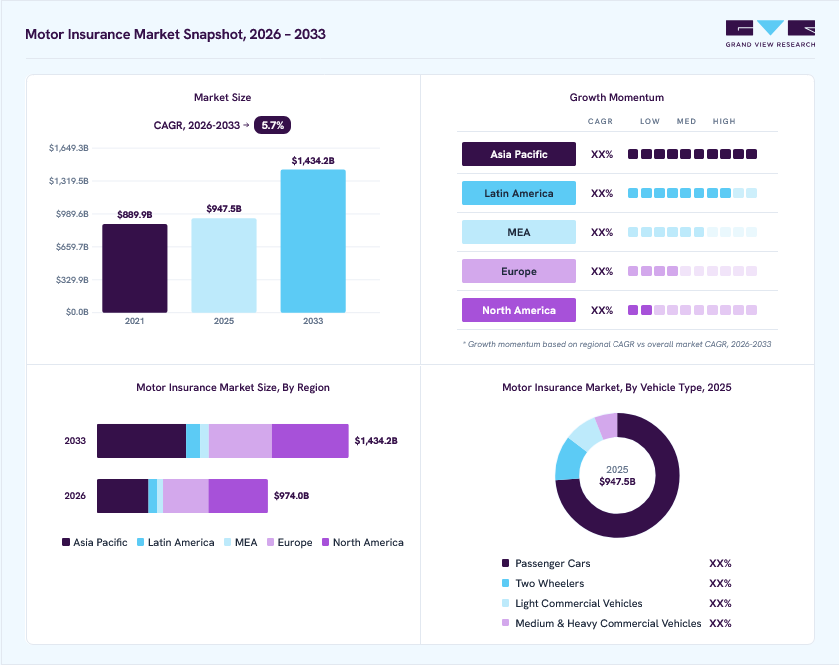
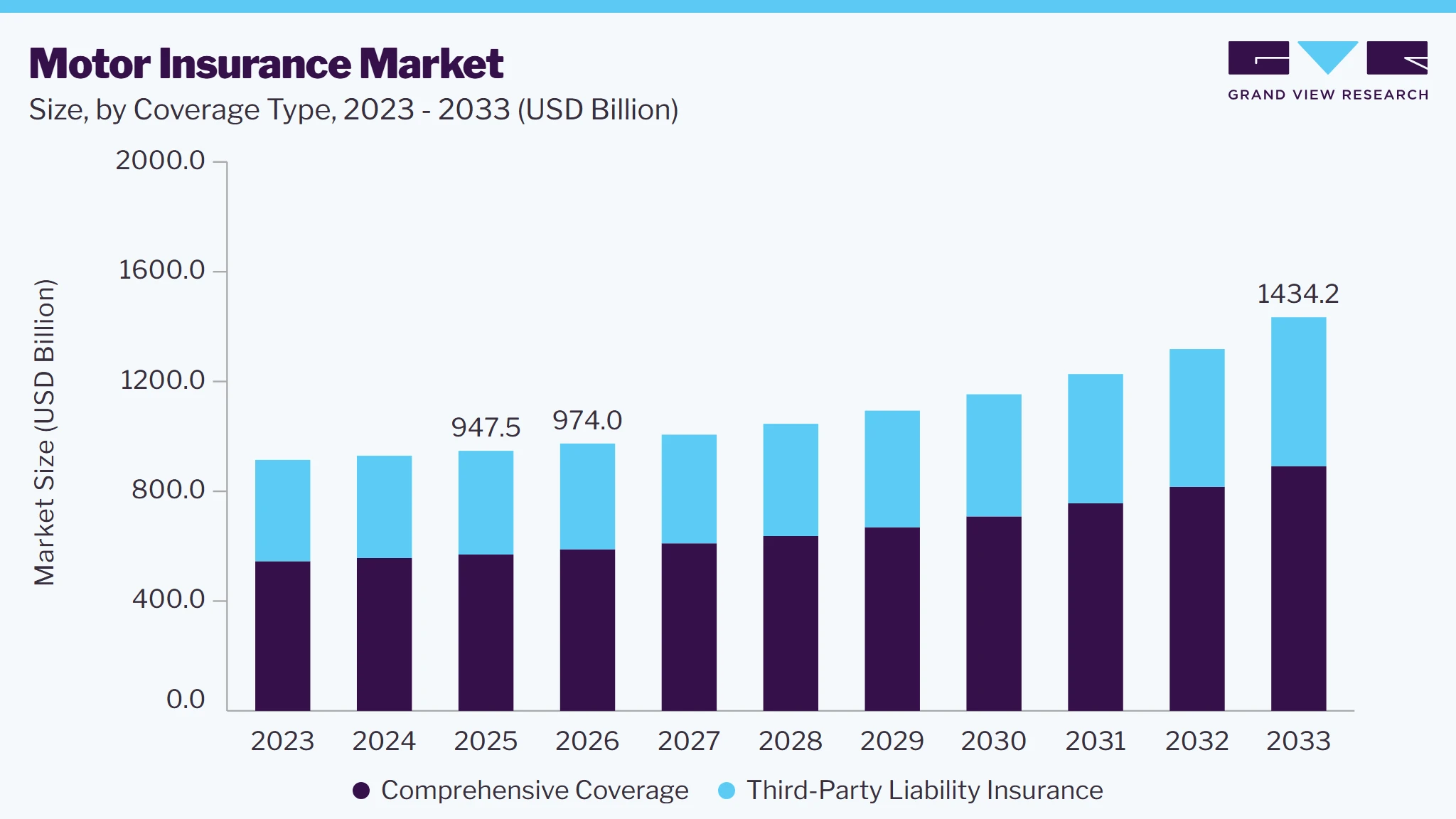
The global motor insurance market size was valued at USD 947.5 billion in 2025 and is projected to grow from USD 974.0 billion in 2026 to USD 1,434.2 billion by 2033, at a CAGR of 5.7% from 2026 to 2033. North America dominated the market, accounting for the largest revenue share of 35.4% in 2025. Growing vehicle ownership and increasing awareness of financial protection are driving market growth.
 Source: Grand View Research, IR Documents, Primary Interviews, Paid DatabasesTo learn more about this report,
 Download Free Sample Report
Key Market Trends & Insights
- Based on coverage: The comprehensive coverage segment led the market and accounted for 60.1% of the global revenue in 2025.
- Based on distribution channel: The insurance agents / brokers segment led the market and accounted for 46.3% of the global revenue in 2025.
- Based on vehicle: The passenger cars segment accounted for the largest share of global revenue in 2025.
- Based on vehicle age: The new vehicles segment accounted for the largest market revenue share in 2025.
Regional Highlights
- Largest regional market: North America (35.4% revenue share, 2025)
- By country: The U.S. held the largest market share in 2025.
Market Size & Forecast
- Market size in 2025: USD 947.5 Billion
- Estimated Market Size in 2026: USD 974.0 billion
- Projected market size by 2033: USD 1,434.2 Billion
- CAGR (2026-2033): 5.7%
Prism AI by Grand View Research Free to tryAsk a question about the motor insurance marketTry asking✓Every figure cited from GVR research Prefer the report? Download free sample →
The increasing number of vehicle owners requiring insurance coverage is driving demand for motor insurance as more cars, two-wheelers, and commercial vehicles are being sold and used on roads. This expanding customer base is increasing the need for financial protection against accidents, theft, vehicle damage, and third-party liabilities. Moreover, mandatory insurance requirements in several countries are encouraging vehicle owners to purchase coverage, further supporting market growth. Furthermore, continued growth in vehicle sales is creating a steady demand for new policies and renewals, thereby strengthening the motor insurance market.Rising digitalization of motor insurance is driving the market growth. As more customers prefer online services, insurers are making policy purchase, renewal, and claim processes available through websites and mobile applications. This makes insurance easier to access and reduces the need for customers to visit insurance offices. In addition, digital services allow customers to compare policies, receive updates, and complete insurance-related activities more conveniently. As a result, the growing preference for online services is encouraging insurers to expand their digital offerings and improve customer experience.
 To learn more about this report, Download Free Sample Report
Stronger consumer protection in the UK is encouraging insurers to provide fairer treatment to motor insurance customers. The regulator focused on improving claims handling practices and strengthening customer service standards. According to the Financial Conduct Authority (FCA), insurers are expected to handle claims promptly and fairly while providing appropriate support to customers throughout the process. This focus is encouraging insurers to improve their claims practices and provide clearer information to policyholders. As a result, stronger consumer protection is supporting better customer service and greater trust in the UK motor insurance market.
Insurance fraud is constraining the industry by increasing losses from false or exaggerated claims. Fraudulent claims can increase the cost of settlements and encourage insurers to implement stricter checks before making payments. Moreover, higher claim-related costs can put pressure on insurance premiums and reduce customer confidence in the market.
Market Dynamics
The motor insurance market is evolving through rising vehicle ownership, mandatory insurance requirements, digital distribution, and technology-enabled claims management. Insurers are increasingly using online platforms, data analytics, and automated processes to improve policy issuance and customer service. Telematics and connected-vehicle data are also supporting more personalized risk assessment. Moreover, the market is shifting toward convenient, data-driven, and customer-focused insurance models.
Growing vehicle ownership is expanding the customer base for motor insurance across passenger cars, two-wheelers, and commercial vehicles. Vehicle owners face financial risks from accidents, theft, vehicle damage, and third-party liabilities. Mandatory third-party insurance requirements further support consistent demand for motor insurance. In India, third-party liability insurance is mandatory for vehicles operating on public roads. This creates a stable base for insurance premium generation.
Motor insurers are responding by offering third-party, comprehensive, and own-damage policies for different vehicle categories. Digital purchase and renewal platforms are making policies easier to access and manage. Add-on covers are also enabling insurers to increase policy value and premium collection. Data-based underwriting helps insurers assess vehicle and customer risk more effectively. These developments support policy penetration and market revenue growth.
Increasing vehicle repair costs are creating pressure on motor insurers by raising claim settlement expenses. Modern vehicles contain advanced electronics, sensors, cameras, and other components that can increase the complexity of repair. Higher spare-part and labor costs can further increase average claim values. This can negatively affect insurers' underwriting margins. The impact is particularly relevant to comprehensive and own-damage policies.
Higher claims costs can encourage insurers to increase premiums or tighten underwriting conditions. This may reduce affordability for price-sensitive customers, particularly in used-vehicle and two-wheeler segments. Insurers, therefore, need stronger claims management and fraud detection capabilities to control losses. Digital claims processing can help reduce administrative costs and improve settlement efficiency. Managing claim severity will remain important for maintaining market profitability.
Increasing smartphone penetration, connected vehicles, GPS systems, and vehicle-generated data are creating opportunities for usage-based motor insurance. Traditional insurance pricing can be complemented by information on mileage, driving behavior, and vehicle usage. This allows insurers to develop more personalized risk profiles and pricing models. Digital platforms are also making it easier to collect and process such information. These developments are creating opportunities for more flexible motor insurance products.
Usage-based insurance can help insurers improve customer segmentation and encourage safer driving behavior. Large insurers with strong digital platforms and extensive customer databases are well-positioned to introduce such products. Insurers can also integrate motor insurance into vehicle purchases, financing, leasing, and mobility platforms. Embedded insurance partnerships can provide additional customer acquisition channels. These developments are expected to support innovation and premium growth.
Market Concentration & Characteristics
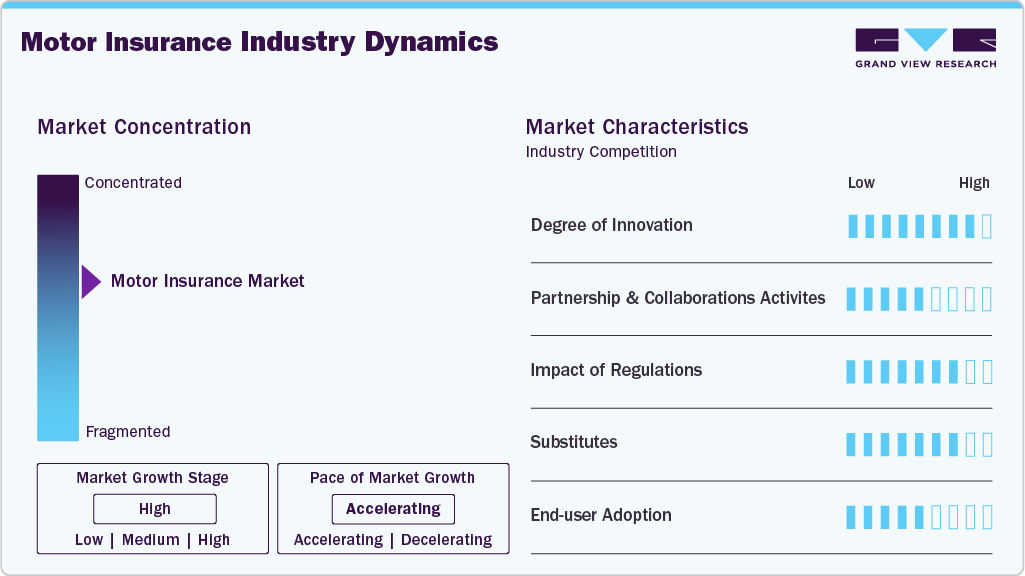
The motor insurance market is moderately consolidated, with a significant share of the market held by several large and well-established insurance providers, while a number of regional, smaller, and digital insurers also compete for customers. Leading insurers benefit from established brands, large policyholder bases, extensive distribution networks, strong claims-handling capabilities, and long-standing relationships with banks, vehicle dealers, automotive companies, and brokers. However, the market is not fully concentrated because customers can choose among multiple insurers that offer third-party liability, comprehensive coverage, and varying levels of additional protection. This creates a competitive environment in which established insurers retain a strong position while smaller and newer providers continue to participate in the market.
 To learn more about this report, Download Free Sample Report
The market is characterized by high industry competition, moderate innovation, strong regulatory influence, and broad end-user adoption. Insurers compete through pricing, coverage benefits, claims support, customer service, and, increasingly, digital policy purchase and management. Partnerships with banks, dealerships, automotive platforms, brokers, and online insurance platforms also support customer acquisition and expand distribution reach. Regulatory requirements, particularly mandatory motor insurance coverage and rules governing insurers and claims, have a strong influence on market operations. Moreover, the combination of established market leaders and a broad base of competing insurers supports a moderately consolidated market structure, while digitalization and evolving distribution channels continue to increase competitive pressure.
Analyst Perspective
The motor insurance market is supported by mandatory coverage requirements, rising vehicle ownership, and increasing demand for financial protection. Digital policy issuance, automated claims, data analytics, and online distribution are reshaping traditional insurance processes. Telematics and usage-based insurance are expected to support more personalized pricing and risk assessment. Insurers are likely to increase investment in digital platforms, AI-enabled claims processing, and connected-vehicle technologies. Competitive differentiation is expected to increase depending on pricing, customer experience, claims efficiency, and digital capabilities.
Coverage Insights
The comprehensive coverage segment accounted for the largest share of 60.1% in 2025. Growing vehicle ownership is encouraging customers to seek broader protection for their cars against accidents, theft, fire, and other losses. As more people depend on their vehicles for daily travel, protecting the value of these vehicles is increasingly important. This encourages customers to choose comprehensive coverage rather than basic protection. Moreover, rising demand for wider financial protection is supporting this segment.
The third-party liability insurance segment is projected to grow at a considerable CAGR over the forecast period. Third-party liability insurance is regulated, requiring vehicle owners to maintain basic protection against losses caused to others. As these requirements are followed more strictly, more vehicle owners are purchasing the required coverage. This creates a steady base of demand for third-party motor insurance. Furthermore, stronger enforcement can reduce the number of uninsured vehicles on roads.
Distribution Channel Insights
The insurance agents / brokers segment accounted for the largest share of 46.3% in 2025. Insurance agents and brokers are increasing in motor insurance distribution as customers increasingly seek guidance when selecting suitable coverage. Their ability to explain policy options and assist customers throughout the purchase process is particularly valuable when coverage choices are complex. Moreover, customers continue to value personalized support when comparing policies and understanding coverage requirements. This preference for direct assistance is sustaining the relevance of agents and brokers within the motor insurance distribution landscape.
The embedded / platform partnerships segment is projected to grow at the fastest CAGR over the forecast period. Embedded and platform partnerships are creating new opportunities for motor insurers to reach customers during vehicle purchases and related transactions. Insurers can offer coverage through vehicle dealerships, financing providers, and online automotive platforms, allowing customers to obtain insurance alongside other vehicle-related services. This approach reduces the need for customers to search separately for insurance and creates a more convenient purchase experience. Furthermore, expanding partnerships across the automotive ecosystem can help insurers reach a wider customer base and support policy growth.
Vehicle Insights
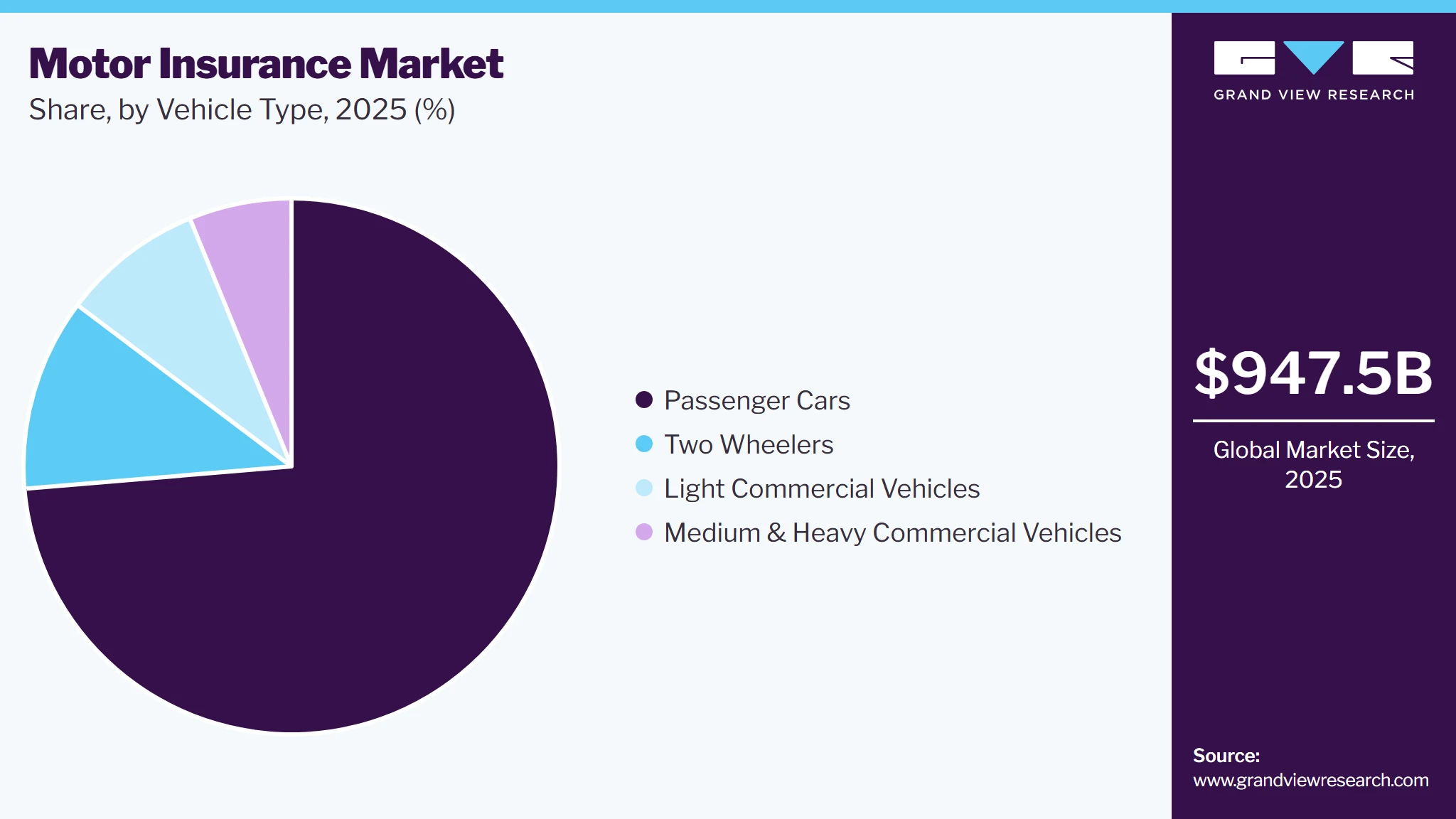
The passenger cars segment accounted for the largest share of global revenue in 2025. Increasing passenger car ownership is expanding the number of vehicle owners who require motor insurance. Growing use of cars for daily travel, family transportation, and personal activities is further increasing the need for protection against unexpected losses. In addition, rising car sales are creating a continuous flow of new insurance policies and renewals. This expanding customer base is supporting the growth of passenger car insurance.
 To learn more about this report, Download Free Sample Report
The light commercial vehicles segment is expected to grow at a significant CAGR over the forecast period. The expansion of delivery and logistics activities is creating new opportunities for motor insurance providers in the light commercial vehicle segment. As e-commerce and home delivery continue to expand, businesses are increasingly adding vans and small commercial vehicles to their delivery operations. As these vehicles are used more frequently to transport goods and serve customers, the likelihood of accidents, damage, and other unexpected losses increases. This growing exposure is encouraging businesses to obtain suitable insurance coverage, thereby creating additional demand for motor insurance for light commercial vehicles.
Vehicle Age Insights
The new vehicles segment accounted for the largest market revenue share in 2025. Customers purchasing new vehicles are increasingly seeking broader insurance protection to safeguard their recently purchased assets. Insurance is also often purchased along with a new vehicle through dealerships and financing arrangements. This makes it easier for customers to obtain coverage at the time of purchase. As new vehicle sales continue to increase, the demand for insurance among new vehicle owners is also expected to grow.
The used vehicles segment is projected to grow at the fastest CAGR over the forecast period. The growing demand for used vehicles is increasing the number of older vehicles that require insurance coverage. As customers choose used vehicles as a more affordable transportation option, they continue to require protection against accidents, theft, and other losses. The expansion of the used vehicle market is creating a larger customer base for insurers. Furthermore, easier access to insurance through online channels can encourage used vehicle owners to maintain coverage.
Regional Insights
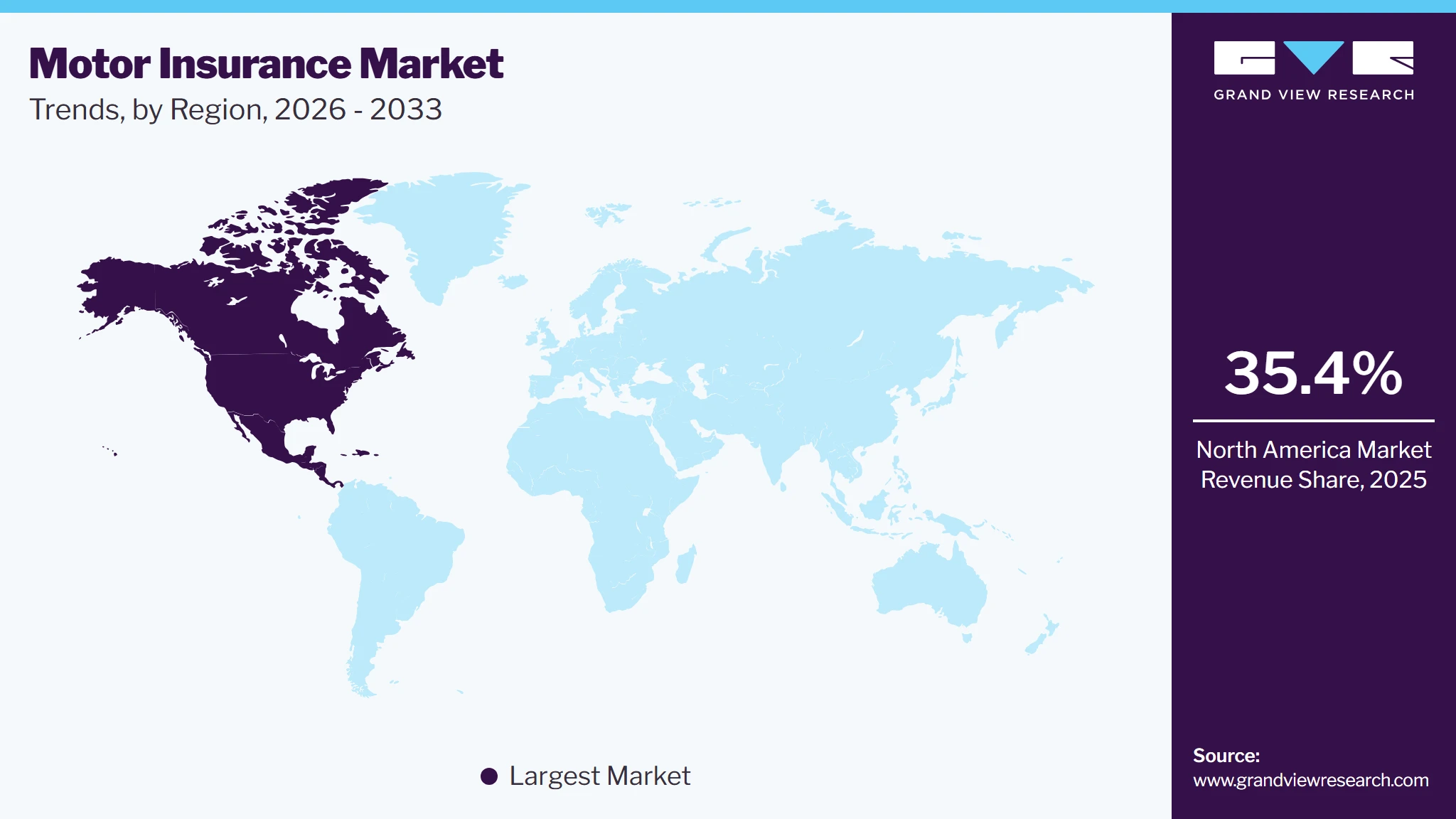
The North America motor insurance market led the global market and accounted for 35.4% of the global revenue in 2025. Increasing vehicle ownership and frequent use of passenger cars are supporting motor insurance demand across North America. As more vehicles are used for personal travel, business activities, and daily transportation, the need for protection against accidents and other losses is increasing. This expanding vehicle base is creating a steady pool of customers for motor insurers.
 To learn more about this report, Download Free Sample Report
U.S. Motor Insurance Market Trends
The motor insurance market in the U.S. held the largest share in the North America market in 2025. The industry is increasingly moving toward digital and personalized insurance services, with customers showing a greater preference for convenient policy purchase, renewal, and claims support. This shift is encouraging insurers to expand online services and offer coverage that better matches individual customer needs. As a result, digital channels are becoming increasingly crucial in the U.S. motor insurance landscape.
Asia Pacific Motor Insurance Market Trends
The motor insurance market in the Asia Pacificis projected to grow at the fastest CAGR over the forecast period. Rapid growth in vehicle ownership across the Asia Pacific is expanding the customer base for motor insurance providers. Rising use of passenger cars, two-wheelers, and commercial vehicles is increasing the need for protection against accidents and vehicle-related losses. In addition, expanding transportation and delivery activities are creating further demand for motor insurance across the region.
The China motor insurance market held a dominant share in the Asia Pacific industry. The market is increasingly influenced by the growing use of online channels for purchasing and managing insurance policies. Customers are showing greater preference for convenient digital services when comparing, purchasing, and renewing motor insurance. This shift is encouraging insurers to strengthen online offerings and reach customers through digital platforms.
The motor insurance market in Japan is expected to grow at a significant CAGR over the forecast period. Japan's aging vehicle population is creating opportunities for insurers to provide coverage suited to used and older vehicles. As customers continue to maintain vehicles for longer periods, demand is shifting toward insurance options that reflect vehicle age and value. This is encouraging insurers to develop more flexible coverage for different vehicle ownership needs.
Europe Motor Insurance Market Trends
The motor insurance market in Europeis poised for significant growth from 2026 to 2033. Stronger motor insurance requirements across Europe are supporting demand for third-party liability coverage. European regulations require appropriate insurance safeguards for vehicles, while efforts to strengthen consumer protection are also influencing how insurers manage policies and claims. These requirements provide a stable foundation for motor insurance adoption across the region.
The UK motor insurance market has gained ground from stronger consumer protection rules to handle customer claims more fairly and provide better services. These rules require insurers to give customers clear information about their policies, claims, and available support. As a result, customers can better understand their insurance coverage and receive more appropriate assistance when making claims. This is improving customer confidence and encouraging better service quality in the industry.
The motor insurance market in Germany held a substantial share of the Europe market. Germany's strong automotive industry is creating opportunities for motor insurers as new passenger cars and commercial vehicles continue to enter the market. The growing use of electric and connected vehicles is also encouraging insurers to develop coverage suited to changing vehicle ownership patterns. This creates opportunities for insurers to expand their offerings across new and evolving vehicle categories.
Key Motor Insurance Company Insights
Key players operating in the motor insurance market include State Farm Mutual Automobile Insurance Company, Bloomington, IL, Aviva, Admiral Group plc, ageas, Bajaj General, Generali Central Insurance Co. Ltd., Tokio Marine Group, GEICO, Hastings Direct, and USAA. Key players are expanding their portfolios with comprehensive coverage options, digital insurance products, usage-based insurance, telematics-enabled solutions, and value-added services. Companies are focusing on digital distribution, personalized pricing, AI-enabled underwriting, automated claims processing, strategic partnerships, customer retention, and expanding their presence across emerging markets.
-
USAA is a financial services group that serves the military community, veterans, and their eligible family members. The company provides insurance, banking, investments, retirement products, and services. Its offerings include auto, home, renters, and life insurance; checking and savings accounts; credit cards; auto loans; mortgages; retirement savings; and other financial services. USAA also operates through a group of companies covering property and casualty insurance, life insurance, investments, and banking services.
-
Aviva is the UK’s diversified insurer, with businesses spanning insurance, wealth, and retirement. Aviva provides a range of insurance, wealth, and retirement products and services to its customers. The company focuses on serving customers across their financial needs and offers products through its businesses in general insurance, wealth, and retirement.
Key Motor Insurance Companies
The following key companies have been profiled for this study on the motor insurance market.
-
State Farm Mutual Automobile Insurance Company, Bloomington, IL
-
Aviva
-
Admiral Group plc
-
ageas
-
Bajaj General
-
Generali Central Insurance Co. Ltd.
-
Tokio Marine Group
-
GEICO
-
Hastings Direct.
-
USAA
Competitive Benchmarking
Operating Strategies
Competitive Edge
Weaknesses
Mature Players: State Farm Mutual Automobile Insurance Company, Aviva, Tokio Marine Group, GEICO, USAA
- Mature players in the motor insurance market are focus on broad motor insurance portfolios, extensive distribution networks, digital policy management, and technology-enabled claims processing.
- Mature players gain a competitive advantage through strong brand recognition, large customer bases, established claims infrastructure, broad geographic presence, and strong financial capabilities.
- These companies often face challenges related to large operating structures can reduce flexibility and increase exposure to high claims costs and competitive pricing pressure.
Emerging Players: Bajaj General, Hastings Direct
- Emerging players in the motor insurance market are focusing on targeted motor insurance products, digital distribution, simplified customer journeys, and technology-enabled servicing.
- Emerging players gain market traction through greater flexibility in digital channels, focused product offerings, and customer-centric insurance solutions.
- Emerging players face limitations due to limited geographic reach and comparatively lower scale can limit expansion and market influence.
Recent Developments
-
In October 2025, Philadelphia Consolidated Holding Corp., a U.S.-based specialty insurance company, acquired the Collector Vehicle Division of Ignyte Insurance to strengthen its presence in specialty vehicle insurance. The acquisition adds established coverage offerings for collector cars, motorcycles, classic trucks, and other specialty vehicles. This expansion broadens the company's motor insurance portfolio and strengthens its position in the collector vehicle insurance.
-
In October 2025, GEICO and Daimler Truck AG. launched Connected Insurance, which uses real-time vehicle telematics data to assess driving risk and support personalized commercial vehicle insurance. The program aims to reward safer driving and improve insurance affordability for truck owners and small fleets.
Motor Insurance Market Report Scope
Report Attribute
Details
Market size in 2025
USD 947.5 billion
Estimated market size in 2026
USD 974.0 billion
Projected market size by 2033
USD 1,434.2 billion
Growth rate
CAGR of 5.7% from 2026 to 2033
Base year for estimation
2025
Historical data
2021 - 2024
Forecast period
2026 - 2033
Quantitative units
Revenue in USD billion and CAGR from 2026 to 2033
Report coverage
Revenue forecast, company ranking, competitive landscape, growth factors, and trends
Segments covered
Coverage, distribution channel, vehicle, vehicle age, region
Regional scope
North America; Europe; Asia Pacific; Latin America; MEA
Country scope
U.S.; Canada; Mexico; Germany; UK; France; China; Japan; India; South Korea; Australia; Brazil; KSA; UAE; South Africa
Key companies profiled
State Farm Mutual Automobile Insurance Company, Bloomington, IL; Aviva; Admiral Group plc; ageas; Bajaj General; Generali Central Insurance Co. Ltd.; Tokio Marine Group; GEICO; Hastings Direct.; USAA
Customization scope
Free report customization (equivalent up to 8 analysts working days) with purchase. Addition or alteration to country, regional & segment scope.
Pricing and purchase options
Avail customized purchase options to meet your exact research needs. Explore purchase options
Global Motor Insurance Market Report Segmentation
The report forecasts revenue growth at global, regional, and country levels and provides an analysis of the latest industry trends in each of the sub-segments from 2021 to 2033. For this study, Grand View Research has segmented the global motor insurance market report based on coverage, distribution channel, vehicle, vehicle age, and region.
-
Coverage Outlook (Revenue, USD Billion, 2021 - 2033)
-
Third-Party Liability Insurance
-
Comprehensive Coverage
-
-
Distribution Channel Outlook (Revenue, USD Billion, 2021 - 2033)
-
Insurance Agents / Brokers
-
Direct Sales
-
Bancassurance
-
Embedded / Platform Partnerships
-
Aggregators & Comparison Portals
-
-
Vehicle Outlook (Revenue, USD Billion, 2021 - 2033)
-
Passenger Cars
-
Two-Wheelers
-
Light Commercial Vehicles
-
Medium & Heavy Commercial Vehicles
-
-
Vehicle Age Outlook (Revenue, USD Billion, 2021 - 2033)
-
New Vehicles
-
Used Vehicles
-
-
Regional Outlook (Revenue, USD Billion, 2021 - 2033)
- North America
-
U.S.
-
Canada
-
Mexico
-
- Europe
-
Germany
-
UK
-
France
-
- Asia Pacific
-
China
-
India
-
Japan
-
South Korea
-
Australia
-
-
Latin America
-
Brazil
-
- Middle East & Africa (MEA)
-
UAE
-
Kingdom of Saudi Arabia (KSA)
-
South Africa
-
- North America
Research Methodology
The motor insurance marketfigures in this report are based on a proven research process that combines executive interviews with secondary research from proprietary databases, company filings, and recognized regulatory and institutional sources. Market size is built through value-chain sizing-reconciling supply-side and demand-side estimates-and triangulated with bottom-up and top-down approaches. Every estimate passes multiple levels of expert validation before publication, with eachmotor insurancesegment quantified using the revenue-capture definitions in the table below.
Segment Definition
Segment - Coverage
Revenue capture definition
Third-Party Liability Insurance
The segment revenue is generated from premiums collected for coverage against the policyholder's legal liability for injury, death, or property damage caused to third parties.
Comprehensive Coverage
The segment revenue is generated from premiums collected for policies covering third-party liability, along with own-damage protection for the insured vehicle.
Segment - Distribution Channel
Revenue capture definition
Insurance Agents / Brokers
The segment revenue is generated from motor insurance premiums generated through agents, corporate agents, and insurance brokers.
Direct Sales
The segment revenue is generated from policies purchased directly through insurer branches, websites, mobile applications, and call centers.
Bancassurance
The segment revenue is generated from motor insurance policies distributed through banks and other financial institutions.
Embedded / Platform Partnerships
The segment revenue is generated from policies sold through automotive, financing, leasing, mobility, e-commerce, and other partner platforms.
Aggregators & Comparison Portals
The segment revenue is generated from policies purchased through online platforms that allow customers to compare insurance premiums, coverage, and policy features.
Segment - Vehicle
Revenue capture definition
Passenger Cars
The segment revenue is generated from premiums collected for private passenger cars and other eligible personal-use four-wheel vehicles.
Two-Wheelers
The segment revenue is generated from premiums collected for motorcycles, scooters, mopeds, and other eligible two-wheeled vehicles.
Light Commercial Vehicles
The segment revenue is generated from premiums collected for light commercial vehicles used for goods transportation, delivery, and other commercial applications.
Medium & Heavy Commercial Vehicles
The segment revenue is generated from premiums collected for trucks, buses, trailers, and other medium- and heavy-duty commercial vehicles.
Segment - Vehicle Age
Revenue capture definition
New Vehicles
The segment revenue is generated from premiums collected for newly purchased or newly registered vehicles, including policies issued around vehicle purchase.
Used Vehicles
The segment revenue is generated from premiums collected for previously registered vehicles that are renewed, transferred, or insured by subsequent owners.
Estimation Model
Layer Name
Key Question
Description
Vehicle & Policy Universe
How large is the addressable motor insurance base?
The estimation begins with the number of insured and potentially insurable vehicles across passenger cars, two-wheelers, and commercial vehicles. Vehicle registrations, vehicle age, usage characteristics, and mandatory insurance requirements are considered to establish the addressable base. The analysis distinguishes between new and used vehicles because their insurance penetration and policy characteristics can differ. This layer establishes the underlying volume from which motor insurance demand is generated.
Policy & Coverage Penetration
What proportion of vehicles purchase each type of coverage?
The second layer estimates penetration across third-party liability, comprehensive, and other applicable coverages. Mandatory third-party requirements provide a baseline level of policy penetration, while vehicle value, customer income, risk perception, and financing arrangements influence comprehensive coverage adoption. Distribution channel differences are also incorporated because digital, intermediary, banking, and embedded channels can produce different customer acquisition patterns. This layer converts the vehicle universe into an estimated policy universe.
Premium & Revenue Pool
How much premium revenue is generated per policy?
The third layer applies average premium assumptions to the estimated policy base. Premium levels are differentiated according to vehicle, vehicle age, coverage, location, risk characteristics, and policy features. Comprehensive policies generally generate a higher premium pool than standalone third-party coverage because they include own-damage protection and may include additional covers. The resulting calculation establishes the gross motor insurance premium revenue opportunity.
Market Validation & Forecast
Does the estimated market size align with industry and company-level evidence?
The final layer validates the calculated market size against insurer financial disclosures, regulatory data, industry premium trends, vehicle registration statistics, and company-level motor insurance performance. Historical growth patterns are assessed alongside expected changes in vehicle ownership, insurance penetration, premium pricing, claims costs, and digital distribution. Forecast assumptions are then applied to estimate future market revenue by coverage, distribution channel, vehicle, and vehicle age. Cross-checking across multiple data points reduces the risk of overestimating or underestimating the Motor Insurance Market.
Delivered Customization
We have successfully delivered the following deep-dive customizations:
Client Request
Customization Delivered
Value Adds
Regional Motor Insurance Market Opportunity Assessment
Country/region-wise market sizing and forecasts
Analysis of demand, adoption trends, and regulatory landscape
Identification of high-growth regions and investment hotspots
Identified region-specific growth opportunities
Supported expansion and go-to-market strategy
Enabled informed regional investment decisions
Cross-Segmentation Analysis for the Motor Insurance Market
Criss-cross market analysis by coverage, distribution channel, vehicle, vehicle age
Demand and adoption assessment across key segments
Segment attractiveness and growth potential benchmarking
Identified high-potential market segments
Supported targeted coverage positioning and marketing strategy
Improved customer and segment prioritization
Competitive Benchmarking and Strategic Positioning in the Motor Insurance Market
Benchmarking of key competitors across coverages, pricing, partnerships, and innovation
Comparative assessment of market share, capabilities, and strategies
Analysis of competitive strengths, gaps, and differentiation areas
Identified competitive white spaces and growth gaps
Supported strategic positioning and differentiation
Enabled data-driven competitive strategy development
Frequently Asked Questions About This Report
The global motor insurance market size was estimated at USD 947.5 billion in 2025 and is expected to reach USD 974.0 billion in 2026.
The global motor insurance market is expected to grow at a compound annual growth rate of 5.7% from 2026 to 2033, reaching USD 1,434.2 billion by 2033.
Comprehensive coverage type segment accounted for 60.1% of the largest share of global revenue in 2025. Growing vehicle ownership is encouraging customers to seek broader protection for their cars against accidents, theft, fire, and other losses.
North America motor insurance market led the global market and accounted for 35.4% of the global revenue in 2025. Increasing vehicle ownership and frequent use of passenger cars are supporting motor insurance demand across North America
Growing vehicle ownership and increasing awareness of financial protection are driving market growth.
Some key players operating in the motor insurance market include State Farm Mutual Automobile Insurance Company, Bloomington, IL, Aviva, Admiral Group plc, ageas, Bajaj General, Generali Central Insurance Co. Ltd., Tokio Marine Group, GEICO, Hastings Direct., and USAA
Insurance agents / brokers segment accounted for 46.3% of the largest share of global revenue in 2025, while embedded / platform partnerships segment is projected to grow at the fastest CAGR over the forecast period
Passenger cars segment accounted for the largest share of global revenue in 2025, while light commercial vehicles segment is expected to grow at a significant CAGR over the forecast period
New vehicles segment accounted for the largest market revenue share in 2025, while used vehicles segment is projected to grow at the fastest CAGR over the forecast period
About the Author(s)
Automotive & Transportation Research Team
Technology · Automotive & TransportationThis report was authored by the automotive & transportation research team at Grand View Research - comprising two research analysts, one senior research analyst, and one industry expert - with specialized expertise in the automotive & transportation segment of the technology industry. All findings are based on proprietary technology databases, executive interviews, and regulatory analysis, subject to internal peer review prior to publication.
Last Updated:
Speak to Analyst

Customize this report to your needs - add regions, segments, or data points, with 20% free customization.
Or view our licence options:


ISO 9001:2015 & 27001:2022 Certified
We are GDPR and CCPA compliant! Your transaction & personal information is safe and secure. For more details, please read our privacy policy.


