
- Home
- »
- Advanced Interior Materials
- »
-
Multi-axis Machining Centers Market Size Report, 2025-2033GVR Report cover
![Multi-axis Machining Centers Market (2025 - 2033)Report]()
Multi-axis Machining Centers Market (2025 - 2033)
Size, Share & Trends Analysis Report By Axis Type (3-Axis, 4-Axis, 5-Axis), By Machine Type (VMC, HMC, Universal Machining Centers), By End Use, By Region, And Segment Forecasts
Market Size, 2024
$79.4BMarket Estimate, 2026
$88.8BMarket Forecast, 2033
$134.9BCAGR, 2025–2033
6.1%Multi-axis Machining Centers Market Summary
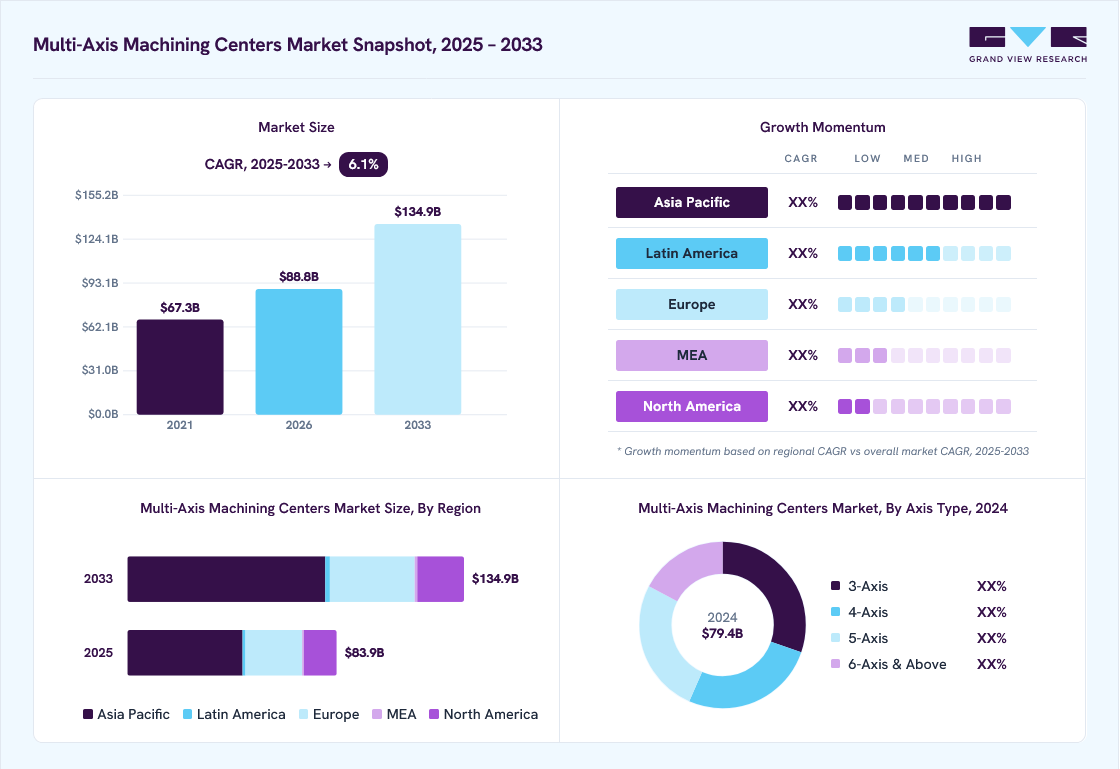
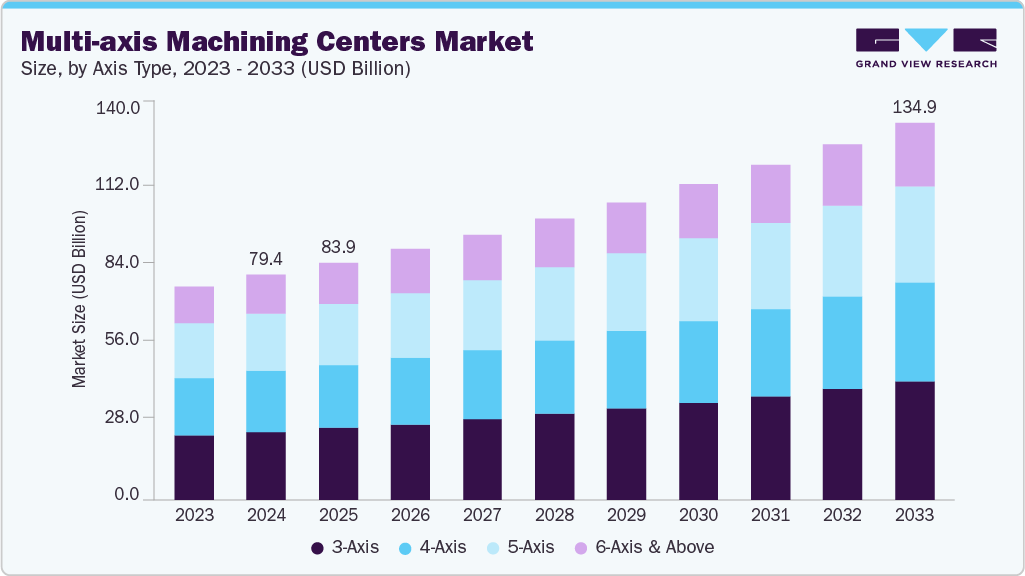
The global multi-axis machining centers market size was valued at USD 79.4 billion in 2024 and is projected to grow from USD 88.8 billion in 2026 to USD 134.9 billion by 2033, at a CAGR of 6.1% from 2025 to 2033. Asia Pacific dominated the market, accounting for a revenue share of 54.5% in 2024. The market is primarily driven by increasing demand for precision manufacturing across various industries such as aerospace, automotive, medical devices, and electronics.
Key Market Trends & Insights
- By axis type, 3-axis segment is expected to grow at a considerable CAGR of 6.6% from 2025 to 2033 in terms of revenue.
- By machine type, universal machining centers segment is expected to grow at a considerable CAGR of 6.7% from 2025 to 2033 in terms of revenue.
- By end use, aerospace segment is expected to grow at a considerable CAGR of 7.3% from 2025 to 2033 in terms of revenue.
Market Size & Forecast
- 2024 Market Size: USD 79.4 Billion
- 2033 Projected Market Size: USD 134.9 Billion
- CAGR (2025-2033): 6.1%
- Asia Pacific: Largest market in 2024
Three ways to get this report
Buy it, customize it, or ask a question.Ask an Analyst
A direct answer, usually in 1 working day
- AccessReport author, directly
- Reply timeWithin 1 working day
- No sales callDirect answer only
- FormatEmail reply
- CostFree, no cost
Get the Full Report
What the study covers
- FormatsPDF · Excel · Dashboard
- Timeline2025–2033 annual, 2024 base
- Coverage20+ countries, 5 regions
- Companies10+ key players profiled
Customize the Report
20% free customization
- IncludeCountries, segments, points
- TailorTo your product definition
- ExtendDeeper competitor detail
- OrA fully bespoke study
- Turnaround5–10 working days
These advanced machining centers, capable of moving tools or parts along multiple axes simultaneously, enable complex geometries and tighter tolerances, enhancing production efficiency and product quality. The rising adoption of Industry 4.0 technologies, including automation and smart manufacturing, is further driving the need for multi-axis machining to optimize production processes and reduce cycle times.
In addition, the growing trend toward lightweight and high-performance components, especially in aerospace and automotive sectors, fuels demand for multi-axis machining centers capable of working with advanced materials like composites and titanium. Expansion in emerging economies and increased investments in infrastructure and manufacturing modernization also contribute to market growth.
Industry Concentration & Characteristics
The multi-axis machining centers industry is moderately fragmented, with numerous small to mid-sized manufacturers alongside a few large global players. This diversity fosters healthy competition, encouraging innovation and customization to meet specific industry needs. While leading companies hold significant market shares due to advanced technology and strong distribution networks, smaller firms often focus on niche applications and regional markets. This balance ensures a dynamic market landscape, with varied product offerings and competitive pricing driving steady growth across different sectors worldwide.
The multi-axis machining centers industry experiences continuous innovation, focusing on enhanced precision, automation, and integration with Industry 4.0 technologies. Advances include smarter controls, adaptive machining, and improved software for complex geometries, enabling faster, more efficient production and catering to evolving industry demands for higher quality and customization.
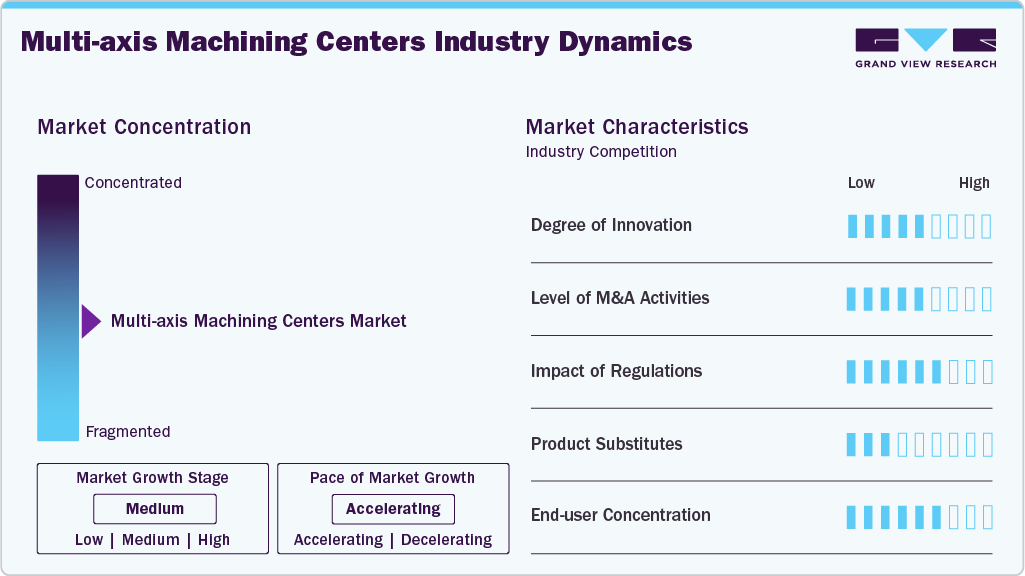
Mergers and acquisitions in the multi-axis machining centers industry are increasing as companies seek to expand product portfolios, access new technologies, and enter emerging markets. These strategic moves help firms enhance competitiveness, streamline operations, and capitalize on synergies, driving market consolidation while fostering technological advancement.
Regulations on safety, environmental impact, and energy efficiency are shaping the multi-axis machining centers industry. Compliance with stricter emission standards and workplace safety laws encourages manufacturers to develop greener, safer, and more efficient machines, influencing product design, manufacturing processes, and adoption rates globally.
Drivers, Opportunities & Restraints
The growing demand for high-precision components in industries like aerospace, automotive, and medical devices is a key driver for the multi-axis machining centers industry. These machines enable complex geometries and tighter tolerances, improving product quality and reducing production time. Increasing adoption of automation and Industry 4.0 technologies further fuels demand by enhancing manufacturing efficiency and flexibility, making multi-axis machining centers essential for modern, competitive manufacturing processes.
Emerging economies present significant growth opportunities for the multi-axis machining centers industry. As countries invest in industrialization and infrastructure, the need for advanced manufacturing equipment rises. In addition, expanding sectors such as renewable energy, electric vehicles, and aerospace require sophisticated machining solutions, creating demand for multi-axis centers. The integration of smart technologies and IoT in machining centers also opens new avenues for innovation and market expansion.
High initial costs and complexity of multi-axis machining centers pose a major challenge for market growth. Smaller manufacturers often find it difficult to invest in such advanced machinery due to budget constraints and the need for skilled operators. In addition, maintenance and training requirements can increase operational costs. These factors limit adoption, especially in developing regions, potentially slowing overall market penetration.
Axis Type Insights
3-Axis segment hold the dominant share in the market and accounted for a share of 30.2% in 2024, due to cost-effectiveness, and suitability for standard machining tasks. It remains popular among small and medium manufacturers focused on basic component production. Its widespread availability and ease of use support consistent demand, especially in industries requiring less complex geometries and high-volume production.
4-Axis is expected to grow significantly over the forecast, as it offers enhanced versatility by enabling rotational movement, allowing more complex part machining in a single setup. This reduces production time and increases precision, appealing to industries like automotive and aerospace. Its ability to handle moderately complex designs efficiently drives adoption in both established and emerging markets.
Machine Type Insights
Vertical machining centers (VMC) continues to dominate the market and accounted for a share of 53.7% in 2024, due to its versatility, ease of use, and cost-effectiveness. VMCs are widely used in industries for producing precision components with high efficiency. Their adaptability to various materials and applications supports strong demand, especially among small to medium manufacturers focused on efficient and reliable machining solutions.
Universal machining center segment is projected to grow as they offer the flexibility to perform multiple machining operations within a single setup. This capability reduces production time and improves accuracy, making them attractive for complex parts manufacturing in aerospace, automotive, and heavy machinery sectors. Their multifunctional design supports growing demand for integrated machining solutions in advanced manufacturing.
End Use Insights
The automotive sector dominates the market and accounted for a share of 39.7% in 2024, due to rising demand for lightweight, high-performance components. Increasing adoption of electric vehicles and stringent safety standards drive the need for precision machining of complex parts, boosting demand for advanced multi-axis machining centers to improve efficiency and reduce production cycles.
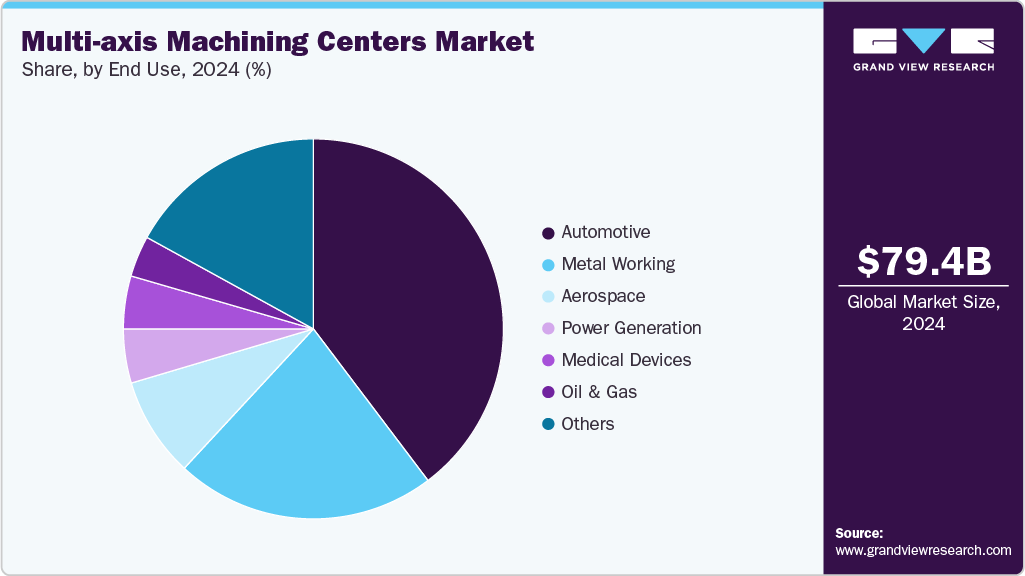
The aerospace segment is projected to expand rapidly as it requires highly precise, complex components made from advanced materials like titanium and composites. Multi-axis machining centers enable the production of these intricate parts with tight tolerances, supporting innovation and safety standards. The expansion of commercial and defense aerospace sectors further fuels the demand for these advanced machining solutions.
Regional Insights
North America growing at CAGR of 4.5% in the multi-axis machining centers market driven by strong industrialization, technological advancements, and increasing demand for precision manufacturing across aerospace, automotive, and medical sectors. Investments in smart manufacturing and automation further boost the adoption of advanced machining centers, driving market expansion.
U.S. Multi-axis Machining Centers Market Trends
The multi-axis machining centers market in the U.S. is leading the region due to high demand from aerospace, automotive, and defense industries. Continuous innovation, government initiatives promoting advanced manufacturing, and integration of automation boost market growth. The country’s focus on reshoring manufacturing and upgrading production capabilities further fuels demand for sophisticated machining centers capable of delivering complex, high-precision parts, thereby driving sustained market development.
Mexico multi-axis machining centers market is witnessing moderate growth in multi-axis machining centers adoption, fueled by increased foreign direct investments and a thriving automotive manufacturing sector. Growing aerospace and industrial sectors also contribute to rising demand for advanced machining technologies, positioning Mexico as an important player in North American market.
Europe Multi-axis Machining Centers Market Trends
The multi-axis machining centers market in Europe is growing rapidly, driven by its well-established automotive, aerospace, and industrial machinery industries. Emphasis on precision engineering, innovation, and Industry 4.0 adoption supports demand for advanced machining centers. Strict regulations promoting energy efficiency and sustainability also encourage modernization of manufacturing processes, further propelling the market.
Germany multi-axis machining centers market is growing due to its strong automotive and industrial manufacturing sectors. The country’s commitment to Industry 4.0 and automation fosters adoption of cutting-edge machining technologies. Germany’s focus on high precision and quality standards drives demand for multi-axis centers capable of producing complex components. Robust R&D infrastructure and skilled workforce further strengthen the market’s growth prospects.
The multi-axis machining centers market in the UK is growing due to increased manufacturing modernization, particularly in aerospace and automotive industries. Government initiatives to boost advanced manufacturing and investments in technology adoption encourage demand for multi-axis machines. The rise in precision engineering and production of complex parts for defense and healthcare sectors further support market growth, highlighting the UK’s evolving industrial landscape.
Asia Pacific Multi-axis Machining Centers Market Trends
The multi-axis machining centers market in the Asia Pacific is a dominant market and accounted for the 54.5% share, fueled by industrialization and increasing manufacturing output in China, India, and Southeast Asia. Rising demand from automotive, aerospace, and electronics sectors drives adoption of advanced machining solutions. Government initiatives to boost manufacturing capabilities and integrate smart technologies enhance market growth.

China multi-axis machining centers market is growing swiftly, supported by massive industrial expansion and government policies promoting manufacturing modernization. Demand from automotive, aerospace, and electronics sectors pushes the need for precision machining. The country’s focus on Industry 4.0 and automation boosts adoption of multi-axis centers, while ongoing infrastructure development and export-driven production ensure sustained market growth.
The multi-axis machining centers market in India is growing significantly with increasing industrial investments and government initiatives like “Make in India.” The automotive, aerospace, and heavy machinery sectors drive demand for precision components, promoting adoption of advanced machining centers. Growing manufacturing capabilities and emphasis on automation and digitalization are expected to enhance market expansion, making India a key emerging market in the Asia Pacific region.
Middle East & Africa Multi-axis Machining Centers Market Trends
The multi-axis machining centers market in the Middle East and Africa is emerging, driven by infrastructure projects, oil and gas sector modernization, and diversification efforts. Investments in industrialization and manufacturing development increase demand for precision machining. Growing adoption of automation and advanced technologies supports market growth, especially in countries focused on reducing oil dependency and expanding industrial capabilities.
Saudi Arabia multi-axis machining centers market is growing under Vision 2030’s economic diversification strategy. Investments in infrastructure, manufacturing, and non-oil industries drive demand for advanced machining solutions. The country’s focus on technology adoption and skilled workforce development supports growth, positioning Saudi Arabia as a key player in the Middle East’s evolving multi-axis machining market.
Latin America Multi-axis Machining Centers Market Trends
The multi-axis machining centers market in Latin America is seeing steady growth is driven by industrial growth and modernization in countries like Brazil and Mexico. Demand from automotive, aerospace, and infrastructure sectors supports the market. Investments in manufacturing technologies and efforts to improve production efficiency further stimulate adoption. However, economic fluctuations and infrastructure challenges may impact growth speed, though overall prospects remain positive.
Brazil multi-axis machining centers market is growing, supported by its automotive and aerospace sectors. Government incentives for industrial modernization and infrastructure development promote adoption of advanced machining technologies. Increasing focus on export-oriented manufacturing and precision engineering for complex components further boosts market demand. Despite economic challenges, Brazil remains an important Latin American market with potential for continued growth in machining solutions.
Key Multi-axis Machining Centers Company Insights
Some key players operating in the market include DMG MORI, Starrag Group Holding AG, Okuma Corporation.
-
DMG MORI is a German-Japanese machine tool manufacturer that designs and produces CNC turning centers, milling machines, and advanced multi-axis machining centers. It serves industries such as aerospace, automotive, and die/mold production. The company also develops automation systems and software solutions to support digital manufacturing, focusing on high-precision machining and complex part fabrication through integrated technologies.
-
Yamazaki Mazak is a Japanese company that manufactures CNC machine tools, including vertical and horizontal machining centers, 5-axis systems, and multi-tasking machines. Known for its advanced CNC control systems, Mazak supports a wide range of industrial sectors. The company emphasizes process integration, allowing multiple operations on one machine, which improves efficiency in high-mix, low-volume manufacturing environments.
Key Multi-axis Machining Centers Companies:
The following are the leading companies in the multi-axis machining centers market. These companies collectively hold the largest market share and dictate industry trends.
- DMG MORI
- Yamazaki Mazak
- Okuma Corporation
- Haas Automation
- Makino Milling Machine Co.
- Hurco Companies, Inc.
- Doosan Machine Tools Co., Ltd.
- Matsuura Machinery Corporation
- GF Machining Solutions
- FANUC Corporation
- Hyundai WIA Corporation
- Chiron Group SE
- Starrag Group Holding AG
- GROB-WERKE GmbH & Co. KG
- Hardinge Inc.
Recent Developments
-
In August 2025, Starrag introduced the Heckert X80, a new 5‑axis machining centre designed to enhance precision and efficiency. Building upon the Heckert HEC series, this model includes a workpiece-side swivel unit that enables full 5‑axis machining from just one clamping position.
-
In September 2025, Nidec OKK developed HX500, a 5-axis horizontal machining center designed for precise, high-performance machining of complex components used in aircraft, electric vehicles, and robotics. The HX500 addresses growing industry demand for accuracy and productivity in manufacturing advanced parts across these rapidly evolving sectors.
Multi-axis Machining Centers Market Report Scope
Report Attribute
Details
Market size in 2024
USD 79.4 billion
Estimated market size in 2026
USD 88.8 billion
Projected market size by 2033
USD 134.9 billion
Growth rate
CAGR of 6.1% from 2025 to 2033
Historical data
2021 - 2023
Forecast period
2025 - 2033
Quantitative units
Revenue in USD million/billion and CAGR from 2025 to 2033
Report coverage
Revenue forecast, company ranking, competitive landscape, growth factors, and trends
Segments covered
Axis type, machine type, end use, region
Regional scope
North America; Europe; Asia Pacific; Latin America; Middle East & Africa
Country scope
U.S.; Canada; Mexico; UK; Germany; France; Spain; Italy; China; Japan; India; Australia; South Korea; Brazil; Argentina; Saudi Arabia; South Africa; UAE
Key companies profiled
DMG MORI; Yamazaki Mazak; Okuma Corporation; Haas Automation; Makino Milling Machine Co.; Hurco Companies, Inc.; Doosan Machine Tools Co., Ltd.; Matsuura Machinery Corporation; GF Machining Solutions; FANUC Corporation; Hyundai WIA Corporation; Chiron Group SE; Starrag Group Holding AG; GROB-WERKE GmbH & Co. KG; Hardinge Inc.
Customization scope
Free report customization (equivalent up to 8 analysts working days) with purchase. Addition or alteration to country, regional & segment scope.
Pricing and purchase options
Avail customized purchase options to meet your exact research needs. Explore purchase options
Global Multi-axis Machining Centers Market Report Segmentation
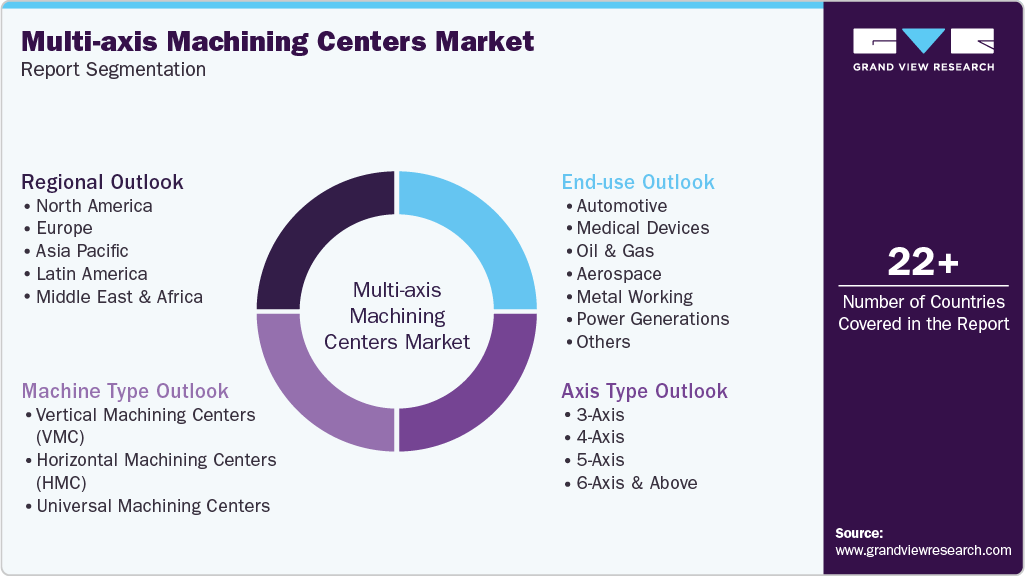
This report forecasts revenue growth at global, regional, and country levels and provides an analysis of the latest industry trends in each of the sub-segments from 2021 to 2033. For this study, Grand View Research has segmented the global multi-axis machining centers market report based on axis type, machine type, end use and region:
-
Axis Type Outlook (Revenue, USD Million, 2021 - 2033)
-
3-Axis
-
4-Axis
-
5-Axis
-
6-Axis & Above
-
-
Machine Type Outlook (Revenue, USD Million, 2021 - 2033)
-
Vertical Machining Centers (VMC)
-
Horizontal Machining Centers (HMC)
-
Universal Machining Centers
-
-
End use Outlook (Revenue, USD Million, 2021 - 2033)
-
Automotive
-
Medical Devices
-
Oil & Gas
-
Aerospace
-
Metal Working
-
Power Generations
-
Others
-
-
Regional Outlook (Revenue, USD Million, 2021 - 2033)
-
North America
-
U.S.
-
Canada
-
Mexico
-
-
Europe
-
Germany
-
France
-
Italy
-
Spain
-
UK
-
-
Asia Pacific
-
China
-
India
-
Japan
-
South Korea
-
Australia
-
-
Latin America
-
Brazil
-
Argentina
-
-
Middle East and Africa
-
Saudi Arabia
-
UAE
-
South Africa
-
-
Frequently Asked Questions About This Report
Automotive segment continues to dominate the market and accounted for a share of 39.7% in 2024, due to rising demand for lightweight, high-performance components. Increasing adoption of electric vehicles and stringent safety standards drive the need for precision machining of complex parts, boosting demand for advanced multi-axis machining centers to improve efficiency and reduce production cycles.
Some of the key players operating in the global multi-axis machining centers market include DMG MORI, Yamazaki Mazak, Okuma Corporation, Haas Automation, Makino Milling Machine Co., Hurco Companies, Inc., Doosan Machine Tools Co., Ltd., Matsuura Machinery Corporation, GF Machining Solutions, FANUC Corporation, Hyundai WIA Corporation, Chiron Group SE, Starrag Group Holding AG, GROB-WERKE GmbH & Co. KG, Hardinge Inc.
Key factors driving the global multi-axis machining centers market include increasing demand for precision in aerospace and automotive industries, advancements in CNC technology, growing adoption of automation, need for complex part manufacturing in fewer setups, and rising focus on reducing production time and costs through efficient machining processes.
The global multi-axis machining centers market size was valued at USD 79.4 billion in 2024 and is estimated at USD 88.8 billion for 2026.
The global multi-axis machining centers market is expected to grow at a CAGR of 6.1% from 2025 to 2033, reaching USD 134.9 billion by 2033.
About the Author(s)
Advanced Interior Materials Research Team
Advanced Materials · Advanced Interior MaterialsThis report was authored by the advanced interior materials research team at Grand View Research - comprising two research analysts, one senior research analyst, and one industry expert - with specialized expertise in the advanced interior materials segment of the advanced materials industry. All findings are based on proprietary advanced materials databases, executive interviews, and regulatory analysis, subject to internal peer review prior to publication.
Last Updated:
Speak to Analyst


Customize this report to your needs - add regions, segments, or data points, with 20% free customization.
Or view our licence options:


ISO 9001:2015 & 27001:2022 Certified
We are GDPR and CCPA compliant! Your transaction & personal information is safe and secure. For more details, please read our privacy policy.


