
- Home
- »
- Automotive & Transportation
- »
-
Multi-lane Free Flow Tolling Market Size, Share Report, 2033GVR Report cover

Multi-lane Free Flow Tolling Market (2026 - 2033)
Size, Share & Trends Analysis By Component (Hardware, Software, Services) By Technology (RFID, ANPR, DSRC), By Lane, By Application (Highways, Urban Roads), By End-use, By Region, And Segment Forecasts
Market Size, 2025
$6.1BMarket Estimate, 2026
$6.5BMarket Forecast, 2033
$11.1BCAGR, 2026–2033
8.0%Multi-Lane Free Flow Tolling Market Summary
The global multi-lane free flow tolling market size was valued at USD 6.1 billion in 2025 and is projected to grow from USD 6.5 billion in 2026 to USD 11.1 billion by 2033, at a CAGR of 8.0% from 2026 to 2033. North America dominated the market, accounting for the largest revenue share of 32.6% in 2025. The increasing demand for sustainable and efficient last-mile transportation solutions is accelerating the adoption of the market.
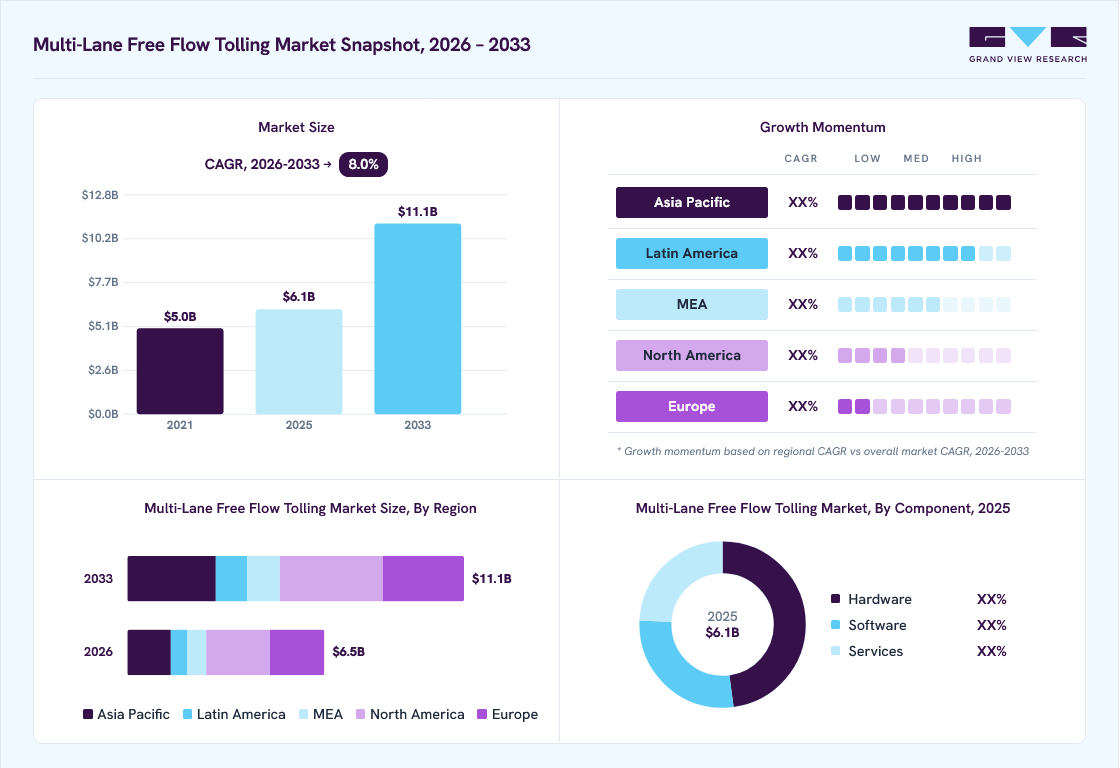 Source: Grand View Research, IR Documents, Primary Interviews, Paid DatabasesTo learn more about this report,
 Download Free Sample Report
Key Market Trends & Insights
- By component: The hardware segment led the market and accounted for 47.8% of the global revenue in 2025.
- By technology: The ANPR segment led the market and accounted for 35.3% of the global revenue in 2025.
- By lane: The multi-lane segment led the market and accounted for 84.3% of the global revenue in 2025.
- By application: The highways segment accounted for the largest share of global revenue in 2025.
- By end-use: The government segment accounted for the largest market revenue share in 2025.
Regional Highlights
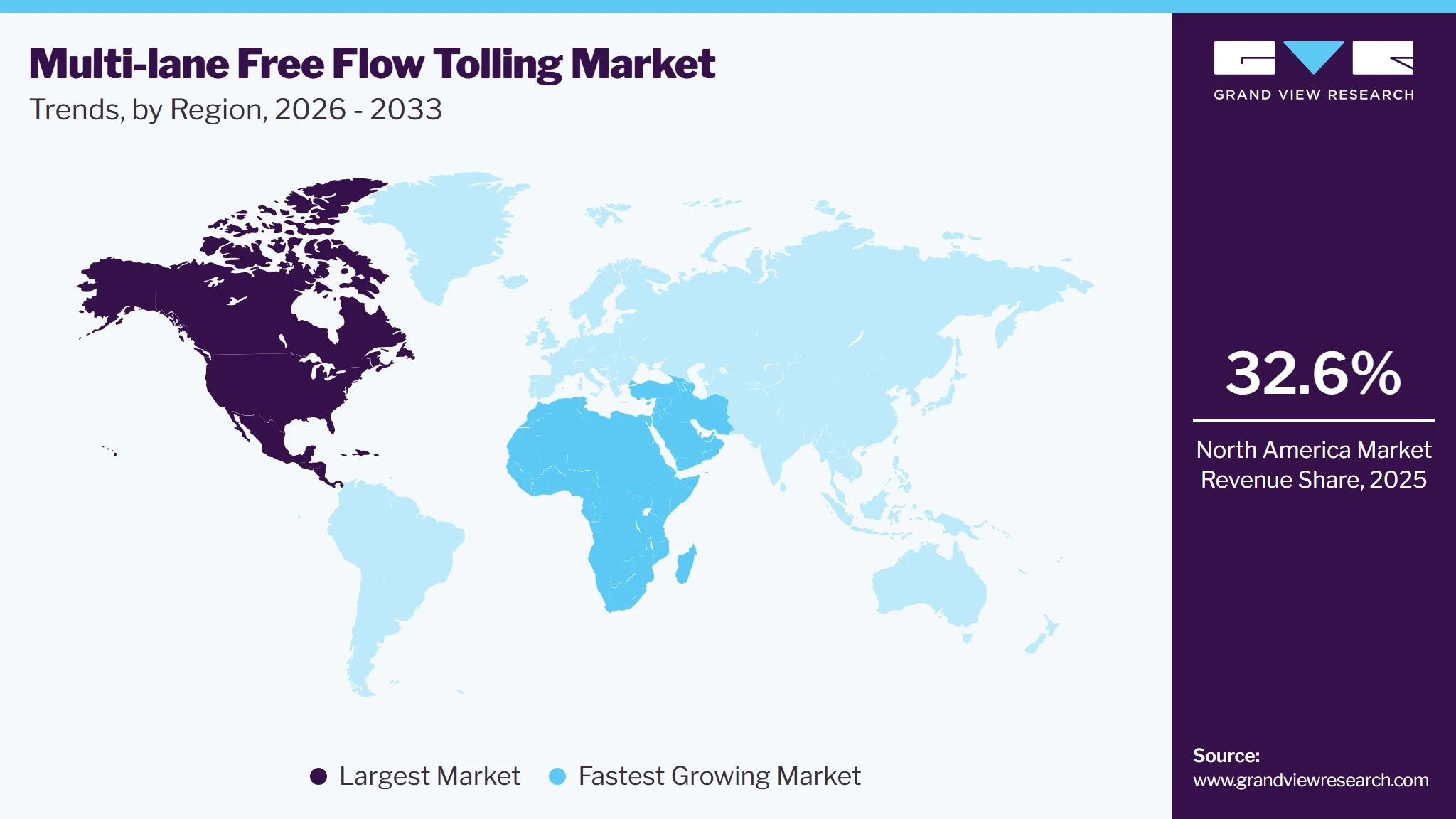
- Largest regional market: North America (32.6% revenue share, 2025)
- Fastest growing regional market: Asia Pacific (highest CAGR, 2026-2035)
- By country: The U.S. held the largest market share in 2025.
Market Size & Forecast
- Market size in 2025: USD 6.1 Billion
- Estimated market size in 2026: USD 6.5 Billion
- Projected market size by 2033: USD 11.1 Billion
- CAGR (2026-2033): 8.0%
Prism AI by Grand View Research Free to tryAsk a question about the multi-lane free flow tolling marketTry asking✓Every figure cited from GVR research Prefer the report? Download free sample →
Increasing urbanization and the expansion of road infrastructure are driving the adoption of multi-lane free-flow (MLFF) tolling systems to manage rising traffic volumes efficiently. MLFF enables vehicles to pass through toll points at highway speeds without stopping, reducing congestion, travel time, and fuel consumption. In addition, growing government investments in smart transportation infrastructure and intelligent transportation systems (ITS) are accelerating the deployment of MLFF tolling solutions, thereby supporting market growth.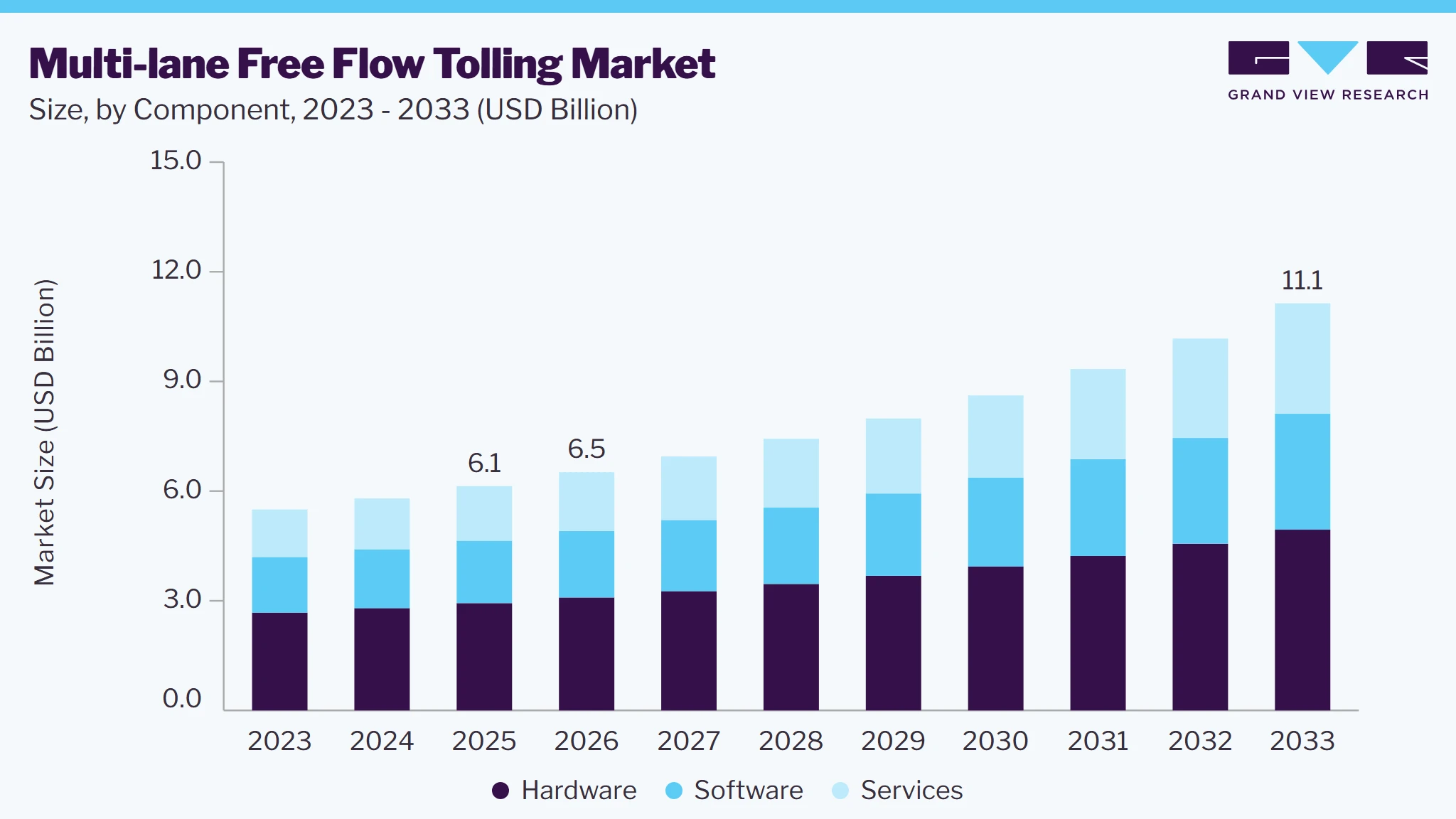 To learn more about this report, Download Free Sample Report
The increasing adoption of advanced tolling technologies such as RFID, Automatic Number Plate Recognition (ANPR), and Dedicated Short-Range Communication (DSRC) is driving the growth of the market. These technologies enable seamless vehicle identification, automated toll collection, and efficient enforcement while reducing operational costs and minimizing manual intervention. In addition, the integration of cloud-based toll management platforms and data analytics improves traffic monitoring, operational efficiency, and infrastructure planning. Furthermore, the ongoing digitalization of transportation infrastructure is further accelerating the deployment of MLFF tolling systems worldwide.
The growing emphasis on interoperable and standardized electronic toll collection systems is supporting the adoption of MLFF tolling across Europe. According to the, the European Commission issued guidelines under Directive (EU) 2019/520 to strengthen the interoperability of electronic toll collection systems across EU member states. These guidelines establish a transparent framework for European Electronic Toll Service (EETS) providers, enabling seamless cross-border toll payments and promoting standardized electronic tolling infrastructure. Furthermore, the regulatory framework is expected to accelerate the deployment of MLFF tolling systems while supporting the modernization and digitalization of Europe's road transport network.
The growing misuse of FASTags poses a challenge to the multi-lane free flow (MLFF) tolling market. The use of loose FASTags rather than permanently affixing them to vehicle windshields leads to lane congestion, incorrect toll transactions, and revenue leakage, thereby reducing the operational efficiency of electronic toll collection systems. As a result, toll operators are required to implement stricter enforcement measures and additional system validations, which can increase operational complexity and slow the seamless deployment of MLFF tolling infrastructure.
Market Dynamics
Governments across major economies are investing heavily in smart transportation infrastructure to improve road efficiency, reduce congestion, and lower vehicle emissions. Conventional toll plazas create bottlenecks, increase fuel consumption, and require significant operational expenditure for staffing and maintenance. As national highway networks continue to expand and traffic volumes rise, transportation authorities are increasingly prioritizing digital tolling systems that enable uninterrupted vehicle movement and improve toll collection accuracy. National intelligent transportation strategies and expressway modernization programs are therefore creating strong demand for MLFF tolling infrastructure.
Multi-Lane Free Flow tolling systems eliminate physical toll barriers by enabling vehicles to travel at highway speeds. In contrast, tolls are collected electronically through RFID tags, ANPR cameras, GNSS/GPS technologies, and video enforcement systems. These solutions improve traffic throughput, reduce travel time, lower operational costs, and enhance revenue collection through automated enforcement. Their compatibility with cloud-based traffic management platforms and interoperable tolling ecosystems further strengthens adoption. As governments continue to prioritize digital highway infrastructure, demand for MLFF tolling platforms is expected to accelerate across both new highway projects and existing toll road upgrades.
Deploying multi-lane free flow tolling infrastructure requires substantial upfront investment in roadside gantries, high-resolution cameras, RFID readers, communication networks, edge computing devices, backend software platforms, and cybersecurity infrastructure. In addition to hardware deployment, operators must integrate the new system with existing toll management software, payment gateways, vehicle registration databases, and traffic management platforms. These implementation requirements significantly increase project costs and deployment timelines, particularly for regions transitioning from conventional toll plazas.
The financial burden is more pronounced in developing economies and smaller toll operators with limited infrastructure budgets. Existing toll roads often require extensive retrofitting, creating operational disruptions during migration. The complexity of integrating multiple technologies while ensuring interoperability across different jurisdictions also increases implementation risks. Consequently, adoption is slower in cost-sensitive markets, delaying full-scale deployment and limiting short-term market growth despite strong long-term demand.
Governments are increasingly pursuing nationwide interoperable tolling ecosystems that allow motorists to travel seamlessly across multiple highways, concessionaires, and jurisdictions using a single payment account or electronic tag. Advances in cloud computing, centralized toll clearing platforms, AI-powered enforcement systems, and standardized communication protocols are making interoperability more practical and economically viable. These developments are encouraging transportation authorities to replace fragmented toll collection systems with unified MLFF platforms.
This transition creates significant growth opportunities for vendors offering integrated hardware, software, transaction processing, and managed tolling services. Companies capable of delivering end-to-end interoperable solutions, cloud-based toll management platforms, and AI-enabled enforcement technologies are well-positioned to benefit from large-scale modernization programs. Opportunities are particularly strong in national highway expansion projects, cross-border transportation corridors, and urban expressway networks where seamless electronic toll collection is becoming a strategic priority.
Market Concentration & Characteristics
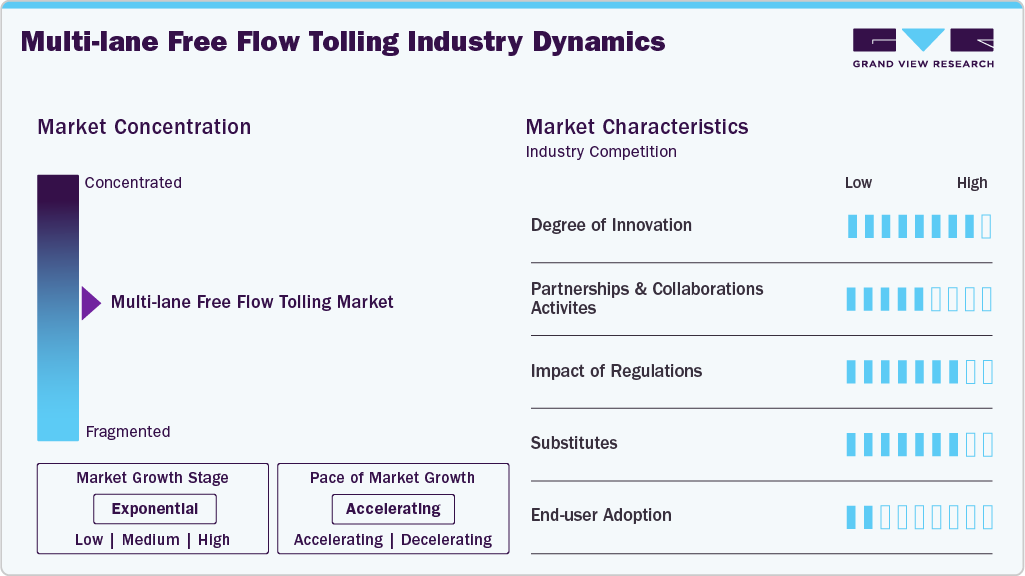
The market for multi-lane free flow tolling is moderately consolidated in nature due to the presence of established intelligent transportation system (ITS) providers, electronic toll collection companies, and transportation technology vendors competing across different segments of the industry. Companies are actively focusing on the development of multi-lane free flow tolling platforms, automatic number plate recognition (ANPR) systems, RFID- and DSRC-based toll collection technologies, cloud-based toll management software, and intelligent traffic management solutions. The market is transitioning from conventional toll plazas to barrier-free electronic toll collection systems, leading to increased competition among technology providers rather than the dominance of a single global player. Continuous advancements in digital tolling technologies, AI-enabled vehicle identification, and growing investments in smart transportation infrastructure are further intensifying competition among market participants.
 To learn more about this report, Download Free Sample Report
Fragmentation in the market is also driven by the growing presence of specialized tolling and intelligent transportation companies, including Kapsch TrafficCom AG, Q-Free ASA, EFKON GmbH, neology, VITRONIC, and TagMaster, which provide advanced MLFF tolling systems, ANPR solutions, RFID technologies, and roadside equipment. At the same time, major transportation technology companies, including Conduent Incorporated, TRANSCORE, YUNEX TRAFFIC, and Emovis, are expanding investments in cloud-based toll management platforms, interoperability solutions, and large-scale tolling infrastructure projects. Market participants are primarily competing through technological innovation, system integration capabilities, deployment partnerships with highway authorities, regulatory compliance, and the scalability of electronic tolling solutions, rather than through market share dominance, thereby maintaining a moderately consolidated market structure.
Analyst Perspective
The market is transitioning from conventional electronic toll collection toward fully digital, barrier-free transportation infrastructure. Government investments in ITS, nationwide interoperability initiatives, and highway modernization programs continue to create sustained market demand. AI-powered video analytics, cloud-native toll management platforms, and integrated enforcement technologies are reshaping competitive differentiation among solution providers. Future investments are expected to focus on interoperable tolling ecosystems, real-time analytics, and centralized transaction processing platforms that improve operational efficiency and enhance the overall mobility experience. Strategic partnerships between technology providers, transportation authorities, and infrastructure operators is expected to be a defining feature.
Component Insights
Based on component, the hardware segment accounted for 47.8%, the largest share of global revenue in 2025. Hardware components, including cameras, sensors, RFID readers, and gantries, constitute the core infrastructure of multi-lane free flow tolling systems. These components enable automatic vehicle detection, identification, and accurate toll collection without requiring vehicles to stop. The growing adoption of high-resolution cameras and advanced sensing technologies is improving vehicle recognition accuracy, enhancing toll enforcement, and increasing the efficiency and reliability of MLFF tolling systems.
The services segment is projected to grow at the fastest CAGR over the forecast period. The services segment includes installation, system integration, maintenance, software upgrades, and technical support for multi-lane free flow (MLFF) tolling systems. MLFF systems rely on technologies such as ANPR cameras, RFID readers, sensors, communication networks, and cloud-based toll management software. These technologies require regular maintenance and cybersecurity updates to ensure accurate vehicle identification and uninterrupted toll collection. As a result, toll operators are increasingly outsourcing system management to specialized service providers to improve operational efficiency and maintain reliable system performance.
Technology Insights
Based on technology, the ANPR segment accounted for 35.3%, the largest share of global revenue in 2025. Automatic Number Plate Recognition (ANPR) technology is experiencing significant adoption due to its ability to identify vehicles by their license plates. ANPR systems use advanced image processing and AI algorithms to capture and recognize license plate information in real time, enabling seamless toll collection. This advance system makes ANPR effective in regions with low RFID penetration or where interoperability between different tolling systems is required. In addition, ANPR is increasingly being integrated with traffic enforcement and security systems to improve compliance and operational efficiency.
The GNSS/GPS segment is projected to grow at the fastest CAGR over the forecast period. The segment growth can be attributed to the increasing adoption of distance-based road pricing and open-road tolling systems by governments and highway operators. GNSS/GPS technology enables accurate vehicle tracking and toll calculation based on the actual distance traveled. Moreover, it eliminates the need for physical toll plazas and supports barrier-free toll collection. In addition, it enables nationwide interoperability and more efficient toll management, accelerating its deployment across modern transportation networks.
Lane Insights
Based on lane, the multi-lane segment accounted for 84.3%, the largest share of global revenue in 2025. The multi-lane segment dominates the market due to the growing deployment of barrier-free tolling systems on high-traffic highways and expressways. The MLFF tolling enables vehicles to travel at normal highway speeds across multiple lanes without stopping, significantly reducing congestion, travel time, and fuel consumption. In addition, increasing government investments in smart transportation infrastructure and large-scale highway modernization projects are further driving the adoption of multi-lane tolling systems.
The single lane segment is projected to grow at the fastest CAGR over the forecast period. The single lane segment is driven by the increasing modernization of existing toll infrastructure, particularly in regions transitioning from manual or conventional toll collection systems. Single-lane MLFF solutions offer a cost-effective approach for upgrading toll lanes while improving traffic flow and reducing vehicle waiting times. Their compatibility with existing highway infrastructure supports continued adoption by toll operators.
Application Insights
Based on application, the highways segment led the market and accounted for the global revenue in 2025. This segment's dominance can be attributed to the increasing deployment of barrier-free toll collection systems on major highways and expressways. High traffic volumes, the need to reduce congestion at toll plazas, and the demand for uninterrupted vehicle movement are driving MLFF adoption across highway networks. In addition, governments and highway operators are investing in the modernization of toll infrastructure to improve toll collection efficiency, reduce operating costs, and enhance travel experience.
The urban roads segment is projected to grow at the fastest CAGR over the forecast period The segment is witnessing significant growth due to increasing urbanization and rising traffic congestion in cities. The MLFF tolling supports congestion pricing, dynamic tolling, and access control, helping authorities improve traffic flow and promote sustainable urban mobility. In addition, the integration of MLFF systems with intelligent transportation systems (ITS), public transport networks, and Mobility-as-a-Service (MaaS) platforms is further driving adoption across urban road networks.
End-use Insights
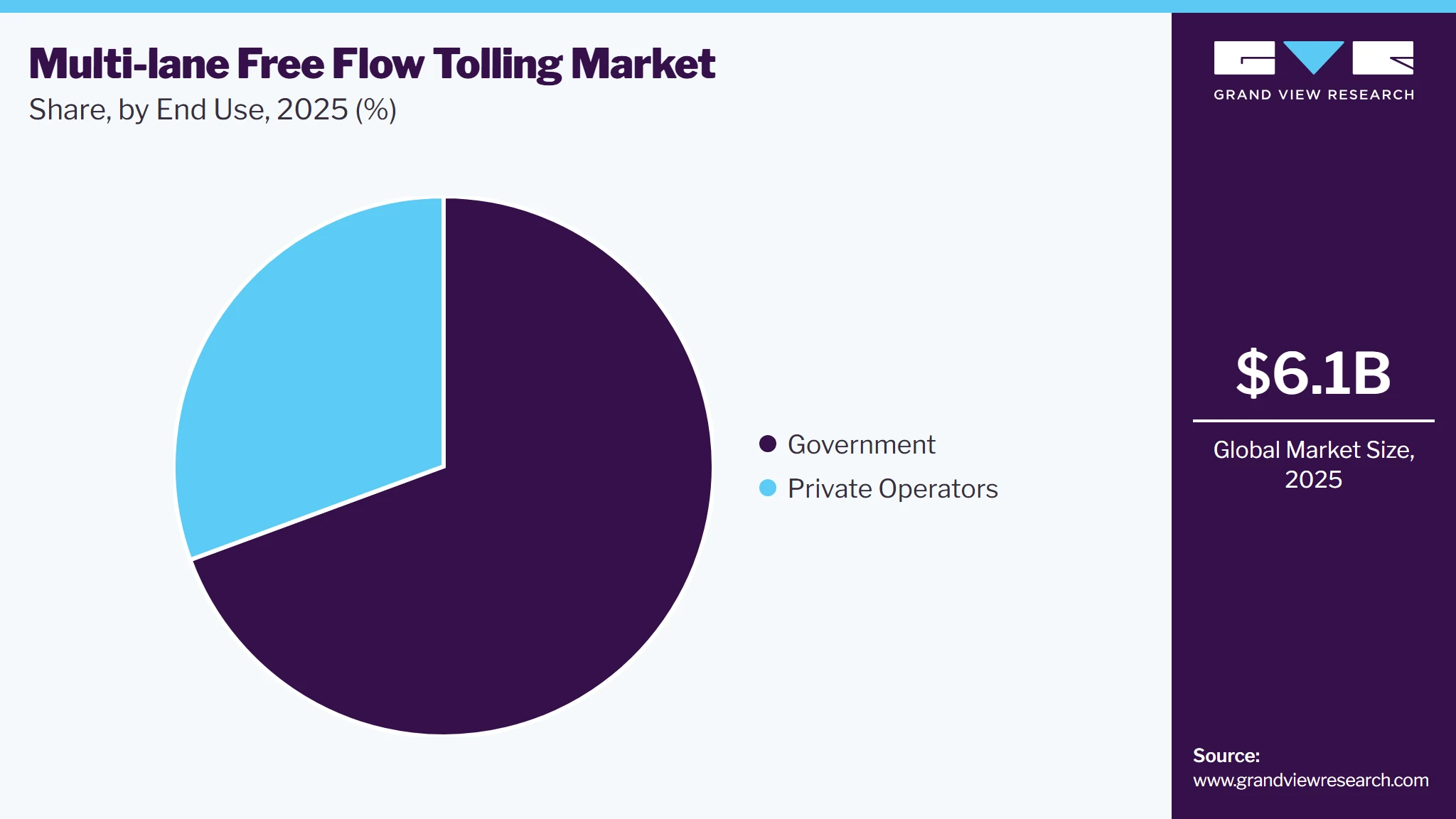
Based on end use, the government segment accounted for the largest share of global revenue in 2025. The government segment dominates the market as public authorities are responsible for the planning, funding, deployment, and regulation of tolling infrastructure. Governments are increasingly adopting MLFF tolling systems to improve toll collection efficiency, reduce traffic congestion, and support smart transportation initiatives. In addition, the real-time traffic and vehicle data generated by MLFF systems help optimize infrastructure planning, road maintenance, and traffic management.
 To learn more about this report, Download Free Sample Report
Private operatorsare projected to grow at the fastest CAGR over the forecast period. The private operator’s segment is gaining traction as the adoption of public-private partnership (PPP) models and privately operated toll roads increases. Private operators are investing in advanced multi-lane free flow (MLFF) tolling systems to improve operational efficiency, reduce revenue leakage, and enhance the user experience. In addition, the growing focus on digital toll collection, dynamic pricing, and value-added mobility services is driving the adoption of advanced tolling technologies among private concessionaires.
Regional Insights
North America multi-lane free flow tolling marketled the global market and accounted for 32.6% of the global revenue in 2025, The North America market is driven by the growing adoption of next-generation V2X-enabled tolling technologies across the U.S. and Canada. For instance, in July 2025, Kapsch TrafficCom AG launched its Next Generation Tolling (NGT) solution based on the SAE J3217 V2X standard, enabling vehicles to communicate directly with tolling infrastructure for seamless toll collection. This solution improves interoperability with existing toll systems, reduces roadside infrastructure requirements, and supports the expansion of connected, multi-lane free flow tolling networks.
 To learn more about this report, Download Free Sample Report
U.S. Multi-Lane Free Flow Tolling Market Trends
The U.S. multi-lane free flow tolling marketis anticipated to register a significant growth from 2026 to 2033. The U.S. dominates the regional market due to its extensive toll highway network and ongoing modernization of transportation infrastructure. Federal and state agencies are increasingly replacing conventional toll plazas with barrier-free electronic tolling systems to improve traffic flow, reduce operational costs, and enhance toll collection efficiency.
Asia Pacific Multi-Lane Free Flow Tolling Market Trends
The Asia Pacificmulti-lane free flow tolling marketis projected to grow at the fastest CAGR over the forecast period, driven by rapid investments in expressway infrastructure, smart transportation systems, and electronic toll collection across countries such as China, Japan, India, and South Korea. Governments are increasingly deploying barrier-free tolling technologies to reduce congestion, improve highway efficiency, and support the digitalization of transportation networks.
China multi-lane free flow tolling marketheld a significant share in the Asia Pacific region. China is witnessing a shift from conventional Electronic Toll Collection (ETC) to intelligent expressway infrastructure, where ETC gantries are being upgraded into vehicle-road-cloud integrated systems. These gantries are increasingly being used for real-time traffic sensing, AI-enabled traffic management, and cooperative intelligent transportation services, expanding their role beyond toll collection.
Japan multi-lane free flow tolling market is expected to grow at a significant CAGR over the forecast period. Japan is expanding its market by leveraging ETC 2.0 vehicle data to enhance traffic management, disaster response, logistics planning, and tourism development. The initiative reflects the growing integration of electronic tolling infrastructure with intelligent transportation systems (ITS) and smart mobility solutions.
Europe Multi-Lane Free Flow Tolling Market Trends
The Europemulti-lane free flow tolling market is poised for significant growth from 2026 to 2033. Europe is witnessing steady growth in the adoption of multi-lane free flow tolling as countries focus on developing interoperable electronic tolling systems and enhancing seamless cross-border mobility. The implementation of the European Electronic Toll Service (EETS) framework under Directive (EU) 2019/520 enables users to access toll services across multiple countries through a single service provider, supporting the wider adoption of advanced free-flow tolling solutions across the region.
The UK multi-lane free flow tolling market is supported by the increasing adoption of barrier-free toll collection systems and digital payment technologies across road infrastructure. The implementation of ANPR-based free-flow tolling, including the Dart Charge system, highlights the country's focus on improving traffic efficiency, reducing congestion, and modernizing toll operations.
The Germany multi-lane free flow tolling market held a substantial share in the Europe market. Germany is witnessing the continued expansion of electronic tolling infrastructure as the country focuses on improving automated vehicle detection, digital payment processing, and efficient road charging systems. The ongoing advancement of the Toll Collect platform supports the broader adoption of free-flow tolling technologies across German highways.
Key Multi-lane Free Flow Tolling Company Insights
Key players in the multi-lane free flow tolling industry are heavily investing in the development of advanced electronic tolling platforms, AI-based vehicle identification technologies, and intelligent transportation solutions to enhance toll collection efficiency. Companies are focusing on strategic partnerships, technology integration, and infrastructure deployments to strengthen their market presence. The growing adoption of smart mobility and connected transportation systems is further encouraging innovation among market participants.
-
Kapsch TrafficCom AG is a global provider of Intelligent Transportation Systems (ITS), offering solutions for electronic tolling, traffic management, and connected mobility. The company provides end-to-end tolling solutions, including hardware, software, and services that enable automated, barrier-free toll collection and efficient transportation management.
-
Q-Free is a global technology company specializing in Intelligent Transportation Systems (ITS) that develops solutions for tolling, traffic management, and connected mobility. Q-Free provides advanced tolling solutions, including free-flow tolling, electronic toll collection, roadside systems, and traffic management platforms. Its technologies support automated vehicle identification, payment processing, and data-driven transportation operations, helping road operators improve efficiency and enhance user experience.
Key Multi-lane Free Flow Tolling Companies
The following key companies have been profiled for this study on the multi-lane free flow tolling market:
-
Kapsch TrafficCom AG
-
Q-Free.
-
EFKON GmbH
-
Conduent Incorporated.
-
neology
-
VITRONIC
-
TRANSCORE
-
YUNEX TRAFFIC
-
Emovis
-
TagMaster
Competitive Benchmarking
Operating Strategies
Competitive Edge
Weaknesses
Mature Players: Kapsch TrafficCom AG, Conduent Incorporated, TRANSCORE, YUNEX TRAFFIC
Mature players in the multi-lane free flow tolling are focus large government infrastructure contracts, end-to-end MLFF platforms, long-term maintenance agreements, interoperability solutions, and continuous investment in AI-enabled toll management technologies.
Mature players gain a competitive advantage through broad global deployment experience, comprehensive product portfolios, strong integration capabilities, established customer relationships, and proven execution of large-scale highway tolling projects.
These companies face challenges related to large organizational structure often results in longer implementation cycles and higher solution costs, making them less competitive for smaller or budget-constrained tolling projects.
Emerging Players: Q-Free, EFKON GmbH, TagMaster
Emerging players in the multi-lane free flow tolling are focus on technology innovation, specialized tolling solutions, strategic partnerships, selective regional expansion, and customized deployments for specific customer requirements.
Emerging players gain market traction through specialized strong expertise in niche tolling technologies, flexible system customization, faster technology adoption, and the ability to respond quickly to changing customer needs.
Emerging players face limitations due to larger competitors, these companies have a relatively smaller global project footprint and fewer large-scale concession contracts, which can limit their ability to compete for complex nationwide MLFF programs.
Recent Developments
-
In March 2026, Q-Free partnered with Sony Semiconductor Solutions Corporation, which specializes in device solutions, to develop GNSS-based road user charging and mobility solutions. The collaboration integrates Sony’s precision positioning technology with Q-Free’s MLFF tolling expertise to enable accurate, scalable, and low-power satellite-based tolling systems, supporting the transition toward digital and barrier-free toll collection.
-
In September 2025, Kapsch TrafficCom AG introduced its Next Generation Tolling (NGT) solution based on the SAE J3217 V2X standard, enabling direct communication between vehicles and tolling infrastructure for seamless toll collection. The solution enhances interoperability with existing tolling systems, minimizes roadside infrastructure requirements, and supports the advancement of connected multi-lane free flow tolling networks.
Multi-Lane Free Flow Tolling Market Report Scope
Report Attribute
Details
Market size value in 2025
USD 6.1 billion
Market size value in 2026
USD 6.5 billion
Revenue forecast in 2033
USD 11.1 billion
Growth rate
CAGR of 8.0% from 2026 to 2033
Base year for estimation
2025
Historical data
2021 - 2024
Forecast period
2026 - 2033
Quantitative units
Revenue in USD billion and CAGR from 2026 to 2033
Report coverage
Revenue forecast, company ranking, competitive landscape, growth factors, and trends
Segments covered
Component, technology, lane, application, end-use, region
Regional scope
North America; Europe; Asia Pacific; Latin America; MEA
Country scope
U.S.; Canada; Mexico; Germany; UK; France; China; Japan; India; South Korea; Australia; Brazil; Kingdom of Saudi Arabia (KSA); UAE; South Africa
Key companies profiled
Kapsch TrafficCom AG; Q-Free; EFKON GmbH; Conduent Incorporated; Neology; VITRONIC; TransCore; Yunex Traffic; Emovis; TagMaster
Customization scope
Free report customization (equivalent up to 8 analysts working days) with purchase. Addition or alteration to country, regional & segment scope.
Pricing and purchase options
Avail customized purchase options to meet your exact research needs. Explore purchase options
Global Multi-lane Free Flow Tolling Market Report Segmentation
The report forecasts revenue growth at global, regional, and country levels and provides an analysis of the latest industry trends in each of the sub-segments from 2021 to 2033. For this study, Grand View Research has segmented the multi-lane free flow tolling market report based on component, technology, lane, application, end use, and region.
-
Component Outlook (Revenue, USD Billion, 2021 - 2033)
-
Hardware
-
Software
-
Services
-
-
Technology Outlook (Revenue, USD Billion, 2021 - 2033)
-
RFID
-
ANPR
-
DSRC
-
GNSS/GPS
-
Video Analytics
-
Others
-
-
Lane Outlook (Revenue, USD Billion, 2021 - 2033)
-
Single Lane
-
Multi-Lane
-
-
Application Outlook (Revenue, USD Billion, 2021 - 2033)
-
Highways
-
Urban Roads
-
Bridges & Tunnels
-
Others
-
-
End-use Outlook (Revenue, USD Billion, 2021 - 2033)
-
Government
-
Private Operators
-
-
Regional Outlook (Revenue, USD Billion, 2021 - 2033)
-
North America
-
U.S.
-
Canada
-
Mexico
-
-
Europe
-
Germany
-
UK
-
France
-
-
Asia Pacific
-
China
-
India
-
Japan
-
South Korea
-
Australia
-
-
Latin America
-
Brazil
-
-
Middle East & Africa (MEA)
-
UAE
-
Kingdom of Saudi Arabia (KSA)
-
South Africa
-
-
Research Methodology
The multi-lane free flow tolling market figures in this report are based on a proven research process that combines executive interviews with secondary research from proprietary databases, company filings, and recognized regulatory and institutional sources. Market size is built through value-chain sizing—reconciling supply-side and demand-side estimates—and triangulated with bottom-up and top-down approaches. Every estimate passes multiple levels of expert validation before publication, with each multi-lane free flow tolling segment quantified using the revenue-capture definitions in the table below.
Segment Definition
Segment - Component
Revenue capture definition
Hardware
The segment revenue is generated from RFID readers, ANPR cameras, gantries, vehicle detection sensors, DSRC units, GNSS devices, communication equipment, servers, controllers, and roadside toll collection infrastructure.
Software
The segment revenue is generated from toll management platforms, transaction processing software, back-office systems, AI-based violation enforcement software, analytics platforms, cloud applications, and interoperability management solutions.
Services
The segment revenue is generated from system integration, installation, consulting, maintenance, managed services, technical support, software upgrades, training, and operational outsourcing contracts.
Segment - Technology
Revenue capture definition
RFID
The segment revenue is generated from RFID tags, RFID readers, encoding systems, middleware, and related RFID-based electronic toll collection solutions.
ANPR
The segment revenue is generated from automatic number plate recognition cameras, image processing software, license plate databases, and enforcement systems.
DSRC
The segment revenue is generated from Dedicated Short-Range Communication roadside units, onboard units, communication modules, and DSRC-enabled toll collection systems.
GNSS/GPS
The segment revenue is generated from satellite-based vehicle positioning systems, onboard tracking units, location-based toll calculation software, and GNSS-enabled tolling platforms.
Video Analytics
The segment revenue is generated from AI-powered video monitoring software, vehicle classification systems, traffic analytics platforms, and automated enforcement applications.
Others
The segment revenue is generated from infrared sensors, laser scanners, weigh-in-motion systems, edge computing devices, and other supporting tolling technologies.
Segment - Lane
Revenue capture definition
Single Lane
The segment revenue is generated from electronic toll collection systems deployed on individual traffic lanes for controlled toll collection operations.
Multi-Lane
The segment revenue is generated from barrier-free multi-lane tolling infrastructure, centralized transaction processing platforms, high-speed vehicle detection systems, and multi-lane enforcement solutions.
Segment - Application
Revenue capture definition
Highways
The segment revenue is generated from MLFF tolling systems deployed on national highways, expressways, and intercity road networks.
Urban Roads
The segment revenue is generated from congestion charging systems, urban road pricing platforms, and city-based electronic toll collection infrastructure.
Bridges & Tunnels
The segment revenue is generated from electronic tolling systems installed at bridges, tunnels, and major transportation crossings.
Others
The segment revenue is generated from toll collection solutions deployed at special economic zones, industrial corridors, ports, airports, and dedicated transport facilities.
Segment - End Use
Revenue capture definition
Government
The segment revenue is generated from contracts awarded by national, regional, and municipal transportation authorities for MLFF tolling infrastructure, software, and services.
Private Operators
The segment revenue is generated from toll road concessionaires, public-private partnership operators, infrastructure developers, and privately managed transportation networks.
Estimation Model
Layer Name
Key Question
Description
Transportation Infrastructure Assessment
Which toll roads and highway projects require MLFF deployment?
The first layer evaluates existing toll roads, planned expressways, and highway modernization projects across major countries. It assesses government infrastructure investment, traffic density, toll road expansion, and replacement of legacy toll plazas. This establishes the total addressable infrastructure opportunity for MLFF deployment.
Technology Adoption Analysis
Which tolling technologies are being adopted?
This layer evaluates the adoption of RFID, ANPR, GNSS/GPS, DSRC, AI-powered video analytics, and cloud-based toll management platforms. It analyzes regulatory requirements, interoperability initiatives, and digital transportation strategies. The analysis identifies the technology mix expected across different regions and applications.
Revenue Opportunity Assessment
Where is commercial revenue generated?
This layer estimates revenues generated from hardware procurement, software licensing, managed services, installation, maintenance, and transaction processing. It evaluates procurement models used by governments and private concessionaires while identifying recurring revenue opportunities from software subscriptions and service contracts.
Competitive Intelligence & Market Validation
Which vendors are best positioned to capture market growth?
The final layer evaluates vendor capabilities, regional presence, technology portfolio, strategic partnerships, and project execution experience. It validates market estimates using public contracts, infrastructure investments, and company developments. The assessment identifies competitive positioning and future expansion opportunities across global MLFF deployments.
Delivered Customization
We have successfully delivered the following deep-dive customizations:
Client Request
Customization Delivered
Value Adds
Regional Multi-Lane Free Flow Tolling Market Opportunity Assessment
- Country/region-wise market sizing and forecasts
- Analysis of demand, adoption trends, and regulatory landscape
- Identification of high-growth regions and investment hotspots
- Identified region-specific growth opportunities
- Supported expansion and go-to-market strategy
- Enabled informed regional investment decisions
Cross-Segmentation Analysis for the Multi-Lane Free Flow Tolling Market
- Criss-cross market analysis by component, technology, lane application, end use
- Demand and adoption assessment across key segments
- Segment attractiveness and growth potential benchmarking
- Identified high-potential market segments
- Supported targeted lane positioning and marketing strategy
- Improved customer and segment prioritization
Competitive Benchmarking and Strategic Positioning in the Multi-Lane Free Flow Tolling Market
- Benchmarking of key competitors across lanes, pricing, partnerships, and innovation
- Comparative assessment of market share, capabilities, and strategies
- Analysis of competitive strengths, gaps, and differentiation areas
- Identified competitive white spaces and growth gaps
- Supported strategic positioning and differentiation
- Enabled data-driven competitive strategy development
Frequently Asked Questions About This Report
The global multi-lane free flow tolling market size was valued at USD 6.1 billion in 2025 and is estimated at USD 6.5 billion in 2026.
The global multi-lane free flow tolling market is expected to grow at a CAGR of 8.0% from 2026 to 2033, reaching USD 11.1 billion by 2033.
North America dominated the market, accounting for the largest revenue share of 32.6% in 2025.
The increasing demand for sustainable and efficient last-mile transportation solutions is accelerating the adoption of multi-lane free flow tolling market.
Some key players operating in the multi-lane free flow tolling market include Kapsch TrafficCom AG, Q-Free, EFKON GmbH, Conduent Incorporated, Neology, VITRONIC, TransCore, Yunex Traffic, Emovis, and TagMaster.
ANPR segment led the market and accounted for 35.3% of the global revenue in 2025, while GNSS/GPS is expected to register the highest growth from 2026 to 2033.
Multi lane segment led the market and accounted for 84.3% of the global revenue in 2025, while single lane is expected to register the highest growth from 2026 to 2033.
Highways segment accounted for the largest share of global revenue in 2025, while urban roads is expected to register the highest growth from 2026 to 2033.
Hardware segment accounted for 47.8%, the largest share of global revenue in 2025, while services segment is the fastest growing component.
About the Author(s)
Automotive & Transportation Research Team
Technology · Automotive & TransportationThis report was authored by the automotive & transportation research team at Grand View Research - comprising two research analysts, one senior research analyst, and one industry expert - with specialized expertise in the automotive & transportation segment of the technology industry. All findings are based on proprietary technology databases, executive interviews, and regulatory analysis, subject to internal peer review prior to publication.
Last Updated:
Speak to Analyst

Customize this report to your needs - add regions, segments, or data points, with 20% free customization.
Or view our licence options:


ISO 9001:2015 & 27001:2022 Certified
We are GDPR and CCPA compliant! Your transaction & personal information is safe and secure. For more details, please read our privacy policy.


