
- Home
- »
- Automotive & Transportation
- »
-
Smart Transportation Market Size, Share Report, 2026-2033GVR Report cover

Smart Transportation Market (2026 - 2033)
Size, Share & Trends Analysis Report By Solution (Ticketing Management System, Parking Management System, Integrated Supervision System, Traffic Management System), By Service (Cloud Services), By Region, And Segment Forecasts
Market Size, 2025
$154.9BMarket Estimate, 2026
$175.1BMarket Forecast, 2033
$393.0BCAGR, 2026–2033
12.2%Smart Transportation Market Summary
The global smart transportation market size was valued at USD 154.9 billion in 2025 and is projected to grow from USD 175.1 billion in 2026 to reach USD 393.0 billion by 2033, growing at a CAGR of 12.2% from 2026 to 2033. North America dominated the global smart transportation market with the largest revenue share of over 34.0% in 2025. The market growth is driven by rising advancements in urban projects and government initiatives aimed at reducing greenhouse gas emissions.
Key Market Trends & Insights
- By solution: Traffic management segment led the market with the largest revenue share of over 33.5% in 2025.
- By service: Cloud services segment led the market with the largest revenue share of around 45.0% in 2025.
Regional Highlights
- Largest regional market: North America (34.0% revenue share, 2025)
- Fastest-growing regional market: Asia Pacific (highest CAGR, 2026-2033)
- By country: The U.S. held the largest market share in 2025.
Market Size & Forecast
- Market size in 2025: USD 154.9 Billion
- Estimated market size in 2026: USD 175.1 Billion
- Projected market size by 2033: USD 393.0 Billion
- CAGR (2026-2033): 12.2%
Three ways to get this report
Buy it, customize it, or ask a question.Ask an Analyst
Analyst response in 1 business day
- AccessReport author, directly
- Reply timeWithin 1 working day
- No sales callDirect answer only
- FormatEmail reply
- CostFree, no cost
Get the Full Report
What the study covers
- FormatsPDF · Excel · Dashboard
- Timeline2026–2033 annual, 2025 base
- Coverage20+ countries, 5 regions
- Companies10+ key players profiled
Customize the Report
20% free customization
- IncludeCountries, segments, points
- TailorTo your product definition
- ExtendDeeper competitor detail
- OrA fully bespoke study
- Turnaround5–10 working days
Moreover, the surging demand for technology integration in traffic control systems for traffic management, lowering congestion, and improving surveillance is expected to drive the market growth. In order to improve traffic management, boost safety, lessen maintenance costs, and enable more efficient use of transportation networks, the market experienced a tremendous expansion in the application of current technology in cars and transportation infrastructure. Furthermore, the introduction of autonomous vehicles, increased expenditures on smart city initiatives, the fall in vehicle ownership, and the expansion of mobility as a service (MaaS) is likely provide significant growth opportunities for players in the smart transportation industry. Source: Grand View Research, IR Documents, Primary Interviews, Paid DatabasesTo learn more about this report,
 Download Free Sample Report
 In July 2025, AEye, Inc. announced the start of field deployments for OPTIS, its full-stack lidar solution designed to provide real-time environmental perception and sensing capabilities. The development highlights the growing role of advanced sensor technologies in supporting smarter transportation infrastructure, traffic monitoring, and safety-focused mobility systems. As industries demand more real-time insight, greater operational efficiency, and adaptable technology, the need for a smarter, integrated sensing solution has become increasingly clear.
Market Dynamics
A key factor contributing to market growth is increasing investments by governments and industries in transportation infrastructure based on digital technology. As the number of residents in cities rises and traffic congestion increases, governments begin to focus on the introduction of intelligent traffic solutions. These investments may involve installing smart traffic lights, V2X communication systems, intelligent road networks, and artificial intelligence traffic management systems. Private funding and government policies also contribute to the accelerated implementation of the highway, metro network, and urban infrastructure renovation projects.
Alongside this development, businesses make massive investments in connected mobility technologies, such as autonomous driving, cloud traffic management systems, and smart tolling technologies. Increasing cooperation between authorities and businesses becomes possible due to the widespread use of PPPs. Another factor contributing to increased investment activity is policy initiatives aimed at reducing carbon emissions, ensuring road safety, and implementing smart city ideas. As a result, transport authorities have become more interested in real-time data analysis and other mobility technologies. This trend is amplified by expanding the coverage of 5G networks and IoT devices.
One important barrier to the growth of smart transportation solutions is the problem of interoperability and cybersecurity. The field of smart transportation involves the usage of various technologies like smart traffic lights, connected vehicles, cloud solutions, sensors, and other innovations. However, since all these innovations are created by different vendors, each of whom uses their own standards of communication, combining all of them into one system becomes complicated, time-consuming, and costly.
Moreover, increased connectivity inevitably leads to an increase in cybersecurity threats. All smart transportation solutions rely on the ongoing flow of data from one device to another. It means that there are many entry points for potential hackers who can hack any part of the process, be it traffic lights, tolling, or any other vehicle-to-everything technology. This poses serious threats to the safety of citizens and critical infrastructure operations. Thus, significant investments are required in cybersecurity measures.
Investments in intelligent transportation infrastructure and adoption of connected and autonomous vehicle technologies are rising at a significant pace, presenting significant growth opportunities for the smart transportation market. Smart transportation solutions play a crucial role in improving traffic management, enhancing road safety, reducing congestion, and optimizing fuel efficiency through real-time data analytics and communication technologies. The rising focus on smart city development, sustainable mobility, and digital transformation of transportation networks is encouraging governments and private organizations to invest in advanced transportation systems. Ongoing advancements in artificial intelligence, IoT, and vehicle-to-everything (V2X) communication technologies are expected to present lucrative growth opportunities for players in the market over the forecast period.
Analyst Perspective
The future of the smart transportation market will be shaped by how well cities plan to manage the growing pressure on existing infrastructure, rather than just by the deployment of new technologies. With expanding urban populations and constrained public finances, transportation organizations will face increasing pressure to improve efficiency in road, transit, and parking operations without the need for significant physical infrastructure expansion. This shift is elevating the importance of data-driven decision-making, performance-based contracts, and centralized oversight of transportation. Over time, companies that can demonstrate measurable improvements in mobility outcomes, secure long-term government partnerships, and integrate seamlessly with complex public-sector procurement and operational environments will have a strong influence in the market.
Solution Insights
The traffic management segment accounted for the largest market share of over 33.5% in 2025. Integrated monitoring systems, intelligent parking systems, transportation planning systems, and ticketing management solutions are among the essential marketable solutions. The traffic management system remains the most well-known option in the market. In April 2025, Argo Corporation and the City of Brampton announced a smart transit partnership to deploy an on-demand, fully electric Smart Routing transit system integrated with existing public transit networks. The 12-month pilot aimed to improve first- and last-mile connectivity, enhance urban mobility through dynamic route optimization and real-time, demand-based transportation services, and expand transit accessibility.
Traffic management systems are in demand due to features such as a high level of safety, effective management of traffic congestion, low energy consumption, and low pollution, among others. The system also promises to address conventional challenges, such as transit delays, and provides additional security for citizens.
Parking management is another segment anticipated to register a high growth rate in the global market over the forecast period. These systems include exit ticket readers, decentralized payment collecting systems, and ticket dispensers at the entrance or exit. The adoption of cloud-based parking services and an increase in off-street parking are expected to drive the growth of this segment.
Service Insights
The cloud services segment led the market with the largest revenue share of around 45.0% in 2025. The segment is anticipated to retain its dominance over the forecast period owing to its capacity to handle the massive amounts of data created by mobile technology and sensors. With the advancement of technologies such as big data and cloud technology, these are becoming increasingly crucial in transportation systems. A safe storage facility and processing power are offered by the cloud platforms to help with traffic forecasts. The increased use and interest in machine learning/data analytics, IoT, and cybersecurity will impact smart transportation ventures during the forecast period.
The professional service segment continues to witness increased penetration in the smart transportation industry. These services also continue to significantly differ from each other, as they offer, among other things, design guidance, strategy formulation, and implementation support. A rise in the demand for professional services is a result of the upgradation of outdated systems to more modern ones, made possible by the increased need for consulting services. With the help of expert services available in the market, traffic control, smart parking, and other options can be rapidly enhanced.
Regional Insights
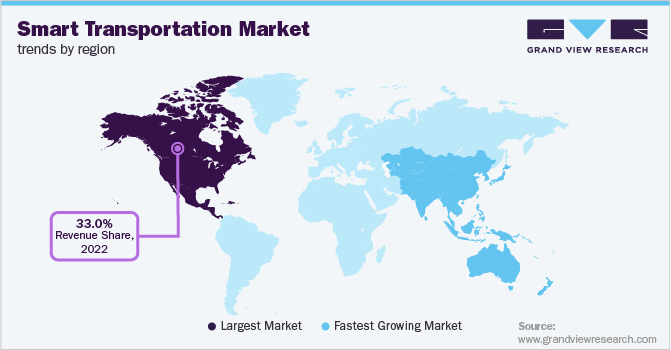
North America smart transportation market accounted for the largest share of over 34.0% in 2025. The region is the largest adopter of smart transportation solutions owing to a growing emphasis of regional governments on improving the transportation infrastructure, against the backdrop of congested highways, poor air quality, and growing highway accidents and fatalities. Major companies in the sector that are suppliers of smart transportation solutions have a base in the U.S.
 To learn more about this report, Download Free Sample Report
 Moreover, major companies related to transport infrastructure are likely to collaborate and innovate solutions by using a wide spectrum of their technical expertise and benefit the region as a whole. February 2025, Iteris, Inc, executed a two-year SaaS agreement with the Minnesota Department of Transportation (MnDOT), which enabled the state to continue to use ClearGuide, which offers analysis and visualization of traffic data to improve mobility and safety, in order to improve the traffic operations.
Europe is expected to present significant opportunities for industry expansion, owing to the rapid adoption of technology and rising traffic congestion in the major cities. Factors such as increasing use of vehicles, which leads to increased parking challenges, and increased demand for efficient transportation worldwide are predicted to accelerate the growth of the intelligent transportation industry. The smart transportation market is expected to benefit from rapid evolution and significant technology advancements in semi-autonomous and autonomous vehicles.
Key Smart Transportation Company Insights
The smart transportation market is highly competitive, with several players catering to different sectors. The presence of established players is a crucial factor deterring potential players from entering the market. However, the increasing development of differentiated smart transportation solutions and services in the market is expected to create growth opportunities for new entrants. Market players are focusing on expanding their businesses and strengthening their market positions through collaborations and partnerships.
Key Smart Transportation Companies
The following key companies have been profiled for this study on the smart transportation market.
-
Accenture PLC
-
Alstom, SA
-
Cisco System, Inc.
-
Cubic Corporation
-
General Electric Company (GE)
-
Indra Sistema S.A.
-
International Business Machines Corporation
-
Kapsch
-
LG CNS Corporation
-
Xerox Holdings Corporation
Recent Developments
-
In June 2025, Qualcomm completed the acquisition of Autotalks, a provider of Vehicle-to-Everything (V2X) communication solutions. The acquisition aimed to accelerate the deployment of connected transportation systems, enhancing road safety, improving traffic efficiency, and supporting the development of automated driving technologies.
-
In June 2025, Siemens Mobility showcased advanced digital transportation technologies at the UITP Summit 2025, including Signaling X, Train2Cloud, Digital Station, and Railigent X. These solutions are designed to improve transportation efficiency, connectivity, infrastructure intelligence, and passenger experience across urban mobility networks.
Smart Transportation Market Report Scope
Report Attribute
Details
Market size in 2025
USD 154.9 billion
Estimated market size in 2026
USD 175.1 billion
Projected market size by 2033
USD 393.0 billion
Growth rate
CAGR of 12.2% from 2026 to 2033
Base year for estimation
2025
Historical data
2021 - 2024
Forecast period
2026 - 2033
Quantitative units
Revenue in USD million, and CAGR from 2026 to 2033
Report coverage
Revenue forecast, company ranking, competitive landscape, growth factors, and trends
Segments covered
Solution, service, region
Regional Scope
North America; Europe; Asia Pacific; Latin America; Middle East & Africa
Key companies profiled
Accenture PLC; Alstom, SA; Cisco System, Inc.; Cubic Corporation; General Electric Company (GE); Indra Sistema S.A.; International Business Machines Corporation; Kapsch; LG CNS Corporation; Xerox Holdings Corporation
Customization scope
Free report customization (equivalent up to 8 analysts working days) with purchase. Addition or alteration to country, regional & segment scope.
Pricing and purchase options
Avail of customized purchase options to meet your exact research needs. Explore purchase options
Global Smart Transportation Market Report Segmentation
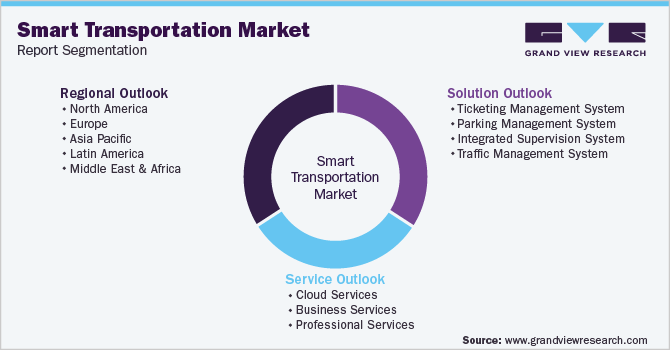
This report forecasts revenue growth at global, regional, and country levels and provides an analysis of the latest industry trends in each of the sub-segments from 2021 to 2033. For this study, Grand View Research has segmented the global smart transportation market report based on solution, service, and region:
 To learn more about this report, Download Free Sample Report
 -
Smart Transportation Solution Outlook (Revenue, USD Billion, 2021 - 2033)
-
Ticketing Management System
-
Parking Management System
-
Integrated Supervision System
-
Traffic Management System
-
-
Smart Transportation Service Outlook (Revenue, USD Billion, 2021 - 2033)
-
Cloud Services
-
Business Services
-
Professional Services
-
-
Smart Transportation Regional Outlook (Revenue, USD Billion, 2021 - 2033)
-
North America
-
U.S.
-
Canada
-
-
Europe
-
U.K.
-
Germany
-
-
Asia Pacific
-
China
-
India
-
Japan
-
-
Latin America
-
Brazil
-
- MEA
-
Frequently Asked Questions About This Report
The global smart transportation market size was valued at USD 154.9 billion in 2025 and is estimated at USD 175.1 billion for 2026.
The global smart transportation market is expected to grow at a CAGR of 12.2% from 2026 to 2033, reaching USD 393.0 billion.
North America dominated with a 34.0% revenue share in 2025.
Cloud services dominated the smart transportation market with a share of 45.0% in 2025.
Key players include Accenture PLC; Alstom, SA; Cisco System, Inc.; Cubic Corporation; General Electric Company (GE); Indra Sistema S.A.; International Business Machines Corporation; Kapsch; LG CNS Corporation; Xerox Holdings Corporation
About the Author(s)
Automotive & Transportation Research Team
Technology · Automotive & TransportationThis report was authored by the automotive & transportation research team at Grand View Research - comprising two research analysts, one senior research analyst, and one industry expert - with specialized expertise in the automotive & transportation segment of the technology industry. All findings are based on proprietary technology databases, executive interviews, and regulatory analysis, subject to internal peer review prior to publication.
Last Updated:
Speak to Analyst

Customize this report to your needs - add regions, segments, or data points, with 20% free customization.
Or view our licence options:


ISO 9001:2015 & 27001:2022 Certified
We are GDPR and CCPA compliant! Your transaction & personal information is safe and secure. For more details, please read our privacy policy.


